‘Fortress Australia’: Why calls to open up borders are meeting resistance

Of note and the challenge of reopening:

Australia has been one of the world’s Covid success stories, where infection rates are near zero and life mostly goes on as normal.

That’s in large part thanks to the early move to shut its borders – a policy that has consistently been supported by the public.

But after a year in the cocoon, there is growing unease in the country over the so-called “Fortress Australia” policy.

Recent announcements declaring that Australia won’t open up until mid-2022 – meaning a two year-plus isolation – have amplified concerns.

Critics argue the extension of closed borders will cause long-lasting damage to the economy, young people and separated families. It also tarnishes Australia’s character as open and free, they say.

Calls for a clear plan to pull Australia back into the world are growing, as the country wrestles with an uncomfortable tension – balancing the safety of closed borders against what is lost by living in isolation.

“A Fortress Australia with the drawbridge pulled up indefinitely is not where we want to be,” says former Race Discrimination Commissioner Dr Tim Soutphommasane.

“Australia is at its best when it’s open and confident – not fearful and insular.”

Locking the gate

In March 2020, the government closed the borders. It barred most foreigners from entering the country and put caps on total arrivals to combat Covid. Mandatory 14-day quarantine and snap lockdowns have also been used to control the virus spread.

The measures are extreme, and among the strictest in the world.

But they’ve worked. Australia regularly sees months without a single case in the community, and it has recorded fewer than 1,000 deaths in the pandemic.

Given that, the strict border controls have proven tremendously popular. Public polls regularly report 75-80% approval ratings for keeping the door shut.

Even higher numbers – around 90% – approve overall of the government’s pandemic handling, and trust in government has increased in contrast to views of voters in some Covid-ravaged nations.

Languishing behind

But the government now also faces mounting pressure over how it plans to handle the next phase of the pandemic.

Prime Minister Scott Morrison – who faces an election next year – has announced Australia won’t re-open borders until mid-2022. The exact timing and just how that will happen are unclear.

But the budget announcement was a shock extension to previous forecasts of an opening-up to occur slowly at the end of this year.

The main reason for the delay is vaccination.

Australia’s immunisation programme has been beset with delays, and lags well behind other developed nations such as the UK and US.

Critics say complacency over the low virus circulation delayed its kick-off. And now rising hesitancy – fuelled at least in part by Australia’s isolation – has also slowed the vaccine rollout.

Facing those failures, the government fell back on the border ban as a resort, critics say.

That’s dealing a heavy blow to sectors like tourism and higher education. Australia’s strong migration programme – relied on to address skills shortages and population growth – has also been cut almost completely.

Ernst and Young, an accounting firm, estimates that Australia’s economy is losing A$7.6bn (£4.18; $5.9bn) a month from the closed borders.

So a group of experts from the University of Sydney have called for an exit plan to be put in place. People need to know their options and prepare for the future, they say.

Their “roadmap to re-opening” focuses on prioritising vaccination, expanding quarantine and starting trials to bring in people for affected industries.

They point to successful examples like the New Zealand travel bubble, and the Australian Open tennis tournament.

“This is the case when measured in hard dollar terms, but also when measured against less tangible factors such as fuelling a negative and inwards-focused national psyche that threatens our global standing, as well as national unity and cohesion.”

‘Us and them’ mentality

Others have also voiced their concerns over how an extended retreat from the world could damage Australia’s character.

When Australia was parochial it had a White Australia policy (1900s-1970s), which restricted immigration from non-European nations. Multiculturalism has replaced that policy in recent decades, but the ideal is still fragile, experts warn.

Dr Liz Allen, a demographer at the Australian National University, contends that Covid has already made the nation more “protectionist and insular”.

Government policies have created an “us and them” division, she argues.

The hostile treatment of migrants is a clear example, she says. Australia’s conservative government of eight years has never advocated for immigration – the coalition won the 2019 election pledging to “slash” the migrant intake.

At the start of the pandemic, Mr Morrison told the nation’s two million migrants on temporary visas to “go home”.

Those visa holders – often doing the low-paid, essential jobs of cleaning and food delivery – were also ineligible for the government’s pandemic welfare support, leaving many facing destitution.

The border ban has also sown community division, seen in its most extreme form last month when Australia took the world-first step of threatening jail for citizens who returned home from Covid-ravaged India. The Indian-Australian community expressed outrage they were being treated like second-class citizens.

Multicultural roots

The issue of stranded Australians reflects Australia’s character as an intensely multicultural nation.

Nearly 30% of the population were born overseas, and another quarter have a parent who was. As a nation of migrants, so many Australians have deep personal ties to other parts of the world.

Prior to Covid, about one million Australians were estimated to be living and working overseas. A section of the population – often highly educated and skilled – was also very mobile.

But the closed-border policy doesn’t appear to recognise these global connections or the disproportionate impact on first and second-generation Australians, critics say.

In addition, the borders created a narrative where blame for a virus outbreak was often laid at the feet of returning individuals.

“We turned on ourselves, on our own people,” says Dr Allen.

Political leaders described the virus as “imported” by returning travellers, rather than escaping through failures in the hotel quarantine system. Such rhetoric egged on social media commentary blaming incoming Australians.

Just happy to be safe

But while there’s division aimed at Australians outside the country, within the borders people feel comfortable with their lot.

First and foremost, people say they feel relieved and grateful to be shielded from the virus.

“There’s a lot of sympathy and real feeling for people caught up outside, and for the people who can’t go to weddings and funerals overseas,” says Melissa Monteiro, head of a migrant resource community centre in western Sydney.

“But you know, everyone ends with ‘that’s just how it is’. People are firstly, just grateful to be in this country and to be safe.”

Race relations researcher Andrew Markus, an emeritus professor at the University of Monash, says most Australians also don’t view the closed borders as a cultural isolation, or a “shutting yourself off from the world”.

Instead it’s just seen as a necessary short-term health measure – an attitude adopted across the political and cultural spectrum, he says.

He notes too that polling throughout the pandemic showed Australians’ support for multiculturalism and globalisation remained strong – about 80% approval – despite concerns about social cohesion and a rise in hate crimes against Asian-Australians.

Dr Allen says that the strong support for the government’s Covid fight is understandable – particularly when it has worked.

But she also says that the Australian public has been presented with no other options. The prolonged border closure and city lockdowns on single infections have all been largely uncontested policies.

She says it’s time now for Australia to move past such policies which she feels are rooted in fear. The country continues to face calls to bring back its own citizens.

“I don’t think it’s bad that people are afraid of Covid – we should be afraid. But we require leadership going forwards that doesn’t leave people behind.”

Source: ‘Fortress Australia’: Why calls to open up borders are meeting resistance
Wells: Who should get a monument? Meet the Canadian man trying to answer the question.

Of interest and relevance given ongoing debates and discussions:

Circumstances have a way of giving meaning to seemingly odd choices. Ten years ago, Ken Lum was an important figure in the Vancouver art scene. Then, without much fanfare, he wasn’t around anymore. But when the long summer of 2020 turned into a global debate about race, memory and commemoration, it turned out Lum was in a vital, important place. In fact, he’d been getting that place ready for years.

In 2012, Lum and historian Paul Farber co-founded Monument Lab, a think tank in Philadelphia that asks what we’re trying to do when we build monuments in public places to historical figures and events.

In the United States in 2012, the political purpose of monuments was already a long-standing debate. It’s just that a lot of people hadn’t noticed. In the years that followed, as controversies over the Confederate flag and monuments to Civil War-era secessionist generals took centre stage in a succession of national controversies, it became harder to ignore the questions Monument Lab exists to raise.

“It started as a pedagogical project,” Lum says in an online interview from his home in the Philadelphia Main Line, a suburb where the 1940 Katharine Hepburn-Cary Grant comedy The Philadelphia Story was set.

“I was teaching a class on observations I had made on my first visit to Philadelphia as a new Philadelphian, regarding the unevenness of the monumental inventory, if I can put that way, of the city.”

Lum had moved to Philadelphia in 2012 to join the faculty of the University of Pennsylvania’s school of design. Over the course of his first summer in the city where the Liberty Bell resides, he had a chance to see many of Philly’s most famous monuments. Ben Franklin, William Penn, Commodore John Barry, all the greats.

Except maybe not all of them? “Philadelphia had over a thousand statues and, at that time, not a single officially sanctioned full-figure African American—in a city that’s 40 per cent African American,” Lum recalls. “And also in the city where John Coltrane, Marian Anderson, Billie Holiday, Paul Robeson”—the legendary jazz saxophonist and three singers, each among the greatest American artists, all Black—“grew up or spent a lot of time. So I became very interested in who gets heeded and who doesn’t get heeded.”

In various ways, Lum has made a career of asking questions about who gets heeded and who doesn’t. If such things can be measured and quantified, Lum was one of Vancouver’s leading artists when he left for Philly. A soft-spoken man with a subtle but persistent mischievous streak, he grew up in Vancouver’s Strathcona neighbourhood and started studying art in his spare time near the end of a difficult undergraduate degree in other subjects. His early experience in art had not been encouraging. “I took art class from Grades 8 to 9 but stopped when the art teacher admonished me for making what he called ‘weird’ images,” Lum writes in the preface to Everything Is Relevant, an essay collection he published in 2020. His teacher “had very strong ideas about what art was and would criticize me harshly for not following his instructions to the letter.” Young Ken would have needed his teacher’s permission to study tenth-grade art, so he gave up.

Eventually he made a career doing the sort of thing that infuriated that middle-school art teacher. Lum’s art is, to some extent, a set of challenges to other people’s strong ideas about what art is. Uninterested in displays of technical skill, he hires tradespeople or buys commercial products to complete his works. His “furniture sculptures” are just that, arrangements of rented furniture. His best-known piece in his hometown is his 2010 Monument for East Vancouver, a neon cross in the form of an image from graffiti art that’s been scrawled on walls and underpasses in the city’s east side since before Lum was born. The A in EAST intersects with the A in VAN, as on a Scrabble board. For a decade the monument has served as a kind of gateway to the neighbourhood.

At times, Lum has seemed to be involved in the design of monuments even without meaning to. In 1990, he was invited to contribute to the opening exhibition of a new contemporary art centre in Rotterdam, Netherlands, the Witte de With Centre for Contemporary Art. One piece he contributed was billboard-sized, a photo of a young woman working an old-fashioned adding machine. The caption is as big as the photo and not subtle: “MELLY SHUM HATES HER JOB.” It was a wry commentary on contemporary workplaces, and its tenure in Rotterdam was meant to be temporary. The museum hung it on the street outside. When the exhibit ended, people called to complain that Melly had vanished. “Every city deserves a monument to people who hate their job,” one caller said. So the museum put Lum’s piece of art back up.

Then, quite recently, things took a surprising turn. The Witte de With Centre was named after the street it is on, which in turn was named after a 17th-century colonial Dutch naval officer who got rich ensuring the Netherlands could efficiently plunder various colonial territories. (As a grim bonus, his name translates as “Whiter Than White.”) The museum decided to change its name, and asked visitors for ideas. The winning suggestion was that it be named after Melly Shum. So since the beginning of 2021, it’s been called the Kunstinstituut Melly, or the Melly Art Institute.

While that entirely accidental process was playing out, Lum and Farber were setting up the Monument Lab. At first the organization was nothing more than a set of questions: what’s a monument? Who decides? Could it be done better? Farber is an academic historian; he wanted to write something. “I was more interested in, ‘Well, how can we make an exhibition out of it?’ ” Lum says. What would the venue be? Lum said the city of Philadelphia itself could be the venue.

In 2015, they set up an office outside city hall and asked visitors, “What is an appropriate monument for the current city of Philadelphia?” Eventually teams of volunteers fanned out across the city to ask the same question. Participants wrote their ideas on file cards. Eventually, more than 4,000 ideas were collected.

Eleven of the proposals were for monuments to soldiers of one kind or another. Sixty-eight proposed monuments to peace, and the word “peace” appeared in 168 proposals. Education was a topic in 173 proposals, the environment in 342. The proposals were sometimes highly specific, and suggested an idea of history at times starkly at odds with the one generations of Philadelphia city elders had promoted. Thirty-five people suggested a monument to commemorate the 1985 firebombing of MOVE, a Black separatist group. During an extended standoff, police helicopters dropped incendiary bombs onto the group’s headquarters. The resulting fire killed 11 people, including five children, and destroyed 65 houses.

To Lum and his colleagues, the desire for a MOVE commemoration suggested people wanted more than a procession of ramrod-straight soldiers in their public squares. “That suggested to us that the citizens, members of a public, which is heeded enough—they have longer memories and a greater sense of decency than the city itself, right?”

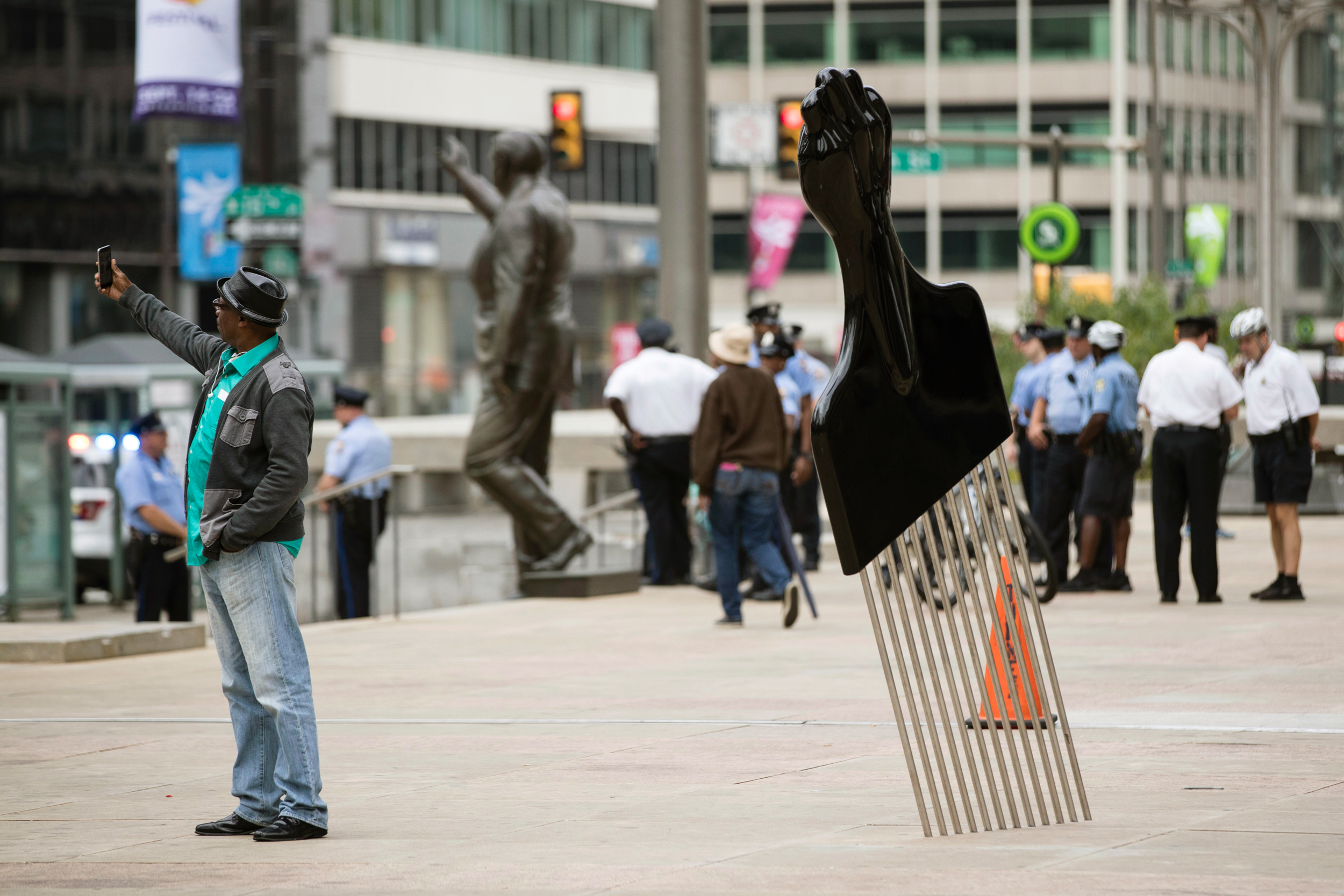
A man takes a selfie in front of Thomas’s sculpture of a 12-foot Afro pick, called All Power to All People, in view of a statue of Philadelphia’s former mayor and police commissioner Rizzo (Matt Rourke/AP/CP)

Monument Lab’s staff published the results of its inquiries as a report to the city. “The way we often talk about existing monuments and public history may severely limit our perception and reinforce the status quo,” they wrote. “We contend that it is not enough to simply say this knowledge is obscure or lost, or that it needs to be discovered or recovered by someone in the future. We must listen and take in what is already common knowledge: an expanded field of history that lives within people and places throughout the city.”

That’s one of the questions you can ask about monuments: who gets heeded, in Lum’s phrase. Another question is how. Big, realistic full-body statues sometimes make sense. There’s been one of those for Joe Frazier in Philly since 2015, an overdue real-life counterpart to the statue of Rocky, the movie boxer, that’s stood in various parts of the city since 1980. But sometimes the depiction can be more oblique or allusive. In 2017, Monument Lab invited 20 artists to build temporary new monuments around the city. Detroit artist Tyree Guyton put dozens of paintings of clocks around every side of a five-storey building: a meditation on time and its different meanings for different people.

Hank Willis Thomas, from Brooklyn, made a 12-foot Afro pick, the distinctive comb that became a symbol of Black pride in the 1970s, and stuck its tines into the ground in front of the Philadelphia municipal services building. For a time it stood within sight of a long-standing statue of Frank Rizzo, a brutal former police commissioner who was Philadelphia’s mayor through the 1970s. Running for a third term, Rizzo urged supporters to “Vote white.” In June 2020, the Rizzo statue came down; the current mayor, Jim Kenney, called his predecessor’s rule “among the worst periods” in the city’s history. Thomas’s giant Afro pick, meanwhile, is part of the permanent collection at the Pennsylvania Academy of Fine Arts.

The debates that fuel Monument Lab’s work have their parallels in Canada. As a Canadian, Lum follows these debates closely. Dundas Street and Yonge-Dundas Square in Toronto are named for a Scottish politician who is viewed by many historians as having delayed the end of the British slave trade. James McGill owned slaves. Egerton Ryerson helped design the residential school system. “Canadians overestimate their benign circumstances,” Lum says, “but there’s a lot of pernicious harm that’s been done.” Should statues come down? Lum isn’t categorical on the question, but whatever happens in every case, there should at least be more discussion and fewer resorts to the notion that monuments, as “history,” are eternal and inviolate.

“I think it’s a testament to a country’s fortitude and character that you can actually say something that is actually true” about the checkered past of previously lionized figures, he says. “It’s not like it’s being made up, or we’re impugning a country for its own sake, right? It’s not like these facts are somehow contrived.”

As most historians would acknowledge, history is about the present as well as the past. Perspectives change. “The whole project” of Monument Lab “is to un-fix the monument, right?” Lum says. “The authority of the monument. I think that’s really important because we tend to bestow this authority upon monuments, as something consensually derived, when in fact it’s particular to certain interests over other people. It’s a reflection of the distribution of power.”

The post Who should get a monument? Meet the Canadian man trying to answer the question. appeared first on Macleans.ca.

‘A deal to be silent’: Public servant paid to keep quiet about discrimination on the job

An annual government report on public servant NDAs would be helpful, which could provide some breakdowns on the nature of complaints, departments and amounts to help identify overall problem areas that should be addressed. Given that Liberal MP and parliamentary secretary Greg Fergus is on record as favouring more information, the government should act:

A Black federal public servant who launched a racial discrimination complaint against the Canadian government says she felt uncomfortable signing a gag order because she feared it could further entrench a culture of silence around racism within the bureaucracy.

“I was signing a deal to be silent about the discrimination I’ve been through,” said the woman, whom CBC/Radio-Canada has agreed not to name because she fears losing her job. “Throughout my entire career, I noticed colleagues, mostly white colleagues, getting privileges that I didn’t.”

The woman said the federal government paid her several thousand dollars in exchange for withdrawing the racial discrimination complaint.

Radio-Canada obtained a copy of the legal document, which was initialled by both the employer and the woman’s union. It contains a confidentiality clause preventing her from speaking out about the racism she says she experienced on the job.”They’re putting a price on it,” she said. “It’s completely inadequate, and those agreements are immoral and they need to stop.”

The woman said the agreement did resolve her specific issue, which she chose not to disclose because she worries it could identify her. However, she said the agreement did little to address the bigger problem of systemic racism within federal departments.

Around 800 current and former Black public servants have launched a class-action lawsuit against the federal government, alleging it has discriminated against Black employees for decades. It was filed with the Federal Court of Canada in December, but the government has yet to file a statement of defence.

The suit, which has not been certified, accuses the government of excluding Black employees from promotions.

‘Making the problem invisible’

Such agreements cover a range of issues from racial slurs to workplace harassment.

Doug Hill, a grievance and adjudication officer for the Public Service Alliance of Canada (PSAC) in Halifax, said about 70 per cent of the complaints he handles are resolved through settlements that contain a similar confidentiality clause. He also said the compensation offered sometimes goes well beyond the maximum $40,000 that can be paid under the Canadian Human Rights Act.

“There is no maximum amount” when it comes to the federal government, Hill said.

But critics say these arrangements are problematic because they cover up the real problem instead of addressing it.

“By making the problem invisible we’re making the victims invisible, and we basically have no precedent to build on and no lessons to learn,” said Fo Niemi, executive director of the Centre for Research-Action on Race Relations (CRARR) in Montreal.

Every year, the non-profit civil rights organization helps about 200 people who are victims of discrimination based on race, gender or disability. Niemi said often, people don’t realize the implications of signing an agreement that includes a confidentiality clause.

“Sometimes the complainant or the victim goes alone, feels very much pressured into signing something that that person may not be able to fully understand,” he said.

Need for transparency

Treasury Board President Jean-Yves Duclos directed Radio-Canada to his parliamentary secretary Greg Fergus, who said he believes these agreements are only acceptable if they are signed at the request of the complainant.

“You want to really recognize that the problem happened, you want to be transparent so you can fix the problem so that we can go ahead and create a better public service,” the Liberal MP for Hull–Aylmer said.

Fergus, who also chairs the Caucus of Black Parliamentarians, said the government needs to keep more detailed data regarding complaints that are withdrawn after the complainant signs a confidentiality clause.

“We can’t change things if we can’t measure them,” Fergus said.

Source: https://www.cbc.ca/news/canada/ottawa/public-servant-signs-deal-to-withdraw-racial-discrimination-complaint-1.6041139

Immigration applicants forced to file access to information requests to get answers on status: report

Hopefully, the GCMS modernization announced in Budget 2021 will enable this through an expanded MyAccount portal with increased functionality to both improve applicant service as well as reduce ATIP requests and costs:

The federal department in charge of immigration applications has been flooded with access to information requests because it provides so little information to applicants proactively, according to a new report by the Information Commissioner.

Have you applied to immigrate in Canada and want to know the status of your application? Or maybe your request was denied and you want to understand why? Well, instead of being able to see that information via your unique login on Immigration, Refugee and Citizenship Canada’s (IRCC) Web portal, you have to file an access to information request (ATIP).

Source: Immigration applicants forced to file access to information requests to get answers on status: report

For the IRCC response, see: IRCC launches efforts to streamline and modernize access to information and privacy system and the related Management Action Plan.

A religious symbol, not a knife: at the heart of the NSW kirpan ban is a battle to define secularism

Australia bit behind Canada in this respect (apart, arguably, from Quebec):

The New South Wales government has put a temporary ban on Sikh students carrying a kirpan in public schools. The kirpan is a ceremonial dagger baptised Sikhs carry to symbolise their duty to stand up against injustice.

The ban was put in place after a 14-year-old boy used a kirpan to stab a 16-year-old at a high school in Sydney.

NSW Premier Gladys Berejiklian said “students shouldn’t be allowed to take knives to school under any circumstances”.

But framing the controversy as whether or not students should be allowed to take knives to school oversimplifies a complex issue.

This issue is not just about knives in schools. It is also about what it means to be a secular school in a multicultural and multi-faith Australia.

Denied the ability to practise their faith

There is a long history of controversy over wearing religious symbols in Australian schools, both religious and secular.

In 2017 the family of a Sikh boy launched legal action against his school after the Christian college banned the boy from wearing a patka (a turban worn by children). The Victorian Civil Administrative Tribunal later ruled the school breached the Equal Opportunity Act.

In 2018 the Secular Party of Australia brought a case against the Victorian education department alleging the department had discriminated against a child by permitting her to wear “religious style clothing that covered her body, leaving only her face and hands exposed”. The case failed.

And in 2019 a Western Australian Catholic high school banned a Hindu girl from attending class after she had her nose pierced for cultural and religious reasons. After six weeks and many meetings, the school appeared to back down and allow the student back to class.

While some of these cases occurred in private and specifically religious schools, they all raise the same issue — to what extent do we accommodate the religious beliefs and practices of minority groups in our community?

In NSW, section 11C of the Summary Offences Act 1988 makes it an offence to carry a knife in a public place or school. The act provides a number of exceptions such as for the preparation of food, or for recreation or sport. Carrying a knife for “genuine religious purposes” is also an exception.

This exception is currently under review by the NSW government. In the meantime, a temporary ban has been put in place. As a result Sikh school children are being denied the ability to fully practise their faith.

What is a secular country?

Controversies like the kirpan ban often occur due to a fundamental disagreement about what a secular education looks like. Western secular democracies have taken two different approaches.

Australia’s government school system is secular. This does not mean it is, nor should be, religion free. Instead Australian secular education means a space where religion is one of many options. Countries that conform to this version of secularism are religiously plural.

In France, secular education means it is religion free. Since 2004 all religious symbols have been banned from state schools. The aim is to create a religiously neutral environment that supports state secularism.

Canada, South Africa and the United Kingdom have adopted a similar approach as Australia. In these countries, secularism means to permit, or even encourage, the expression of multiple faiths in schools to various degrees. The aim is to create a multicultural environment.

The kirpan is fundamentally a religious symbol. It is one of five markers of faith worn by baptised Sikhs, including kesh (unshorn hair symbolising respect for God’s will). Wearing the kirpan is not optional for baptised Sikhs.

The kirpan is similar to the hijab worn by some Muslim women, the kippah worn by Jewish men or the cross or crucifix worn by some Christians.

As the Supreme Court of Canada put it, describing the kirpan as a knife is “indicative of a simplistic view of freedom of religion”.

Banning the kirpan because it resembles a knife heads Australia down a path of religion-free schools. This would be inconsistent with Australia’s commitment to multiculturalism.

There are other options besides a ban

Instead of an outright ban, the NSW government and Australian schools more generally need to find ways to safely accommodate this important religious symbol. This does not mean there should be no restrictions.

In 2006 the Supreme Court of Canada found that a school had discriminated against a Sikh boy when it banned him from wearing his kirpan. A fundamental part of the court’s decision was there were alternatives available to the school.

The student was prepared to accept restrictions on how he wore his kirpan to ensure it could not be used as a weapon. The restrictions included wearing it enclosed in a wooden sheath sewn inside a cloth envelope, which must itself be attached to a shoulder strap worn under the student’s clothing.

Similar restrictions could be implemented in Australia.

The current debate about the kirpan in schools is an opportunity to educate both school children and the wider public about Australia’s secular multicultural society. As the Constitutional Court of South Africa noted in a case about wearing nose studs for religious and cultural reasons:

Granting exemptions will also have the added benefit of inducting the learners into a multi-cultural South Africa where vastly different cultures exist side-by-side.

Allowing kirpans, and other symbols of faith, to be worn in Australian schools is an important part of a multicultural secular education.

Source: A religious symbol, not a knife: at the heart of the NSW kirpan ban is a battle to define secularism

BIPOC or IBPOC? LGBTQ or LGBTQ2S+? Who decides which terms we should use?

Good discussion on names or labels, along with practical advice on their use.

I still stick with visible minorities as it is the term used by the employment equity act and thus Statistics Canada and other government data sources. I have largely shifted to using Indigenous peoples instead of Aboriginal peoples given that the government has taken some symbolic steps in that direction (eg., department names) without formally changing the language of the EE act.

And personally, while I understand that names and labels are important, I am more interested in what the data shows in terms of differences and similarities between and among groups than discussing terminology.

And sometimes new usage can be silly, e.g., pregnant people rather than pregnant women:

It does not take a degree to notice that the names for groups of people sharing a common skin colour, ethnicity, gender identity, disability or racial background change frequently — and how the grammar of these names also change. 

In many cases it is no longer acceptable to use a plain unadorned noun to identify someone from a marginalized group (this person is a(n) X). Nouns become adjectives (a disabled/homeless person) and those adjectives are then further embedded in modifying phrases (a person with disabilities/experiencing homelessness). 

Longer strings of adjectives are gathered into acronyms, which can be pronounced as one word (BIPOC), or initialisms, which cannot (LGBTQ+). The issue of which letters should be included along with the order in which they should appear may be debated (BIPOC vs. IBPOCLGBTQ+ vs. LGBTQIA vs. LGBTQ2S+).

Capitalization may vary (black vs. Blackwhite vs. Whitedeaf vs. Deaf). Some of these new terms open up grammatical questions: should I ask my non-binary friend to introduce themselves or themself?

If you are the type of person who finds this baffling or intolerable, you probably hold the mistaken belief that names stay fixed over time, or at least that they should.

If, on the other hand, you are sincerely concerned with using the appropriate terms, you may wonder how to determine what is correct. Who is the person or committee invested with the power to decide which terms are the right ones and which should be put to rest? Who is the arbiter of contentious language? The answer, in the case of terms that refer to people, is the people to whom those terms refer

Use the description the person has chosen

On an individual level, it is common courtesy to ask someone what their name is with the intention of using that name for them. We do not meet a new person and decide what their name should be. If we have only seen their name written down we may also check the pronunciation, although we may discover that we are unable to reproduce it. And if we forget someone’s name or mispronounce it, most of us instinctively apologize. When people change their names, as women who marry sometimes still do, we endeavour to call them by their new name. 

This courtesy extends to the way we describe people. Taking nationality as an example, someone may have parents from one country (Iran), have been born in another (Great Britain) and have lived most of their life in a third (Canada). Whether that person thinks of themself as Iranian, British, Canadian or some hyphenated blend of the three is as much a personal choice as it is legally defined. Politeness dictates that we use the description the person in question has chosen.

Names and descriptions of groups of people are necessarily more complicated because groups can be smaller or bigger in size. Canadians can include Iranian-Canadians while Indigenous communities can include Anishinaabeg and Cree peoples. Asians are members of the BIPOC community and lesbians are members of the LGBTQ+ community. And all of these people can be members of multiple communities.

It is incumbent on us to use the level of granularity that fits the context and when unsure, ask the people we are introducing or speaking about how they want to be identified. Where group membership is contested (for example, should women include people who do not menstruate? Should people who menstruate be called women?) opting for a superordinate term (adults, humans, people) is one way for non-members to avoid taking a side.

Describing groups can be even more difficult

Descriptions of groups of people can also be complicated by the fact that group members rarely all hold the same opinion regarding what they should be called. 

Unanimity on virtually any issue is almost impossible to achieve. What do we call people who cannot agree on what to be called? If we are guided by politeness, we can check with a group member who we perceive to have influence or follow what seems to be the dominant usage of the moment. And courtesy goes both ways. If we use an outdated or disliked term in good faith, we are entitled to polite, not hostile, correction.

Politeness and courtesy are best practices when we use language as individuals. But some of us also speak or write as members of organizations. For example, teachers, professors, journalists, editors, politicians and policy writers all represent institutions that set standards for language use. 

While the use of an older-term-now-replaced can be excused at an individual level, it is unacceptable at the institutional level where power resides. Institutions do well to choose language carefully, to be prepared to change often and to be fully open about how decisions around language have been made. Language acknowledgement statements, to the effect that the language chosen may not be used by all communities and individuals, can highlight, in a positive way, that choices are never perfect and that they are contingent on time and place.

People are not organized into neat categories and the names of categories are never static. Language is fluid and always moving.

The sound of language change is the sound of people using language differently until the majority settles on one usage. The voices of people debating and arguing about which terms that apply to them are pejorative, inadequate, or inappropriate demonstrates the ways in which language choice matters deeply. It is a beautiful chorus and the best practice is to listen closely.

Source: https://theconversation.com/bipoc-or-ibpoc-lgbtq-or-lgbtq2s-who-decides-which-terms-we-should-use-159188?utm_medium=email&utm_campaign=Latest%20from%20The%20Conversation%20for%20May%2026%202021&utm_content=Latest%20from%20The%20Conversation%20for%20May%2026%202021+CID_21254e324be5b15705d6cb7002b1e42c&utm_source=campaign_monitor_ca&utm_term=BIPOC%20or%20IBPOC%20LGBTQ%20or%20LGBTQ2S%20Who%20decides%20which%20terms%20we%20should%20use

New data provides a rare glimpse at ‘substantial’ Black overrepresentation in Ontario’s jails

Of interest:

Nearly one out of every 15 young Black men in Ontario experienced jail time, compared to one out of about every 70 young white men, and incarcerated Black people were more likely to live in low-income neighbourhoods, a new study of hard to come by race-based inmate data shows.

Using a snapshot of every Ontario inmate released in 2010, self-reported race data, home address data and 2006 census demographics, researchers from the University of Toronto, Ryerson University, McMaster University, St. Michael’s Hospital and ICES, a non-profit clinical research institute, have provided a rare glimpse at “substantial” Black overrepresentation in jails.

“The key thing here is really just the extent to which young Black men experience incarceration in Ontario,” said lead author Akwasi Owusu-Bempah. “It’s hugely troubling, especially in light of what we know about the consequences of criminalization, of incarceration for their futures and the futures of their families and their communities. We know what it does. Incarceration derails lives.”

The jail data, provided by the Ontario Ministry of the Solicitor General, held details of 45,956 men and 6,357 women who were released from provincial correctional facilities, which house accused awaiting bail or trial, and offenders sentenced to less than two years.

Overall, 12.8 per cent of men identified as Black and had an incarceration rate of 4,109 per 100,000; 58.3 per cent identified as white, for an incarceration rate of 771 per 100,000, and 28.9 per cent as “other,” for a rate of 1,507 per 100,000.

“Other” includes Indigenous, another group vastly overrepresented in jails and federal prisons but not the focus of this study.

For women, the rates were much smaller for all groups but, overall, Black women were incarcerated at a rate of 259 per 100,000, white women had a rate of 96 per 100,000 and the rate for “other” was 248 per 100,000.

Young men between the ages of 18 and 34 had the highest rates of incarceration in all groups, but young Black men had rates ranging around 7,000 per 100,000, compared to about 1,400 per 100,000 for younger white men.

Neighbourhood demographic data gleaned from the forward sortation area of postal codes showed Black men and women were more likely to come from low-income areas of the province. Black men spent more days incarcerated than white men and had higher rates of being transferred to a federal prison.

“This study demonstrates that incarceration is heavily concentrated among young Black men who come from economically marginalized neighbourhoods,” concluded Owusu-Bempah, an assistant sociology professor at U of T, and co-authors Maria Jung, an assistant criminology professor at Ryerson, Firdaous Sbai, a doctoral sociology student at U of T, Andrew S. Wilton, an ICES researcher, and Fiona Kouyoumdjian, an assistant professor in McMaster’s department of family medicine.

At the root of the higher rates are “historical and contemporary social circumstances of Black people in Canada,” note the researchers. These include 200-plus years of slavery and anti-Black racism, and disparities in many systems, including education, employment, child protection and justice.

Black people experience higher rates of child apprehensions and school suspensions and expulsions, and are more heavily policed, the authors said in highlighting disparities found in numerous studies, and also groundbreaking reporting done by the Star around Toronto police arrest and charging patterns and carding, when police stop, question and document citizens in non-criminal encounters.

Lower incomes for Black people have resulted in Black families living in areas that are “underserved by transit, libraries, schools and hospitals,” and those neighbourhoods tend to have higher levels of crime and crime victims, and concentrated law enforcement, the paper notes, citing academic work done by David Hulchanski on Toronto.

In the United States, the “American experience” with race and incarceration “shows us that concentrated incarceration has negative consequences at the individual, family and community levels, including social problems relating to poverty, mental health, education, employment and civic involvement,” the researchers wrote.

That ends up distorting “social norms, leads to the breakdown of informal social control, and undermines the building blocks of social order which are essential for community safety,” the paper concludes.

The often claimed but false trope that Canada is better on race and racism than the United States is also examined at the outset of the paper, which is published in the journal Race and Justice.

While not directly comparable, the authors later note that 2016 data from the U.S. Bureau of Justice Statistics showed Black men were jailed in state and federal institutions each day at a rate of 2,417 per 100,000. In the Ontario study, the annual incarceration rate in 2010 for Black men was 4,109 per 100,000.

That, the authors wrote, helps to “contextualize the extent of Black over-incarceration in Ontario.”

Owusu-Bempah, in an interview, said that “when we think about mass incarceration and we think about this kind of concentrated incarceration as an American phenomenon, I think we can see very clearly here that the levels of overrepresentation that we see in the United States is here in Canada.”

The age of the Ontario data — now over a decade old — speaks to how rare it is to come across race-based Canadian data, the researchers noted in an emailed response to Star questions.

“While these data are from 10 years ago, our ongoing involvement in the criminal justice system indicates that the overrepresentation of Black people persists today,” said the research team. “We think that monitoring and publicly reporting on the overrepresentation of Black people on an ongoing basis is important.”

In order to examine Ontario jail demographics, the researchers used gender and birthdates to link the provincial jail data to health administrative data held by ICES that was used in a 2018 study that looked at use of health care during incarceration and following release from jail. That study found the access rates of all types of health care were significantly higher for incarcerated people.

There is also a huge financial cost involved in jailing people. The Star has twice used inmate postal code data, length of incarceration data and daily cost of housing an inmate to show that in some Toronto city blocks, tens of millions of dollars are being spent to jail their citizens.

Preventing and reducing incarceration could free up money that could be reinvested in those neighbourhoods.

The authors of this report are part of a growing chorus of researchers, academics and advocates calling for more racially disaggregated justice data in Canada, which lags behind the U.S. and U.K.

More data around Canadian incarceration populations in provincial and territorial jails that identifies areas and groups experiencing high levels of incarceration, the paper concludes, “will help inform targeted initiatives to prevent criminal justice involvement” and “mitigate” the impacts on people and communities.

Source: New data provides a rare glimpse at ‘substantial’ Black overrepresentation in Ontario’s jails

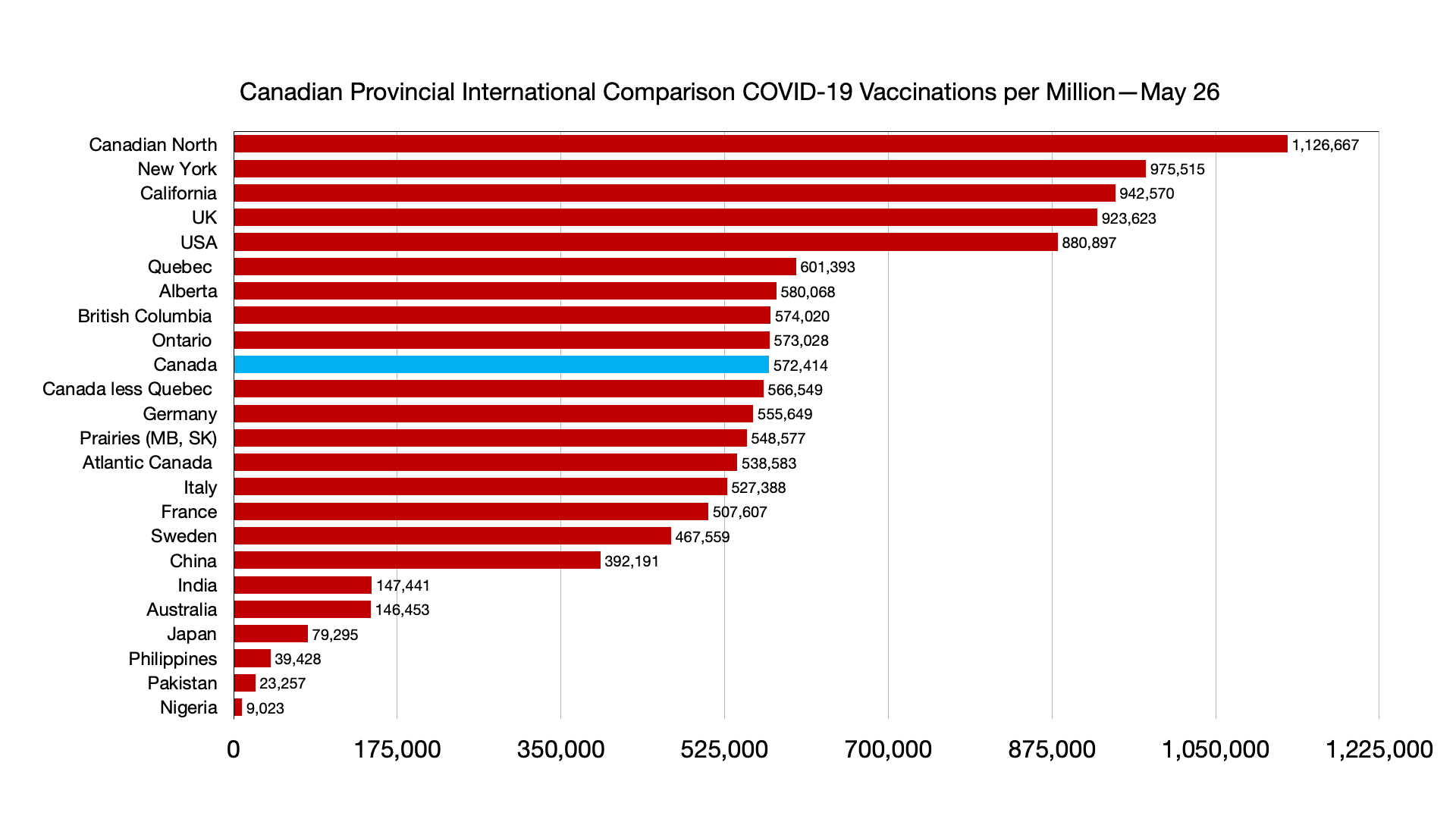
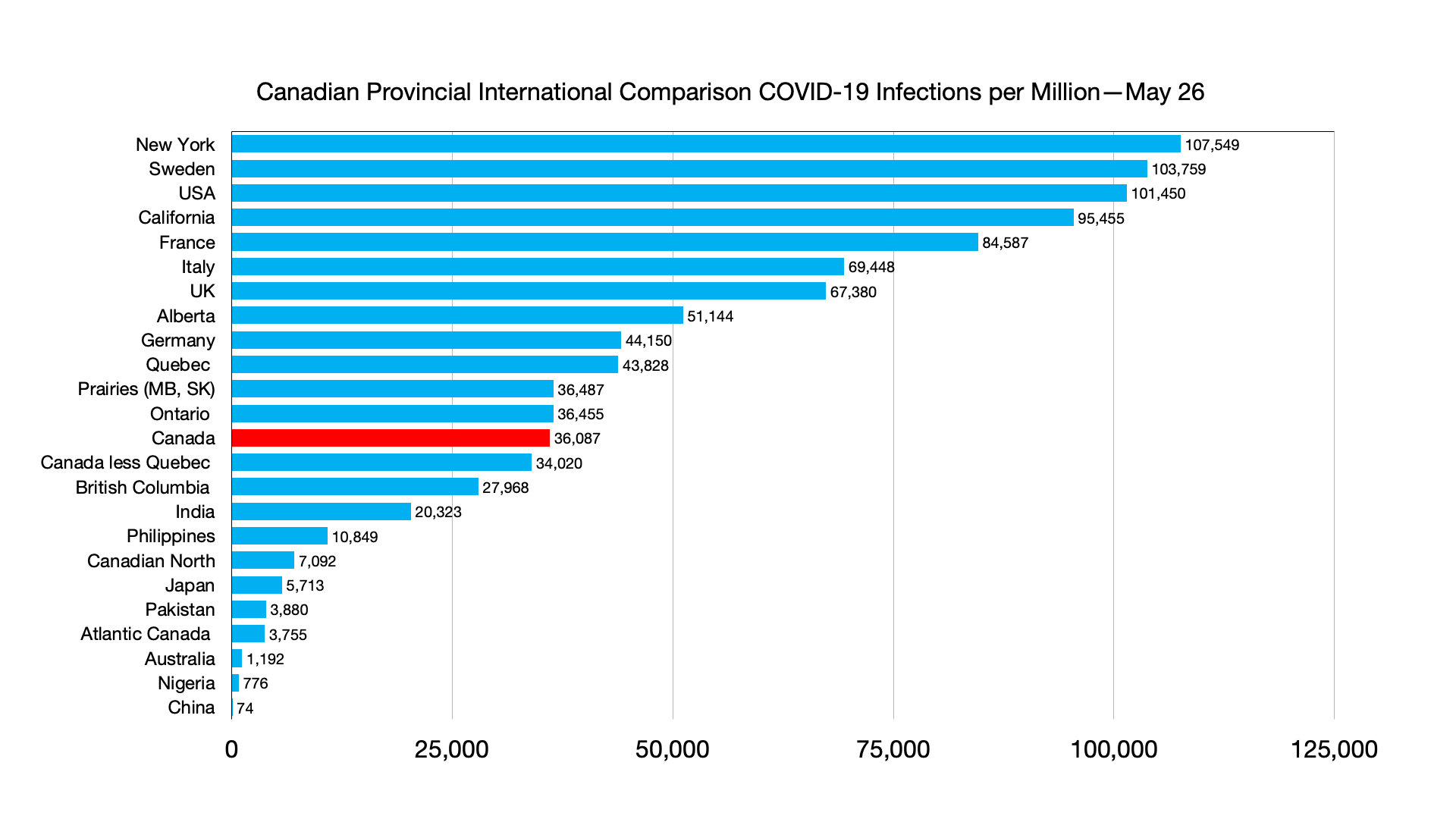
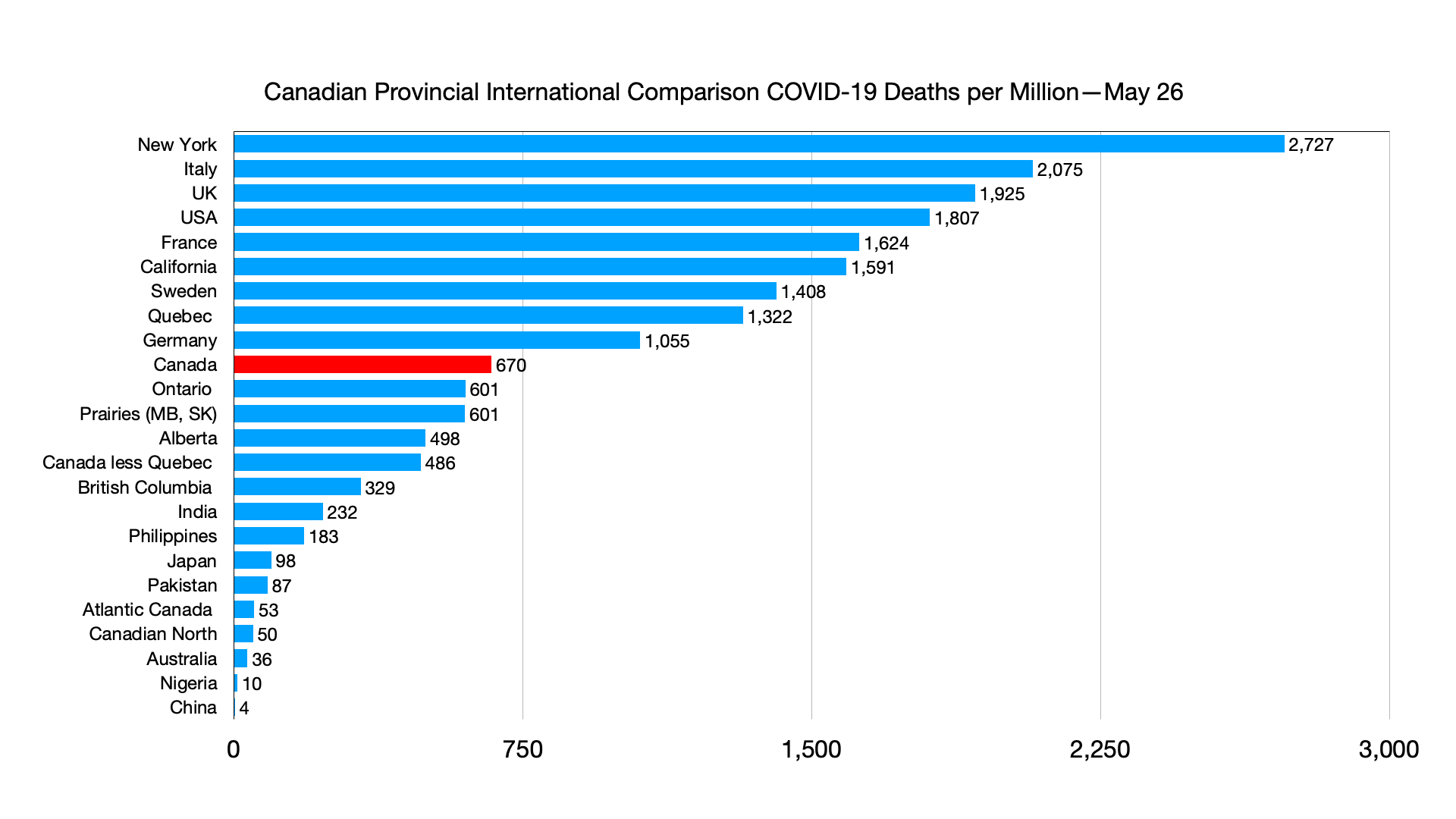
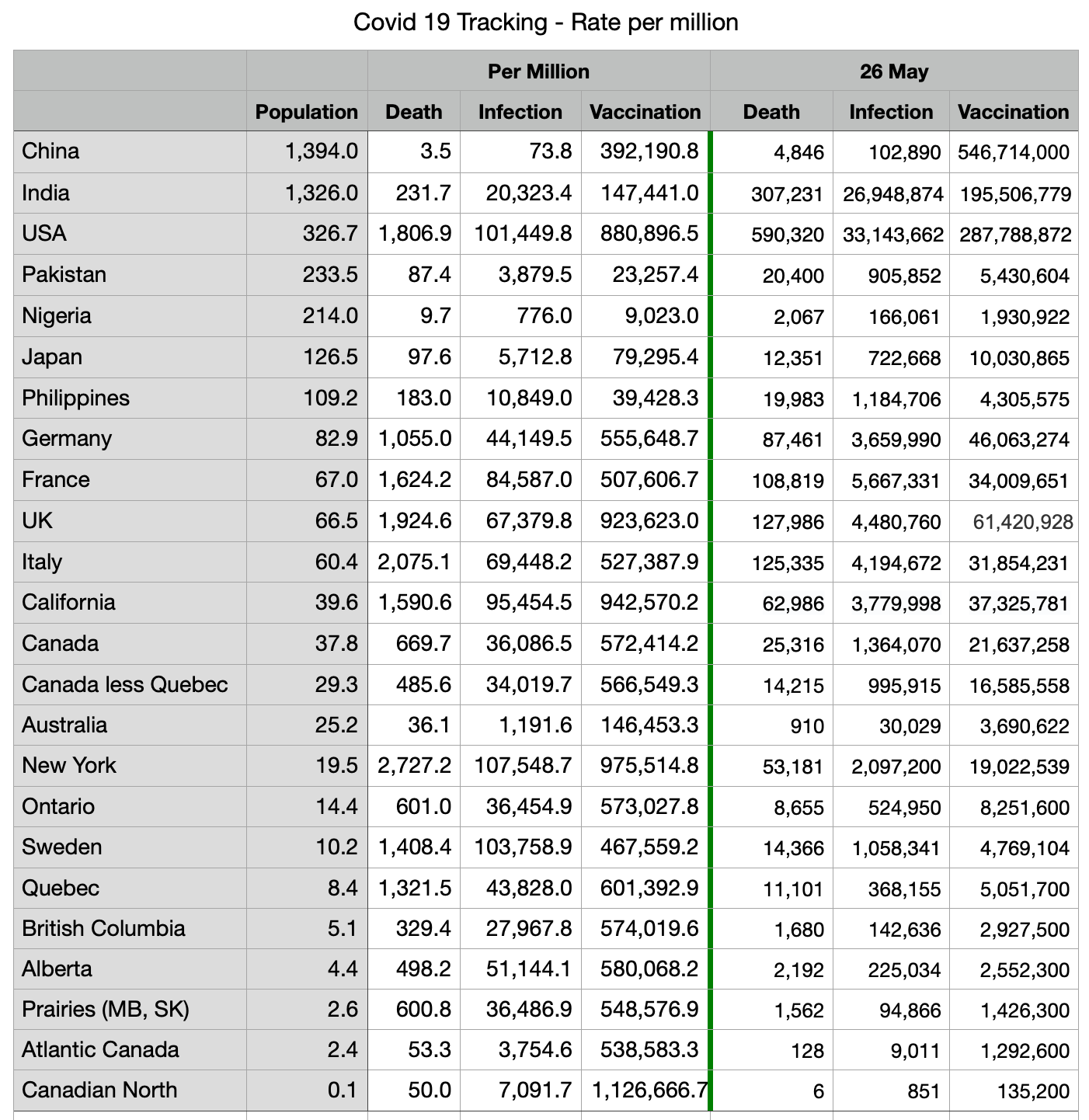
#COVID-19: Comparing provinces with other countries 26 May Update

The latest charts, compiled 26 May as overall rates in Canada continue to come down along with increased vaccinations.

Vaccinations: Minor relative changes, with Alberta moving ahead of British Columbia and Ontario, Atlantic Canada ahead of Italy and France.

Trendline charts

Infections per million: Alberta levelling off and upsurge in Manitoba is resulted in Prairie rate marginally more than Ontario.

Deaths per million: No significant change.

Vaccinations per million: Canadian vaccination rates have largely caught up to G7 less Canada with Quebec ahead.

Weekly

Infections per million: Prairies ahead of Ontario, driven by Manitoba.

Deaths per million: No relative change.

India

While there is undercounting in all countries as analysis of above average deaths indicate (e.g., The Economist’s Tracking covid-19 excess deaths across countries), this article on India is of particular interest.

The official Covid-19 figures in India grossly understate the true scale of the pandemic in the country. Last week, India recorded the largest daily death toll for any country during the pandemic — a figure that is most likely still an undercount.

Even getting a clear picture of the total number of infections in India is hard because of poor record-keeping and a lack of widespread testing. Estimating the true number of deaths requires a second layer of extrapolation, depending on the share of those infected who end up dying.

In consultation with more than a dozen experts, The New York Times has analyzed case and death counts over time in India, along with the results of large-scale antibody tests, to arrive at several possible estimates for the true scale of devastation in the country.

Even in the least dire of these, estimated infections and deaths far exceed official figures. More pessimistic ones show a toll on the order of millions of deaths — the most catastrophic loss anywhere in the world.

India’s official coronavirus statistics report about 27 million cases and over 300,000 deaths as of Tuesday. The country’s response to the pandemic has been further complicated this week by a cyclone that is battering India’s eastern coast, with winds of more than 95 miles per hour.

Even in countries with robust surveillance during the pandemic, the number of infections is probably much higher than the number of confirmed cases, because many people have contracted the virus but have not been tested for it. On Friday, a report by the World Health Organization estimated that the global death toll of Covid-19 may be two or three times higher than reported.

The undercount of cases and deaths in India is most likely even more pronounced, for technical, cultural and logistical reasons. Because hospitals are overwhelmed, many Covid deaths occur at home, especially in rural areas, and are omitted from the official count, said Kayoko Shioda, an epidemiologist at Emory University. Laboratories that could confirm the cause of death are equally swamped, she said.

Additionally, other researchers have found, there are few Covid tests available. Families are often unwilling to say that their loved ones have died of Covid. And the system for keeping vital records in India is shaky at best. Even before Covid-19, about four out of five deaths in India were not medically investigated.

Source: https://www.nytimes.com/live/2021/05/26/world/covid-vaccine-coronavirus-mask

Guerrero: How to Fight White Supremacy by Inverting Stephen Miller’s Playbook

Not a bad list, one that can be applied more broadly than in the USA (as is already happening in Canada to an extent):

Former Trump White House senior adviser Stephen Miller played a significant role in mainstreaming white supremacy over the past five years, promoting virulently racist literature, organizing anti-immigrant round tables, crafting Trump’s most xenophobic speeches, and strangling legal pathways into the United States for nonwhite people.

He is continuing his white nationalist campaign through frequent guest appearances on Fox News, hawking the dangerous delusion of anti-white racism. And through his nonprofit, “America First Legal,” he is attacking the Biden administration’s small steps toward building a humane immigration system and a more equitable society, including efforts to diversify schools. President Joe Biden has been reluctant to scale back many of Trump’s white nationalist immigration policies as Republicans attack him in hysteria-inducing language Miller helped normalize, casting Biden as an “open borders” president responsible for an imagined “Third World invasion.”

What Biden’s team must understand is that the radicalized Republican Party is going to use immigration to attack him regardless of what he does. “Bottom line: the less Biden talks about the border, the more the GOP must,” Miller tweeted on April 29. The only way to neutralize this weaponization of immigration and to illuminate the threat of nativists’ war on brown and Black people is not through inaction on the Southwest border or a more intense crackdown (the Obama administration revealed the futility of that strategy), but rather to radically reframe the national conversation about immigration by inverting Miller’s playbook, which I document in my biography Hatemonger: Stephen Miller, Donald Trump and the White Nationalist Agenda.

Opponents of white supremacy, xenophobia, and racism must wrest control of the immigration debate from hatemongers, or else the immigration reform bill in Congress is doomed to fail, Democrats will lose the midterms elections, and white extremism will continue to spread, further endangering people’s lives and democracy. What follows is a handbook for how Biden’s team, lawmakers, journalists, and other public figures can co-opt Miller’s strategies to fight the spread of hate.

  1. Use vivid, visceral anecdotes about immigrants’ contributions to the United States in speeches, press releases, news articles, interviews, and more. One of Miller’s favorite techniques was to insert graphic descriptions of alleged migrant crimes into Trump’s speeches and documents. In Trump’s 2015 immigration plan, he described an “illegal” immigrant “breaking into a 64-year-old woman’s home, crushing her skull and eye sockets with a hammer, raping her, and murdering her.” The incident reappeared in a Trump speech. He repeatedly exploited the tragic death of Kate Steinle, and pressured the Department of Homeland Security to inundate the public with press releases about immigrant crimes, manufacturing the false impression that brown and Black foreigners commit more crimes than the native born. The demonization can be countered by highlighting much more common examples of immigrants contributing to the United States., while being careful not to caricature immigrants as superhumanly heroic or hardworking, which is dehumanizing in a different way. Homeland Security Secretary Alejandro Mayorkas should issue press releases about acts of immigrant heroism as reminders of the full humanity and positive impact of immigrants, particularly nonwhite ones without legal status. Julia Ainsley’s 2020 NBC story, “Immigrant workers on Covid frontlines risk deportation to help save lives,” or the 2017 Univision story by Fernando Peinado and Anna Spelman, “The undocumented heroes never mentioned by Donald Trump,” are good examples.
  2. Hold press conferences, roundtables, and other reality-TV-style events that celebrate and inform about the above immigrant contributions to US national security, health, and the economy, while sharing accurate statistics. In the White House, Miller repeatedly helped organize anti-immigrant round tables, press briefings, and other streamed events in collaboration with law enforcement and lawmakers that cast immigrants as welfare-guzzling, diseased, and violent “animals,” including through the use of falsified statistics. It’s an old playbook that has been used time and again in the United States, notably with the vilification of Chinese immigrants in the 19th century: Spread falsehoods about unwanted foreigners bringing crime and illness, simultaneously stealing jobs, and draining public resources. Public figures should organize compelling events that inform about the true value of immigrants to public safety, health, and prosperity in partnership with law enforcement officers, lawmakers, and high-profile medical institutions and more. They should be entertaining, enlightening, and streamed to wide and diverse audiences.
  3. Promote literature, websites, and think tanks that center immigrants and refugees and depict them as they really are. Our storytelling industries, from publishing to media and entertainment, are still disproportionately white and male, resulting in a society with a seemingly bottomless capacity to empathize with white antiheroes, while dehumanizing complex brown and Black people. In 2016, Stephen Miller urged allies at Breitbart to promote the white supremacist dystopian book The Camp of the Saints by Jean Raspail. Breitbart blogger Julia Hahn published an ode to the book, which tells of the destruction of the white world by brown refugee “monsters.” Demand for the book has sinceskyrocketed. Miller also recommended that Breitbartsource material from American Renaissance and VDare, white nationalist websites. He pulled policies from anti-immigrant think tanks funded by racist heiress Cordelia Scaife May in collaboration with white supremacist John Tanton, such as the Federation for American Immigration Reform, which was designated as a “hate group” by the Southern Poverty Law Center. Public figures should counter white supremacist propaganda by promoting literature and other content that conveys the truth about immigrants, such as Karla Cornejo Villavicencio’s The Undocumented Americans and Reyna Grande’s The Distance Between Us. Remezcla has a list of the best books by Latin American authors that center the immigrant experience. The Center for American Progress and Migration Policy Institute are nonpartisan, and their websites can serve as resources for facts to counter anti-immigrant propaganda.
  4. Call anti-immigrant rhetoric what it is: a tactic of largely white elites to distract from the real problems they created for working people of all colors. At a 2016 Trump rally, Miller spoke of elites looking “down from their glass window condominiums at all of you,” before returning to his glass-window condominium. Anti-immigrant propagandists like Miller are elitists who politicize immigration to distract from their elitism and from policies and treaties that protect and expand their privileges. Trump bashed NAFTA as a “disaster” for American manufacturing workers, claiming that Mexico had been “spoiled” by the treaty, which had in fact displaced millions of Mexican farmworkers and devastated the southern country’s rural sector. During his administration, Trump used the anger he’d whipped up against the treaty to update it and change its name, not eliminate it, let alone address its biggest problems. Our nation’s storytellers, from Hollywood to Washington, must resist and expose attempts to use immigration to splinter working-class communities while enriching largely white male elites, often from both political parties.
  5. Forge alliances with other people in positions of power to accomplish the above goals and, crucially, to inspire hope. Miller’s mentor David Horowitz advocated stoking fear rather than hope. “Fear is a much stronger and more compelling emotion,” he wrote in a strategy paper that referenced the political utility of hate and other negative feelings, and encouraged Republicans to demonize their opponents. Miller forged strategic alliances with the right-wing site Breitbart and provocateurs such as Sean Hannity and Tucker Carlson, who recently endorsed a white supremacist conspiracy theory on air, to spread anti-immigrant and anti-liberal hate. From the time Miller was a teenager calling into The Larry Elder Showrailing against multiculturalism, he was cultivating relationships with powerful people to peddle hate. The opponents of hate must believe in hope, and leverage it in collaboration with one another. Part of leveraging that hope is embracing the reality that most extremists aren’t innately evil or cruel. While they pose a very real threat to national security, their reasons for being radicalized often aren’t simple. Some are vulnerable, isolated individuals dealing with trauma and other mental health issues. Sociopaths and swindlers manipulate them, giving them a false sense of purpose and meaning in the form of a scapegoat. Not all are irredeemable, demonstrated by the case of former Breitbart editor Katie McHugh, who was radicalized by Miller before realizing she had joined a dangerous movement. Some can be coaxed out slowly, with empathy, because we are stronger with people who have seen the light on our team.

Source: How to Fight White Supremacy by Inverting Stephen Miller’s Playbook

USCIS: Citizenship agency eyes improved service without plan to pay

Canada also needs to modernize its citizenship program (https://policyoptions.irpp.org/magazines/april-2021/amid-languishing-numbers-canadas-citizenship-process-needs-to-be-modernized/), including full integration into the GCMS modernization project):

Less than a year after being on the verge of furloughing about 70% of employees to plug a funding shortfall, the U.S. agency that grants citizenship, green cards and temporary visas wants to improve service without a detailed plan to pay for it, including granting waivers for those who can’t afford to pay fees, according to a proposal obtained by The Associated Press.

The Homeland Security Department sent its 14-page plan to enhance procedures for becoming a naturalized citizen to the White House for approval on April 21, It involves U.S. Citizenship and Immigration Services, which is part of Homeland Security and has been operating entirely on fees, without funding from Congress.

The plan describes short- and long-term changes that reflect “a realistic assessment of our aspirations and limitations,” including more video instead of in-person interviews with applicants, authorizing employees to administer citizenship oaths instead of having to rely on federal judges, and promoting online filing to reduce processing times.

Homeland Security says it can all be done without the approval of Congress, where consensus on immigration has proven elusive for years.

Taken together, the changes mark a complete break from the Trump administration, when the agency focused on combatting fraud and adjusted to shrinking immigration benefits, such as ending the Deferred Action for Childhood Arrivals program to shield young people from deportation.

The plan also seeks to give potential U.S. citizens the benefit of the doubt. For instance, it specifies that an immigrant who mistakenly registers to vote in U.S. elections before becoming a citizen won’t be punished. Doing so now can lead to deportation or criminal charges, likely ending a person’s chance for citizenship.

The issue has been in the spotlight amid a recent surge in automatic voter registration and former President Donald Trump’s repeated unsubstantiated claims that millions of people voted illegally in 2016. Last year, Illinois’ automatic voter registration program mistakenly registered hundreds of people who said they weren’t U.S. citizens. At least one voted.

The document that aims to improve the citizenship process is designed to “encourage full participation in our civic life and democracy” and to deliver services effectively and efficiently.

It doesn’t provide cost estimates for any of the proposed changes, though some measures appear designed to save money as well as achieve efficiencies. It also acknowledges success depends on long-term financial stability, which includes asking Congress for money.

Under the plan, the agency would continue subsidizing the costs of becoming a citizen to make sure the process is available to as many people as possible. Guidelines on fee waivers would be consistent and transparent, it said.

The administration “recognizes that the cost of fees can be a barrier to certain individuals filing for naturalization and is committed to providing affordable naturalizations,” the document reads. “This will mean that other fee-paying applicants and petitioners will continue to subsidize this policy decision to ensure full cost recovery.”

The White House and Homeland Security Department did not immediately respond to requests for comment.

Fiscal challenges came to a head last summer when the agency threatened more than 13,000 furloughs to tackle a projected $1.26 billion shortfall. But a few tense months later, it said it didn’t need the money after all and would end the year with a surplus. The agency’s then-acting director, Joseph Edlow, said application fees rebounded more than expected as offices reopened from coronavirus shutdowns and contracts were reviewed for cost savings.

The anticipated shortfall first surfaced in November 2019, when the agency proposed major fee increases — well before COVID-19 threatened finances.

The budget whiplash raised doubts about how the agency’s finances deteriorated so rapidly then suddenly recovered. Ur Jaddou, who was nominated by President Joe Biden in April to lead the agency, was among those with questions.

Jaddou, who served as the agency’s chief counsel under President Barack Obama, said in October that the agency needed a financial audit. She questioned some changes under the Trump administration, including justification for a major expansion of an anti-fraud unit and a requirement, since abandoned by Biden, to reject applications that left any spaces blank.

“It really is a bunch of bureaucratic red tape,” she said when discussing the agency’s financial woes.

Fees were set to increase by an average of 20% last October but a federal judge blocked them days before they were to take effect. The fee to become a naturalized citizen was set to jump to $1,170 from $640. Fee waivers were to be largely eliminated for people who could not afford to apply.

Other Trump-era fee changes that were stopped included a first-ever charge to apply for asylum of $50. Asylum-seekers would also have to pay $550 if they sought work authorization and $30 for collecting biometrics.

The wait to process a citizenship application grew to more than a year by the end of Trump’s presidency from less than eight months four years earlier.