Blanchet seeks to drive values wedge between Quebec and Trudeau government

Virtue signalling during the pandemic, when Quebec has some of the highest per capita infection and death rates worldwide:

Bloc Québécois Leader Yves-François Blanchet is doubling down on efforts to draw a line separating his party’s values from those of the Trudeau Liberals — particularly on the fraught ground of free speech.

Blanchet posted a tweet Sunday suggesting Justin Trudeau’s response to attacks in France that authorities have attributed to Muslim extremists did not go far enough, and highlighted what the Bloc leader called a “disturbing gap” in values that he chalked up to possible “weakness” or “ideology” on the prime minister’s part.

Blanchet said in French that Trudeau is threatening Quebec’s friendship with France. He’s sought to align his province with that country’s “republican and secular” principles, contrasting them with what he called an “Anglo-Saxon multiculturalist doctrine.”

Source: Blanchet seeks to drive values wedge between Quebec and Trudeau government

What the Public Service Employee Survey breakdowns of visible minority and other groups tell us about diversity and inclusion

My companion piece to the earlier https://policyoptions.irpp.org/magazines/october-2020/what-new-disaggregated-data-tells-us-about-federal-public-service-diversity/:

PSES data supports the view that the government has considerable work to improve the workplace organizational culture to reduce harassment and discrimination for both visible minority and Indigenous groups. 

Black employees report being a victim of discrimination the most, generally and with respect to race and colour. But all groups report significantly higher discrimination than all employees, according to data analyzed by Andrew Griffith. 

Following the 2019 Employment Equity Report provision of disaggregated representation for visible minorities, Indigenous people, and persons with disabilities, the 2019 Public Service Employee Survey (PSES) similarly lays out these breakdowns for the four employment equity categories along with LGBTQ2 persons, to assess whether or not the public service is inclusive to all groups.

With the availability of disaggregated data, we now can compare the experiences of different visible minority and Indigenous groups, using the helpful summary tables available at Open Data.

For ease in analysis, I have separated indicators pertaining more to organizational culture (employee engagement, senior management, workplace well-being, empowerment, career development, diversity and inclusion) from those of personal experience (harassment and discrimination).

Figure 1 contrasts the results for the 22 organizational culture questions for women, visible minorities, Indigenous peoples, persons with disabilities (PwD) and LGTBQ2, highlighting those with a variance of five per cent better or worse compared to all employees. Overall, the major issues appear to be with respect to PwD across virtually all indicators followed by Indigenous employees with respect to diversity and inclusion. Visible minorities and LGBTQ2 are largely similar to all employees, with the exception of higher stress due to discrimination for visible minorities. However, visible minorities also indicated being more satisfied with senior management and less stressed after the workday.

Figure 2 compares the harassment and discrimination indicators across the categories. The results are as one would expect for each category. While visible minorities are comparable to all employees with respect to harassment, they are more likely to have encountered discrimination based on their race, ethnic origin, colour, or religion. Indigenous people are more likely to feel excluded and encounter discrimination based on their race. Once again, PwD are more likely to encounter harassment, whether being subject to excessive control, being excluded, humiliated or encountering interference in their work, and being discriminated against in their disability. LGBTQ2 people encounter more sexual comment or gesture harassment, along with greater discrimination on sexual orientation or gender identity.

Visible minorities

Figure 3 contrasts the responses for the different visible minority groups for the organizational culture indicators compared to all employees. Generally, employee engagement indicators show comparable results across all groups to all employees with minor variations. Most groups are more satisfied with senior management than all employees, particularly with respect to information flow. Workplace well-being indicators are generally more positive than for all employees, with the notable exception of harassment- and discrimination-induced stress. While empowerment indicators generally are similar to all employees, Black, Japanese, and Korean feel the least empowered. Career development indicators are also generally comparable, with the exception of more negative perceptions by Japanese, Black, South Asian, and West Asian employees responding that discrimination has adversely affected their career progress. While diversity and inclusion indicators are generally comparable across groups, Japanese employees have the lowest satisfaction along with Black employees regarding support for a diverse workplace.

Overall, Filipinos have the highest levels of satisfaction of all groups consistently across all indicators.

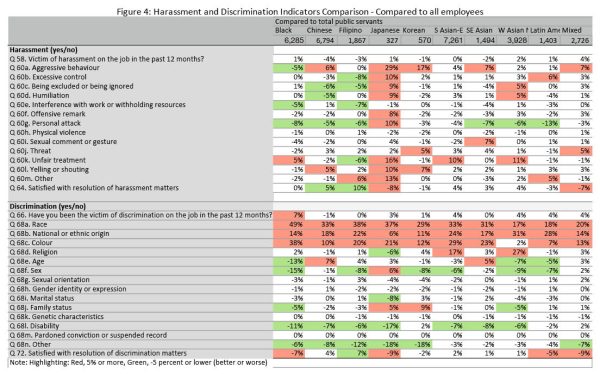
Figure 4 contrasts the responses for the different visible minority groups for the harassment and discrimination indicators compared to all employees. Black, Filipino, and Chinese employees report lower harassment for most indicators than other groups. Aggressive behaviour is highest among some Asian groups, along with yelling or shouting. Perceived unfair treatment is common to most groups, save Filipino and Southeast Asian.

Overall, Japanese employees report the greatest harassment and least satisfaction regarding harassment resolution and Filipinos the least harassment and greatest satisfaction with resolution, followed by Chinese employees.

Black employees report being a victim of discrimination the most, generally and with respect to race and colour. But all groups report significantly higher discrimination than all employees, whether by race, ethnic origin or colour, save for West Asians/Arab. However, Southeast Asian and West Asians/Arab report high levels of religious discrimination, most likely related to Islam. Interestingly, both Chinese and Southeast Asian employees report higher levels of age discrimination, and family status discrimination is highest among Japanese. Discrimination resolution satisfaction is highest with Filipinos and lowest with Black, Japanese, Latin American and mixed.

Indigenous groups

Figure 5 contrasts the responses of the three Indigenous groups for the organizational culture indicators compared to all employees. Overall, Inuit have higher levels of satisfaction across the vast majority of these indicators, with Métis having the lowest levels with respect to employee engagement, the highest work-related stress and the lowest levels of empowerment. North American Indian/First Nations and Métis employees rate the psychological health lower than all employees and all three groups report higher levels of discrimination-induced stress.

Figure 6 contrasts the responses with respect to harassment and discrimination. All Indigenous groups report harassment over the past 12 months, being excluded or ignored. Inuit have higher rates of being humiliated or being subject to offensive remarks while Métis report being subject to excessive control and personal attacks. Only Inuit are satisfied with harassment resolution while Métis are least satisfied. With respect to discrimination, all have experienced higher levels of discrimination than all employees, with very high levels based on race for First Nations and Inuit and high levels with respect to nation or ethnic origin. As in the case of harassment resolution, only Inuit are as satisfied as all employees while Métis are least satisfied.

While it appears that the experience of visible minorities is worse than Indigenous peoples, PSES data supports the view that the government has considerable work to improve the workplace organizational culture to reduce harassment and discrimination for both visible minority and Indigenous groups. This needs to take place at the general and the specific group levels by each department given the variances between the individual groups.

As in the case of disaggregated data with respect to employment equity groups, the increased granularity of the PSES provides a richer evidence base for managers and human resources to develop measures to improve inclusion in the public service at the departmental and organizational levels.

Methodology:

This analysis is based upon the TBS abridged PSES data table, 2019 PSES —Diversity and Inclusion Tables. The data tables contain comparisons of the 2019 PSES results between certain demographic groups or sub-types of designated groups under the Employment Equity Act and the rest of the public service. As the PSES is a voluntary survey, open to core public administration (Schedule I and IV) and separate agencies (Schedule V), the responses cover a broader range of organizations than TBS Employment Equity reports which only apply to core public administration. Responses for categories and groups were contrasted with all responses, save for the general question on harassment and discrimination for women which is a direct comparison with men. TBS weighs the responses based on workforce demographics. The response numbers by group were taken from the  2019 Public Service Employee Survey open dataset.

A threshold of five per cent to flag significant differences was used, with red indicating worse and green better.

Larger format tables (pdf):

Source: https://www.hilltimes.com/2020/11/02/what-the-public-service-employee-survey-breakdowns-of-visible-minority-and-other-groups-tell-us-about-diversity-and-inclusion/270120?utm_source=Subscriber+-++Hill+Times+Publishing&utm_campaign=952f203e8a-EMAIL_CAMPAIGN_2020_11_03_11_00&utm_medium=email&utm_term=0_8edecd9364-952f203e8a-90755301&mc_cid=952f203e8a&mc_eid=685e94e554

Immigration levels plan: Reactions

Have been following the various reactions to date regarding the government’s (overly) ambitious targets for the next three years. Relatively few op-eds and commentary, possibly due to the focus on COVID and the US presidential election which are taking up most of the oxygen.

And much of the commentary focusses overly on the administrative issues, not the more substantive issues related to economic integration of immigrants during an economic recession, one that is likely to linger for a few years.

Have grouped these by constituency:

Business-oriented

The plan was welcomed by the business sector.

“There is widespread agreement across party lines that immigration is essential to long-term economic growth,” said Goldy Hyder, president and CEO of the Business Council of Canada, which represents some of the country’s largest businesses.

“Newcomers bring energy, skills, new ideas and entrepreneurial spirit. They start companies, fill skill shortages, buy houses and pay taxes, … The minister’s plan will allow Canada to make up lost ground as the pandemic eases. It will inject new dynamism into our economy.”

The Canadian Manufacturers and Exporters even went one step further, saying Ottawa’s objectives were too modest and will not allow the country to catch up quickly enough over the coming months to compensate for the reduced number of immigrant admissions this year.

“Manufacturers are increasingly using immigration to supplement their workforce but there are not enough immigrants to meet the demand,” said Dennis Danby, its president and CEO, who represents 2,500 leading manufacturers in the country.

“If manufacturing is to be at the core of the economic recovery following the COVID-19 crisis, we must do more in prioritizing immigration from the economic stream.” (Toronto Star)

As Canada’s leading voice on smart population growth, Century Initiative continues to advocate not just for increasing our population, but for policies to support that growth through investments in education and in the national and urban infrastructure that will allow our communities to grow in a sustainable manner. We also need to prioritize supporting parents with a national childcare strategy, and our children with early education programs.

Now is the right time to invest in growing our population. Environics Institute’s recent Focus Canada survey shows that a record two-thirds (66%) of Canadians reject the idea that immigration levels are too high, and that Canadians recognize the critical contribution immigrants make to our economy and our social fabric. We have a tremendous opportunity before us and welcome the opportunity to continue working with gover(nment to seize it in the interest of future generations of Canadians. (Century Initiative)

Opposition critics

Opposition MPs took aim at the way the government has handled immigration throughout the pandemic and questioned how the new targets would be achieved.

Conservative immigration critic Raquel Dancho said the government is announcing new levels without a plan for how they will be safely implemented.

Jenny Kwan, immigration critic for the NDP, said she believes the numbers are “a bit of a hoax” because the backlog to process applications is so great that the targets will be hard to meet.

Christine Normandin, the Bloc Québécois immigration critic, said in French that Ottawa is taking the opposite approach to the Quebec system. She said the province takes only as many immigrants as it can process in one year, while Ottawa sets goals without taking into account its capacity to do the paperwork. (Globe)

That lower-end target is actually below the low end of the number of immigrants, pre-pandemic, the Liberals had planned to admit in 2021, pointed out NDP immigration critic Jenny Kwan. 

“The Liberals demonstrate a lack of conviction in their targets and left the door wide open for immigration levels to decrease,” she said in a statement.

It’s also not clear how unused room is being carried over. 

For example: the Liberals had planned to admit 49,000 refugees this year. Next year, according to Friday’s plan, they are aiming for 59,500. 

While that looks like an increase of 10,000, the number of refugees who have actually arrived in the first eight months of this year was down nearly 60 per cent from 2019 arrivals. 

So it’s possible that the 2021 figures merely incorporate the shortfall from this year, as opposed to being an overall increase. Mendicino wasn’t clear when asked about that issue Friday.  (Canadian Press)

NDP immigration critic Jenny Kwan said the government must not overlook the compassionate aspects of the immigration system, such as removing travel restrictions for asylum seekers and ensuring permanent residence status for migrant workers in recognition of their contributions during the pandemic.

“The immigration department’s processing abilities is still spotty at best and serious investment in staffing, far beyond what we’ve seen so far, is needed,” said Kwan.

“Without these investments, applicants are to expect significant increases in processing times for years to come, which were already long before the pandemic.” (Toronto Star)

Tweets from CPC critic Dancho:

The Liberals have failed to layout a plan to  bring in newcomers to Canada safely. No widespread access to rapid tests and the 14 day quarantine is not a financial option for many people. #cdnpoli https://twitter.com/RaquelDancho/status/1322270115921055746?s=20

They have no plan to better resource immigration department to fulfil the levels promised.  Liberals are simply adding to their massive, years-long immigration backlogs that fail to provide potential newcomers with certainty, dignity or respect. #cdnpoli https://twitter.com/RaquelDancho/status/1322270117384851456?s=20

The ministers announcement did not acknowledge the economic devastation caused by COVID-19 or the hundreds of thousands of Canadians facing unemployment since the pandemic hit and how these new ambitious immigration numbers will impact them. #cdnpoli https://twitter.com/RaquelDancho/status/1322270118290903040?s=20

International organizations

Either way, that Canada even continues to open its arms is welcome, said Rema Jamous Imseis, the UN refugee agency’s Canadian representative. 

“In an era of travel restrictions and closed borders, refugees continue to be welcomed by Canadians,” she said in a statement.

“The significance of this lifeline and the deep generosity of Canadians cannot be overstated.” (Canadian Press)

Academics

While experts had expected Ottawa to stay the course with its immigration goals — given the government had publicly stated immigration would be key to restarting the post-COVID-19 economy, they were surprised the Liberals would decide to take it up a notch.

Although critics have raised concerns about high immigration given that the country’s jobless rate hovered at nine per cent in September — after peaking at 13.4 per cent in May — from 5.6 per cent before the pandemic, some experts say the government is on the right track.

“The timing for expanding the program now is good. But I’m surprised how high the targets are they have set. I don’t know how realistic it is from a bureaucratic administrative perspective,” said Carleton University economist Chris Worswick, who specializes in the economics of immigration.

“I commend the government for thinking about immigration again. I was worried that it wouldn’t happen. I wonder if they’re being too ambitious. I’m cautiously optimistic that we’ll end up at a good place.” (Toronto Star)

Immigration lawyers and advocates

Immigration and refugee experts welcomed the move to grant permanent residency to those already in the country.

“I’ve always thought, even before COVID, that it makes a lot more sense to target people who are already educated here, or have work experience here, or at least have lived here. … These are people who are already demonstrating their genuine interest in Canada,” immigration lawyer Chantal Desloges said.

Janet Dench, executive director of the Canadian Council for Refugees, said her organization has urged the government to give permanent residency to those in Canada.

“What we need to see is that realization actually reflected in actual operations, actual policies, because at this point, the way the Immigration Department is working is running in completely the opposite direction,” she said. (Globe)

We need #StatusforAll and Fairness.
Today’s Canada’s Immigration Plan does neither. pic.twitter.com/xhsJtrZBtj— Migrant Workers Alliance for Change (@MWACCanada) October 30, 2020

Contrary to what the government is saying, there is NO INCREASE in IMMIGRATION LEVELS. Instead, there was a 150,000 shortfall in immigrants in 2020, and the government is trying to catch up for it by increasing 50,000 each year for the next three years. But as COVID-19 continues, these promises are unlikely to be kept.+

The overall proportion of new immigrants remain the same, with the primary focus on “high waged” immigrants. However, to qualify for these immigration programs, migrants must show 12-24 months of high-waged work. With COVID-19-related job losses disproportionately impacting racialized people, many migrants don’t have access to these jobs and won’t qualify. No plan has been announced to ensure full and permanent immigration status for all migrant and undocumented people right now.+ Many migrants — including care workers and former international students — were not able to complete requirements for permanent residency in 2020 due to COVID-19. However, there is no meaningful increase in numbers on fixing of rules for these migrants in today’s announcement. (Migrant Workers Alliance)

On the right

Recent polls have shown that Canadians are weary about increasing immigration levels in the wake of the coronavirus pandemic. 

A poll commissioned by True North found that an overwhelming 76% of Canadians strongly agreed with the idea of a temporary pause until a coronavirus vaccine is developed and unemployment drops to pre-coronavirus levels. Note: Polling firm unknown and thus is not credible

The poll results show a surprising consensus among political parties as well with 67% of Liberals wanting to impose a temporary pause, 66% of NDP voters and 89% of Conservatives. 

“Given today’s global circumstances of a public health pandemic and severe economic crisis, now is the perfect opportunity to revert back to our successful historic immigration model, listen to the majority of Canadians, and take another pause,” True North’s founder Candice Malcolm wrote when the poll was released. 

“It’s time for our leaders to listen to the people and do what’s best for our country.” (“True” North)

While the government touted the need for migrants to strengthen the economy, the unemployment rate in Canada, the unemployment rate currently stands at 9%, from an all-time high of 14% in May. Over 8 million Canadians applied for emergency COVID relief benefits in the form of the CERB. Canada’s unemployment rate was around 5% prior the pandemic. (Rebel Media)

Links:

https://www.thestar.com/news/canada/2020/10/30/canada-raises-immigration-targets-to-record-level-eyeing-covid-19-recovery.html

https://www.theglobeandmail.com/politics/article-canada-aims-to-accept-far-more-immigrants-in-next-three-years/

https://www.nationalnewswatch.com/2020/10/30/open-arms-in-an-era-of-closed-borders-pandemic-era-immigration-plan-to-be-released/

https://www.centuryinitiative.ca/2020/10/30/statement-by-century-initiative-in-response-to-todays-announcement-on-canadas-new-immigration-levels-plan/

https://www.rebelnews.com/canada_to_increase_immigration_targets_after_covid_disruption

https://www.facebook.com/notes/migrant-workers-alliance-for-change/immigration-announcement-fails-to-ensure-fairness-status-for-all/10101179406532842/

The U.S. election results could influence immigration to Canada

Good analysis by Craig Damian Smith (header understates influence):

Immigration was largely absent from the U.S. presidential campaign until the final debate. The short exchange highlighted the chasm between the Biden and Trump platforms and came a day after reports that lawyers could not locate the deported parents of 545 previously incarcerated children. This grave outcome of “zero tolerance” on the U.S.-Mexico border is but one example of President Donald Trump’s vast and punitive changes to immigration and asylum.

Trump policies have already affected Canada. Increased immigration enforcement, the gutting of the U.S. asylum system and plans to cancel Temporary Protected Status opened the Roxham Road route on the New York-Quebec border, where almost 60,000 people have claimed asylum since 2016. Slashing U.S. refugee resettlement quotas from more than 100,000 in 2016 to 15,000 in 2020 made Canada the world’s top resettlement country. It is also likely that skilled immigrants, entrepreneurs and students considered Canada over the U.S.

Tomorrow could bring more significant change. A second Trump term could dismantle the remnants of America’s asylum and resettlement systems. The Supreme Court’s conservative majority could be weaponized against “Dreamers,” Temporary Protected Status recipients, sanctuary jurisdictions and groups that aid migrants. It could mean more immigration raids, incarceration and deportation and may further embolden militarized white supremacists.

Canada may have to reconcile its role as a champion of refugee rights with the fact that its asylum policies are hitched to those of the U.S. In July, the Federal Court struck down the Canada-U.S. Safe Third Country Agreement (STCA) because it subjects asylum seekers to punitive detention in the U.S. Last week the government was granted a stay by arguing that ending the STCA will create a “pull factor” for a surge of asylum seekers. While this argument misses the point about refugees’ rights, forecasting and political considerations are warranted.

Though overlooked by advocates, the STCA is predicated on “responsibility (or burden) sharing.” Its preamble stipulates a commitment to equivalent asylum systems and co-operation. More broadly, the norm of responsibility sharing underpins global agreements concerning refugees, recognizing that states have common but differentiated roles in addressing displacement. Poor countries host 85 per cent of the world’s 26 million refugees. Rich countries have a choice between financial support, offering asylum or resettlement. The Trump administration has reneged on all three. In Trumpian terms, there is no deal.

Joe Biden’s immigration platform is vastly different. In the final debate, Mr. Biden distanced himself from Barack Obama’s record-level deportations and border policies. He promised to reform asylum, stop immigration raids and work to regularize 11 million undocumented people.

Reforms will not change the fact that immigration judges have resigned or retired early in record numbers. Nor will they immediately bring back the dozens of closed local settlement offices or fill massive vacancies at the U.S. State Department and Citizenship and Immigration Services. More immediately for Canada, Mr. Biden faces a long road to repairing the perception that the U.S. is not a safe destination.

Speculating on the election’s impacts means abandoning simple “push” and “pull” arguments. A growing body of research shows asylum seekers carefully consider destinations based on existing networks, welfare provision and perceptions about long-term safety. We should expect no less given the intergenerational implications of such a decision. Indeed, the STCA’s purpose is to limit what is pejoratively called “asylum shopping” by politicians and pundits whose neoliberal worldview is based on individuals making decisions in their best interests.

States compete to attract the best, brightest and wealthiest immigrants. Conversely, they dissuade refugees by militarizing borders, limiting social supports and the right to work, incarcerating migrants and making asylum more onerous. Mr. Trump’s America leads that race to the bottom. The Trudeau government’s insistence on maintaining the STCA hews dangerously close to joining it. It should instead prepare for what’s to come.

A Trump victory makes more asylum claims likely; it is possible even if Mr. Biden wins. Canada must immediately reconsider whom it lets across the border during the pandemic in the event of a second Trump term. As the Canadian Association of Refugee Lawyers, Amnesty International and experts have argued, letting hockey players and businesspeople cross while barring asylum seekers is wrong. In the longer term, it will mean four more years of reacting to a malign neighbour working to shift the burden, foster a climate of fear of and for immigrants and avoid international responsibility sharing.

A Biden victory would mean shouldering more responsibility while the U.S. repairs its institutions and reputation. For example, hundreds of thousands are trapped in Mexico and Central America because of Mr. Trump’s policies and pandemic border closings. Canada can ease the burden through resettlement while it supports U.S. reforms.

Refugee advocates should admit that ending the STCA will influence mobility decisions. Luckily, Canada has the world’s most developed settlement sector, an increasingly efficient asylum system and a remarkable resistance to anti-immigrant populism. Our resilience and policy options will depend on having a partner in the White House.

Source: https://www.theglobeandmail.com/opinion/article-the-us-election-results-could-influence-immigration-to-canada/

How a racial reckoning and a pandemic opened the door for some Asian Canadians to talk about racism like never before

Of note:

Born and raised in a small Ontario community, Cindy Tran says she learned racism was something Asians endured.

Then, her beloved grandmother was assaulted during the COVID-19 pandemic.

So Tran, a Carleton University student, unleashed her long bottled-up anger and frustration with a blog post, which became the talk of Pembroke, her small city of 15,000 northwest of Ottawa.

“It’s shocking that a town that marches for Black Lives Matter still breeds hate toward people of colour,” she wrote back in August, before describing the attack by a group of young teenagers on her 80-year-old grandmother, Thi Nga Doan.

“I grew up in this town, but I have never truly called it home.”

The journalism student’s decision to speak out and the ensuing reaction prompted the mayor to form a diversity committee to tackle racism.

It’s a situation, Tran acknowledges, that might not have unfolded without the collison of the coronavirus pandemic and the widespread protests against systemic racism sparked by the death of George Floyd in the United States.

“Race was not something that was discussed in Pembroke. My story and opinion piece got so much interaction and interest from people,” said Tran. “So much was happening with Black Lives Matter. In the midst of that, you see an 80-year-old elderly woman attacked in her own home. That’s what’s bringing everything together, unfortunately.”

It’s been widely observed that twin epidemics have dominated North American news in 2020 — the scourge of COVID-19 and that of racism.

The pandemic has found society’s weak points and exacerbated its fissures. The crisis had had a disproportionate impact on the working poor, often racialized people, bringing society’s existing systemic racism, whether anti-Black or anti-Asian or other, to the fore.

Against the backdrop of the health crisis, the killing of Floyd by police gave people stuck in lockdown fresh reason to reflect on systemic injustices, triggering an awareness that advocates hope will lead to long-lasting change. For many, the moment has stirred memories of the discrimination they faced early in their lives — and which they continue to see today.

“People’s consciousness was raised. If you can shift one’s consciousness, everything else will flow,” said Kiké Roach, lawyer, community activist and the Unifor National Chair in Social Justice and Democracy at Ryerson University.

“The two pandemics — COVID-19 and racism — touch all different people. We are in this moment together.”

‘They would interrogate us’

Canada has seen before the racism that can emerge amid a public health crisis.

But there’s been a progression in how political leaders and the media have responded to anti-East Asian incidents since the SARS epidemic in 2003, says Amy Go, president of the Chinese Canadian National Council for Social Justice.

As early as January, Toronto Mayor John Tory and medical officer Dr. Eileen De Villa stood side-by-side with Chinese community members to condemn emerging racism directed at Chinese Canadians and decry boycotts of Chinese businesses.

In May, government funding was quickly made available to support a community website, Fight COVID Racism, for alleged hate crime victims to file incident reports, trace documented cases through an interactive timeline and map in its response to the wave of hate crimes.

So far, more than 600 alleged incidents have been reported.

“During SARS, very few mainstream media would listen to our stories or they would interrogate us and ask, ‘How do you know it’s racially motivated?’” said Go. “With COVID, we didn’t have to justify we had been victimized due to our race.”

‘I was born and raised here’

Connie Lee was 14 during that SARS pandemic in Toronto. In school, a fellow student came up to her and said, in front of the whole class, that all Chinese people had SARS so she couldn’t hang out with her anymore.

Now 31, Lee was recently at a No Frills store in North York when she was yelled at by a white man, who not only cut in front of her in the checkout line but called her a “stupid b—–” for wearing a medical mask, then told her to go back to where she came from.

“SARS was severe, but it was short-lived. COVID’s scope is different in terms of how far it’s spread and its long time span. Anti-masking and anti-Asian sentiments are going together now,” said Lee, a municipal government administrator.

“I was born and raised here, but people don’t see me that way. Even though I identify as Canadian on paper, the way other people see me is different.”

Like Tran, who felt she had no outlets to talk about racism in school or at home, Lee said Asians are often caught in the middle between Blacks and whites.

“We’re a group used as model minorities. People think we can’t experience racism because some of us can be very successful, but we are used as a pawn, seen as good and bad, depending on how the politics go. We are not white enough and we are not black enough,” said Lee, who grew up in Toronto.

“This puts things into perspectives about Asians not having a voice.”

However, the current pandemic, she said, has given some Asians a framework to tell their stories.

“Before, if you wanted to talk about it, you didn’t have the context to talk about it. You’re seen as a troublemaker by saying anything,” said Lee, who has spent a lot of her time during the lockdown on virtual workshops about anti-Asian racism to “unlearn” some of the white supremacist views she said she internalized while growing up.

“Now you can see (racism) confidently because there’s a larger conversation about it. Previously you could talk about it, but you’d get dismissed as a one-off experience. Systemic racism has always been there but the pandemic has brought it to the forefront.”

‘Mutual friends do nothing’

Toronto’s Ian Hood, who is half Japanese and half Scottish, was taunted during his school days with racial slurs. As a young person, his coping mechanism was to toss slurs back at his classmates based on their European heritage.

Now an adult, he’s seen fresh racism related to COVID-19, which he says has brought out the worst even from a friend he grew up with in Aurora.

Since February, the friend has started posting anti-Chinese and anti-Asian Japanese comments on Facebook directed at him, with stories about how the Chinese and Asians brought the disease to Canada and why they should all go back where they came from. The worst part, Hood said, was how everyone in this friends’ group kept silent about it.

“He kept using the term ‘deal with it.’ In private messages, he called me (slurs) and went on with his tirades. At first, he thought they’re funny. When I spoke against it, he became angry. His humour seemed to be hiding his violent attitude and anger at Asian people,” said Hood, 42. “Mutual friends do nothing. They let him.”

The experience reminds him of his upbringing in Aurora, especially one incident in elementary school during a class about geography and heritage. His teacher repeatedly asked him where he was from, even though he was born and raised in Canada, until he responded that his mother was Japanese and father was Scottish.

“It was the recognition that I wasn’t like the others. She was trying to teach me that I wasn’t like the others. It’s a constant reminder that you don’t quite fit in like others,” said Hood, who is a program evaluation analyst with the Canadian Red Cross. “It hurt.”

During the pandemic, given the confluence of all the forces that have created an openness to discuss racism, Hood said he has felt encouraged to speak up and confront it.

“The experience during COVID motivated you to be more active in fighting racism and engage in conversations. The experiences we’ve had since this pandemic has motivated all of us to have these conversations,” he said.

“Personally, it has made me far more willing to talk about this. The ability to have a conversation about racism empowers me to stand up against it.”

Hood said the global BLM protests stemming from Floyd’s death helped open up people to look at systemic racism that cuts across ethnic boundaries affecting all visible minority groups.

“If we look after the most marginalized people in our society, we can only make the society better for everybody,” said Hood, who has since joined the new diversity and inclusion task force established at his workplace.

“COVID shows us that a lot of the inequity we are seeing has to do with socio-economic status, which in turn is related to race and ethnicity. They are intertwined.”

‘Black Lives Matter has triggered all these conversations’

Although South Asians, visibly appearing different from their East Asian counterparts, are not targeted in COVID-19-related racism, activist Shalini Konanur said their own experiences during the pandemic, such as job losses, have also served as a reminder of the systemic racism to which they’re not immune.

Some people in the community started to look at the role they themselves play in perpetuating racial stereotypes, biases and discrimination within the bigger system.

“They look at the disconnect and where the South Asians are in this,” said Konanur, executive director and a lawyer at the South Asian Legal Clinic of Ontario, who is also part of a new online group called South Asian Allyship to build partnerships with other communities to address these issues.

“Black Lives Matter has triggered all these conversations. It has addressed the apathy piece in the community.”

The underlying thread of the pandemics of coronavirus and systemic racism is the breakdown of the system and the collective urge for people to confront the lack of accountability and transparency, said Ryerson’s Roach.

In both pandemics, she says, some people are bearing the brunt more than others and the crisis has prompted the much-needed public discussion around different ideas that had not been widely talked about, such as abolitionism and defunding police.

“You must understand it’s not a mater of a few bad apples and someone is being mean to another person. It is about understanding the way the system perpetuates the unequal distribution of power, inequitable representation of ideas, views and experiences from a cross section of diverse people. We need to look at the system and have hard conversations.”

‘You can’t be afraid’

Back in Pembroke, where her grandmother’s alleged assailants were arrested and charged, Tran says she has been flooded with emails and messages from people who didn’t feel they could speak up about their own experiences of racism.

“A lot of people who see my blog say, ‘You are so creative in writing this.’ They say, ‘You’re courageous.’ What makes a good advocate is you abandon your fear. You can’t be afraid of people calling you a liar or saying your issues don’t matter,” Tran said.

“It’s weird that there had never been a reckoning like this before but now there is. It’s an encouraging sign.”

Source: How a racial reckoning and a pandemic opened the door for some Asian Canadians to talk about racism like never before

International recruitment – Is Canada facing a big squeeze?

Good discussion of the changing and possibly declining comparative advantage of Canadian university education for international students, with a credible recommendation to focus on employability post-graduation:

With Canada announcing the opening of its borders on 20 October, no one can fail to be impressed by its meteoric rise in the realms of international education. But past gains are no guarantee of future success and the shifting tides of international student mobility can rapidly change direction. 

There has been plenty of talk over the years about some United Kingdom universities being in the ‘squeezed middle’ of being relatively small and not academically top rank. They tend to rely on their reputation as places that are friendly, very welcoming to students and not the most demanding on entry requirements. It begins to sound like a caricature of the Canadian approach to international marketing.

In terms of global ranking, the United States and United Kingdom are streets ahead of Canada in globally ranked institutions and even Australia has 22 in the Times Higher Education or THE World University Rankings top 300 compared to Canada’s 14.  

We are beginning to see Canadian institutions under financial pressure in provinces such as Calgary and Alberta opening up to talks with private pathway providers. But the marketing machine continues to offer easier visa channels, post-study work opportunities and routes to citizenship – none of which is a sustainable advantage if other countries choose to compete. 

Canada’s rise

The Canadian success story is worth reviewing. Between 2014 and 2018, the number of international students in Canada increased by 68%. In 2018, a total of 721,205 international students at all levels studied in Canada – the largest number ever. 

Canada has moved into third place globally behind the United States of America and Australia.

Total income from international students increased from CA$1.25 billion in 2009-10 to CA$2.75 billion in 2015-16. The CA$1.5 billion increase almost exactly offset the CA$1.7 billion fall in combined federal and provincial government funding over the same period. 

International student fees now account for 12% of operating revenue and 35% of all fees collected by institutions and that percentage is increasing. Already some large institutions – including the University of Toronto – are receiving more money from international student tuition fees than they are in operating grants from their provincial governments.

In terms of diversity, Canada’s student population is almost twice as dependent on India, accounting for 56% of international students compared to 22% from China, as the US, UK and Australia, where these positions are reversed.

The post-COVID reality

Considering borders reopening and this glowing report card to date, why should we predict trouble ahead for Canada?

• The prospect of a Biden-Harris administration will make the US far more popular.

• The UK seems to have been the main beneficiary (if there is one) of COVID-19, taking market share from all major English-speaking markets (Australia, Canada and the US).

• Australia will not rest on its laurels after losing out on a full academic cycle and will return to the market stronger and more determined to grow, especially in emerging markets.

• Market dependency on India and China, which account for more than 75% of Canada’s international student population. India’s economy contracted by 23.9% in the three months to the end of June, making it the worst slump since 1996 and the worst impacted economy in Asia. This combined with trade tensions with China could spell trouble ahead.

• A lack of jobs due to the global recession may lessen the attractiveness of Canada in terms of post-study work and a route to immigration.

With the UK on the move, Australia hungry to get back in the game and the US possibly resurgent if Biden wins in November, Canada may only have a six-month window to differentiate its offer. 

In order to maintain its meteoric rise and fend off the prospect of increased competition from English-speaking counterparts, it would be worthwhile for EduCanada and their partners to think strategically about how they will differentiate and maintain their growth during and following the global pandemic.

Our top tip is to focus on employability, both for students that remain in Canada (the majority of whom are from South Asia) and those who return home. With robust data on international graduate outcomes, Canada would be the first nation to put employability at the heart of their National Inbound International Student Recruitment campaign and lead the pack in terms of evidencing the return on investment of a Canadian degree.

Louise Nicol is director of the Asia Careers Group.

Source: https://www.universityworldnews.com/post-nl.php?story=20201028145737147

How does technology keep up with ever-evolving language on race and identity? We asked people who write dictionaries

Interesting:

The Rolodex of terms that can describe identity seems to expand and change on a steady basis. So, how do dictionaries both physical and online keep up? Sometimes they don’t.

The term “BIPOC” meaning Black, Indigenous and people of colour, has become the topic of many explainers since June, when this year’s racial reckoning began after George Floyd’s death. According to the New York Times, BIPOC was first used on social media by a Toronto-based account in 2013. Yet the date stamp on Merriam-Webster’s entry for “BIPOC” is just Sept. 3, 2020, and Google has yet to generate its own dictionary landing at the top of search.

It took some time for the word “racialized” to move from academic papers to colloquial use. Even as it has become more common, it’s a toss up if it can be typed out free of a crimson spell check flag depending on the online browser or platform being used.

And according to Merriam Webster’s online time traveller tool, which shows the year words were first recorded, “genderqueer” first appeared in 1995, but when typed into the messaging app Slack, it generates a red underline.

Kory Stamper is a New Jersey-based lexicographer and author of the book “Word by Word: The Secret Life of Dictionaries.” Stamper said that the challenge is that many English-speaking countries have set up the dictionary as an authority on language, which is not the case.

“As a lexicographer, you’re always way behind. You’re basically behind (language), picking up the crumbs, so that you can follow where it’s heading,” she said. Dictionaries record a snapshot of language at a particular time, she adds.

Even for words that are age-old but in need of updating, it’s still a process. Stamper once had to update the definition for “god” which hadn’t been updated in 60 years when she was an associate editor at Merriam-Webster. It took her four months.

For a term like “BIPOC” to enter the dictionary, it has to come across a lexicographer’s desk, have a good amount of printed uses, and is ultimately a subjective decision of that worker and the dictionary, if it’s widely used enough to make the cut. And from there, a lot of thought consideration and research is required to make sure that the definition crafted is nuanced and does the word justice.

But just because a word hasn’t made it through this process, doesn’t mean it’s not a real word or accepted term.

“Just because a word is not in the dictionary, does not mean it is not a word,” Stamper said. “That just means that a lexicographer has not found enough evidence or the production cycle has not moved quickly enough (for it to be entered).” If two people are having a conversation, and they understand the meaning of the words they are using, they are using real words, she said.

Still Stamper thinks about what out-of-date tech and dictionaries can mean for people who aren’t native English speakers.

Once, she typed out “person of colour” and got a grammar suggestion which recommended “coloured person,” a phrase that has long gone out of fashion and leans more offensive, in North America today.

Stamper said that while she and a good amount of people are aware that “people of colour” isn’t grammatically incorrect, and is a fixed phrase, she still thinks of people who may be learning English as a foreign language and may be heavily reliant on these prompts. “Would I have enough knowledge of the nuances of the language to know?”

As for the spell check inconsistencies, Vancouver-based software engineer Dawn Chandler notes that tech companies don’t all refer to the same dictionaries or data sets to operate these tools. Nor do they publicly share exactly what those algorithms are.

There would always be a chance of a lag or bias depending on where the data is being collected from, Chandler said. “Dictionaries are written to record and reflect the language people use.” Still, she said, “they can’t capture languages in every region, in every subculture.”

Kola Tubosun is a linguist currently based in the U.K. who created an online dictionary of Yoruba names after noticing that computers often red-underlined common Yoruba names, and also disregarded tonal accents necessary to write them correctly. He advocates for Nigerian languages to be more accessible and recognized through tech. He’s noticed, for example, that in Nigeria, ATMs are usually only in English, which ends up discouraging Nigerians who only speak local dialects from using banks.

Tubosun does note that media in North America, whether publications or dictionaries, do pay attention to new words, new ways of speaking, the language, the interpretation.

One instance he’s noticed where there can be tech and dictionary gaps in English, are in cultural colloquialisms. A phrase like “see you next tomorrow” which is commonly used in Nigerian culture and means “the day after tomorrow” made it into the Oxford English Dictionary in 2020. But with or without the dictionary recognition, it is still a phrase with a fixed meaning.

“There are many levels in which words get adopted and accepted,” he said.

Angelyn Francis is a Toronto-based reporter for the Star covering inequity and inequality. Her reporting is funded by the Canadian government through its Local Journalism Initiative. Reach her via email: afrancis@thestar.ca

Source: How does technology keep up with ever-evolving language on race and identity? We asked people who write dictionaries

Scientific Journals Commit to Diversity, but Lack the Data

Of interest:

On June 16, three weeks after the killing of George Floyd set off a wave of protests that would blaze across the globe, Joël Babdor received an unexpected email.

It was an invitation for Dr. Babdor, an immunologist at the University of California, San Francisco, to write a blog post to share his “personal experience as a Black man in academia,” the email said. The sender was a marketing manager from Springer Nature, a company that publishes Nature and thousands of other scientific journals. Springer Nature most likely needed little introduction, the email noted to Dr. Babdor, “since you have published with us before.”

Dr. Babdor recalled being excited and flattered by the message. But then, he said, “I started to spiral.”

Three years prior, he had been a first author on a paper published in Nature Immunology, a highly respected journal. But even after nearly a decade in his field, Dr. Babdor could not name more than a few other Black immunologists. He couldn’t help but wonder how much of an anomaly he was.

“Are they contacting all their Black authors?” he mused of Springer Nature. “I was like, ‘How many of us are there?’”

Dr. Babdor posed the question to the company, but it had no answers; it kept no database of Black scientists who had published in Springer Nature journals.

Neither do many other prominent academic publishers in the life sciences.

When asked by The New York Times to provide data on the racial and ethnic diversity of researchers publishing on their platforms, several journals or journal families that deal in the biosciences — including Cell Press, eLife, JAMA Network, the Lancet, PLoS, PNAS, the New England Journal of Medicine and Springer Nature — said that they did not keep tabs on these metrics, or had no numbers to share. A few publishers said that they were early in the process of collecting this data, or had begun discussing the possibility, but could not yet disclose details.

The paucity of data rang a discordant tone, experts said, in the wake of editorials and commentaries published by these journals in recent months that pledged to combat racism in science and medicine.

“They were making those statements from even less of a grounded place than I thought,” said Ambika Kamath, a behavioral ecologist at the University of California, Berkeley. “What does it mean to say ‘I’m in favor of diversity’ when you haven’t even reckoned with what the state of diversity is in your own institution?”

Only two organizations, the American Association for the Advancement of Science and the Royal Society, provided data on its authors, as well as on their reviewers — the outside experts that vet manuscripts en route to publication, and who can make or break their success. But the data provided from these two pools of authors and reviewers, which was collected by voluntary surveys, accounted for only about 10 to 20 percent of the people who had recently contributed to the journals. And what little data was available revealed a familiar skew.

Two-thirds of the authors and reviewers who reported their race or ethnicity to A.A.A.S., which publishes the Science family of journals, listed themselves as white. People identifying as Black, Latino, Indigenous or Native together composed less than 10 percent of these groups. (Pacific Islanders were grouped together with Asians; this category accounted for roughly one-quarter of authors and reviewers.)

At the Royal Society, which is based in Britain and publishes annual diversity reports, about 75 to 80 percent of the authors and reviewers who responded to the institution identified as white. The remainder of the scientists were grouped together as “Black and minority ethnic.”

Sudip Parikh, the chief executive of A.A.A.S., cautioned against over-interpreting what little data existed. “The data is meaningless right now,” he said. Still, the association decided to publish what data it had, Dr. Parikh said, because “transparency can lead to accountability.”

Other experts noted that a more complete data set would have been unlikely to showcase much more racial and ethnic diversity. People who identify as white and Asian still make up the vast majority of Americans who earn doctorates each year, according to the National Science Foundation.

“This is not at all reflective of the demographics of broader society,” said Cassandra Extavour, a geneticist and evolutionary biologist at Harvard University. “But it is highly representative of the demographics of academia.”

A.A.A.S. also reported that nearly 90 percent of the people who had received awards and honors from the organization — a nomination-based process — identified as white.

“That was a punch in the gut,” said Bianca Jones Marlin, a neuroscientist at Columbia University. “It does not correlate with the amazing work in those that should be honored.”

Studies continue to reaffirm that diversity — on a multitude of axes — boosts performance and the quality of work across disciplines. Science is no exception. Only researchers as diverse as the people and phenomena they study, experts said, can accurately capture the dizzying amount of variation in the natural world and innovate beyond it. Scientists who hail from across spectra of gender, race, ethnicity, disability, sexuality and more are also uniquely equipped to collaborate with communities that have been ignored, silenced or even exploited and abused by the discriminatory practices of Western scientists.

“Better science is accomplished with more diverse perspectives,” said Martha Muñoz, an evolutionary biologist at Yale University. “How many discoveries are we missing out on?”

A.A.A.S., the Royal Society and PLoS also provided some figures on racial and ethnic diversity among their employees, including the editors who shepherd scientific papers through the publication process. Close to 90 percent of the members of the Royal Society’s editorial boards were white. Among editors employed in the United States by PLoS, 74 percent were white; none identified as Black. Roughly 80 percent of A.A.A.S. leadership, editors and advisers were white.

In an editorial published in June, the eLife editor in chief, Michael B. Eisen, wrote, “The entire leadership team of eLife is white.” Another editorial, released by the editors of the journal Cell just weeks later, said: “We are 13 scientists. Not one of us is Black.”

Publishing papers in top-tier journals is crucial scholastic currency. But the process is deeply insular, often hinging on personal connections between journal editors and the researchers from whom they solicit and receive manuscripts.

“Science is publicized as a meritocracy: a larger, data-driven enterprise in which the best work and the best people float to the top,” Dr. Extavour said. In truth, she added, universal, objective standards are lacking, and “the access that authors have to editors is variable.”

To democratize this process, editors and reviewers need to level the playing field, in part by reflecting the diversity that journals claim they seek, Dr. Kamath said. “People think this is a cosmetic or surface issue,” she said. “But in reality, the very nature of your scholarship would change if you took diversity, equity and inclusion seriously.”

In responses to The Times, several organizations, including A.A.A.S., Cell Pressthe Lancet and PLoS, pointed to ongoing efforts to track and boost equitable gender representation in science. Of the journals who kept tabs on these trends, many had hired women into leadership and editor positions. But where reported, authors and reviewers who identified as male still outnumbered their female colleagues — and not all organizations offered a nonbinary option. (Publishing rates among women have also fallen since the start of the Covid-19 pandemic.)

Other journals largely skirted questions.

Jim Michalski, a senior public information officer at JAMA, did not provide data on the company’s employees, instead inviting The Times in an email “to visit our websites and assess the diversity of all aspects of the leadership of each JAMA Network journal, including Editors in Chief, Deputy Editors, Editorial Boards, etc.”

After evaluating some of the publishers’ written responses to The Times, Dr. Crystal Wiley Cené, a physician and health equity researcher at the University of North Carolina School of Medicine, said, “I really questioned whether I would submit my work there again.”

The barriers raised to people of color in academia — often referred to as an ivory tower — arise early and often. “There is this false narrative that to achieve diversity, we have to compromise on excellence,” Dr. Muñoz said.

Keolu Fox, a human genome scientist at the University of California, San Diego, recalled being put down by a peer after receiving top marks on a prestigious fellowship during graduate school. “Another student saw my score, and he was like, ‘Oh man, I wish I could have borrowed your brownness for my application package,’” said Dr. Fox, who is Native Hawaiian. “That crushed me.”

Alison Mudditt, the chief executive of PLoS, said her organization was now prioritizing collecting more demographic data from its journals’ contributors. But she added that regulations around privacy, which can affect how such data is collected and stored and can differ between countries, would inevitably bog down the process.

Journals will also need to address low response rates among the contributors they survey, Dr. Marlin, of Columbia University, said. Poorly framed questionnaires could be interpreted as diminishing or even exploiting the people they are targeted to. “People need to hear, ‘We’re not going to use this against you,’” she said.

Some scientists are trying to encourage publishers to speed the process along. Dr. Babdor, for instance, is leading the charge behind #BlackInImmunology week, a celebration of Black immunologists that will take place at the end of November. In the lead-up to the event, the team will be approaching journals and publishers to request that they begin to collect and report more diversity data.

Keolu Fox, a human genome scientist at the University of California, San Diego, recalled being put down by a peer after receiving top marks on a prestigious fellowship during graduate school. “Another student saw my score, and he was like, ‘Oh man, I wish I could have borrowed your brownness for my application package,’” said Dr. Fox, who is Native Hawaiian. “That crushed me.”

Alison Mudditt, the chief executive of PLoS, said her organization was now prioritizing collecting more demographic data from its journals’ contributors. But she added that regulations around privacy, which can affect how such data is collected and stored and can differ between countries, would inevitably bog down the process.

Journals will also need to address low response rates among the contributors they survey, Dr. Marlin, of Columbia University, said. Poorly framed questionnaires could be interpreted as diminishing or even exploiting the people they are targeted to. “People need to hear, ‘We’re not going to use this against you,’” she said.

Some scientists are trying to encourage publishers to speed the process along. Dr. Babdor, for instance, is leading the charge behind #BlackInImmunology week, a celebration of Black immunologists that will take place at the end of November. In the lead-up to the event, the team will be approaching journals and publishers to request that they begin to collect and report more diversity data.

“We share similar goals,” Dr. Babdor said. “It’s time to start this conversation.”

Source: https://www.nytimes.com/2020/10/30/science/diversity-science-journals.html?action=click&module=Well&pgtype=Homepage&section=Science

Outcomes of STEM immigrants in Canada and the U.S.

Good overview of this study, showing that overall STEM immigrants do worse in Canada than the USA, with Statistics Canada providing possible explanations:

Immigrants make up a large share of university-educated workers in STEM fields in both Canada and the U.S., and a recent study looked into which country sees better outcomes for immigrants in these sectors.

The Statistics Canada study looked at the economic outcomes of immigrants age 25 to 64 who had at least a bachelor’s degree in a STEM— science, technology, engineering, mathematics—field. In Canada, the data is from 2016, while U.S. data is from 2015 to 2017.

In general, U.S. immigrants saw better outcomes.

In both countries, immigrants with at least a bachelor’s degree were twice as likely as the native-born population to have studied in a STEM field. They were also three times as likely to have studied engineering, computer science, and math.

In terms of occupational outcomes, more than half of STEM-educated immigrant workers in both countries held non-STEM jobs. The study said this was, generally, not a big issue because STEM skills are valued in many other occupations. However, it becomes an issue when STEM-educated immigrants in Canada end up  working at jobs that do not require a university education. In Canada, only 20 per cent of STEM educated immigrants working outside of the field are actually working a job that requires a university degree. In the U.S., it is 48 per cent.

Among all STEM-educated workers, immigrants earned 25 per cent less than their Canadian-born counterparts. There was no earnings gap between immigrants and U.S.-born workers.

Even within the Canadian STEM field, immigrants who found work earned 17 per cent less than Canadian-born individuals. In the U.S., immigrants earned about 4 per cent more than their native-born counterparts.

STEM-educated immigrants who did not find a job in the field earned about 34 per cent less than Canadians with the same education. The wage gap was narrower in the States, with immigrants earning about 7 per cent less.

Why are outcomes better in the U.S.?

Statistics Canada offers five possible explanations, though little research has been done on this question.

U.S. is first choice for many high-skilled immigrants

It may be that the skills of STEM-educated immigrants entering the U.S. are higher on overage than those entering Canada.

The study referenced a paper that examined the wage gap between immigrants and native-born workers in Australia, Canada and the U.S. It found significant earning gaps in Australia and Canada compared to the U.S. The authors said the tendency for highly-skilled immigrants to choose the U.S. over other countries was a primary factor in their better relative earnings outcomes in the U.S.

More STEM-educated immigrants in Canada

A higher percentage of Canada’s STEM-educated workforce are immigrants compared to the U.S. The number of STEM-educated immigrants who entered Canada rose significantly in the 1990s in response to the high-tech boom, and has remained at high levels since. Canada does not face a general shortage of STEM workers, the study says.

When there’s an abundance of workers, employers may tend to hire STEM graduates from universities that they are familiar with, and who have experience from countries with similar economies to Canada.

Different immigrant selection processes

In order to immigrate to the U.S. as a skilled worker, immigrants typically already have a job offer when they arrive, or they are international students who can be interviewed by prospective employers in the country. Immigrants who entered the U.S. contingent on job offers were more likely to get skilled jobs. Those who entered on a student, trainee, or temporary work visa, had a significant advantage over the native-born population in wages, patenting and publishing. Much of this advantage was due to their comparatively higher levels of education.

Canada’s points-based immigration system, which has been in use since the 1960s, selects economic immigrants based on their human capital. These days, the Express Entry system ranks candidates based on factors like education, work experience, age, and language ability. The highest-scoring candidates get invited to apply for permanent immigration. Though candidates can get extra points for having a job offer, in some cases, it is not required in order to immigrate to Canada.

Canadian employers play a larger role in immigrant selection in the Canadian Experience Class (CEC) federal immigration program, as well as many Provincial Nominee Programs (PNP), than compared to the Federal Skilled Worker Program.

The study found that STEM-educated immigrants that immigrate through the CEC do relatively well compared to others, and those who go through the PNP typically have the poorest outcomes. One major difference is that the CEC requires immigrants to have at least one year of skilled work experience in Canada, whereas the PNP is more varied, and includes pathways for low-skilled and medium-skilled workers to become permanent residents.

Differences in country of education

Country of education is one of the most important determinants of immigrant earnings, along with language and race or visible minority status, the study says.

Country of education may differ significantly among STEM-educated immigrants in Canada and the U.S. STEM immigrants educated in non-Western countries do not do as well, economically, as others. The study suggest this is for a number of reasons, for example, the quality of education may be lower, or perceived to be lower. In the absence of a shortage of STEM workers, employers may prefer to hire those educated in Western counties. Also, some credentials are not recognized by professional associations in the host country, either for valid or invalid reasons, and this may prevent immigrants from developing countries from getting STEM jobs. Language or cultural issues may also prevent immigrants from being able to use their STEM education. Discrimination may also be a factor.

Other factors unrelated to immigration policy

Factors unrelated to immigration policies may also contribute to better outcomes of STEM-educated immigrants in the U.S., for example, the U.S. industrial structure may result in a higher demand for STEM-educated workers in comparison to other countries.

Source: Outcomes of STEM immigrants in Canada and the U.S.

Study Links Trump Rallies to 700 COVID-19 Deaths

Despite some of the methodological concerns, overall no surprise and akin to a death cult:

Eighteen Trump rallies may have led to more than 700 COVID-19 deaths, including among people who did not attend the rallies, according to a new working paper from Stanford University researchers.

While Joe Biden has tailored his presidential campaign toward smaller, more socially distanced events during the pandemic, President Donald Trump has made a selling point of his packed rallies, where mask use is often scarce. The Stanford paper studied 18 Trump rallies this year, and linked them to a significant spike in COVID-19 cases—approximately 30,000—in surrounding counties.

The paper, from the school’s economics department, has not been peer reviewed, leading epidemiologists to raise some caveats about its findings. However, one such infectious disease expert told The Daily Beast that the study’s broader findings do suggest a post-Trump COVID bump, and further illustrate the effect of wearing a mask.

The study’s authors wrote that their findings affirmed previous warnings about large gatherings.

“Our analysis strongly supports the warnings and recommendations of public health officials concerning the risk of COVID-19 transmission at large group gatherings, particularly when the degree of compliance with guidelines concerning the use of masks and social distancing is low,” they wrote. “The communities in which Trump rallies took place paid a high price in terms of disease and death.”

Dr. Jeffrey Klausner, an infectious diseases expert at UCLA who was not involved with the study, said it “does indeed raise the possibility that these outdoor rallies increased the incidence of COVID in counties where they occurred.”

Klausner raised several caveats, noting that the study’s authors had not individually counted deaths, but looked at post-rally COVID surges, applied COVID death rates in the affected counties and predicted the number of deaths that had resulted from the rallies. The method meant researchers could not control for certain demographic factors, like the age of the affected people, he said. (Old age appears to be a significant factor in COVID death rates.)

Other epidemiologists, like Michael Mina of the Harvard T.H. Chan School of Public Health, also urged caution in extrapolating too much from the study.

“There are better ways to look at this data through actual infectious disease epidemic lenses,” Mina told Politico. “It offers a data point, but nothing I would want to draw any strong conclusions from. It is also so overtly political that it makes it hard to distinguish if there were decisions made out of perhaps unrecognized bias.”

Klausner and another epidemiologist who spoke to Politico said the study’s methods seemed generally sound, if a little speculative.

Fifteen of the 18 Trump rallies (held from June to September across multiple states) were held outside. COVID-19 research has suggested outdoor events with good ventilation are safer than indoor events with poor air circulation. Despite that, the researchers recorded a notable uptick in COVID-19 cases in surrounding areas after the rallies. Meanwhile, similar studies on outdoor Black Lives Matter rallies this summer did not find a notable outbreak among protest participants.

The difference might have been mask use, Klausner noted.

Although Black Lives Matter rallies “had crowding, a lot of people yelling, and other attributes we associate with COVID, you had a much higher percentage of mask-wearing,” compared to Trump rallies where fewer people were photographed in protective gear, he noted.

“Lack of masks may have been the key difference between Black Lives Matter rallies and Trump rallies,” Klausner said.

Source: Study Links Trump Rallies to 700 COVID-19 Deaths