What We Know About The Latino Vote In Some Key States

Expect to see more detailed analyses over the coming months. But a forceful reminder of the diversity of views among different immigrant-origin communities and the danger of over-generalized political strategies and assumptions:

Democrats’ long-term hopes for electoral success have long cited the growing Latino population in the country. But former Vice President Joe Biden’s performance in heavily Latino areas of key states has concerned members of his party — and may have cost him Electoral College votes, according to groups and activists working to mobilize Latino voters.

Nationally, Biden appears to have gotten support from roughly twice as many Latino voters as President Trump, but that support looked very different depending on where you looked in three key states with large Latino populations.

Democrats were pleased with their performance in Arizona, where The Associated Press awarded Biden the state’s 11 electoral votes early Wednesday morning, while anxiety ran high about the results in Florida, where President Trump’s strength with conservative Cuban American voters helped secure him that state’s 29 electoral votes, according to AP. And while Texas was a long shot for Biden, Democrats had seen opportunity in the explosive growth in the state’s Latino population.

During a post-election virtual press conference on Wednesday, leaders from groups aimed at mobilizing Latino voters expressed frustration that the votes of Latinos were not more aggressively pursued, even as they cheered record levels of turnout among Latinos in some key states.

Domingo Garcia, president of the League of United Latin American Citizens (LULAC), said that the Biden campaign missed an opportunity in Florida and Texas.

“The Democrats cannot take Latinos for granted. I think Biden missed a grand opportunity to have been able to carry both Florida and Texas,” he said. “If he had just invested in the Latino community more, if he had delivered the correct message. The numbers that we’ve seen out of Miami-Dade is he got 250,000 less Latino votes than Hillary Clinton got.”

Leaders in the Latino community have repeatedly stressed the diversity and complexity of the Latino vote, ranging from conservatives with more traditional social views to young liberals. There are first-generation citizens and families who have been in the United States for decades.

President Trump’s reelection campaign has aggressively courted Latino voters in Florida for years, particularly conservative Cuban Americans, in an effort to offset likely losses among suburban voters and seniors. Trump won a significant majority of Cuban American voters in Florida, as Republican attacks on Joe Biden and Democrats as “socialists” have resonated.

While Trump won over Cuban Americans across the state, Biden’s campaign won the other segments of the state’s Latino electorate. But Biden’s support among Florida’s Latinos fell short of the support that Hillary Clinton carried them with in 2016.

Four years ago, Clinton won Miami-Dade County, the state’s largest county where nearly 7 out of every 10 residents are Hispanic, by 30 percentage points, despite losing the state. This year, Biden won it by just seven points.

Biden’s campaign manager, Jen O’Malley Dillon, told reporters on Wednesday that Biden had not underperformed among Latinos.

“We just saw Donald Trump increase his support with the Cuban American vote,” she said. She defended the campaign’s Latino voter outreach program both in Florida and nationally, citing strong Latino support in states like Arizona and Nevada.

Democrats also had high hopes to turn Texas blue, due to a combination of Democratic breakthroughs in the suburbs and demographic change that they believed benefitted them, including explosive growth in the state’s Latino population. Democrats in the state had been focused heavily on the Rio Grande Valley near the southern border with Mexico, but they ultimately came up short.

Garcia and others pointed to Trump’s victory in Zapata County, just north of the Rio Grande Valley, where voters had overwhelmingly backed the Democratic candidate in the past two presidential elections.

“It went from Hillary to Trump. Why? Because the issues of law and order are impacting Latinos quite a bit,” Garcia said. “For example, a lot of the border patrol, law enforcement are heavily Latino in the Rio Grande Valley. So when you are talking about defunding the police, and you don’t stand up to those types of rhetoric, then it leaves an opening for Republicans to come in and take advantage of that.” That’s despite the fact that Biden vociferously opposed defunding the police, something that has support in the Democratic base.

Biden’s strength in Arizona was in Maricopa County, which includes Phoenix and its suburbs. Biden’s campaign focused its efforts there, and drove up turnout among Latinos there, who are largely of Mexican origin. Strategists say that they believe Latinos younger than 30 to have been decisive in that state.

The Trump campaign also worked to win over Latinos in this state, particularly Latino men, and the president was in the state in the closing days of the election, holding rallies despite the coronavirus pandemic.

Source: What We Know About The Latino Vote In Some Key States
Ivison: Trudeau makes sudden course correction on freedom of speech

While current concerns over freedom of expression relate mainly with respect to Muslims, there are many examples from other religions. The advent of social media makes navigating between hate speech (high threshold) and that which is offensive or a microaggression:

Justin Trudeau was asked by a reporter on Tuesday whether he condemns the publication of cartoons caricaturing the Prophet Muhammad.

“No,” he said, definitively in French. “I think it is important to continue to defend freedom of expression and freedom of speech. Our artists help us to reflect and challenge our views, and they contribute to our society.”

Source: Trudeau makes sudden course correction on freedom of speech

L’expérimentation multiculturaliste

As in the separate post on Ivison’s legitimated critique of different messages in English and French regarding limits to freedom of speech, what I found more interesting that some of the usual misunderstandings of multiculturalism in Quebec, the realization that Quebec’s demographic weight will continue to decline as the rest of Canada continues to increase immigration while Quebec immigration remains largely flat:

La semaine dernière, après avoir atermoyé pendant 12 jours, Justin Trudeau a finalement réagi à la décapitation par un islamiste radical de l’enseignant français Samuel Paty, qui avait montré à ses élèves des caricatures de Mahomet. Le premier ministre a dénoncé cet attentat terroriste tout en plaidant pour qu’on abaisse les tensions. « On ne doit pas avoir d’autres tisons pour accroître les flammes », a-t-il dit. Il s’engageait à parler à différents leaders, dont « des leaders dans la communauté musulmane ici au Canada pour comprendre leurs inquiétudes, leurs préoccupations ».

On pouvait y voir une critique à peine voilée d’Emmanuel Macron, qui s’est engagé à combattre le « séparatisme islamique » en France, tout en déplorant « la crise de l’Islam », un combat qui lui vaut les foudres de nombreux pays à majorité musulmane. « Nous ne céderons rien », a dit le président français, refusant que la liberté recule devant les menaces terroristes.

Le premier ministre canadien en a rajouté une couche. Interrogé sur ce droit de dessiner Mahomet, il a affirmé que la liberté d’expression avait des limites et qu’elle devait s’exercer dans « le respect des autres » et dans le souci « de ne pas blesser de façon arbitraire ou inutile ». Il recevait l’appui sans équivoque du chef du Nouveau Parti démocratiqueJagmeet Singh.

Or, mardi, Justin Trudeau a fait volte-face en reconnaissant que « nos journalistes, nos artistes ont un rôle dans la société de nous confronter et nous devons les laisser libres de faire leur travail ».

Pourtant, sa conception du respect, voire de la bienséance, qui doit limiter la liberté d’expression est parfaitement compatible avec la position qu’il avait adoptée au sujet de la liberté d’enseignement et de ces professeures sanctionnées pour avoir utilisé, à des fins pédagogiques, un mot qui blesse des étudiants noirs.

La liberté d’expression et d’opinion est un droit fondamental de nos sociétés démocratiques, un droit qui existait bien avant l’adoption de nos chartes des droits et libertés. Le droit canadien est clair : en dehors des propos haineux, des appels à la violence, de la diffamation qui cause un dommage et du harcèlement, la liberté d’expression est entière. La parole peut ne pas être vraie ou vertueuse ; elle peut blesser. La même chose peut être dite de la liberté d’enseignement, tout aussi fondamentale, qui est aussi celle de connaître, d’explorer, de critiquer.

Justin Trudeau peut prêcher la vertu multiculturelle si cela lui chante, mais il ne peut mettre en doute des libertés fondamentales auxquelles tient la grande majorité des Québécois. Et pour ce qui est de les représenter sur la scène internationale, on repassera. Il n’avait pas à prendre de haut le président français qui défend les valeurs de la République face à l’islam radical.

Le premier ministre François Legault a remis les pendules à l’heure : il a exprimé son appui indéfectible à Emmanuel Macron et à la France. Il s’est en pris à « certains dirigeants politiques qui craignent le terrorisme et qui, devant le chantage de certains groupes religieux radicaux, sont prêts à faire des accommodements qui ne sont pas raisonnables ». La nation québécoise a des valeurs et elle entend les défendre : la liberté d’expression, la laïcité, la langue française, a-t-il dit.

Deux conceptions s’opposent. Justin Trudeau n’a que le mot « communauté » à la bouche. Il parle de la communauté noire ou de la communauté musulmane comme s’il s’agissait de blocs monolithiques d’individus composant un « État post-national » — c’est son expression — devenu un assemblage multiculturel de communautés. Le Canada est d’ailleurs le seul pays où le multiculturalisme est inscrit dans sa constitution.

Dans cette optique, le peuple québécois n’est plus qu’un groupe ethnique parmi d’autres au Canada, les « Quebs », comme disent les jeunes anglophones du West-Island.

L’autre conception, c’est celle d’une nation québécoise qui tente de poursuivre son aventure en français avec tous ceux qui s’y joignent dans une perspective universaliste et démocratique.

Depuis l’élection des libéraux, le Canada a haussé à 250 000, puis à 300 000, puis, récemment, à 400 000 le nombre d’immigrants qu’il entend accueillir chaque année. Impossible pour le Québec de maintenir ce rythme : il lui faudrait accueillir 90 000 nouveaux arrivants par an, presque le double du niveau actuel. Dictée par Ottawa, cette réduction du poids politique de la nation québécoise au sein de la fédération n’a jamais fait l’objet d’un débat public. Pour certains, Justin Trudeau et l’élite torontoise qui le soutient sont engagés dans une expérimentation sociale inédite, une « a-nationalisation », pour ainsi dire, dont il faut discuter.0 commentaire 

Source: https://www.ledevoir.com/opinion/editoriaux/589107/liberte-et-integrisme-l-experimentation-multiculturaliste?utm_source=infolettre-2020-11-05&utm_medium=email&utm_campaign=infolettre-quotidienne

Heather Scoffield: Hey, election-weary Americans, Canada would love to take you in

Valid approach to target foreign nationals currently working or studying in the USA:

In the difficult, bewildering days right after Donald Trump won the presidential election in 2016, then-vice-president Joe Biden made a quick trip to snowy Ottawa for a state dinner.

It’s worth remembering what he told Canadian leaders at the time: Canadians and Americans are deeply united in their values, Biden said, especially “the abhorrence of the abuse of power, whether it’s physical, economic or political, as well as the notion that every person deserves to be treated with dignity.

“It’s about dignity.”

The words were probably meant to console Canadians as much as to console himself at the turn of events and the coarsening of politics that a Trump victory would surely herald.

Fast-forward four years, and the day after the 2020 election was equally bewildering for many Canadians who could not digest the fact that, regardless of who the eventual president is, about half of American voters chose Trump for a second time.

But when we’re done reeling over the stark, pervasive divisions within the American electorate and move on to grappling with what next, perhaps we can put our own appreciation of dignity to good use, and make it work to our advantage — through immigration.

Just last week, Immigration Minister Marco Mendicino set out a very ambitious plan for Canada: to boost immigration to never-seen-before levels and pull the country’s economic growth out of its funk.

“We are at a unique juncture in Canadian history. We are facing the challenge of our generation, and we will meet our moment,” Mendicino said. “Before the pandemic, our government’s goal to drive the economy forward through immigration was ambitious. Now, it is simply vital.”

Canada will aim to bring in 1.2 million new immigrants over the next three years, partly to make up for lost ground during the pandemic but also raising the target substantially from previous plans. Instead of 351,000 people targeted for 2021, Ottawa is now aiming for 401,000. Instead of 361,000 in 2022, Ottawa hopes for 411,000.

For sure, there are many reasons to increase immigration. Family reunification and a safe haven for refugees are what dignified, decent countries do. But since the federal government’s overriding goal is to boost the economy, it’s time to take a strategic look at the U.S. landscape.

Of course, the move-to-Canada idea was all the rage after the 2016 election, and especially after Trump kicked off his term in power by cracking down on immigrants from specific countries — a move that prompted Justin Trudeau to famously tweet #WelcomeToCanada because “diversity is our strength.”

The Canadian dream bubbled up again on Wednesday in the media and on social media.

But initial efforts over the past few years to recruit large numbers of skilled immigrants from the ranks of disaffected Democrats didn’t really materialize.

We have a second chance this time around and can take steps, and have money, to make it happen.

“There is an opportunity there,” says Mikal Skuterud, an economics professor at the University of Waterloo who specializes in immigration and labour.

Not all immigration automatically boosts Canada’s pace of growth, which is why Mendicino is putting more weight on the economic class of immigration than on family reunification and refugees. The hope is that by attracting skilled workers from other countries, Canada can expand the population of entrepreneurs, consumers, taxpayers, homebuyers, hard workers and wealth contributors in our economy.

People educated in the United States come with easily recognized credentials and are a quick fit into Canada’s labour market.

“If you want to leverage immigration for economic growth, you have to look at talent,” Skuterud says.

But Canada has long had stiff competition from the Americans next door in attracting those people, he adds, pointing to research that shows skilled immigrants to the United States prospering while those with a similar profile in Canada have struggled with lower wages.

Canada’s best bet to attract highly-skilled immigrants from the United States is to look there for foreigners and migrants, especially students and recent graduates, since they’re usually more mobile than the rest of the population, says Skuterud.

If Canada is to bolster growth over the long term, not just to recuperate from the pandemic but also to improve our standard of living and our ability to care for the most vulnerable in our society, we will need to make some bold, strategic moves to make our mark.

So much of Canada’s policy and recovery from the pandemic is in slow motion right now, waiting to see where Washington lands and how the U.S. political dynamic washes over the border.

Immigration is one area where we have already dared to stick our neck out and go our own way, at least in the targets and the rhetoric that comes from our political leaders. Dignity looks like a selling point these days.

Source: Heather Scoffield: Hey, election-weary Americans, Canada would love to take you in

How Many Immigrants Does Canada Really Need?

Needed discussion and questioning of the 2021-23 immigration plan given the economic and social context:

Canada’s ambitious plan to admit 1.2 million immigrants over the next three years sparks discussion on the nation’s ability to accommodate this surge.

It is hard to find anyone who doubts Canada’s need for immigrants, the only point of disagreement seems to be the number of immigrants Canada admits each year.

In September, the Department of Immigration’s annual tracking study found that four in 10 Canadians believed immigration quotas were too high, and 52 per cent of the surveyed agreed with the statement that “Canada should focus on helping unemployed Canadians rather than looking for skilled immigrants for our workforce.”

This poll obviously wasn’t taken into account because last week Minister of Immigration, Refugees and Citizenship Marco Mendicino announced a plan to bring in 1.2 million new immigrants over the next three years — a historic high for the country.

Few would argue with the need to bring in around 300,000 immigrants annually, but increasing that number at a time when 1.8 million people in Canada are officially categorized as unemployed (as of September) has taken many aback.

It seems to me that apart from politicians, immigration consultants, manufacturing and business associations, there is little appetite among many Canadians for high levels of immigration during an economic crisis brought about by COVID-19.

The rationale offered by Minister Mendicino is that since the pandemic struck, immigrants and international students played a prominent role as front-line workers in grocery stores, warehouses and in long-term care facilities.

Very supportive of high immigration numbers is the Canadian Manufacturers and Exporters association, who are on record stating that the immigration numbers for the next three years were too modest given the shortfall of admissions in 2020.

As the Business Council of Canada President and CEO Goldy Hyder said in a statement, “There is widespread agreement across party lines that immigration is essential to long-term economic growth.  Newcomers bring energy, skills, new ideas and entrepreneurial spirit. They start companies, fill skill shortages, buy houses and pay taxes.”

The reality of the job market

According to StatsCan, as of August, there were still 2.2 million unemployed people in Canada. The unemployment rate for people aged 15 to 69 was 11.3 per cent. As of September, it hovered around nine per cent.

But Canada’s unemployment rate would likely be much higher had it not been for the Canada Emergency Wage Subsidy (CEWS), which has ensured that employers continue to keep on their rolls 3.7 million Canadian workers

The CEWS will continue until June 2021, after which a spike in unemployment is a distinct possibility. Most companies across the country are restructuring their businesses, reducing staff and investing more in automation.

Amazon, one of Canada’s largest employers, with 21,000 full- and part-time staff, as well as its rivals are increasingly requiring warehouse employees to get used to working with robots. Amazon alone now has more than 200,000 robotic vehicles it calls “drives” that are moving goods through its delivery-fulfilment centres around the U.S. That’s double the number it had last year and up from 15,000 units in 2014. 

It is quite likely that in a matter of years, most manufacturing companies and warehouses here in Canada won’t be needing more than a few dozen workers to oversee the robots.

Another big employer, Loblaws, began investing heavily in artificial intelligence and automation at the company’s offices, distribution centres and stores in 2019.

So, it is quite possible that those politicians and mostly small-business owners who are up at night worrying about impending labour shortages are not taking into account the rapid pace at which artificial intelligence and other technologies are expected to significantly reduce their staffing needs.

Working from “home” could mean anywhere

Thousands of employees working at some of Canada’s top companies are expected to work from home even after the pandemic passes. Technological improvements over the past year has made it possible for any company to outsource an even greater number of jobs. 

There is little stopping a company from hiring a software engineer anywhere in the world and giving him or her the option of working from “home” without setting foot in Canada. Technology makes “attracting” the best brains and talent from around the world possible on a scale that could never have been imagined.

Immigration has historically been a convenient way to address labour shortfalls which could last for decades, however in today’s fast-changing economy, it may not be wise to bring in permanent residents to essentially do jobs that are expected to become redundant in a matter of years. 

By 2034, immigration will account for 100 per cent of Canada’s population growth, as the number of deaths is expected to exceed the number of births. There will have to be a steady influx of immigrants, but not in the numbers we see today. While most Canadians have been led to believe that fewer immigrants would lead to the collapse of the economy, perhaps one could point to Japan which is facing a steep population decline. In  2014, its population was 127 million and is expected to shrink to 107 million by 2040. Not wanting to stoke xenophobia, the government has not resorted to mass immigration despite a growing labour shortage. There is more acceptance of automation and robots than for immigration and companies are automating at record speed.

At some point in the near future, Canada will have to become more creative when it comes to dealing with its labour shortages.

A case to calibrate immigration with the economy

There is plenty of evidence that in previous Canadian recessions new immigrants suffered high rates of chronic unemployment and underemployment, sometimes with lasting effect — a phenomenon referred to as the “scarring effect.”

For example, immigrants who had been in Canada for less than five years preceding the 2009 economic downturn suffered job losses at a rate far more than their Canadian-born peers. During the current COVID-19 pandemic, several visible minority groups have significantly higher rates of joblessness, such as South Asian (17.8 per cent), Arab (17.3 per cent), and Black (16.8 per cent) Canadians. 

Whether Canada sinks deeper into recession after government subsidies dry up in mid-2021 or rebounds is anybody’s guess. Public hostility toward immigrants could rise and xenophobes could blame them for worsening a bad economic situation when immigrants themselves could well be hurting more than the average out-of-work Canadian.

Source: https://newcanadianmedia.ca/19021-2-immigration-canada/

Macron wants to fix France’s social ills – but he won’t do it by ‘reforming’ Islam

Good commentary by Art Goldhammer:

The Turkish president, Recep Tayyip Erdoğan, minced no words in his recent diatribe against his French counterpart, Emmanuel Macron. “Macron needs mental treatment,” Erdoğan said. This blast from Ankara came in response to Macron’s announcement of a series of measures intended to “reform” the practice of Islam in France and end “Islamic separatism” – proof, to Erdoğan, that Macron had “a problem with Islam”.

Then, just five days later, on 29 October, a newly arrived Tunisian immigrant killed three Christians at prayer in Nice. France had yet again been the victim of “an Islamist terrorist attack,” Macron proclaimed. He did not need to remind his countrymen of the beheading of schoolteacher Samuel Paty by another immigrant, this one of Chechen descent, in broad daylight two weeks earlier, or of the prior stabbing of two people outside the former offices of the satirical newspaper Charlie Hebdo. The execution of Paty, the murders in Nice, and the Paris stabbings are just the latest in a series of attacks that have claimed the lives of 260 French citizens since 2012. No one can deny that France has a terrorism problem.

Source: Macron wants to fix France’s social ills – but he won’t do it by ‘reforming’ Islam

Canada needs a permanent fix for its abuse-prone caregiver programs

Lou Janssen Dangzalan is an immigration lawyer who works with home care workers, healthcare workers, and international students.

Possible expansion of Express Entry stream for caregivers?

Last week, Migrant Rights Network, an advocacy group advancing the cause of migrant justice, published a report titled Behind Closed Doors, which documented the challenges faced by Canada’s foreign care workers. The abuses are not new, but the pandemic has made them worse: accounts ranged from gruelling 12-hour work shifts with no days off, to wage theft. Some involved workers barred from leaving their employer’s house – becoming virtual prisoners – for fear of bringing COVID home. As these temporary-work permit holders depend on their employers to secure permanent residence (PR), they generally do not speak up.

The report advocates PR status for all migrant workers, which would give them more options to work for other employers, but it’s unlikely that this will happen owing to the current high bar to qualify. But there are concrete steps the government can take to prevent these abuses by creating clear and predictable pathways to permanent residence for our care workers.

Many governments in the past have unsuccessfully tried to find a solution to the abuses faced by migrant care workers, who will endure mind-boggling abuses for PR status because this allows them to bring their family to Canada These abuses remain a black eye on Canada’s reputation as a country that claims to uphold human rights and fight modern-day slavery.

The Live-In Caregiver Program introduced in 1992 allowed a foreign national to apply for PR after working in Canada as a caregiver for two years. It remained until 2014, when the Harper government introduced two pilot programs – Caring for Children and People, and Caring for People with High Medical Needs – to address the abuses that had started to be uncovered by the media. These pilots removed the “live-in” requirement, meaning that caregivers were no longer required to reside with their employers, which was thought to be one of the major causes of abuse. The Harper pilots also introduced higher language and education requirements.

Confused with all the changes? So are the caregivers – and there’s more. The latest occurred in 2019, when the Trudeau government implemented new pilots: Home Child Care Provider, and Home Support Worker. These programs prescreen would-be caregivers for permanent residence before they receive their work permits. The purpose is to sift out caregiver candidates who would not qualify for PR through some form of inadmissibility. They also implemented an interim program designed to eliminate the backlog from the legacy Live-In Caregiver Program. However, the Interim Pathway for Caregivers’ introduction was abrupt and it was open only for two brief windows of three months each in 2019, and did not clear the backlog. Reintroducing this program in a meaningful way would address that problem and buy the government some time to put together a more effective immigration program for caregivers.

Today, the Trudeau pilot programs prescreen caregiver applicants for permanent resident status, allowing workers who complete the two-year program to quickly qualify. However, this new requirement is leading to longer processing times. PR screening requires a stricter security, background, and health check compared with those applying for a work permit. Depending on the visa office in a caregiver’s home country, the time added to process an application could be in the order of months, or worse, years. This renders the programs untenable for most employers. Someone who needs a caregiver cannot wait that long.

Two days after the release of the Migrant Rights Network report, Immigration Minister Marco Mendicino announced Canada’s plan to welcome 1.2 million permanent residents in the next three years. As the government will undoubtedly have trouble fulfilling its ambitious target of 400,000 new PRs in 2021, they should prioritize those who are already in Canada, including caregivers, who do not enjoy PR status. Such a move would increase Ottawa’s chance of meeting that target.

A clear and sustainable long-term caregiver program must be developed. Government must do away with flimsy pilot programs that only confuse our caregivers. There is a clear demand for caregivers in Canada and the vocationdeserves its own permanent place in the immigration system.

One approach would be to piggy-back the caregiver program under the Express Entry system. Express Entry, Canada’s main intake system for economic immigration, is seen as a huge success, especially from the government’s perspective. The government can create a class or program under the system similar to the Federal Skilled Trades program and ensure that there are caregiver-specific Express Entry draws from the general pool of candidates.

This would create predictability and transparency in the system. Successful government programs already exist that can serve as blueprints to ensure quick deployment. Mr. Mendicino has shown an openness to revamping our immigration system in the face of once-in-a-century challenges such as COVID. If he succeeds in finding a tenable solution to the caregiver immigration mess, it would be a legacy he would leave that ends decades of abuses, exploitation and failed pilot programs.

Source: https://www.theglobeandmail.com/opinion/article-canada-needs-a-permanent-fix-for-its-abuse-prone-caregiver-programs/

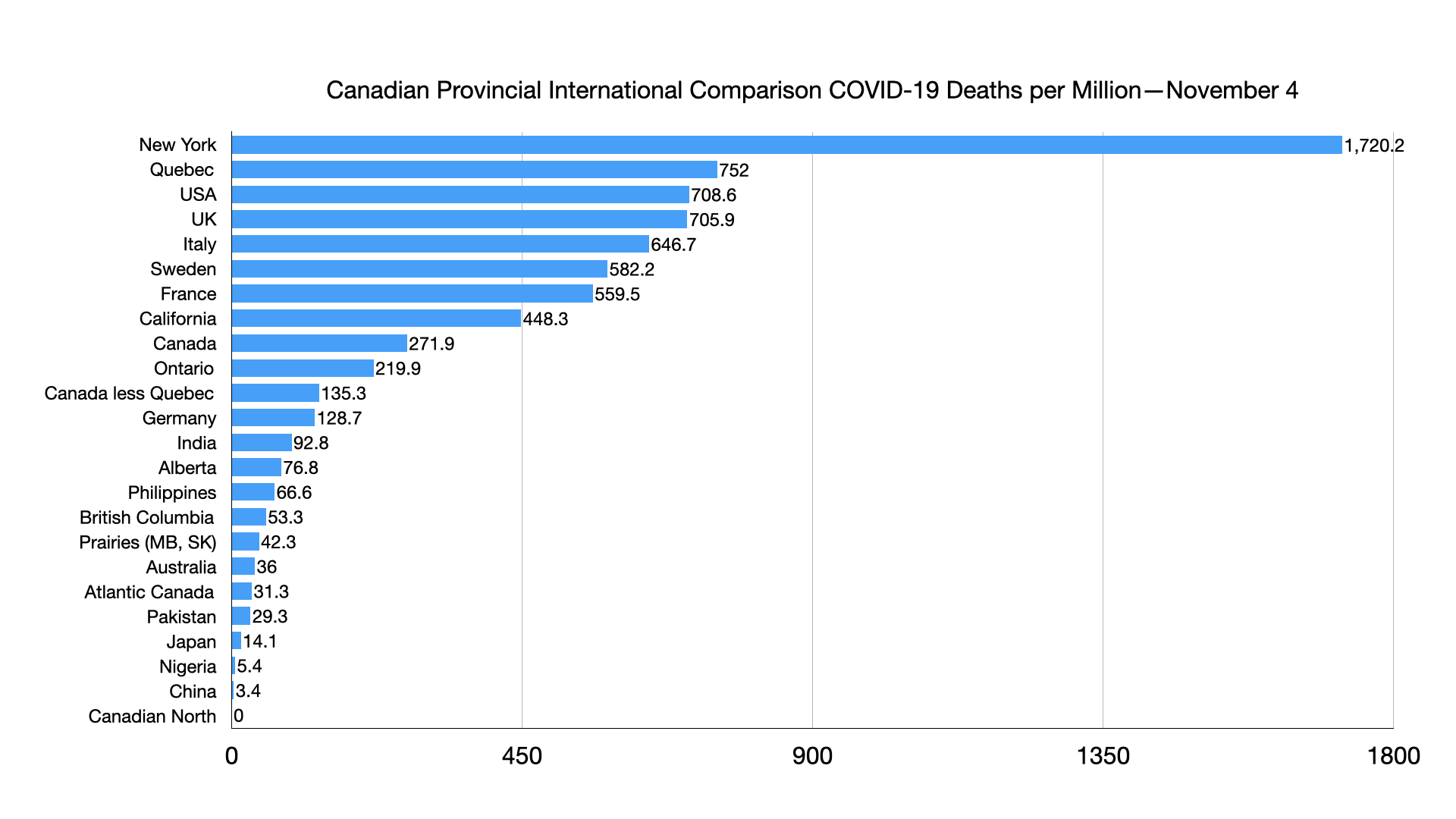
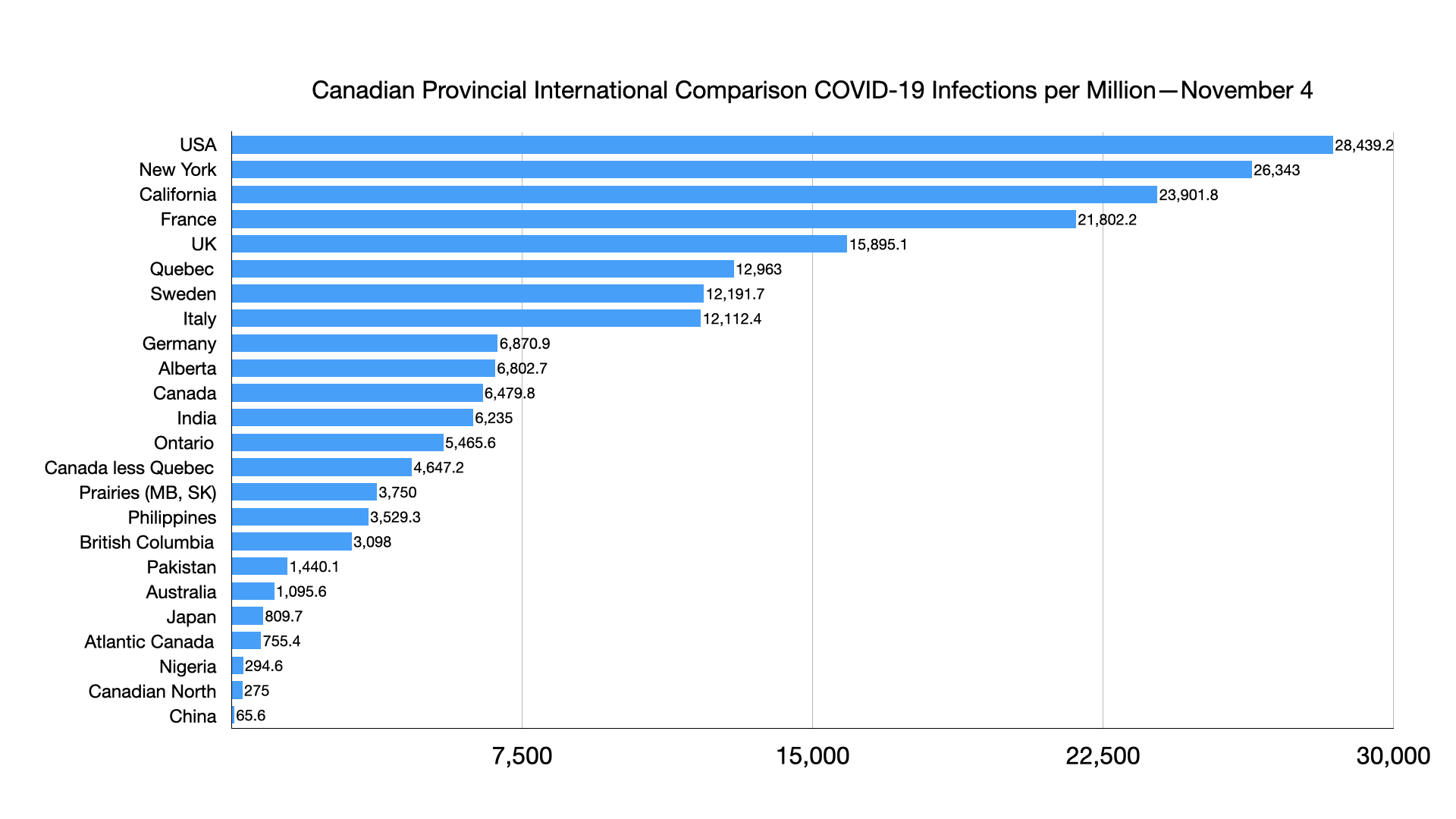
#COVID-19: Comparing provinces with other countries 4 November Update

Main news continues to be with respect to infections and relative increase of COVID cases and deaths in Prairie provinces:
 
Weekly:
 
Infections per million: Germany now ahead of Alberta, Canada, India, Prairies now ahead of Philippines
 
Deaths per million:nPrairies now ahead of Australia


Stopping Online Vitriol at the Roots: With the election upon us, we’re awash in misleading and angry information. Here’s what we can do.

Some useful pointers, not just applicable to the USA post-election:

America, it’s one day before a pivotal election, and we’re awash in a lot of garbage information and online vitriol. It comes from strangers on the internet, scammers in our text messagesdisreputable news organizations and even our friends and family.

Whitney Phillips, an assistant professor in the department of communication and rhetorical studies at Syracuse University and an author on polluted information, says that all of this is making our brains go haywire.

With the U.S. election ginning up misleading information and the nonstop political discussions online wearing many of us out, I spoke to her about how we can individually and collectively fight back. Here are edited excerpts from our discussion:

You’ve written that angry conversations online and misleading information essentially short circuits our brains. How?

When our brains are overloaded, and we’re confronted constantly with upsetting or confusing information, it sends us into a state in which we’re less capable of processing information. We say things we probably shouldn’tPeople get retweet happy. It’s not productive, even when people have good intentions and think they’re helping.

How do we stop that process?

I’ve been researching how mindfulness meditation processes can help us navigate this information hellscape. When you see or read something that triggers that emotional reaction, take a moment to breathe and try to establish some emotional space. It doesn’t mean you shouldn’t say the critical thing you’re thinking, but you should first reflect on the most constructive thing to do next.

But we don’t tend to think that we’re the ones acting irresponsibly or irrationally. We think the people who disagree with us are irrational and irresponsible.

Most people think if they’re not setting out to do damage or don’t have hate in their hearts, then they don’t have to consider what they do. But even if we aren’t vicious ourselves, we’re still fundamentally a part of what information spreads and how.

We all affect the ecology around us. Bad actors like high-profile influencers can scar the land, but everyone else does, too. The more information pollution there is in the landscape, the less functional our democracy is. If you feel that everything is terrible and everyone lies, then people don’t want to engage in civic discourse.

This imposes a lot of personal responsibility on a problem that is much bigger than us as individuals.

Yes, individual solutions are not enough. We all can make better choices, but that means nothing if we’re not also thinking about structural, systemic reasons that we’re forced to confront bad information in the first place.

What are those structural forces? What can be done to make the information environment better at the structural level?

For us to understand how bad information travels we have to think about all the forces that contributed to it — decisions made by the internet platforms, broader capitalist forces, local and national influences. And it includes you. All of them feed into each other.

Part of the problem is that people haven’t understood how information works or recommendation algorithms of social media companies that influence why we see what we do online. If people understand, they can imagine a different world and they can fight to change the system.

I’m tempted to unplug the internet and go live in a cave. Should I?

We need to find a way to balance between evacuating from the hurricane and running toward the hurricane. If we only evacuate, we’re not doing our part as citizens, and we force people on the informational front lines to bear that burden. If we only run toward the storm, we’ll burn out.

Source: https://www.nytimes.com/2020/11/02/technology/stopping-election-misinformation.html

The U.S. Separated Families Decades Ago, Too. With 545 Migrant Children Missing Their Parents, That Moment Holds a Key Lesson

Useful reminder. Canada, of course, separated Indigenous children from their parents in residential schools:

On Thursday, the House Judiciary Committee released a 550-page report confirming that the Trump Administration had “full knowledge that hundreds of children would likely be lost to their families forever” as a result of its 2018 “zero tolerance” policy. This discovery directly contradicts Administration officials’ repeated denials that “zero tolerance” intentionally separated families—the insistence that what happened to children was nothing more than a side effect of the decision to prosecute adults for unlawful entry.

Now, 545 children are still living with the consequences of “zero tolerance,” more than two years after its implementation. These minors still have not been reunited with their parents. President Trump has demonstrated no urgency to reunite these families and has even brushed aside concern by insisting that children were “so well taken care of” in immigration custody.

Despite the apparent novelty of this policy, this is not the first time undocumented children have had to endure prolonged family separation, lone deportation or relegation to the foster care system. About 40 years ago, authorities separated families and lost track of children. Nor is this the first time government officials have obscured such a situation—a fact that offers dual lessons for the present about how to reconcile competing accounts of immigrant treatment.

In the 1970s and ’80s, at a moment when the law numerically restricted Latino immigration while poverty and violence constrained young people’s lives in Mexico and Central America, the face of unauthorized immigration changed dramatically to include growing numbers of women and children. The Immigration and Naturalization Service responded by stepping up its enforcement efforts. This hardening of the U.S.-Mexico border, the U.S. government’s preference for refugees fleeing communism and growing desperation among migrants contributed to the explosion of the coyotaje(human smuggling) business.

Source: The U.S. Separated Families Decades Ago, Too. With 545 Migrant Children Missing Their Parents, That Moment Holds a Key Lesson