Professor’s use of racial slur ignites uOttawa debate

Interesting debate. From my reading, the professor was using the word in the context of reappropriation by Blacks and not in a gratuitous manner, although she would have been wiser to say the “N-word.” On the other hand, in popular culture, the term has been used by rap artists as well as by directors such as Spike Lee, Tarantino and others. So should it always be off-limits or do context and intent matter?

The student union at the University of Ottawa is calling on University president Jacque Frémont to denounce a group of professors who defended the right to use “racial slurs” as a part of academic freedom.

The slur in question was the N-word, which was used by a part-time sociology professor last month in a Zoom discussion on language and the reappropriation of offensive words by groups such as people of colour, the disabled and the LGBTQ communities. In a statement posted online Sunday night, the University of Ottawa Student Union complained that the N-word remains “offensive, hurtful and reprehensible.”

Source: Professor’s use of racial slur ignites uOttawa debate

After Months of Minimal COVID-19 Containment, Sweden Appears to Be Considering a New Approach


Better late than never:

Swedish authorities appear to be reconsidering their notoriously lax approach to COVID-19 containment, which has contributed to one of the world’s higher coronavirus death rates.

Starting Oct. 19, regional health authorities may direct citizens to avoid high-risk areas such as gyms, concerts, public transportation and shopping centers, the Telegraph reports. They may also encourage residents to avoid socializing with elderly or other high-risk individuals.

“It’s more of a lockdown situation—but a local lockdown,” Dr. Johan Nojd, who leads the infectious diseases department in the city of Uppsala, told theTelegraph.

In a statement provided to TIME, however, a spokesperson for the Public Health Agency of Sweden rejected that characterization.

“It is not a lockdown but some extra recommendations that could be communicated locally when a need from the regional authorities is communicated and the Public Health Agency so decides,” the spokesperson said.

A legal official from Sweden’s public health agency told the Telegraph the new policy is “something in between regulations and recommendations.” Violating the guidelines, for example, would not result in fines. Still, it’s a significant shift from Sweden’s previous handling of the coronavirus pandemic. While countries around the world implemented lockdowns once the virus began spreading, Swedish authorities largely let life continue as normal.

The Swedish government in March limited public gatherings to 50 people, but the policy left gaping loopholes—it doesn’t apply to private and corporate gatherings, nor to schools, shopping malls and plenty of other locations. Restaurants and bars never closed. Masks are not recommended in most places. There’s little to stop people from going to school or work if they come into contact with an infected person. Sweden’s testing and contact tracing capacitiesare lacking.

As of Oct. 18, Sweden’s per-capita death rate—58.6 per 100,000 people—was among the highest in the world. And from early September to early October, average daily cases nationwide rose by 173%, with particularly dramatic increases in cities such as Stockholm and Uppsala.

These hard-hit areas are the focus of Sweden’s shifting guidance, according to theTelegraph‘s report. Nojd told the outlet he is considering telling people in Uppsala not to visit the elderly and other vulnerable populations, and to avoid making unnecessary trips on public transportation. He also mentioned the possibility of imposing curfews on restaurants.

Representatives from the city of Uppsala did not immediately respond to TIME’s request for further comment.

Swedish authorities appear to be conceding that reaching herd immunity—the threshold at which enough of a population is immune to the virus for it to stop spreading widely—is unlikely to be happen without a vaccine. While officials have avoided explicitly calling herd immunity the goal of their casual containment approach, emails obtained by journalists show high-level Swedish public-health officials discussing that strategy as early as March, apparently motivated by economic concerns.

National studies, however, show that far fewer people have developed natural immunity than officials hoped—as evidenced by the ongoing spike in infections. Sweden’s state epidemiologist Anders Tegnell acknowledged that reality last week.

“I think the obvious conclusion is that the level of immunity in those cities is not at all as high as we have, as maybe some people, have believed,” Tegnell said. “I think what we are seeing is very much a consequence of the very heterogeneous spread that this disease has, which means that even if you feel like there have been a lot of cases in some big cities, there are still huge pockets of people who have not been affected yet.”

Source: After Months of Minimal COVID-19 Containment, Sweden Appears to Be Considering a New Approach

Germany: Coronavirus an extra burden for immigrants

Common pattern in most countries:

The German federal government commissioner for integration, Annette Widmann-Mauz, highlighted the plight of asylum seekers and people with immigration backgrounds during the coronavirus pandemic and the related economic crisis in a statement on Sunday.

“They often work in industries which are particularly affected by the economic consequences of the pandemic, such as retail, logistics or the hospitality sector,” she said, on the eve of the 12th integration summit which shines a light on the effects of the pandemic on immigrants.

At the same time as work conditions are becoming more difficult, the number of opportunities for integration are also shrinking.

The national integration action plan took on a digital offensive offering online integration courses, language teaching and consultations over social networks. The focus is on supporting women to enter and integrate into the job market.

“We mustn’t lose any time on integration, in spite of coronavirus,” Widmann-Mauz said.

A joint effort on integration policy

The integration summit, which began in 2006, will see around 130 representatives from immigrant organizations, religious communities, the economy, politics and sports come together over video conference to discuss the current topics regarding integration policy.

The government’s vice-spokeswoman, Martina Fietz, announced in advance of the summit, that those taking part “will discuss answers to the important question of how we can also strengthen integration in times of coronavirus, as many people with an immigration background are particularly hard hit.”

German Chancellor Angela Merkel will lead the discussion which will also look at the possibility of recognizing foreign professional and educational qualifications, as well as the promotion of early childhood education.

The first summit took place 14 years ago following a national debate about violence in schools. Teachers from a school in Berlin triggered the founding of the summit through a protest letter they wrote.

Source: Germany: Coronavirus an extra burden for immigrants

Foreign students start gradual return — along with their much-missed tuition

Will continue to watch application and admission statistics to assess the return:

Canada will begin allowing international students into the country on Tuesday, but it may take weeks before they arrive in significant numbers.

Travel restrictions are being lifted on Oct. 20, allowing foreign students to enter Canada if their post-secondary institutions’ COVID-19-readiness plans are approved by a provincial or territorial government. Universities, colleges and language schools are required to have a plan to quarantine students for 14 days.

Since March, international travel restrictions have limited entry into Canada for most non-essential travellers.

The return of foreign students is a relief for Canada’s post-secondary schools, with universities potentially losing as much as $3.4 billion this year, due mainly to the drop in international students, Statistics Canada reported earlier this month.

Tuition fees paid by foreign students have become an ever-bigger source of revenue for universities. The average tuition paid by an international student this year is $32,041, almost five times what a Canadian student pays. And the number of foreign students in Canada has tripled in 12 years to more than 640,000, generating roughly $22 billion a year in economic activity in Canada, according to federal estimates.

“This could be in the billions of dollars of loss this year alone,” said Denise Amyot, president and CEO of Colleges and Institutes Canada, which represents 135 post-secondary institutions.

Amyot said the return of international students will benefit rural colleges, in particular, where there are seldom enough domestic students to fill classes. Foreign students are also important because many decide to settle in Canada and are often trained for occupations that are short of workers, she said.

“Those are potential immigrants for our country,” Amyot said. “If they know the language, they have studied here, and they have Canadian experience, they make really well-prepared Canadians.”

With the fall semester well underway, Immigration, Refugees and Citizenship Canada (IRCC) spokesperson Shannon Ker told iPolitics that amendments to travel restrictions that kick in Tuesday “should result in a gradual movement of international students to Canada.”

Many foreign students are arranging to arrive before the winter semester starts in January, said Bryn de Chastelain, chair of the Canadian Alliance of Student Associations.

“I’m not sure if we’ll see a huge influx starting tomorrow, but I think, over the next few months, we will start to see kind of a slow trickle begin to pick up,” de Chastelain said.

Ker said it’s too hard to guess how many students will arrive in the weeks ahead, but it would depend on how many decide to study online from their home countries and the number of institutions that have their readiness plans approved. But a spokesperson for Ontario’s Ministry of Colleges and Universities says it has given 12 publicly funded schools the green light so far.

IRCC has yet to publish the list of schools — known formally as “designated learning institutions” — whose plans have been approved, although its website says it will be available by Oct. 20.

Students arriving in Canada must undergo the same screening and quarantine as any other traveller.

But the students’ arrival may be delayed because Canadian visa-application offices abroad are short-staffed due to the pandemic, Amyot said. That includes those in India, where most foreign students attending Canadians colleges and institutes come from.

International students require two stages of permits in order to study in Canada. Stage 2 includes biometrics, a medical exam, and a criminal background check that often require physically going to a visa office.

“That will become a barrier, because they need those biometrics to travel to Canada,” Amyot said.

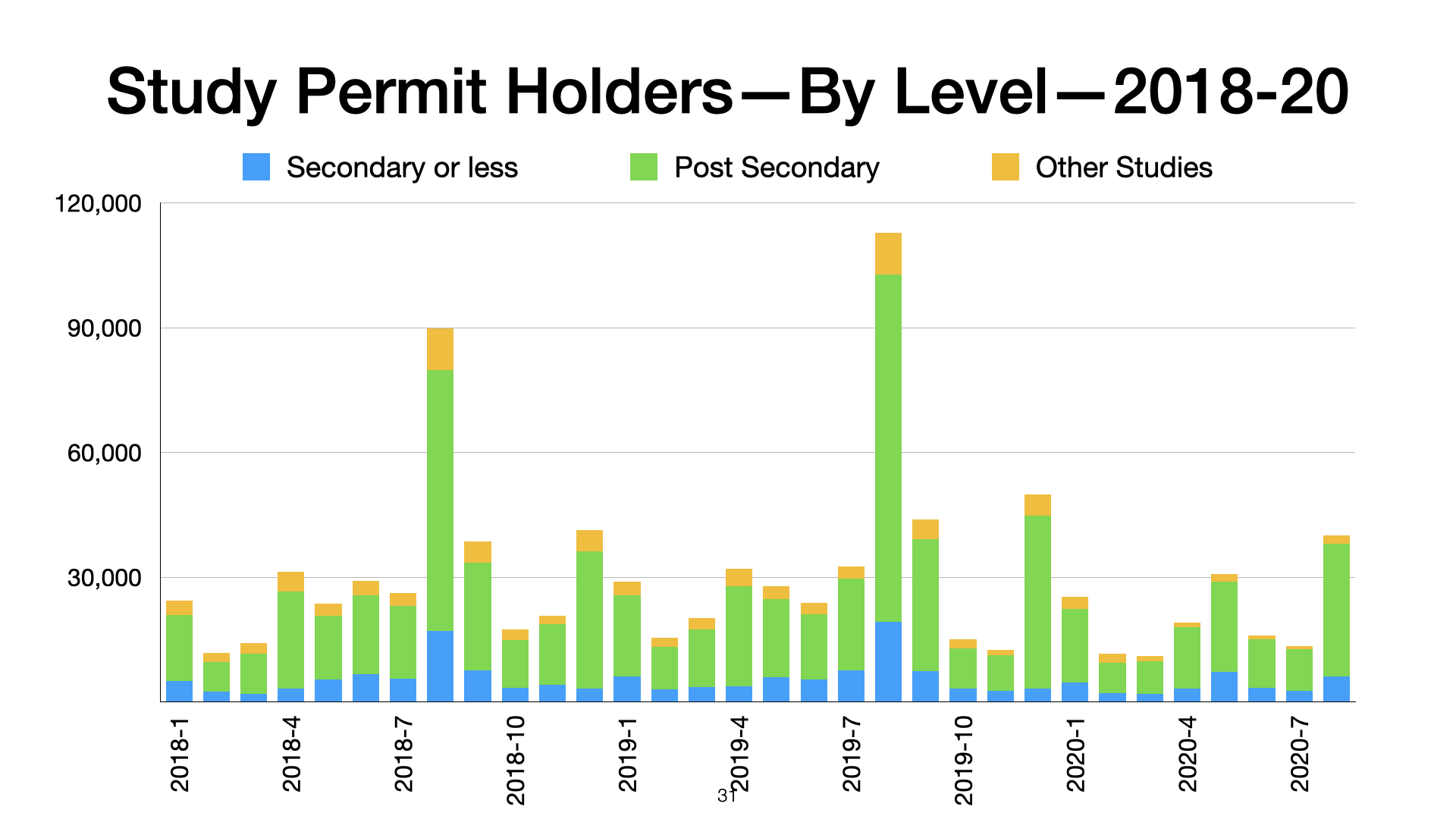
The IRCC’s Ker said that, since March 15, more than 121,000 study permits have been issued, of which 10,000 are initial study permits and 111,000 are study permit extensions. In most cases, applicants approved for an initial study permit are abroad, whereas applicants approved for a study permit extension are already in Canada.

According to de Chastelain, foreign students have received “next-to-no financial support” from Ottawa during the pandemic. He said the federal government should help students struggling financially, and cover some expenses for digital technology as most classes move online. One idea de Chastelain proposes is reallocating unspent funds from the $9-billion student-aid package announced in April.

Despite the pandemic, most international and out-of-province students still prefer to live near the schools they’re attending, he said.

Source: Foreign students start gradual return — along with their much-missed tuition

The Long History of Blaming Immigrants in Times of Sickness

Useful reminder of history as the Smithsonian collects items from the current pandemic for future generations:

On a chilly morning in February, about a thousand Chinese immigrants, Chinese Americans and others filled the streets of San Francisco’s historic Chinatown. They marched down Grant Avenue led by a bright red banner emblazoned with the words “Fight the Virus, NOT the People,” followed by Chinese text encouraging global collaboration to fight Covid-19 and condemning discrimination. Other signs carried by the crowd read: “Time For Science, Not Rumors” and “Reject Fear and Racism.”

They were responding to incidents of bias and reported significant drops in revenue in Chinatown and other local Asian American-owned businesses, even at a time when the city had not yet experienced any Covid-19 cases. The rally banner is soon to join the collections of the Smithsonian’s National Museum of American History for the story it tells of America’s history of associating its immigrants with disease.

“There have been long-standing messages about disease being particularly something that Chinese immigrants, Chinese spaces incubate, that Chinese people spread, either because of their unsanitary living conditions or especially the weird, exotic food that Asians allegedly eat,” says Erika Lee, director of the Immigration History Research Center at the University of Minnesota.

How this phenomenon continues now during the Covid-19 pandemic was recently the subject of a curatorial colloquium called “Fear and Scapegoating during a Pandemic.” The online discussion kicked off Pandemic Perspectives: Stories Through Collections, a twice-monthly online panel discussion organized by the curators and historians at the museum. The series invites audience participation in the examination of objects and images from the collections, using them as a jumping off point for discussions on various aspects of life during the pandemic. Upcoming sessions will focus on such topics as voting, masks, comfort food, essential workers and the race for a vaccine.

“[Fear and scapegoating are] something that emerged right at the beginning of the pandemic, and it’s one of the most pervasive, stubborn kind of myths and prejudices that have emerged,” says Alexandra Lord, medical historian at the museum and the discussion’s moderator. “So we thought it was really important to start by talking about this topic in particular.”

While the virus had only just reached American shores—the day of the San Francisco rally saw America’s first Covid-19 related death in Washington—many Chinese Americans already saw how such terminology as “China virus” intensifiedan existing anti-Chinese sentiment that would bubble to the forefront of the country’s social conscience.

“We didn’t really shut down as a society until mid-March, yet we see how early Chinese Americans are feeling the impact of the virus, partly because of the history, partly because they are connected transnationally to families and communities in China, but also because the xenophobia that has risen out of Covid-19 was already global before we really experienced the pandemic ourselves,” says Lee, a panelist at the colloquium.

One object discussed was an illustration from the May 26, 1882 issue of the San Francisco Illustrated Wasp, published just weeks after the Chinese Exclusion Act passed. Depicting three ghoulish figures called malarium, smallpox and leprosy and with one holding a sash that says “Chinatown,” the artist’s intent was clear: to suggest that the places Chinese people inhabit spawn disease.

View the pre-recorded seminar: “Fear and Scapegoating During the Pandemic”

On the cover of an 1899 issue of another mainstream magazine, Judge, U.S. President William McKinley is depicted bathing a Filipino native baby in the “waters of civilization.” In the background, two figures dressing themselves in clothes made from the Puerto Rican flag have presumably just been freshly washed with the same “brush of education” that McKinley holds in his hand. Published during the Spanish-American War just after the U.S. colonized the Philippines and Puerto Rico, the illustration vividly visualizes the racist ideas of the period, according to Theodore Gonzalves, a curator at the museum who specializes in Asian American and performing arts history.

“One thing that we’re seeing in these images is this idea that it’s not just policy that shapes our ideas about immigration, but also, our concept of health, both at a policy level and in terms of medical inspections and also at a cultural level in the stories we tell about race,” said panelist Natalia Molina, a professor of American Studies and Ethnicity at the University of Southern California.

The popular narratives about race have often been tied to differences in physical health and intelligence, as Molina noted after an audience member asked about the role of eugenics in shaping these stories. Lee pointed to the Ku Klux Klan and its reliance on myths of physical and mental disparities between races as a method of enforcing racial segregation and white supremacy, to maintain an “America for Americans.”

In another context, purported differences in physical constitution encouraged agricultural and railroad construction employers to hire Mexicans. Molina explained that people in the United States believed Mexicans to be biologically different: their bodies, it was said, could withstand 110-degree Fahrenheit heat better and produce more work in the fields. But when the Great Depression rolled around, those same workers became economic scapegoats, and characterized as immigrants who were taking jobs away from native-born Americans. During this period, racist notions created the medical myth that portrayed Mexican workers as more susceptible to diseases like tuberculosis and led to charges that they would burden the nation’s healthcare system.

“It doesn’t begin with ethnic and racial minorities,” Gonzalves emphasized. “If we go back to the 1790 Naturalization Act, we have to think about how that was a law that equated citizenship with free white persons of good moral character. . . we have to think about who was really identifying and obsessed with identities. It’s clearly the founders themselves. . . . Of course it’s going to be an obsession, because [America was founded] on stolen land and everything follows from that. So we are following in the great tradition of America, which is to be obsessed with these questions of identity.”

The museum’s curators are collecting items that document the Covid-19 pandemic in the U.S., and are asking the public to help decide what objects or images will represent this time to future generations. “It’s so important to be documenting the impact of Covid especially on immigrant and refugee communities,” Lee said, noting that these populations of people are disproportionately working in occupations and industries that put them at greater health and economic risk. “As Dr. Molina pointed out, they are essential workers, but they are not treated as essential. . . . And we need to be collecting their stories.”

Source: The Long History of Blaming Immigrants in Times of Sickness

The Consequences Of Dehumanizing Language In Politics

Of note:

United States politicians are no strangers to using unkind language against their opponents. It’s a trend that dates back to at least 1800 when, during the presidential campaign, Thomas Jefferson hired James Callender to slime John Adams. But Alexander Theodoridis, who teaches political science at the University of Massachusetts Amherst, says that today’s partisanship can lend itself to particularly dehumanizing language not only between political opponents, but also between regular Americans who belong to opposite political parties.

Theodoridis told NPR’s Weekend Edition that “dehumanizing language,” which includes people referring to others as animals, can lead to people believing that those who disagree with them don’t deserve the same treatment or respect as those who agree with them.

“That is often where things lead,” he said. “As either a justification post hoc for treating somebody differently or, in some cases, a precursor to treating a group differently.”

One fear is that this kind of dehumanization leads to violence. Another is that it leads people to believe in conspiracy theories that further demonize the people they disagree with. Theodoridis says while both Democrats and Republicans use this kind of language, Republicans tend to believe conspiracy theories like QAnon more easily.

“I think part of that is just the composition of the parties,” Theodoridis said. “One feature of the sorting that has happened in terms of who is a Democrat and who is a Republican, there is this sort of diploma divide, and I think that’s a factor.”

In an interview with NPR’s Lulu Garcia-Navarro, Theodoridis reflects on the political polarization of this moment, the dehumanizing language that has risen up and where we go from here.

Interview Highlights

How do you capture how dehumanizing language has seeped down from politicians to the body politic in your studies?

One of the measures we use literally shows people a “ascent of man” picture, which is basically the image where you have where you go from sort of a stooped ape-like figure up to a standing human. And we ask them, how evolved do you think these groups are? And we ask them, Democrats and Republicans, how evolved?

And what we find is around 80% of people rate their own side higher than they rate the other side. And almost 70% of people rate their own side more than 10 points higher than the other side. And the average is in the 30s, like 35-point difference. So this is a pretty substantial gap.

And the fear is that our use of language, or how we talk, can lead to action, or in this case, violence.

I don’t want to be alarmist. I don’t think that we’re very close to widespread political violence, largely because I think most people in this country are still fairly happy and are not concerned enough with politics on a day-to-day basis to take to the streets and do awful things.

But we asked people to give a [prison] sentence to somebody who had attacked a senator from one party or the other, randomizing the party of the senator and those who dehumanize more give a more lenient sentence. Right. So they view it as less of an offense when you attack the other side than when you attack their own side.

Other social scientists we have spoken to wonder if the genie can actually be put back in the bottle. I will say, as someone who has covered countries where there is deep polarization outside of the United States, it is hard to roll that back.

My thoughts on this are actually somewhat pessimistic. We long for a period in our history in the latter part of the last century where polarization along party lines, not necessarily along other lines, but along partisan lines, was not very pronounced. Your race, religion, education level, didn’t necessarily predict your partisanship the way that it does today. And because all those identities are aligned, it becomes this sort of superordinate, super powerful identity.

So then where should we go from here? Because what I hear over and over again from voters is that they are tired of this partisanship and yet they are part of this partisanship.

That’s right. So I really do think the focus should be, first of all, on just trying to lower the temperature and I think that falls largely on elites, on elected officials. I think we should hold them to a higher standard and the media should hold them to a higher standard in terms of not stoking these fires in ways that can be dangerous.

But beyond that, I think we should really look for ways to make it so that our government can work effectively under polarization, because I think this is a much more natural state of affairs than the kind of odd period historically that we have recently emerged from where the parties weren’t really aligned with ideology and all sorts of characteristics.

Source: The Consequences Of Dehumanizing Language In Politics

Why the World Should Care About Language in Inner Mongolia

Yet another example of Chinese government repression and attempts at cultural genocide:

On August 26 China passed a law to sideline teaching in the Mongolian language in the region of Inner Mongolia (also referred to as Southern Mongolia). This measure, which sparked immediate protests, will create irreparable losses not just for ethnic Mongolians, but also for many cultures around the world.

What is at stake here is not just the spoken language, but an 800-year-old script with a multicultural lineage that emanated from the golden era of the Silk Route.

Mongolian, as a language, is still widely spoken in independent Mongolia, but the “Mongolian script” was largely lost after the Russians introduced Cyrillic in the 1940s, when Stalin sought to control the country as a buffer against China. This makes the Inner Mongolians, who are currently under Chinese rule, the last custodians of the script. For academics, historians, linguists, and cultural aficionados, the Mongolian script holds the key to historical links between cultures that were forged during the Silk Route era and earlier. Understanding this connection might help people realize that this is not Mongolia’s fight alone.

For decades, China’s ongoing efforts to assimilate its minorities had it cracking down harshly on the religions, and languages of Tibetans, Uyghurs, and Mongolians. These are all largely nomadic cultures that were propagators of multicultural exchanges at the height of the Silk Route era.

Like the Tibetans and the Uyghurs, who have been struggling against Chinese hegemony, Mongolians have been protesting since August, but punitive measures taken by the Chinese government leave Mongolians with little choice but to concede.

“This is the final blow to our culture,” said Enghebatu Togochog, director of the Southern Mongolian Human Rights Information Center.  “The world should know that it is not simply a language issue. This strikes at the very heart and existence of our national identity. If we lose our language we lose everything. We’ve already lost political autonomy, our nomadic way of life, and our environment. This is cultural genocide.”

Meanwhile, on the other side of the border, in the independent state of the Mongolian People’s Republic (MPR), a democratic revolution in 1990 pushed for a switch from Russian Cyrillic to the old Mongolian script. That idea, however, received little interest and gained no traction. Parents saw it as a hindrance to their children’s future prospects at the time. But the recent protests in the Inner Mongolian region have made Mongolians in the MPR realize what they failed to in 1990. The significance and threat to their cultural, intellectual, and literary heritage is now being viewed through a new lens.

“Public opinion in MPR has changed drastically since China’s crackdown on Inner Mongolia,” said Otgonsuren Jargaliin, an outer Mongolian teacher, linguist, and environmental activist. “Mongolians now see the urgent need to preserve and protect this ancient script and not take it for granted. They now appreciate that 80 years of Cyrillic is not on par with 800 years of a writing that is our lineage and ancestry.”

She pointed out that as recently as last week MPR National Television was now carrying subtitles not only in Cyrillic, but also in the old Mongolian script, which was a new development.

The Mongolian Script

The story of the Mongolian script starts with Genghis Khan. In 1204 he appointed the Uyghur scholar Tatatunga to develop a unifying script after he established his empire. The new Mongolian script was adapted from an old Uyghur script.

The Uyghurs today are Turkic-speaking Muslims, descended from the Uyghur Khaganate, a nomadic kingdom in Mongolia, which was predominantly Manichaean and then later Buddhist. It lasted from 744 to 840 CE. It was while they were Manicheans that the Uyghurs adopted their script from the Sogdians. By the 16 century, however, the Uyghurs had transitioned to the Arabic script and were no longer using their own.

The Sogdians, meanwhile, were the remnant traders of the ancient Achaemenid Persian Empire, who capitalized on economic opportunities along the Silk Route from the fourth to ninth centuries. Like many Silk Route traders, they exported not just material goods but fashion, culture, religion, arts, and language. Their script had its roots in Aramaic.

The Uyghurs replaced the Sogdians as custodians of the script from the eighth to the beginning of the 13th century, when Genghis Khan introduced it to his new empire, the largest contiguous one the world had ever seen. As the lingua franca of the Mongolian Empire, the script was used widely connecting east with west, the Pacific to the Mediterranean.

The history of the script, therefore, offers a well documented evolution of a writing that originated from the ancient Mesopotamian civilization, and traveled across time and cultures through the Silk Route. The script’s history tells us how people from vast geographical backgrounds were connected, often not out of choice, but nevertheless linked through trade and travel. It shows us how our ancestries and heritages are all interlinked and interconnected.

The indigenous nomadic tribes from different cultures, along with traders from different regions and countries, brought a broader understanding of a socio-cultural world through their free movement along the Silk Route. Unlike China’s nationalistic ideology, they were not confined to a specific religion, nationality, ethnicity, language, or geographical boundary. This was what promoted cultural connectivity and created an era of great cultural exchange.

Today China is trying to recreate its idea of a Silk Route through its “One Belt, One Road” foreign policy and economic strategy, also known as the Belt and Road Initiative. But what China fails to recognize is that the success of the original Silk Route was due to its recognition and acceptance of the many cultures it spanned and encountered. Cultural legacies were embraced and valued rather than wiped out along the way in the name of uniformity. The Belt and Road Initiative can’t replicate the success of the Silk Route if it persecutes the very people and cultures, like the Mongolians, that made the original routes last for centuries.

The irony is that, in trying to recreate the Silk Road through its nationalistic lens, China may once again end up with something that is just another “Made in China” imitation.

Source: Why the World Should Care About Language in Inner Mongolia

New head of Canadian Race Relations Foundation says group will take a stronger advocacy role

Will be interesting to see if a more activist approach results in an increase in influence and impact or not. All CRRF CEOs have had to grapple with the fact that as a crown corporation, the CRRF is not completely independent of government:

In its 2018 annual report, the Canadian Race Relations Foundation wrote: “It is not the Foundation’s role to be a strong advocate.” For an organization born out of an apology for systemic racism, that starting point made little sense to Mohammed Hashim.

Wanting to change it, he applied to lead the Crown corporation. To his surprise, the hiring committee handed him the keys, rather than showing him the door.

“I told them it was wrong for them to put that in the annual report, I was shocked to hear that. And I think we need to figure out a new approach, one that has advocacy as a central core,” Mr. Hashim said in an interview last week, during his first few days on the job.

The foundation was launched in 1997, as part of the federal government’s Japanese Canadian Redress Agreement struck a decade earlier. In the late 1980s, Prime Minister Brian Mulroney’s government apologized for Canada’s treatment of Japanese Canadians who were interned and stripped of their human and civil rights during the Second World War.

In the intervening years, some activists and experts in the field say the organization has not gone as far as it could in holding the government to account and advocating for the most vulnerable in Canadian society. At times, Jack Jedwab a former foundation board member and the president of the Association for Canadian Studies, said it’s looked “as though they’re getting direction from government rather than giving direction to government,”

Mr. Jedwab said the foundation needs to play a bigger advocacy role and “reaffirm leadership.”

In response to that criticism, Mr. Hashim said the foundation will be outspoken in addressing racism, pushing Ottawa to move from studying the issues to actually fixing them.

“I think there’s lots of room for the government to move on the criminal-justice system, on reforming the police, and I hope that the foundation can play a role in bringing people together,” Mr. Hashim said.

The Black Lives Matter movement has helped to show “the absolute necessity of public policy-makers to finally respond and respond decisively,” he said.

His risky interview pitch wasn’t the only thing that made him an unusual appointment by a Liberal government to a non-partisan position. His anti-racism work started as a response to Stephen Harper’s government, he said, and until taking this job, Mr. Hashim was a member of the NDP, worked on Jagmeet Singh’s leadership campaign, and organized for the provincial party.

’s now shedding his partisan stripes and will be reaching out to the party once led by Mr. Harper. In a 2018 podcast interview, he was highly critical of the former prime minister. Last week, he told The Globe and Mail that he was particularly concerned about the 2015 election campaign, which he called “horrible” and “terrible.” Mr. Hashim said the Conservative push for a snitch line on “barbaric cultural practices” contributed to a spike in violence against Muslim women.

Since that election, Mr. Hashim said the Conservatives have become more inclusive and are “going in the right direction” on race relations.

Among the issues seizing his attention today is the rise in anti-Asian sentiment, which he said is being fuelled by rhetoric from the small-c conservative movement.

“You can replace ‘China’ with ‘Islam’ and it feels like 2003,” he said, referring to the backlash of Islamophobia that rose out of the 9/11 terror attacks. China, he said, is deserving of criticism for its human-rights record, but he said it needs to be talked about in a way that’s “not alienating.”

Now on a national stage, he said he plans to continue the grassroots approach he honed as a senior organizer at the Toronto & York Region Labour Council. In that job, he flew to Quebec City to help with the response to the mass murder at a mosque, was an unofficial adviser to the Muslim community in times of crisis, and consulted with the Toronto Police Service on using language that doesn’t malign Black people or perpetuate stereotypes.

His role, he said, is to help people navigate uncomfortable conversations, which he calls necessary to changing the status quo. It’s a skill, his former boss at the Toronto-based Labour Community Services, Faduma Mohamed, says has allowed him to bring an “urgency and greater awareness” of systemic racism to decision and policy-makers.

Canadian Heritage Minister Steven Guilbeault, who signed off on Mr. Hashim’s appointment, said his posting shows that the minority Liberals are “ready and willing” to act.

Still charting the organization’s plan for the next five years, Mr. Hashim is not yet ready to say what will be on the agenda. But for a sense of what it might look like, he said if it wasn’t for COVID-19, he would already be in Nova Scotia, amplifying the story of Mi’kmaq fishermen who have been the victims of violent attacks from non-Indigenous, commercial fishermen.

“I want to push as hard as we possibly can so that 50 years down the line, we don’t have to apologize again,” he said.

Source: New head of Canadian Race Relations Foundation says group will take a stronger advocacy role

Federal government asks court to keep Canada-U.S. pact to prevent ‘influx of refugee claimants’

Expected:

Canada would face “an influx of refugee claimants” and other “ripple effects” in the absence of a bilateral pact that stops would-be asylum seekers from making a claim here via the U.S., the federal government is warning.

This country will suffer “irreparable harm,” especially amid a global pandemic, if the Federal Court of Appeal does not suspend an earlier lower-court order that struck down the Safe Third Country Agreement, Ottawa argues.

In July, the Federal Court ruled the accord unconstitutional because the United States routinely detained asylum seekers in poor conditions. It gave Ottawa six months — until Jan. 22 — to fix the policy and make sure it complies with the Canadian Charter of Rights and Freedoms before the pact becomes invalid.

On Friday, the appeal court will hear a motion by the federal government to extend the deadline until a full appeal can be heard on a later date.

“An influx of refugee claimants will impair the sustainability of the systems that support refugee claimants while their claims are pending. Provincial and municipal governments are struggling to provide housing and social services,” the government says in its submissions.

“This unpredictability is significantly heightened by the global pandemic. Should the reopening of the border between Canada and the USA coincide with the end of the suspension period, a surge of asylum claims at the border is anticipated.”

Critics have argued the U.S. asylum system is cruel and inhumane, especially since President Donald Trump came into power in 2016 on an anti-immigrant agenda, building a wall to shut out illegal immigrants from the south and separating migrant children from their families. These critics said the Canadian government’s request should be dismissed because infringements of refugees’ rights outweigh any alleged public interest in maintaining the status quo.

“While the court gave Parliament six months to remedy the law, the government has squandered that opportunity in favour of an appeal,” said Justin Mohammed of Amnesty International Canada, one of three litigants who launched and won the constitutional challenge.

“We are hopeful that the Federal Court of Appeal will affirm the deadline, so that no refugee protection claimant will be handed over by Canada to face the horrors of U.S. immigration detention past January 2021.”

Under the bilateral agreement, Canada and the U.S. each recognize the other country as a safe place to seek protection. It lets Canada turn back potential refugees who arrive at land ports of entry along the Canada-U.S. border, on the basis that they should pursue their claims in U.S., the country where they first arrived.

In its submissions, the federal government says the agreement, in place since 2004, is in line with international refugee law to ensure claimants have access to a fair asylum process in an “orderly and efficient manner.” There are exemptions and mechanisms in place to avoid returning would-be asylum seekers to risks and danger.

While the U.S. asylum detention system may be unacceptable, it says the Canadian charter does not apply to foreign laws and processes.

“Failure to grant this stay will result in irreparable harm to the public interest, the functioning of the border, the sustainability of the Canadian asylum system and the services and resources that support claimants in Canada,” the government says.

According to Ottawa, all levels of governments are already struggling to provide services to the 56,515 asylum seekers who skirted the safe third country restrictions by crossing “irregularly” into Canada between official land ports of entry from 2017 to 2019.

“An additional influx would further strain those already stretched systems and resources,” the government cautions, adding that the surge will create further “negative ripple effects and backlogs” in the overall immigration and refugee protection scheme.

“There is a strong public interest in affording Canada control of its borders to regulate the flow of persons and goods and to ensure the orderly processing of claims between Canada and the USA.”

However, the respondents, also including the Canadian Council for Refugees and the Canadian Council of Churches, argued that the lower court’s finding is already “tantamount” to a determination that the Canada-U.S. agreement is not in the public interest.

They said the government’s assertions of irreparable harm to the asylum system and services for claimants in Canada are based not on evidence but on a series of speculative claims by officials at the immigration department and Public Safety Canada.

The pandemic has actually made the conditions worse for asylum seekers, they argue. As of Oct. 6, the U.S. Immigration and Customs Enforcement reported 6,387 confirmed COVID-19 cases in custody, including eight COVID-19-related deaths of detainees.

“The appellants’ suggestion that COVID-19 makes it more difficult to predict ‘asylum intake volumes’ is misleading. While the pandemic is unprecedented, its effect on ‘asylum intake volumes’ is clear: it is dramatically suppressing the number of new refugee claims,” said the respondents in their submissions.

“It is simply harder and more dangerous to travel during the pandemic, and travel to Canada is far more restricted.”

The NDP’s immigration critic Jenny Kwan agrees.

“By appealing the court ruling, the federal Liberals are saying they’d rather let people seeking the safety of asylum here in Canada suffer under Donald Trump’s rules, than stand up for human rights and Canadian values,” said Kwan, who is also the MP for Vancouver East.

“Instead of accepting the court’s ruling and terminating the agreement, they have chosen to double down on turning back asylum seekers to a country that has a policy of separating children from their parents without any way of reuniting them,” she added. “It’s a heartless and shameful act. It’s un-Canadian.”

Source: Federal government asks court to keep Canada-U.S. pact to prevent ‘influx of refugee claimants’

Des milliers de dossiers de résidence permanente dans les limbes

Interesting. From monthly data I have been looking at, does not appear to be radically different to elsewhere in Canada unless I am missing something:

Déjà stressés par des délais de traitement qui n’en finissent plus de s’allonger, des milliers d’immigrants en attente d’une résidence permanente depuis parfois plus d’un an s’inquiètent de n’avoir reçu aucun accusé de réception des autorités fédérales. Dénonçant un « manque de transparence », ces travailleurs vivant au Québec craignent maintenant que leur dossier ne soitperdu ou ne croupisse quelque part dans leur enveloppe au centre de traitement situé en Nouvelle-Écosse.

« On voudrait juste avoir la confirmation que notre dossier a été reçu et qu’il n’y a pas d’éléments manquants », explique Valentine Clary, qui réside depuis sept ans à Montréal et qui a déposé une demande de résidence permanente avec son conjoint il y a plus de 15 mois.

Ne mettant généralement pas plus de deux ou trois mois à arriver, l’accusé de réception est une preuve écrite qu’un dossier a été vérifié et qu’il contient tous les documents et les signatures exigés pour être mis dans la pile et être traité par Immigration, Réfugiés et Citoyenneté Canada (IRCC). C’est aussi une preuve précieuse qui permet de demander une couverture à laRAMQ ou de maintenir en vigueur un Certificat de sélection du Québec (CSQ), en cas d’expiration.

Mme Clary a très peur de retourner malgré elle à la case départ. « J’ai peur de me faire renvoyer mon dossier parce qu’il manque quelque chose et de ne plus avoir aucun recours pour continuer à rester ici », explique cette Française d’origine, qui travaille dans le domaine de l’intelligence artificielle. « Ce n’est pas une question de délai. Personnellement, ça ne me dérangerait pas que le traitement prenne encore quatre ans, du moment que je sais que mon dossier va être étudié et ne me sera pas renvoyé. »

Des milliers de vies en suspens

Avec d’autres de ses compatriotes dans la même situation qu’elle, Valentine Clary administre un groupe Facebook de plus de 1500 personnes qui réclament toutes cet accusé de réception. Mais elles seraient beaucoup plus nombreuses en réalité.

Surtout originaires de pays francophones, comme la France, ces personnes, qui sont au Québec depuis plusieurs années, œuvrent comme ingénieurs, architectes ou dans d’autres professions qualifiées et ont toutes postulé à la résidence permanente par l’entremise du Programme des travailleurs qualifiés sélectionnés par le Québec.

Pour ces gens, tous ces dossiers demeurés sans réponse sont autant de projets de vie en suspens. « Ce que nous demande IRCC en ce moment, c’est de mettre nos vies sur pause », déplore Amandine Lafitte, une Française arrivée au Québec il y a six ans avec son conjoint. Le couple, qui avait prévu de se marier auprès de ses proches en 2021, a maintenant mis ce projet en veilleuse. Leur couverture de RAMQ l’est aussi. Et impossible de sortir du pays. « Mon dossier a été déposé il y a déjà 15 mois et, depuis, je n’ai aucune preuve qu’il va être traité », dit-elle, en craignant que son dossier ne lui revienne avec la mention « incomplet » après l’expiration de son CSQ.

Élodie Boonefaes estime aussi sa vie « bloquée » par ce silence radio d’IRCC. « Si, pour une démarche quelconque, on me demande de justifier que j’ai fait une demande de résidence permanente, je ne peux pas », dit-elle. Elle craint que son dossier ne lui revienne avec la mention « incomplet » après l’expiration de son CSQ, ce qui lui ferait perdre ce dernier.

Pour Louise Mazauric, une architecte qui vit depuis sept ans au Québec, le gouvernement fédéral pourrait faire preuve d’un peu plus d’égards. « J’aimerais au moins une confirmation que je suis “dans la boucle” et que je n’ai pas dépensé tout cet argent pourrien », dit la jeune femme d’origine française qui n’a pas reçu d’accusé de réception pour son dossier déposé il y a un an.

Une raison politique ?

Les membres du groupe Facebook à qui Le Devoir a parlé n’ont pourtant pas ménagé leurs efforts pour savoir où en était leur dossier : courriels et appels répétés à IRCC, demandesd’accès à l’information, appels aux cabinets des ministres de l’Immigration ou à leurs députés au provincial et au fédéral. Au mieux, certains immigrants ont obtenu un numéro « XEP », qui signifie qu’IRCC a bien reçu leurenveloppe, mais cela n’est pas une garantie que le dossier a été vérifié.

Pourquoi cette absence d’accusé de réception pour les travailleurs qualifiés sélectionnés par le Québec qui demandent la résidence permanente ? Et combien de dossiers dorment toujours dans leur enveloppe ? IRCC n’a pas répondu aux questions du Devoir dans les délais impartis.

L’Association québécoise des avocats et avocates en droit de l’immigration (AQAADI) a quant à elle fait ses propres démarches auprès des hauts fonctionnaires d’Immigration Canada, mais n’a réussi qu’à obtenir le nombre de demandes qui sont en traitement, soit 27 000. Un chiffre énorme selon David Chalk, un avocat en immigration impliqué dans l’AQAADI. « Honnêtement, j’étais si étonné de ce nombre que j’ai dû demander s’il s’agissait bel et bien de « dossiers » et non de « personnes » [visées par ces dossiers]. »

Selon lui, le gouvernement provincial de la Coalition avenir Québec ayant diminué ses quotas de 20 %, le gouvernement fédéral aurait rapidement atteint les cibles à l’été 2019 et cessé de traiter de nouveaux dossiers. « Donc tous les dossiers arrivés après juillet 2019 sont restés dans leur enveloppe et n’ont pas été traités. Les gens n’ont donc pas pu obtenir d’accusé de réception », affirme-t-il. Cette information n’a pu être corroborée auprès des deux ministères de l’Immigration, mais plusieurs membres du groupe Facebook disent avoir reçu des explications similaires de la part de leurs députés fédéraux.

La faute de la COVID-19

Le traitement aurait quelque peurepris, mais la pandémie nuirait auprocessus. La COVID-19 a toutefoisle dos large, estime Me Chalk, qui ne croit pas à cette excuse désormais donnée par IRCC pour expliquer les délais et l’absence d’accusés de réception. Les cas actifs se comptent sur les doigts d’une main en Nouvelle-Écosse, rappelle-t-il.

Il exhorte le gouvernement fédéral à s’engager à ne pas retourner les dossiers incomplets qu’il finira par ouvrir, mais demande qu’il octroie plutôt un délai pour fournir les pièces manquantes. Ainsi, les gens ne perdraient pas leur place dans la file. « Il ne faudrait pas que les gens en attente d’un accusé de réception subissent les conséquences de la lenteur du traitement en Nouvelle-Écosse »,dit-il. « Au lieu de traiter les demandes de résidence permanente venant de l’étranger, il faudrait donner la priorité à celles provenant de gens qui sont déjà au Québec. »

Source: Des milliers de dossiers de résidence permanente dans les limbes