Spotify, Apple Music and YouTube Music have now removed racist, anti-Semitic and homophobic content from their services, following a BBC investigation.
Deezer was also made aware of similar songs, mostly linked to white supremacy, on its platforms.
Spotify said the content flagged by the BBC clearly violated that policy. YouTube said there was no place for hate on its platform while Apple Music has now hidden the majority of the tracks.
The evidence
It’s difficult to quantify the scale of the problem. However, the BBC investigation easily found at least 20 songs with disturbing content:
Songs glorifying ‘Aryan nations’ (The Nazis’ racial philosophy taught that Aryans were the master race)
Bands repeatedly using anti-Semitic stereotypes and language, even celebrating the Holocaust
Publicly curated playlists on Spotify under the title NSBM (National Socialist Black Metal), a genre linked to Nazism
More than 30 groups associated with organisations classified as hate groups by civil rights groups
Searching out the music required no specialist skills or effort.
In some cases, racist titles of albums and songs had been changed to remove words such as ‘Aryan’ and ‘white’ but the lyrics remained the same.
Most examples were found on Spotify and in one case, a song on its platform contained these lyrics:
So wake from your bed, and raise your head
Aryan child, listen to what is said
So rise your hand and learn to love your land
For the white revolution needs your uncorrupted hand.
The BBC has decided not to name the bands or the songs in an effort not to assist people searching for hateful content.
Eric Ward, a civil rights strategist at the Western States Center, said people “trust streaming services” and didn’t use them “to be presented with hate music and hate lyrics”.
“The onus is on streaming platforms to do a better job at monitoring and searching for this music. They simply need to invest more.
“This is about the credibility of a company and a brand. Brands are important and white power music will damage your streaming brand.”
‘More accessible’
Eric Ward says streaming has made hate music “more accessible” with “algorithms suggesting this music to those who may not actually be searching for it”.
On Spotify, public playlists and “suggested artists” did make it easier for the BBC to find extreme content.
In some cases, users created playlists that collated songs and bands associated with the National Socialist Black Metal (NSBM) movement.
The metal sub-genre largely comes from Eastern Europe and Russia. Anti-Semitism and glorification of the Holocaust is common in its lyrics, according to Nick Spooner, from anti-fascist group Hope Not Hate.
He said the metal community has been waking up to the presence of the NSBM and how the scene “has been allowed to fester within the wider metal scene”.
“The growth of the white power music scene in the 70s and 80s ran in parallel with a growth of fascist parties in the UK so there’s a big worry that could happen again.”
‘We understand that things will inevitably slip through the cracks.
But with great power comes great responsibility.
And streaming services have set themselves up to be the primary source of music.’
– Eric K Ward, civil rights strategist.
White Power music
Music has been an integral part of neo-Nazi and white power movements since the 1980s.
The British-based Blood and Honour movement was spearheaded by a neo-nazi called Ian Stuart Donaldson, the lead singer of a band called Skrewdriver. He died in 1993.
The group didn’t start out with a racist agenda but Donaldson took them in that direction.
Many of the groups we found on streaming services idolise Skrewdriver and Donaldson in their songs.
Some of the bands – from the UK, US and Europe – have long been on the radar of civil rights and anti-hate campaign groups, and venues have been criticised in the past for allowing such groups to play gigs.
What else have the platforms said?
The streaming platforms can use a combination of technology and people to actively search for content – but also rely on customers reporting offensive material.
There are currently more than 65 million songs and over 1.5 million podcasts on Spotify.
In a statement, Spotofy said it “prohibits content which expressly and principally advocates or incites hatred or violence against a group or individual based on characteristics (race, religion etc).”
It said it was “continuously developing, improving, and implementing monitoring technology that identifies content in our service that violates our policy, including but not limited to, content flagged as hate content.”
Apple Music said the company had hidden the majority of the tracks highlighted by the BBC, while the rest are still under investigation.
It also highlighted that it has “strong editorial guidelines that prohibit distributors and rights owners submitting content like this”.
In a statement, YouTube Music said: “We’ve worked hard to develop responsible guidelines to define and make clear what content is unacceptable or when artistic expression crosses the lines of safety.
“When content is flagged to us, we work quickly to remove videos that violate our policies.
“We’re committed to continuing our work on this issue to ensure YouTube is not a place for those who seek to do harm.”
Youtube adverts
Content on YouTube is less regulated than music platforms. But for videos to have adverts, it has to comply with terms and conditions.
Despite this, many of the bands and songs found on the music platforms are preceded by adverts for household brands including Cadbury’s and Uber.
Users must apply to be able to ‘monetise’ their videos, which allows them to earn money from advertisers – the more views, the more income.
According to YouTube’s rules, users can only earn money from adverts if they follow guidelines, including a ban on “hateful content”.
This is defined as anything that “incites hatred against, promotes discrimination, disparages or humiliates an individual or group of people” based on a list of characteristics that includes race, ethnicity and religion.
YouTube reviewers “regularly check to see if monetising channels follow these policies”.
Deezer has not commented at this stage but is looking into the issue.
Visa requirements by their very nature discriminate between those more likely to overstay and those not:
Still in pain after delivering her first child, Kaitlyn Hebb asked her mother in the birthing room to video-call her husband in Egypt, so he could meet their newborn son.
It’s the closest the new mother from Bridgewater, N.S., could come to sharing the moment with Alaa Ali, who has been kept out of Canada while waiting for his stalled spousal sponsorship application to be processed in the middle of a pandemic.
“Alaa is never going to get this moment back. He’s never going to be in pictures. He couldn’t be here to help me. He couldn’t be here to hold our baby. I felt guilty,” said Hebb, a registered nurse, who married Ali in 2018 after the couple met online two years earlier.
The coronavirus pandemic has exposed a practice entrenched in Canada’s immigration system that critics say is discriminatory against some travellers — the majority of whom are from the developing world — who need a valid visa to come into this country.
However, one is out of luck if the foreign partner, even married, as Ali is to Hebb, is from a country that needs a visa — a barrier that travellers from visa-exempted countries don’t face.
“Alaa is being discriminated against because of the country he’s from,” said Hebb, whose husband was refused a visitor visa and has yet to hold their now-six-month-old son, Enzo.
“People are saying, ‘It’s like that for everyone. It’s the pandemic. Wait your turn and we need to keep people safe.’ But they don’t realize it has been that way before the pandemic.”
Advocates say couples’ married status can actually work against their chances of getting a visitor visa.
Chantal Dube is a spokesperson for Spousal Sponsorship Advocates, a 5,000-member advocacy group that has been lobbying for family reunifications during COVID-19. She said officials almost always refuse to grant a visitor’s visa if they don’t believe that the applicant’s stay in Canada will be temporary. Those being sponsored by their Canadian spouses are viewed to have the intent to overstay, she said.
The majority of the advocacy group’s members have a spouse from a visa-required country. A survey it conducted in September found only five per cent — or 29 of the 553 respondents — have had their foreign spouses’ visitor visas approved.
“As we are watching all these other spouses and partners and extended family members being granted permission to come to Canada, we have members of our group who can’t even come for the birth of their children. It’s very difficult to wrap our head around it,” said Dube.
“How’s that fair and compassionate? That’s a misstep for our government. It’s important to investigate a possibility of systemic discrimination going on.”
Dube is from Sault Ste. Marie, Ont., and her husband, Arvind Singh Grewal, is from India. With their spousal sponsorship application in the system since last October, he has not applied for a visitor visa, for just this reason.
“Why would we put our spousal sponsorship applications at risk by overstepping the boundaries of the time limit put on the temporary visas?” asked Dube, whose members will stage a national virtual protest Saturday.
Opposition NDP immigration critic Jenny Kwan said officials often “robotically” refuse applicants, citing their lack of travel history and assets in their home country.
“We have dealt with cases where people are still rejected on this ground even if they have had travel history without incident,” Kwan said.
“It’s as if the travel history for individuals in developing countries is somehow less valid than those in developed countries. It is as if there is some unspoken rule that the standards to obtain a travel visa for those from developing countries are much higher.”
Deanna McConnell of Perth, Ont., said her Haitian husband, Jean Bernard Valeus, has had his visitor visa applications refused twice because immigration officials were not convinced he would leave Canada after his stay.
That was on top of a refusal of their first spousal sponsorship in 2018 because officials didn’t believe it was a genuine marriage. A new sponsorship application was submitted in February 2019 and a decision is pending.
“Our lives are on hold with no recourse. On Feb. 14, 2021, we will be married for four years. That is less than three months away. We are at the mercy of the system,” said McConnell, who met Valeus while visiting her cousin in Haiti in 2011.
“Why is this so difficult?”
Joelle Bruneau of Val-David, Que., was so sick and tired of the separation from her husband, Erick Pineda in Honduras, that she and their 20-month-old daughter, Estrella, flew down to see him as soon as his country’s border reopened in August.
He has twice been refused a visitor visa during Bruneau’s pregnancy and twice after the girl’s birth. Meanwhile, Bruneau said the parents of her friend were allowed to visit Canada from France during the pandemic.
“This is totally unfair. It’s a racist system we live in. All the people from privileged systems can come and enjoy their time with their families. Erick is from a developing country. The process is so much harder for him,” said Bruneau, who met Pineda while vacationing in 2018.
“All the moments Canada Immigration has stolen from us, we will never have it back,” added Bruneau, whose spousal sponsorship has been in the queue since January 2019.
In response to a growing immigration backlog, the federal government in September announced a plan to assign 66 per cent more staff to process spousal sponsorship applications. It aims to accelerate, prioritize and finalize some 6,000 applications each month from October until December.
“We understand that the last few months have not been easy for those who are far from their loved ones in these difficult times. This is why we are accelerating the approval of spousal applications as much as possible,” said Immigration Minister Marco Mendicino.
Spousal Sponsorship Advocates says it’s great to see the government invest in addressing the backlog but what their members immediately need is a visitor visa for their loved ones to be with them in Canada now.
FOR THE industry’s critics, it is a scandal that exposes exactly what they have been warning about. Many people have an almost instinctive distaste for the business in selling long-term-residence rights in a country or even citizenship there for cash, usually in the form of an authorised investment. So a documentary this month on Al Jazeera, a Qatar-based television channel, seeming to uncover corruption in an “investment migration” scheme offered by Cyprus, did not not seem especially shocking. It showed Cypriot politicians filmed in a sting operation, apparently willing to sell their country’s passport to a (fictitious) Chinese businessman who, in the cover story, had been convicted to seven years in jail for money-laundering, and so should have been ineligible.
For the industry’s practitioners—the consultants, accountants, bankers, wealth managers, lawyers and government departments selling their country’s charms—this is a blow. Although the politicians involved have protested their innocence, Cyprus has suspended its “golden passport” scheme from November 1st. European Union officials in Brussels and members of the European Parliament were already hostile to such schemes. And in response to the latest scandal, the European Commission has begun legal action (“infringement procedures”) to investigate both Cyprus’s scheme and one offered by Malta. It is an extremely sensitive issue for the EU. On the one hand, no issue is more jealousy guarded as a “national” competence than whom a country allows to be a citizen. On the other hand, a passport from an EU member confers the right to live and work anywhere in the EU; and a “Schengen” visa allows free travel to 22 EU members and four other countries.
Defenders of the schemes insist that criminals seeking a bolthole are the exception, and that they are making great strides in imposing stricter “due diligence” standards. The vast majority of their customers, they argue, are honest, respectable people with a legitimate hankering after an alternative to the passport and residence rights they acquired by the lottery of birth. The loss of Cyprus restricts their options. But there are plenty of others, and demand is booming, despite the huge decline in global mobility brought by the pandemic. Indeed, covid-19 has spurred interest in investment migration.
“The industry is not merely robust in turbulence,” says Christian Nesheim, editor of Investment Migration Insider, a trade journal, “it thrives on it.” Indeed it really took off partly as a response to the global financial crisis of 2007-08. Like so many other businesses, it ground to a halt in the early days of the pandemic, as travel became impossible for much of the world and governments stopped processing paperwork. But since then it has enjoyed “more demand than we have ever seen”, in the words of Paddy Blewer of Henley & Partners, which advises both individuals seeking new residence or citizenship and governments designing programmes for them. People in countries with high infection rates and creaking health services began to see that as a reason to move elsewhere. And people with passports that had previously found themselves able to travel the world more or less unimpeded found their countries on banned or quarantine lists. At the beginning of the year, for example, according to Henley’s research, an American passport entitled its holder to travel to 185 countries without first securing a visa. That number has since shrunk to fewer than 75.
Around the world, nearly 100 countries offer a “residence by investment” programme, including many of the world’s richest countries, such as America, Australia, Britain and New Zealand. Only a dozen or so countries offer citizenship—including five Caribbean island-states (Antigua and Barbuda, Dominic, Grenada, St Kitts and St Lucia), a Pacific one (Vanuatu), Jordan, Turkey and, within the European Union, Austria, Bulgaria and Malta (as well as, until the end of the month, Cyprus). The citizenship or residence by investment (CRBI) business traces its ancestry to a law passed in 1984 in tiny St Kitts and Nevis, offering citizenship to foreigners who made a “substantial” investment. How substantial varies from country to country. In Cyprus’s case at least €2m ($2.3m) in investment, usually in property, is required. Malta demands a “donation” of €650,000 to a government fund, €150,000 invested in government bonds and a property purchase or long-term lease. Research this subject online, and you will soon be seeing advertisements offering a choice of Caribbean citizenships “from $150,000”.
Al Jazeera’s choice of a Chinese applicant made sense, China is by far the biggest market for most CRBI schemes. Much the most popular destination for Chinese investment migrants is America. But the waiting-list for Chinese applicants to America’s “EB-5” long-term visa programme is 10-15 years. The EU is a good second choice. The commonest reason Chinese people want residence elsewhere is education. Parents want to spare their offspring the gruelling university-entrance exam, the gaokao. And they believe that a foreign education will open up opportunities unavailable at home. Even childless Chinese also see the attractions of a “plan B” should they find the political or economic climate in China inhospitable.
China’s success in containing the virus and the deterioration in its relations with America and some other countries have done nothing, apparently, to dent demand this year. A worsening climate of repression continues to make the option of an alternative residence abroad seem desirable. That is especially true in Hong Kong since the imposition in June of a draconian national-security law. In fact, many Hong Kong residents already have a second potential home. In the 1980s and 1990s, as the handover from British to Chinese sovereignty in 1997 loomed, Hong Kong was a big driver of the growth of the CRBI industry.
Bruno L’ecuyer, chief executive of the Investment Migration Council, an industry lobbying group, says demand is also increasing during the pandemic in other big markets such as India and Russia. And the Middle East seems to be behind the rapid growth in Turkey’s citizenship by investment programme, which granted 4,000 passports between March and May. Worldwide, says Mr L’ecuyer, the business is “slowly becoming more mainstream”. It is no longer just for the “ultra” and “very high net-worth” individuals. These days, it seems, merely very rich will do.
What has been new during the pandemic is burgeoning interest from countries previously seen as destinations rather than sources of investment migration, such as Britain, and, in particular, America, which has, as Mr Nesheim points out, far more very rich people than any other country. In Britain, interest in second passports or residences has been increasing ever since the country voted for Brexit in 2016. In America, the election of Donald Trump that year had a similar effect. In both countries, the pandemic has accelerated the trend. Henley reports an increase of 238% in inquiries from Americans in the first nine months of this year compared with the same period in 2019, though they still make up only a small percentage of the global business’s overall numbers.
Indeed, those numbers themselves are fairly small—about 5,000 passports a year, and several times that number of long-term resident’s visas. And the industry likes to point to the good done with the large sums of money raised from investors—facilitating the rebuilding of Dominica after Hurricane Maria in late 2017, for example; or Cyprus’s recovery from the financial crisis. In Dominica the citizenship by investment programme was forecast by the government to make up 51% of recurrent government revenue and 25% of GDP this year. Doubtless, as minds turn to the cost of recovery from the pandemic, many governments will find investment migration’s attractions hard to resist. The industry is confident Cyprus’s scheme will be back.
While the mantra for the COVID-19 crisis has been “let’s build back better,” it will be impossible to do so without acknowledging that this pandemic has hit demographic groups unequally. Immigrant women faced many challenges in the workforce before COVID, but this pandemic has had a way of further exacerbating existing social and economic inequities. To ensure we come out of this crisis with a more resilient economy and better institutions, it is essential that we understand the differentiated impact of the pandemic on our diverse communities and bring forth policy ingenuity to make sure workers and their families are not left behind.
The impact of the pandemic on the labour market has been profound, particularly for women. The overall gender differences in the impact of COVID-19 are partly due to school and daycare shutdowns and the crisis in our long-term care centres. Gendered norms still designate women as the ones to step up and tend to our homefront, which has compounded the daily care responsibilities of many women during the pandemic. But the closure of economic activity has also directly induced larger drops in the employment of immigrant women.
Undoubtedly, the pandemic has had devastating effects on new entrants to the labour market, young adults and recently arrived immigrants. Yet among workers with more secure jobs – those aged 25 to 54 and immigrants arriving more than 10 years ago – the differentiated impact on immigrant women is startling. Employment rates for these immigrant women dropped by 12.2 percentage points between May 2019 and May 2020, according to our calculations using Statistics Canada’s Labour Force Survey. This compared to drops of 7 percentage points for Canadian-born men and women and of 8 points for immigrant men.
Employment rates offer one view of the labour market. A falling number indicates that workers have quit or lost their jobs. Unemployment rates, on the other hand, measure the fraction of individuals who do not currently have jobs but are actively looking for work.
In the year between May 2019 and May 2020, the unemployment rate of these immigrant women dramatically increased, by around 7 percentage points. During that time, the unemployment rate of Canadian-born men and women and of immigrant men rose significantly less, approximately by 4.5 points. It is worth noting that increases in unemployment rates were even higher among recent immigrant women (9.6-point increase) but not recent immigrant men (4.3-point increase). Even more troubling is the fact that immigrant women with high levels of education were particularly disadvantaged. University-educated immigrant women experienced the largest unemployment rates, 12.6 percent in May 2020, 7.3 percentage points higher than in May 2019. In contrast, university-educated Canadian-born women experienced unemployment rates of 5 percent, only 2.7 percentage points higher than last year.
We know that workers in the service sector were more negatively impacted than in other industries. Clearly, we are travelling less, eating out less, and we shifted our purchases to online shopping instead of visiting bricks and mortar retailers. However, even within the service sector, shutdowns affected immigrant women workers differently.
To illustrate, the bars in Figure 1 show the year’s growth in unemployment (May 2019 to May 2020) across service industries for immigrant women and Canadian-born women. Unemployment rates are most pronounced in retail trade and information, culture and recreation sectors, and are quite significant in finance and insurance. In the retail sector, unemployment rates of immigrant women increased by 9 percentage points, whereas that of Canadian-born women rose only by 2.3 percentage points. To get a rough sense of the severity of the shutdown across industries, the blue dots in Figure 1 show the increase in the number of women from these sectors who report that they are unemployed. The hospitality and retail trade industries have seen the largest of such increases with 142,000 and 132,000 more women being unemployed, respectively, this year over last.
As well as realizing the differential impact of the pandemic, it is important to understand the differences in the recovery process so far. Even if preliminary, the most recent Labour Force Survey data indicates that immigrant women are still further below pre-pandemic employment levels than men and other Canadian women.
Figure 2 shows the difference in employment rates between August and February 2020 for different groups. Larger bars indicate that employment rates are still far from those seen in February, before the pandemic, with immigrant women showing the largest differentials.
The differentiated labour market impact of the pandemic on immigrant women compared to other groups, including the differences within sectors, is more likely to be related to the precariousness of their work. They tend to work in hourly jobs rather than salaried jobs and have weaker protections in their labour contracts. Many immigrant women are underemployed, working in low-skill, part-time, and high-risk occupations. This has been decades in the making.
It is particularly worrisome that education does so little to mitigate the adverse effect of the pandemic for immigrant women.
Among the longstanding challenges immigrant women face in the workforce, the lack of recognition of their foreign credentials, their lack of Canadian work experience, and their limited access to social capital and professional networks are some of the most important. Since many immigrant women are also racialized, these constraints feed into systemic biases in hiring and advancement that affect immigrant women’s careers. It is particularly worrisome that education does so little to mitigate the adverse effect of the pandemic for immigrant women. In the retail and accommodation service sector, for instance, settled immigrant women are more than twice as likely to hold bachelor and postgraduate degrees than Canadian-born workers in the sector, but during this crisis their higher levels of education did not insulate them from being more likely to lose their jobs. These trends in the recovery are worrying and require policy action to course-correct.
As much of the Canadian federal government funding to businesses and workers is winding down, we need to ask what other policy instruments can help us get out of our economic predicament, particularly with increased recognition that some of the economic activity, and the jobs associated with it, will never return. So where do we go from here?
Undoubtedly, business trends point to an acceleration of the digital economy, increased automation of tasks, rise of artificial intelligence, reshoring production in response to supply chain disruptions and increased reliance on gig workers. These plausible trends will challenge policy-makers in charting an economic recovery path and finding the right policy instruments to ensure equality of opportunities for all workers. Looking to emerging economic sectors might be part of the answer. The green economy remains under invested in and society’s normative turn in favour of climate action and sustainability means that green jobs will be needed.
The time is ripe, then, to invest in workers to take advantage of the new economy. The opportunity to direct these investments in ways that address the diversity of our communities should not be passed over. Government should increase support for projects of social value – shovel-worthy over shovel-ready projects – that make use of diversity talent and promote fairer access to employment for immigrant women and those who are racialized, whose talents are currently underutilized. Further, investment in upskilling and retraining displaced workers – those hardest hit by the pandemic – will be needed across the country. Given the large portion of immigrant and racialized women who fall into this unemployed group, training needs to be designed, tailored, and delivered to improve their employment outcome.
Canada’s social and economic well-being cannot afford to let marginalized groups repeatedly fall through the cracks. We need to find innovate ways for immigrant women, particularly those who are racialized and newcomers, to not be left behind in the post-COVID economic recovery. Otherwise, building back better will be for some and not for all.
As a child, Tierra Price was mesmerized by Dr. Dolittle, portrayed by Eddie Murphy in the 1998 film—not only because he could talk to dogs and sad circus tigers, but because he was a person of color who treated animals. “That resonated deeply with me,” says Price, who wore an oversized white coat and carried around a stuffed Dalmatian for her first-grade career day. “I grew up thinking that I was going to be one of the first Black veterinarians because I had never seen any,” says Price, now 26.
There were no Black doctors at vet clinics near her Louisville, Ky. home or at the local animal shelter where she volunteered. Price didn’t see her first real Black veterinarian until she was 19 and participating in a veterinary program for minority undergraduates. By the time she started veterinary school, she felt like an outcast. In 2018, Price created an online networking group for Black vets just to connect and commiserate with people who looked like her. “I was going into a profession I didn’t really belong in,” she says.
Years later, not much has changed. Veterinarians are projected to be among the most in-demand workers in the next decade. As more people of all races own pets, the U.S. Bureau of Labor Statistics (BLS) predicts jobs for vets and vet technicians will grow 16% by 2029. Nearly 65% of white households have pets, 61% of Hispanic households have pets, and almost 37% of Black households have pets, according to the most recent industry data. Yet pet lovers are faced with a predominantly white world once it’s time to see a vet. Of the more than 104,000 veterinarians in the nation, nearly 90% are white, less than 2% are Hispanic and almost none are Black, according to 2019 BLS figures.
This spring, Kimberley Glover spent nearly two months searching for a Black veterinarian in Birmingham, Ala., to care for her 2-year-old puppy Stokely—named after civil rights activist Stokely Carmichael—and to serve as a role model for her two children, who attend predominantly white schools. After scouring the internet and Facebook groups for Black pet owners, she finally received a suggestion from a college classmate, but the clinic was too far away.
“I have given up the search, honestly,” says Glover, 46. “It just tells me there’s more work to do.” Price, who graduated from the Virginia-Maryland College of Veterinary Medicine in May and is now a veterinarian in Los Angeles, agrees. “We have so much catching up to do,” she says.
Stark disparities have permeated the vet world for decades, advocates say, long before George Floyd’s death in May sparked a national movement for racial justice. In 2013, the profession was dubbed the whitest in America. “It has always been a problem,” says Annie J. Daniel, who founded the nonprofit National Association for Black Veterinarians (NABV). “This was just the wake-up call.”
Despite youth outreach efforts at schools and community partnerships to grow the number of Black veterinarians, the group has barely moved the needle since it was formed in 2016. In fact, the number of Black vets dropped from 2.1% of the total vet population in 2016 to below 1% in 2019, which Daniel says is largely due to systemic racism. “In this day and time, you don’t stay that way unless you’re ignorant to the fact that diversity is good,” Daniel says. “Or,” she adds, “you just don’t care that you’re purposefully omitting a group of people.”
Many issues prevent the veterinary profession from becoming more diverse. Chief among them is a lack of access and exposure to veterinarians at an early age, particularly among children who live in urban or low-income areas, where pet healthcare is considered more of a luxury, advocates say. “It’s not that they don’t want to become veterinarians,” Price says, “but they don’t know that it’s a career option.”
Such was the case for Dr. Will Draper, 53, who didn’t live near vet clinics or animal shelters while growing up in a predominantly Black community in Inglewood, Calif. Differing cultural views on animals also limited his exposure to veterinarians. “I didn’t really have many pets growing up because my father didn’t like animals,” says Draper, who now runs his own practice in Decatur, Georgia with his wife. Draper loved animals, but he didn’t realize he wanted to enter the field until his father took him to see the College of Veterinary Medicine at his alma mater, Tuskegee University. The historically Black college has educated more than 70% of the nation’s current Black vets. Draper was hooked after one visit.
‘Mountains and mountains of debt’
For many others, getting into vet school and paying for it pose additional challenges. On top of requiring prospective students to complete a number of undergraduate prerequisite courses, which can be costly, many top vet schools require or recommend that applicants have hundreds of hours of clinical experience working with animals and licensed veterinarians. Even before the pandemic, Price says that was tough for applicants who don’t live near clinics or shelters, especially if they have to work to support themselves or their families. “A lot of the experience that you have to have to get into veterinary school, you’re not paid for,” Price says. “That really selects for populations that have the luxury of forgoing income.”
In 2019, veterinary students in the U.S. graduated with an average of $150,000 in debt, according to the American Veterinary Medical Association (AVMA). Yet federal data shows the median annual wage for veterinarians in 2019 was about $95,000. Starting salaries were much lower. It costs graduate students attending in-state vet schools at Cornell University in New York and at the University of California, Davis upwards of $32,000 per academic year for just tuition and fees, according to the schools’ websites. Tuition for Tuskegee’s vet school costs more than $20,000 per semester. “When they come out of veterinary school,” Price says, “they’re under mountains and mountains of debt.”
While many young veterinarians are wracked with student debt, no matter their race, daily discrimination in the workplace is another job challenge. Draper—who stars in a reality TV show called Love & Vets on Disney Plus—is often the first Black veterinarian his clients have ever seen. In turn, at least two have refused his service. More than 30 years ago, Draper says an older white man balked when he saw that Draper was Black. The man insisted a white doctor treat his chihuahua, Tiny, who was suffering from congestive heart failure.
“He said Tiny doesn’t see colored people,” Draper recalls. He saved the chihuahua that day, but the man referred to Draper as “the colored doctor” for the next couple of appointments. “Nobody would have blamed me if I told that guy to screw off,” Draper says. “But that’s not what it was about.” When asked if clients have mistaken Draper for a technician or assistant, Draper laughs. “All the time,” he says, adding that they often insist on speaking to the clinic’s owner. “One time, I even said, ‘Hold on,’” Draper says. “I walked away and came back and said, ‘I am the owner.’”
For Black veterinarians and pet owners, systemic racism in the industry is the norm. That’s why Cheryl Kearney, 65, has no problem driving more than 50 miles to and from Detroit each time her 6-month-old kitten, Roger, needs to see a doctor. Kearney says she’s had negative experiences with her own white doctors speaking to her condescendingly, assuming that because she’s a Black woman, she wouldn’t understand their explanations unless they dumbed them down. Kearney says she couldn’t bear enduring that discomfort when it came to caring for her “baby” Roger, so she made it a point to find a Black vet. “It was a much more personal experience,” she says.
Dion Hobbs, a 46-year-old Houston financial advisor, also noticed that difference when he switched to a Black vet. Hobbs had been taking his 11-year-old dog Sadie to the same vet, who’s white, for more than a decade when Sadie cut open her back leg in June—her first major injury. Hobbs says he was disappointed with the clinic’s bedside manner during a vulnerable and frightening time.
“Competency wasn’t the issue,” he says. “I thought there would at least be a little bit more warmth in the conversion.” Hobbs says he doesn’t think race played a major role in what he considered Sadie’s chilly treatment, but he saw the experience as an opportunity to give his business instead to a Black veterinarian, who he says has shown more compassion. “If I’m going to spend my dollars,” he says, “why not have it go to someone who looks like me?”
An industry slow to change
When an industry is stifled by homogeneity, it can breed a culture of leaders often inflexible to change, advocates say. Amid a pandemic, when social distancing restrictions limited in-person appointments, some veterinarians criticized the AVMA for not tweaking its telemedicine policy, which discourages vets from prescribing medication or diagnosing new pet patients remotely except in emergency situations. The AVMA said it does not regulate or set laws that govern the use of telemedicine, but some vets say industry leaders should be better champions for changing those laws nationwide. For some, it was the latest example that the industry was not keeping up with the times.
<strong>“Pets need us. People need us, and aspiring veterinarians need us to drive a change for the profession.”</strong>“The veterinary industry, in general, has been very resistant to change in every facet,” Price says. Since July, nearly 6,000 people have signed an online petition, written by nearly a dozen multicultural advocacy groups, calling for the AVMA to take concrete steps to assess where it stands with inclusion issues and to ensure an equitable process for all. “Our profession could really benefit from more diversity because it brings creativity,” Price says. “It brings innovation and it brings new ideas.”
In a statement to TIME, the AVMA, which has more than 95,000 members, said it was “building on” efforts to “further infuse” inclusion into its programs and outreach. It added that it would develop new programs to bring leaders of color to the forefront and that it would work to amplify multicultural vet advocacy groups. In July, the AVMA approved the idea of forming a commission to assess diversity issues, but it has not yet been created. “Transformative change doesn’t happen overnight,” says AVMA President Dr. Douglas Kratt. “It will take an industry-wide, profession-wide collaborative effort to move the needle and to attract more young people to consider a career in veterinary medicine. No single organization can do this alone.”
Now, amid America’s racial reckoning, more leaders are pledging to step up. On Sept. 14, Banfield Pet Hospital, one of the nation’s largest employers of veterinary professionals, announced it would invest $1 million in diversity efforts and ensure at least 30% of its veterinarians and support staff are people of color by 2030. “This is absolutely just the start,” says Dr. Molly McAllister, Banfield’s chief medical officer. Banfield also gave $125,000 to help in-need Tuskegee vet students afford their schooling. “This is a critical time,” McAllister says. “Pets need us. People need us, and aspiring veterinarians need us to drive a change for the profession.”
A new vet school that opened at the University of Arizona in August is among those that have stopped requiring applicants to have a minimum number of hours of clinical experience. Instead, applicants can explain how they’ve found success in the face of hardship or how they’ve adapted to change. Of the 110 students in its inaugural class, 33% were minorities, officials say.
“We should not exclude someone from our profession just because they may come from an underserved community,” says Julie Funk, the vet school’s dean. “The very future of the veterinary profession is dependent on our ability to serve society as a whole.” Several other vet schools have recently hired managers to oversee diversity efforts or have donated to scholarships that help underrepresented minority students. The Association of American Veterinary Medical Colleges says it reached a milestone in 2020 of having about 20% of its total enrollment consisting of racial and ethnic underrepresented minorities.
There’s no better moment for industry leaders to commit, advocates say. The demographics of the U.S. are changing, and so are those of pet owners. A record high number of Americans own pets, according to the American Pet Products Association trade group, with estimates ranging from 56.8% to more than 65% of U.S. households. Minority groups are fueling that growth, a 2019 study found. Between 2008 and 2018, the number of Hispanic pet owners increased 44%, the number of Black pet owners grew 24% but the white pet owner population went up only 2%, according to the study. At this rate, Daniel says, the industry could suffer financially if it doesn’t keep up with the needs of the changing pet-owning population.
“We have to do more,” Daniel says, “and this is the time.”
Le clivage entre la classe politique québécoise et celle du reste du Canada se confirme dans l’affaire du « mot en N ». Alors qu’à Québec, tous les partis politiques pensent qu’il devrait encore être possible de prononcer le mot « nègre » dans le cadre d’une discussion académique, à Ottawa, les voix affirmant le contraire se multiplient.
Après le chef du NPD Jagmeet Singh, c’est au tour de la nouvelle chef du Parti vert de soutenir que le mot honni devrait être banni du vocabulaire. Annamie Paul, qui est elle-même Noire, estime que le mot « nègre » ne devrait jamais être utilisé par des personnes blanches. Elle laisse aux personnes noires le choix de l’utiliser ou non entre elles. « J’encourage tout le monde, surtout les personnes qui ne font pas partie de notre communauté, à éviter de l’utiliser, dit-elle en entrevue avec Le Devoir. Ça cause beaucoup de peine. Ce n’est pas nécessaire de l’utiliser, pas même dans un milieu académique. »
Mme Paul reconnaît que la communauté noire n’est pas « monolithique ». Mais elle rappelle que ce mot « n’est pas un mot que la communauté noire a choisi pour elle-même. C’est un mot qui a été imposé sur nous par la société blanche ». « Alors s’il y a des personnes de notre communauté qui ont choisi de se l’approprier, le réclamer comme un mot qu’on utilise entre nous, c’est une chose. Mais c’est tout à fait possible de discuter de ce mot, de son histoire, dans un contexte académique sans l’utiliser. »
Selon Mme Paul, « il y a beaucoup de façons » de parler du mot sans utiliser le mot. Mme Paul a toutefois dit ne pas connaître suffisamment le débat pour se prononcer sur la pertinence de suspendre la professeure de l’Université d’Ottawa qui avait prononcé le mot pendant un cours et qui est à l’origine de toute cette controverse. La professeure Verushka Lieutenant-Duval voulait parler de la réappropriation par des communautés minoritaires de certains mots à l’origine insultants pour elles. Il était question du mot « queer » et elle a dressé un parallèle avec le mot « nigger ».
Le premier ministre Justin Trudeau a lui aussi ajouté son grain de sel au débat. Il a déclaré mercredi que « nous devons tous être conscients de la portée de nos paroles. Nous favorisons le respect des autres et l’écoute des communautés. Notre priorité est toujours de mettre de l’avant des actions concrètes pour combattre le racisme sous toutes ses formes. » La veille, sa vice-première ministre Chrystia Freeland avait déclaré que « le racisme anti-Noir est à la fois odieux et illégal ». Elle n’avait pas dit ouvertement qu’elle jugeait raciste l’usage du mot, mais l’avait laissé entendre en déclarant que « lorsque de telles choses se produisent, nous devons nous rassembler et reconnaître les expériences vécues par nos concitoyens ».
À Québec, tous les leaders des partis représentés à l’Assemblée nationale ont soutenu qu’il devrait encore être possible de prononcer le mot, incluant la cheffe libérale Dominique Anglade qui est Noire elle-même.
The people who run Canada’s institutions of higher learning can no longer be trusted to stand up for the very principle for which those institutions exist in the first place. When faced with a choice between defending or silencing open debate on campus, they invariably pick the latter.
This cowering in the face of controversy sets the entirely wrong example for the young minds universities were invented to develop. Yet, university administrators who know better would rather give in to the dictates of cancel culture than face the wrath of those who do not.
Consider the response of University of Ottawa Arts dean Kevin Kee in the face of complaints that an art-history professor had used the N-word during an online seminar to illustrate the concept of subversive resignification, or the process by which an insult is reappropriated by those it is meant to insult. The songs of mainstream Black hip-hop artists provide ample proof of this phenomenon. But apparently this is a topic too hot to handle at the U of O.
“This language was offensive and completely unacceptable in our classrooms and on our campus,” Prof. Kee said in a statement this month after a backlash erupted on social media against art-history professor Verushka Lieutenant-Duval. “Everyone at the University of Ottawa has the right to an environment free of discrimination and harassment, and the right to be treated with dignity and respect.”
The dean’s statement was highly problematic in and of itself. That someone in Prof. Lieutenant-Duval’s class was offended by her use of the N-word is no excuse for its blanket prohibition in an academic setting. The professor obviously did not use it as a slur. She used it to illustrate a form of cultural expression that seeks to gut offensive words of their power to debase by reappropriating them as markers of identity. She also used the word “queer” as an example.
The U of O’s administration was having none of it, however. On Monday, president and vice-chancellor Jacques Frémont, a former head of Quebec’s human-rights commission, weighed in on the matter with this: “Members of dominant groups simply have no legitimacy to decide what constitutes a microaggression.” According to this point of view, a white professor’s right to freedom of expression comes second to the “right to dignity” of minority students.
To put these two concepts on equal footing is a sophism unacceptable from someone in Mr. Frémont’s position. Academic freedom means having the freedom to offend, even if that was most definitely not Prof. Lieutenant-Duval’s intention. Mr. Frémont added insult to injury by saying that Prof. Lieutenant-Duval, who was briefly suspended from teaching this month, “could have chosen not to use the full N-word. Yet she did and is now facing the consequences.”
The consequences? What is that supposed to mean? That she was only asking for online harassment and threats directed at her by daring to treat her students as adults? If those who attacked Prof. Lieutenant-Duval are unwilling to discuss difficult topics, and risk being offended in the process, perhaps a university classroom is the wrong place for them.
The controversy at the U of O, which bills itself as the world’s largest bilingual university, has particularly reverberated in Quebec. Many of the online attacks directed at Prof. Lieutenant-Duval referenced the fact that she is francophone; some used well-worn slurs to do so.
“What also troubles me is seeing the university throw this professor to the wolves of aggressive militants who use violent language against her and [other] francophones. I can’t help but see a certain cowardice on the part of the administration,” Quebec Deputy Premier Geneviève Guilbault wrote in a Facebook post defending Prof. Lieutenant-Duval’s academic freedom.
“It’s as if there is a censorship police,” Premier François Legault added on Tuesday, saying he would take up the matter with his Ontario counterpart, Doug Ford.
Prof. Lieutenant-Duval needs better advocates than these two. Mr. Legault’s government has stubbornly resisted calls to recognize systemic racism in provincial institutions, on the grounds that doing so would be tantamount to labelling Quebec a racist society. His government’s attempt to make a cause célèbre of Prof. Lieutenant-Duval’s case only muddies the water.
Still, francophones also make up most of the nearly three dozen U of O professors who signed a letter defending Prof. Lieutenant-Duval, suggesting many of her anglophone colleagues are too afraid to speak up on her behalf. After all, there would be “consequences.”
One of the better articles soon the Alberta proposed revised curriculum, reminding me of some of the internal discussion regarding the citizenship guide, Discover Canada, steered by the same political staffer to Jason Kenney:
The former chair of the commission on residential schools says a proposal from government-appointed advisers in Alberta to shield younger children from that dark history would be a “terrible mistake” that would leave them with a distorted view of the mistreatment of Indigenous people in Canada.
Senator Murray Sinclair, who led the Truth and Reconciliation Commission, said children can handle information about the difficult topic of residential schools when it is presented in an appropriate way. If the education system waits until they are older, as contemplated in a leaked curriculum proposal, he said that will perpetuate a “wall of mythology” about Indigenous people and their history that will be next to impossible to undo.
“It’s not only a terrible mistake, but it would be an act of discrimination against the Indigenous people,” Mr. Sinclair told The Globe and Mail.
“It would be, in fact, a continuation of the white supremacy which the residential schools and the public schools have historically perpetrated against the Indigenous people of this country. And we should call it what it is and we should fight it when we can.”
An advisory panel appointed by the United Conservative Party government has presented the Education Minister with a package of recommendations, published Wednesday by the CBC, for the kindergarten-to-Grade 4 social studies curriculum. The document argues that information about residential schools should not be taught to children in Grade 3.
Instead, the document says that material should wait until students are older, potentially in Grade 9, and with residential schools presented as one example of “harsh schooling.”
“The ugliness of Dickensian schooling, boarding schools, 19th-century discipline methods, and residential schooling that applied to some Indigenous kids can probably best be saved for later when learners are more mature and are less emotionally vulnerable to traumatic material,” the document says.
“For example, there could be a Grade 9 unit about benign vs. harsh schooling in the past, inclusive of all cultures not only Indigenous, but with regard to the particular problematic of residential schooling even if it applied only to a minority of Indigenous children.”
Mr. Sinclair rejected that idea, and said it is possible to present the history of residential schools in a way that that is appropriate for young children.
“We’re not asking them to start holding up bloody pictures and demanding that they cry,” he said. “What we’re saying is, talk about it from the perspective of children. Talk about it in ways that they can understand, that they can utilize. It can easily be done.”
Mr. Sinclair, who has called on provincial education ministries to ensure students learn about residential schools, said young children already learn about potentially upsetting topics, such as wars.
Education Minister Adriana LaGrange stressed the ideas in the document are merely recommendations. She said residential schools would be taught in elementary school but she declined to say at what age that would start or how that information would be presented.
“We are absolutely committed to truth and reconciliation and to ensuring that the truth about residential schools is in our K-6 curriculum. That is non-negotiable,” she told reporters at the provincial legislature in Edmonton.
She noted that a larger working group that will include teachers will examine the curriculum this fall and a draft will be ready for public feedback next year.
Richard Feehan, the Opposition New Democrats’ critic for Indigenous relations, said teaching all students about residential schools should be non-negotiable.
“They worry that young children can’t hear that story, and yet here we are approaching Nov. 11, when we go into every grade in school and talk about the history of World War One and the history of World War Two,” he said.
“But somehow, when we talk about Indigenous children being harmed or being killed, it’s somehow too much for children to handle. It doesn’t make sense to me.”
The Truth and Reconciliation Commission’s report in 2015 described the Canadian government’s long-running policy of removing Indigenous children from their communities as cultural genocide.
The report also found that abuse was rampant within the residential school system.
“Child neglect was institutionalized, and the lack of supervision created situations where students were prey to sexual and physical abusers,” the report said.
The commission called on ministers of education across the country to include the history and legacy of residential schools in kindergarten-to-Grade 12 curriculums. In 2014, the Progressive Conservative government of the day publicly committed to ensure students at all grade levels learn about the legacy of residential schools.
When it comes to First Nations, the proposed curriculum document focuses on teaching young children about the life and customs of Indigenous people, particularly before contact with Europeans. Topics include the structure of First Nations leadership, farming, hunting, Arctic survival and “warfare.”
While the document argues lessons about residential schools would be traumatic, it also proposes that students in Grade 3 be taught about ancient Rome, battles of the Middle Ages and slavery in the Ottoman Empire.
COVID-19 is the great revealer. It has revealed yawning gaps in Canada’s current patchwork of social programs, which manifestly failed to cope with the crisis. Emergency measures such as the Canada Emergency Response Benefit (CERB) and wage subsidies had to be rushed into place simply to keep individuals, families and the economy afloat.
Other fatal limitations soon appeared. Lax regulation of long-term care facilities had tragic consequences for thousands of vulnerable elderly, a crisis which required the emergency deployment of military health personnel in our two largest provinces. More broadly, the pandemic shone a harsh light on inequality in Canada. Many ‘essential’ workers had to travel to work for low pay in infectious workplaces, while the professional middle class worked from the safety of their homes, with little if any hit to their incomes.
These burdens were not shared equally across Canada’s diverse society. The economic and health impacts were greatest in the case of women, recent immigrants, racialized minorities, and members of the First Nations. An analysis by Statistics Canada documents the economic hit. Poverty rates were already high among recent immigrants and racialized communities before the pandemic, but the gaps grew during the crisis, with recent immigrants and racialized communities among the hardest hit. Poverty rates increased most in the South Asian, Chinese, Black, Korean, Arab, Latin American and West Asians communities.
With emergency programs set to wind down, Canadians are engaged in an intense debate over how to ‘build back better’ by improving our social programs. The agenda is larger and more complex than at any time in recent memory.
Income security programs are front and centre. There is pressure to expand eligibility for Employment Insurance to include contingent workers and more of the self-employed. Additional options range from incremental change, such as expanding the existing Canada Workers Benefit, to radical change, such as the introduction of some form of Basic Income.
Other reformers prefer to tackle precarious work, not through income transfers, but through market-shaping policies. Too many workers are in low paying jobs that lack any guarantee of sufficient hours, job security, or sick leave. From this perspective, Canada needs tougher labour market policies, including higher minimum wages and stronger worker rights, to ensure all jobs pay a living wage that can support a dignified life.
Beyond the world of incomes and wages, the social policy agenda extends to the improvement of core services, such as an expansion of childcare and a much stronger long-term care sector. In addition, stronger protections for temporary foreign workers, especially in the agricultural sector, are clearly essential.
Income security, market protections, stronger services: This is a huge agenda.
Canada needs tougher labour market policies, including higher minimum wages and stronger worker rights
Immigrant groups, however, have an ambiguous place in this great debate. With many recent immigrants and racialized minorities working in precarious, low-wage, unsafe jobs, their interests are deeply affected by the political struggle. Many of them would benefit the options on the table. Despite this, the politics of race and immigrant integration are unlikely to play a distinctive, energizing role in the political struggle. The issues are being framed around generic or ‘universal’ workers and their needs. This is the standard way of thinking about social policy in Canada.
The 2015 election provides an earlier example. The Liberal Party promised to raise taxes on high-income earners, cut taxes for the middle class and significantly expand child benefits, which help low-income families most. Strikingly, there was virtually no mention of race and racial minorities during the election debates. Rather, the Liberals presented their package designed to help “the middle-class and those working hard to join it.” Many racial minority families with children, including newly arrived Syrian refugee families, were significant beneficiaries when the new Liberal government significantly expanded child benefits. But racial inequality was not part of the politics that drove policy expansion.
Admittedly, there may be benefits in this generic framing. In the United States and Europe, many commentators argue that ethnic and racial diversity erodes a sense of community, weakens feelings of trust in fellow citizens, and fragments coalitions that might otherwise support social programs. They fear that members of the majority public might be reluctant to support social programs that give money to ‘strangers’ who are not part of ‘us’.
So far, such corrosive politics have been muted in Canada. Nevertheless, one cannot help but wonder whether the politics of diversity might bring added energy to social policy struggles. The Black Lives Matter movement is bringing much needed pressure on the justice system. But it is not part of the social policy debate. This framing of social policy, with its limited acknowledgement of the diversity of those whose interests are at stake, is a little unsettling, a sign perhaps that Canada is not fully comfortable in its own social reality.
My latest in Policy Options, taking advantage of disaggregated employment equity data:
Just how diverse is the federal public service? This question recently has attracted more scrutiny, particularly when it comes to the inclusion of Black Canadians in the bureaucracy. Before February, no Black person had made it to the deputy minister rank of the public service – Caroline Xavier is now associate deputy minister of immigration, refugees and citizenship. The speech from the throne included a commitment to “Implementing an action plan to increase representation in hiring and appointments, and leadership development within the public service.”
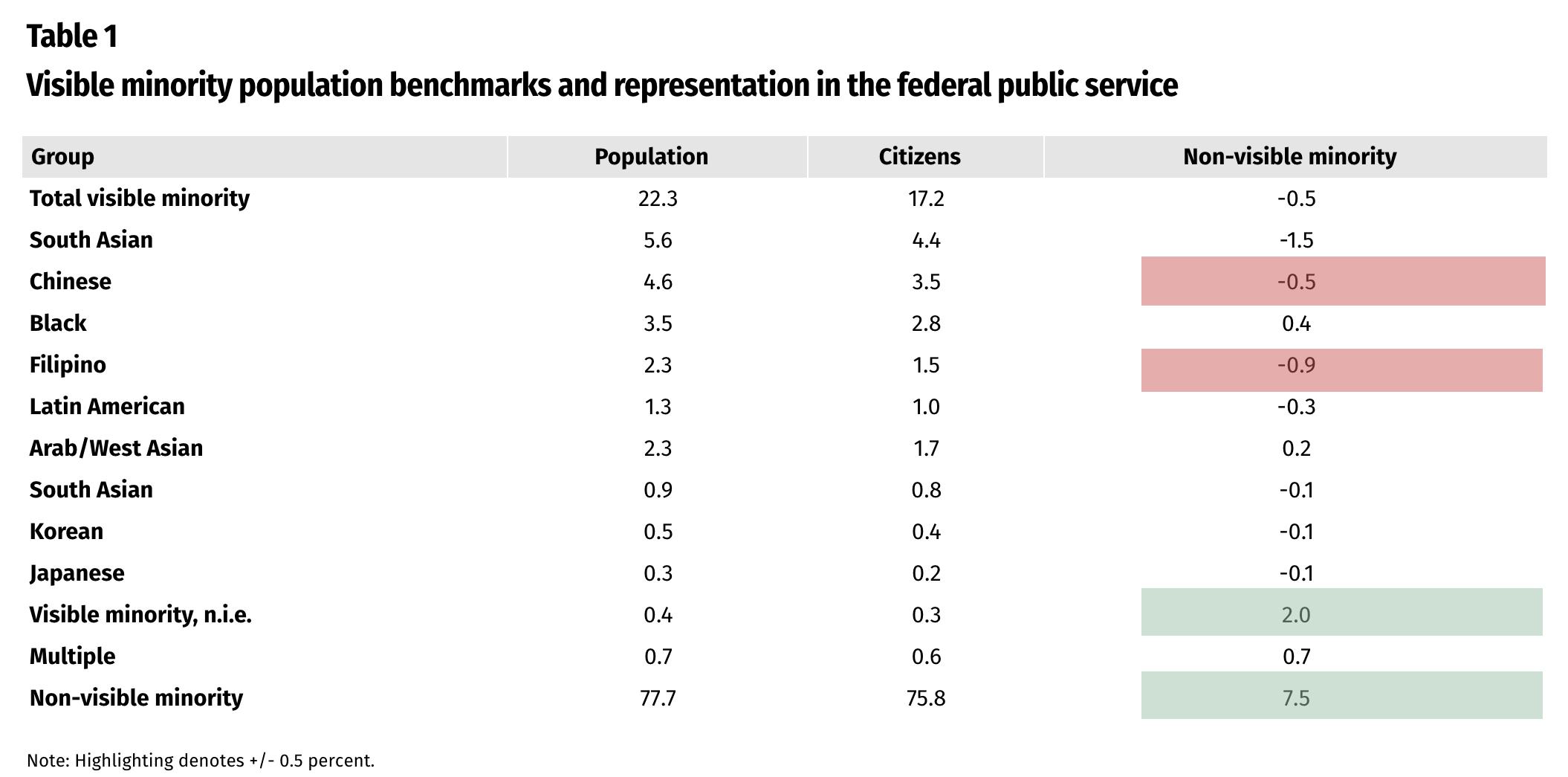
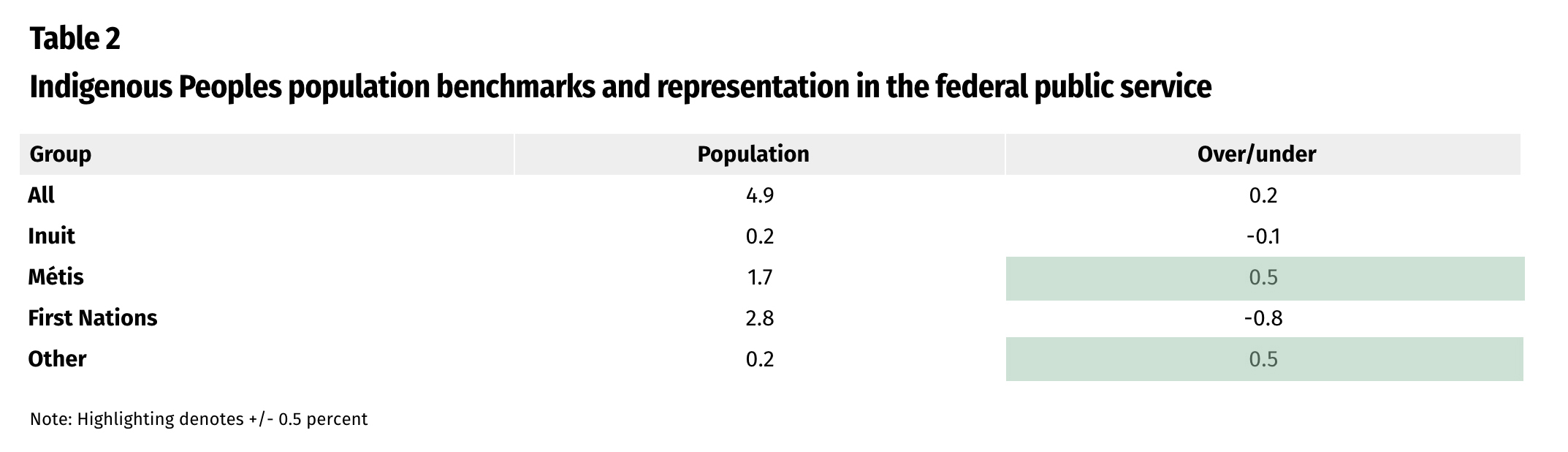
Now, for the first time, the federal government is providing disaggregated data related to the diversity of the public service as part of its Employment Equity Report. The Treasury Board Secretariat’s (TBS) report looks at the three fiscal years from 2016-19 by occupational group. Previously, disaggregated data for visible minority and Indigenous individuals employed in federal public administration (excluding the military) was only available through census data every five years. We now have the tools to do a more granular analysis of visible minority representation in each occupational group and see where work remains to be done. Table 1 looks at the overall visible minority representation in Canada, the visible minority population that are citizens, and the numbers shared in the government’s equity report. The citizenship number is taken here as a benchmark, since citizens are given preference in government staffing processes. This gives us a picture of the degree to which there is under-representation of certain groups compared to the citizenship-based benchmark. A note about the terminology: I have used the term visible minority, as do Statistics Canada and the Treasury Board Secretariat. Indigenous Peoples are their own category for data purposes, and do not fall under visible minority. While the visible minority group definitions are similar to those used by Statistics Canada, TBS groups Arab and West Asians together under “non-white West Asian, North African or Arab.” “Mixed Origin” refers to those with one visible minority parent. The representation of most groups is relatively close to their share of the citizenship population, with South Asian, Chinese and Filipino public servants less represented.Table 2 takes the same approach with respect to Indigenous representation with the exception that total and citizenship-based populations are identical, showing relative under-representation of First Nations and Inuit people.Table 3 compares the representation of each visible minority by occupational group, expressed as the percentage difference with non-visible minority, non-Indigenous employees for the three-year period 2017-19. For most groups, relative representation has not shifted dramatically from 2017 to 2019, with general under-representation in the executive, technical and operational categories.Among executives, no group has improved its representation by one percent or more from 2017 to 2019, with only individuals of mixed origins showing an increase of 0.6 percent, and Black, Filipino and Southeast Asian people showing marginal increases (0.1, 0.3 and 0.1 percent respectively). Table 4 similarly compares the representation of each Indigenous group by occupational groups, expressed as the percentage difference with non-visible minority, non-Indigenous employees for the three-year period 2017-19 (for the executive and technical occupational groups, there are fewer than five Inuit public servants, and thus the federal government does not provide numbers out of concern for privacy).While this analysis highlights the differences in visible minority and Indigenous representation among the different occupational categories, it does not break it down by seniority level. TBS declined to provide a disaggregated breakdown for assistant deputy ministers (level EX4-5) and directors and directors general (level EX1-3) given that breaking down the numbers to those subgroups would present a privacy risk. But TBS did say that of the 335 ADMs, 30 are visible minority (9.0 percent) and nine Indigenous (2.7 percent). Black Canadians are the visible minority group with the strongest numbers in the public service compared to their share of the citizen population, but their representation is overwhelmingly in the two administrative categories. This is not unique – there is significant under-representation among Latin American, Chinese, Filipino and South East Asian groups in the executive ranks of the public service. A similar general pattern can be found with Indigenous public service representation. With this type of disaggregated data in hand, policy discussions and responses can be based more solidly on evidence rather than relying on examples and anecdotes about who works in the public service. With better data, the government can hopefully build a more representative and inclusive public service at all levels.
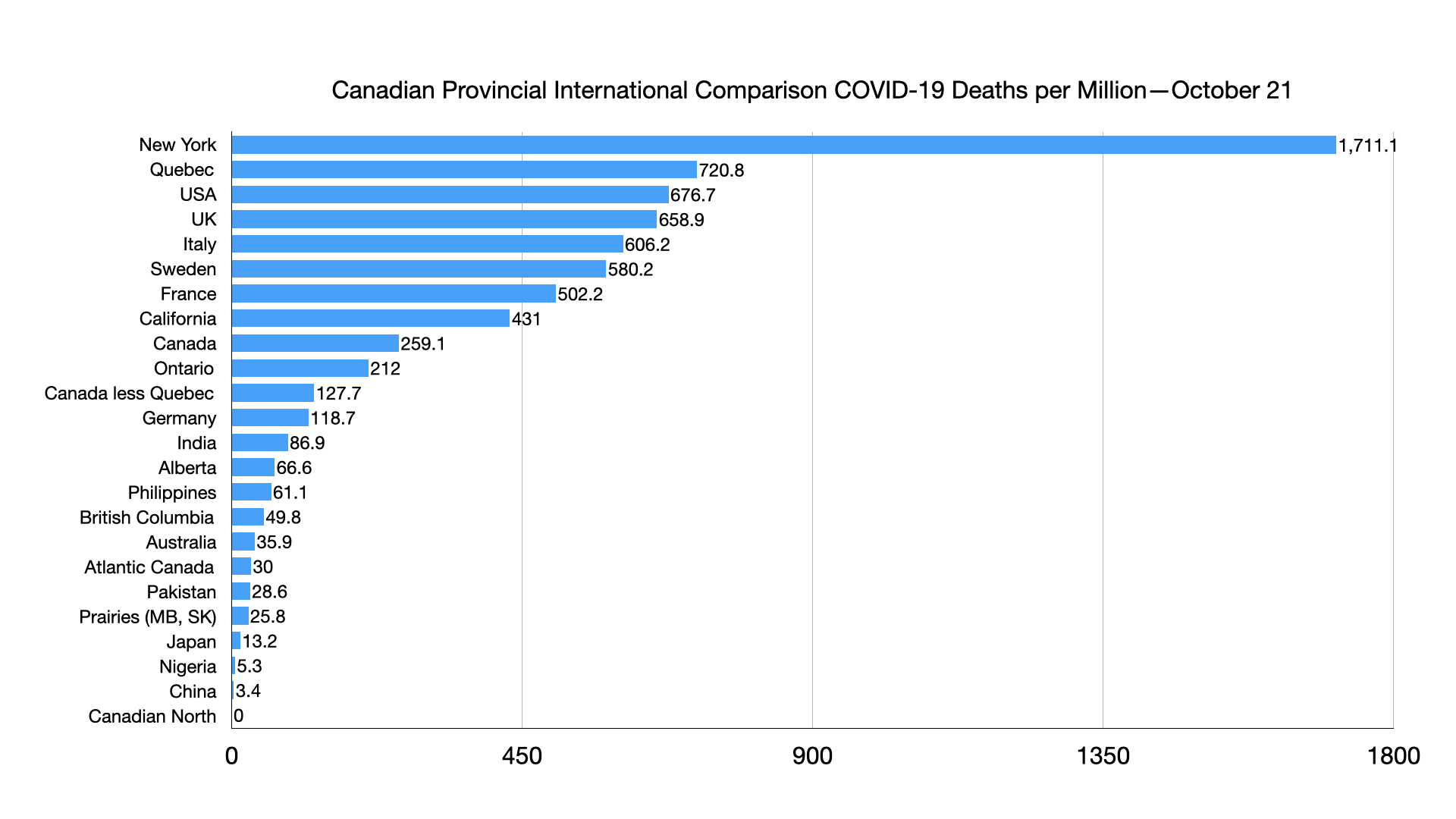
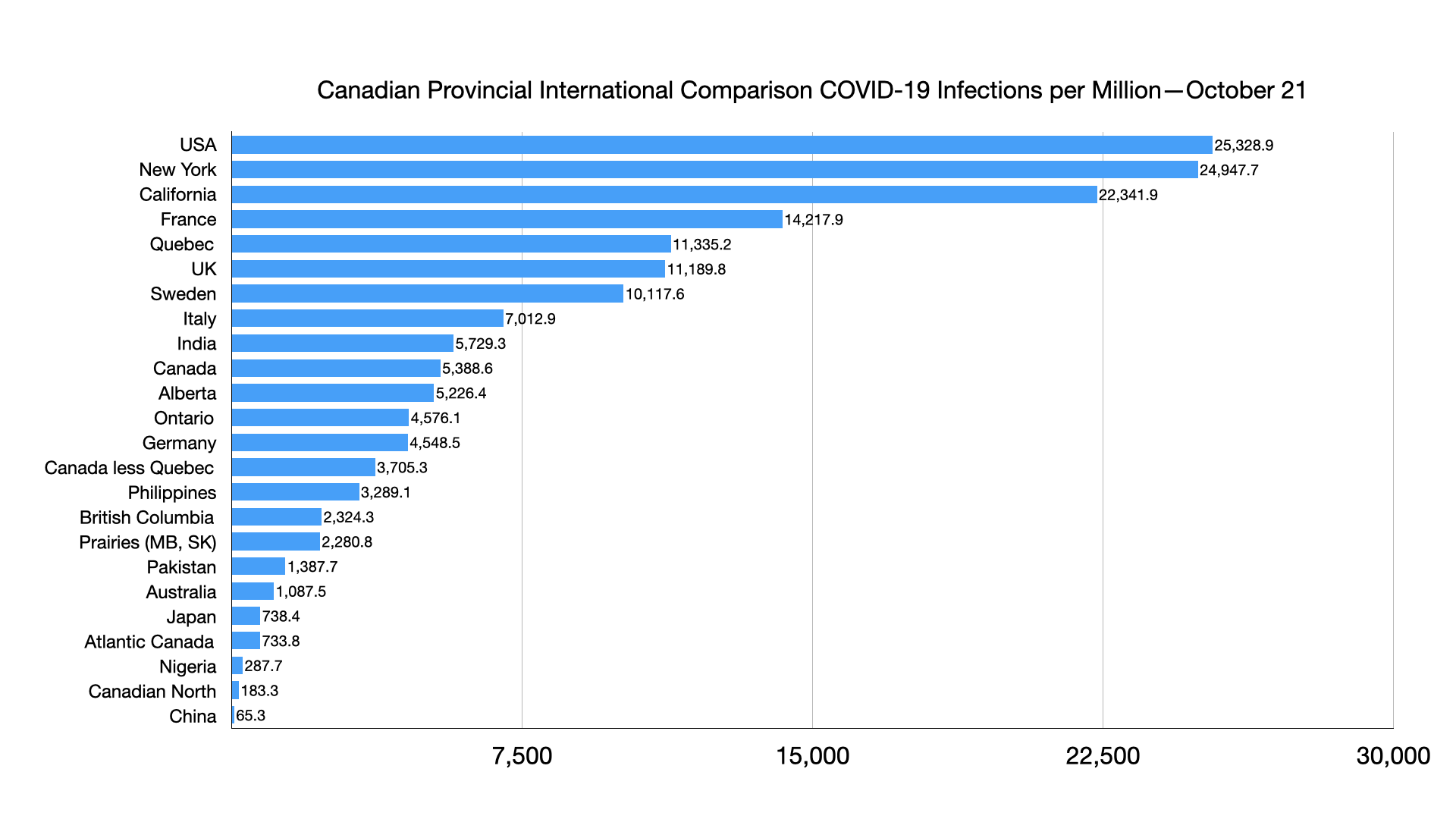
Apart from overall large increases in infections in most jurisdictions, and corresponding increases in death rates in some, overall country and jurisdiction ranking largely unchanged.
Deaths per million: no change
Infections per million: Sweden now higher than UK (so much for herd immunity), Japan ahead of Atlantic Canada





 Multicultural Meanderings
