The Whitelash Next Time

Of note despite treating all white Americans the same:

Two months. That’s how long it took for white Americans’ support of Black Lives Matter—which climbed to an unprecedented peak in June after the brutal police murder of George Floyd—to tumble back toward preprotest levels. Over the same period, surveys show, declining numbers of white respondents cited anti-Black racism as a “big problem” in American society. An NPR/Ipsos poll from late August found white people are the racial group least likely to report taking even the most minor “actions to better understand racial issues in America” since protests began sweeping the country. Just half of white Americans concede “racism is built into the American economy, government, and educational systems.” And 49 percent believe America has already done enough “to give Black Americans equal rights with white Americans.”

It’s always true that most white folks are unbothered and unmoved by anti-Black discrimination and violence; the steadfast endurance of American institutional racism proves that. It is also clear from history that white anti-racism has always had a dangerously short shelf life. Ignore the barrels of digital ink spilled lately about white people’s new willingness to reckon with structural racism. When the pendulum swings toward Black equality and full citizenship, white supremacy mounts a counteroffensive.

Cornell University historian Lawrence Glickman notes the word “backlash” gained circulation during the civil rights movement in 1963 as a shorthand for the “topsy-turvy rebellion in which white people with relative societal power perceived themselves as victimized by what they described as overly aggressive African Americans demanding equal rights.” The term summed up the most reliable white reaction to Black rights dating at least to Reconstruction, when the mere facts of Black emancipation and voter enfranchisement were construed as provocations for justifiable white racist terrorism. Between 1865—when six former Confederate soldiers founded the Ku Klux Klan—and 1950, nearly 6,500 Black men, women, and children were lynched for affronts that included bumping into a white woman and not using “Mister” when talking to a white man. “The more I studied the situation,” wrote Ida B. Wells, “the more I was convinced that the [white] Southerner had never gotten over his resentment that the Negro was no longer his plaything, his servant, and his source of income.”

Refugees of the Great Migration, the mass movement of African Americans to the North and West to flee that terror, were subjected to yet more white violence. Enraged by Black folks seeking equal employment and housing, as well as returning Black World War I veterans’ demands for the rights at home they had fought for abroad, white mobs in at least 25 riots around the country—including in Chicago; Syracuse, N.Y.; and Washington, D.C.—killed over 250 African Americans during the Red Summer of 1919. Those murders foreshadowed anti-Black pogroms in the thriving Black enclaves of Tulsa, Okla., in 1921 and Rosewood, Fla., in 1923.

The white backlash is typified by what Glickman identifies as “its smoldering resentment, its belief that the movement [for Black rights is] proceeding ‘too fast,’ its demands for emotional and psychological sympathy, and its displacement of African Americans’ struggles with its own claims of grievance.” Case in point: Just months after passage of the 1964 Civil Rights Act, The New York Times reported pervasive white anger over “inverse discrimination.” Then as now, backlashers maligned Black protests and uprisings, insisting property destruction canceled out Black deservedness of human rights. In one 1963 survey, 73 percent of white Southerners and 65 percent of white Northerners said civil rights demonstrations “hurt the Negro’s cause for racial equality,” and multiple white New York City dwellers told the Times in 1964 that “nonviolent civil rights demonstrations had hurt Negroes’ chances” (my emphasis). Historical revisionism has attempted to erase the fact that 75 percent of white folks disapproved of Martin Luther King Jr. in early 1968. In the 1960s, when he was leading protests, a survey found that just 36 percent of white Americansthought he was helping “the Negro cause of civil rights.”

“The trigger for white rage, inevitably, is black advancement,” Carol Anderson wrote in her 2016 book White Rage. That rage helped ardent segregationist and presidential candidate George Wallace winfive Southern states in 1968 and five primaries in 1972, including Michigan and Maryland. Promises to send “welfare bums back to work” and to defend white home sellers’ right to “discriminate against Negroes” propelledRonald Reagan to California’s governorship in 1966 and later to the Oval Office. It is right to call the 2016 election of Donald Trump a white backlash against the first Black president—one so fervent, it won poorly educated, college-degree-holding, and young white folks alike—but it is also critical to recognize it as just one white backlash among many. Trump’s presidency is no anomaly but a confirmation of America’s pattern of Black political progress and white retaliation.

Source: The Whitelash Next Time

COVID-19 disproportionately impacted immigrants and refugees in Ontario, new report finds

Better data confirming what we know:

The spread of COVID-19 has disproportionately affected immigrants, refugees and those who live in low-income neighbourhoods in Ontario, a new report has found.

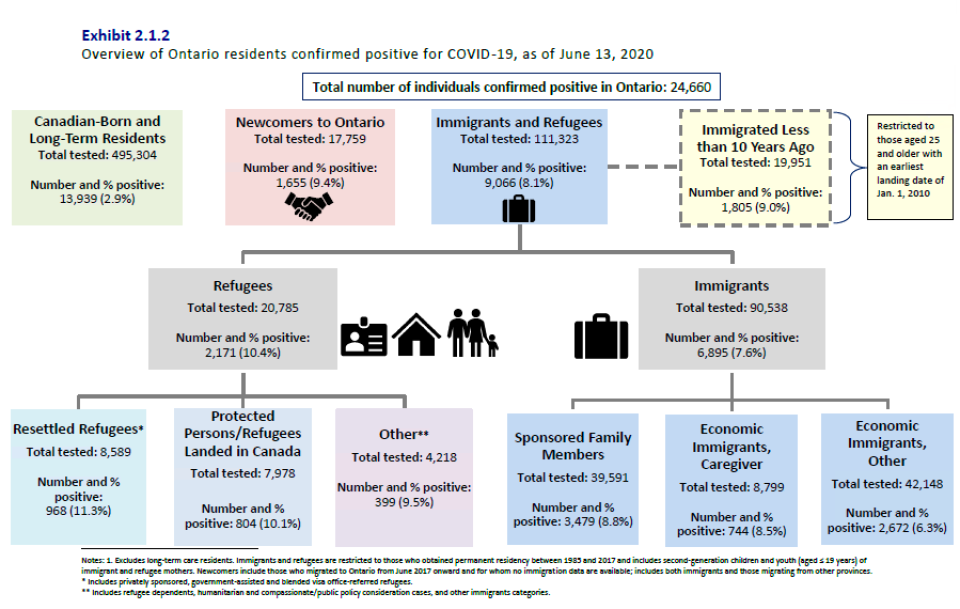
The report released Wednesday by ICES, a not-for-profit research institute focusing on health-related data in Ontario, found that while immigrants and refugees in the province accounted for only about a quarter of those tested for COVID-19 between January and June, they represented 43.5 per cent of all positive cases.

“We document disproportionately higher rates of infection among those who landed in Ontario as economic caregivers, refugees, those with lower levels of education and language fluency, those who currently live in lower income neighbourhoods and with more crowded housing,” Dr. Astrid Guttmann, Chief Science Officer at ICES and lead author on the report, said in a statement.

“Apart from addressing many of (the) root causes of higher risk of infections, very high test positivity in certain groups of immigrants also suggests that there may be important barriers to testing that will be important to address if there is a second wave in Ontario this fall.”

The data was pulled from test results conducted between January 15 and June 13. According to the report, rates of testing were lower for most immigrants and refugees compared with Canadian-born and long-term residents—with an exception for economic caregivers who tend to work in health-care and were prioritized for testing.

The data found that of the 4.4 per cent of Canadian-born and long-term residents tested for COVID-19 in Ontario, 2.9 per cent tested positive.

Of the 3.4 per cent of people who identify as immigrants or refugees who were tested for COVID-19, 8.1 per cent received a positive diagnosis.

Refugees alone had the highest positivity rate within that time period at 10.4 per cent.

Chart

The report also found that while testing positivity peaked at the beginning of April among Canada-born and long-term residents, there were two “pronounced peaks of positivity” for immigrants, refugees and newcomers in April and May respectfully.

“The pandemic has sharpened the focus on structural and societal inequalities that have long existed,” the report reads. “These inequities put many racialized and immigrant populations at higher risk of both contracting the infection and suffering poor outcomes.”

The highest rates of positivity in Canada were found in racialized immigrants and refugees from Central, Western and East Africa, South America, the Caribbean, Southeast Asia and South Asia, the report found. The rates were also higher for those living in low-income neighbourhoods.

Public health units with larger immigrant populations such as Toronto, Peel Region, Durham Region, Waterloo, Windsor and York also reported a high number of COVID-19 positive patients among that demographic.

In Toronto specifically, 4,027 immigrants and refugees have tested positive for COVID-19 (9.8 per cent of those tested) compared to 3,788 Canadian-born patients (4.9 per cent of those tested).

What data was available and what was missing?

The general findings presented in the report are not necessarily new. Advocacy groups have been calling on all levels of government to support the gathering of race and socio-economic data for months, arguing that marginalized communities are disproportionately contracting or dying from COVID-19.

As a result of these calls, the City of Toronto began collecting race-based data in May.

Toronto Public Health said that of the data collected between May 20 and July 16, 83 per cent of known COVID-19 cases involve members of racialized communities.

It also found that patients with a household income level of $50,000 or less represents more than 50 per cent of reported infections in the city, despite the fact that the 2016 census revealed only 30 per cent of Toronto’s population reported being in that income bracket.

The data released by city officials are based on voluntary questions collected by a local public health unit.

Provincially, officials and politicians have all said they support the collection of race and income-based data, but they have yet to provide any information about the trends they are seeing.

In mid-June, the government proposed regulatory changes that would allow those who test positive for COVID-19 to be asked about their race, income, languages spoken and household size.

The questions are optional and the government said personal privacy would be protected. Since then, not much has been said about the data collection.

The ICES report said they were limited in the creation of the report by incomplete immigration data and could only include information on immigrants or refugees who landed in Ontario from January 1985 to May 2017 and who became permanent residents. They also included second-generation immigrant children under the age of 19 who were born in Ontario to permanent residents.

A “newcomer,” a status defined separately from an immigrant or refugee, is described as an individual who became eligible for OHIP after May 31, 2017

The authors also noted that ICES lacked data on “important risk factors for testing and positivity” such as occupation and living conditions.

“We currently do not have comprehensive data on important outcomes such as hospitalization and death,” the report says. “We have data on demographic and some census-based characteristics but not on the critical structural factors that play an important role in shaping inequities.”

ICES was able to access information on the health-care sector. The report found that employment as a health-care worker, especially among women, accounted for a disproportionate number of COVID-19 cases among immigrants and refugees. Among the 36 per cent of women employed as health-care workers and who tested positive in Ontario, 45 per cent were within that demographic.

Inequities ‘are complex’ and often rooted in racism

The report suggests that the “causes of these inequities are complex and often rooted in social and structural inequities, including systemic racism.”

It notes that a large proportion of immigrants, refugees and newcomers to Canada hold temporary or minimum-wage jobs at facilities where physical distancing is difficult. These positions may also not have paid sick leave or other health benefits.

ICES says that employment in any of these sectors— such as occupations in retail, factories or transportation– “is considered precarious” and could impact testing and quarantine.

Other factors such as language barriers, education and accessibility to quality healthcare could impact whether a person gets a COVID-19 test.

The not-for-profit is calling for more accessible testing options ahead of a possible second-wave in the fall as well as better training and enforcement of safety measures for those at risk of COVID-19 exposure in the workplace.

“A continued focus is needed on securing funding to house those who cannot safely quarantine in their homes or are homeless, as well as for income supplements for workers must quarantine who do not have employer-sponsored sick leave,” the report says.

The report also noted that the findings should be interpreted in the context of Ontario’s testing strategy. Initially, local public health units were only testing those in essential workplaces, those who had recently travelled and for those with acute medical conditions. Later that strategy evolved to include long-term care homes, hospitalized patients, and the general population, including asymptomatic patients.

“This means that some groups are over-represented in the testing numbers and that positive cases include those who were symptomatic at the time of testing, as well as those who were asymptomatic,” the report says.

“This may distort some associations of characteristics with both testing rates and potential to test positive. It also means that there is an unknown number of untested infected individuals in the general population.

Source: https://toronto.ctvnews.ca/covid-19-disproportionately-impacted-immigrants-and-refugees-in-ontario-new-report-finds-1.5097363

Burton: China threatens and intimidates people within Canada as Ottawa remains silent

Harsh words, not without merit:

Notwithstanding its nimble handling of a pandemic, Justin Trudeau’s government will be vulnerable in the next election if voters don’t see meaningful action replace Canada’s passive rhetoric on China’s human rights, trade and hostage diplomacy.

This summer, the Commons Subcommittee on International Human Rights and the Commons Special Committee on Canada-China Relations heard harrowing testimony from witnesses who say Chinese government agents threaten them and their families in Canada and in China.

Canadian Chinese and Canadian Uighur activists told of being threatened with rape or even death if they keep speaking out against violations committed by China against the Uighurs, or the persecution of Hong Kong residents clinging to political rights.

Witnesses pleaded for Canada to stop this intimidation campaign being co-ordinated by the Chinese Embassy in Ottawa and its consulates in Montreal, Toronto, Calgary and Vancouver. All people in Canada are entitled to the protection of the Canadian Charter of Rights and Freedoms, including Chinese Canadians or citizens of China here in Canada as students or for other purposes.

Foreign Affairs Minister François-Philippe Champagne’s nonresponse to calls to protect Chinese Canadians amounts to tacit consent for Beijing to continue acting as if ethnic Chinese, Tibetans and Uighurs within Canada should still be subject to repression by China’s Communist regime.

Sadly, this is consistent with Canada’s nonaction on China. Regarding offering sanctuary to Hong Kong activists facing persecution due to repressive moves by Beijing, we are told that Ottawa is thinking it over. Ditto to applying Magnitsky sanctions against Chinese officials complicit in genocidal measures against Uighur people, including forced sterilization of women.

These sanctions are already applied against officials in Saudi Arabia, Venezuela and other countries engaging in human rights abuses less serious than China’s. If Ottawa defers these decisions as long as they have delayed ruling on Huawei 5G, Canada’s sagging reputation as a weak link in maintaining international rules-based order will be confirmed.

Magnitsky sanctions would seriously impact China’s “red nobility,” who park dubious assets in Canada. For them this country serves as a bolt hole in case of being on the losing end of factional struggles that characterize China’s unstable nondemocracy.

This includes Meng Wanzhou, the Huawei CFO with a $5-million, six-bedroom residence plus a $13-million estate more than triple that size in one of Vancouver’s toniest neighbourhoods. (Meng was carrying seven passports when detained by Canadian authorities.) People like this are not so concerned about military conflicts or decoupling from the West, as they are of Magnitsky cancellation of their visas and confiscation of their overseas money and assets.

To maintain power, Party General-Secretary Xi Jinping must be seen as protecting the interests of Communist elites. If they believe his mismanagement of relations with Canada will impact them directly, Xi has a major problem. But this point appears lost on Canadian policy-makers, those same people who seem in no hurry to consider a Canadian iteration of Australia’s Foreign Influence Transparency Scheme Act.

That law has led to numerous former senior Australian government people resigning from the lucrative China-related boards and consultancies. Such plums are a key tactic of China’s covert and corrupt approach to cultivating influential Western “friends.”

What of the sotto voce reservations expressed about the impact of Canada doing anything that China would not like on the fate of hostages Michael Spavor and Michael Kovrig? After more than 600 days of incarceration, Ottawa’s refrain “we are working very hard” to achieve their release has worn thin. The fact is, Beijing will hold these two innocent men for as long as it benefits the furtherance of China’s agenda in Canada, regardless of any impact on China’s global credibility.

Currently, Beijing has got us where they want us. The tragic fallacy of Canada’s silence is that the longer we remain passive in the face of China’s appalling violations of international trade, diplomacy and human rights, the longer we can expect Kovrig and Spavor to remain in Chinese prison hell.

Charles Burton is a senior fellow at the Macdonald-Laurier Institute in Ottawa, and non-resident senior fellow of the European Values Center for Security Policy in Prague. He is a former professor of political science at Brock University, and served as a diplomat at Canada’s embassy in Beijing.

Source: China threatens and intimidates people within Canada as Ottawa remains silent

Oscars make historic change to encourage diversity in best picture nominees

Overdue:

In a historic move, the Oscars are raising the inclusion bar for best picture nominees starting with the 96th Academy Awards in 2024. The Academy of Motion Picture Arts and Sciences on Tuesday laid out sweeping eligibility reforms to the best picture category intended to encourage diversity and equitable representation on screen and off, addressing gender, sexual orientation, race, ethnicity and disability.

The film academy has established four broad representation categories: On screen; among the crew; at the studio; and in opportunities for training and advancement in other aspects of the film’s development and release.

Each standard has detailed subcategories as well. To meet the on-screen representation standard, a film must either have at least one lead character or a significant supporting character be from an underrepresented racial or ethnic group, at least 30 per cent of secondary roles must be from two underrepresented groups or the main storyline, theme or narrative must be focused on an underrepresented group.

According to the academy, underrepresented groups include women, people of colour, people who identify as LGBTQ or people with disabilities

The best picture award, which is handed out to the producers of a film, is the one category which every film academy member can vote for. Earlier this year, the South Korean film Parasite became the first non-English language film to win the award.

‘Long-lasting, essential change’

All other categories will be held to their current eligibility requirements.

“The aperture must widen to reflect our diverse global population in both the creation of motion pictures and in the audiences who connect with them,” said Academy president David Rubin and CEO Dawn Hudson in a written statement. “We believe these inclusion standards will be a catalyst for long-lasting, essential change in our industry.”

The second category addresses the creative leadership and crew composition of a film. In order to meet the standard a film must have either at least two leadership positions or department heads be from an underrepresented group and at least one be from an underrepresented racial or ethnic group; at least six other crew be from an underrepresented racial or ethnic group; or at least 30 per cent of the film’s crew be from an underrepresented group.

The third category deals with paid internship and apprenticeship opportunities as well as training opportunities for below-the-line workers, and the fourth category addresses representation in marketing, publicity and distribution teams.

The inclusion standards form will be confidential and will not be required for best picture hopefuls for the 94th and 95th Academy Awards.

The inclusion standards were developed by a task force led by academy governors DeVon Franklin and Jim Gianopulos and in consultation with the Producers Guild of America. They also took into account diversity standards used by the British Film Institute and the British Academy of Film and Television Awards.

These changes will also not affect the 93rd Academy Awards, although the academy has had to make a few alterations because of COVID-19’s effects on the movie business, including pushing the ceremony back two months to April 25, 2021 and allowing films that debuted on a streaming service to be eligible for best picture.

Source: Oscars make historic change to encourage diversity in best picture nominees

Quebec judge who asked woman to remove hijab apologizes, 5 years later

Of note:

A Quebec court judge, who refused to hear the case of a Montreal woman because she was wearing a hijab, has finally apologized for the incident, more than five years after it happened.

At an online hearing of the Quebec Council of the Magistrature on Tuesday, a lawyer for the council read Judge Eliana Marengo’s apology to Rania El-Alloul.

The council is the body responsible for disciplining judges in the province.

In her statement, Marengo said she acknowledged that she erred in asking El-Alloul to remove her hijab, that she regretted any inconvenience and that she never intended any offence or disrespect.

Marengo addressed the fact that at the time she had compared El-Alloul’s hijab to a hat and sunglasses being worn in the courtroom.

“My reference to hats and sunglasses was simply meant to exemplify how the rules of decorum are generally applied in the courtroom and was most certainly not meant to disrespect either you or your beliefs,” Marengo said.

She concluded by offering El-Alloul her most sincere apologies.

El-Alloul read her own statement in response, saying she accepted Marengo’s apology.

“I remember that day in the courtroom like it was yesterday. I couldn’t imagine that I would be turned away from the justice system because of my hijab, that my rights would be taken away because of my beliefs,” El-Alloul said.

“I hope she understands the pain she caused me, and why it is so important for her to account for her actions. Our justice system is not made for some and not others. No, this is a democracy, where everyone is to be treated equally before the law,” she continued.

“I accept her apology. This is what my faith teaches me.”

‘Not suitably dressed’

The controversy dates back to February 2015 when El-Alloul was in court trying to get back her impounded car.

“In my opinion, you are not suitably dressed,” Marengo told El-Alloul at the time. The judge said the court was a secular space, and no religious symbols should be worn by those before it.

The case was suspended, and El-Alloul eventually got her car back. But the story made headlines around the world.

Dozens of people, including El-Alloul, ultimately filed complaints with the Council of the Magistrature.

El-Alloul’s complaint was dismissed on a technicality, but the council agreed to look into the dozens of other complaints on the matter.

Marengo challenged the authority of the council to examine the complaints. She sought leave to appeal a Quebec Court of Appeal decision that unanimously found she was wrong to bar El-Alloul from her courtroom.

But in 2018, the Supreme Court refused to hear Marengo’s challenge.

Change of heart

The Council of the Magistrature sent a letter earlier this summer to the complainants, informing them of today’s hearing.

“The purpose of this hearing will be to study a settlement proposal from the prosecutors on file, including a letter of apology from Judge Marengo to Mrs. El-Alloul,” the letter said.

The council also told the complainants the apology would be released to the public, in exchange for dropping the disciplinary charges against Marengo.

The settlement was jointly proposed by Marengo’s lawyers and the lawyer handling the complaint for the council.

The panel of judges presiding over the hearing said it would take time to consider today’s arguments before deciding whether to accept the settlement.

Source: Quebec judge who asked woman to remove hijab apologizes, 5 years later

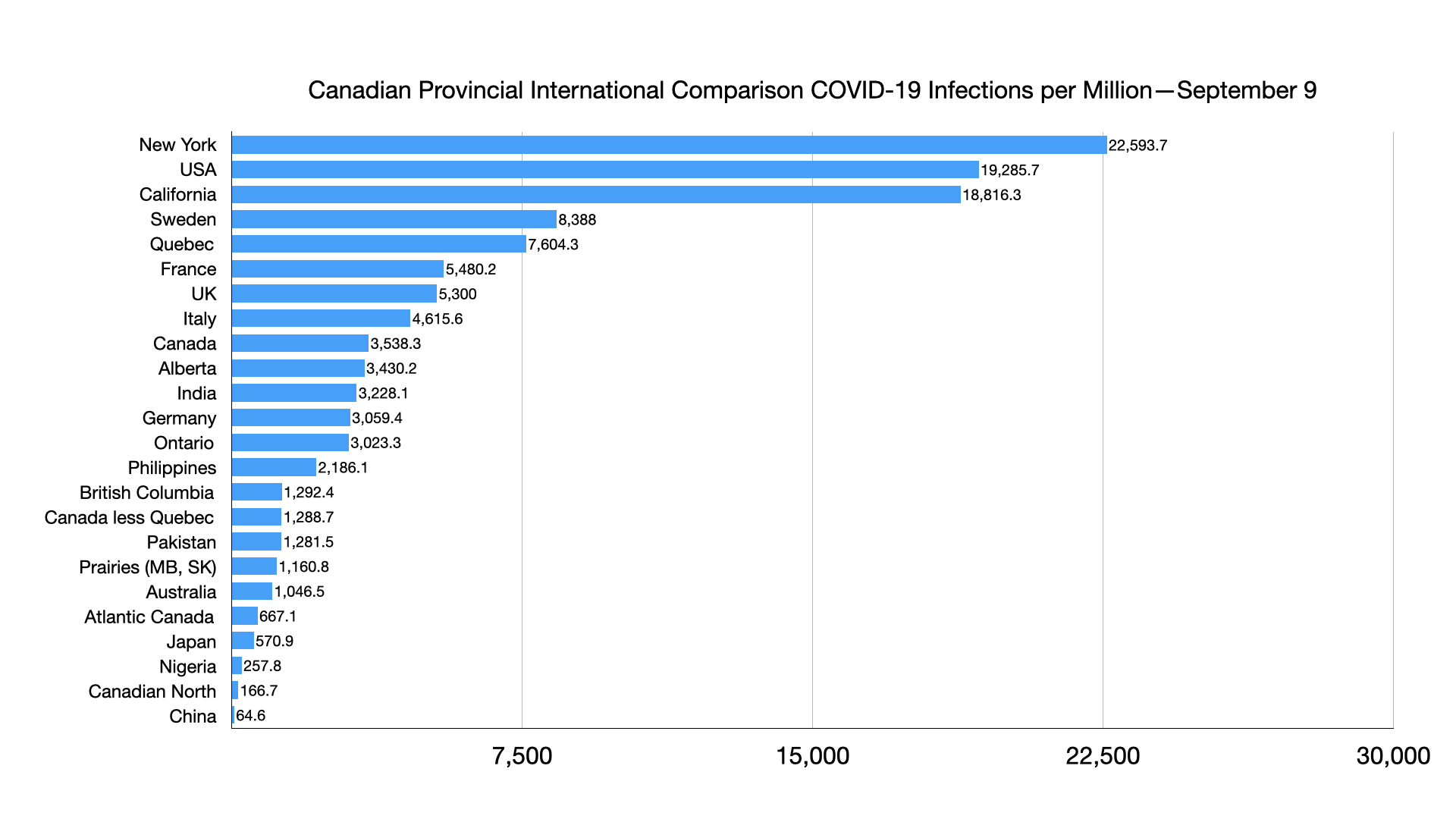
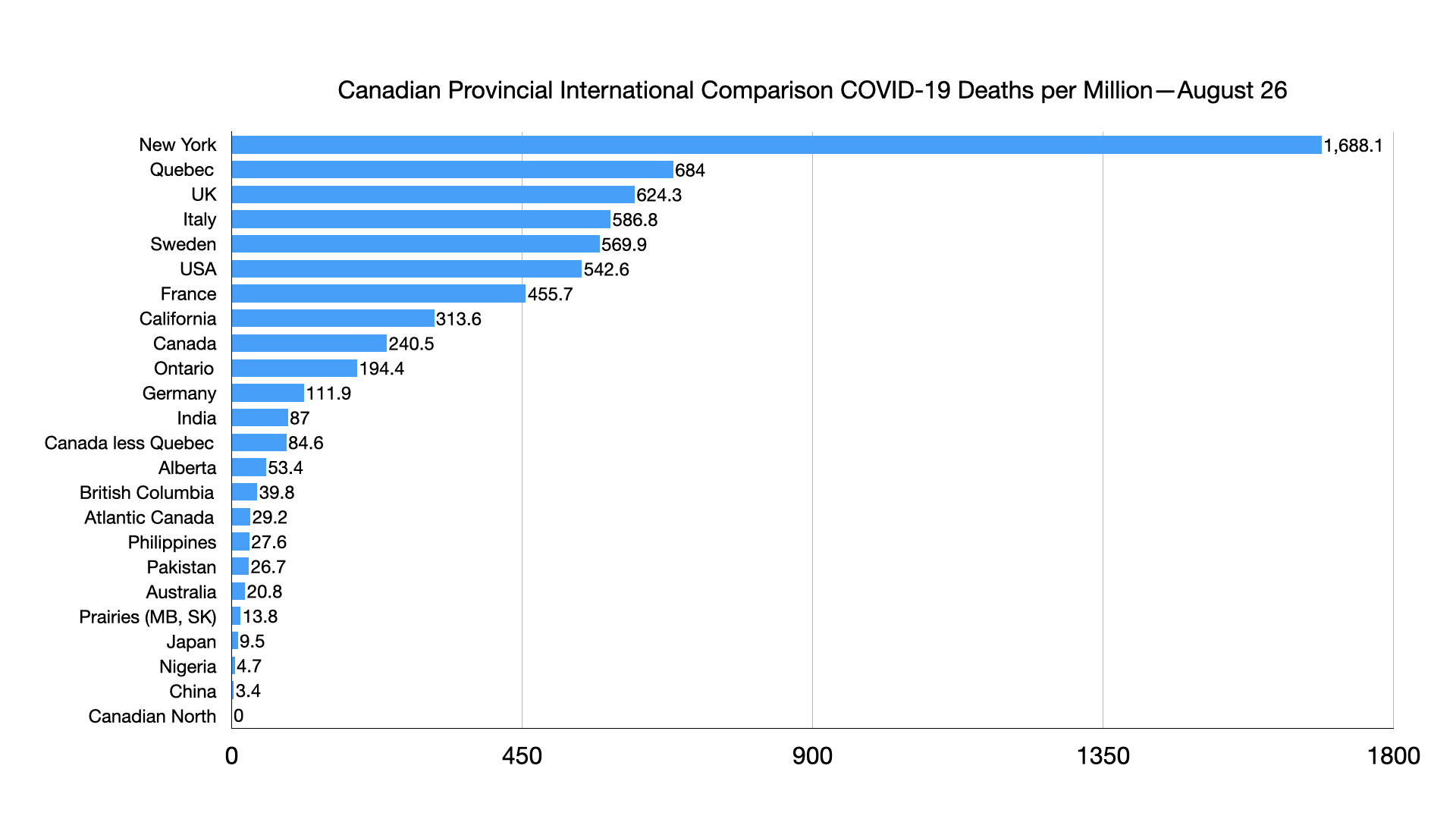
#COVID-19: Comparing provinces with other countries 9 September Update

Highlights:

Deaths per million: USA now higher than Sweden, Australia now higher than Atlantic Canada

Infections per million: France now higher than UK, India now higher than Germany and Ontario, British Columbia now higher than Canada less Quebec


Hyder: Canada needs to get its stalled immigration system back on track

The Canadian big business perspective, arguing that Canada should go back to the previous immigration targets given a larger population means more consumers and hence business revenues.

However, it focusses on GDP, not per capita GDP, it ignores the fact that previous recessions have hit hardest on recently arrived immigrants and have long-term impact on their earnings.

Moreover, an almost cult-like fixation on previously announced target without any serious reexamination of whether they remain appropriate is  incredibly short-sighted. The only interesting point is the the reference to Anna Triandafyllidou’s innovation proposal for virtual immigration (for knowledge industries), the rest is simply repeating previous arguments:

The effects of COVID-19 on Canada’s economy can be measured in many ways. Some are obvious: millions unable to work, thousands of firms forced to close their doors, more than $250-billion in emergency government spending.

Less obvious, but of potentially greater significance to Canada’s long-term economic health, is the impact of the pandemic on immigration.

Canada’s ability to attract newcomers to its shores has long been one of this country’s greatest strengths and competitive advantages. Immigration enriches the social fabric of the nation while boosting the economy, helping to offset a low birth rate and an aging population.

Immigrants bring energy, skills, new ideas and entrepreneurial spirit. They start companies, fill skill shortages, buy houses and pay taxes.

It’s no exaggeration to say – as Marco Mendicino, Minister of Immigration, Refugees and Citizenship, declared in a speech to the Canadian Club of Toronto last Feb. 28 – that the future of Canada “hinges on immigration.”

The minister couldn’t have foreseen it at the time, but less than a month later Canada responded to the global pandemic by temporarily closing its borders to all non-essential foreign travellers.

Overnight, the country’s intake of immigrants – which had been expected to hit 341,000 this year – slowed to a trickle.

In April, Canada welcomed just 4,140 new permanent residents, 85 per cent fewer than in the same month in 2019. Since then, the pace of admissions has gradually picked up, reaching 11,000 in May and 19,200 in June.

Still, at the current rate we can expect to see 170,000 fewer permanent residents entering the country in 2020 than planned, according to a recent report by RBC Economics.

The collapse in immigration means Canada’s population is currently experiencing its slowest growth since 2015. That will have important implications across many sectors, including residential construction, industries with labour shortages, and Canada’s postsecondary education system.

Canada currently ranks third in the world as a destination for international students. In 2019, 642,000 foreign students injected more than $22-billion into the economy, supporting 170,000 jobs.

The good news is that, despite the new coronavirus, Canadian officials are continuing to process new applications for permanent and temporary residence, albeit at a reduced rate due to physical distancing and other pandemic-related restrictions.

In addition, Mr. Mendicino has removed at least some of the obstacles standing in the way of would-be immigrants. Recently he introduced a special “one-time” pathway to permanent residency for refugee claimants who are working in front-line health and long-term care jobs.

He also announced that visitors to Canada who have a valid job offer will be able to apply for a work permit without the normal requirement to leave the country. The temporary policy is aimed at helping employers who continue to face challenges recruiting and hiring international workers during the pandemic.

Such measures are welcome, even though they won’t make a big difference to Canada’s immigration numbers.

There’s no getting around the fact that the longer the COVID-19 pandemic persists, the more difficult it will be for the country to meet its goal of more than one million new permanent residents between 2020 and 2022.

What can be done to close the gap? Anna Triandafyllidou, the Canada Excellence Research Chair in Migration and Integration at Ryerson University, has proposed a workaround for highly skilled people who have a job offer in Canada but are unable to get here because of travel restrictions. Under the rules, they can’t obtain a work permit or a social insurance number until they enter the country, which means they can’t be paid.

The solution, Ms. Triandafyllidou says, is technology. Her idea is to issue digital work permits and temporary SINs that would allow these “virtual immigrants” to start working remotely for their Canadian employers while they wait for the health emergency to abate.

Beyond that, immigration must be a pillar of Canada’s postpandemic economic recovery plan. In November, the federal government is expected to table its next multiyear immigration plan. It should move to make up lost ground by raising the targets for 2022 and beyond. The incremental growth should emphasize economic-class newcomers – those admitted through Express Entry programs, the Provincial Nominee Program, Quebec’s programs, and other federal streams such as the Atlantic Immigration Pilot.

The demographic factors that drive Canada’s need for immigrants have not changed due to COVID-19. Neither, it seems, has public support for immigration. In a Leger poll this summer, respondents agreed by a three-to-one margin that newcomers will help rather than hurt Canada’s long-term economic recovery. The sooner Canada’s immigration system gets back on track, the better.

Goldy Hyder is the president & chief executive officer of Business Council of Canada.

Source: Canada needs to get its stalled immigration system back on track

Health Minister orders review of pandemic warning system, concerns raised by scientists

Really hope the review will be truly independent, review all appropriate documentation, analysis and memos and identify what level and persons were responsible for the decision (i.e., was the decision made at the bureaucratic or political level):

Canada’s Health Minister has ordered an independent review of the country’s pandemic early warning system, after The Globe and Mail reported that the respected surveillance and research unit was silenced last year, several months before the COVID-19 outbreak hit.

Health Minister Patty Hajdu said the federal review will probe the shutdown of the system, as well as allegations from scientists inside the Public Health Agency of Canada that their voices were marginalized within the department, preventing key messages from making it up the chain of command.

“My hope is that we can get the review off the ground as soon as possible,” Ms. Hajdu said in an interview. “The independence of this review is critically important.”

A Globe investigation in late July detailed how the unit, known as the Global Public Health Intelligence Network, or GPHIN, was effectively silenced in May, 2019. The team of analysts – including doctors and epidemiologists specially trained to scour the world for health threats – were reassigned to other tasks within the government amid shifting department priorities.

Though GPHIN had garnered a stellar reputation internationally, and was dubbed a “cornerstone” of global pandemic preparedness by the World Health Organization, officials within Public Health decided in late 2018 and early 2019 that the operation was too internationally focused and could be put to better use working on domestic projects. The new work did not involve pandemic preparedness.

Those changes led to the shutdown of a special surveillance and alert system that helped Canada and the WHO gather intelligence on potentially threatening outbreaks, particularly in situations where foreign governments were trying to hide or play down the event.

Current and former scientists and doctors at Public Health also said they began to fear that their messages were not being heard, or understood, by layers of department officials who lacked a sufficient background in science. That made it difficult to convey urgent and complex information up the chain of command.

Responding to those concerns, Ms. Hajdu said her office has spent the past month looking into the problems at the departmental level, which led her to order the review.

“I’m concerned when there is an accusation that scientists are not being fully empowered, or in some way feel their voices are being blunted or muted,” Ms. Hajdu said in an interview.

“I can listen to those kinds of worries and do the kinds of things that I’m prepared to do, which is to order a review of the program and to determine whether or not the changes are actually resulting in the kind of information that Canada needs.”

Ms. Hajdu said she has asked that the review be done expeditiously, so that fixes can be identified and the recommendations implemented as soon as possible. She said that could mean having the recommendations back in six months.

“We’re working on [appointing] some professionals that would have the experience and the expertise to be able to do this review thoroughly, but also expeditiously … I don’t want this to be a two-year review,” the Health Minister said. The people leading the review are expected to be named in the coming weeks and will be independent of Public Health Canada.

Created as an experiment in the 1990s, GPHIN became a key part of Canada’s pandemic preparedness capacity after the deadly 2003 SARS outbreak, and was seen as a way to collect intelligence on global outbreaks. The point was not merely to identify the threat early, but also to monitor crucial developments and clues about the spread, often before official announcements were made by foreign governments, to speed up government decision-making.

With a team of roughly a dozen highly specialized analysts working in multiple languages, GPHIN was globally renowned for its ability to collect and disseminate credible information. It scoured more than 7,000 data points a day, including medical data, news reports, scraps of information on social media, and details on internet blogs to gather intelligence on outbreaks.

GPHIN had been credited with detecting some of the most important signals from the 2009 H1N1 outbreak in Mexico, outbreaks of Zika in West Africa, and a potentially catastrophic 2005 bird flu outbreak that the Iranian government tried to hide. As recently as two years ago, the WHO credited the Canadian unit for supplying 20 per cent of its “epidemiological intelligence.”

However, department changes effectively shuttered the operation, and limited the power of scientists inside the agency. The Globe obtained 10 years of internal GPHIN records which showed the system, which had issued more than 1,500 intelligence alerts about potential health threats over that time, went silent on May 24 last year. That coincided with a department edict that all such alerts had to be approved by senior managers inside Public Health. GPHIN analysts were shifted to domestic projects, such as tracking the effects of vaping in Canada, which effectively curtailed Canada’s surveillance of international health threats.

Past and present employees told The Globe that the system was designed to provide information to speed up Canada’s response to a dangerous outbreak such as COVID-19, including measures such as shutting down the border, quarantining travellers, enforcing physical distancing, and locking down long-term care homes.

“A lot of the work that we’ve done [over the past month] is to try to dig a little bit deeper into how this is working and why were these changes made,” Ms. Hajdu said.

GPHIN “has the potential to be a very valuable asset for Canada. It can’t be wasted,” the Health Minister said.

“The intent when there is an emerging pathogen is to close it off, to try and contain it as best as possible – at its source. So that you don’t end up in a pandemic like this again.”

The independent review follows a pair of other developments in recent weeks. Last month, the Auditor-General of Canada launched an investigation into the shutdown of the pandemic surveillance unit. And Public Health officials have restarted the GPHIN alert system.

COVID-19 has been a reckoning for governments around the world, exposing weaknesses in pandemic readiness and responsiveness. Ms. Hajdu said countries must now take stock of what needs to be done to implement stronger measures, including early warning and surveillance capacity, that will remain effective and not be eroded over time, when the memories of the crisis fade.

The federal review will look at “governance and what works best” for GPHIN, Ms. Hajdu said, adding that the messages raised by scientists inside Public Health, who took risks by speaking out publicly, resonated with her.

“In [The Globe’s] reporting, the plea from the scientists and the researchers that work in that team were particularly profound,” Ms. Hajdu said.

“There is still enough there to save, and to boost, and I think this independent review is going to be very helpful,” she said. “Obviously there is a lot of work to do.”

Source: Health Minister orders review of pandemic warning system, concerns raised by scientists

Top Legal Scholar: Trump Team Radically Restricted Immigration

Interview with the author of the Immigration Law Sourcebook on the extent to the changes (similar to the MPI study Dismantling and Reconstructing the U.S. Immigration System: A Catalog of Changes under the Trump Presidency):

The Trump administration has radically restricted immigration to the United States through administrative actions and executive orders, according to a leading immigration scholar. Ira Kurzban, author of the 2,650-page Kurzban’s Immigration Law Sourcebook, 17th edition, has documented the changes made since Donald Trump took office. To better understand the changes, I interviewed Kurzban about what his research revealed.

Stuart Anderson: How is a book of this size meant to be used?

Ira Kurzban: As the title implies, it is a sourcebook and should be used as the first place a lawyer, scholar, member of Congress, or someone just interested in immigration issues may go to find answers about a particular topic concerning immigration law. Immigration law inevitably intersects with constitutional law, international law, criminal law, family law, employment law, contract and tort law, and virtually every other area of practice. The Sourcebook will get you to those areas of the law as they relate to immigration.

If you are interested in learning about any area within immigration law, the book includes business, family, asylum, deportation, detention, citizenship, litigation, workers’ rights and employers’ obligations and all other areas of immigration law. It is all there. It is the place to start research in any area of immigration law that you need to investigate.

Anderson: What surprised you the most in conducting research for the book?

Kurzban: I was most surprised at how sweeping the changes in immigration law have been. The transformation of immigration law was shocking and Covid-19 has accelerated those changes in the law of asylum, relief in deportation proceedings, family and employment-based permanent immigration, and the treatment of nonimmigrants, including students, exchange scholars, multinational executives and high skilled workers. The book, in painstaking detail, covers all of those changes through July 2020.

Anderson: Is it accurate to say the Trump administration has made significant changes to the U.S. immigration system with little or no legislation passing Congress?

Kurzban: After Trump won the election, he held meetings at Trump Tower with Kris Kobach, Stephen Miller and others who sought to transform and some might say disfigure immigration law. In the earliest days of the Trump administration they announced a plan to develop a highly restrictive immigration policy with a narrow point system that would designate few entrants into the country. They have executed that plan in a manner that few could have imagined.

Without any new legislation, but with a complete understanding of how the immigration bureaucracy operates, they have been able to radically restrict immigration and immigration law through presidential proclamations and executive orders, and by using policy manuals, websites, forms, procedures and regulations. In essence, they have ground immigration to a halt with massive backlogs and they have reoriented the immigration field to be almost exclusively the province of enforcement agencies at the cost of granting few immigration benefits, including residency and citizenship.

They created a system of an outer wall preventing people from entering the United States, a physical wall as a barrier to entry and an “inner” wall shutting down most lawful immigration through endless investigations, interrogations and denial of benefits. At the same time, they have sought to deport massive numbers of people, and today there are over 1 million people waiting for removal proceedings.

Anderson: What executive branch authorities have been the most important to the Trump administration’s efforts to change the immigration system?

Kurzban: Presidential proclamations and executive orders have played a key role in shutting down migration to the United States. Although these orders are temporary, Trump has continued to extend them. For example, we have a “Muslim ban” that was supposed to be for 90 days and is now in its fourth year. The most recent presidential proclamation banning most lawful permanent immigration to the United States, which was supposed to be in effect for 60 days, has now been extended to December 31, 2020, and is likely to be extended indefinitely if Trump is reelected.

Similarly, the administration has used every lever of executive authority to shut down immigration in the U.S. by establishing discretionary reasons for denying otherwise eligible applicants and by creating regulations that allow them to deny applications with impunity. By prioritizing investigations over examinations, they have ground benefit adjudications to a halt, leaving over three-quarters of a million citizenship applications and a similar amount of employment authorizations on the table without adjudication.

They have also ended asylum law as we know it by refusing to adjudicate hundreds of thousands of refugee and asylum applications that are pending, cutting refugee admissions to 18,000 with a threat to go to zero, ending virtually all forms of parole into the United States, restricting the standards for asylum and employment authorization for asylees, ending most Temporary Protected Status programs and weaponizing Covid-19 to shut the southern border in violation of the Refugee Act, the Trafficking Victims Protection Act and our international commitments under the Protocol Relating to the Status of Refugees.

Anderson: Given the past four years of the Trump administration, what reforms or changes in immigration law or policy would you like to see?

Kurzban: I believe we need to have a much broader vision, consistent with our heritage, economy and values, that recognizes the positive aspects of immigration. While the current administration has tried to demonize and denigrate immigrants, we have a long and beautiful tradition of welcoming people into our country who have made the country better economically, culturally and intellectually.

We need an immigration system that not only works for the country economically, but one that calls upon our best instincts as a world leader in welcoming people fleeing oppression and hardship. We have the capacity to be that emblem of freedom and dignity so eloquently represented by the Statute of Liberty and we need to return to policies that restore our country as an example for the rest of the world.

Source: Top Legal Scholar: Trump Team Radically Restricted Immigration

Meta-analysis confirms that multicultural ideology is associated with less racial bias

Not surprising:

A recent memo sent to U.S. government agencies from the Trump administration directs these agencies to suspend trainings related to racial sensitivity, labeling this training “divisive, anti-American propaganda.” This development highlights a broader issue regarding the different, and often conflicting, ways people think about and navigate increasing diversity in society. In other words, the memo taps into fundamental differences in diversity ideologies.

Diversity ideologies refer to the beliefs people hold regarding the importance of differences between groups in society, and the best way to navigate those differences. A significant amount of research has examined how these different ideologies are related to and impact racial/ethnic bias, with mixed results. A meta-analysis recently published in The Journal of Applied Psychology sought to make sense of these conflicting results. In it, psychologists Leslie, Bono, Kim, and Beaver examined the extent to which various diversity ideologies are related to racial/ethnic stereotyping, prejudice, discrimination, and support for diversity-related policies.

Diversity ideologies fall into two broad categories – identity-conscious and identity-blind. Identity-conscious ideologies argue that differences between groups are important and should be meaningfully acknowledged. The most common form is multiculturalism. In contrast, identity-blind ideologies assert that differences between groups are unimportant and it is best for intergroup relations to downplay and minimize these differences.

Three common identity-blind ideologies are colorblindness, meritocracy, and assimilation. Colorblindness adopts the position that one can best minimize group differences by seeking to ignore them (e.g., I don’t see color). Those that embrace the meritocracy ideology “see” color, but believe one should simply try to treat all groups equitably (e.g., I don’t care if you’re purple, green, or polka dot, I treat all people the same). The assimilation ideology also recognizes there are group differences, but seeks to reduce these differences by arguing that members of non-dominant groups should conform to and adopt the culture, practices, and beliefs of the majority group.

In their meta-analysis, Leslie and her colleagues examined how each of these diversity ideologies (colorblindness, meritocracy, assimilation, and multiculturalism) are related to racial/ethnic stereotyping, prejudice, discrimination, and support for diversity policies designed to provide non-dominant groups with additional resources and/or opportunities (e.g., affirmative action).

Since meta-analyses are essentially statistical summaries of previous research findings, their analysis included the results from 167 independent samples from 114 articles that examined diversity ideologies and racial/ethnic bias. The majority of these studies were correlational (77%), but about a quarter (23%) were experimental.

The colorblind and meritocracy identity-blind ideologies yielded mixed outcomes. Colorblindness was associated with less stereotyping, weakly associated with less prejudice, unrelated to discrimination, and associated with less support for diversity policies. Meritocracy was unrelated to both stereotyping and prejudice, but was related to lower discrimination and lower support for diversity policies.

Results were more internally consistent for the assimilation and multiculturalism ideologies. Assimilation was associated with greater stereotyping and lower support for diversity policies. It was also associated with increased prejudice and increased discrimination, but only among study participants that were members of majority groups. In contrast, multiculturalism was associated with lower stereotyping, lower prejudice, lower discrimination, and higher support for diversity policies. These relationships were especially strong among participants from majority groups.

Additional analyses directly compared the ideologies on their associated outcomes. Both colorblindness and multiculturalism were associated with lower prejudice, but this relationship was stronger for multiculturalism. Both meritocracy and multiculturalism were associated with lower discrimination, but this relationship was stronger for meritocracy. Finally, both colorblindness and multiculturalism were associated with lower stereotyping. This relationship was stronger for multiculturalism when the outcome was negative stereotypes, but the relationship was stronger for colorblindness when the outcome was neutral stereotypes.

In sum, multiculturalism showed the most consistent relationship with positive intergroup outcomes. It was most strongly associated with lower prejudice, lower negative stereotyping, and greater diversity policy support. Outcomes were more mixed for colorblindness and meritocracy, but out of all the ideologies, colorblindness was most strongly associated with lower neutral stereotyping, and meritocracy was most strongly associated with lower discrimination. Assimilation was the only ideology to consistently demonstrate associations with negative intergroup outcomes.

Several limitations should be kept in mind when interpreting these results. First, the vast majority of the measures used in the studies to measure stereotyping, prejudice, discrimination, and policy support were explicit rather than implicit. The results of this meta-analysis may not generalize to implicit forms of these biases, and explicit measures are more vulnerable to socially desirable responding. Also note that only one category of diversity policies was examined. Different results might be obtained if the diversity policies focused on enforcing nondiscrimination, as opposed to providing additional resources for non-dominant groups. Finally, the correlational design of the majority of the studies in the analysis limits our ability to determine the extent to which the various diversity ideologies actually cause the observed differences racial bias.

It is clear diversity and racial sensitivity training programs endorse a multicultural ideology – they explicitly acknowledge differences between racial/ethnic groups and assert these differences deserve our careful attention. Critics of multiculturalism often argue that its emphasis on differences exacerbates racial conflict and animosity, and this seems to be an underlying message in the recent memo. However, out of the ideologies examined in the meta-analysis, multiculturalism exhibited the greatest promise for addressing racial and ethnic bias. Of course, this is a moot point if one does not believe there is a significant racial bias problem in society. But that is a subject for another day.

The study, “On melting pots and salad bowls: A meta-analysis of the effects of identity-blind and identity-conscious diversity ideologies“, was authored by Lisa M. Leslie, Joyce E. Bono, Yeonka (Sophia) Kim, and Gregory R. Beaver.

Source: Meta-analysis confirms that multicultural ideology is associated with less racial bias