Kingwell: We are all students of The Plague

Kingwell on reading the plague during COVID:

Albert Camus’s 1947 novel The Plague has enjoyed renewed success during the 2020 pandemic, to the point where it is no longer easy to get a hold of a copy in person or by mail. When I set it as the first text in a small seminar I’m teaching this fall, Ethics and Literature, I knew it would prove both timely and provocative.

The syllabus for this course was fixed some months ago, but since then two significant facts have been added to the resonance of the novel. The first is that this class, a limited-enrolment course for first-year undergraduates, is happening entirely online. The second is that, owing to a visit to the United States to help with my in-laws’ acute but non-COVID-19 medical care, I’m in quarantine right now.

This isn’t onerous. During initial lockdown and even over the more liberated summer months, I spent most of every day at home, with books and screens for company. My spouse and I would meet in the evening to cook dinner and drink some wine. We might go for a walk, or sometimes meet someone in the park nearby. No ballgames, plays, restaurants, or travel.

But a grim truth of Camus’s story is how much it matters whether you are homebound by choice or by decree. Likewise, the routine boredom of his setting, the sleepy town of Oran, becomes a fearsome restlessness under cordon conditions. The denizens, lacking long-distance communication – even the mail is halted for fear of infection – fall back upon themselves in attitudes that run from religious mania and suicidal tendencies to resolute fortitude and various degrees of self-delusion.

There are also many instances of bureaucratic incompetence and heartlessness, of just the sort we have come to expect from authorities in our own plague days. Attempting to cross into the U.S., I was challenged to justify my existence in a manner as stonily ruthless as anything in Kafka. “What do you need him for?” my American spouse was asked incredulously. (To her credit, her first response was, “Well, he’s my husband.”) I managed to say nothing during this hostile exchange, even though I really wanted to point out that, barring family duty, I had no desire to visit the insane, disease-riddled, conspiracist-authoritarian wasteland that used to be America.

The most unsettling period was between this first “interview” and the second stage of inspection, which we endured in a parking lot without our passports. Like many Canadians, I take for granted the magical niceness of the Canadian passport, which usually opens doors without a pause. At that moment, I felt the tiniest twinge of stateless anxiety, the feeling that you are nothing absent highly contingent credentials. We got across, finally, and spent the next 10 days dealing with hospitals, caregivers, medical supply companies and big-box stores that sell everything from baby monitors and special pillows to probiotics and painkillers.

One of the students in my seminar is in quarantine, too. Another is in Delhi, attending the class late at night. The rest are scattered around Toronto and distant parts of Canada and the U.S. There is no such thing as a perfect technology, but our online meetings have been upbeat and fun considering how depressing the subject matter is. A shared story creates community. The students are especially fond of the chat function on our video platform, adding a running commentary to the main conversation that I find funny and they find engaging. So far so good.

In their weekly papers and comments during class, though, a darker mood emerged. Camus’s novel offers many obvious parallels to the COVID-19 pandemic, not least the initial refusal of citizens and authorities alike to take it seriously. Then, as the pestilence takes hold more firmly, comes a creeping sense that life may never be the same again.

One of my students wrote, “I’m constantly questioning whether it’s possible for us to go back to the way things were, or if the pandemic will ever end at all.” Another said: “Before the plague, the people of Oran are imprisoned by their habits but, during the plague, they are prisoners to their city and furthermore imprisoned within themselves. … [T]he irony of the situation is that they yearn to go back to being prisoners of their habits, almost as though suffering from Stockholm syndrome.”

This is Camus on the larger point: “[N]ow they had abruptly become aware that they were undergoing a sort of incarceration under that blue dome of sky, already beginning to sizzle in the fires of summer, they had a vague sensation that their whole lives were threatened by the present turn of events.” A plague is many things, sometimes only incidentally a potentially fatal disease. It is above all a social condition and a challenge to self – and maybe an opportunity for reflection. One needn’t be an absurdist to appreciate how Camus demonstrates the lurking meaninglessness of ordinary life when it is unmoored from familiar lines, habits and experiences of time.

Consider perhaps the most interesting character in the novel, the loner Jean Tarrou. In one of his notebooks we find this query: “How contrive not to waste one’s time? Answer: By being fully aware of it all the while. Ways in which this can be done: By spending one’s days on an uneasy chair in a dentist’s waiting-room; by remaining on one’s balcony all a Sunday afternoon; by listening to lectures in a language one doesn’t know; by traveling by the longest and least-convenient train routes, and of course standing all the way; by lining up at the box-office of theaters and then not buying a seat; and so forth.”

Later, speaking of his choice to affirm life over death, he says this: “[O]n this earth there are pestilences and there are victims, and it’s up to us, so far as possible, not to join forces with the pestilences.” Not all plagues are physical, after all. Unwasted time is a form of resistance, especially when the hours drag. Lively minds in action, struggling with new realities and old books, my seminarians remind us all how to cope when life feels stalled and out of joint. The cardinal virtues are patience, humility and compassion – because, in philosophy class or out, we’re all plague students now.

Source: https://www.theglobeandmail.com/opinion/article-we-are-all-students-of-the-plague/
How right-wing extremists, libertarians and evangelicals built Quebec’s movement against COVID-19 restrictions

Of note:

The main event at a demonstration protesting COVID-19 restrictions last weekend north of Montreal was a speech by Steeve L’Artiss Charland, one-time leader of a far-right group that has since faded from view.

In a parking lot in Mont-Tremblant, Que., Charland told a crowd of around 75 about his miraculous recovery from a childhood illness that had stumped doctors. He then told them they were part of a cosmic struggle of good against evil.

“It’s us against them,” Charland said to applause. “We’re in a spiritual war. We’re in a war of darkness against light.”

The opposition to public health measures in Quebec has given many figures in the province’s foundering far-right movement a chance to re-invent themselves, and to find new audiences.

Charland had been one of the leaders of the Islamophobic group La Meute before leaving last year amid an internal power struggle.

The infighting, according to researchers who monitor the group, contributed to La Meute’s decline in popularity.

Charland, meanwhile, has become an active spokesperson for the movement against COVID-19 restrictions. He’s been criss-crossing the province to take part in demonstrations.

Several other prominent organizers in what’s colloquially known as the anti-mask movement also have close ties to Quebec’s far right.

The group behind a large demonstration in Montreal earlier this month, for instance, is headed by Stéphane Blais, a fringe politician who has courted far-right supporters for years.

The march began outside Quebec Premier François Legault’s office near the McGill University campus, and wound through the streets. 1:00

His political party, Citoyens au Pouvoir, received less than one per cent of the vote in the last provincial election.

But the non-profit organization he founded in the spring to challenge public health rules claims to have raised $400,000. In Montreal, he spoke to a crowd of several thousand people.

“The far-right movement had kind of died down last year before some of them recycled the anti-mask issue,” said Roxane Martel-Perron, a specialist in right-wing extremist groups at the Center for the Prevention of Radicalization Leading to Violence in Montreal.

The movement in Quebec has drawn a wide range of other figures into its orbit as well, including evangelical pastors, libertarian radio hosts and conspiracy theorists.

Their interests sometimes intersect only tangentially, but for the moment these unusual alliances have managed to organize recurring demonstrations across the province, with more slated this weekend. Together, they are seeking to undermine the government’s efforts to fight the spread of COVID-19.

Blurred lines

Along with members of the far right, the organizational core of the movement in Quebec is composed of conspiracy theorists, though the distinction between the two is not always clear.

The career arc of Quebec’s best-known conspiracy theorist, Alexis Cossette-Trudel, illustrates the fuzziness.

Before starting his own YouTube channel, Radio-Québec, Cossette-Trudel was a frequent contributor to several far-right media outlets in the province.

With Radio-Québec, he was among the first to translate into French material from QAnon, a conspiracy movement that began in the U.S. and believes the world is run by a cabal of satanic pedophiles. QAnon theories are often overtly racist or anti-Semitic.

Since the pandemic began, Cossette-Trudel has focused almost exclusively on criticizing the public health rules put in place by Quebec and Ottawa. Subscriptions to his YouTube channel have increased nearly fourfold.

His criticisms are often variations of QAnon theories, such as his recent baseless claim that Premier François Legault is exaggerating the threat of COVID-19 as part of an international plot to prevent U.S. President Donald Trump from being re-elected.

Cossette-Trudel uses his social media reach — his personal Facebook page has 36,000 followers — to promote demonstrations where people rally against COVID-19 restrictions. His speeches at these events are often shared widely by participants.Last week, Cossette-Trudel was a guest on the top-rated lunch-hour radio show in the Quebec City area.

The radio station, CHOI 98.1 FM (Radio X), is known for airing populist conservative opinions, often with a libertarian bent.

Its hosts and on-air personalities have repeatedly criticized Quebec’s public health restrictions, saying they are not justified by current infection rates (experts say the province is already being hit by a second wave.

One Radio X columnist, Éric Duhaime, even organized his own demonstration in August. It attracted more than 1,000 people in Quebec City.

“To force me to wear a mask, to threaten me with $600 tickets — I’m sorry, we’re not in communist China here. We live in a democracy,” he said in a video ahead of his rally.

Though these on-air figures try to distance themselves from conspiracy theorists, the distinction, again, is not always clear.When Cossette-Trudel appeared on the lunch-hour radio show, host Jeff Fillion said he was interviewing a “star” whose work was “very detailed and well researched.”

Evangelicals step into the public

Next month, Cossette-Trudel and Charland are scheduled to speak at a protest in Montreal that is billed as a “demonstration-gospel concert.”

A poster for the event features the names of several evangelical preachers who have become active supporters of the movement.

An evangelical media outlet, ThéoVox, has even taken to broadcasting live from some demonstrations, and produces polished video interviews with organizers and prominent speakers.

André Gagné, a Concordia University professor who studies the Christian right, said it is unusual for evangelical groups in Quebec to engage in politics, but a small number appear to be influenced by pastors in the U.S. who have publicly opposed public health rules.

This particular strain of evangelicalism, Gagné said, associates government control with godless communism or socialism.It is rooted in an apocalyptic world view that shares many similarities with QAnon-style conspiracy thinking, with its paranoia of secret programs out to control us through vaccines or internet towers.

“This very much parallels the eschatological fictions that have developed in some evangelical circles about the eventual rise of a one-world government headed by an anti-Christ,” Gagné said.

This mode of thinking might appear to clash with other spiritual groups that have also joined the protests, such as advocates of new-age therapies.

But Martin Geoffroy, an academic who has studied both new-age and right-wing movements, suggested focusing instead on the fundamental values they do share.

“The common thing is that they are all anti-authority movements,” said Geoffroy, who heads CEFIR, the anti-radicalization research centre at Cégep Édouard-Montpetit, a public francophone college in Longueuil.

“Conspiracy theories help them to create a parallel reality where they are the authorities.”

Source: How right-wing extremists, libertarians and evangelicals built Quebec’s movement against COVID-19 restrictions

‘Shocking’: How phoney Sikh temples are taking advantage of religious immigrants

Sigh. The ingenuity of fraudsters…:

Judging from its online presence, the Sikh temple that purportedly sits on the edge of this Niagara-region border town is a lovely spot.

“They serve food all time with good flavoured chutney and the taste is superb,” says an August 2019 review on the Fort Erie Khalsa Darbar’s Facebook page . “The place of god to relax and calm your mind. “

The social media page and the temple’s website reinforce the pleasant image with photos of devotees and succulent-looking food.

What actually exists at its address in Fort Erie is something else: A long-abandoned motel surrounded by scrub land overgrown with weeds, and fronted by a no-trespassing sign.

The land is zoned rural. “A place of worship,” says Janine Tessmer, a spokeswoman for the town, “would be considered a zoning infraction.”

There is no temple, in other words. Yet Fort Erie Khalsa Darbar, incorporated as a federal non-profit in April, 2019, and granted religious charity status this February, has sponsored at least three priests to come here from India on special visas issued by Ottawa.

Directors of the Fort Erie temple — called a gurdwara in Punjabi — say they fully intend to open it one day and thought it would be running by the time their priests arrived.

Representatives of the country’s many functioning gurdwaras say they know little about the new facility, and couldn’t comment on its operation. But they warn that temples by name only, operating “under false pretenses” are a major problem, charging priests, real or not, tens of thousands of dollars each for sponsorships that can lead to visas and a cherished foothold in Canada.

They also say federal governments have long ignored their warnings about the unique, religiously inflected form of immigration fraud.

“The sharp rise in cases coming forward in the public regarding potential immigrants paying tens of thousands of dollars to these societies in order to secure work permits is shocking and undermining the immigration process and laws,” the heads of the Ontario Gurdwaras Committee and B.C. Gurdwaras Council said in a letter this July to Immigration Minister Marco Mendicino.

“Potential immigrants to Canada are often fleeing poverty, state sponsored violence, genocide and oppression and to be further marginalized by this type of illegal and fraudulent behavior … is unacceptable,” they said.

In lower mainland British Columbia, a priest from India says he had to pay $29,000 to have gurdwara leaders sponsor him for a work permit to preach in what turned out to be a phoney temple. He says he and his young family are now destitute.

Directors of the Fort Erie gurdwara deny that money changed hands with the priests they sponsored, and that incomplete renovations on that vacant building in Fort Erie meant the men could not work there.

Bachittar Saini, the temple president, said he is covering all the project’s expenses from his own pocket as a gift to the area’s small Sikh population — non-existent in 2011, according to the most recent federal household survey that canvassed religious beliefs.

“When you are serving the community, you don’t have to be only serving the Sikh community,” Saini said. “It could be anyone, black, brown, white, whatever. We don’t ask ‘Are you Sikh, are you Christian, are you Muslim?’”

Meanwhile, there’s evidence that at least one of the three priests may now be working as a truck driver, and allegations he tried to obtain a visa fraudulently four years ago. Saini says the preachers have all disappeared, and that he reported them missing to immigration authorities.

Matieu Genest, a spokesman for Immigration Minister Marco Mendicino, said Friday the government would not comment on any ongoing investigations, but takes allegations of fraud seriously and “constantly monitors” to ensure the safety of people using the system and safeguard the system itself.

“We encourage anyone who suspects immigration fraud to contact the Canada Border Services Agency’s Border Watch,” he said.

Genest said the program for bringing religious workers to gurdwaras is important to the Sikh community, and is regularly reviewed to ensure its integrity. Officials work closely with the community “to identify and eliminate opportunities for abuse.”

Two of the Fort Erie gurdwara directors have links to Navdeep Bains, a Liberal MP and minister of innovation, science and industry. President Bachittar Saini and the minister’s father, Balwinder, were advisors to the same slate of candidates in a board election last year at a large gurdwara in Mississauga. Fort Erie director Bahadur Bains is uncle to Balkar Bains, Liberal riding association president in Bains’ Mississauga-Malton constituency.

But John Power, a spokesman for the minister, said he had nothing to do with the Fort Erie project and no one on his staff helped in any way to obtain visas for the priests.

Gurdwaras are the places of worship for Canada’s 700,000 Sikhs, but also serve as community hubs, offering food to people in need and hosting weddings and funerals at halls that are often part of the temple complex.

To meet the demand for such services, many temples sponsor jathas — groups of three priests — to come from India for stays of about six months in Canada.

They are admitted under various types of work permits, a Canadian consulate in India co-ordinating with gurdwaras to ensure no one over-stays their visa, said Béatrice Fénelon, an Immigration Refugees and Citizenship spokeswoman.

In total, 519 work permits or permit extensions were issued to religious workers from India between 2018 and July this year, while 70 were granted permanent resident status, she said.

The gurdwara associations say in their letter that a system developed in 2012 to deter abuse had some early success. But now, they say, there are “hundreds if not thousands” of non-profit Sikh religious societies that are using their paper credentials to make money off of would-be immigrants.

They call for a crackdown to ensure perpetrators do not “continue to financially gain from this illegal activity.”

“There are so many gurdwaras registered but they are not existing any place. They are fraud,” said Amarjit Singh Mann of the Ontario Gurdwaras Committee. “They rent a place in the plaza or somewhere else, and they say this is a gurdwara … but there is nothing.”

Saini, the Fort Erie temple president, is a realtor and also director of a numbered company — 2323266 Ontario Inc. — that bought the property in 2019 for $310,000, according to land registry records. All the gurdwara’s board members are based in Brampton, 150 kilometres away.

Fort Erie is a curious location for a Sikh religious facility. The 2016 census found just 10 residents whose mother tongue is Punjabi — which could also include Hindus and Muslims — while Statistics Canada’s 2011 national household survey revealed zero adherents of the Sikh religion. The town’s population has increased little since then.

Director Bahadur Bains suggested otherwise, estimating that there are “300 or 400” Sikhs in the town of 30,000. The gurdwara would also be of benefit, he added, to Sikhs in Belleville, though that city is 340 kilometres away in eastern Ontario.

The temple’s online presence gives no hint that it exists in the record books only. The administrator of its Facebook page began posting messages there in April 2019, and continued until as recently as the middle of September.

Then there are the reviews. That one posted in August 2019, in praise of the temple’s food and meditative ambience, was posted by Buy Sell on Time, a company run by president Saini.

At the property itself, site of the former Tatler Motel , someone was working inside the building without a permit in 2019, prompting the town to issue an order to comply in September, then a stop-work order in November, said Tessmer.

The structure looks thoroughly abandoned now. But the sponsored priests still received their visas last year.

Saini said the stop-work order prevented the building being ready to accommodate them and a potential congregation. He said he now plans to tear down the motel and build anew, but said work was halted because of the pandemic. In fact, Ontario allowed construction to proceed throughout the COVID-19 lockdown.

Meanwhile, no one has applied to change the zoning to make opening a temple there legitimate, said Tessmer.

Where the sponsored priests are now is also murky.

Unable to take up work in Fort Erie, they found jobs at a gurdwara in Brampton called Jot Parkash, then vanished, said Saini. But Jot Parkash spokesman Satbir Singh said he’s never heard of them, or the Fort Erie facility.

Meanwhile, a Windsor, Ont., businessman, Amarjit Grewal, initially confirmed to the National Post that one of the preachers was working for him as a truck driver. Then, in a subsequent interview, he denied that was true, saying the man, whom the National Post could not reach and is not naming, was at a temple in Mississauga.

In 2016, a priest of the same name and two jatha members forged letters from Canada’s largest gurdwara — Ontario Khalsa Darbar (OKD) — in a bid to win visas, the temple alleged in a letter to immigration officials at the time. Their warning seems to have been for naught, as the same preachers managed to get visas later after convincing a different temple to sponsor them, said a follow-up letter to Immigration.

“It would be greatly appreciated if you can address this matter promptly and help us eradicate fraudulent behavior,” the OKD gurdwara wrote in April 2017.

It’s “mind-boggling” that despite the warnings the same priests are now back in Canada, granted visas after being sponsored by a temple that does not physically exist, said Jaspal Bal, an advisor to Ontario Khalsa Darbar.

When he found out they had returned, Bal said, “I thought ‘man oh man, what is going on’”?

Source: ‘Shocking’: How phoney Sikh temples are taking advantage of religious immigrants

The RCMP’s atrocious response to racism in Alberta

Good commentary by Gary Mason:

A couple weeks ago, a group marching under the banner of the Black and Indigenous Alliance Alberta organized a demonstration in Ponoka, Alta. But it didn’t go so well: People drove by and called the protesters names, accusing them of belonging to “antifa.” Some reportedly told them to go back to where they came from. And then, the group alleges that a truck intentionally swerved into them, striking a protester. He was taken to hospital with an injury to his eye and later released.

When they reported the alleged hit-and-run, an RCMP spokesperson said that police didn’t have the video footage needed to investigate.

A few days later, on Sept. 14, alliance members, including the man who was allegedly struck by the truck, held a news conference at the RCMP detachment to alert media to what happened. As they tried to begin, a small group of counterprotesters began shouting the alliance members down. One of the men brought a megaphone to drown out anything the group was saying to reporters. They also hurled vicious epithets at the alliance members who were there.

It was an ugly scene. But it got uglier.

Rachelle Elsiufi, a reporter with CityNews Edmonton, asked the head of the Ponoka detachment, Sergeant Chris Smiley, why nothing was done to deter those who arrived to disrupt the news conference. “Are you suggesting one side’s voice is more important than the others? Because it’s not,” he replied.“So we let everybody say what they need to say as peacefully as they can and that’s how this country works.” According to Ms. Elsiufi, two men “with connections to hate groups in Alberta” were standing beside her, and “celebrated” the officer’s response.

But as disconcerting as that moment was, things would get even worse.

The following weekend, the alliance decided to hold a demonstration in a park in Red Deer, Alta. Soon after they arrived to begin their rally, so did a convoy of trucks carrying a group of men that appeared to be looking for trouble. Again, many were identified by reporters as wearing the symbols of hate groups such as the Soldiers of Odin.

It didn’t take long for things to turn violent. The men walked up to the alliance demonstrators, many of whom were people of colour, and screamed into their faces, telling them to go home. Video from the scene shows a couple of clear assaults on alliance demonstrators, one of whom was punched in the face. Footage later shows three RCMP officers standing off to the side monitoring the situation.

Initially, the RCMP said there would be no investigation into what happened at the park. When video from the scene went viral on social media, the RCMP changed its tune, saying it would open a criminal investigation into two alleged assaults. The police defended their initial decision, saying the violence happened before their officers had arrived.

It sure looks like the RCMP has a problem here. The fact that people with racist ties can disrupt a peaceful news conference and be defended by police is outrageous. No one’s voice is more important than another’s? Are you kidding me? When one of those voices is that of a bigot and white supremacist, it is not as important as someone peacefully advocating against racism.

Alberta Justice Minister Kaycee Madu, who is Black, seemed genuinely upset by what happened in Red Deer. But I don’t think it’s enough to simply say it’s “unacceptable” and that it should never happen. He needs to have a conversation with senior officials in the RCMP about the type of people it has representing the force in the province and whether or not they are part of the problem here.

It sure sounds like they are.

It shouldn’t take long for the RCMP to lay criminal charges in the Red Deer incident. The people responsible for the assaults are clearly visible in the footage. But beyond that, the RCMP has to do a far better job of ensuring the safety of people who are demonstrating for a cause that police know will upset some who will then come looking for trouble.

The idea of a convoy of trucks arriving and disgorging a group of angry white men with menace in their eyes brings back terrifying images of the American South in the 1950s.

I realize police have a difficult job. But trust in the RCMP is undermined when some among them exhibit behaviour that makes us question whose side they’re on.

Zoom refuses to stream university event featuring member of terrorist organization

Facing similar issues as Twitter and Facebook in terms of responsibility or not for content (and security given zoombombing):

Pre-COVID-19, colleges and universities decided which speakers were too controversial to visit their campuses. But this week’s events at San Francisco State University demonstrate how tech companies increasingly are the arbiters of who’s fit to address students.

Here’s what happened: two professors, Rabab Abdulhadi, professor of Arab and Muslim ethnicities and diasporas studies at San Francisco State, and Tomomi Kinukawa, lecturer in women’s and gender studies, organized a virtual roundtable discussion on Palestinian rights called “Whose Narratives? Gender, Justice and Resistance: A Conversation with Leila Khaled.”

A digital flier for the event described Khaled as a “Palestinian feminist, militant and leader.” What it didn’t say was that Khaled was one of two terrorists who hijacked TWA flight 840 from Italy to Israel in 1969, in affiliation with the Popular Front for the Liberation of Palestine. No one was killed in the incident, but two hostages were held for months. Khaled was released without charges in a prisoner exchange, and she went on to unsuccessfully attempt to hijack a second international flight in 1970. She was again released in a hostage exchange.

Khaled, now a resident of Jordan, has lived a quieter life since then. But she continues to speak out on Arab-Israeli relations and against the premise of a peace process. Some accuse her of advocating violence against Israel.

“Ι am afraid I am a freedom fighter, whatever that means or whatever the media that is controlled by Zionism and the imperialists say,” Khaled told Euronews in 2017. Asked about her tactics in that fight, she said, “When you defend humanity, you use all the means at your disposal. Some use words, some use arms and some use politics. Some use negotiations. I chose arms and I believe that taking up arms is one of the main tools to solve this conflict in the interest of the oppressed and not the oppressors.”

For obvious reasons, Khaled remains controversial: she was banned from entering several countries, including Italy, in 2017, on the grounds that she is a member of terrorist organization. Khaled remains a member of the Popular Front militant group, which the U.S., among other countries, has designated a terrorist organization.

News of Khaled’s virtual invitation to San Francisco State spread fast, and the university faced intense pressure to cancel the event.

“We recognize that it is not always easy to know whether a faculty member intends to educate or politically indoctrinate students,” reads a letter to the university from 86 organizations, including the AMCHA Initiative, a watchdog group against anti-Semitism. “However, sometimes it is crystal clear, as in the case of [Abdulhadi], who organized this event and specifically invited Leila Khaled, a leader of a U.S. State Department-designated terrorist organization, who continues to make public statements in support of armed violence against Israel.”

Zoom also faced pressure to refuse to stream the roundtable. San Francisco State — which supported Abdulhadi and Khaled’s right to speak — offered Zoom assurances that Khaled was not being compensated for her talk or was in any way representing the Popular Front. Yet a day before the planned event, on Tuesday, Zoom said it could not facilitate the roundtable.

Brendan Carr, commissioner of the Federal Communications Commission, praised Zoom’s decision, as did others, saying on Twitter, “Don’t need to hear both sides.”

Organizers decided to stream the event on YouTube instead. But it, too, faced pressures to censor the event. About 20 minutes into the broadcast, it cut the feed. The conversation was effectively over.

Facebook also removed promotional material about the event from its pages.

John K. Wilson, independent scholar and an editor of the American Association of University Professors’ “Academe” blog, wrote a post about the incident, saying that for “those on the left who demand that tech companies censor speech they think are wrong or offensive, this is a chilling reminder that censorship is a dangerous weapon that can be turned against progressives.”

It’s also a reminder of “how vulnerable online learning is under corporate control,” Wilson wrote. “All colleges that use Zoom ought to demand that Zoom commit to protecting free expression of academic classes and events on its platform.”

A Zoom spokesperson said in a statement that the service is “committed to supporting the open exchange of ideas and conversations, subject to certain limitations contained in our Terms of Service, including those related to user compliance with applicable U.S. export control, sanctions and anti-terrorism laws.”

In light of Khaled’s “reported affiliation or membership in a U.S. designated foreign terrorist organization, and SFSU’s inability to confirm otherwise,” the spokesperson said, “we determined the meeting is in violation of Zoom’s Terms of Service and told SFSU they may not use Zoom for this particular event.”

YouTube said that it terminated the livestream in line with “clear policies” regarding content featuring or posted by members of violent criminal organizations, specifically “content praising or justifying violent acts carried out by violent criminal or terrorist organizations.” ​

A spokesperson for Facebook said the promotional content it took down violated its policy “prohibiting praise, support and representation for dangerous organizations and individuals, which applies to pages, content and events.”

Abdulhadi, director of the Arab and Muslim ethnicities and diasporas program, did not respond to a request for comment.

Some have said that Abdulhadi’s actions were criminal, in that she misused the public university’s name and resources for personal or political gain, including the promotion of the academic boycott movement against Israel, in which she is active.

The letter from AMCHA and other groups, for instance, says that Abdulhadi “deprives her students of access to vital information about complex topics of global importance, as well as their fundamental right to be educated and not indoctrinated; foments a divisive and toxic atmosphere, both inside and outside the classroom, that incites hatred and harm towards Jewish and pro-Israel students; and seriously erodes the public trust in your university to uphold its academic mission and ensure the safety and well-being of all of its students.”

The Foundation for Individual Rights in Education scoffed at the notion that Abdulhadi broke the law, saying the idea that faculty members can’t discuss “anything that might be seen as ‘political'” is “unconstitutionally overbroad, reaching far beyond the government’s interest in limiting the use of public resources” in the narrow matter of elections.

San Francisco State referred all questions about the matter to a statement by President Lynn Mahoney, saying that San Francisco State “remains steadfast in its support of the right of faculty to conduct their teaching and scholarship free from censorship, in this instance the right of two faculty members to host ‘Whose Narratives? Gender, Justice, & Resistance: A Conversation with Leila Khaled’ as part of a virtual class.”

A university can, “at the same time, allow its students and faculty the freedom to express contrary, even objectionable, views while also condemning anti-Semitism, Islamophobia, anti-Blackness, racism, and other hateful ideologies that marginalize people,” Mahoney said. “These are complex issues but universities above all other places should be places to debate and question complexities.”

San Francisco State worked “hard to prevent this outcome and [has] been actively engaging with Zoom,” Mahoney said, and “based on the information we have been able to gather to date, the university does not believe that the class panel discussion violates Zoom’s terms of service or the law.” Although the university disagrees with and is “disappointed by, Zoom’s decision not to allow the event to proceed on its platform, we also recognize that Zoom is a private company that has the right to set its own terms of service in its contracts with users,” she said.

Going forward, Mahoney said, “We cannot embrace the silencing of controversial views, even if they are hurtful to others. We must commit to speech and to the right to dissent, including condemning ideologies of hatred and violence against unarmed civilians.”

Audrey Watters, an independent scholar who writes about education technology and has called herself ed tech’s Cassandra, said the Khaled case reveals “what a precarious place academic freedom is in right now. Attacks are coming from the Trump administration, with its threats to withhold fundsfor those who study and teach about race and gender, as well as from the technology companies that universities have become reliant upon, particularly during the pandemic.”

While the upcoming presidential election “might give some people hope to address the censorship threats that come from the former,” she continued, those coming from tech companies “are going to be much harder to unwind. Can there be academic freedom and open inquiry when technology companies are able to control what gets researched and discussed on their platforms?”

Typically when scholars question academic freedom at their institutions, they appeal to their faculty governance bodies or administrations, or to the AAUP and other outside groups to apply pressure. Ed-tech companies, and especially general platforms such as Zoom, don’t necessarily deal day to day in academic freedom issues and may be less responsive to faculty demands. Khaled presents something of an extreme test, given her history, but it’s worth asking where else Zoom, YouTube and the like might draw the line. Would all these platforms have streamed former Iranian president Mahmoud Ahmadinejad’s controversial 2007 speech at Columbia University, for instance?

Watters said the discussion reminded her somewhat of “efforts taken a decade-ish ago when departments started to prepare what to do in case the social media mob came for a professor.”

“It seems worth talking about the potential for this problem now, before another Zoom censorship situation arises,” she added.

Source: Zoom refuses to stream university event featuring member of terrorist organization

Saunders: Climate migration isn’t a thing – but maybe we should make it one

Good commentary by Saunders on the reality:

The world is likely to suffer a lot of destruction, disruption, economic and political instability and death as a result of rising global temperatures and ocean levels, even if we’re able to keep atmospheric warming to 2 degrees.

One thing we’re not going to encounter, however, is mass immigration across international borders. “Climate migration,” scholars of the subject tend to agree, is not something that will happen internationally on any significant scale, even under the worst imaginable projections. “Climate refugees” are not a plausible future problem for any developed country.

You may have been led to believe otherwise. A startling range of international organizations and publications have issued reports and alarmist stories based on the assumption that the millions of people whose lands will be hurt by climate change are going to respond by fleeing to another country.

United Nations agencies have embarrassed themselves by predicting climate migrations that never materialize. One charity predicts that a billion people will be displaced by 2050; a news report last year amplified that assumption to 1.5 billion. In July, The New York Times Magazine ran a cover story that observed (correctly) that “billions of people” will have their livelihoods hurt by global warming, and then inferred that most of them will become migrants.

The renowned Dutch migration scholar Hein de Haas warned recently that these studies and forecasts lack any credibility because they “are not based on fact and scientific knowledge. They either have no scientific basis at all, or reflect extremely simplistic quasi-scientific reasoning.”

In fact, the scholarly community has come together to warn, with increasing urgency, that the notion of “climate migration” is false and dangerous.

Last November, 31 of the world’s most respected climate scholars published a paper in the scientific journal Nature Climate Change warning against “misleading claims about mass migration induced by climate change” which, they said, continue to circulate in both academia and policy circles without any scientific foundation. Although climate change will indeed threaten lives, they agreed, the notion that a warming climate and rising ocean levels will produce “climate refugees” is a “false narrative” driven by political motives.

Dr. de Haas outlined those motives: “For left-wing groups, it serves to raise attention to the issue of climate change… For right-wing groups, it serves to raise the spectre of future mass migration, and the need to step up border controls.”

Earlier this year, the world’s leading migration scholars published the sixth edition of the standard textbook on the subject, The Age of Migration. Though their work is otherwise deeply concerned about both refugees and climate change, they included a new chapter on “climate migration,” which warns that the concept contradicts everything that actually is known about human responses to climate shocks and disasters.

In the world of actual knowledge, the last 10 years have seen an unprecedented amount of serious, well-funded study into the question of what families and communities in climate-devastated places are going to do when their livelihoods turn into ocean or desert. While the answers are varied and often disturbing, one thing people almost never do under such circumstances is move far away.

The definitive work on climate migration remains the Foresight Report, commissioned in 2011 by Britain’s Government Office for Science, which commissioned more than 80 studies in multiple disciplines. It found that climate will sometimes have an impact on local migration. But that impact is quite likely to be negative – that is, climate change will often prevent people from migrating. Not only that, but it found that when regions suffer climate devastation, people are equally likely to migrate into those regions.

In 2018, the Migration Policy Institute conducted a comprehensive review of all the research evidence on climate and migration. It found that climate shocks are highly likely to reduce a community’s likelihood of moving (by hurting their ability to afford to migrate); when they do use migration as a survival strategy, it’s almost always within the local region.

None of that should have been a surprise. The one thing we’ve long known about immigrants and refugees is that they’re products not of ruin and absolute poverty but of comparative prosperity – and thus ability to move – within their communities.

There will be a lot of human migration during the coming decades – most of it regional or internal – and the small number moving to faraway cities because of climate devastation will be greatly outnumbered by those making exactly the same journey simply in order to have a better life.

The fact is that people who live in highly climate-vulnerable regions, where incomes tend to be low anyway, really ought to be migrating – and countries such as Canada could use them. Rather than spreading false alarm about desperate hordes headed for our borders, we ought to be thinking of ways to encourage and make possible climate migration. The world would be better off if it really was a thing.

Toronto-area school board sorts online classes alphabetically, raising concerns of racial segregation

Perhaps a more neutral approach like the date of birth?

In a kindergarten virtual classroom at the York Region District School Board, half the children have the surname Wong, and two of them have the same first name.

It’s a similar story in other online classes that are filled with children sharing the same last names after the board, north of Toronto, separated its roughly 30,000 virtual learners into four areas and assigned them to classes alphabetically by surname. The board only later discovered it had inadvertently created groups that did not reflect the racially diverse nature of this part of the province.

The issue at York highlights the challenges school boards face launching virtual classes after the Ontario government let families choose between in-class learning and online instruction. Parents in a Facebook group have raised concerns about the lack of diversity and described classes in which all the students have the surname Chen or Cao. In other instances, half the class are Khans or Wongs.

Clayton La Touche, an associate director at the board, said he understood parents’ concerns but that redoing the classes in a different way would have delayed the start of the school year. It is not out of the ordinary to have more than one student in a classroom with the same surname, but he acknowledged that having an entire class is unusual.

“It is an unintended impact of the decision,” Mr. La Touche said. “However, although we certainly respect and would wish to have had mixed classes in that way, if it is a matter of mixing names versus forming classes in time to be able to have a reasonable start, in my belief it is a measured risk.

“At the end of the day, what we have is our students in front of teachers.”

At other school boards, including Peel and Toronto, an effort was made to keep virtual learners with their neighbourhood peers as much as possible, or to mix students.

One parent, whose son’s last name is Wong, said 15 of the 29 kindergarten children in his son’s York Region online class have the same surname. His classroom last year had only one other Wong out of 28 students. The parent, who lives in Markham, asked that his first name not be used to keep his child’s identity private.

The parent said it was comical when he first saw it. Then he wondered why the board was segregating and creating a lack of diversity in the class.

He hastened to add that the family likes the teacher and the class is going pretty well. It was just that he felt the whole process was not ideal.

Another parent, Michael She, who lives in Richmond Hill, said his two children’s virtual classrooms have students with various last names, but that is not the case for some of his friends. “For fairness, a lot of parents would have wished, at a minimum, for a random distribution to keep it more representative of the York Region area,” Mr. She said.

Several school boards in the Greater Toronto Area, including York, have started virtual school more slowly than in-person classes because of families switching to online learning at the last minute amid a rise in COVID-19 cases. Some students still do not have assigned teachers.

Mr. La Touche said scrapping the process because of the alphabetical listing would have further delayed the start of the school year for thousands of students. “Not to minimize the concern in any way, however, the greater interest was in ensuring that we had a successful start and as timely a start as possible,” he said.

Vidya Shah, an assistant professor in education at York University, said considering that the provincial government gave boards only about a month to organize students for in-person and virtual schooling, mistakes were inevitable.

Prof. Shah said that for some students who were perhaps the only ones with a particular surname at their regular school, being grouped by surname “can be quite honouring and create a sense of community automatically.”

“In other ways,” she added, “it goes against the very heart of public education, which is to have very diverse spaces with lots of students, with various identities that can come together and learn and take risks together.”

In non-pandemic times, class lists are typically done in collaboration with teachers and school administrators. Darren Campbell, president of the elementary teachers’ union in York Region, said many factors go into forming classes, including paying attention to the learning needs of students.

“This method [the alphabetical grouping] is not one teachers would feel creates the most successful class communities in a school,” Mr. Campbell said, adding: “It’s far from ideal.”

Source: https://www.theglobeandmail.com/canada/article-toronto-area-school-board-sorts-online-classes-alphabetically-raising/


Wealthy Britons step up citizenship shopping to thwart Brexit

Not surprising:

The number of British entrepreneurs looking to “buy” citizenship from countries offering visa-free access to the European Union has risen sharply, investment migration firms say, as prospects of a post-Brexit trade deal between Britain and the bloc darken.

Investment immigration firm Astons said it had seen a 50% and 30% year-on-year increase in interest from clients seeking Cypriot or Greek citizenship respectively this quarter, less than four months before UK passport-holders are likely to lose their rights to freedom of movement across the EU.

Henley & Partners also reported a rise in requests for advice on investment migration applications to Malta, Portugal, Austria and several Caribbean islands, which offer a range of residency rights, visa-free travel to the EU and citizenship to investors in local business or property.

Citizens of certain Caribbean sovereign states including St. Lucia and St Kitts & Nevis also enjoy preferred access to the EU, thanks to close ties with EU members as a result of historic, diplomatic and modern trade agreements.

“This isn’t about tourists. This is the UK high net worth community that have a constant need to travel to and spend significant time in the EU,” said Henley & Partners director Paddy Blewer.

“This is investment migration as a volatility hedge and a component in a high net worth portfolio value defence strategy,” he said, adding that volumes of client engagement were higher now than immediately after the 2016 Brexit vote.

Interest in additional citizenships is rising even as the European Commission examines possible steps to curb EU states selling passports and visas to wealthy foreigners, due to concerns it can help organised crime groups.

Cypriot residency can be secured in two months with a 300,000 euro ($351,870) property purchase. Securing citizenship takes six months and requires a minimum property investment of 2 million euros.

Reuters reported in December how some donors to Britain’s ruling Conservative Party had sought Cypriot citizenship including hedge fund manager Alan Howard.

“Both Cypriot and Caribbean investments are proving very popular … primarily driven by high-net-worth individuals (HNWIs) from the UK who have an eye on the future and life after Brexit,” said Astons spokesman Konstantin Kaminskiy.

CARIBBEAN DREAM

Henley & Partners said its volume of engagement with clients seeking alternative citizenship or residence by investment climbed 40% in the first quarter of 2020 versus Q1 2019, before flattening during the COVID-19 lockdown in Q2.

But interest has rallied since July 1, with a 15% year-on-year increase in engagement to Sept. 10, as the end of the Brexit transition phase nears.

Henley & Partners’ Blewer said clients were increasingly drawn to Caribbean citizenship applications – which is likely to give them better travel access to the EU than Britain – but which have a lower minimum investment and a quicker approval process.

Saint Lucia citizenship, offering visa-free travel to 146 countries, can be obtained in around four months for a minimum investment of 76,152 pounds, data supplied by Astons showed.

For less than 40,000 pounds more, investors can obtain citizenship of St. Kitts & Nevis – and visa-free travel to 156 countries – in around 60 days.

In contrast, Malta offers citizenship in exchange for around 1 million pounds of investment, but the process takes up to 14 months.

Portugal, meanwhile, typically processes investment migration applications in three months but only grants EU residency to investors and visa-fee travel to just 26 countries.

“With HNWIs, time is often more important than what is essentially a small fluctuation in cost and many are looking to secure additional citizenship as fast as possible in the pandemic landscape,” Arthur Sarkisian, managing director of Astons, said.

EU authorities are under pressure to clamp down on investment migration programmes by member states.

Sven Giegold, a member of the European Parliament from Germany’s Green party, said these kind of citizenship sales “posed a serious threat to EU security and the fight against corruption” in the bloc.

“EU passports and visas are not a commodity. Money must not be the criterion for citizenship and residence rights in the EU,” he said.

Source: Wealthy Britons step up citizenship shopping to thwart Brexit

Army commander orders Canadian soldiers to call out racism in the ranks

Clear message:

Soldiers who witness — or become aware of — racism and hateful conduct in the ranks will be expected to blow the whistle to their superiors under a sweeping new order issued today by the commander of the Canadian Army.

The new directive, which is being distributed to all army units across the country, also warns of consequences for those who turn a blind eye.

“We will hold our members accountable for their actions,” Lt.-Gen. Wayne Eyre wrote in the order, a copy of which was obtained by CBC News.

Soldiers “at all levels will be expected to intervene and report incidents,” he said, “and where necessary, we will provide support to those affected by these behaviours.

“Failure to act is considered complicity in the event.”

Eyre, who verbally outlined his expectations last week at a virtual meeting of commanding officers from across the country, promised he would give explicit direction on how to handle a growing number of cases of far-right extremism in the ranks.

He made the pledge as the army conducts an investigation of the 4th Ranger Group. That probe was triggered by a series of CBC News reports about a reservist who was allowed to continue to serve after being identified as a member of two far-right groups.

The order also comes as prosecutors in the U.S. are pursuing firearms charges against former Canadian army reservist Patrik Mathews, who is accused of recruiting for a white supremacist organization in the States.

Eyre was not available for an interview Thursday. He’s told CBC News previously that he is deeply concerned about the spread of a far-right ideology across the army.

While only a handful of such cases have been made public to date, Eyre said “one is too many” and vowed the army would take action in concert with the rest of the Canadian Armed Forces.In his interview with CBC News earlier this month, Eyre said it “sickens” him to see racism and intolerance in Canadian society — especially when people holding those views want to join the military.

The 25 page order, which was signed late Wednesday, said that a commanding officer is now “directed to take a proactive response to concerns of hateful conduct and does not need a written complaint to investigate any concerns.”

Those in charge of army units and formations now also have the authority to “temporarily” relieve someone accused of racist behaviour from duty “until the appropriate investigation or follow up has concluded.”

There are limits to that authority, however: the order says that commanders must “balance the public interest, including the effect on operational effectiveness and morale, with the interests of the member” before taking the formal step of relieving soldiers of duty.

And the order still depends on the willingness of soldiers to call each other out over racist and inappropriate behaviour.

“Bystander intervention training will be key in our efforts to eliminate hateful conduct, because we all have a responsibility to act and respond if we witness hateful conduct and associated incidents,” says the order.To that end, commanding officers have been told they need to keep an eye out for whistleblowers and “investigate any reports of threatening, intimidating, ostracizing, or discriminatory behaviour taken in response to a hate incident report.”

Some aspects of the order still need to be worked out. The order cites the need for a way to identify soldiers who “may be leaning towards a hateful ideology, or who are exhibiting troubling conduct.”

The army says it plans to develop a mechanism to monitor and track reports of hateful conduct in the ranks, which will plug into an existing Department of National Defence system announced last summer.

Range of penalties includes dismissal

Evan Balgord, executive director of the Canadian Anti-Hate Network, has suggested in the past that commanders take the proactive step of regularly monitoring the social media accounts of soldiers under their command.

The army also plans to train soldiers in identifying hateful conduct in the ranks.

Balgord said his group is pleased with what it sees in the order but remains concerned about the amount of discretion allowed when it comes to punishing those caught engaging in in hateful conduct.”The devil in the detail here is really going to come down to how this new order is put into effect,” he said, adding that “any member caught participating in a hate group” should be ejected from the Armed Forces.

There are a range of sanctions available under the military’s disciplinary and administrative systems, up to and including dismissal from the Forces.

The order also explicitly gives the commander the option of rehabilitating the individual.

Source: Army commander orders Canadian soldiers to call out racism in the ranks

How Hispanics see themselves varies by number of generations in US

Interesting how identity changes over generations, not atypical for many with immigrant ancestry:

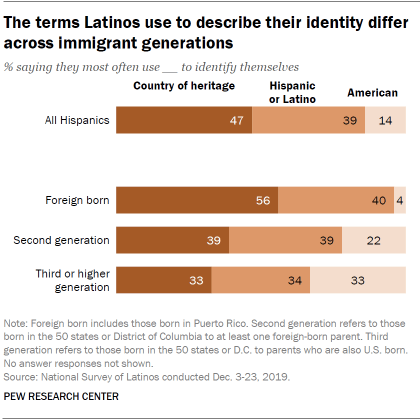
The terms Hispanics in the United States use to describe themselves can provide a direct look at how they view their identity and how the strength of immigrant ties influences the ways they see themselves. About half of Hispanic adults say they most often describe themselves by their family’s country of origin or heritage, using terms such as Mexican, Cuban, Puerto Rican or Salvadoran, while another 39% most often describe themselves as “Hispanic” or “Latino,” the pan-ethnic terms used most often to describe this group in the U.S.

The terms Latinos use to describe their identity differ across immigrant generations

Meanwhile, 14% say they most often call themselves American, according to a national Pew Research Center survey of Hispanic adults conducted in December 2019.

The use of these terms varies across immigrant generations and reflects their diverse experiences. More than half (56%) of foreign-born Latinos most often use the name of their origin country to describe themselves, a share that falls to 39% among the U.S.-born adult children of immigrant parents (i.e., the second generation) and 33% among third- or higher-generation Latinos.

How we did this

Meanwhile, the share who say they most often use the term “American” to describe themselves rises from 4% among immigrant Latinos to 22% among the second generation and 33% among third- or higher-generation Latinos. (Only 3% of Hispanic adults use the recent gender-neutral pan-ethnic term Latinx to describe themselves. In general, the more traditional terms Hispanic or Latino are preferred to Latinx to refer to the ethnic group.)

The U.S. Hispanic population reached 60.6 million in 2019. About one-third (36%) of Hispanics are immigrants, according to a Pew Research Center analysis of U.S. Census Bureau data. Another third of Hispanics are second generation (34%) – they are U.S. born with at least one immigrant parent. The remaining 30% of Hispanics belong to the third or higher generations, that is, they are U.S. born to U.S.-born parents.

A large majority of Hispanics who are third or higher generation see themselves as typical Americans

The December 2019 survey also finds U.S. Hispanics are divided on how much of a common identity they share with other Americans, though views vary widely by immigrant generation. About half (53%) consider themselves to be a typical American, while 44% say they are very different from a typical American. By contrast, only 37% of immigrant Hispanics consider themselves a typical American. This share rises to 67% among second-generation Hispanics and to 79% among third-or-higher-generation Hispanics – views that partially reflect their birth in the U.S. and their experiences as lifelong residents of this country.

Speaking Spanish seen as a key part of Hispanic identity

What it means to be Hispanic can vary across the group. Hispanics most often say speaking Spanish is an essential part of what being Hispanic means to them, with 45% saying so. Other top elements considered to be part of Hispanic identity include having both parents of Hispanic ancestry (32%) and socializing with other Hispanics (29%). Meanwhile, about a quarter say having a Spanish last name (26%) or participating in or attending Hispanic cultural celebrations (24%) are an essential part of Hispanic identity. Lower shares say being Catholic (16%) is an essential part of Hispanic identity. (A declining share of U.S. Hispanic adults say they are Catholic.) Just 9% say wearing attire that represents their Hispanic origin is essential to Hispanic identity.

The importance of most of these elements to Hispanic identity decreases across generations. For example, 54% of foreign-born Hispanics say speaking Spanish is an essential part of what being Hispanic means to them, compared with 44% of second-generation Hispanics and 20% of third- or higher-generation Hispanics.

For U.S. Hispanics, speaking Spanish is the most important part of Hispanic identity across immigrant generations

Most Latinos feel at least somewhat connected to a broader Hispanic community in the U.S.

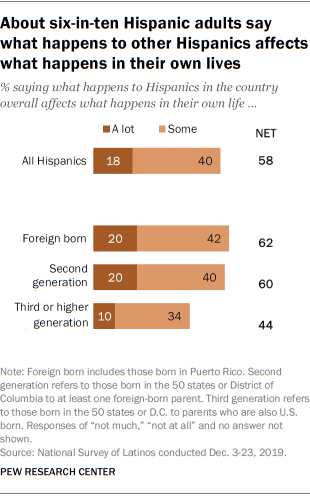
About six-in-ten Hispanic adults say what happens to other Hispanics affects what happens in their own lives

For U.S. Latinos, the question of identity is complex due to the group’s diverse cultural traditions and countries of origin. Asked to choose between two statements, Latinos say their group has many different cultures rather than one common culture by more than three-to-one (77% vs. 21%). There are virtually no differences on this question by immigrant generation among Latinos.

Few Hispanics report a strong sense of connectedness with other Hispanics, with only 18% saying what happens to other Hispanics in the U.S. impacts them a lot and another 40% saying it impacts them some. Immigrant Hispanics (62%) are as likely as those in the second generation (60%) to express a sense of linked fate with other Hispanics. This share decreases to 44% among the third or higher generation.

Note: Here are the questions used for this report, along with responses, and its methodology.

Source: How Hispanics see themselves varies by number of generations in US