Immigrants in America: Current Data and Demographics

Good reference source (MPI also has a great reference collection):

There were a record 44.8 million immigrants living in the U.S. in 2018, making up 13.7% of the nation’s population. This represents a more than fourfold increase since 1960, when 9.7 million immigrants lived in the U.S., accounting for 5.4% of the total U.S. population. Click the link below each summary table to download the data.

To find more context on the figures below, visit the blog post “Key findings about U.S. immigrants,” and for a downloadable version of the tables below, see the PDF and the Excel workbook. For facts on Latinos in the United States, see our profile on U.S. Hispanics.

For details on our regional grouping of countries, see our “Countries by regional classification” document (PDF).

Nativity of U.S. immigrants

Foreign-born population total 44,760,622
Percent born in Mexico 25.0%
Percent who are citizens 50.7%

Download Excel sheet with all population and nativity findings


Race of U.S. immigrants

Percent who are white alone, not Hispanic 17.7%

Download Excel sheet with all race findings


Language use among U.S. immigrants

Percent speaking English at least very well
(ages 5 and older)
53.2%

Download Excel sheet with all language findings


Age and gender of U.S. immigrants

Median age of foreign-born population (in years) 45
Percent of foreign born who are female 51.8%

Download Excel sheet with all age and gender findings


Marital status and fertility of U.S. immigrants

Percent who are married
(ages 18 and older)
61.2%
Percent who are women ages 15-44 giving birth in past year 7.5%

Download Excel sheet with all marriage and fertility findings


Education of U.S. immigrants

Highest degree completed, ages 25 and older

High school or less 49.2%
Two-year degree/Some college 18.8%
Bachelor’s degree or more 32.0%

Download Excel sheet with all education findings


Work status and occupations of U.S. immigrants

Ages 16 and older

Percent in labor force
(among civilian population)
66.6%

Download Excel sheet with all work findings


Earnings and income of U.S. immigrants

Ages 16 and older

Median annual personal earnings
(in 2018 dollars, among those with earnings)
$31,900
Median annual household income
(in 2018 dollars)
$59,000

Download Excel sheet with all income findings


Poverty and health insurance among U.S. immigrants

Percent living in poverty 14.6%
Percent uninsured 19.6%

Download Excel sheet with all poverty and insurance findings


Homeownership and households of U.S. immigrants

Percent in family households 82.3%

Download Excel sheet with all homeownership and household findings


Region and top states of residence of U.S. immigrants

West 33.9%
California 23.7%
South 33.7%
Texas 11.0%
Florida 10.0%
Northeast 21.2%
New York 10.0%
New Jersey 4.6%
Midwest 11.3%

Source: Immigrants in America: Current Data and Demographics

WES Survey: Are Intentions to Immigrate to Canada Changing in the Face of COVID-19?

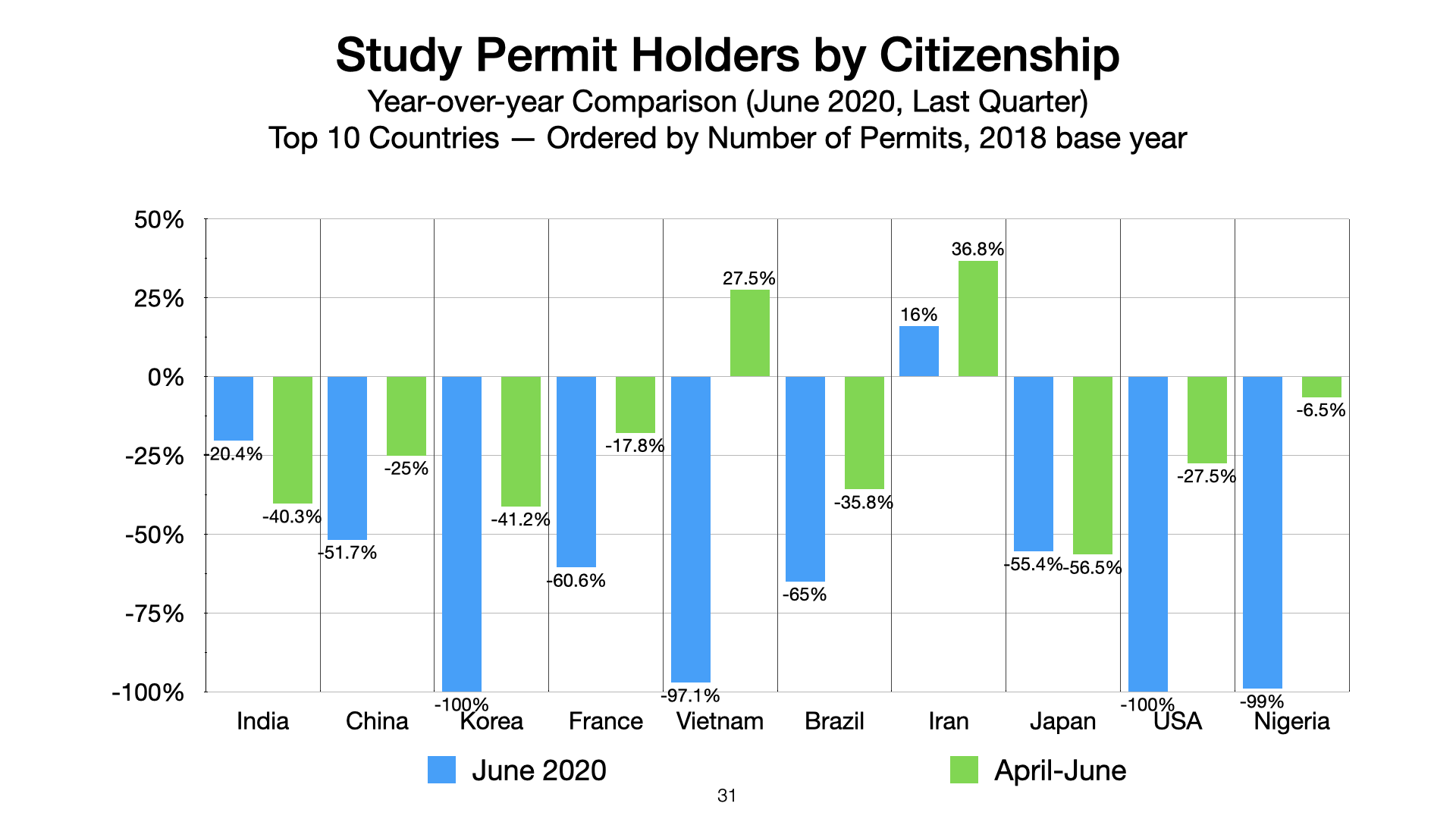
The second survey, showing increased interest in immigrating to Canada. Like all surveys, it is a snapshot, and interest doesn’t necessarily translate into action. The chart above highlights the year-over-year change in study permit holders for the 10 top source countries. As this quarter – July to September – is the historic peak, August numbers will be particularly important to assessing the impact:

What impact will COVID-19 and the resulting global economic recession have on prospective immigrants’ interest in moving to Canada? Recent research from World Education Services (WES) shows how these twin crises have affected the intentions of aspiring immigrants, shedding some light on this question.

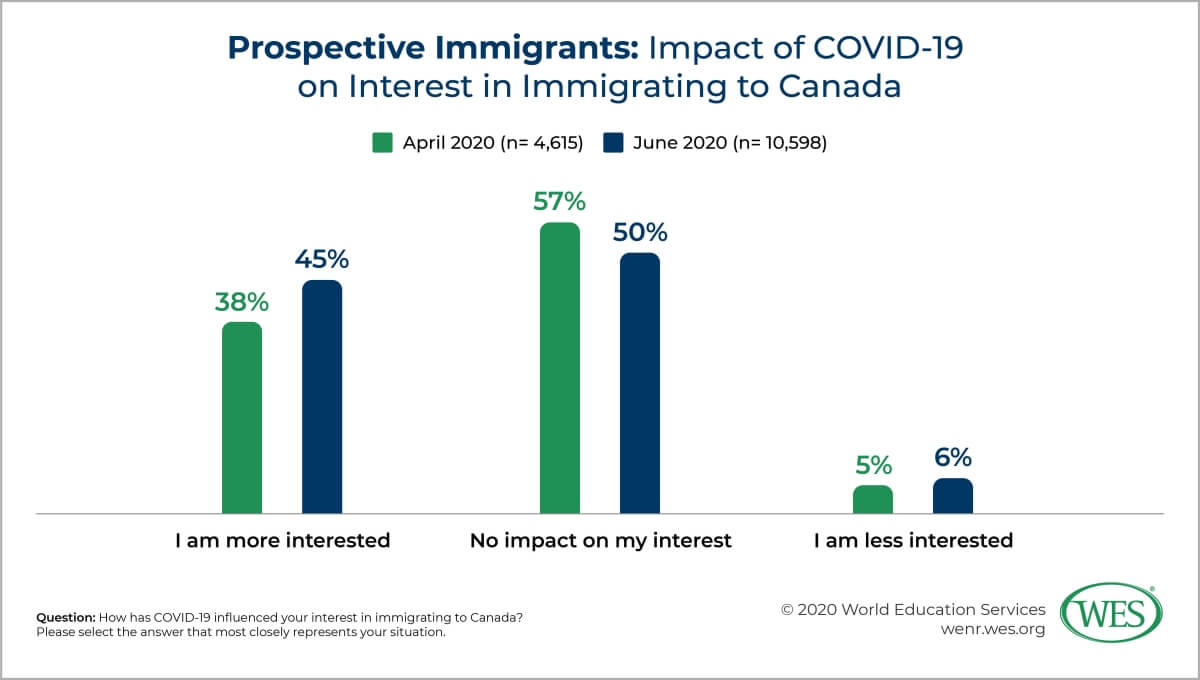
Fully 45 percent of respondents to a June 2020 survey reported that COVID-19 had increased their interest in immigrating to Canada, up from 38 percent in a similar survey in April. The survey will be sent out again in late August.

As a designated provider of the educational credential assessments required for those invited to apply to immigrate to Canada under one of the country’s economic immigration categories, WES is uniquely positioned to gauge the intentions and motivations of aspiring immigrants. Each week, WES interacts with thousands of prospective immigrants who apply for an educational credential assessment. This work gives us ready access to a pool of prospective immigrants who, by completing our surveys, can provide insight into their aspirations. What we’ve learned in these surveys may prove helpful to Canada’s immigration advocates, policy makers, and employers as they plan for a successful economic recovery.

INTEREST IN IMMIGRATING TO CANADA IS INCREASING AS A RESULT OF THE PANDEMIC

Despite COVID-19’s severe disruptions to international mobility and the global economy, both surveys reveal that the pandemic has increased interest in immigrating to Canada among a high and rising percentage of immigrant hopefuls, as noted above. Far fewer—just 5 percent in April and 6 percent in June—reported that the pandemic had decreased their interest in immigrating to Canada.

Are Intentions to Immigrate to Canada Changing in the Face of COVID-19? Image 1: Bar chart showing the impact of COVID-19 on the interest of prospective immigrants in immigrating to Canada

Image 1: Prospective Immigrants: Impact of COVID-19 on Interest in Immigrating to Canada

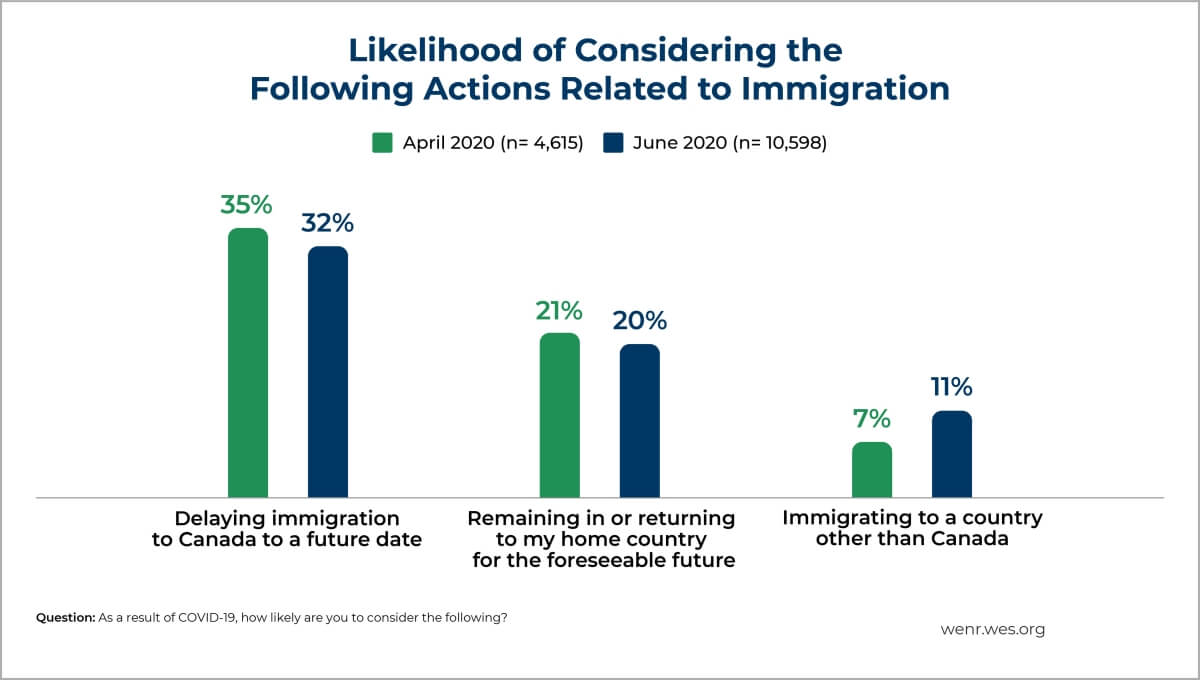
Respondents also reported that they were reconsidering their immigration plans and timelines in response to the pandemic. In June, around a third (32 percent) reported that they were considering delaying their immigration to Canada, a slight decline from the percentage in April (35 percent). A smaller proportion—11 percent of respondents in June, up from 7 percent in April—said they would consider immigrating to a country other than Canada.

Are Intentions to Immigrate to Canada Changing in the Face of COVID-19? Image 2: Bar chart showing the likelihood of prospective immigrants to consider certain immigration-related actions

Image 2: Likelihood of Considering the Following Actions Related to Immigration

ECONOMIC CONDITIONS IN CANADA AND ABROAD MAY BE DRIVING INTEREST

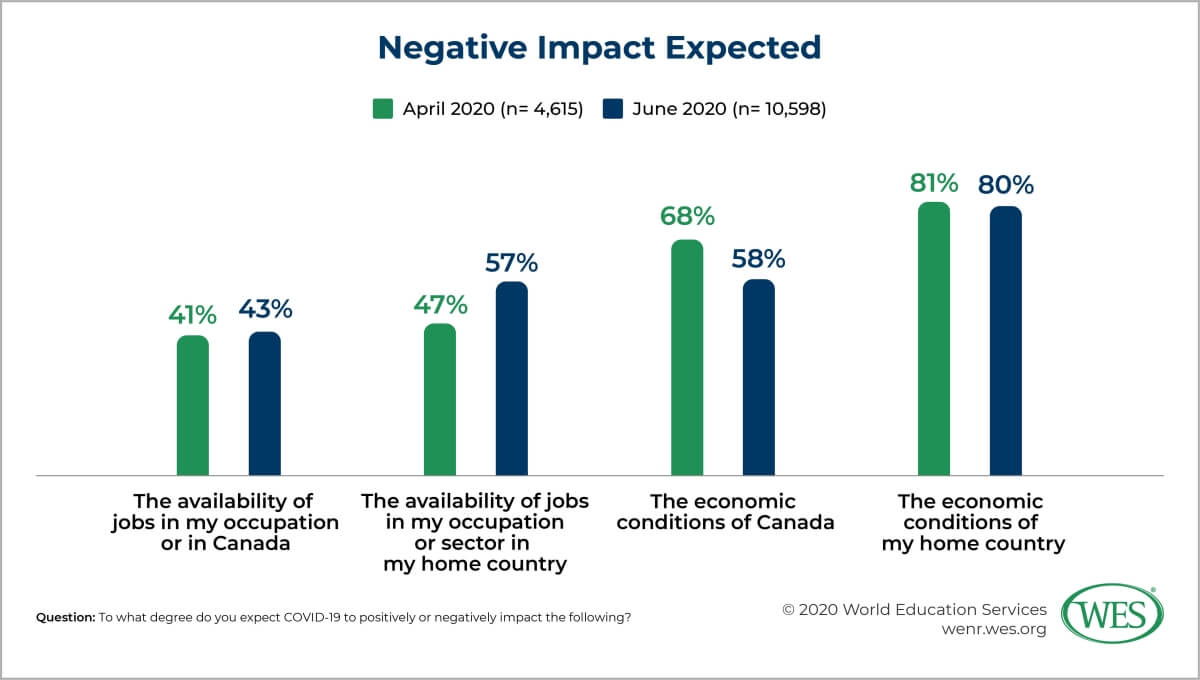
The relative resilience of Canada’s economy may be driving some of the interest in immigrating. While the surveys found that COVID-19-related economic concerns were widespread among immigrant hopefuls, our research also revealed that many respondents expected the economic impact in Canada to be less extreme than in their home country. The difference in expectations has grown greater over time. In April, 81 percent expected a negative impact on economic conditions in their home country, while fewer, 68 percent, expected a negative impact on conditions in Canada. In June, that expectation remained roughly the same for the respondents’ home country (80 percent), but by then only 58 percent expected a negative impact in Canada.

Similarly, by June, 57 percent of respondents expected a negative impact on jobs in their occupation or sector in their home country, up considerably from 47 percent in April. Far fewer—43 percent in June, up from 41 percent in April—expected a negative impact on jobs in their sector in Canada. This overall expectation of a less negative impact in Canada in terms of both overall economic conditions and the availability of sector-specific jobs may help to explain why by June nearly half of the respondents were more interested in immigrating to Canada as a result of COVID-19.

Are Intentions to Immigrate to Canada Changing in the Face of COVID-19? Image 3: Bar chart showing the prospective immigrants' expectations of the negative impact of COVID-19 on economic conditions in Canada and their home countries

Image 3: Negative Impact Expected

IMMIGRANTS WILL PLAY A VITAL ROLE IN CANADA’S RECOVERY

Canada’s continued attractiveness to those looking to settle there is good news for the country. Newcomers will play a critical role in the nation’s recovery. Despite high unemployment rates brought on by the pandemic, Canada still faces long-term talent shortages due to high rates of retirement and a shrinking pool of individuals entering the workforce each year. In the coming years, studies projecting workforce composition and growth estimate that immigrants will make up 100 percent of the net growth of the country’s labour force. Newcomers will be vitalboth to reenergizing and sustaining Canada’s post-pandemic economic recovery.

APPENDIX

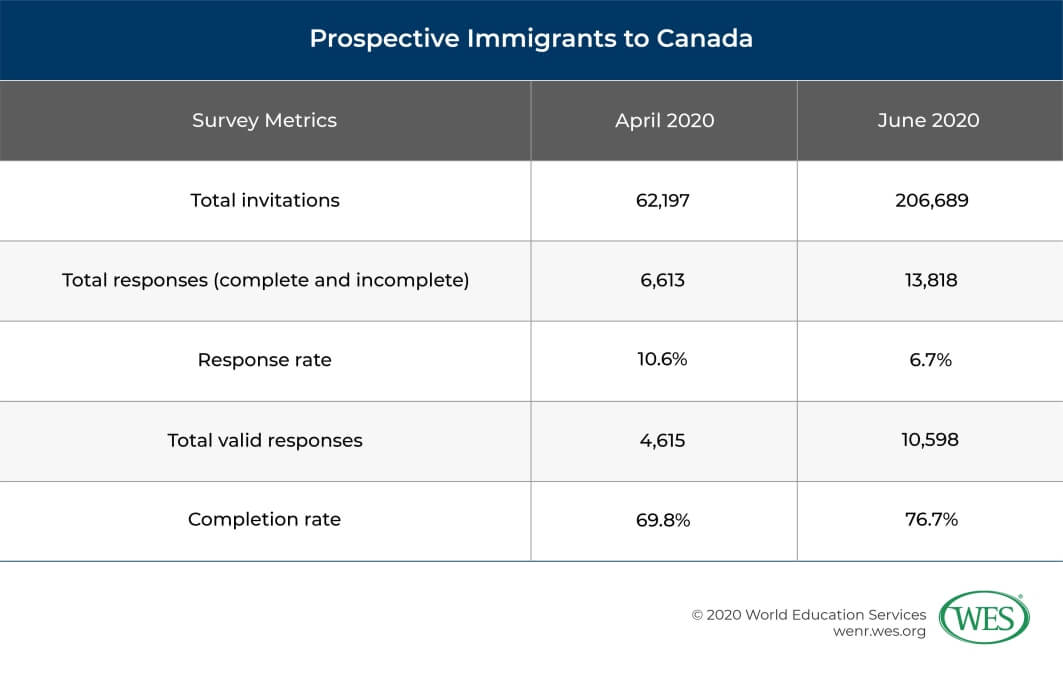
Are Intentions to Immigrate to Canada Changing in the Face of COVID-19? Image 4: Table displaying survey metrics

Image 4: Survey Metrics

RBC report says immigration slowdown due to COVID-19 threatens Canadian economy

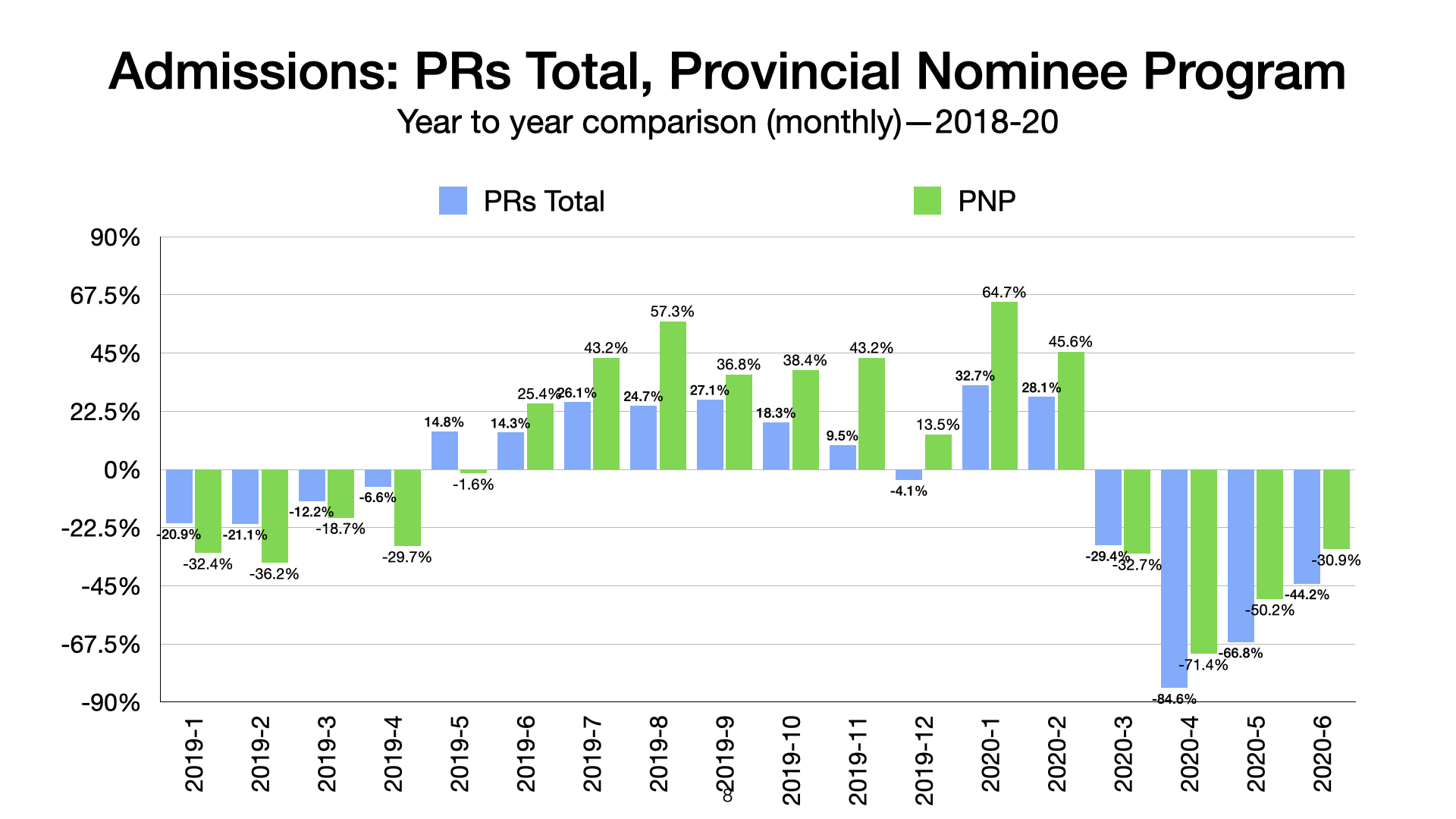
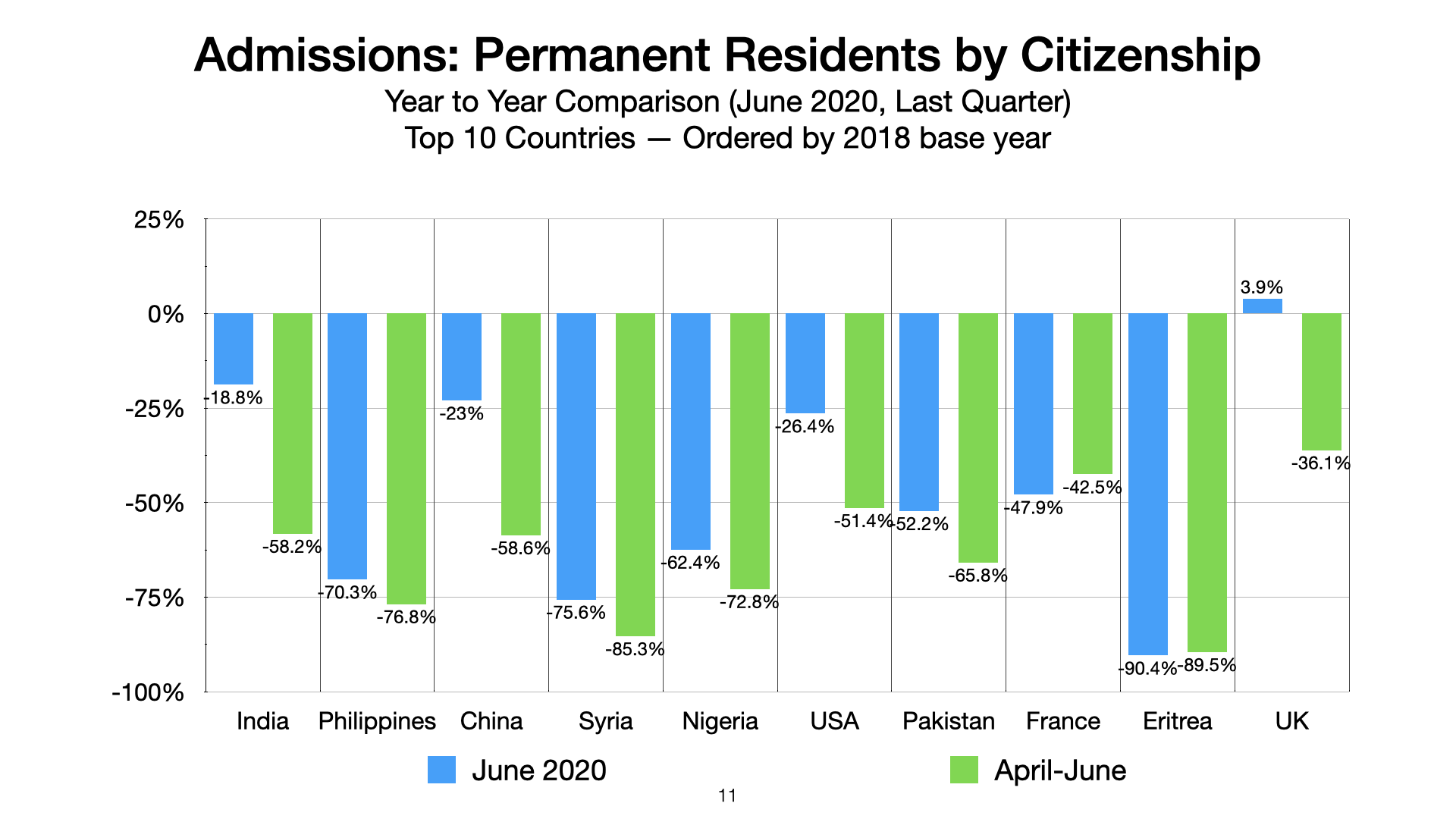
Not much new, but still a reckoning for Canada. The charts below show the year over year for immigrants (economic, family and refugees) as well as the subset coming under the various Provincial Nominee Programs, along with the top 10 countries:

A slowdown of immigration to Canada due to the COVID-19 pandemic threatens to derail a major source of economic and labour force growth, according to a report from the Royal Bank of Canada.

The shortfall jeopardizes the ability of the country to find employees needed in sectors such as health and elder care as the baby boom generation moves into retirement over the next few years, the report says.

It calls on the federal government to find new ways to encourage more immigrants to move to Canada.

“Canada does rely on having large numbers of people coming to the country to fuel growth and, if we see these large declines, one concern could be that people may decide maybe they don’t want to come to Canada anymore,” said report author Andrew Agopsowicz, a senior economist for RBC who studies labour trends.

“I think it’s really important for Canada to ensure the process is clear and that we still put out this attitude that we are open and we want people from the rest of the world to come to our country.”

Canada added 34,000 permanent residents in the second quarter, down 67 per cent from the same period last year, the RBC study said.

Meanwhile, new permanent residency applications to Canada were down 80 per cent and just over 10,000 new study permits were processed, down from 107,000 a year earlier.

Despite a recent recovery in the pace of immigration, the bank expects to see only 70 per cent of the originally targeted 341,000 new permanent residents at the end of the year, a decline of about 100,000 people.

The shortfall is particularly bad news for elder care as labour shortages have gotten worse in the wake of the pandemic’s deadly sweep through the country’s nursing homes, said Dr. Samir Sinha, director of health policy research at the National Institute on Ageing at Ryerson University and director of geriatrics at Mount Sinai Hospital.

“We’ve been having a huge struggle finding workers and retaining workers in this sector for years … and we were only keeping it afloat by often recruiting immigrants who are willing to take on these jobs that we as Canadians didn’t want to do,” he said.

“The fact it’s low paid and not valued also speaks to one of the reasons it’s been incredibly hard retaining (staff).”

Sinha said higher wages are needed not only to recruit Canadian-born workers but also to keep ambitious immigrants on the job longer.

Canada’s ability to attract immigrants with meaningful work as the economy struggles to rebound from the pandemic may be difficult.

A Statistics Canada report published Thursday finds that recent immigrants were harder hit by pandemic-related job losses, with 17 per cent becoming unemployed from March to April compared with 13.5 per cent of workers who are Canadian-born or immigrants who have been in Canada more than 10 years.

The percentage was higher, almost 20 per cent, for recent female immigrants.

The difference is significant, said Statistics Canada analyst Feng Hou, adding it is attributed mostly to recent immigrants having less work experience and earning lower wages.

“From past experience, when immigrants come during hard times, they tend to have a hard time finding jobs,” he said, adding there’s no data as yet to tell if that will happen in the current environment.

Travel restrictions that began in March and continue today make it difficult for people to physically come to Canada, Agopsowicz said.

At the same time, the lockdowns in the early days of the pandemic slowed processing of applications in Canada and prevented potential immigrants from accessing programs to ease application in their home countries.

An unknown is whether the COVID-19 virus, which hits senior citizens hardest, will have a dampening affect on the desire of foreigners to come to Canada and leave behind their vulnerable elderly relatives, Agopsowicz said.

“There’s a lot of uncertainty, I think, when people arrive already during normal times, so I think people are starting to work through what that means,” he said.

“This may be somewhat of a lost year (but) is this going to be easy to recover from next year in terms of bringing increased numbers back?”

Only about 20 per cent of new permanent residents are former students or temporary workers, he pointed out, suggesting Ottawa could do more to try to convince those people to permanently reside in Canada to bolster numbers.

Source: RBC report says immigration slowdown due to COVID-19 threatens Canadian economy

H-1B Visa Guidance Means Trump Likely Expects To Lose In Court

Interesting interview with immigration lawyer  H. Ronald Klasko and Stuart Anderson (Canadian tech immigration advantage):

Recent guidance issued by the U.S. Department of State to provide more exceptions to a presidential proclamation that banned the entry of H-1B and L-1 visa holders signals the Trump administration likely expects to lose in federal court. Examining a chronology of events supports this view.

–        On June 22, 2020, the Trump administration issued a presidential proclamation (P.P. 10052) that suspended the entry of foreign nationals on H-1B, L-1 and certain other temporary visas until at least December 31, 2020. The proclamation extended another proclamation, P.P. 10014, which suspended the entry to the United States of most immigrant visa applicants.

–        On July 15, 2020, Wasden and Banias, LLC filed a motion for preliminary injunction on behalf of 174 Indian nationals, asking a court to compel the State Department “to issue decisions on the plaintiffs pending requests for H-1B and H-4 visas.”

–        On July 31, 2020, the American Immigration Lawyers Association, Justice Action Center and Innovation Law Lab filed a motion for a preliminary injunction to enjoin the presidential proclamations on behalf of families, employers and organizations.

–        On August 10, 2020, 52 prominent companies and organizations filed an amicus brief in a lawsuit against the June proclamation brought by the National Association of Manufacturers, the U.S. Chamber of Commerce, the National Retail Federation, TechNet and Intrax. In the amicus brief, companies provided examples of how the proclamation harmed U.S. employers by blocking access to talented professionals, executives and others.

–        On August 12, 2020, just two days after the amicus brief from companies was filed, the State Department issued new guidance that broadened the “national interest exceptions” to the June 22nd proclamation (and P.P. 10014) to provide, at least in theory, more ways that foreign nationals and their employers could overcome the suspension on entry contained in the proclamations.

To explore the reasoning and implications behind the Trump administration’s legal maneuvers, I interviewed H. Ronald Klasko, managing partner and founding member of Klasko Immigration Law Partners, LLP. Klasko has practiced immigration law for more than three decades.

Stuart Anderson: Why do you think the State Department issued a guidance memo on August 12th that added more exceptions to the proclamation’s ban on H-1B, L-1 and other visa holders?

H. Ronald Klasko: In my opinion, the answer is obvious. The government’s attorneys likely advised that there is a very good chance that an injunction enjoining the implementation of the nonimmigrant (temporary) visa ban will be issued by one or more of the federal court judges in the pending litigations challenging the legal authority for the issuance of the ban.

The guidance memo appears to be an attempt to address many of the specific issues raised in the declarations and the amicus briefs regarding the prejudice and irreparable harm that this ban is inflicting on companies and foreign nationals. To me it is a clear sign that the administration is cognizant of the likelihood that it will be unsuccessful in avoiding the preliminary injunction unless it attempts to ameliorate the most harmful effects of the proclamation.

I do not believe that this tactic will be successful in preventing the issuance of an injunction because it does not address the legality of the ban. I believe the arguments challenging the legality of the ban are strong.

In addition, I assume that the lawyers involved in the various lawsuits challenging the ban will raise a number of issues, including some or all of the following: 1) the State Department guidance is not binding; 2) its issuance violates the Administrative Procedure Act (APA); and 3) the guidance is an attempt to impose the administration’s wish list for new H and L requirements, which it had planned to issue through regulation, by imposing these new requirements at the consular level as ways to be granted national interest exceptions to avoid the visa ban.

Presently there are no separate H or L requirements at the consular level. Rather, qualifications for these visas are based on a set of regulatory requirements at U.S. Citizenship and Immigration Services (USCIS) that can be reviewed by the courts. The State Department guidance memo creates a new set of requirements for the issuance of these visas that do not exist in the regulation.

By placing the requirements in a State Department guidance memo, it puts them in the context of national interest exceptions that are discretionary determinations and arguably non-reviewable in the courts. In contrast, USCIS adjudications and regulations can be challenged in court.

Anderson: Are there other reasons why the administration issued these measures on H-1B and L-1 visas in the guidance memo rather than in a regulation through the Department of Homeland Security?

Klasko: If the guidance were done through Administrative Procedure Act (APA) rulemaking, the process for notice and comment would be very lengthy time-wise. If the regulation were issued without notice and comment, it would be immediately challenged in the courts. In addition to the timing issue, many of the changes contained in the guidance memo would be subject to challenge as being inconsistent with the statute. (See here.)

Anderson: How would recent immigration memos and regulations be affected if Chad Wolf and Ken Cuccinelli are found to have been unlawfully holding their posts at the Department of Homeland Security and U.S. Citizenship and Immigration Services as the Government Accountability Office concluded?

Klasko: It likely will not impact the nonimmigrant visa ban and the immigrant visa ban, which were implemented through presidential proclamations rather than through memos or policies issued by the Department of Homeland Security (DHS) or USCIS. However, it could definitely be an issue in litigation challenging policies emanating from DHS or USCIS, such as public charge, asylum changes and possibly challenges to possible H-1B regulations.

Anderson: Do think the State Department guidance was helpful to companies and visa applicants?

Klasko: The State Department guidance is helpful in that it creates some possibilities for ameliorating the impacts of the nonimmigrant visa ban for at least some foreign nationals and companies. However, it is an example of a memo where there is less than meets the eye. It creates out of whole cloth an extremely document-intensive process with new requirements completely independent of the (document-intensive) process necessary to obtain USCIS approval of the H or L petition. Companies will have to document conformity with all new standards and requirements with no interpretations and with no certainty if, when and how the consular officers will adjudicate the national interest exceptions (NIEs).

Let’s look at how this will work. First, before there can be an adjudication of the NIE, the foreign national will have to be approved for an emergency appointment at the consulate, which requires proof that the travel is of an emergent nature.

Second, the consular officers will have to adjudicate the national interest exception application subject to no standards or guidance. Who knows how long it will take consular officers to complete these adjudications given that they already have extremely lengthy backlogs from 5 months of closure and they have never had to adjudicate these types of applications previously? This doesn’t even mention the fact that travel bans are still in effect for Schengen, UK, Ireland, China and Brazil.

None of this even addresses how difficult it will be to meet the language of the guidance memo. Most H-1Bs who are not resuming ongoing employment in the U.S. must meet a very difficult standard: their travel must be “necessary” to facilitate the “immediate and continued economic recovery of the U.S.” Think about it, how many H-1Bs are necessary to facilitate the immediate and continued economic recovery of the U.S.?

If the applicant meets those requirements, he then must show that he is making a “significant” and “unique” contribution to an employer meeting a critical infrastructure need. Uniqueness has never been a requirement of the immigration law. If it is really interpreted as requiring that the H-1B be the only person who could possibly do the job, the entire memo may be illusory. One other note: If the applicant is performing or could perform the functions of the position remotely from outside the U.S., he apparently doesn’t qualify.

For L-1s, it is not enough to be a manager or executive, which is the statutory and regulatory requirement. Under the State Department guidance, it is necessary to be a “senior level” executive or manager, which has no definition or guidance. Also, the statutory and regulatory requirement for an L-1 is that the transferee has been employed by the employer for at least 1 year. The State Department guidance requires multiple years of employment. How many years is multiple years?

In summary, the State Department guidance is better than no guidance at all, but possibly not much better.

Anderson: What do you think will happen between now and the end of the year on high skill immigration?

Klasko: I think in the coming months there is a good chance that the nonimmigrant ban and the immigrant ban will be enjoined by at least one federal court. I think that it is possible, and even likely, that there will be additional presidential proclamations of highly questionable legality attempting to implement further restrictions on high skilled immigration. I also think it is possible, or even likely, that there will be an effort to restrict high-skilled immigration through the regulatory process, possibly avoiding the notice and comment rulemaking required by the Administrative Procedure Act. I think litigators will be busy.
Source: https://www.forbes.com/sites/stuartanderson/2020/08/19/h-1b-visa-guidance-means-trump-likely-expects-to-lose-in-court/?utm_source=newsletter&utm_medium=email&utm_campaign=follow&utm_campaign=follow&cdlcid=5e4bc7f55b099ce02faa6b40#69373e5f15ab

Quebecers and other Canadians display similar concepts of national identity, according to Concordia researcher

Good summary of an interesting survey, with some similar conclusions as the 2020 Survey of Canadians: REGIONAL PERSPECTIVES on the ECONOMY and CLIMATE CHANGE regarding regional differences being somewhat less pronounced than public and political discourse would have one believe:

It is no secret that Quebec distinguishes itself through its unique culture, particularly its historical and linguistic background.

In a recent study, Antoine Bilodeau, professor of political science in the Faculty of Arts and Science, and University of Ottawa professor Luc Turgeon wanted to address the topic of national identity in Quebec and the rest of Canada. They tackled the question of whether Quebecers hold a more exclusive sense of identity than other Canadians.

Their article, published in Nations & Nationalism, the Journal of the Association for the Study of Ethnicity and Nationalism, examines how majority-group members in Quebec and the rest of Canada define members of their respective political communities.

“We wanted to see how Quebecers define what it means to be a true Quebecer and compare it to how other Canadians define what it means to be a true Canadian,” Bilodeau explains.

The co-authors analyzed a set of “boundary markers,” which Bilodeau explains consist of traits people use to characterize members within their national communities.

“These are mental boundaries that we use to define who belongs inside the national group and who does not,” he says. “Boundary markers are images that people have in their head, so it’s not because you’re a Canadian citizen that other people might see you as such.”

Bilodeau and Turgeon examined two types of boundary markers — ascriptive and attainable characteristics. Ascriptive markers of identity are more hereditary or non-acquirable traits such as ancestry, religion and birthplace. Whereas attainable markers are developed traits such as feelings of belonging, respect for the laws and institutions of the political community and knowledge of national languages.

The researchers examined three ways Quebec and the rest of Canada might differ. Their conclusion? Quebecers and Canadians are quite similar in their approach to defining a member of their national community.

More importance attributed to attainable traits

A total of 3,688 individuals were surveyed — 551 respondents from Quebec with a French mother tongue and 3,137 respondents from the rest of Canada with an English mother tongue.

First, they examined how each group would separate ascriptive and attainable characteristics. Bilodeau explains that Quebecers and other Canadians give relatively more importance to acquired characteristics than other traits.

“In both communities, the main emphasis in defining group membership appears to be on attainable characteristics,” he notes.

“Increasingly, people are putting emphasis on criteria such as feeling like a Canadian or speaking the language, rather than being born or having ancestors from the country.”

Similar value of language

The second aspect they examined was the importance attributed to language.

“We found out that language was not a major point of differentiation between Quebec and the rest of Canada,” Bilodeau notes.

Given the historical and cultural significance around language in Quebec, Bilodeau was surprised to see that it was attributed almost the same importance in Quebec as in the rest of Canada, in the context of defining national identity.

Comparable views on immigration

Bilodeau also points out that group members in Quebec and elsewhere in Canada expressed somewhat similar views toward immigration.

“Respondents expressing a stronger attainable conception of national identity did not provide more positive attitudes toward immigration,” reports Bilodeau. “The effect is not significantly different in Quebec than in the rest of Canada.”

However, respondents who focused on ascriptive traits to determine national identity, such as ancestry and birthplace, tended to have less positive attitudes toward immigration.

“It was quite interesting to see the distinction between those two aspects.”

A rather rigid sense of identity

“The way Quebecers define what it means to be a Quebecer was not fundamentally different than the way other Canadians define what it means to be a true Canadian,” Bilodeau concludes.

And despite the fact that attainable characteristics were overwhelmingly more important than ascriptive ones in both groups, the researchers were extremely surprised by the relatively high support for the ascriptive characteristics overall.

“There is a significant residue of a more exclusive definition of national identity that really puts emphasis on being born here, having spent a lot of time in the country, but also even having ancestry in both Quebec and the rest of Canada,” Bilodeau says.

“For a country that is so proud of its inclusive definition of national identity and its policy of multiculturalism, I’m not sure we’re really there yet.”

Source: Quebecers and other Canadians display similar concepts of national identity, according to Concordia researcher

How Netflix’s Immigration Nation shows the true horror of Ice agents

One of the better articles on the Netflix series, a must see:

The initial main draw of Immigration Nation, the six-part documentary series on immigration enforcement under Trump released on Netflix this month, was that US authorities did not want you to see it. After viewing a final cut, US Immigration and Customs Enforcement (Ice), which had allowed the film-makers, Christina Clusiau and Shaul Schwarz, to embed with agents for over two years, attempted to intimidate the production team into delaying the release. The agency threatened Clusiau and Schwarz with lawsuits, according to a New York Times report, and to use the “full weight” of the federal government to block publication of certain Ice scenes usually invisible to the American public.

It didn’t work, and watching the six-hour series, it is clear why the agency did not want the footage to become public. Immigration Nation, more than any other documentary of the Trump administration’s immigration crackdown, allows Ice agents and officials to explain their perspective. And thus more than any other documentary, Immigration Nation reveals how a government agency upholds and perpetuates evil. Two-plus years of Cops-style embedment doesn’t glorify Ice agents, but instead reveals the agency to be populated by, in some cases, callous people who gloat over arrests; more often, affable people fulfilling their small part of the contract as directed, with the compartmentalization it requires.

StatCan/IRCC Study: Selecting economic immigrants from among temporary foreign workers and labour market outcomes by admission programs

Another insightful data-based analysis by StatCan and IRCC, showing the importance of Canadian work experience from being former temporary foreign workers:

Canada selects economic immigrants through various programs, including the Federal Skilled Worker Program (FSWP), the Provincial Nominee Program (PNP) and the Canadian Experience Class (CEC).

Previous research has shown that the last two groups fare better in the labour market than the first one, at least in the initial years after immigration. The difference stems largely from the fact that proportionately more economic immigrants selected from the PNP and the CEC were former temporary foreign workers, according to the first study released today.

The study, titled ‘Two-step immigration selection: Why did immigrant labour market outcomes vary by admission programs?,’ shows that from 2009 to 2016, about two-thirds of immigrants selected from the PNP and essentially all immigrants selected from the CEC were former temporary foreign workers, i.e. had employment earnings in Canada before obtaining their permanent residence.

In contrast, about one-quarter of their counterparts selected from the FSWP were former temporary foreign workers.

Since having worked in Canada before obtaining one’s permanent residence is associated with higher employment incidences and earnings, the fact that a relatively high proportion of immigrants selected from the PNP and the CEC worked in Canada in the past explains to a large extent their better labour market outcomes.

For example, 93% of immigrants selected from the PNP and 95% of immigrants selected from the CEC found employment in the first full year after obtaining permanent residency. The corresponding percentage for their FSWP counterparts was substantially lower, at 80%.

The study shows that the greater propensity to have worked in Canada in the past accounts for about 40% of the 13-percentage-point difference observed between immigrants selected from the PNP and the FSWP. It also accounts for about two-thirds of the 15-percentage-point difference observed between immigrants selected from the CEC and the FSWP.

The relatively high proportion of PNP and CEC immigrants who had previous work experience in Canada also explains why these groups earn more than their FSWP counterparts. It accounts for at least 94% of the earnings differences observed between these groups, on the one hand, and immigrants selected from the FSWP, on the other hand, during the first year after immigration.

Likewise, the greater propensity to have worked in Canada in the past accounts to a large extent for the differences in employment incidences and earnings observed between the three groups, five years after immigration.

The second study, titled ‘Two-step immigration selection: Skilled work experience vs. pre-arranged jobs,’ focuses on the economic immigrants who were selected under Canada’s Express Entry system in 2015 and 2016. It compares the degree to which Canadian work experience before immigration and pre-arranged employment at the time of application predict the initial labour market outcomes of these economic immigrants.

Both Canadian work experience and pre-arranged employment are key criteria underlying Canada’s Express Entry system of economic immigration selection.

The study shows that Canadian work experience appears to be a better predictor of initial labour market outcomes than pre-arranged employment.

Economic immigrants who had pre-arranged employment displayed, in the first two years after immigration, employment incidences that were similar to those of other economic immigrants selected under the Express Entry system.

In contrast, economic immigrants who had worked in Canada before immigrating and who had received relatively high annual earnings while doing so (over $50,000 in 2017 dollars) had employment incidences that were 8 percentage points higher than those of other economic immigrants without Canadian work experience.

Canadian work experience was also a stronger predictor of initial earnings after immigration than pre-arranged employment.

Even after controlling for education, among other factors, immigrants with a pre-arranged job earned 15% more than those without a pre-arranged job in the first two years after immigration. However, immigrants who had received high earnings in Canada before immigrating earned almost twice as much as those who had no Canadian work experience.”

View or download the full reports:

Two-step Immigration Selection: Why Did Immigrant Labour Market Outcomes Vary by Admission Programs?

Two-step Immigration Selection: Skilled Work Experience vs. Pre-arranged Jobs


UK must restore ISIL bride Shamima Begun’s citizenship

Echoes of previous debates regarding citizenship revocation under C-24, repealed by the Liberal government. Challenge, of course, remains in successfully prosecuting those involved in ISIS.

And of course, given that those involved in ISIS range from immigrants, second generation and “old-stock” citizens, revocation has a broader impact than just immigrants and their children.

Moreover, there is a risk of viewing those involved in ISIS only as victims, without any agency or responsibility:

ISIL bride Shamima Begum, whose British citizenship was revoked in 2019 on national security grounds, can return to the UK from Syria to plead her case to restore her citizenship, according to a UK court. The Court of Appeal ruled on July 16 that Begum had been denied a fair hearing because she could not properly defend herself from Syria. The verdict means that the UK government is now required to find a way to coordinate the return of Begum, who is currently being held in Camp Roj, a refugee camp in northern Syria.

This case could set a precedent for Canada and the rest of the Western world.

At the age of 15, Begum travelled to Syria to marry a Dutch jihadi who had converted to Islam and joined ISIL. After four years with ISIL, Begum, nine months pregnant, revealed her identity to war correspondent Anthony Loyd. “I am a sister from London,” she told him. “I’m a Bethnal Green girl…I’m scared that this baby is going to get sick in this camp…That’s why I really want to get back to Britain, because I know it will get taken care of, health-wise at least.”

By then, Begum’s two other children had died in ISIL territories, reportedly due to malnutrition. Loyd’s story appeared on the front page of The Times and created a social media storm.

In under a week, the UK government stripped Begum of her citizenship. While the Geneva Conventions prohibit making citizens stateless, the government justified taking away citizenship by pointing out that Begum’s mother is Bangladeshi, which means Begum might be eligible for Bangladeshi citizenship. However, in May 2019, the Bangladeshi foreign minister, Abul-Kalam Abdul-Momen, stated that Begum has “nothing to do” with Bangladesh and would be denied entry, and if she did find her way there she would face capital punishment due to zero-tolerance policies for terrorist activities. “The British government is responsible for her,” he said. Three weeks after her citizenship was revoked, Begum’s baby died of a respiratory infection. She continues to be effectively stateless.

Loyd described Begum as emotionless and awkward, with no discernible sympathy. Begum revealed she was not disturbed by the sight of decapitated heads of fighters in a trash can in Raqqa, by other atrocities or by the torture and murder of Western journalists by ISIL. After hearing this, anyone would see Begum as someone who does not deserve empathy. Scholar Lisa Downing has argued that it should not matter how we feel about Begum. Even so, if Begum’s intention has been to return, why has she not at least pretended to be remorseful?

Begum’s statements are precisely what I would anticipate from an indoctrinated child, spending years living within the reach of ISIL’s extreme propaganda machine. Her demeanour and lack of emotion and remorse may be a response to emotional trauma. We don’t know the full story because she has not undergone a proper evaluation with a trauma specialist. Begum’s lack of emotion matches that of many born-again insurgents whom I have interviewed.

In my fieldwork, an ex-combatant with Jundallah, an insurgent group in Iran, told me about the first time he was assigned to execute a hostage to prove his devotion to the cause. “The man was weltering around, fighting for his life, screaming.” It took multiple bullets to kill the prisoner, not the single shot he had imagined. “It killed me inside…After that experience, nothing fazes me anymore…I am dead inside.” The reality of what it means to fight for the cause shook him, and he eventually escaped to Turkey to help with a disillusionment, deradicalization and disengagement initiative. He explained that many foreign recruits want to prove themselves, to be considered insiders. They take their assignments seriously and cling strongly to the ideology to remove any remnant of hesitation, doubt or guilt.

Putting aside Begum’s lack of penitence, the first question should never have been “Where are her parents from?” but rather “What is the right thing to do?” It was much easier to strip her of citizenship and reframe the discussion in the media than to ask the hard question: Why do men and women join extremist organizations? Western-born members often have the opportunity to enjoy comfortable, middle-class lives, with the chance to advance in admired, conventional careers. Instead, they choose terrorism and commit heinous acts of violence against their fellow citizens, often at the price of their own lives. We need to rewind and ask what went wrong.

During my 2018 fieldwork, I met Jabbar, a 32-year-old barbershop owner in Paris. While he disdained acts of terror, he told me that he understood why people join extremist groups. When he was younger, with no job, and “constantly getting harassed by everyone on every occasion,” he internalized vast challenges with his identity and harboured a deep sense of alienation. He was accepted neither in France nor in Algeria, where his parents emigrated from. To be accepted as French, “you have to change your hair, switch your name to Pierre, eat pork, drink wine, and in the end, they still call you a cosmopolitan Muslim.” He was also ridiculed in Algeria and was not considered a true Algerian because of his accent and clothing. He asserted that was why second-generation youths feel alienated and excluded.

Begum’s case is an example of how citizenship, along with other rights often taken for granted by the majority, is variable and portrayed as a privilege for those whose parents or grandparents are immigrants.

In a story that made headlines recently, a sales manager named Mohamed Amghar described being coerced to change his name to Antoine, a traditional French name, at work. He is suing his former firm for 440,000 euros and filing a discrimination complaint. He was pressured into using the name on business cards, conference badges, plane tickets and even performance awards. “If people like me, who did what was necessary to get good jobs, to get training, to live as citizens, are besmirched and denied our rights, where are we going?” Amghar said. “I only have one name, I only have one nationality,” he added. “My name is Mohamed, and I am French.” The systemic nature of micro-aggressions, discrimination, racism and xenophobia has been documented throughout most of Western Europe, the United States and Canada. This narrative was common across my fieldwork and may be applicable for young recruits who have gone on to conduct terrorist activities, recruited by a group that claimed to finally accept them in all aspects of their being.

As part of Western governments’ obligations to fix their counterterrorism strategies, Western countries need to create an effective response for returnees. Begum’s case is an example of how citizenship, along with other rights often taken for granted by the majority, is variable and portrayed as a privilege for those whose parents or grandparents are immigrants. Insurgent groups appeal to this notion. An ISIS magazine  stated, “They never will consider you an equal to the white man,” and claimed you will always be considered second-class citizens. Efforts have continued to “other” Begum for her mother’s immigrant status. All the while, politicians have riled up the public, framing her case as a decision about whether to “welcome back a terrorist.”

I am not saying Begum shouldn’t be held accountable. I firmly believe that she should be subject to criminal prosecution, if appropriate, along with rehabilitation. As I have argued before, bringing back returnees may provide the opportunity to enhance counterterrorism intelligence by drawing upon them as a resource on extremist recruitment and radicalization strategies. Perhaps even more importantly, bringing back returnees would allow the UK and other Western nations to uphold human rights by pursuing justice through the judicial system and by providing the appropriate rehabilitation. Instead, we are seeing an acceleration and cultivation of separate justice for separate peoples. Consider this: Would Begum have lost her citizenship if her parents were from Leeds?

Revoking citizenship based on parents’ immigration status sidesteps the ethical obligations that states have toward their citizens and alienates second-generation immigrants, deepening prejudices they are already well accustomed to experiencing. The UK has the opportunity to change its course and set an example for Canada and the rest of the world. Begum should have a fair trial in the only country where she has ever held citizenship.

Western nations should reconsider their stance on repatriation despite the challenges involved. They should bring home their citizens to demonstrate their commitment to justice for all and prevent the secondary effects of the cycle of alienation, isolation and othering that leads to extremism in the first place. This is part of any proper justice system and could reduce radicalization in youth in the long run. It could foster belonging, which is something the politics of fear cannot do. Western nations must look upstream and deconstruct the systems and policies in place that are riddled with micro-aggressions, structural xenophobia and outright racism to reconstruct an inclusive society that would eliminate the breeding ground for radicalization that currently exists.

Source: UK must restore ISIL bride Shamima Begun’s citizenship

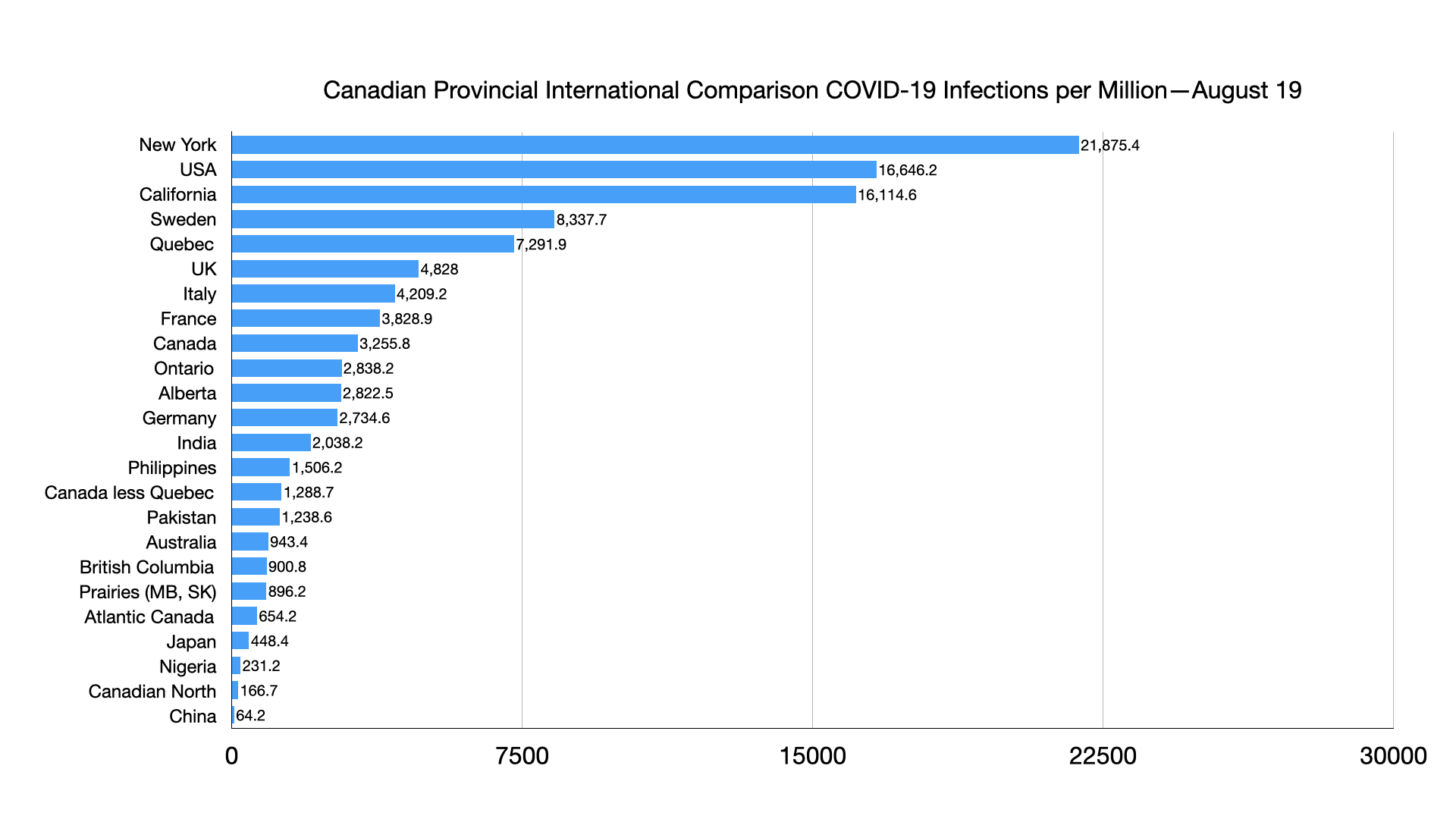
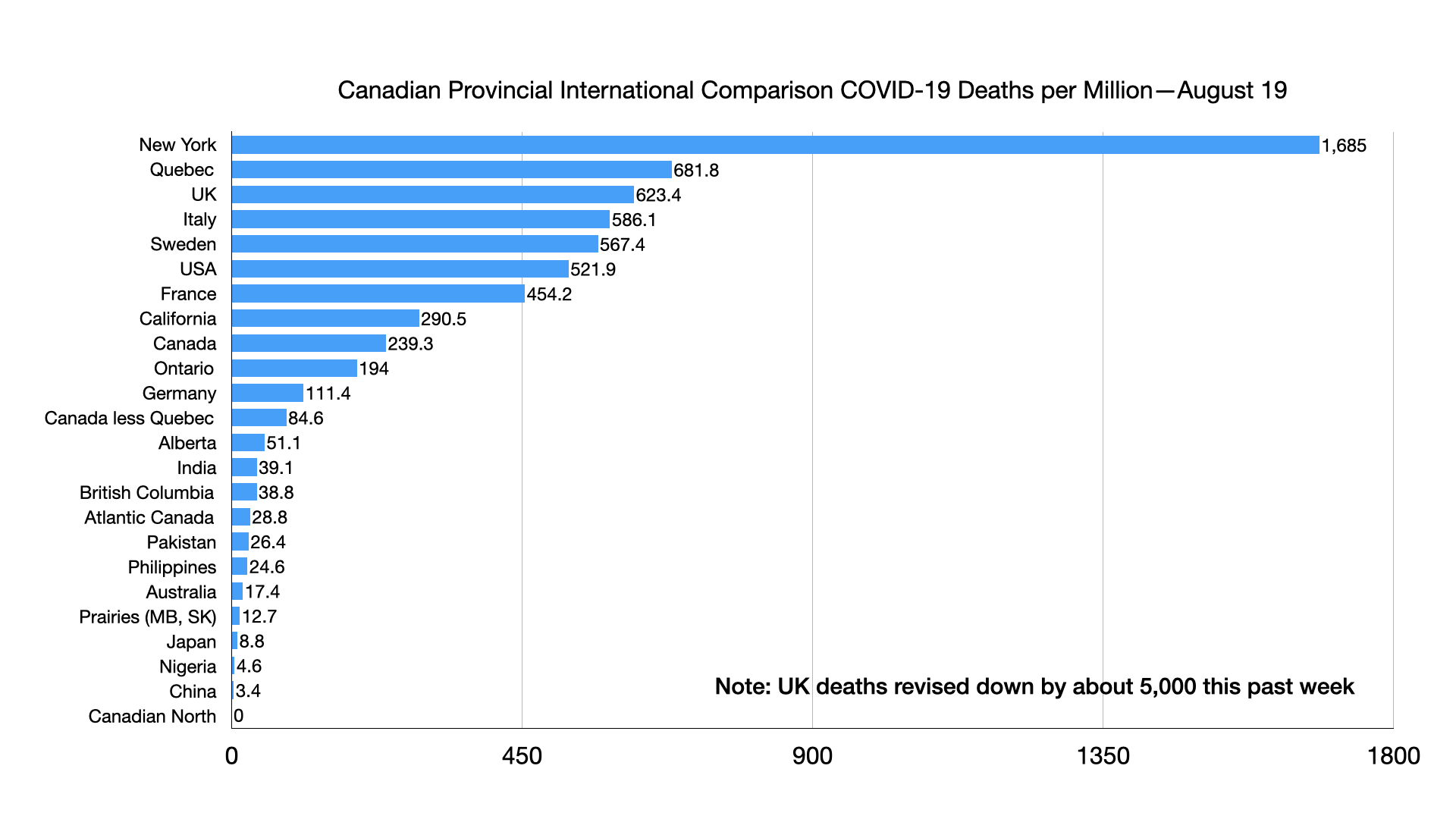
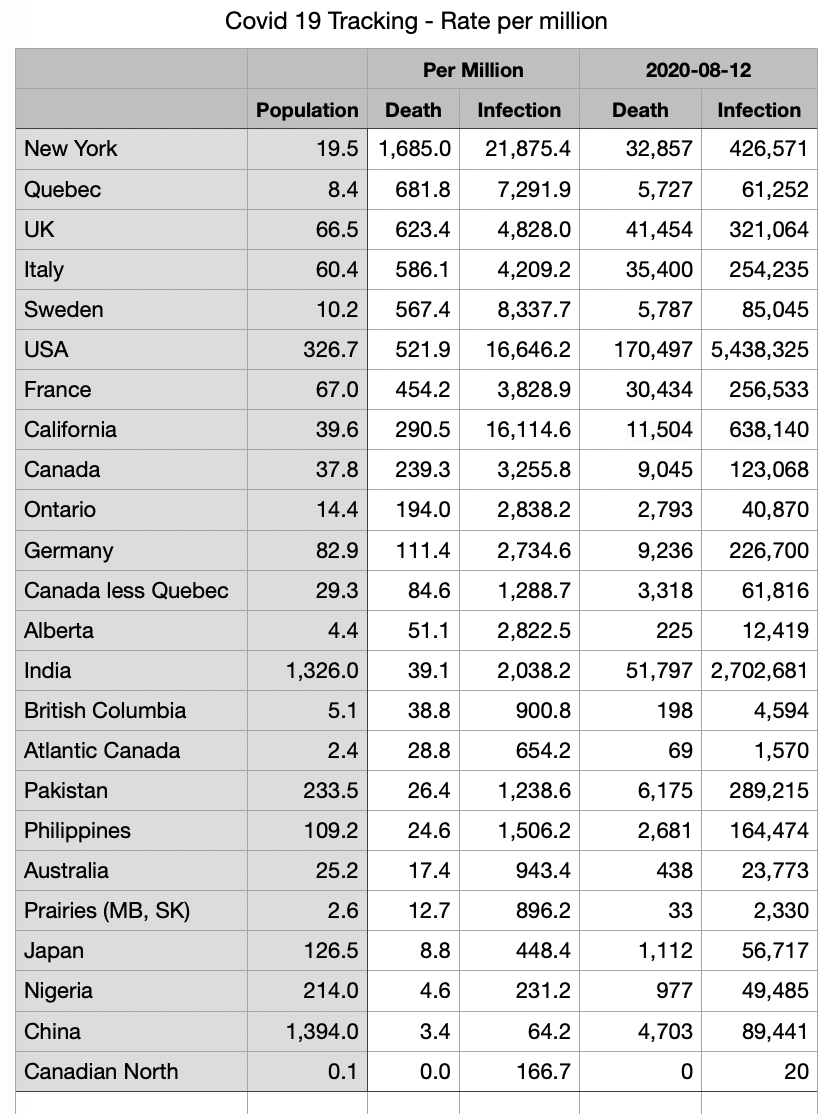
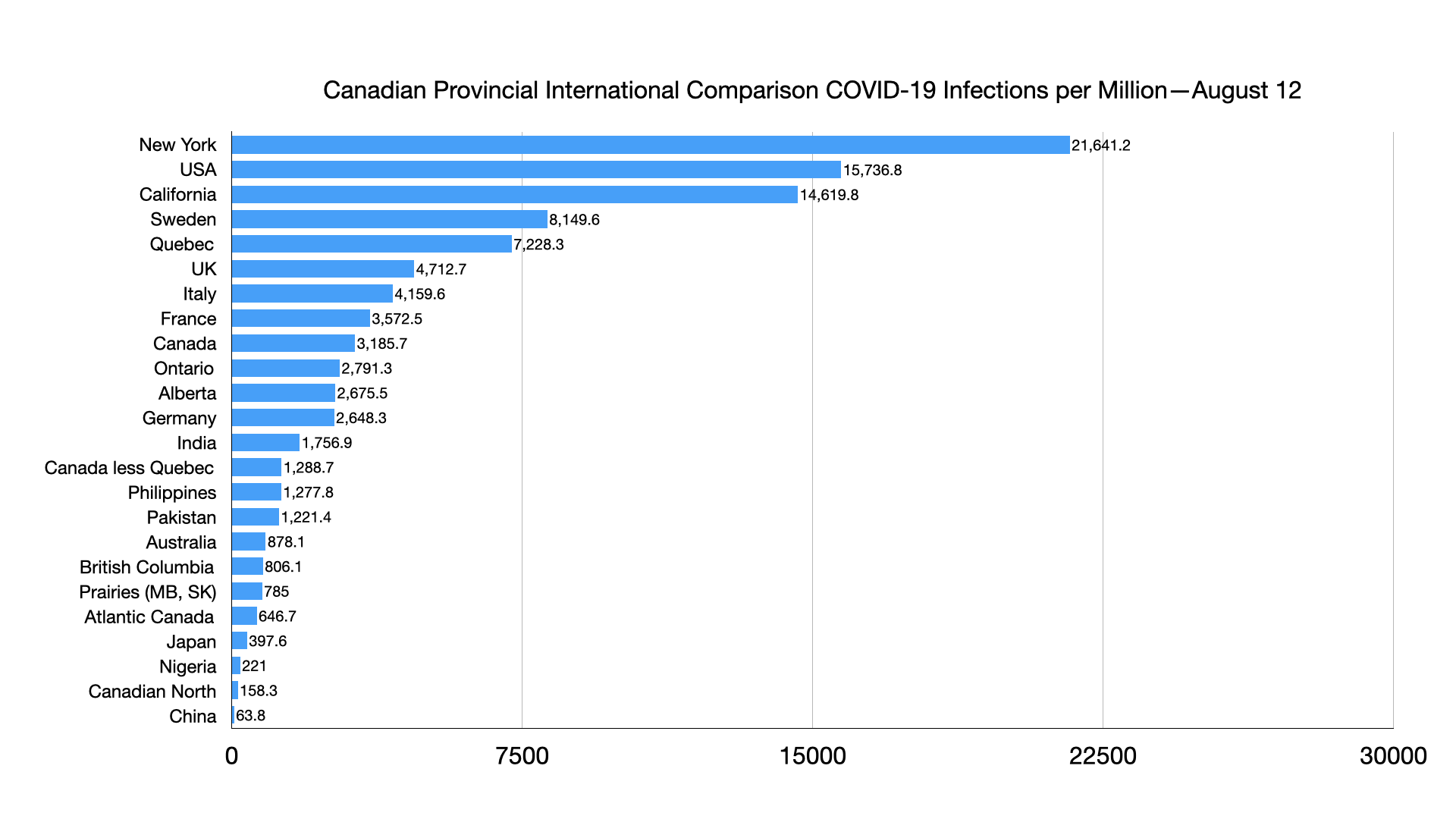
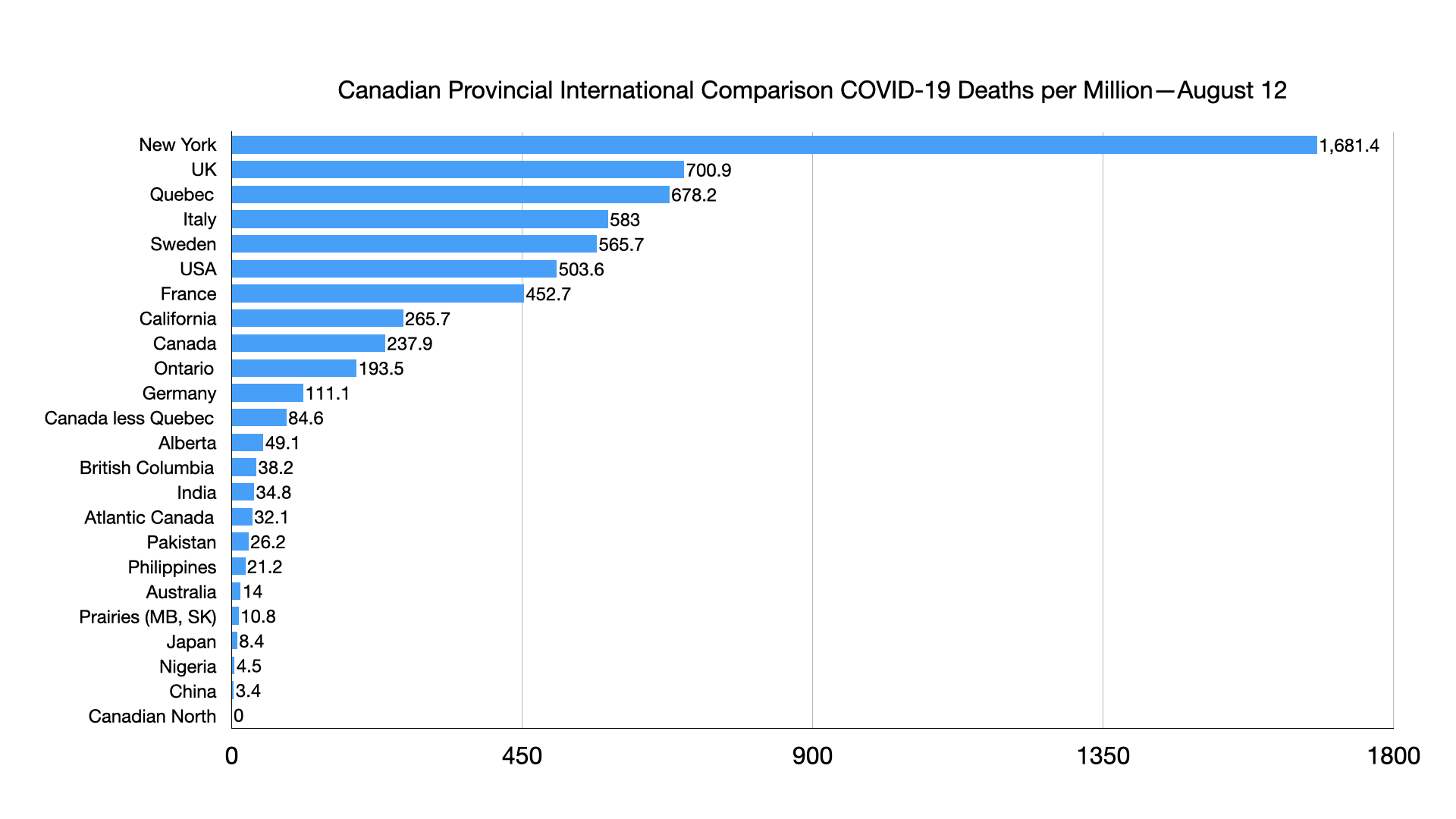
#COVID-19: Comparing provinces with other countries 19 August Update

Latest update. As UK revised the number of deaths by about 5,000, Quebec now has the highest death rate per million. Overall infection and death numbers continue to increase given the impact of some of the opening up measures.

Wealthy turn anti-immigrant when their riches are threatened

Interesting psychological study, with the fear of loss (absolute or relative) being the motivator (association/correlation, not necessarily causation):

Anti-immigration sentiment rises when affluent people fear losing their wealth, a psychological study has found.

The University of Queensland’s Professor Jolanda Jetten said harsh attitudes towards immigrants were found in times of economic downturn and relative deprivation—and also in prosperous times.

“Affluent people who fear losing in the short or long term experience collective angst about their group’s future vitality and wealth status,” she said.

“Our research found this fuels negative attitudes toward immigrants and minorities. Even though may have a lot, their fear of falling is associated with opposition to immigration.”

Professor Jetten said the research turned accepted wisdom on its head, showing that society’s most economically vulnerable were not always the most supportive of anti-immigration calls.

“In explaining the rise of right-wing populism, many have pointed to the 2008 Global Financial Crisis as the root cause of rising anti-immigrant sentiments,” she said.

“Experts had long believed that economic downturns triggered perceptions of relative deprivation and chances of civil conflict. Moreover, , so the argument typically goes, increase fear and frustration among poor working-class voters. These dynamics are typically referenced when discussing Trump’s victory in the 2016 US presidential elections, and the success of populist parties like One Nation in Australia. The assumption that economic crises combined with individual relative deprivation provide for populism, dominate many of the discussions on the origins of right-wing populism and anti-immigrant sentiments more generally.”

But the new research highlighted wealthier people who might be attracted to such populist parties, said Professor Jetten from the UQ School of Psychology.

“It seems that if you have a lot of money, you feel you have a lot to lose and the fear of falling makes you feel vulnerable and concerned about the future,” she said.

The research team, including Dr. Frank Mols and Dr. Nik Steffens, found an association between opposition to immigration and fear of losing wealth, individually or collectively, across four studies involving a total of more than 1000 people.

“In the laboratory, when we made people feel wealthy they were more opposed to immigration when they were made to feel that they might lose some of their wealth in the future than the group who felt their wealth was secure,” Professor Jetten said.

“In a study among Australian participants we found the their own financial future, or that of Australia’s, will be worse than the present, was associated with more opposition to immigration. The results may help us to explain why support for political parties with anti-immigrant messages sometimes comes from the wealthiest in society. This is important at a time when populist parties and leaders with strong anti-immigrant stances are a force to be reckoned with in many countries.”

Source: Wealthy turn anti-immigrant when their riches are threatened