Agree. Starts, of course, with better and more comprehensive data:
In the COVID-19 era, Canada needs to better understand the relationship between identity and health. To do that, we need to use intersectional analysis, the study of the way identity categories such as gender, race and ability interconnect to create discriminatory systems that impact individuals in different ways. Fortunately, we have a policy tool in our policy toolbox for precisely this purpose, and it can and should be deployed by provincial ministries of health across this country: Gender-Based Analysis plus (or GBA+). Our federal government has been using GBA+ for years across many departments, though it is not mandatory for all federal departments. But it is in use at the Privy Council Office, Finance, the Department of National Defence and Health Canada. There is therefore a wealth of Canadian policy experience with this tool, and we need GBA+ now more than ever.
The GBA+ tool was developed by the federal Department of Women and Gender Equality (WAGE), formerly Status of Women Canada. It is an approach to understanding sex and gender alongside other identity factors such as race, ability and age, to assess how various groups experience policies, programs and initiatives. The aim of GBA+ is the creation of equitable policies, programs and initiatives — equitable from inception to execution. Awareness of the differential impacts that government policies and actions have on different identity groups is central to that goal.
There are no hard and fast rules on how GBA+ should be done; in fact, it is perhaps best thought of as a competency rather than a methodology. In other words, there is no set formula to achieve equity in all situations; rather, progressing toward equitable change requires the continued cultivation of knowledge about various groups, the challenges they face and potential avenues for change. Nevertheless, GBA+ consistently relies on the use of disaggregated data, in addition to other forms of research, to gain insights into policy. Reliable data are essential to effect change, especially with identity-based issues. Showing patterns of discrimination is more compelling than anecdotal accounts in documenting a need for policy change. GBA+ also requires the monitoring and evaluation of the effects of policies on Canadians. It is not enough to enact change; change must be equitable.
Properly applied to the government’s COVID-19 response, GBA+ would have directed policy-makers to draw on fine-grained differentiated data to evaluate equity considerations. In asking whether policies are equitable, GBA+ analysts ask whether policy outcomes track a range of identity factors, including race, ethnicity and socio-economic background. Thus, if GBA+ had been applied to provinces’ public health response to COVID-19 from the start, requisite data would have been collected from the outset. These data, as the trickle of international evidence is making increasingly apparent, are key to targeting necessary medical supplies, policies and programs to those most affected, and hence helping to curb the spread of the virus.
GBA+ directs policy-makers to include identity-based considerations in the formulation, deployment and evaluation of their policies. Of course, GBA+ is not perfect: critics sometimes charge that it is too abstract, offering little actionable guidance to policy-makers. While its goals may be commendable, it is not always readily apparent how GBA+ should influence decisions within a specific portfolio or policy. This is why proponents of GBA+ argue it is a competency rather than a methodology. Policy-makers need to develop the ability and experience needed to make equitable decisions. Whether or not this response satisfies critics, it is true that GBA+ has clear implications in the context of COVID-19. If it had been employed in the appropriate offices before the pandemic, it would have helped policy-makers see and act upon considerations of identity in the making of health policy, including in their collection of data. Even at this later stage, the deployment of GBA+ would significantly improve our understanding of the virus and our response to it.
Our obliviousness to the potential relationship between race, ethnicity and socio-economic status and infection, hospitalization and death rates will negatively impact our ability to control the spread of the virus in the short term and impair our understanding of how this virus impacts societies’ well-being in the long term. In response to criticism about this gap in data collection, Ontario’s chief medical officer of health, Dr. David Williams, for example, has said that statistics based on race aren’t collected in Canada unless certain groups are found to have risk factors.
Frankly, this position just does not align with mounting international evidence that race, ethnicity and socio-economic status have an impact on health outcomes related to COVID-19. A recent study released by a United Kingdom think tank, the Institute for Fiscal Studies, finds that minority groups are overrepresented in hospitalizations and deaths from the virus, with Black Britons nearly twice as likely to die from COVID-19 as the white British majority. Similar patterns have emerged in the United States, where the Centers for Disease Control confirmed that current data suggest a disproportionate burden of illness and death among racial and ethnic minority groups. New York City, for example, has recorded a disproportionate death rate among African-Americans (33.2 percent) and Hispanics (28.2 percent), and a Washington Post analysis shows that American counties that are majority-black have three times the rate of infections and almost six times the rate of deaths as counties where white residents are in the majority
There is further reason to apply a GBA+ lens to race, ethnicity and socio-economic data of those infected, hospitalized or succumbing to COVID-19. Academic studies have noted that racial discrimination, specifically when directed against Canada’s Black and Indigenous people, may itself be a determinant of chronic diseases and their underlying risk factors. Clearly, racial and ethnic inequalities in health outcomes are found throughout Canada, but the severity of these inequalities varies across racial and ethnic groups, further illustrating the importance of intersectional analysis. Moreover, academic evidence notes that a failure to distinguish between Canadian-born visible minorities and visible minorities who are immigrants to Canada is a key gap in Canadian health data of racialized individuals. This further indicates the importance of taking intersectionality into account when collecting health data.
When policy-makers truly embrace GBA+ as a lens for equitable policy-making, we can then better assess the toll of the pandemic. Only with an intersectional lens on the impact of COVID-19 on society will we see the differentiated impact of this virus on individuals and communities. Thus far, we have been flying blind, but it may not be too late to make a course correction in our COVID-19 policies.
They call them the “guardian angels,” the thousands of personal-support workers (PSWs), orderlies, cooks and janitors who have been toiling for months in Quebec’s beleaguered and often overwhelmed long-term care homes during the COVID-19 pandemic.
Almost all of them are women, many from racialized communities, including a disproportionately large number from Quebec’s Haitian community.
In recent days, one subset of this overworked, underpaid work force has received a lot of attention – asylum seekers.
Why?
Because, despite doing essential work that no one else would and literally putting their lives at risk, juggling multiple part-time gigs for as little as $13 an hour, many of these front-line workers could face deportation.
That’s disgraceful, and un-Canadian.
Lawyer and social entrepreneur Fabrice Vil has been leading the social-media campaign #JeMeSouviendrai (I will remember) to get the provincial and federal governments to “regularize” the immigration status of asylum seekers working as essential workers.
“This pandemic has shown us the human face and the real sacrifices of essential workers,” Mr. Vil said on the popular Radio-Canada talk showTout le monde en parle. “When people make a contribution to society, we need to recognize that contribution.”
Quebec Premier François Legault has been cool to the idea, but in recent days, in response to growing public pressure, he has softened his position a bit.
A little recent history helps explain the political volatility of this issue.
In 2017 and 2018, more than 37,000 people made an “irregular” border crossing and requested asylum in Canada. Most of them simply trudged up Roxham Road in Saint-Bernard-de-Lacolle, Que., exploiting a loophole in the Canada-U.S. Safe Third Country Agreement, which said they could only be turned back at official border crossings.
Before he was Premier, Mr. Legault took a hard line on the asylum seekers, saying Quebec could not welcome “all the world’s misery” and demanding the Roxham Road crossing be shut down. It has been. Since March, there have been only 14 “irregular” crossings and all have been sent back to the United States. Yet, “Roxham Road” remains a dog-whistle term for anti-immigration proponents.
Let’s not forget that most of the asylum seekers have been working while waiting for their cases to be processed. Many have been working in long-term care for two or three years, invisible until the pandemic hit.
When the idea of granting residency to asylum seekers was first floated, the now-Premier rejected it out of hand, saying: “We can’t open the door and say, ‘If you come here illegally, if you find a job, we’ll accept you as an immigrant.’ That’s not how it works.”
His critics responded by saying that, first of all, asylum seekers are not illegals. Further, they stressed that what is wanted is a special dispensation for those who work in health care facilities in these extraordinarily difficult times. The precise number is unclear, but believed to be at least 2,000.
Mr. Legault responded by promising to review their requests on a case-by-case basis, potentially accepting them as economic immigrants. (While immigration is a federal jurisdiction, this is a provincial program.) Federal Immigration Minister Marco Mendicino has tried to stay out of the fray, saying “all asylum claimants will receive a fair and full hearing on the individual merits of their claim.”
Quebec’s Immigration Minister, Simon Jolin-Barrette, has also announced a plan to recruit 550 temporary workers as PSWs and fast-track their permanent residency applications.
Around the same time, Quebec also announced a bold plan to hire 10,000 PSWs by offering a paid three-month training course and full-time jobs at $26 an hour. (About a $50,000 annual salary.)
The catch is that the program is only for Canadian citizens, so asylum seekers, refugees and migrant workers are shut out again.
This sparked another wave of outrage.
Wilner Cayo of the advocacy group Debout pour la dignité says the exclusion adds insult to injury.
“These women were good when it came to working for a miserable salary,” he told CBC News. “But now that this work is going to be well paid, the thank-you they get is ‘You can’t be part of the program.’”
At a demonstration last week, the sentiment was well summarized on a protester’s sign, written in Haitian Créole: “Nou pap mouri pou gran mèsi!”
Translation: “We will not die for a ‘thank you’ and we will not die in vain.”
Indeed, a proper thank-you must begin with granting permanent residency. Then full-time jobs. And speeding up family reunifications.
It’s the least we can do for these guardian angels, for services rendered selflessly.
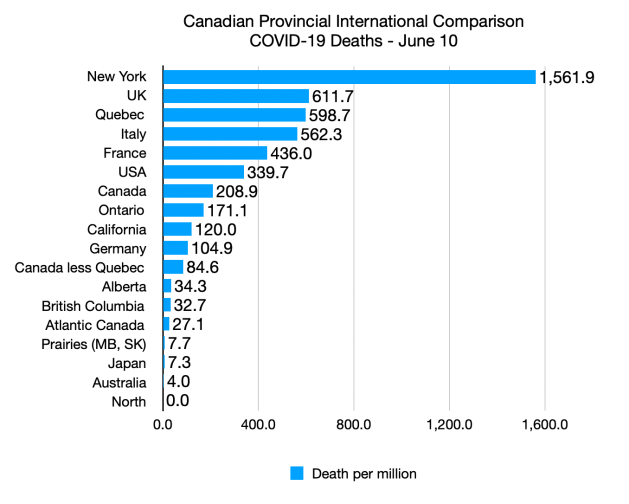
No surprise. Broadly consistent with other countries:
On 21st May 2020, the government released its ‘Immigration statistics, year ending March 2020’, and it confirmed what those in the world of academia already knew; that there was a sharp drop in the number of international students when the lockdown took hold at the end of March. While the publication was not intended to provide a full analysis of the impact of Coronavirus on the immigration system, it did find a significant fall in applications for study visas in March 2020; it states, “in March 2020, Tier 4 visa applications fell significantly when compared to March 2019, in particular for Chinese nationals, and likely related to COVID-19. At the same time, the number of Tier 4 (sponsored study) visas issued in the first quarter of 2020 increased by 84&#x c;ompared with the same quarter in 2019, although there were falls towards the end of March 2020”.
The fall in student numbers follows record increases in 2019
The clear reduction in student numbers is all the more jarring given that the sector has seen a boom in international students in recent years, helped in large part by the reversal of Theresa May’s student immigration policy which required students to depart only four months after completing their studies. According to Government data, in the year ending September 2019, sponsored study visas increased by a not inconsiderable 13&#x (;258,787 students), of which 86&#x w;ere for university education.
UK universities planning for a return of students
There is no doubt that UK academic institutions have been hit hard by COVID-19, not least because of the large black hole which now exists in place of the regular supply of domestic and international student fee revenue. According to a recent analysis by London Economics for the University and College Union, it is expected that UK universities will see a £2.6 billion shortfall in the next academic year due to the ongoing impacts of COVID-19. Of this £2.6 billion is from domestic students and the remainder from international students. It is clear; therefore, how important overseas students are to UK universities and positive and reassuring that plans are now in place to allow some students to return to campus-based learning.
Some UK universities are planning to reopen from June 2020 with a range of essential measures to ensure the safety of staff and students being put place. Smaller class sizes and an increase in the number of online lectures will become normal from the middle of this year. While not all universities have a plan to reopen yet and are instead waiting for clarity from the government before reopening, some have mature plans almost ready to go. The University of Wolverhampton, for example, will be offering a “full digital suite of course material”, and will prioritise the opening of building openings over time. The university’s vice-chancellor Geoff Layer stated, “We will be looking at a gradual return to certain buildings being open and we will develop a plan which prioritises which parts can open first. It won’t be ‘we’re all back’. Social distancing has to be part of what we do, so I’d imagine we would be opening selected spaces over time”.
At Birmingham City University some, but not all, of the 2019-20 cohort of students will be returning for lessons from June 2020. The 2020-21 intake will start their courses in September 2020 with a new set of COVID-19 safety measures designed to protect the wellbeing of students and teachers in place. The university’s vice-chancellor, Professor Philip Plowden, says that students will be returning to the campus “on a limited basis”, and that changes are being made to the way in which buildings are utilised to ensure adherence with social distancing. Professor Plowdon believes that this partial reopening is essential to allow students who are reliant on-campus facilities to complete their courses; “Our priority for this year is to ensure that every student gets the qualifications for which they are working, or are able to make progress towards getting those qualifications. Our absolute priority is the safety of our staff and students and all of our decisions continue to be made with the safety of our community in mind.”
Even if academic institutions won’t be back to where they were before the COVID-19 pandemic, the confidence and boost to sentiment, not to say, cash flow, will be warmly welcomed by the sector.
Those universities which are not reopening in June 2020 will no doubt be watching those that do with considerable interest, not only to see whether it can be done but also to understand the measures which they too will need to put in place in the near future. It is also likely that international students will be watching to see how safe UK universities are over the next few weeks in anticipation of resuming their own studies in September 2020. As such, UK learning institutions can do much to inspire confidence in prospective overseas students by responding effectively now.
Returning students will be required to self-isolate
Anyone arriving in the UK from the 8th June 2020, including those holding a Tier 4 study visa, will be required by law to self-isolate. They will be asked to provide an address for where they will be in quarantine and will face fines of up to £1,000 and random spot checks. Unfortunately, there is no guarantee these additional measures put in place by the government will be lifted by September 2020 for the start of the new academic year, hence it is best to plan for an earlier arrival.
Wrapping up
The impact of COVID-19 on the UK’s education sector will be remembered for many years, but hopefully, with time, students from overseas will be able to continue their studies in earnest. Global events such as this allow us to truly appreciate the wonderful opportunities provided by the overseas study. As we start to see the light at the end of the tunnel, our immigration specialists look forward to helping international student clients and their families over the coming months to return to the UK to resume their studies.
Wonder whether any of these types of targeted initiatives are taking place in Montreal and Toronto?
When COVID-19 first hit the United States, it spread through communities of color at alarmingly disproportionate rates.
This was especially true in Chicago. More than 70% of the city’s first coronavirus deaths were African-American. Those numbers have declined, but black residents continue to die at a rate two- to three-times higher than the city’s white residents. Researchers believe underlying health conditions that are prevalent in Latinx and black communities, such as hypertension and diabetes, make residents there more vulnerable to the disease.
While blacks suffer the most deaths, the number of people who have contracted the disease is the highest now in the city’s Latinx communities. Chicago Mayor Lori Lightfoot calls it a public health “red alarm.” She’s worked with community groups to create a Racial Equity Rapid Response Team or RERRT. They are tackling long-standing needs for residents in African-American and Latinx neighborhoods — everything from adequate nutrition to jobs to healthcare.
One of those Chicago neighborhoods is Auburn-Gresham. It’s a predominantly African-American and working class area on the city’s South side. It’s seen its share of troubles — 30% unemployment, gang warfare. Then came the wrath of COVID-19.
The first to die was Patricia Frieson, 61, a retired nurse who lived in the neighborhood. Her older sister, Wanda Bailey, 63, also died from the coronavirus days later.
Recently, a drive-in test site opened up on 79th street, one of the main commercial strips that’s seen better times.
“Oh, this is critical. We’ve been screaming for weeks to get testing in Auburn Gresham,” says Carlos Nelson, CEO of the Greater Auburn-Gresham Development Corporation. He says it’s been dire with more than 1,000 confirmed coronavirus cases and “we are dying, because we don’t have the same resources or access to information.”
Mayor Lightfoot says the racial gap is unacceptable and is the result of a racist system that for generations left black neighborhoods with little access to health care, jobs, education and healthy food. Conditions she adds that aren’t unique to Chicago.
“We’re seeing this manifest in large urban areas with large black populations,” says Lightfoot. “All over the United States — Cleveland, Detroit, Milwaukee and other places are experiencing the same thing, but we are going to step up and do something about it.”
Distributing free masks, hundreds of door hangers and thousands of postcards about COVID-19 are part of the effort by the rapid response team.
Recently, hundreds of people on foot and in cars lined the blocks for a pop-up food pantry run by Carlos Nelson’s group and the Greater Chicago Food Depository. Volunteers helped Carolyn Bowers load boxes of canned goods, meat and produce into a cart. Bowers works part time caring for seniors and says COVID-19 has caused lots of financial havoc.
“I’m not been able to service as many people as I have been because a lot of people are afraid to let people in their home,” Bowers says.
She’s been working 8 hours a week instead of her typical 30 to 35 hours. But Bowers considers herself lucky since since she and her adult children live with her mother. She says everyone chips in but Bowers says, “the food pantry is a real help to the family because I am not able to buy food.”
In Chicago’s Latinx neighborhoods, there’s the same push by RERRT to educate people about the pandemic with bilingual messaging. There’s also a focus on workplaces where there’s been a cluster of coronavirus cases. Unions are part of the outreach effort.
Efrain Elias is vice president and residential division director of SEIU Local 1. The union represents janitors, security officers and others.
“These are workers who are heading to the front line of this crisis to keep the public clean, safe and healthy every day and our workers are not able to stay at home,” Elias says.
In a neighborhood near Chicago’s downtown, the sound of a vacuum cleaner dies down as Javier Flores goes over the day’s cleaning schedule with his maintenance crew at a nearly 200-unit residential building.
“Thank God, we haven’t had any cases here or any type of incidents what so ever,” Flores says. Both he and his wife are considered essential employees. She is a cook for the Chicago Public Schools and prepares free breakfast and lunch for students that families pick up.
The couple live with their two young daughters in Chicago’s Belmont-Cragin area. With nearly 3,000 confirmed cases, it’s one of the Latinx communities with the most coronvirus cases in the state. It also makes Flores anxious.
“My youngest daughter started coughing, telling me her throat hurt,” Flores says, “and I can’t avoid just thinking about, man, COVID-19?”
His daughter turned out to be fine. Flores says he hopes the city’s racial equity work will help make that true for so many others in communities of color hard hit by the COVID-19 pandemic.
In contrast to Ontario’s Premier Ford who walked back his initial comment. Consistent with his general positions on multiculturalism and diversity, restrictive approach to immigration, and the head covering ban for public servants and teachers:
A day after demonstrators in Montreal criticized Francois Legault for his refusal to acknowledge systemic racism in the province, the Quebec premier held firm on his position.
Legault told reporters in Montreal on Monday he’s committed to implementing a plan to stamp out racism in the province and expects details in the coming days.
Thousands marched in Montreal on Sunday in an anti-racism rally, with some expressing frustration with Legault’s stance.
But Legault said he doesn’t want to get drawn into a war over the term “systemic,” nor does he want it to turn into a trial of Quebecers – the vast majority of whom Legault says aren’t racist.
The premier conceded that racism exists and called for a “quiet evolution” on the matter to deal with it – evoking the province’s Quiet Revolution in the 1960s that brought about social and political change in Quebec society.
Legault noted black members of his own caucus have recounted their own experiences with racism, and he repeated a promise to go beyond rhetoric and establish a provincial policy to fight racism.
“For me, we have Quebecers of different colours, different origins, but we are all human beings and we’re all equals, no exceptions,” Legault said. “But we must face the reality and the problems lived by some of our fellow citizens, and we must act.”
Demonstrators Sunday said Legault’s refusal to acknowledge the systemic nature of racism – biases, policies and practices entrenched in institutions – is missing the bigger picture.
“I don’t understand why people are trying to stick on one word. I think what is important is to say and all agree that there is some racism in Quebec, and we don’t want that any more,” Legault said on Monday.
He said the province could have cancelled Sunday’s march and one the previous weekend for public health reasons, but he decided they should be allowed to go ahead. Legault noted that francophones and women in Quebec have made advances to overcome discrimination, and he said the same must happen for racial minorities.
Fo Niemi, executive director of the Centre for Research-Action on Race Relations, a civil rights advocacy group, said it is important to recognize that racism isn’t always direct and can be subtle.
Niemi noted that courts have recognized systemic discrimination and systemic racism for more than three decades, but there’s a level of intellectual confusion surrounding it.
“Systemic racism is not a general indictment of a society as a whole, and it’s important to stop using systemic as a tool to generalize or accuse an entire society in a sweeping manner,” Niemi said.
More bad news regarding Hong Kong institutions and Chinese government repression:
The heads of the governing councils of Hong Kong’s eight publicly funded universities have backed a plan announced by Beijing last month to impose a national security law on the city, in an act that many academics see as ‘doing Beijing’s bidding’.
Some fear such statements on policies from Beijing emanating from universities could lead to the politicisation of institutions in Hong Kong, which are already polarised between pro-democracy and pro-Beijing groups.
China’s view is that increasingly violent protests over the past year in Hong Kong are a threat to national security. But when it was first revealed last month, the national security law took Hong Kong and the world by surprise – in particular because it would be imposed directly by Beijing on Hong Kong, in contravention of treaties allowing Hong Kong to keep freedoms separate from mainland China under the policy of ‘one country, two systems’.
A resolution was passed in the 28 May session of China’s rubber-stamp parliament, the National People’s Congress (NPC), to draft the law to prohibit “acts of subversion, succession, terrorism and involvement with foreign interference in Hong Kong”. It would also allow China’s security intelligence agencies to operate in Hong Kong.
The joint statement released on 1 June by the chair of the governing councils of eight Hong Kong universities said: “As residents of Hong Kong, we enjoy the protection provided by the state, and in turn have a reciprocal obligation to protect the state by supporting the introduction of legislation which prohibits criminal acts that threaten the existence of the state.”
”We therefore support the national security laws which will operate under the principle of ‘one country, two systems’, to better ensure universities can continue to create knowledge through research and learning,” it added.
Council statement followed a more limited statement
But hours earlier, university vice-chancellors and presidents of five of the eight universities – Hong Kong University, the Chinese University of Hong Kong, Hong Kong Polytechnic University, Lingnan University and the Education University of Hong Kong – issued their own joint statement which said: “We fully support ‘one country, two systems’, understand the need for national security legislation and value the freedom of speech, of the press, of publication, of assembly and other rights the Basic Law confers upon the people of Hong Kong.”
The Basic Law is Hong Kong’s mini constitution.
Conspicuous by their absence were the signatures of the heads of City University of Hong Kong, Hong Kong Baptist University and Hong Kong University of Science and Technology. City University sources said the university administration sought to “separate education and politics” while backing the ‘one country, two systems’ principle.
A separate statement from Baptist University President Roland Chin was a more subdued version. “We highly appreciate the importance of national security and Hong Kong’s stability,” Chin said. “It is our earnest hope that the national security legislation will continue to protect academic freedom and institutional autonomy as promised in the Basic Law.”
Willy Lam, adjunct professor at the Centre for China Studies at the Chinese University of Hong Kong (CUHK), said: “The council is the highest ruling body in any university so adding the council means doubling down on this protestation of support for Beijing. Usually the [university] president would be enough.”
Lam said he assumed the governments in Beijing and Hong Kong had put pressure on university presidents to profess public support for the national security law. “In the NPC discussion about Hong Kong they emphasised a need to boost patriotic education, so education is very important for the Chinese government. They are very keen to have [university] presidents sign up to this profession of support for Beijing,” Lam told University World News.
“This is standard [Communist] Party strategy to prop up its legitimacy by showing its policies have ‘support’,” said another CUHK academic. “Beijing wants to show that their hated national security law has support of respected academics and academic institutions.”
A proportion of university council members are directly appointed by Hong Kong’s chief executive, who also acts as chancellor of all the publicly funded universities. The two statements came just before a trip to Beijing on 3 June by Hong Kong Chief Executive Carrie Lam and other top Hong Kong officials, reportedly to discuss the new law.
Carrie Lam said last week her administration would fully cooperate with Beijing on the legislation, which will be enacted in Hong Kong without any input from Hong Kong’s legislature.
Precedents in issuing joint statements
Academics noted that it was not unusual for university presidents in Hong Kong to issue joint statements, though these were usually in relation to issues directly related to university affairs and student activities, particularly during the Umbrella Movement student protests in 2014-16 and student protests over the now withdrawn Hong Kong bill to extradite criminals to China, which saw weeks of unbroken protests from June 2019 to January 2020.
In June 2019, 10 university heads issued a joint statement urging calm as students began their protests against the extradition bill.
Joint statements from university governing councils are rarer, but in October 2019, in the wake of a large number of students being arrested during protests, and attempts by university heads to assist them in various ways, the heads of eight university governing councils in Hong Kong issued a joint statement saying assistance provided by universities to arrested students and staff did not represent any support for their political views.
In September 2017, 10 university presidents and vice-chancellors issued a joint statement condemning “abuses” of freedom of expression after some students put up banners advocating Hong Kong’s independence from China. “We do not support Hong Kong independence, which contravenes the Basic Law,” that statement said.
Beijing demands support
Beijing-backed groups in Hong Kong have been exhorting companies and organisations to publicly support the proposed law, including civil servants, police and immigration officers, as well as canvassing individuals to sign a petition in favour of the law.
“Calling on university administrations to back the law proposed by Beijing is not the Hong Kong way of doing things. This law is not directly part of campus governance. Instead, it is the Communist Party’s common practice of co-opting groups and individuals to show allegiance and support of the party,” said one normally outspoken academic who asked in this instance to remain anonymous. “Hong Kong’s universities are autonomous; they should not be backing political positions decided in Beijing.”
Lokman Tsui, assistant professor at CUHK’s school of journalism and communication, said via Twitter: “As a professor at CUHK I want to express my opposition to the national security legislation. I am concerned it will harm Hong Kong’s freedom of speech, press freedom, academic freedom and the rule of law that underpins these and other freedoms.”
Well-known Hong Kong publisher Jimmy Lai, who was arrested on 28 February, along with other major pro-democracy figures on charges of illegal assembly, and was later released on bail, referred to the joint statement by the five university heads in a tweet: “This is the end of academic freedom in HK. Higher education was once a paramount institution in defending our freedom to pursue knowledge.”
Interesting observations of how technology embeds biases and prejudices and the related risks:
Today the United States crumbles under the weight of two pandemics: coronavirus and police brutality.
Both wreak physical and psychological violence. Both disproportionately kill and debilitate black and brown people. And both are animated by technology that we design, repurpose, and deploy—whether it’s contact tracing, facial recognition, or social media.
We often call on technology to help solve problems. But when society defines, frames, and represents people of color as “the problem,” those solutions often do more harm than good. We’ve designed facial recognition technologies that target criminal suspects on the basis of skin color. We’ve trained automated risk profiling systems that disproportionately identify Latinx people as illegal immigrants. We’ve devised credit scoring algorithms that disproportionately identify black people as risks and prevent them from buying homes, getting loans, or finding jobs.
So the question we have to confront is whether we will continue to design and deploy tools that serve the interests of racism and white supremacy,
Of course, it’s not a new question at all.
Uncivil rights
In 1960, Democratic Party leaders confronted their own problem: How could their presidential candidate, John F. Kennedy, shore up waning support from black people and other racial minorities?
An enterprising political scientist at MIT, Ithiel de Sola Pool, approached them with a solution. He would gather voter data from earlier presidential elections, feed it into a new digital processing machine, develop an algorithm to model voting behavior, predict what policy positions would lead to the most favorable results, and then advise the Kennedy campaign to act accordingly. Pool started a new company, the Simulmatics Corporation, and executed his plan. He succeeded, Kennedy was elected, and the results showcased the power of this new method of predictive modeling.
Racial tension escalated throughout the 1960s. Then came the long, hot summer of 1967. Cities across the nation burned, from Birmingham, Alabama, to Rochester, New York, to Minneapolis Minnesota, and many more in between. Black Americans protested the oppression and discrimination they faced at the hands of America’s criminal justice system. But President Johnson called it “civil disorder,” and formed the Kerner Commission to understand the causes of “ghetto riots.” The commission called on Simulmatics.
As part of a DARPA project aimed at turning the tide of the Vietnam War, Pool’s company had been hard at work preparing a massive propaganda and psychological campaign against the Vietcong. President Johnson was eager to deploy Simulmatics’s behavioral influence technology to quell the nation’s domestic threat, not just its foreign enemies. Under the guise of what they called a “media study,” Simulmatics built a team for what amounted to a large-scale surveillance campaign in the “riot-affected areas” that captured the nation’s attention that summer of 1967.
Three-member teams went into areas where riots had taken place that summer. They identified and interviewed strategically important black people. They followed up to identify and interview other black residents, in every venue from barbershops to churches. They asked residents what they thought about the news media’s coverage of the “riots.” But they collected data on so much more, too: how people moved in and around the city during the unrest, who they talked to before and during, and how they prepared for the aftermath. They collected data on toll booth usage, gas station sales, and bus routes. They gained entry to these communities under the pretense of trying to understand how news media supposedly inflamed “riots.” But Johnson and the nation’s political leaders were trying to solve a problem. They aimed to use the information that Simulmatics collected to trace information flow during protests to identify influencers and decapitate the protests’ leadership.
They didn’t accomplish this directly. They did not murder people, put people in jail, or secretly “disappear” them.
But by the end of the 1960s, this kind of information had helped create what came to be known as “criminal justice information systems.” They proliferated through the decades, laying the foundation for racial profiling, predictive policing, and racially targeted surveillance. They left behind a legacy that includes millions of black and brown women and men incarcerated.
Reframing the problem
Blackness and black people. Both persist as our nation’s—dare I say even our world’s—problem. When contact tracing first cropped up at the beginning of the pandemic, it was easy to see it as a necessary but benign health surveillance tool. The coronavirus was our problem, and we began to design new surveillance technologies in the form of contact tracing, temperature monitoring, and threat mapping applications to help address it.
But something both curious and tragic happened. We discovered that black people, Latinx people, and indigenous populations were disproportionately infected and affected. Suddenly, we also became a national problem; we disproportionately threatened to spread the virus. That was compounded when the tragic murder of George Floyd by a white police officer sent thousands of protesters into the streets. When the looting and rioting started, we—black people—were again seen as a threat to law and order, a threat to a system that perpetuates white racial power. It makes you wonder how long it will take for law enforcement to deploy those technologies we first designed to fight covid-19 to quell the threat that black people supposedly pose to the nation’s safety.
If we don’t want our technology to be used to perpetuate racism, then we must make sure that we don’t conflate social problems like crime or violence or disease with black and brown people. When we do that, we risk turning those people into the problems that we deploy our technology to solve, the threat we design it to eradicate.
Three articles on expectations for the Trudeau government with respect to countering anti-black racism, starting the Campbell Clark of the Globe, followed by former Conservative Senator Don Oliver and Liberal MP Greg Fergus. Clark focusses on RCMP reform, both Oliver and Fergus stress, among other issues, increased Black Canadian representation at senior levels:
When Justin Trudeau joined an anti-racism protest on Friday, taking a knee to express solidarity, it was as though he still didn’t know the next step after kneeling.
He had already spoken, in a press conference earlier that day, about the “disturbing” videos and reports of incidents that surfaced last week. He asserted, in earnest Trudeau-esque tones, that although “we can’t solve all this overnight,” change is needed, and “we need to start today.” Yet he didn’t offer any clear notion of what a first step could be.
Those disturbing reports, though, offered at least one obvious place to start: more transparency.
On Saturday, Chief Allan Adam, who leads the Athabasca Chipewyan First Nation, held a press conference to present grainy videos of the night in March when, Chief Adam said, he was beaten by RCMP officers when they stopped him and his wife over an expired registration for their car.
Chief Adam’s lawyer, Brian Beresh, called for the suspension of one of the officers involved, but what was notable was the basic call for transparency in the other three things he sought.
He called for the RCMP to release their own, clearer video of the incident, taken from an RCMP dashcam. He called for a full investigation by another police force – not the RCMP. And he called for body cameras to be worn by all RCMP officers.
Independent investigations? Public transparency? Body cams? Yes to all of that. Because it’s 2020.
And stats, too – disaggregated race-based statistics, so Canadians can get a sense of who gets arrested over expired registrations.
One thing on Chief Adam’s list, an outside investigation, is now happening. Alberta’s Serious Incident Response Team, which investigates serious injuries and deaths involving the police, said Saturday afternoon that they would review the allegations. The RCMP had previously said they had reviewed their own video of the incident, and that it didn’t meet the threshold for an outside investigation.
That’s a threshold that cries out for scrutiny: If there is video of police using force with a citizen, someone outside the organization should be looking at it.
Doing those things won’t eliminate racial discrimination in policing, let alone dismantle systemic racism in the country, which doesn’t start or end with the police. Body cams don’t prevent all abuses. They just offer the potential for a record.
But if Mr. Trudeau is looking for a place to start, he might start with the obvious: Disturbing events that came to light only because of bystanders taking video on their phones. More transparency is a basic step.
Mr. Trudeau’s government doesn’t hold all the levers on these things. Local policing is a provincial responsibility, even when it is done by the RCMP, and for much of the population, the local police are municipal or provincial forces.
But he does exert control over the RCMP, including appointing its Commissioner. He can demand standards of accountability for incidents that involve the use of force, and that they be reviewed independently. He can fix the broken complaints system for the RCMP – a small reform is already proposed in legislation before Parliament. He can demand that the collection, and publication, of statistics on arrests and charges be disaggregated by ethnic background.
He has federal spending power. A national initiative to have police wear body cameras can be pushed forward with funding from Ottawa. Especially if he moves forward now. He can press provincial premiers to join him in setting basic national standards of transparency.
That is, for starters, what the symbolism of taking a knee demands. You can judge for yourself if you think Mr. Trudeau is sincere or engaged in political play-acting, or some mix of the two, but you don’t have to look further than Donald Trump to see that the opposite symbolism is bad government. Mr. Trudeau chose to acknowledge systemic racism, rather than to deny it.
There is a lot that necessarily follows from that symbolism. But if Mr. Trudeau can’t find a first step now, he can look to the things that should have been done a long time ago to bring a little more transparency to policing.
Both Canada and the United States are each deeply embroiled in the largest pandemic of anti-Black systemic racism since the height of the Martin Luther King civil rights movement that featured vicious attack dogs, and the brutal beatings, shootings, and murders by whites and by police of unarmed, innocent Black, men, women and children.
Only now, with the internet, technology, and social media, millions and millions of eyes from around the world are watching the United States. People are also watching Canada to see if this middle-ranked world power, once recognized and worshipped for its even-handedness, compassion, understanding and respect for diversity, can rise now to its former exalted position in the world. The world is watching us in the face of the ugly and racist murder of George Floyd in the United States to see if Canada can now give hope and demonstrate once again its earned reputation for understanding and tolerance, and produce a roadmap that all can see and read for overcoming and eliminating anti-Black systemic racism.
Some would argue that there was abject failure of leadership on the part of the Trudeau government to provide more than the vacuous, “we’re in this together,” but it’s clear that words alone will not eliminate anti-Black racism. Many people, including victims of anti-Black racism in Canada, are looking for some concrete resolutions.
The prime minister, however, has clearly stated repeatedly that anti-Black systemic racism exists in Canada today, and on June 2, he said, with humility: “I am not here today to describe a reality I do not know or speak to a pain I have not felt.” That’s probably because he’s white and privileged. He was born into that and it’s not a sin.
The reality, however, for most African Canadians is that their pigmentation defines who they are thought to be by the rest of the world, and it’s usually not positive. The sad reality for many Blacks is that with every step they take and every move they make they are liable to be stopped, suppressed, held back, criticized, ridiculed, and prevented from proceeding for perhaps no reason other than the colour of their skin. Those barriers exist particularly in housing, employment, health care, and criminal justice.
But it cannot be forgotten that there are throughout Canada thousands and thousands of white people who I salute and who do not see colour when they deal with us, and many of them have been on the streets the last nine days walking with us side by side, peacefully demonstrating for an end to systemic racism and protesting the horrible death of George Floyd in Minnesota. Many more have been at their homes praying for an end to Black-based systemic racism in Canada. These are the people of good faith who help make our country strong.
In my case, I started school at the age of five, in a small university Baptist town, the only Black child in the class. For the next 10 years or so, we all had the same school teachers, the same coaches for sports; we basically all went to the same Sunday school and church, played on the same hockey teams and attended all the same parties and socials.
But sometimes when I was engaged in an interesting discussion with teachers or with people around the university, or when I was playing sports with my classmates, I would momentarily forget about the colour of my skin. It didn’t seem that important in the scheme of things; after all, we had so many things in common. Colour was not always the foremost thought in my mind.
For a glancing moment, I had a feeling that there was really no difference and that we were indeed intrinsically alike. I had completely forgotten that pigmentation always denoted a marked physical and psychological difference. It had all the shades of invoking a subtle master/servant relationship from the days of slavery, and that being Black meant being inferior and less worthy than your white counterpart. Pigmentation would always describe who I was as a physical being.
So, how could I ever forget something so fundamental, even for an instant. It was painfully and blatantly clear that I would have to be conscious of my colour at all times and be ready to defend it as well. The colour of my skin is a situational fact that has stayed with me all my life. But even though pigmentation was not something that I thought about every hour of every day, it did help orient my entire life.
When in the middle of something very important and demanding, I would often receive the strange query—“don’t you realize you’re Black”—and it would happen on some of the most unexpected occasions, and I had to be ready. The situation is called racism. That is the constant reality for most Blacks in Canada today. We encounter race hatred, intolerance, discrimination, contempt, and prejudice in virtually everything we become part of in our daily lives.
The prime minister cannot possibly fathom our reality of racism because it defies so many of our senses and it’s just there with disquieting regularity. For instance, imagine you are eminently qualified and Black, with excellent managerial skills and experience, have superior, advanced education, are proficient in three languages, are the proper age, and that you’ve just learned that you’ve been passed over for the eighth time in an executive job competition. What a shock. What else can you do? You know implicitly that racism is present and totally in control of what is happening. But it has defied all your senses. Nothing overt gave you an explanation for the result. It’s something painful and hurtful. You want to cry, to scream out. But you dare not. It’s how systemic racism manifests itself, and that’s the pain and the reality our prime minister cannot possibly ever know and understand.
And it’s just like the anti-Black racism demonstrated by the beatings, shootings, and killings of Black people throughout Canada for which there are thousands of white and Black Canadians protesting and peacefully demonstrating in the streets. Prime Minister Trudeau must understand that anti-Black racism has to stop.
The job now for public policy-makers looking for solutions is to dig deeply into the very core of systemic racism, analyze it, and produce detailed, comprehensive, and professional recommendations for change that must be acted upon by government immediately. Remember, the eyes of the world are watching Canada with hope.
The prime minister can put a lot of easy and meaningful things in place immediately, if there is the will. As I have been saying for decades, some of these helpful things are very, very easy for a prime minister to implement and to make happen quickly.
For instance, one way to start to dispel the sting of anti-Black racism is for eminent and qualified Blacks to be appointed to senior positions on boards, commissions, and Crown corporations. For example, you will recall that, as prime minister, Brian Mulroney appointed Lincoln Alexander as the Queen’s representative of Canada’s largest province; Julius Isaacs was appointed chief justice of the Federal Court of Canada, and I was Speaker Pro Tempore of the Senate of Canada.
There are dozens of great Lincoln Alexanders out there today who could become significant influencers on major government boards and commissions and this would help reduce the impact of anti-Black racism. We desperately need more Black judges appointed to our Superior Courts across the country. We need Black deputy and associate deputy ministers appointed to our senior bureaucracy in Ottawa. We need more Black chiefs of staff in government offices. We need a new federal government Department of Diversity headed by a Black deputy minister. The upper echelons of power in Canada must reflect the diverse faces of Canada. A number of these things can be done by Prime Minister Trudeau with the stroke of his pen, and what a difference it would make for Canada.
In conjunction with these initiatives in boardrooms across the nation, we also need to make policy more effective. We urgently need accurate information: facts and race-based disaggregated data. Prime Minister Trudeau should pick up his pen this week and sign any prerequisite documentation from the Privy Council Office to order the immediate collection of comprehensive data on COVID-19 from every province and territory in Canada. This data should be submitted to Statistics Canada on a daily and weekly basis, possibly retroactively, to the beginning of the COVID-19 pandemic.
The United States now has close to 110,000 reported deaths from COVID-19 and, regretfully, a disproportionately high per cent of those deaths are Blacks and Latinos. In Canada, we have some general information that a disproportionately high percentage of those who have died from COVID-19 are also Black. We know these deaths in both countries involve socio-economic issues such as lack of a nutritious diet, access to the health-care system, employment opportunities, affordable, adequate housing and, most of all, the subtle, all-pervading yet omnipresent anti-Black systemic racism.
To examine and report on these issues, in-depth, I urgently call on Prime Minister Trudeau to appoint in June 2020 a commission of inquiry under the Inquiries Act, chaired by an eminent Black Canadian judge, to examine in detail the above socio-economic issues, call evidence and hear from those impacted by racism in the communities across Canada, and report back to Parliament with specific recommendations in each area designed to eradicate or substantially limit the reach and influence of anti-Black systemic racism in Canada. All aspects of the inquiry must involve in its membership and research a majority of eminent, qualified African Canadian men and women. The inquiry would, as well, receive all the race-based data collected by Statistics Canada, and hopefully provide recommendations to the government before the next wave of COVID-19.
No reasonable Canadian expects this prime minister to fully understand the reality and the 400 years of the pain of anti-Black systemic racism in Canada, but they do expect him to take some positive steps towards its elimination, such as those set out above.
Greg Fergus spent much of last week in video conferences, talking to black Canadians and community leaders. The Liberal MP for Hull-Aylmer and chair of the parliamentary black caucus says many people are “traumatized.”
But, he said, they also know that this moment is an opportunity for other Canadians to “finally see the systemic barriers that are in place here.”
“Everyone says, I’m up and I’m down … I’m angry and I’m hopeful. It’s an awful mix,” he said in an interview. “And because we have attention on the issue, everybody’s being asked about it. I’m happy to engage with this, but it’s hard to engage with it, because it’s overwhelming.
“We saw those brutal images of racism … and it triggers all those big and little things that every person of colour has been through.”
On Friday, Fergus was beside Justin Trudeau when the prime minister attended the Black Lives Matter rally on Parliament Hill and kneeled along with many others in the crowd, the symbolically powerful gesture that has become a hallmark of the protests and rallies against anti-black racism that have followed the May 25 killing of George Floyd by police officers in Minneapolis.
Trudeau’s participation was part of a week that will certainly be remembered as a significant moment in the history of protest against anti-black discrimination. But much now depends on what steps his government takes next.
Prime Minister Justin Trudeau made an appearance at an anti-racism rally on Parliament Hill in Ottawa Friday. He was met with chants of “Stand up to Trump!” from the crowd and kneeled for eight minutes and 46 seconds to remember George Floyd. 1:47
“We always said we need to do more. Now we’re seeing why it’s important to do more,” Fergus said. “Racism kills.”
The list of what the Trudeau government could or should do is long. But Fergus said he is proud of what the government did in its first four years — action he believes his fellow black parliamentarians and Liberal staff were part of making happen.
Over its last two budgets, the Trudeau government committed $19 million over five years to develop mental health programs for black Canadians and support for young people, and $25 million over five years for community programming.
Statistics Canada was provided with $6.7 million to create a new Centre for Gender, Diversity and Inclusion Statistics, which is mandated to “increase the disaggregation of various data sets by race, with a particular focus on the experience of black Canadians.” A new anti-racism strategy, including the creation of an anti-racism secretariat in the public service, was given $45 million over three years.
But Celina Caesar-Chevannes, the former Liberal MP who broke with the party last year, wrote this week that the funding committed to black Canadians for mental health was not nearly enough and “certainly [does] not speak to black lives mattering.”
In 2018, the government officially recognized the UN International Decade for People of African Descent and the prime minister publicly acknowledged the existence of “anti-black racism” — the first prime minister, Fergus said, to do so.
But a year later, Fergus also expressed frustration with how little the machinery of government had moved to match the prime minister’s words.
“It’s hard to convince people that there’s a problem,” he said.
Diversifying government’s highest ranks
Fergus has since been appointed parliamentary secretary to Jean-Yves Duclos, the president of the Treasury Board, and he is interested in promoting diversity throughout the upper echelon of the public service.
“I don’t think the public service is any different from Canada in general, in the sense that it’s hard to overcome the systemic barriers. We have an excellent public service that hires [people] in a way that reflects the way Canada looks. Where the public service doesn’t do as well is, as you go up the ranks, it becomes more and more homogeneous,” Fergus said.
In Fergus’s view, this is a textbook example of unconscious bias.
“This is an example of systemic discrimination — there are practices or assumptions or biases at play that end up having these kinds of results. You have to be conscious of these biases, and we have to really challenge the way it is,” he says.
“It doesn’t make sense that there’s been no black deputy ministers — you can’t convince me that there aren’t black people who are competent. But there’s something that went into the calculation over time that that person didn’t make the right fit, or didn’t get that promotion. We can justify any individual decision, but when you aggregate all these decisions, you end up with a biased result.
“Those are the things that we’ve got to take a look at. But it’s hard to do the things which are hard to do. And it’s hard to see bias. People don’t want to admit that’s going on.”
When the Trudeau government promoted Caroline Xavier to associate deputy minister at the Department of Immigration, Refugees and Citizenship, she became the first black woman to reach that level of the public service. (Duclos’s chief of staff, Marjorie Michel, is also the first black of woman to hold that title in the federal government.)
But diversifying the public service is just one path of change and other areas crying out for government action.
Immigration policy, police reform other points of debate
Caesar-Chevannes laid out a proposed agenda that includes a review of immigration policy, increased government funding and the expunging of criminal records for marijuana possession, a charge that disproportionately punished black Canadians. She also called for the repeal of mandatory minimum sentencing guidelines.
The RCMP and policing reform have emerged as significant points of debate in the weeks and months ahead. The NDP has already called for bans on racial profiling and the practice of “carding,” in which police stop individuals and ask to see ID without any evidence of wrongdoing.
Questions about policing and justice can be politically difficult to navigate — for decades, the incentive for politicians has been to seem “tough” on crime. That tide could be turning, but, regardless, the Trudeau government is unlikely to be excused for failing to deal with these issues.
But combating systemic racism and improving the lives of black Canadians means going well beyond such issues.
Fergus: ‘If there ever was a time to speak, it’s now’
Fergus said there is interest among black community leaders in federal support for black-owned businesses. The federal government could, for instance, provide microcredit and organize a program to provide mentorship from black financial experts. It has also been suggested that federal procurement policy could be used to benefit black-owned companies, similar to how Indigenous businesses have been a specific focus since 1996.
An emphasis on data — to better understand how black Canadians are doing and how public policy affects them — is a common theme across calls for change, including an essay penned last week by Sen. Wanda Thomas Bernard.
“That will be the gift that keeps giving,” Fergus said of better data.
Fergus said his advice to black Canadians and activists is to capitalize on this moment.
“If there was ever a time to speak it’s now. If there was ever a time to get that story out, it’s now,” he said. “We have 15 minutes of people’s attention. Let’s try to make this something that resonates longer and leads to substantive and systemic changes. This is the time.”
What Fergus saw around him on Friday tells him that Canadians are ready for and expecting that change.
“I think Canadians expect us to do more. And looking at the people who were in the crowd — really, it was good for me. It was really good for me to so many non-blacks took part. They were clearly the majority,” he said.
Expect the same with respect to Canada if not already in place given the importance of Chinese tourism and standard Chinese regime pressure tactics:
Trade and Tourism Minister Simon Birmingham has labelled China’s warning against its citizens visiting Australia “unhelpful”, as Chinese state media said the warning was issued in response to Australia’s “anti-China” policies.
Key points:
There have been a number of high-profile racist incidents in Australia targeting Asians during the coronavirus pandemic
Nevertheless, analysts say that China’s travel warning is the latest attempt to pressure Australia into cooperation
Incidents of xenophobia and harassment of foreigners have also been recorded in China during COVID-19
Senator Birmingham told RN this morning that he accepted Asian-Australians had faced incidents of racism since the COVID-19 pandemic began, but rejected the idea that Australia was unsafe for foreign tourists.
“Australia’s a country where our leaders and our communities condemn racism and where we have very clear processes in place if violent attacks occur for people to report them,” Senator Birmingham said.
“But I think the idea that Australia, in any way, is an unsafe destination for visitors to come to is one that just does not stand up to scrutiny.”
Australia accused of ‘anti-China’ strategy
An editorial published by the Global Times, a Communist Party mouthpiece, warned the travel ban “may just be the tip of the iceberg”.
“If Australia wants to retain the gain from its economic ties with China, it must make a real change to its current stance on China, or it will completely lose the benefits of Chinese consumers,” it wrote.
“The tourism loss may be just a tip of iceberg in its loss of Chinese interest.”
Another article attributed the travel warning to “Australian animosity” and “rocky bilateral ties”, quoting analysts as saying that the official warning was “reasonable” given “abundant evidence” of racist acts.
“Australia has become a close collaborator of the US in its anti-China strategy at the expense of China-Australia relations,” the Global Times paraphrased Chen Hong, director of the Australian Studies Centre at East China Normal University in Shanghai, as saying.
Delia Lin, a senior lecturer from the Asia Institute at the University of Melbourne, told the ABC the travel warning was “not about genuine concern over racist attacks or genuine concern over the safety of Chinese citizens”.
“If you look at it from a practical perspective, this travel warning is pretty meaningless because nobody can really travel at the moment,” she said.
Jane Golley, director of the Australian Centre on China in the World at The Australian National University, said that Australia’s relations with China had been deteriorating since at least 2017.
“I think we’ve started treating them as an adversary in general, while still trying to maintain that they’re an important trading and investment partner for us,” she told the ABC.
Federal Government defends Australian multiculturalism
Asked by RN whether he believed China was attempting to do diplomatic damage to Australia with the travel warning, Senator Birmingham said it was unclear.
“It’s difficult for me to try to ascribe motivations to other countries; this is an unhelpful statement, no doubt about that,” he said.
“This is a bullying tactic,” said Dr Lin of the Asia Institute. “China doesn’t see it as bullying, they say it as a way of showing strength.”
Senator Birmingham says Australia’s embrace of multiculturalism stood out in the world.
“That’s what frustrates me and disappoints me in relation to China’s statement,” he said.
Mr Birmingham has tried to speak about ongoing diplomatic tensions with his Chinese counterpart over recent weeks, but he said he was yet to hear back from Commerce Minister Zhong Shan.
China has “become very adept at using economic tools to send geopolitical messages,” Professor Golley said.
‘Convenient’ criticism of Australia amid reports of racism
Deputy Prime Minister Michael McCormack earlier rejected the suggestion there had been an increase in racist attacks in Australia.
“I don’t know why this has been stated, I don’t know what was in the thinking of the organisation or the person who made the statement, all I can say is the statement is not true,” he said.
In April, two Melbourne University students were allegedly verbally abused and physically assaulted after a pair of women screamed “coronavirus” at them and told them to get out of the country.
In March, a Bundaberg teenager was charged for assaulting a 27-year-old South Korean backpacker and accusing her of bringing the coronavirus to Australia.
The 15-year-old was charged with assault occasioning bodily harm while armed, assault occasioning bodily harm, common assault and stealing. The matter has been finalised.


 Multicultural Meanderings