@JohnIbbitson Our competitive advantage: Canada hasn’t completely gone off the deep end

My vote for the best slogan to attract highly talented and skilled immigrants:

At the moment, Canada enjoys the unique competitive advantage of being the only major developed, English-speaking country that hasn’t gone crazy.

As a result, once the pandemic travel restrictions are lifted, we should be able to attract many thousands of the world’s most skilled and talented workers, making Canada a global leader in the next generation of the knowledge economy.

The United States suffered yet another self-inflicted wound this week, when President Donald Trump suspended all new work visas – including the H-1B visa used to recruit foreign workers in the technology sector – until the end of the year.

“America is making a pretty big mistake here, and Canada and our tech sector are going to be the beneficiaries of that,” said Yung Wu, chief executive officer of the MaRS Discovery District, a high-tech incubator in Toronto.

“The thing that fuels the entire innovation economy and ecosystem is talent,” he said in an interview. “When you starve the supply of talent, your innovation and tech ecosystem wither.”

Talent might have been having second thoughts about moving to the U.S. even before the latest visa restrictions. America in the age of Trump is not a welcoming place. The rampant racism, the toxic polarization, the collapse of competence revealed by America’s mishandling of the COVID-19 pandemic, the protests and clashes with police – who would want to move there right now?

Great Britain is not much better. The decision to leave the European Union was economically destructive, driven in part by a deeply ingrained resentment of foreigners felt by some Britons. The country’s per-capita death rate from COVID-19 is one of the worst in the world – almost three times as high as Canada’s – offering further evidence of Britain‘s declining competence and confidence.

“With the U.S. and the U.K. going crazy, sideways, whatever you want to call it … if you’re a highly skilled individual who doesn’t happen to be American or English, where are you going to go?” asks Dan Breznitz, chair of innovation studies at the Munk School of Global Affairs. The answer, he says, is Canada. “And that’s great.”

We are far, far from perfect. The police killing of George Floyd in Minneapolis has forced Canadians to confront anti-Black and anti-Indigenous racism in this country. My English settler culture has much to answer for.

But there is much to be proud of as well, including the hundreds of thousands of immigrants Canada welcomes each year. The federal and provincial governments actively encourage high-technology workers and students to come to and stay in Canada. The closing of American and British doors gives us the chance to bring in even more.

Our companies may never pay as well as the big players in Silicon Valley. But our cities are diverse and peaceful, our education system is one of the best in the world, and the pandemic proved how superior the Canadian health care system is to the American. Such things may matter more to newcomers today than they did even a few months ago.

We need every one of those who will come. Before the pandemic, analysts predicted more than 200,000 technology jobs would go unfilled in the tech sector in 2021. Canada competes with the United States for tech-skilled workers from other countries, and we have been decidedly No. 2.

But now the United States has taken itself out of the running. Even if presumptive Democratic nominee Joe Biden defeats Mr. Trump in November, it will take years to undo the damage. And America’s deep divisions will remain.

The key, for Mr. Wu, is for Canadian governments to recruit even more aggressively for workers in the life sciences, advanced manufacturing, energy transition, clean tech and agri-tech sectors. Mr. Breznitz would like to see governments investing directly in individuals and companies.

At the same time, we should hope the U.S. gets its mojo back. Canada’s tech sector is joined at the hip to the American tech sector. “They need to be strong for us to be strong,” said Mr. Wu. Every future in which the United States does not lead is a bad future for Canada.

But while we wait for the United States to recover, perhaps we can take advantage of the situation by luring more of the brightest and best.

In these times, apart from February, what’s not to love about Canada?

Source: https://www.theglobeandmail.com/politics/article-our-competitive-advantage-canada-hasnt-completely-gone-off-the-deep/

Why CSIS believes Canada is a ‘permissive target’ for China’s interference

Useful reminder, as Canada faces the ongoing hostage taking of the two Michaels by the Chinese government, of the need for greater caution in dealing with the Chinese government and its various entities:

Canada is an “attractive and permissive target” for Chinese interference that endangers the “foundations of our fundamental institutions, including our system of democracy itself,” according to a recent national security review.

The reason, experts suggest, is because China’s Communist Party has won the support of some influential Canadians by using economic carrots and sticks, while public attention on Beijing’s broad campaign is “almost non-existent.”

The national security review says “for years Canadian Security Intelligence Service has investigated and reported on the threat” of foreign interference. But unlike Canada’s Western intelligence allies, Ottawa hasn’t responded with strong countermeasures.

Chinese-Canadian community leader asks Ottawa to offer support against Beijing influence networks

In an interview, Global News pressed Liberal MP David McGuinty, chair of the national security and intelligence committee, to explain why Canada is “permissive” of China’s methods.

McGuinty said he could only answer by citing the report findings because of its sensitivity. He chose to read this quote: “The People’s Republic of China utilizes its growing economic wealth to mobilize interference operations: ‘with deep coffers and the help of western enablers, the Chinese Communist Party uses money, rather than Communist ideology, as a powerful source of influence, creating parasitic relationships of long-term dependence.’”

‘Sweetheart deals’

The committee’s report named two countries — Russia and China — among those conducting “sophisticated and pervasive foreign interference activities against Canada.”

But intelligence officials and former diplomats, including Canada’s former ambassador to China, believe China is the greater threat, in large part because the country has been successful in “elite capture.”

“China is the No. 1 threat to Canada and has been for some time,” David Mulroney, former ambassador to China, said in an interview.

China has used its economic leverage to secure “the voices” of political and business leaders in Canada with “sweetheart business deals” and “various inducements,” including lucrative board positions or honours in China, he said.

And as a result, Mulroney said he often hears people reciting Beijing’s line on issues such as the extradition case of Huawei executive Meng Wanzhou or are silent in the face of China’s mass detention of Uyghurs and incursions on democracy in Hong Kong.

“There are people a lot more senior than I was in government, and they have some serious business links with China,” Mulroney said. “China is very willing to weaponize trade and investment to compel people to say what they want them to say.”

The argument that Mulroney and experts interviewed by Global News make is not that all Canadian politicians and businesses that have traded with China have been influenced. Rather, they say, Beijing has targeted elites and deftly attempted to interweave the CCP’s interests with Canada’s economic interests, seeking to bend major decisions away from Canada’s democratic values.

And they say Canadians should see Hong Kong as a case study.

But recent events in the United States, Australia and Canada suggest that pushing back on China’s interference could have consequences. In 2019, China called for the firing of an NBA executive who tweeted support for Hong Kong, using the NBA’s business in China as leverage.

And Australia has faced trade sanction threats and was targeted in sophisticated state-based cyberattacks, its government said in June. Australia recently pressed for an international probe of Beijing’s actions in the coronavirus pandemic and Australia’s intelligence experts say China is likely behind the attacks. China denies the accusation.

And on Monday, Beijing warned Prime Minister Justin Trudeau to “stop making irresponsible remarks,” according to The Associated Press, after Trudeau told reporters Beijing’s decision to charge Canadians Michael Kovrig and Michael Spavor with spying was related to the Meng case.

But despite warning signs of China’s incursions, Canadian academics, think tanks and media have been way behind the international curve in scrutinizing China’s “clandestine” tactics, Mulroney said.

“Canada is kind of a sleepy and unaware target,” he said. “We don’t have the same kind of vigilance that you now see in places like Australia and New Zealand. That had better change.”

United Front operations

China uses a vast network of political, business and media operatives directed from Beijing, known as the United Front, in attempts to co-opt Chinese-Canadian communities and leaders, Mulroney and the experts interviewed by Global News said.

In June, Alex Joske, an analyst with the Australian Strategic Policy Institute, released a report aimed at helping international journalists identify and demystify United Front networks.

In it, Joske defines the United Front as “the system at the heart of the Chinese Communist Party’s (CCP) efforts to influence foreign politicians, meddle in ethnic Chinese communities and transfer technologies from abroad … it is an exportation of the CCP’s political system (which) undermines social cohesion, exacerbates racial tension, influences politics, harms media integrity, facilitates espionage.”

He believes the United Front could be just as active in Canada as it is in Australia, where an alleged United Front leader, billionaire and casino high-roller became a major funder of Australian political parties. An Australian senator also allegedly accepted funds from Chinese agents and touted China’s South China Sea policy against Australia’s position after the billionaire threatened to withdraw a $400,000 political donation.

Joske said in order to understand the United Front, people should look at China’s patient campaign to control Hong Kong, where China has used front groups to co-opt political leaders, tycoons and institutions since the 1990s.

“Hong Kong is a long way down the track,” Joske said. “But by looking at Hong Kong, you understand how the United Front works.”

Joske’s report also underlined the United Front’s mobilization during the COVID-19 pandemic — in Australia, Canada, the U.S. and U.K., Japan, Argentina and the Czech Republic — “to gather increasingly scarce medical supplies from around the world and send them to China.”

And based on China’s success using United Front networks during thecoronavirus pandemic, Beijing can be expected to ramp up the intensity of its United Front interference worldwide as tensions between China and the world rise in the post-COVID-19 landscape, Joske said.

“The CCP’s attempts to interfere in diaspora communities, influence political systems and covertly access valuable and sensitive technology will only grow.”

Joske’s report says United Front pioneers such as Premier Zhou Enlai, a CCP revolutionary, said the United Front should use “the legal to mask the illegal,” and the CCP should be “nestling intelligence within the United Front.”

And Chinese President Xi Jinping has elevated the United Front’s prominence in Beijing’s global plans.

“The United Front … is an important magic weapon for strengthening the party’s ruling position … and an important magic weapon for realizing the China Dream of the Great Rejuvenation of the Chinese Nation,” Xi said in a 2015 speech.

But China does not acknowledge the United Front facilitates espionage.

‘Many elected officials’

Experts describe Beijing as holding out carrots and sticks.

And unfortunately, it is Chinese diaspora communities that often face the sticks. According to the Canadian Security Intelligence Service, China uses “a range of tactics including threats, harassment, detention of family members abroad and refusal to issue travel documents or visas.”

Chinese-Canadian community leader Gloria Fung, director of democracy advocacy group Canada-Hong Kong Link, says she has seen China’s influence efforts in Canada become increasingly aggressive with both the carrot and the stick.

In the 1990s, United Front networks just made passive political donations to all Canadian political parties, Fung said. Now they are aggressively lobbying for Beijing’s policies, covertly offering political funding from Beijing and attempting to promote covert CCP party members for election, Fung claimed.

And Fung said she believes China has successfully influenced “many elected officials.”

“They could be bribing, offering money or material benefits to targets in the decision-making process,” Fung said. “Many elected officials are offered free tours to China. And many, when they returned, seem to have changed their positions towards China.”

Tensions reached a new level in August 2019, Fung said, when Hong Kong Canadians were targeted in anti-democracy counter-protests in a number of Canadian cities.

Fung pointed to a Hong Kong democracy counter-rally at Toronto’s Old City Hall on Aug. 17, where she says her group was surrounded by students and middle-aged leaders, who Fung associated with Toronto United Front groups.

A similar conflict occurred in Vancouver on Aug. 18 when a pro-China crowd surrounded a church where Hong Kong Canadians were praying.

By comparing photos and video of the event with pictures of meetings involving Chinese consulate officials, Global News sources identified several senior members in the crowd as directors of a pro-CCP association, which Chen Yonglin, a defected Chinese diplomat, alleges is a “controlling level” United Front group in Canada.

The pro-CCP association is part of the Overseas Chinese Affairs Office, a United Front group that Beijing uses to influence the Chinese diaspora, according to a 2018 report from the U.S.-China Economic and Security Review Commission.

“United Front work is Beijing’s strategy to influence overseas Chinese communities, foreign governments and other actors … mainly through economic or financial inducement,” the commission’s chair, Robin Cleveland, told Global News. “The CCP considers ethnic Chinese everywhere to ultimately be Chinese subjects, regardless of their citizenship, and seeks to treat them as resources to assist in ‘the great rejuvenation of the Chinese nation’ whether they like it or not.”

A Chinese-Canadian academic ⁠— who is studying Beijing’s influence networks ⁠— agreed with Fung’s assessment of China’s efforts to control community groups.

The academic asked to remain anonymous because of fears that officials in Chinese consulates could interfere with their ongoing research.

“Many in the Chinese-Canadian diaspora do not want to have anything to do with the Chinese government. But unfortunately, immigrants from China and Hong Kong are not completely free from the government’s control and surveillance,” the academic said.

How Australia has combated the United Front

Most experts interviewed by Global News said Australia’s legislative reforms should be a model for other countries combating China’s interference campaigns.

In an interview, McGuinty, the intelligence committee chair, said the report underlined how Australia has taken concrete measures since 2018, including adding new offences to its Criminal Code.

The report says the new offences “provide a high degree of specificity on offences and threat activities, including on whether the activity was in the planning stages, intentional, reckless or funded by a foreign intelligence service.”

The penalties range from 10 to 20 years’ imprisonment. And “the legislation creates a new transparency scheme that prescribes the registration of persons acting as agents of foreign principals and requires regular public disclosures.”

Trudeau questioned on reports of pressure from Chinese government on Chinese-Canadian citizens

In an interview, Mulroney said: “We need to invest in national security and insist on greater transparency.”

He said currently, Canadians have no real idea whether influential politicians and businesspersons are acting for China or Canada. And it is extremely difficult to hold Canadian citizens that may be acting against Canadian interests to account under current laws.

“What Australia have done is give transparency requirements some legal teeth,” Mulroney said. “And they use their intelligence apparatus to make the case against people that are not transparent. And I think we need to consider these things so Canadians become far more aware of who is speaking for whom.”

Gloria Fung agreed.

“Legislative tools on corruption and fishy transactions need to be closely monitored and put under Parliament’s radar,” Fung said. “Australia has all kinds of legislative tools to handle political collusion.”

McGuinty was asked by Global News to explain the evident gap between Canadian intelligence’s strong warnings of China’s interference and the federal government’s response.

McGuinty reiterated that the committee recommendations are bipartisan and straightforward, and the committee purposefully chose Australia as an exemplar to be considered by Prime Minister Justin Trudeau’s government.

“We believe the government needs to up its game when it comes to foreign interference,” he said. “There is lots of room for improvement.”

‘Comparatively rare’

But University of B.C. China expert Prof. Paul Evans, who has argued for closer ties with China and published research indicating Canadians are losing confidence “about the role of the United States” in global affairs, told Global News “the discourse of ‘capture’ is especially dangerous.”

Evans draws a distinction between influence and “interference activities” and says “it is very difficult to estimate how many such incidents happen in Canada each year.”

“My sense is that they are comparatively rare,” Evans wrote in an email response. “It is unproductive to talk about undermining ‘institutions’ without specifying which ones are being discussed.”

Evans said it is “dangerous” to rely on Australia’s data and examples of foreign interference, and assume the same kinds and scale of interference activity is occurring in Canada.

“We have reached a dangerous phase of our debates about China policy where advocates of engagement, past and present, are being attacked not just for the content of their views and actions but also for their integrity and even loyalty,” Evans wrote. “This is vile terrain and reminiscent of the worst of the McCarthy era and anti-communist actions in the United States in the 1950s.”

Source: https://globalnews.ca/news/7075248/canada-china-interference-permissive-target/
Related commentary of interest:

Asian Americans Are Still Caught in the Trap of the ‘Model Minority’ Stereotype. And It Creates Inequality for All

Good long and reflective read:

The face of Tou Thao haunts me. The Hmong-American police officer stood with his back turned to Derek Chauvin, his partner, as Chauvin knelt on George Floyd’s neck for 8 minutes and 46 seconds and murdered him.

In the video that I saw, Tou Thao is in the foreground and Chauvin is partly visible in the background, George Floyd’s head pressed to the ground. Bystanders beg Tou Thao to do something, because George Floyd was not moving, and as he himself said, he could not breathe.

The face of Tou Thao is like mine and not like mine, although the face of George Floyd is like mine and not like mine too. Racism makes us focus on the differences in our faces rather than our similarities, and in the alchemical experiment of the U.S., racial difference mixes with labor exploitation to produce an explosive mix of profit and atrocity. In response to endemic American racism, those of us who have been racially stigmatized cohere around our racial difference. We take what white people hate about us, and we convert stigmata into pride, community and power. So it is that Tou Thao and I are “Asian Americans,” because we are both “Asian,” which is better than being an “Oriental” or a “gook.” If being an Oriental gets us mocked and being a gook can get us killed, being an Asian American might save us. Our strength in numbers, in solidarity across our many differences of language, ethnicity, culture, religion, national ancestry and more, is the basis of being Asian American.

Let me go back in time to a time being repeated today. Even if I no longer remember how old I was when I saw these words, I have never forgotten them: Another American driven out of business by the Vietnamese. Perhaps I was 12 or 13. It was the early 1980s, and someone had written them on a sign in a store window not far from my parents’ store. The sign confused me, for while I had been born in Vietnam, I had grown up in Pennsylvania and California, and had absorbed all kinds of Americana: the Mayflower and the Pilgrims; cowboys and Indians; Audie Murphy and John Wayne; George Washington and Betsy Ross; the Pledge of Allegiance; the Declaration of Independence; the guarantee of life, liberty and the pursuit of happiness; all the fantasy and folklore of the American Dream.

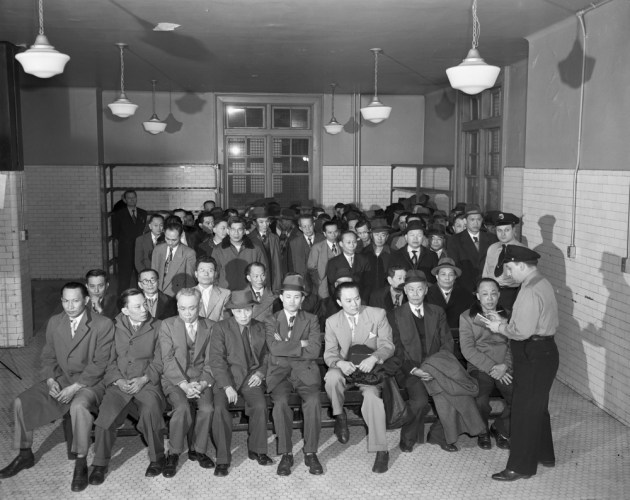
Two immigration officers interrogate Chinese immigrants suspected of being Communists or deserting seamen at Ellis Island.

Two immigration officers interrogate Chinese immigrants suspected of being Communists or deserting seamen at Ellis Island.
Bettmann Archive/Getty Images

Part of that dream was being against communism and for capitalism, which suited my parents perfectly. They had been born poor to rural families, and without much formal schooling and using only their ingenuity and hard work, had become successful merchants. They fled communist Vietnam in 1975, after losing all of their property and most of their fortune. What they carried with them–including some gold and money sewn into the hems of their clothes–they used to buy a house next to the freeway in San Jose and to open the second Vietnamese grocery store there, in 1978. In a burst of optimism and nostalgia, they named their store the New Saigon.

I am now older than my parents were when they had to begin their lives anew in this country, with only a little English. What they did looms in my memory as a nearly unimaginable feat. In the age of coronavirus, I am uncertain how to sew a mask and worry about shopping for groceries. Survivors of war, my parents fought to live again as aliens in a strange land, learning to read mortgage documents in another language, enrolling my brother and me in school, taking driver’s-license examinations. But there was no manual telling them how to buy a store that was not advertised as for sale. They called strangers and navigated bureaucracy in order to find the owners and persuade them to sell, all while suffering from the trauma of having lost their country and leaving almost all their relatives behind. By the time my parents bought the store, my mother’s mother had died in Vietnam. The news nearly broke her.

Somehow the person who wrote this sign saw people like my mother and my father as less than human, as an enemy. This is why I am not surprised by the rising tide of anti-Asian racism in this country. Sickened, yes, to hear of a woman splashed with acid on her doorstep; a man and his son slashed by a knife-wielding assailant at a Sam’s Club; numerous people being called the “Chinese virus” or the “chink virus” or told to go to China, even if they are not of Chinese descent; people being spat on for being Asian; people afraid to leave their homes, not only because of the pandemic but also out of fear of being verbally or physically assaulted, or just looked at askance. Cataloging these incidents, the poet and essayist Cathy Park Hong wrote, “We don’t have coronavirus. We are coronavirus.”

Looking back, I can remember the low-level racism of my youth, the stupid jokes told by my Catholic-school classmates, like “Is your last name Nam?” and “Did you carry an AK-47 in the war?” as well as more obscene ones. I wonder: Did Tou Thao hear these kinds of jokes in Minnesota? What did he think of Fong Lee, Hmong American, 19 years old, shot eight times, four in the back, by Minneapolis police officer Jason Anderson in 2006? Anderson was acquitted by an all-white jury.

Confronted with anti-Asian racism from white people, the Hmong who came to the U.S. as refugees in the 1970s and 1980s were often resettled in diverse urban areas, some in dominantly Black communities where they also confronted racism. “Stories abounded within our community of battery, robberies and intimidations by our Black neighbors,” Yia Vue wrote recently. “Hmong people live side by side with their African-American neighbors in poorer sections of town, with generations of misunderstanding and stereotypes still strongly entrenched on both sides.” Yet when Fong Lee was killed, Black activists rallied to his cause. “They were the loudest voices for us,” Lee’s sister Shoua said. “They didn’t ask to show up. They just showed up.”

Unlike the engineers and doctors who mostly came from Hong Kong, Taiwan, China and India–the model minority in the American imagination–many Hmong refugees arrived from a rural life in Laos devastated by war. Traumatized, they were resettled into the midst of poverty and a complicated history of racial oppression of which they had little awareness. Even the Hmong who condemn Tou Thao and argue for solidarity with Black Lives Matter insist that they should not be seen through the lens of the model-minority experience, should not be subject to liberal Asian-American guilt and hand-wringing over Tou Thao as a symbol of complicity. Christian minister Ashley Gaozong Bauer, of Hmong descent, writes, “We’ve had to share in the collective shame of the model minority, but when have Asian Americans shared in the pain and suffering of the Hmong refugee narrative and threats of deportation?”

Like the Hmong, the Vietnamese like myself suffered from war, and some are threatened by deportation now. Unlike many of the Hmong, a good number of Vietnamese refugees became, deliberately or otherwise, a part of the model minority, including myself. The low-level racism I experienced happened in elite environments. By the time I entered my mostly white, exclusive, private high school, the message was clear to me and the few of us who were of Asian descent. Most of us gathered every day in a corner of the campus and called ourselves, with a laugh, or maybe a wince, “the Asian invasion.” But if that was a joke we made at our own expense, it was also a prophecy, for when I returned to campus a couple of years ago to give a lecture on race to the assembled student body, some 1,600 young men, I realized that if we had not quite taken over, there were many more of us almost 30 years later. No longer the threat of the Asian invasion, we were, instead, the model minority: the desirable classmate, the favored neighbor, the nonthreatening kind of person of color.

Or were we? A couple of Asian-American students talked to me afterward and said they still felt it. The vibe. The feeling of being foreign, especially if they were, or were perceived to be, Muslim, or brown, or Middle Eastern. The vibe. Racism is not just the physical assault. I have never been physically assaulted because of my appearance. But I had been assaulted by the racism of the airwaves, the ching-chong jokes of radio shock jocks, the villainous or comical japs and chinks and gooks of American war movies and comedies. Like many Asian Americans, I learned to feel a sense of shame over the things that supposedly made us foreign: our food, our language, our haircuts, our fashion, our smell, our parents.

What made these sentiments worse, Hong argues, was that we told ourselves these were “minor feelings.” How could we have anything valid to feel or say about race when we, as a model minority, were supposedly accepted by American society? At the same time, anti-Asian sentiment remained a reservoir of major feeling from which Americans could always draw in a time of crisis. Asian Americans still do not wield enough political power, or have enough cultural presence, to make many of our fellow Americans hesitate in deploying a racist idea. Our unimportance and our historical status as the perpetual foreigner in the U.S. is one reason the President and many others feel they can call COVID-19 the “Chinese virus” or the “kung flu.”

The basis of anti-Asian racism is that Asians belong in Asia, no matter how many generations we have actually lived in non-Asian countries, or what we might have done to prove our belonging to non-Asian countries if we were not born there. Pointing the finger at Asians in Asia, or Asians in non-Asian countries, has been a tried and true method of racism for a long time; in the U.S., it dates from the 19th century.

It was then that the U.S. imported thousands of Chinese workers to build the transcontinental railroad. When their usefulness was over, American politicians, journalists and business leaders demonized them racially to appease white workers who felt threatened by Chinese competition. The result was white mobs lynching Chinese migrants, driving them en masse out of towns and burning down Chinatowns. The climax of anti-Chinese feeling was the passage of the 1882 Chinese Exclusion Act, the first racially discriminatory immigration law in American history, which would turn Chinese entering the U.S. into the nation’s first illegal immigrant population. The Immigration and Naturalization Service was created, policing Chinese immigration and identifying Chinese who had come into the U.S. as “paper sons,” who claimed a fictive relation to the Chinese who had already managed to come into the country. As the political scientist Janelle Wong tells me, while “European immigrants were confronted with widespread hostility, they never faced the kind of legal racial restrictions on immigration and naturalization that Asian Americans experienced.”

American history has been marked by the cycle of big businesses relying on cheap Asian labor, which threatened the white working class, whose fears were stoked by race-baiting politicians and media, leading to catastrophic events like the Chinese Exclusion Act and the internment of Japanese Americans in 1942. The person who wrote that sign I remember seeing as a child, blaming the Vietnamese for destroying American businesses, was simply telling a story about the yellow peril that was always available for fearful Americans.

The reality was that downtown San Jose in the 1970s and 1980s was shabby, a run-down place where almost no one wanted to open new businesses, except for Vietnamese refugees. Today, Americans rely on China and other Asian countries for cheap commodities that help Americans live the American Dream, then turn around and blame the Chinese for the loss of American jobs or the rise of American vulnerability to economic competition.

It is easier to blame a foreign country or a minority, or even politicians who negotiate trade agreements, than to identify the real power: corporations and economic elites who shift jobs, maximize profit at the expense of workers and care nothing for working Americans. To acknowledge this reality is far too disturbing for many Americans, who resort to blaming Asians as a simpler answer. Asian Americans have not forgotten this anti-Asian history, and yet many have hoped that it was behind them. The slur of the “Chinese virus” has revealed how fragile our acceptance and inclusion was.

In the face of renewed attacks on our American belonging, the former presidential candidate Andrew Yang offered this solution: “We Asian Americans need to embrace and show our Americanness in ways we never have before … We should show without a shadow of a doubt that we are Americans who will do our part for our country in this time of need.” Many Asian Americans took offense at his call, which seemed to apologize for our Asian-American existence. Yang’s critics pointed out that Asian Americans have literally wrapped themselves in the American flag in times of anti-Asian crisis; have donated to white neighbors and fellow citizens in emergencies; and died for this country fighting in its wars. And is there anything more American than joining the police? Did Tou Thao think he was proving his belonging by becoming a cop?

None of these efforts have prevented the stubborn persistence of anti-Asian racism. Calling for more sacrifices simply reiterates the sense that Asian Americans are not American and must constantly prove an Americanness that should not need to be proven. Japanese Americans had to prove their Americanness during World War II by fighting against Germans and Japanese while their families were incarcerated, but German and Italian Americans never had to prove their Americanness to the same extent. German and Italian Americans were selectively imprisoned for suspected or actual disloyalty, while Japanese Americans were incarcerated en masse, their race marking them as un-American.

Asian Americans are caught between the perception that we are inevitably foreign and the temptation that we can be allied with white people in a country built on white supremacy. As a result, anti-Black (and anti-brown and anti-Native) racism runs deep in Asian-American communities. Immigrants and refugees, including Asian ones, know that we usually have to start low on the ladder of American success. But no matter how low down we are, we know that America allows us to stand on the shoulders of Black, brown and Native people. Throughout Asian-American history, Asian immigrants and their descendants have been offered the opportunity by both Black people and white people to choose sides in the Black-white racial divide, and we have far too often chosen the white side. Asian Americans, while actively critical of anti-Asian racism, have not always stood up against anti-Black racism. Frequently, we have gone along with the status quo and affiliated with white people.

And yet there have been vocal Asian Americans who have called for solidarity with Black people and other people of color, from the activist Yuri Kochiyama, who cradled a dying Malcolm X, to the activist Grace Lee Boggs, who settled in Detroit and engaged in serious, radical organizing and theorizing with her Black husband James Boggs. Kochiyama and Lee Boggs were far from the only Asian Americans who argued that Asian Americans should not stand alone or stand only for themselves. The very term Asian American, coined in the 1960s by Yuji Ichioka and Emma Gee and adopted by college student activists, was brought to national consciousness by a movement that was about more than just defending Asian Americans against racism and promoting an Asian-American identity.

Asian-American activists saw their movement as also being antiwar, anti-imperialism and anticapitalism. Taking inspiration from the 1955 Bandung Conference, a gathering of nonaligned African and Asian nations, and from Mao, they located themselves in an international struggle against colonialism with other colonized peoples. Mao also inspired radical African Americans, and the late 1960s in the U.S. was a moment when radical activists of all backgrounds saw themselves as part of a Third World movement that linked the uprisings of racial minorities with a global rebellion against capitalism, racism, colonialism and war.

The legacy of the Third World and Asian-American movements continues today among Asian-American activists and scholars, who have long argued that Asian Americans, because of their history of experiencing racism and labor exploitation, offer a radical potential for contesting the worst aspects of American society. But the more than 22 million Asian Americans, over 6% of the American population, have many different national and ethnic origins and ancestries and times of immigration or settlement. As a result, we often have divergent political viewpoints. Today’s Asian Americans are being offered two paths: the radical future imagined by the Asian-American movement, and the consumer model symbolized by drinking boba tea and listening to K-pop. While Asian Americans increasingly trend Democratic, we are far from all being radical.

What usually unifies Asian Americans and enrages us is anti-Asian racism and murder, beginning with the anti-Chinese violence and virulence of the 19th century and continuing through incidents like a white gunman killing five Vietnamese and Cambodian refugee children in a Stockton, Calif., school in 1989, and another white gunman killing six members of a Sikh gurdwara in Wisconsin in 2012. The murder of Vincent Chin, killed in 1982 by white Detroit autoworkers who mistook him for Japanese, remains a rallying cry. As do the Los Angeles riots, or uprisings, of 1992, when much of Koreatown was burned down by mostly Black and brown looters while the LAPD watched. Korean-American merchants suffered about half of the economic damage. Two Asian Americans were killed in the violence.

All of this is cause for mourning, remembrance and outrage, but so is something else: the 61 other people who died were not Asian, and the majority of them were Black or brown. Most of the more than 12,000 people who were arrested were also Black or brown. In short, Korean Americans suffered economic losses, as well as emotional and psychic damage, that would continue for years afterward. But they had property to lose, and they did not pay the price of their tenuous Americanness through the same loss of life or liberty as experienced by their Black and brown customers and neighbors.

Many Korean Americans were angry because they felt the city’s law-enforcement and political leadership had sacrificed them by preventing the unrest from reaching the whiter parts of the city, making Korean Americans bear the brunt of the long-simmering rage of Black and brown Angelenos over poverty, segregation and abusive police treatment. In the aftermath, Koreatown was rebuilt, although not all of the shopkeepers recovered their livelihoods. Some of the money that rebuilt Koreatown came, ironically, from South Korea, which had enjoyed a decades-long transformation into an economic powerhouse. South Korean capital, and eventually South Korean pop culture, especially cinema and K-pop, became cooler and more fashionable than the Korean immigrants who had left South Korea for the American Dream. Even if economic struggle still defined a good deal of Korean immigrant life, it was overshadowed by the overall American perception of Asian-American success, and by the new factor of Asian capital and competition.

This is what it means to be a model minority: to be invisible in most circumstances because we are doing what we are supposed to be doing, like my parents, until we become hypervisible because we are doing what we do too well, like the Korean shopkeepers. Then the model minority becomes the Asian invasion, and the Asian-American model minority, which had served to prove the success of capitalism, bears the blame when capitalism fails.

Not to say that we bear the brunt of capitalism. Situated in the middle of America’s fraught racial relations, we receive, on the whole, more benefits from American capitalism than Black, brown or Indigenous peoples, even if many of us also experience poverty and marginalization. While some of us do die from police abuse, it does not happen on the same scale as that directed against Black, brown or Indigenous peoples. While we do experience segregation and racism and hostility, we are also more likely to live in integrated neighborhoods than Black or Indigenous people. To the extent that we experience advantage because of our race, we are also complicit in holding up a system that disadvantages Black, brown and Indigenous people because of their race.

Given our tenuous place in American society, no wonder so many Asian Americans might want to prove their Americanness, or to dream of acceptance by a white-dominated society, or condemn Tou Thao as not one of “us.” But when Asian Americans speak of their vast collective, with origins from East to West Asia and South to Southeast Asia, who is the “we” that we use? The elite multiculturalism of colored faces in high places is a genteel politics of representation that focuses on assimilation. So long excluded from American life, marked as inassimilable aliens and perpetual foreigners, asked where we come from and complimented on our English, Asian immigrants and their descendants have sought passionately to make this country our own. But from the perspective of many Black, brown and Indigenous people, this country was built on their enslavement, their dispossession, their erasure, their forced migration, their imprisonment, their segregation, their abuse, their exploited labor and their colonization.

If Hmong experiences fit more closely with the failure of the American Dream, what does it mean for some Asian Americans to still want their piece of it? If we claim America, then we must claim all of America, its hope and its hypocrisy, its profit and its pain, its liberty and its losses, its imperfect union and its ongoing segregation.

To be Asian American is therefore paradoxical, for being Asian American is both necessary and insufficient. Being Asian American is necessary, the name and identity giving us something to organize around, allowing us to have more than “minor feelings.” I vividly remember becoming an Asian American in my sophomore year, when I transferred to UC Berkeley, stepped foot on the campus and was immediately struck by intellectual and political lightning. Through my Asian-American studies courses and my fellow student activists of the Asian American Political Alliance, I was no longer a faceless part of an “Asian invasion.” I was an Asian American. I had a face, a voice, a name, a movement, a history, a consciousness, a rage. That rage is a major feeling, compelling me to refuse a submissive politics of apology, which an uncritical acceptance of the American Dream demands.

But the rage that is at the heart of the Asian-American movement–a righteous rage, a wrath for justice, acknowledgment, redemption–has not been able to overcome the transformation of the movement into a diluted if empowering identity. In its most diluted form, Asian-American identity is also open to anti-Black racism, the acceptance of colonization, and the fueling of America’s perpetual-motion war machine, which Americans from across the Democratic and Republican parties accept as a part of the U.S.

My presence here in this country, and that of my parents, and a majority of Vietnamese and Hmong, is due to the so-called Vietnam War in Southeast Asia that the U.S. helped to wage. The war in Laos was called “the Secret War” because the CIA conducted it and kept it secret from the American people. In Laos, the Hmong were a stateless minority without a country to call their own, and CIA advisers promised the Hmong that if they fought along with them, the U.S. would take care of the Hmong in both victory and defeat, perhaps even helping them gain their own homeland. About 58,000 Hmong who fought with the Americans lost their lives, fighting communists and rescuing downed American pilots flying secret bombing missions over Laos. When the war ended, the CIA abandoned most of its Hmong allies, taking only a small number out of the country to Thailand. The ones who remained behind suffered persecution at the hands of their communist enemies.

This is why Tou Thao’s face haunts me. Not just because we may look alike in some superficial way as Asian Americans, but because he and I are here because of this American history of war. The war was a tragedy for us, as it was for the Black Americans who were sent to “guarantee liberties in Southeast Asia which they had not found in southwest Georgia and East Harlem,” as Martin Luther King Jr. argued passionately in his 1967 speech “Beyond Vietnam.” In this radical speech, he condemns not just racism but capitalism, militarism, American imperialism and the American war machine, “the greatest purveyor of violence in the world today.” In another speech, he demands that we question our “whole society,” which means “ultimately coming to see that the problem of racism, the problem of economic exploitation and the problem of war are all tied together.”

Little has changed. The U.S. is still a country built on war and for war. This is why “Vietnam,” meaning the Vietnam War, continues to haunt this country, stuck in a forever war. And this is why Tou Thao’s face haunts me. It is the face of someone who shares some of my history and has done the thing I fear to do when faced with injustice–nothing. Addressing Tou Thao, the poet Mai Der Vang, also Hmong, wrote in her poem “In the Year of Permutations”: “Go live with yourself after what you didn’t do.” Thao was “complicit in adding to the/ perpetration of power on a neck … Never truly to be accepted/ always a pawn.” While the life of a Hmong-American police officer descended from refugees is different from that of a stereotypical model-minority Chinese-American engineer or a Vietnamese-American writer like me, the moral choices remain the same. Solidarity or complicity. Rise against abusive power or stand with our back turned to the abuse of power. If we as Asian Americans choose the latter, we are indeed the model minority, and we deserve both its privileges and its perils.

Our challenge is to be both Asian American and to imagine a world beyond it, one in which being Asian American isn’t necessary. This is not a problem of assimilation or multiculturalism. This is a contradiction, inherited from the fundamental contradiction that ties the American body politic together, its aspiration toward equality for all, bound with its need to exploit the land and racially marked people, beginning from the very origins of American society and its conquest of Indigenous nations and importation of African slaves. The U.S. is an example of a successful project of colonization, only we do not call colonization by that name here. Instead, we call successful colonization “the American Dream.” This is why, as Mai Der Vang says, “the American Dream will not save us.”

“Asian Americans” should not exist in a land where everyone is equal, but because of racism’s persistence, and capitalism’s need for cheap, racialized labor, “Asian Americans” do indeed exist. The end of Asian Americans only happens with the end of racism and capitalism. Faced with this problem, Asian Americans can be a model of apology, trying to prove an Americanness that cannot be proved. Or we can be a model of justice and demand greater economic and social equality for us and for all Americans.

If we are dissatisfied with our country’s failures and limitations, revealed to us in stark clarity during the time of coronavirus, then now is our time to change our country for the better. If you think America is in trouble, blame shareholders, not immigrants; look at CEOs, not foreigners; resent corporations, not minorities; yell at politicians of both parties, not the weak, who have little in the way of power or wealth to share. Many Americans of all backgrounds understand this better now than they did in 1992. Then, angry protesters burned down Koreatown. Now, they peacefully surround the White House.

Demanding that the powerful and the wealthy share their power and their wealth is what will make America great. Until then, race will continue to divide us. To locate Tou Thao in the middle of a Black-Hmong divide, or a Black-Asian divide, as if race were the only problem and the only answer, obscures a fatal statistic: the national poverty rate was 15.1% in 2015, while the rate for African Americans was about 24.1% and for Hmong Americans 28.3%.

The problem is race, and class, and war–a country almost always at war overseas that then pits its poor of all races and its exploited minorities against each other in a domestic war over scarce resources. So long as this crossbred system of white supremacy and capitalist exploitation remains in place, there will always be someone who will write that sign: Another American Driven Out of Business by [fill in the blank], because racism always offers the temptation to blame the weak rather than the powerful. The people who write these signs are engaging in the most dangerous kind of identity politics, the nationalist American kind, which, from the origins of this country, has been white and propertied. The police were created to defend the white, the propertied and their allies, and continue to do so. Black people know this all too well, many descended from people who were property.

My parents, as newcomers to America, learned this lesson most intimately. When they opened the New Saigon, they told me not to call the police if there was trouble. In Vietnam, the police were not to be trusted. The police were corrupt. But a few years later, when an armed (white) gunman burst into our house and pointed a gun in all our faces, and after my mother dashed by him and into the street and saved our lives, I called the police. The police officers who came were white and Latino. They were gentle and respectful with us. We owned property. We were the victims. And yet our status as people with property, as refugees fulfilling the American Dream, as good neighbors for white people, is always fragile, so long as that sign can always be hung.

But the people who would hang that sign misunderstand a basic fact of American life: America is built on the business of driving other businesses out of business. This is the life cycle of capitalism, one in which an (Asian) American Dream that is multicultural, transpacific and corporate fits perfectly well. My parents, natural capitalists, succeeded at this life cycle until they, in turn, were driven out of business. The city of San Jose, which had neglected downtown when my parents arrived, changed its approach with the rise of Silicon Valley. Realizing that downtown should reflect the image of a modern tech metropolis, the city used eminent domain to force my parents to sell their store. Across from where the New Saigon once stood now looms the brand-new city hall, which was supposed to face a brand-new symphony hall.

I love the idea that a symphony could have sprung from the refugee roots of the New Saigon, where my parents shed not only sweat but blood, having once been shot there on Christmas Eve. But for many years, all that stood on my parents’ property was a dismal parking lot. Eventually the city sold the property for many millions of dollars, and now a tower of expensive condominiums is being built on the site of my parents’ struggle for the American Dream. The symphony was never heard. This, too, is America.

So is this: the mother of Fong Lee, Youa Vang Lee, marching with Hmong 4 Black Lives on the Minnesota state capitol in the wake of George Floyd’s killing. “I have to be there,” she said. She spoke in Hmong, but her feelings could be understood without translation.

“The same happened to my son.”

Nguyen is a Pulitzer Prize–winning novelist and a University Professor at the University of Southern California
Source: Asian Americans Are Still Caught in the Trap of the ‘Model Minority’ Stereotype. And It Creates Inequality for All

Express Entry mid-year 2020 report: The Coronavirus Impact

Some good analysis and data here. The degree to which those invited will come, of course, remains to be seen once the travel restrictions relax.

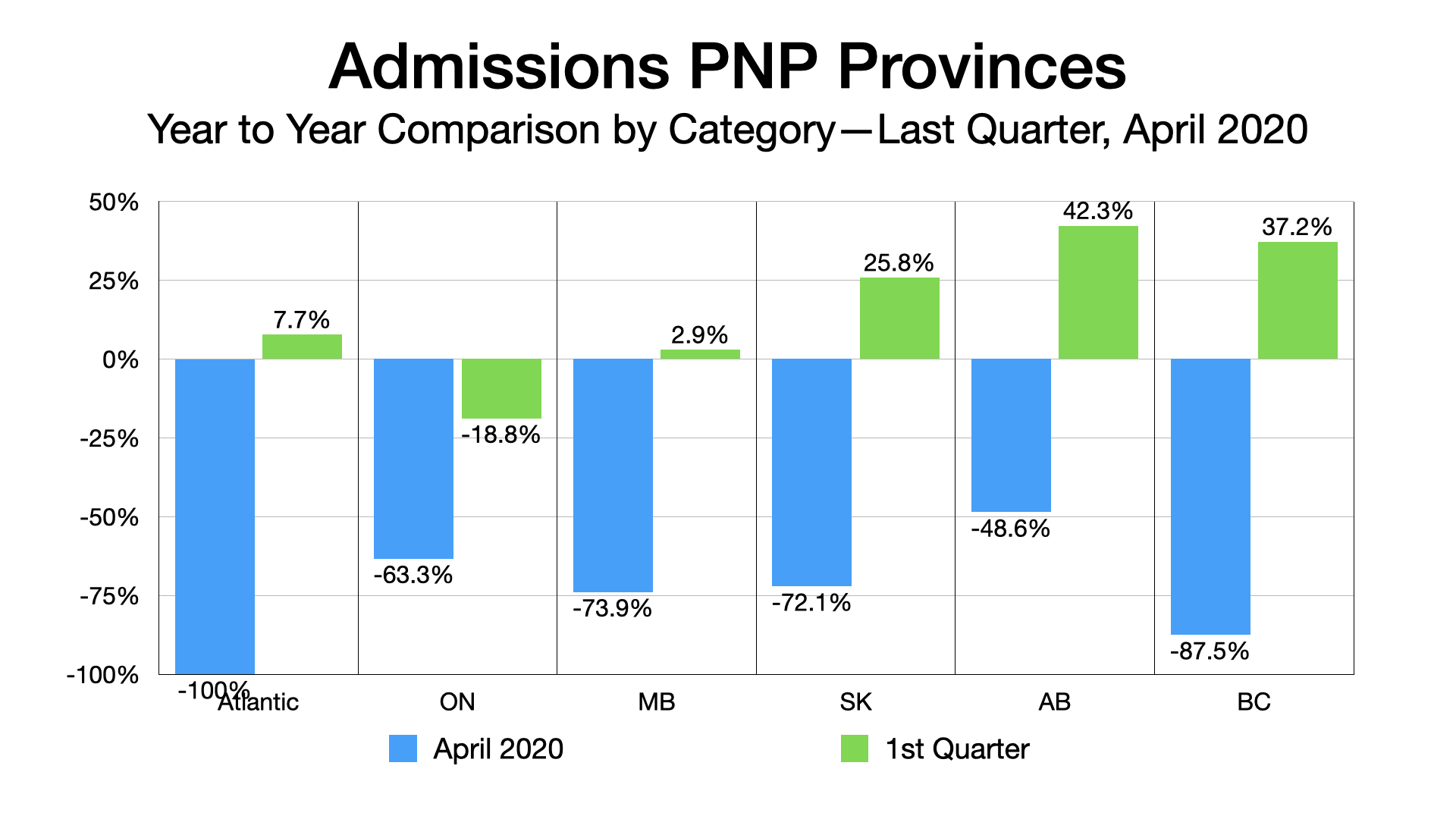
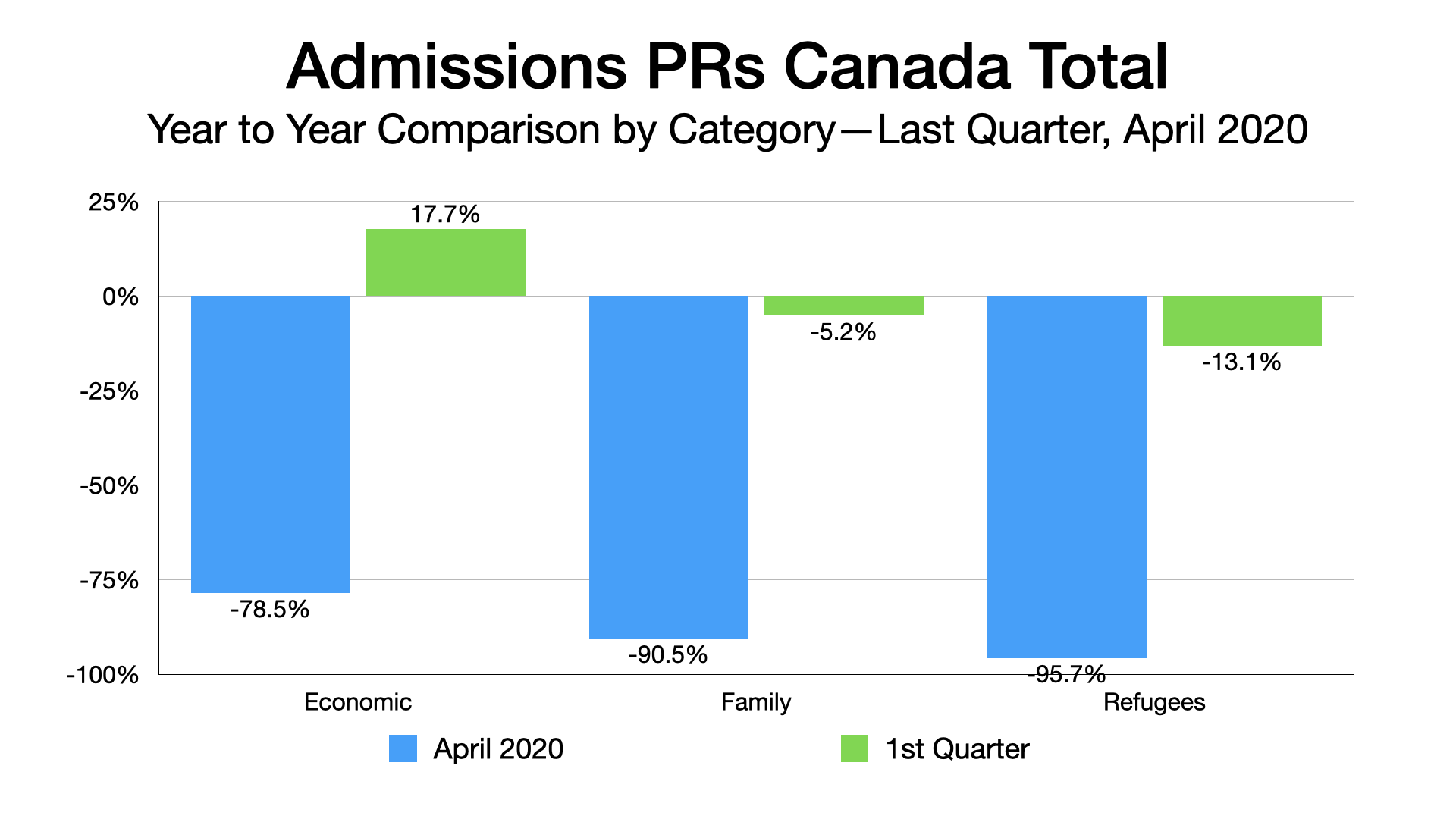
The following charts show the dramatic drop in actual admissions for the three immigration categories as well as a separate view for PNPs:

The first half of 2020 has been unlike any other period in the history of Express Entry. Canada saw both the largest and smallest Express Entry draws ever as a result of the coronavirus pandemic.

Immigration, Refugees and Citizenship Canada (IRCC) held the biggest Express Entry draw ever on February 19, inviting 4,900 candidates in a single draw.

A few weeks later, on March 12, the new immigration minister, Marco Mendicino, announced that Canada would welcome over one million immigrants by 2022, many of whom would arrive through Express Entry.

Just a few days later, March 18 would change many things for hopeful Canadian immigrants. Coronavirus was becoming a bigger threat within Canada, and so the federal government closed the border to most foreign travel. The future of Express Entry was up in the air.

Find out if you are eligible for any Canadian immigration programs

More Express Entry draws during pandemic

It was quickly established that Canada would continue to hold Express Entry draws, and Minister Mendicino said that immigration would be key to economic recovery.

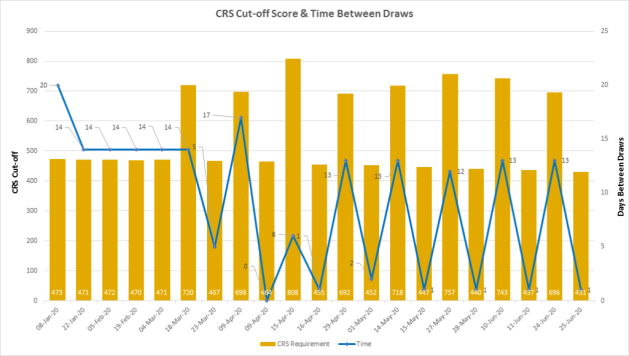
Express Entry draws changed significantly. The all-program draws, which includes candidates from the Foreign Skilled Worker Program (FSWP), Federal Skilled Trades Program (FSTP), and Canadian Experience Class (CEC), were no longer held every two weeks. Instead, two draws would be held within days or hours of each other. One would target Provincial Nominee Program(PNP) recipients, and the other would only invite people from CEC. These draw pairings would take place roughly every two weeks.

As a result, there have been 21 draws held as of today, including the June 25 Express Entry draw. Last year, 2019, there were 12 draws held in the same time frame.

However, more Invitations to Apply (ITAs) have been issued this year compared to the same time last year.  This year 49,900 ITAs have been issued in the first half of 2020, whereas 2019 saw 41,800 ITAs issued at the mid-year point.


The differences in PNP and CEC draws

PNP draws would always be smaller than CEC draws, and they would have higher Comprehensive Ranking System (CRS) score requirements.

This is because a provincial nomination automatically gives candidates an extra 600 points in addition to their human capital score. The lowest CRS requirement of a PNP draw this year was 692 on April 29. This means, without the nomination, recipients only needed a human capital score of at least 92 in addition to the requirements of the PNP that awarded them the nomination.

The smallest Express Entry draw ever was a PNP draw that issued 118 ITAs on April 15. It also had the largest CRS cutoff of the year at 808. This is still not the biggest CRS requirement of all time, which was 886 in the first Express Entry draw ever on January 31, 2015.

CEC candidates must have at least one year of skilled work experience in Canada, meet the Canadian Language Benchmark (CLB) required in their field, and live outside of the province of Quebec.

Express Entry draws that targeted CEC candidates this year were comparatively bigger and had much smaller CRS requirements.

FSWP and FSTP candidates were not drawn unless they had a provincial nomination. IRCC said they are prioritizing programs like CEC and PNP for the number of candidates that are currently in Canada.

IRCC has not said when FSWP and FSTP candidates will once again be included in Express Entry draws.

Nonetheless, Express Entry candidates currently outside of Canada who do not have Canadian work experience or a Canadian job offer are still receiving ITAs through Express Entry-linked PNP draws.

Express Entry-linked PNP draws

Alberta has held a total of 11 Alberta Express Entry Stream draws so far this year, at least six of them took place after the March 18 travel restrictions went into effect. Candidates invited on the latter dates had to be in Canada at the time of their nomination, as part of Alberta’s temporary measures against coronavirus.

B.C. continues to hold draws weekly, though certain draws were affected by business closures resulting in some occupations being left out of draws. Candidates were invited from both the Express Entry BC and Skills Immigration categories

Manitoba started off the year with the first PNP draw on January 2. In total Manitoba has held 12 draws so far, with seven of them taking place during the travel restrictions. A number of Express Entry candidates were invited in each draw.

Nova Scotia has held two Labour Market Priorities draws. The first inviting Express Entry candidates who could demonstrate French and English proficiency, among other eligibilty criteria. The second invitation round was for candidates who had work experience in nursing.

Ontario has held eight draws that invited Express Entry candidates, most of them during the travel restrictions. There were also two Express Entry Human Capital Priorities stream draws, and two Tech draws. Invitation rounds for candidates who may be eligible for the French Speaking Skilled Worker, and Express Entry Skilled Trades streams happened within one day of each other on two occasions.

Prince Edward Island normally follows a predetermined schedule for its PNP draws, however due to coronavirus, draws were re-scheduled in March, April, May and June. The draws they have held so far targeted Express Entry candidates who worked in essential services such as healthcare and trucking.

Saskatchewan has held five Express Entry-linked draws this year. The province is allowing some flexibility for nominees and applicants who are unable to submit completed applications, or whose circumstances had changed due to coronavirus.

Express Entry in the next half of 2020

A lot will be determined before the end of the month, as the current travel ban restrictions are in effect until June 30. Prime Minister Justin Trudeau is due to make the announcement in the coming days.

In a new TV interview, minister Mendicino reiterated that Canada will continue to rely on Express Entry and other streams to welcome global talent from all over the world.

Source: Express Entry mid-year 2020 report: The Coronavirus Impact

Quebec stops publishing daily COVID-19 data despite leading country in number of cases UPDATED: Quebec reversal

Update: Quebec announced that it will continue publishing the data on a daily basis following an outcry (Québec recule: les données sur l’évolution de la pandémie seront publiées sur une base quotidienne). Still curious about the rational behind the original decision.

——-

Not sure this strategy will address the “communications” issue as weekly reporting will likely continue to highlight Quebec’s relatively poor performance both domestically and internationally.

Not a great example of transparency and accountability.

Will change my weekly update to accommodate their Thursday release schedule:

Quebec’s Health Ministry says it will only provide weekly reports about COVID-19, rather than providing a daily rundown of the situation.

The province’s public health institute, INSPQ, had also been publishing daily updates, including the number of cases and hospitalizations in Quebec, the number of tests conducted and how many people have died.

The data was also broken down by age and region and showed how many long-term care homes have outbreaks.

The move from daily to weekly updates appears to mean Quebec is providing data less frequently than any other Canadian province, despite leading the country in number of cases. Ontario, which has the second-highest number of cases, continues to provide daily numbers.

As of Thursday, Yukon’s Emergency Measures Organization is providing a public update once per week — but the territory has only 11 confirmed cases.

Prime Minister Justin Trudeau addressed the change in his daily news conference on COVID-19 Thursday, saying it’s up to each province to decide how transparent it needs to be.

He also said that Quebec still has a “significant number of cases” and deaths every day.

“I certainly hope that Premier [François] Legault would continue to be transparent and open with Quebecers and indeed with all Canadians as he has been from the very beginning,” Trudeau said.

The Health Ministry and INSPQ will only publish the data on their respective websites every Thursday, the first of them beginning July 2. The ministry will also be sending out a news release with the figures on that day every week.

The decision was first announced in a news release on Fête nationale, the province’s annual holiday.Dr. Horacio Arruda, the province’s public health director, said Thursday that the decision was made in order to provide the public with “more stable numbers,” as fewer confirmed cases each day will make any day-to-day increase appear more significant than it is.

He said this would also allow the province to provide a more accurate portrait of how the virus is spreading, as reporting delays have often prompted a revision of the daily numbers.

“As soon as there is some important data to share with the population, we will do that.” Arruda said, suggesting that the daily updates could return in the event of a second wave of infections.

The government announcement appeared to take the INSPQ by surprise. A notice on its website Tuesday said it would begin limiting its updates to weekdays only, rather than seven days a week.

But on Thursday, following the Health Ministry’s announcement, it said it too would only provide a weekly update. A spokesperson referred any questions to the Health Ministry.

The number of daily cases and deaths in Quebec has declined in recent weeks.As of Thursday, 55,079 people in Quebec have tested positive for the coronavirus that causes COVID-19. That’s an increase of 142 new cases since Wednesday.

There are 487 people in hospital and 5,448 have died. A total of 520,227 tests have come back negative.

The Quebec government has allowed most businesses to reopen, including restaurants, bars, gyms and shopping malls, with physical-distancing restrictions in place.

Source: Quebec stops publishing daily COVID-19 data despite leading country in number of cases

We Don’t Have to Like Them. We Just Need to Understand Them.

Good commentary on historic statues in a way that understands the differences between historical figures, their contexts, and the need for case-by-case consideration of whether to remove or relocate:

Some sights are so searing that you can’t unsee them. And, like it or not, you end up seeing the world through them. Reality hasn’t changed; you have, which makes you want to change reality. Right now.

That pretty much describes the cause-and-effect physics surrounding the release, on May 25, of the cellphone video of George Floyd pinned to the ground and having the life squeezed out of him, second by second, by a Minneapolis policeman.

In the protests that followed, white supremacist images of all kinds — Confederate memorials, statues of slave-owners, tributes to colonizers — have come under attack. Some have been destroyed; others forklifted into storage; still others left in place to await an uncertain fate.

More recently, the anti-monument movement appears to be spreading beyond a focused demand for racial justice. Earlier this week in Madison, Wis., protesters toppled a statue of Hans Christian Heg, an abolitionist who died trying to end slavery.

Among a number of racially charged images in New York City, one of the most contested, the equestrian statue of Theodore Rooseveltat the entrance the American Museum of Natural History, has finally had its day of reckoning. Last week the museum itself asked the city for permission to remove the statue, and got the O.K.

In a press statement, the museum was careful to explain the reason behind its request for removal. Roosevelt himself — whose father was a founder of the museum — was not the main problem. The monument’s optics were.

Roosevelt is a complicated historical figure, an unstable ethical compound of bad and good. As an ardent conservationist, he put vast stretches of American land under federal protection, but took much of that land from Native Americans. He was internationalist in his thinking, but largely because he considered the resources of the world, particularly parts of the world with dark-skinned populations, to be ripe for the taking.

A Smithsonian Institution website describes him bluntly as “a racist whose beliefs reflected those of the elite of his day. Roosevelt thought African Americans to be inferior to white citizens.”

But even if you didn’t know any of this, one look at the monument tells you that it’s a problem, one that no extenuating information can make right.

Twenty-four feet tall, including an eight-foot high base, the 1940 sculpture by James Earle Fraser depicts Roosevelt, armed with pistols and perched on a spirited charger. Below him, walking on either side of the horse, their heads reaching barely higher than its back, are two other male figures, one Native American, one African, both in “native” attire. Each carries a rifle. Are they meant to be Roosevelt’s gun-bearers? His guides? His security detail? Whatever, he doesn’t look like he needs them. His face is alert, resolute, forward-directed; theirs, passive, withdrawn, cast down.

The image is, of course, a fantasy, one that can, and has been, interpreted in varying ways. One historian reads the standing figures as allegorical embodiments of Africa and America. To Fraser himself they represented “Roosevelt’s friendliness to all races.” But to contemporary eyes, the white supremacist import of its composition is unmistakable, and unacceptable: heroic white man on top of the world. No question, the thing has to go. And in the vaunted “great awakening” to racial injustice underway in the country now (how long will it last? How deep does it run?) the museum, and the city, figured that out.

But here comes a question. What do we do with other monuments that have similar compositions but more complex images and histories, and are, in addition, works of aesthetic distinction (a claim rarely made for the Roosevelt statue)? I’m thinking of the Memorial to Robert Gould Shaw and the Massachusetts 54th Regiment in Boston — a monument that got graffiti-tagged during protests in May.

This bronze bas-relief by Augustus Saint-Gaudens, installed on the Boston Common in 1897, also centers on a dominant white equestrian figure, in this case surrounded by black men in military uniforms. It commemorates Shaw as the leader of the first all-black volunteer Union army brigade that formed in Boston in 1863, and marched to a battle in South Carolina, where many soldiers, including Shaw, died, and where they were all buried together.

The visuals here say “white supremacist,” too: the racially hierarchical composition, the single-name dedication, the suggestion of the Union army’s enforced segregation.

At the same time, does a narrative of interracial loyalties between leader and troops add a mitigating factor to a judgment of the work? Or the fact that Frederick Douglass came to Boston to attend the 1897 unveiling? (Two of his sons were in the 54th Regiment.) Or even the fact that the Saint-Gaudens relief is widely regarded as a masterpiece of American public art?

To fully weigh such factors requires some knowledge of history, a discipline that has long been shunted aside in education. The story of Shaw and the 54th Regiment, or at least a highly romanticized version of it, has had the advantage of popular exposure: It was the subject of the 1989 film, “Glory. ” But even so, the monument was targeted by protesters. And the real question is, what’s the correct — meaning useful — response to the monument’s image of an egregious racial power dynamic? Eliminate or obscure it, or explain it?

All to say that the disposal of monuments should be approached case by case. Public political images are never innocent. But some are complex, with questions to ask and lessons to teach, while others — so-called “Lost Cause” Confederate monuments, created long after the Civil War to reassert white power — are, and were intended to be, racist assault weapons, plain and simple. In the current, healthy drive to neutralize assaultive images, it’s necessary, for history’s sake, that we first stand back, look hard, sort them out.

As for the disposition of the Roosevelt monument, which has not been officially announced, I have an idea. Clearly a racist artifact, the work cannot continue to serve as the visual introduction to an institution that, through its modern department of ethnology, is deeply devoted to the study of human culture.

I suggest that the museum retain the sculpture but display it for what it is: an outsize ethnological specimen, the product of a specific era and culture (the piece was unveiled in 1940, a year after the release of the “Lost Cause” film “Gone With the Wind”), now subject to critical evaluation in a different, Black Lives Matter era and culture. This conceptual change in use and value would require moving it, minus its base, into a gallery — and an apt context for display already exists.

In 2019, in response to earlier protests around the sculpture, the museum organized a small, ongoing documentary show called “Addressing the Statue,” which details the work’s history and includes commentary by contemporary ethnologists, social historians, art historians and artists.

Almost everyone says, in different ways, that the monument’s not a good thing and never was. And it would be useful for present and future audiences to be able to learn why it’s not a good thing, and why this not-good-thing — as big and bullying as a Tyrannosaurus — stood where it stood in this city for so long.

As for what might replace it out front, at the entrance: Something should. Why let an empty stone base the size of a small stage go to waste when we have so many politically savvy artists, young and old, who need a platform for their ideas?

As least one has already had a say about the Roosevelt monument: David Hammons, in a 1991 group show called “Dislocations” at the Museum of Modern Art. For his installation there, titled “Public Enemy,” he surrounded photomurals of the sculpture with sandbags and, police barriers. Who was being protected? It — or us? Way back then he wanted it gone, and now the deal’s done. The museum should ask him over for a victory lap.

And the museum could commission new work, keep it impermanent and have it change often, even daily. Mr. Hammons’s “Public Enemy” was ephemeral. When the MoMA show ended, his installation disappeared, perhaps into closets, studios, dumpsters; I don’t know where. More and more right now, impermanence makes sense. Losses from Covid-19, the flood of violent deaths and a new political art that seems to exist entirely on plywood and pavement contribute to this perception.

We’re at an inflection point in this country, potentially the most significant one in generations. Black Lives Matter brought us here. Now it’s everyone’s job to sustain the momentum. New art certainly has a contribution to make. So do our historical public images.

Some examples, like the Roosevelt and Shaw monuments, are eye-and-mind grabbers, dense packages of information and emotion. We should study them as closely and critically as we do the monuments of any age and culture. We don’t have to like them; we just need to understand them, examine their mechanics, what made them persuasive in their time, and how that persuasion works, or doesn’t, now.

By comparison, most of the commemorative statues now under attack across the land — and there are more and more each day — have little visual charisma. They’re generic period images of white male power. You’re tempted to think: If they go, small loss. Let’s move on.

Then you remember that each of those images comes with a name and a history, and some of those names belong to murderers, enslavers and genocidists. And their history is our history. It’s good to keep reminders of that visible, somewhere. Sometimes the most effective way to push yourself into the future is by reviewing the record of how bad the past has been.

Holland Cotter is the co-chief art critic. He writes on a wide range of art, old and new, and he has made extended trips to Africa and China. He was awarded the Pulitzer Prize for Criticism in 2009.

Social Media Platforms Claim Moderation Will Reduce Harassment, Disinformation and Conspiracies. It Won’t

Harsh but accurate:

If the United States wants to protect democracy and public health, it must acknowledge that internet platforms are causing great harm and accept that executives like Mark Zuckerberg are not sincere in their promises to do better. The “solutions” Facebook and others have proposed will not work. They are meant to distract us.

The news in the last weeks highlighted both the good and bad of platforms like Facebook and Twitter. The good: Graphic videos of police brutality from multiple cities transformed public sentiment about race, creating a potential movement for addressing an issue that has plagued the country since its founding. Peaceful protesters leveraged social platforms to get their message across, outcompeting the minority that advocated for violent tactics. The bad: waves of disinformation from politicians, police departments, Fox News, and others denied the reality of police brutality, overstated the role of looters in protests, and warned of busloads of antifa radicals. Only a month ago, critics exposed the role of internet platforms in undermining the country’s response to the COVID-19 pandemic by amplifying health disinformation. That disinformation convinced millions that face masks and social distancing were culture war issues, rather than public health guidance that would enable the economy to reopen safely.

The internet platforms have worked hard to minimize the perception of harm from their business. When faced with a challenge that they cannot deny or deflect, their response is always an apology and a promise to do better. In the case of Facebook, University of North Carolina Scholar Zeynep Tufekci coined the term “Zuckerberg’s 14-year apology tour.” If challenged to offer a roadmap, tech CEOs leverage the opaque nature of their platforms to create the illusion of progress, while minimizing the impact of the proposed solution on business practices. Despite many disclosures of harm, beginning with their role in undermining the integrity of the 2016 election, these platforms continue to be successful at framing the issues in a favorable light.

When pressured to reduce targeted harassment, disinformation, and conspiracy theories, the platforms frame the solution in terms of content moderation, implying there are no other options. Despite several waves of loudly promoted investments in artificial intelligence and human moderators, no platform has been successful at limiting the harm from third party content. When faced with public pressure to remove harmful content, internet platforms refuse to address root causes, which means old problems never go away, even as new ones develop. For example, banning Alex Jones removed conspiracy theories from the major sites, but did nothing to stop the flood of similar content from other people.

The platforms respond to each new public relations challenge with an apology, another promise, and sometimes an increased investment in moderation. They have done it so many times I have lost track. And yet, policy makers and journalists continue to largely let them get away with it.

We need to recognize that internet platforms are experts in human attention. They know how to distract us. They know we will eventually get bored and move on.

Despite copious evidence to the contrary, too many policy makers and journalists behave as if internet platforms will eventually reduce the harm from targeted harassment, disinformation, and conspiracies through content moderation. There are three reasons why it will not do so: scale, latency, and intent. These platforms are huge. In the most recent quarter, Facebook reported that 1.7 billion people use its main platform every day and roughly 2.3 billion across its four large platforms. They do not disclose the numbers of messages posted each day, but it is likely to be in the hundreds of millions, if not a billion or more, just on Facebook. Substantial investments in artificial intelligence and human moderators cannot prevent millions of harmful messages from getting through.

The second hurdle is latency, which describes the time it takes for moderation to identify and remove a harmful message. AI works rapidly, but humans can take minutes or days. This means a large number of messages will circulate for some time before eventually being removed. Harm will occur in that interval. It is tempting to imagine that AI can solve everything, but that is a long way off. AI systems are built on data sets from older systems, and they are not yet capable of interpreting nuanced content like hate speech.

The final – and most important – obstacle for content moderation is intent. The sad truth is that the content we have asked internet platforms to remove is exceptionally valuable and they do not want to remove it. As a result, the rules for AI and human moderators are designed to approve as much content as possible. Alone among the three issues with moderation, intent can only be addressed with regulation.

A permissive approach to content has two huge benefits for platforms: profits and power. The business model of internet platforms like Facebook, Instagram, YouTube, and Twitter is based on advertising, the value of which depends on consumer attention. Where traditional media properties create content for mass audiences, internet platforms optimize content for each user individually, using surveillance to enable exceptionally precise targeting. Advertisers are addicted to the precision and convenience offered by internet platforms. Every year, they shift an ever larger percentage of their spending to them, from which platforms derive massive profits and wealth. Limiting the amplification of targeted harassment, disinformation, and conspiracy theories would lower engagement and revenues.

Power, in the form of political influence, is an essential component of success for the largest internet platforms. They are ubiquitous, which makes them vulnerable to politics. Tight alignment with the powerful ensures success in every country, which leads platforms to support authoritarians, including ones who violate human rights. For example, Facebook has enabled regime-aligned genocide in Myanmar and state-sponsored repression in Cambodia and the Philippines. In the United States, Facebook and other platforms have ignored or altered their terms of service to enable Trump and his allies to use the platform in ways that would normally be prohibited. For example, when journalists exposed Trump campaign ads that violated Facebook’s terms of service with falsehoods, Facebook changed its terms of service, rather than pulling the ads. In addition, Facebook chose not to follow Twitter’s lead in placing a public safety warning on a Trump post that promised violence in the event of looting.

Thanks to their exceptional targeting, platforms play an essential role in campaign fundraising and communications for candidates of both parties. While the dollars are not meaningful to the platforms, they derive power and influence from playing an essential role in electoral politics. This is particularly true for Facebook.

At present, platforms have no liability for the harms caused by their business model. Their algorithms will continue to amplify harmful content until there is an economic incentive to do otherwise. The solution is for Congress to change incentives by implementing an exception to the safe harbor of Section 230 of the Communications Decency Act for algorithm amplification of harmful content and guaranteeing a right to litigate against platforms for this harm. This solution does not impinge on first amendment rights, as platforms are free to continue their existing business practices, except with liability for harms.

Thanks to COVID-19 and the protest marches, consumers and policy makers are far more aware of the role that internet platforms play in amplifying disinformation. For the first time in a generation, there is support in both parties in Congress for revisions to Section 230. There is increasing public support for regulation.

We do not need to accept disinformation as the cost of access to internet platforms. Harmful amplification is the result of business choices that can be changed. It is up to us and to our elected representatives to make that happen. The pandemic and the social justice protests underscore the urgency of doing so.

Source: Social Media Platforms Claim Moderation Will Reduce Harassment, Disinformation and Conspiracies. It Won’t

Donald: Give us your wired masses, yearning to breathe free

Intriguing idea of Scott Gilmore (have seen similar suggestions from India and Europe):

Two historic developments have aligned to create a momentary and monumental opportunity for Canada.

First, we are weathering a global pandemic that has dramatically changed the way the world works. Suddenly, we are all discovering that the technology exists to allow many of us to work remotely, and to continue to be effective doing so. In fact, experts are predicting a sizeable portion of the workforce will choose not to return to the office when this is over.

At the same time, a tide of nationalism has risen in many western countries such as the United Kingdom and the United States. There, governments are making it increasingly difficult for immigrants to arrive or to stay.

For example, President Donald Trump signed an executive order that cancels the H-1B visa category, which permits highly skilled workers, who have already been offered a job by an American company, to live and work in the United States. American economists and CEOs are horrified at the decision. Without these well-trained immigrants, Silicon Valley would still be pastureland.

And here is Canada’s golden opportunity: we should immediately offer residency to all 85,000 holders of H-1B visas, permitting them to live in Canada while they work remotely for their current employers in the United States.

The benefits to Canada are numerous and obvious. To begin with, this would not take any existing jobs from Canadians. There are legitimate (albeit mostly misplaced) concerns that our current unemployment crisis would be exacerbated by increased immigration. Holders of this visa would be permitted to remain only if they have a full-time job in the United States (or another foreign country) that can be performed remotely.

It would give Canada an instant boost in revenue. These new arrivals might be working in the U.S., but they’d be paying their taxes and spending their paycheques here. Our services industry is in desperate need of a boost, and with international travel facing a long recovery, relying on foreign tourism will not be enough. We can replace that by effectively transplanting billions in household spending that is currently rooted south of the border.

This new visa class would be a tremendous boost to our pool of creative and productive talent. Canada has traditionally been a runner up when it comes to attracting the world’s best and brightest. This has gradually been changing, but this new visa could accelerate the shift. We would inject some of the world’s brightest minds into our cities, and if the visa provided a pathway for citizenship, we could hold on to that talent and all the benefits it would bring.

As many public policy experts, demographers, economists and others have pointed out, we need more Canadians. We have an ageing population that will produce relatively less tax revenue to support a growing number of elderly people. And if we want to achieve our full potential, we need a critical mass of talented citizens to do so. This is an argument that has been best made by Globe and Mail writer Doug Saunders in his recent book ‘Maximum Canada’. This visa class is one of the easiest paths towards that goal. The U.S. government has basically pre-screened all these immigrants, vetted them for security and health issues, confirmed they are employable, and socialized them to living in a western democracy. We should be paying Washington for the privilege of taking these people off their hands.

This visa would be an obvious blessing for the would-be immigrants. Unwelcome in the U.S. and facing unemployment, they will be greeted warmly here and allowed to continue to do their work and even remain in the same time zone. What’s more, they will benefit from Canada’s high quality of life, and excellent (but improvable) health-care system.

They will also discover that the American Dream has moved north. Compared to the United States, Canada now has higher rates of employment, education and homeownership. We even have longer lives and more vacation days. And while working from home is not ideal, all of our major cities now have ample shared workspace facilities.

This visa is even good for American employers. First and foremost, they get to keep their talent. And, they would no longer have to pay extravagant health insurance costs. Even Donald Trump would welcome this move. In his mind, out of sight is out of mind and these would be just one less class of immigrants to worry about.

We could call this an IWFC: an International Work From Canada visa and offer it to more than just H-1B candidates. If someone has a high paying job in Paris that they can do on their laptop from Montreal, why wouldn’t we want them to do so? It is a new world, and we need to look at it from a new angle. As the global workforce shifts to tele-commuting, the idea of living in Whistler while managing a marketing team in San Jose is not only possible, it is logical.

If Canada were to seize this opportunity, we would have to do it fast. Other countries are likely considering something similar. Who wouldn’t? And, the American election is just months away. The political landscape could shift, and this incredible pool of talent might be allowed to remain in the U.S. Let’s act before then, let’s bring them home to Canada, before someone else puts out their own welcome mat first.

Source: Donald: Give us your wired masses, yearning to breathe free

Trump’s Freeze On H-1B Work Visas Disproportionately Affects Indians

Given the number of articles I have been seeing in Indian media, not surprising:

The Trump administration’s latest freeze on certain types of work visas, designed to protect American jobs during the COVID-19 crisis, is having a disproportionate effect on workers in India.

The executive order, signed Monday by President Trump, extends a ban on green cards issued outside the United States and adds several types of work visas to the freeze, including the H-1B visa for skilled workers. Last year, 72% of those visas were granted to Indians.

The change means tens of thousands of Indians who planned to come to the U.S. this year will have to scrap or delay their plans.

On Tuesday, Sunny Kumar Hirpara awoke in India to news of a temporary ban on his exact type of visa.

“I woke up at like 5 o’clock in the morning, and I saw the messages. I almost started crying,” Hirpara says.

Hirpara, 26, earned a master’s degree in the U.S. and landed a job as an electrical engineer in Irvine, California. In March, he returned to India to visit his parents and to convert his student visa to an H-1B, sponsored by his company. Then the pandemic hit. His paperwork was delayed.

“I’m sad that I invested five years studying in the U.S. and preparing for a job there,” says Hirpara.

Last year, nearly 280,000 Indians were granted H-1B visas or renewed them. New ones are capped at 85,000 annually. The process is now frozen through Dec. 31, 2020.

In some cases, families separated by the pandemic now face more time apart. Social media is flooded with pleas to lawmakers from H-1B holders who temporarily left the U.S. and worry they won’t be allowed back.

Many have advanced degrees and work for U.S. tech giants. Google CEO Sundar Pichai tweeted that he’s “disappointed” by Trump’s order. He was once an H-1B recipient from India.

“We as a country have been such a vibrant economy and society because of our ability to draw talent from around the world,” Nisha Biswal, president of the U.S.-India Business Council, tells NPR. “If we stop, I think that will adversely impact our ability to be at the top.”

India’s IT industry association called the freeze “misguided & harmful” and urged the U.S. government to shorten restrictions to 90 days. Some Indian IT companies with employees in the U.S. will also be affected.

Others, though, suggest that the visa freeze could be a boon to Indian companies, and even to the government.

“This is a fantastic opportunity,” Vikram Ahuja, co-founder of Talent500, a recruitment firm in the southern Indian city of Bengaluru, told India’s NDTV channel. He said working from home — now common during the pandemic — could change how tech companies hire.

“The world is changing, and I think as long as great companies seek great talent, then location and physical proximity becomes irrelevant,” Ahuja said.

He said H-1B visa holders could even still work for U.S. companies, but from home in India — thus paying into Indian tax coffers instead of U.S. ones.

Source: Trump’s Freeze On H-1B Work Visas Disproportionately Affects Indians

‘The Computer Got It Wrong’: How Facial Recognition Led To False Arrest Of Black Man

A very concrete case of facial recognition getting it wrong and police incompetence or indifference in not examining evidence or circumstances:

Police in Detroit were trying to figure out who stole five watches from a Shinola retail store. Authorities say the thief took off with an estimated $3,800 worth of merchandise.

Investigators pulled a security video that had recorded the incident. Detectives zoomed in on the grainy footage and ran the person who appeared to be the suspect through facial recognition software.

A hit came back: Robert Julian-Borchak Williams, 42, of Farmington Hills, Mich., about 25 miles northwest of Detroit.

In January, police pulled up to Williams’ home and arrested him while he stood on his front lawn in front of his wife and two daughters, ages 2 and 5, who cried as they watched their father being placed in the patrol car.

His wife, Melissa Williams, wanted to know where police were taking her husband.

” ‘Google it,’ ” she recalls an officer telling her.

Robert Williams was led to an interrogation room, and police put three photos in front of him: Two photos taken from the surveillance camera in the store and a photo of Williams’ state-issued driver’s license.

“When I look at the picture of the guy, I just see a big Black guy. I don’t see a resemblance. I don’t think he looks like me at all,” Williams said in an interview with NPR.

“[The detective] flips the third page over and says, ‘So I guess the computer got it wrong, too.’ And I said, ‘Well, that’s me,’ pointing at a picture of my previous driver’s license,” Williams said of the interrogation with detectives. ” ‘But that guy’s not me,’ ” he said, referring to the other photographs.

“I picked it up and held it to my face and told him, ‘I hope you don’t think all Black people look alike,’ ” Williams said.

Williams was detained for 30 hours and then released on bail until a court hearing on the case, his lawyers say.

At the hearing, a Wayne County prosecutor announced that the charges against Williams were being dropped due to insufficient evidence.

Civil rights experts say Williams is the first documented example in the U.S. of someone being wrongfully arrested based on a false hit produced by facial recognition technology.

Lawyer: Artificial intelligence ‘framed and informed everything’

What makes Williams’ case extraordinary is that police admitted that facial recognition technology, conducted by Michigan State Police in a crime lab at the request of the Detroit Police Department, prompted the arrest, according to charging documents reviewed by NPR.

The pursuit of Williams as a possible suspect came despite repeated claims by him and his lawyers that the match generated by artificial intelligence was faulty.

The alleged suspect in the security camera image was wearing a red St. Louis Cardinals hat. Williams, a Detroit native, said he would under no circumstances be wearing that hat.

“They never even asked him any questions before arresting him. They never asked him if he had an alibi. They never asked if he had a red Cardinals hat. They never asked him where he was that day,” said lawyer Phil Mayor with the ACLU of Michigan.

On Wednesday, the ACLU of Michigan filed a complaint against the Detroit Police Department asking that police stop using the software in investigations.

In a statement to NPR, the Detroit Police Department said after the Williams case, the department enacted new rules. Now, only still photos, not security footage, can be used for facial recognition. And it is now used only in the case of violent crimes.

“Facial recognition software is an investigative tool that is used to generate leads only. Additional investigative work, corroborating evidence and probable cause are required before an arrest can be made,” Detroit Police Department Sgt. Nicole Kirkwood said in a statement.

In Williams’ case, police had asked the store security guard, who had not witnessed the robbery, to pick the suspect out of a photo lineup based on the footage, and the security guard selected Williams.

Victoria Burton-Harris, Williams’ lawyer, said in an interview that she is skeptical that investigators used the facial recognition software as only one of several possible leads.

“When that technology picked my client’s face out, from there, it framed and informed everything that officers did subsequently,” Burton-Harris said.

Academic and government studies have demonstrated that facial recognition systems misidentify people of color more often than white people.

One of the leading studies on bias in face recognition was conducted by Joy Buolamwini, an MIT researcher and founder of the Algorithmic Justice League.

“This egregious mismatch shows just one of the dangers of facial recognition technology which has already been shown in study after study to fail people of color, people with dark skin more than white counterparts generally speaking,” Buolamwini said.

“The threats to civil liberties posed by mass surveillance are too high a price,” she said. “You cannot erase the experience of 30 hours detained, the memories of children seeing their father arrested, or the stigma of being labeled criminal.”

Maria Miller, a spokeswoman for the prosecutor’s office, said the case was dismissed over insufficient evidence, including that the charges were filed without the support of any live witnesses.

Wayne County Prosecutor Kym Worthy said any case sent to her office that uses facial recognition technology cannot move forward without other supporting evidence.

“This case should not have been issued based on the DPD investigation, and for that we apologize,” Worthy said in a statement to NPR. “Thankfully, it was dismissed on our office’s own motion. This does not in any way make up for the hours that Mr. Williams spent in jail.”

Worthy said Williams is able to have the case expunged from his record.

Williams: “Let’s say that this case wasn’t retail fraud. What if it’s rape or murder?”

According to Georgetown Law’s Center on Privacy and Technology, at least a quarter of the nation’s law enforcement agencies have access to face recognition tools.

“Most of the time, people who are arrested using face recognition are not told face recognition was used to arrest them,” said Jameson Spivack, a researcher at the center.

While Amazon, Microsoft and IBM have announced a halt to sales of face recognition technology to law enforcement, Spivack said that will have little effect, since most major facial recognition software contracts with police are with smaller, more specialized companies, like South Carolina-based DataWorks Plus, which is the company that supplied the Detroit Police Department with its face-scanning software.

The company did not respond to an interview request.

DataWorks Plus has supplied the technology to government agencies in Santa Barbara, Calif., Chicago and Philadelphia.

Facial recognition technology is used by consumers every day to unlock their smartphones or to tag friends on social media. Some airports use the technology to scan passengers before they board flights.

Its deployment by governments, though, has drawn concern from privacy advocates and experts who study the machine learning tool and have highlighted its flaws.

“Some departments of motor vehicles will use facial recognition to detect license fraud, identity theft, but the most common use is law enforcement, whether it’s state, local or federal law enforcement,” Spivack said.

The government use of facial recognition technology has been banned in half a dozen cities.

In Michigan, Williams said he hopes his case is a wake-up call to lawmakers.

“Let’s say that this case wasn’t retail fraud. What if it’s rape or murder? Would I have gotten out of jail on a personal bond, or would I have ever come home?” Williams said.

Williams and his wife, Melissa, worry about the long-term effects the arrest will have on their two young daughters.

“Seeing their dad get arrested, that was their first interaction with the police. So it’s definitely going to shape how they perceive law enforcement,” Melissa Williams said.

In his complaint, Williams and his lawyers say if the police department won’t ban the technology outright, then at least his photo should be removed from the database, so this doesn’t happen again.

“If someone wants to pull my name and look me up,” Williams said, “who wants to be seen as a thief?”

Source: ‘The Computer Got It Wrong’: How Facial Recognition Led To False Arrest Of Black Man