Glavin: Religious freedom is under assault. Will Canada be its champion?

Hard to say whether the Office of Religious Freedom had any substantive impact beyond raising the profile of religious freedom issues compared to having religious freedom as part of overall human rights, where it now resides.

The Evaluation of the Office of Religious Freedom conducted by Global Affairs Canada in 2016 was mixed in its review of the Office’s work and impact, providing a rationale for the Liberal government’s closing the office.

The planned evaluation of Partnerships and Development Innovation: Human Rights, Governance, Democracy and Inclusion to be approved February 2021 will give a sense of whether the human rights program effectively included religious freedom in its programming/activities or not:

Monday was a fairly uneventful day for Peter Bhatti, the 60-year-old president of International Christian Voice, a non-denominational organization based in Brampton, Ont. But it was a sad day, as March 2 has been, every year, for nine years. It was on March 2, 2011 that Peter’s younger brother Shahbaz was assassinated in Islamabad.

As Pakistan’s minister for minority affairs, Shahbaz Bhatti had drawn the ire of Islamist extremists for his outspoken advocacy on behalf of Pakistan’s persecuted Christians, Hindus and Sikhs, and the Hazara and Ahmadi Muslim minorities. Bhatti died from 22 gunshot wounds in an attack claimed by the Tareek-e-Taliban only six weeks after he’d visited Ottawa, where his activism served as an inspiration for the establishment of the Office of Religious Freedom.

The high-level diplomatic project was shuttered by former Foreign Affairs Minister Stephane Dion in March 2016. It was a move that Peter Bhatti says was shortsighted and ill-advised, especially now that religious liberty is under such brutal assault around the world.

You know, we are so lucky here in Canada. We have all kinds of freedom here,” Peter told me on Monday. “But if Canada is going to be a champion of human rights, we should be paying more attention to places where people have no religious liberty at all.”

China is engaged in a brutal campaign involving intensive surveillance and internment without trial in an all-out effort to eradicate the Muslim identity of the Uighur people of Xinjiang. Myanmar continues to evade responsibility for its enforced expulsion of nearly a million Rohingya Muslims from Rakhine state, bordering Bangladesh.

In Pakistan, the blasphemy law that Shahbaz Bhatti fought against not only remains on the books despite international condemnation. It is increasingly deployed to intimidate and persecute religious minorities and liberal intellectuals. Hundreds of people have been prosecuted under the law in recent years.

Shahbaz Bhatti had been particularly outspoken in the notorious case of Asia Bibi, the Christian farmworker who was convicted on a wholly contrived blasphemy charge and languished on death row for eight years before a high court overturned her conviction in November 2018. Several weeks before Bhatti’s murder, on Jan. 4, 2011, Punjab governor Salman Taseer was also assassinated for protesting the obvious miscarriage of justice in Asia Bibi’s case. Taseer was murdered by his own bodyguard.

The judicial reversal of Bibi’s conviction prompted riots across Pakistan. Bibi was placed in protective custody, and it wasn’t until last May that she arrived in Canada—two of her daughters had already relocated here. For the past 10 months, Bibi and her family have been living in Canada on temporary visas, at an undisclosed location and under assumed names for security reasons.

Last week, French President Emanuel Macron invited Bibi to apply for permanent asylum in France, where Bibi is currently promoting her memoir, co-authored by the French journalist Anne-Isabelle Tollet. Last Tuesday, she was presented a certificate of honorary citizenship from the mayor of Paris, Anne Hidalgo. “France is a symbol for me,” Bibi told reporters, adding that Canada’s harsh winters were also a factor in her consideration of France as her permanent home. Besides: [France] was the first country in the world to really support me, and the country from which my name became known.”

While Shahbaz Bhatti’s name has been nearly forgotten in official Canadian circles, his memory lives on among Pakistani minorities and progressive Muslims. Last Sunday, memorial masses in his name were held in Catholic churches across Pakistan. Several commemorations were underway in his honour this week, in the Bhatti family’s home village of Kushpur, and also in the capital, Islamabad. A celebration of Bhatti’s life was planned at the site of Bhatti’s murder in Islamabad, bringing together Muslim and Christian leaders, politicians, diplomats and representatives of the All-Pakistan Minorities Alliance, led by another of the five Bhatti brothers, Paul.

Peter Bhatti’s International Christian Voice (ICV) organization and its supporters will be gathering for a commemorative fundraising dinner in Woodbridge, Ont. on Friday. “But we are no longer mourning,” Peter said. “We are trying to carry on the work of my brother, to continue his legacy.”

A priority for ICV is the resettlement in Canada of Pakistani Christians who have fled to Thailand and are now at risk of arrest and deportation. While it’s easy for Pakistanis to travel to Thailand, the government in Bangkok doesn’t recognize them as genuine refugees. So they end up stuck in limbo in Thailand, and often end up imprisoned in what the ICV calls “intolerable and inhumane conditions” in Bangkok’s Immigration Detention Centre. Working with several churches, the ICV has managed to resettle several dozen Pakistani exiles from Thailand under the federal private-sponsorship program.

The ICV wants Global Affairs and the UN High Commissioner for Refugees to urge Thailand to stop arresting and incarcerating refugees for repatriation back to Pakistan. Ottawa should also pressure the Thai government to provide Pakistani refugees with temporary asylum, at least, the ICV says. The organization has also asked Ottawa to formally recognize Pakistani Christians as bona fide refugee claimants fleeing persecution, and also to expedite claims filed by families.

Meanwhile, back in Pakistan, the country’s three million Christians—whose heritage goes back to a late 16th century Jesuit mission during the reign of the Mughal emperor Akbar the Great—are increasingly singled out for spurious blasphemy prosecutions. Over the past 10 years, Christians have been subjected to several suicide bombings, pogroms, anti-Christian riots and the official demolition of Christian neighbourhoods. But it is the blasphemy law that allows extremists to engage the full force of the state most effectively against Christians and other minorities.

There are at least 25 Christians in prison on blasphemy convictions in Pakistan at the moment. Six are on death row. One of them, Shagufta Kausar, has been awaiting an appeal hearing, along with her husband Shafqat Emmanuel, ever since they were both sentenced to death in 2014.

Kausar was Asia Bibi’s cellmate.

Source: Religious freedom is under assault. Will Canada be its champion?

India: UK expresses concerns over potential impact of Citizenship Act and it’s effects

Contrast with Trump administration:

The UK government has reiterated its concern over the potential impact of the Citizenship Amendment Act (CAA) and said it is continuing to follow the events in India closely.

In response to an urgent question on ‘Recent Violence in India’ tabled by Pakistani-origin Opposition Labour Party MP Khalid Mahmood in the House of Commons on Tuesday, UK’s Minister of State in the Foreign and Commonwealth Office (FCO) Nigel Adams said the UK engages with India at all levels, including on human rights, and also referred to the country’s “proud history” of inclusive government and religious tolerance.

“The UK government also have concerns about the potential impact of the legislation (CAA),” said Adams, the Minister for Asia who was standing in for UK Foreign Secretary Dominic Raab, who is on a visit to Turkey.

“It is because of our close relationship with the government of India that we are able to discuss difficult issues with them and make clear our concerns where we have them, including on the rights of minorities.

“We will continue to follow events closely and to raise our concerns when we have with them,” said the minister.

While Mahmood, who had tabled the urgent question for an FCO statement, described the government response as “facile”, another Pakistani-origin MP Nusrat Ghani called on the government to relay the UK Parliament’s concerns to the Indian authorities.

British Sikh Labour MP Tanmanjeet Singh Dhesi said the violence had brought back “painful personal memories” from the 1984 Sikh riots while he was studying in India and fellow Sikh MP Preet Kaur Gill also referenced 1984 in her intervention.

Other MPs sought to highlight the steps taken by the Indian authorities to restore “peace and tranquillity” in Delhi.

“He will be aware that it is not just Muslims who have been killed; Hindus have also been killed as part of the riots,” said Conservative Party MP Bob Blackman.

Scottish National Party (SNP) MP Alyn Smith sought the UK government’s intervention to share best practice around countering the online disinformation campaign being used in India to “inflame tensions”.

“We are in constant contact on these issues, and we know how important this is to Members of Parliament and their constituents, who may have family in the area,” said Adams, in his response.

Source: UK expresses concerns over potential impact of Citizenship Act and it’s effects

Most of the 23 million immigrants eligible to vote in 2020 election live in just five states

Useful perspective and comparisons:

About one-in-ten people eligible to vote in this year’s U.S. presidential election are immigrants. And most (61%) of these 23 million naturalized citizens live in just five states.

California has more immigrant eligible voters (5.5 million) than any other state, more than New York (2.5 million) and Florida (2.5 million) combined. Texas and New Jersey round out the top five, with 1.8 million and 1.2 million immigrant eligible voters, respectively.

Here is a closer look at immigrant eligible voters in these five states.

How we did this

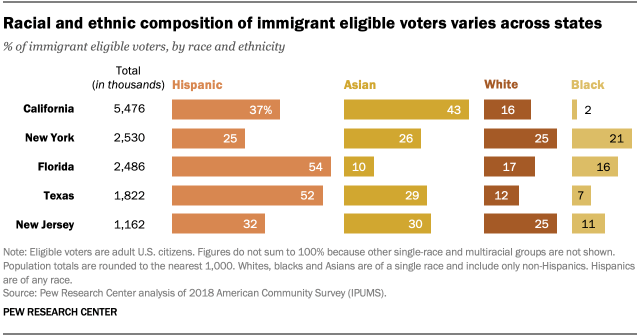
1Asians make up 43% of immigrant eligible voters in California, the highest of any racial or ethnic group.Nationally, Latinos make up a higher share of immigrant eligible voters than Asians (34% vs. 31%), but the reverse is true in the Golden State, where many Latino immigrants are ineligible to vote because they do not hold U.S. citizenship.

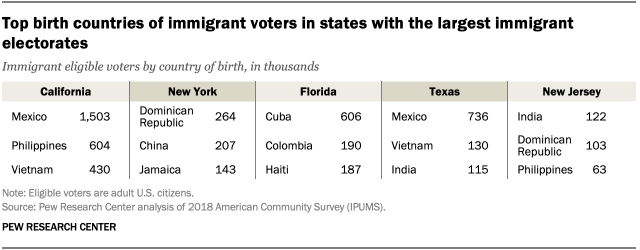
California’s immigrant eligible voters come from many countries. But three origin countries account for 46% of the total: Mexico (1.5 million immigrant eligible voters), the Philippines (604,000 voters) and Vietnam (430,000 voters).

The vast majority of California’s immigrant eligible voters (75%) have lived in the United States for more than 20 years. The share is highest (82%) among California’s Latino immigrant voters. Smaller majorities of Asian (71%), white (71%) and black (59%) immigrant eligible voters in California have lived in the country for at least two decades. English proficiency varies widely among the state’s immigrant eligible voters. For example, 86% of black immigrant eligible voters in California are English proficient, a substantially higher share than among all the state’s immigrant eligible voters (55%).

2New York stands out for the racial and ethnic diversity of its immigrant eligible voters. Asians (26%), Latinos (25%) and whites (25%) make up similar shares of the state’s immigrant eligible voters, while black immigrants (21%) are a slightly lower share.

When it comes to speaking English, black immigrant eligible voters in New York are substantially more likely to be English proficient (89%) than white (66%), Asian (52%) and Latino (47%) immigrant voters.

In New York, no single birth country accounts for a large share of the state’s immigrant eligible voters; about a quarter of foreign-born voters come from the state’s three largest birth countries. Immigrants from the Dominican Republic are the largest single group, with 264,000 eligible voters, followed by China (207,000) and Jamaica (143,000).

3Latinos make up 54% of Florida’s immigrant eligible voters, far higher than the shares of white, black and Asian immigrant voters in the state (17%, 16% and 10% respectively).

Florida’s immigrant voters have varying levels of English proficiency. For example, around half (51%) of Latino immigrant eligible voters are proficient in English, a far lower share than among white (82%) or black (81%) immigrant voters.

With 606,000 voters, Cuban immigrants are the largest group in Florida’s foreign-born electorate. Colombian immigrants, at 190,000, and Haitian immigrants, at 187,000, are the second- and third-largest groups.

4Texas rivals Florida in its share of Hispanic immigrant voters. Roughly half (52%) of all immigrant eligible voters in Texas are Hispanic, a share that trails only Florida (54%) among the top states. Asian immigrants are the second-largest group in Texas at 29%.

Around seven-in-ten immigrant voters in Texas (68%) have lived in the U.S. for more than two decades, similar to the share among all U.S. immigrant voters (68%). However, the share of long-term residents is notably lower among black immigrant voters in Texas (40%).

A high share of black and white immigrant voters in Texas are English proficient (88% and 85%, respectively). Lower shares of Asian (64%) and Hispanic (47%) immigrant voters are proficient. This is similar to the pattern nationally.

By country of birth, Mexican immigrants alone account for 40% of all immigrant voters in Texas, or 736,000 people. The second-largest group, with 130,000 voters, are immigrants from Vietnam, while Indian immigrants, with 115,000 voters, make up the third-largest group in the state.

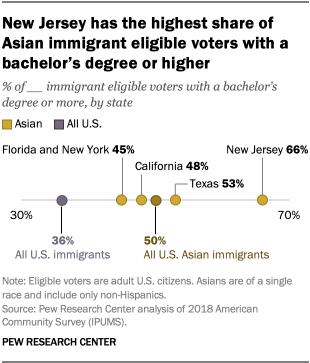
New Jersey has the highest share of Asian immigrant eligible voters with a bachelor’s degree or higher5New Jersey has a high share of Asian immigrant voters with a college degree. About two-thirds of Asian immigrant voters in New Jersey (66%) have a bachelor’s degree or higher. That’s substantially higher than the share among other immigrant voter groups in the state and the share among immigrant voters in the U.S. overall (36%), including those who are Asian.

Among New Jersey’s 1.2 million immigrant eligible voters, 32% are Latino, 30% are Asian, 25% are white and 11% are black.

Meanwhile, the top birth countries for immigrant eligible voters in New Jersey are India (122,000 voters), the Dominican Republic (103,000) and the Philippines (63,000).

See the table below (or open it as a PDF) for detailed characteristics of immigrant eligible voters in California, New York, Florida, Texas, New Jersey and nationally.

Demographics of naturalized citizen eligible voters in select states

Source: Most of the 23 million immigrants eligible to vote in 2020 election live in just five states

The shifting lens through which Canadians see the Wet’suwet’en crisis

Interesting analysis by Michael Adams and Andrew Parkin:

Canadians have lived through many confrontations over Indigenous rights and resource development, but few have had such high stakes as the one that erupted last month and is still unfolding, with a proposed deal newly announced after weeks of rail blockades across the country as Wet’suwet’en hereditary chiefs have protested the Coastal GasLink pipeline that would run through their territory in British Columbia. Hanging in the balance, depending on one’s perspective, are not only the rights of particular First Nations but the coastal environment, the livelihoods of people travelling or shipping by rail, Canada’s reputation as a reliable trading partner, the survival of the federal minority government and the future of reconciliation itself.

Also at stake are the hearts and minds of the Canadian public. Some worry that the prolonged blockades of roads and railways has put public buy-in to the reconciliation agenda at risk — and with good reason. A look back at survey data from 1990 shows that the Oka crisis did erode public support for Indigenous land claims. While few Canadians approved of how the federal and provincial governments handled the crisis, there was little sympathy for the Mohawk barricaders, either. Tellingly, the only actor in the Oka dispute whom the public did support was the army. Two-thirds of Canadians backed the decision to call the army in to deal with the situation.

But Canada is a very different country than it was 30 years ago. Using excessive force to bring down the barricades would likely have been seen by many Canadians as a strategy that is three decades out of date. It would also have set back the clock on years of slow but steady bridge-building.

One big change in the public’s mindset is the emergence of climate change as a major concern. At their heart, both the Oka crisis of 1990 and the current conflict are about Indigenous control over Indigenous lands. But the current conflict can also be framed as being about whether the need to move fossil fuels to market should continue to trump all other concerns. It comes at a time when more Canadians name climate change than name the economy as the most important issue facing the country. The interweaving of Indigenous self-determination with the fight against climate change has shifted the lens through which the public is gauging the federal government’s reaction to the crisis — and, as a result, has affected the government’s room to manoeuvre.

A second change has to do with the bumpy journey toward reconciliation. As distant as the end point of this journey may seem, it would be a mistake to think that the past several decades of public discussion has left Canadians no better informed than before. In fact, most Canadians now recognize the wrongs that Indigenous peoples have faced and support actions to redress those wrongs.

For instance, most Canadians believe that Indigenous peoples experience discrimination in our society and are disadvantaged in their standard of living. And overwhelming majorities support policies such as equalizing funding for Indigenous education and spending more to improve the quality of housing and drinking water in Indigenous communities.

More important, two in three Canadians believe that individuals like themselves have a role to play in efforts to bring about reconciliation. This points to a recognition that reconciliation is not just about what governments do; it is also about broadening understanding and promoting dialogue more widely across society.

Generational change will likely keep the momentum for reconciliation going. Almost two-thirds of non-Indigenous youth in Canada now have an awareness of the history of Indian residential schools. And young Canadians want to know more: over 80 percent agree that everyone will benefit from looking more closely at Indigenous perspectives on community, land and culture, and almost 90 percent agree that it is important to understand the true history of how Indigenous peoples have been treated by governments and society in this country.

None of this is to suggest that the public can be counted on to support those who disrupt the country’s transportation networks. There remains a gap between the public’s strong desire to see improvements in the treatment of Indigenous peoples in Canada, and its uncertainty about the nature and extent of Indigenous rights and what these mean in practice for resource development. And if the lines between peaceful protest, civil disobedience and resistance get more blurred, most may once again side in the short term with those entrusted to reimpose order.

But Canada has moved on from where it was in 1990 — before reconciliation entered the public’s lexicon. Canadians don’t just want things to get back to normal, they want things to get better. That is why the onus is on Indigenous and non-Indigenous leaders alike to find a way out of this crisis that differs from what was done in the past.

Source: The shifting lens through which Canadians see the Wet’suwet’en crisis

Immigration attitudes have barely changed – so why is far right on rise?

Interesting take:

There are three major reasons why voters have become more likely to back far-right parties in Europe

Over the last three decades, far-right parties in Europe have tripled their vote share, from about 5% in the early 1990s to more than 15% today. About one in six Europeans now vote for parties such as Marine Le Pen’s National Rally (previously National Front) in France, Matteo Salvini’s League in Italy, or Viktor Orbán’s Fidesz in Hungary. This is one of the most striking outcomes of a new edition of the PopuList, a research collaboration supported by the Guardian, which launches on Tuesday.

Political scientists have demonstrated that the single most important reason why people vote for far-right parties is their attitude towards immigration. In other words, those who support these parties tend to do so because they agree with them that immigrants are “dangerous others” who form an economic and/or cultural threat to their own native group. This in itself is not remarkable – it just shows that many supporters of far-right parties are rational voters in the sense that they opt for outlets that express ideas they agree with and deem important.

What is remarkable, however, is that people’s attitudes towards immigration have not changed much over the years. On average, people have become neither more positive nor more negative about the influx of immigrants. This confronts us with an interesting puzzle: how is it possible that the electoral successes of far-right parties have increased so much, while at the same time the main determinant of far-right support – anti-immigration sentiment – has remained relatively stable? Let me mention three developments that can help us understand what is going on.

First, far-right parties have learned how to better mobilise voters. Until the turn of the millennium, most far-right parties were generally conceived of as beyond the pale. Voters associated them with fascism and violent anti-democratic skinheads. This has changed as many far-right parties have succeeded in moderating their images. A good example is Le Pen’s detoxification” strategy. She cut connections to extremists, changed her party’s tarnished name and distanced herself from her father, the more radical previous leader and founder of the party. It is important to emphasise, however, that although various far-right leaders have succeeded in moderating their party’s reputation, when it comes to their actual programmes most of them have remained as radical as ever.

Mainstream parties have also played an important role in this process of reputation moderation. They have legitimised the ideas of far-right parties by incorporating watered-down versions in their own political programmes. Many academic studies have shown that when it comes to their positions on immigration and integration, mainstream parties have moved towards the far right. The Dutch prime minister, Mark Rutte, for instance, wrote a letter to all citizens in the Netherlands, in which he argued they had to actively defend the country’s values against people who refused to integrate or who acted antisocially. “Behave normally or leave,” was one of his letter’s core messages. Similar strategies have been employed by mainstream parties in Austria, Denmark and France.

Second, it is not only political parties that have adapted their behaviour – voters have also changed. Not so long ago the average voter was loyal to their political party; a typical social democrat remained a social democrat forever, and did not even consider voting for a conservative or liberal party. Yet processes of individualisation and emancipation have made people much more whimsical when it comes to their electoral behaviour. Slowly but steadily, loyal voters became floating voters, and many of them started to switch between parties – in particular in multi-party democracies. These voters often have a “choice set” of several parties to which they feel attracted, and base their eventual choice on things such as election promises, the performance of party leaders, or parties’ past behaviour in parliament. Voters have started to actually vote, and have thereby become available for mobilisation by far-right parties.

Source: Immigration attitudes have barely changed – so why is far right on rise?

FATCA: U.S. tax rules raising the stakes for Canadian residents with American citizenship

The ongoing saga of compliance with US tax law and Foreign Account Tax Compliance Act (FATCA) following the end of the grace period January 1:

Many Canadian residents with U.S. citizenship could risk fines or the closure of their banking or investment accounts in the coming months if they don’t provide financial institutions with U.S. identification numbers, officials warn.

Experts say that in some cases, financial institutions may close accounts rather than face fines for not providing U.S. social security or taxpayer identification numbers for clients who could be subject to U.S. income tax, such as dual citizens.

That means the stakes are about to get higher for those who haven’t been filing returns and for “accidental Americans” — Canadians with U.S. citizenship (from being born in the U.S. or to an American parent) who did not realize that, as American citizens, they’re obliged to file U.S. tax returns.

The changes won’t affect those who are already filing income tax returns to both Canada and the United States and who already have provided their financial institutions with U.S. identification numbers.Unlike most countries, which levy income tax based on where taxpayers live, the United States requires all those with U.S. citizenship to file income tax returns, regardless of where they live or how much time they’ve spent in the U.S.

The Canada Revenue Agency, not the U.S. Internal Revenue Service, will be enforcing the requirement and levying any fines.

How FACTA works

In 2010, the United States adopted the controversial Foreign Account Tax Compliance Act (FATCA) in a bid to curb offshore tax evasion. Under FATCA, financial institutions outside the United States are obliged to search their files for customers who could be subject to U.S. income tax and report information about those accounts.

Former prime minister Stephen Harper’s government negotiated an agreement that tasks the Canada Revenue Agency with collecting that information from financial institutions for the IRS.

In September 2019, the CRA sent 900,000 financial records belonging to Canadian residents to the IRS — nearly a third more than it sent the previous year. The records were for the 2018 tax year.

The arrangement with the IRS included a ‘grace period’ that allowed financial institutions to send on records that were missing valid U.S. social security numbers or taxpayer identification numbers (TINs) without being fined. That grace period ended Jan. 1.

The CRA says it expects the records it receives from banks, mutual funds, credit unions and other institutions for the 2020 tax year to include that information. Those records will be sent to the IRS in September, 2021.

CRA has authority to fine

If the social security or taxpayer identification number is missing or invalid, the IRS would flag it to the CRA and the CRA would notify the financial institution, which would have 120 days to get the information. The CRA has the authority to levy fines for non-compliance, although it can also exercise discretion. Officials said that there would be an 18-month delay before the CRA issued a notice of non-compliance to a financial institution.

Canada Revenue Agency officials held a meeting Jan. 29 with more than 200 representatives of financial institutions to discuss a proposed guidance document on how they should proceed. Some industry insiders said they expect that guidance, which should be out by the end of March, to say financial institutions can close accounts if they can’t get the information after making reasonable efforts.

No one seems to know how many Canadian residents’ tax files are missing the relevant information. The CRA says it doesn’t know how many files it has transmitted to the IRS without the identifying information and that its compliance efforts are in the early stages.

The CRA and financial institutions are not obliged to inform account holders before their records are shared with the IRS. That means many Canadian account holders may not know that information about their banking or investment accounts is already in the hands of the IRS.

Higher stakes in Canada

Mathieu Labreche, spokesman for the Canadian Bankers Association, said the association is waiting for more information from the CRA before commenting. He said the banks send to the CRA only what Canadian law requires.

Alexandra Jacobs of the Canadian Credit Union Association said the association is working with stakeholders to ensure that credit unions meet their compliance obligations.

Grace Pereira is senior counsel with the BLG law firm in Toronto, specializing in advising investment funds. She said the stakes are higher in Canada than in many other countries.

“We did have the largest number of accounts with missing TINs,” she said. “I think we’re in this lull where we don’t know what is going to happen to those particular account holders.

“I have a lot of empathy for the financial institutions because, at the end of the day, how can they force somebody to get a Taxpayer Identification Number? … Which is essentially sticking up your hand and saying, ‘Yeah, I’ve not been complying for all these years.'”

Kevyn Nightingale, a partner with the accounting firm MNP, said his contacts in financial institutions have told him that they’re already implementing the new rules. He said he expects banks to start refusing to open accounts for those who may be subject to U.S. income tax but who can’t provide a taxpayer identification number.

“The big guys, to my understanding, have not turned people away yet, but I wouldn’t be surprised if that’s ultimately where they go because it’s just easier to do that than deal with the hassle of a recalcitrant U.S. taxpayer,” he said.He said some institutions could accept a client while remitting money to the IRS on the account holder’s behalf, said Nightingale.

While income taxes paid in Canada usually wipe out the taxes due in the U.S., Nightingale said the two systems have different provisions and individuals sometimes still end up owing U.S. tax.

“The choice is now down to either lying about your U.S. status to the financial institutions that you deal with or telling the truth,” he said. “If you tell the truth and don’t provide a social security number, you’re either going to have withholding or they simply won’t accept you. If you provide a social security number, then eventually you’re going to get letters from the IRS that will become gradually more and more insistent.

“And if you continue to ignore those, then it may no longer be feasible to enter the United States.”

Nightingale said the IRS has a program for those who didn’t realize they were supposed to file U.S. income tax returns. Under the program, a taxpayer can come back into compliance by filing three years worth of tax returns and six years of Foreign Bank and Financial Accounts reports.

Source: U.S. tax rules raising the stakes for Canadian residents with American citizenship

Parrainage de réfugiés: une solution demandée dès maintenant

More Quebec immigration-related debate, this time over privately sponsored refugees:

Des associations à but non lucratif d’aide aux immigrants et aux réfugiés demandent au ministre de l’Immigration d’admettre 100 demandes supplémentaires de parrainage privé en 2020 pour compenser le cafouillage dont elles estiment avoir été victimes lors du processus de dépôt des dossiers de parrainage de réfugiés, le 20 janvier dernier.

« Pour nous et pour les ONG, pour tout le monde — même le Ministère l’a admis —, c’est clair qu’il y a eu des problèmes [le 20 janvier], et on veut savoir quelles sont les solutions. De dire que “l’an prochain, on fera mieux”, pour nous, ça ne règle pas le mal des familles aujourd’hui », déclare Me Guillaume Cliche-Rivard, président de l’Association québécoise des avocats et avocates en droit de l’immigration (AQAADI).

Dans une lettre envoyée lundi matin au ministre de l’Immigration, de la Francisation et de l’Intégration, l’AQAADI et la Table de concertation des organismes au service des personnes réfugiées et immigrantes (TCRI) demandent à Simon Jolin-Barrette de trouver une « solution juste et équitable » pour ceux qui ont été défavorisés par le processus de sélection du programme de parrainage collectif.

« Au nom de ces dizaines, voire centaines, de familles effondrées, nous vous demandons respectueusement de rouvrir le processus de réception des demandes et de permettre à ce qu’au moins cent (100) demandes additionnelles soient acceptées dans le cadre de l’exercice du programme pour 2020, et ce, suivant un processus équitable qui offre une réelle possibilité d’accès à tous », écrivent conjointement l’AQAADI et la TCRI.

Un avis juridique sur les enjeux soulevés par les irrégularités de la réception des dossiers de demande de parrainage collectif accompagne la lettre. Même si le document laisse entendre qu’il y a matière à poursuite, Me Cliche-Rivard précise que ce n’est pas le but visé.

« Notre demande, c’est vraiment de dialoguer, de discuter pour trouver une solution. On ne veut pas brandir les armes, mais on veut être pris au sérieux. C’est pour ça qu’on a été chercher un avis légal », explique Me Cliche-Rivard.

« Nous avons reçu la correspondance et nous en prenons acte », a répondu sans plus de détails l’attachée de presse du ministre Jolin-Barrette, Élisabeth Gosselin.

File d’attente de plusieurs jours

Le Programme de parrainage privé de réfugiés (PPPR) permet à des groupes privés de parrainer des réfugiés qui se trouvent à l’étranger. Des 750 dossiers admis par le programme au Québec, 100 places sont réservées aux groupes de deux à cinq parrains. Cette année, le ministre Jolin-Barrette a imposé que les demandes soient déposées le 20 janvier par l’entremise d’un messager pour qu’elles soient traitées selon le principe de « premier arrivé, premier servi ».

Des gens ont fait la queue durant plusieurs jours pour s’assurer l’une des 100 places. Or, dans les faits, comme aucune limite du nombre de demandes par messager n’avait été imposée, le processus a donné lieu à de la corruption, à de l’intimidation et à un traitement injuste des demandes. Le ministre a par la suite assuré que Québec mettrait fin au système de messagers.

Source: Parrainage de réfugiés: une solution demandée dès maintenant

Change to citizenship oath not needed, [Conservative MP] Melillo

The Conservatives are making this an issue (while I agree with the original TRC proposed additional wording, the government version is excessively long – see Liberals propose changes to citizenship oath to respect Indigenous rights):

Kenora MP Eric Melillo says a change to Canada’s Oath to Citizenship shouldn’t be the priority of the House of Commons, as the Indigenous community is facing much larger issues than the wording of an oath.

In his comments at the House of Commons, Melillo spoke of Bill C-6, an act to amend the Citizenship Act. The bill aims to address the Truth and Reconciliation Commission’s Call to Action #94, which is to update Canada’s current Oath of Citizenship. The official oath is recited at a citizenship ceremony, and it is the final step to becoming a Canadian citizen.

“As an MP who represents 42 First Nation communities in my riding, I recently took the opportunity to speak with chiefs, community leaders and community members on their thoughts on this proposed change,” said Melillo.

The current oath reads as “I swear (or affirm) that I will be faithful and bear true allegiance to Her Majesty Queen Elizabeth the Second, Queen of Canada, Her Heirs and Successors, and that I will faithfully observe the laws of Canada, and fulfil my duties as a Canadian citizen.”

The proposed new oath reads as “I swear (or affirm) that I will be faithful and bear true allegiance to Her Majesty Queen Elizabeth the Second, Queen of Canada, Her Heirs and Successors, and that I will faithfully observe the laws of Canada, including the Constitution, which recognizes and affirms the Aboriginal and treaty rights of First Nations, Inuit and Métis peoples, and fulfil my duties as a Canadian citizen.”

“What I heard resoundingly, was that we should not be spending our time debating this, when we could be talking about issues like clean drinking water, healthcare, and many things that impact the lives of First Nation communities much more prominently,” added Melillo.

In response, Richmond Hill MP Majid Jowhari says that this is just one step on the journey of reconciliation, and more needs to be done.

As of Feb. 15, 88 long-term drinking water advisories have been lifted since November 2015, and 62 long-term drinking water advisories are still in effect. This is actually higher than the previous 57-long term advisories that were in place as of July 10, 2019.

Across Canada, northwestern Ontario has the highest concentration of long-term drinking water advisories. Of the 62 advisories remaining, 20 can be found in the Kenora District.

Source: Change to citizenship oath not needed, Melillo

Peter Kent, at Second Reading, on 24 February:

….In the week since these proposed changes were reintroduced by the government, I have received messages from constituents, and from far beyond, which contend that this amendment amounts to typical Liberal tokenism and virtue signalling, pandering and should be opposed.

    I cannot speak to the Liberal government’s motivation here, because when it comes to public policy, inconsistency and contradiction are the hallmarks of legislative process and decision-making. However, I can say that I have spoken often in this House against proposals, very often from the Liberal government, to burden various sections of clearly written sections of law, of the Criminal Code, with unneeded specificities.
    In this debate, I must be clear that I believe the existing oath of citizenship does not need to be burdened with 19 new words that I believe are redundant. If we are to add first nations specificity, why not official bilingualism, why not privacy, why not national security, why not anti-Semitism?
    Therefore, I propose the following amendment. I move:
     That the motion be amended by deleting all of the words after the word “That” and substituting the following: “this House declines to give second reading to Bill C-6, An Act to amend the Citizenship Act (Truth and Reconciliation Commission of Canada’s call to action number 94), since the existing Oath of Citizenship already includes the profound promise of citizens to faithfully observe the laws of Canada and the bill does nothing to support real action to address reconciliation with Canada’s first nations, Inuit and Métis peoples.”

Wealthy Indians see a route to US via Grenada

Didn’t know about this relatively low-cost loophole:

With the EB-5 immigrant investor visa to the United States getting more expensive, wealthy Indians are turning to the Caribbean island of Grenada as a route to their US citizenship dreams.

Immigration lawyers said, in the past three months, interest in the Grenada Citizenship by Investment (CBI) programme has increased from India, as the Caribbean country has an investment visa treaty with the US. Mark Davies, the global chairman of immigration law firm Davies & Associates, said there had been a definite drop in interest towards the EB-5 programme after the US changed the investment guidelines under it.

1From November 2019, the minimum investment required under the EB-5 Immigrant Investor Program had been raised to $900,000 from $500,000 in a Targeted Employment Area (TEA) and from $1 million to $1.8 million in non-TEAs. “This, coupled with a longer wait time for Indians because of an annual country cap of 700, has led people to explore other options,” said Davies, who has been working with clients in India on their EB-5 investments for almost a decade.

Davies’ firm is currently helping processes a few applications for the Grenada CBI programme. There are a lot more enquiries which are likely to convert into applications over time, he said. Turkey is another country which offers a similar route to the US. Under the Grenada CBI programme, the applicant has to make a $220,000 investment in a government-approved real estate project. What makes the country an attractive destination is that it has an E2 visa treaty with the US, wherein a Grenadian can apply for US citizenship and usually get it within three months. A US E-2 visa allows an investor to live and do business in the US in exchange for a minimum investment of $150,000. The investment must be in an enterprise that the investor is able to “develop and direct” and which is at least 50% owned by the investor. In 2018, the US processed 40,000 E2 visas. Country-wise breakups are not available.

Mohammed Asaria, who is the director of Range Investments that facilitates investments in real estate projects for citizenship in Caribbean countries, said he was seeing a lot of interest from Indians, including NRIs from the Middle East, for this programme. The quick processing time, typically 90 days for the Grenadian citizenship, and another 90 days for the E2 visa, is also a big factor driving the shift towards this. “This is no longer an outlier — at all immigration conferences, Grenada is very topical and is at the forefront at the moment,” he said.

The added advantage of this route is that it allows the spouse of the visa holder to freely work in the US and also covers dependent children under 21. And it’s not just the Caribbean island that is benefiting from the higher entry threshold for the EB-5 programme. The Republic of Cyprus, which also offers a similar programme, is emerging as another preferred option. “In the last few months, we’ve seen a lot more interest from India after the changes to the EB-5 programme,” said Dillon Bhatt, the chief of international business development at investment consultancy firm Millwood Kane International.

Source: Wealthy Indians see a route to US via Grenada

Le Québec perd la course aux étudiants étrangers

More pressures from within Quebec regarding more immigration, this time on the part of students and the relatively low number studying in Quebec:

Le nombre d’étudiants étrangers qui entrent au pays a doublé en quatre ans. L’Ontario en profite à plein. Le Québec ? Si peu que la province risque de perdre la course aux talents internationaux.

Selon les données d’Immigration Canada, le Canada a délivré 256 000 permis d’études à des étrangers en 2019, le double d’il y a quatre ans.

La moitié des candidats acceptés au pays étudie en Ontario. Le Québec, pour sa part, accueille seulement 12 % des titulaires de permis d’études, moins que le poids de sa population de 22,5 % dans le Canada.

Cette sous-représentation n’est pas sans conséquence, puisque l’attraction et la rétention des étudiants étrangers constituent un axe stratégique en vue de créer de la richesse et de soulager un tant soit peu la pénurie de main-d’œuvre à moyen terme. Le ministre de l’Immigration du Québec, Simon Jolin-Barrette, a décliné notre demande d’entrevue en nous invitant à communiquer plutôt avec Ottawa.

« La réalité, c’est que l’écart se creuse entre le Québec et les autres provinces dans la course aux talents », déplore Christian Bernard, économiste à Montréal International, organisme de prospection des investissements directs étrangers, qui fait aussi la promotion de Montréal comme ville étudiante internationale.

M. Bernard rappelle que le Canada est en compétition avec la plupart des pays occidentaux dans cette course aux talents.

D’après les chiffres obtenus par La Presse, 51 % des étrangers voulant étudier au Québec se sont vu refuser leur permis d’études par le gouvernement canadien en 2019, contre 38 % dans le reste du pays.

Outre la barrière de la langue française, qui réduit le nombre de demandes à son égard, le Québec est pénalisé par le refus du Canada de laisser entrer au pays un fort contingent d’étudiants francophones en provenance d’Afrique.

Selon Immigration, Réfugiés et Citoyenneté Canada (IRCC), les raisons courantes pour refuser une demande sont que « le demandeur n’a pas prouvé qu’il a assez d’argent pour subvenir à ses besoins pendant ses études ». Ou qu’« il n’a pas convaincu l’agent des visas qu’il quittera[it] le Canada à la fin de sa période d’études », explique, dans un courriel, Peter Liang, conseiller en communication d’IRCC. Pour certains pays, un examen médical est également requis. Dans tous les cas, le candidat ne doit pas avoir de dossier criminel.

« Ce qui est désolant, ajoute Christian Bernard, de Montréal International, c’est la contradiction entre, d’une part, les critères mis de l’avant pour délivrer ou non le permis d’études et, d’autre part, la volonté de tous les paliers de gouvernement qui déploient des initiatives et qui investissent des sous avec l’intention d’attirer et de retenir davantage d’étudiants internationaux au Canada et au Québec. »

Le 31 janvier, l’organisme a recommandé que le Canada réduise le taux de refus des étudiants francophones dans une étude sur la connectivité de la métropole, produite conjointement avec la Chambre de commerce du Montréal métropolitain.

Accepter deux fois plus d’étudiants dans l’espoir de pourvoir les places disponibles

Au trimestre d’automne 2019, à l’Université de Sherbrooke, 37 des 102 places réservées aux étudiants étrangers admis au bac en régime coopératif avec stages de travail rémunérés n’ont même pas pu être pourvues, les étudiants admis ayant été refusés par Immigration Canada. L’institution avait pourtant admis 189 étrangers au départ pour que soient pourvues ces 102 places.

À l’Université Laval, le taux d’inscription des étudiants internationaux préalablement admis a décliné depuis 2014. Il se situait à 67 % en 2018, dernière année pour laquelle la donnée est disponible. « En nombre absolu, le nombre a augmenté de 1100 à 1400 étudiants internationaux. Ce qui nous préoccupe, c’est qu’en pourcentage, ça baisse. On a des étudiants qui ne peuvent pas venir chez nous faute d’obtenir leur permis d’études à temps », dit Yan Cimon, vice-recteur adjoint aux affaires externes, internationales et à la santé et directeur des affaires internationales et de la francophonie.

Ces bourses d’exemption de droits de scolarité pour la francophonie du Sud, au nombre de 235 par an, ont été créées par le premier ministre Philippe Couillard lors du Sommet de la Francophonie tenu au Madagascar en 2016.

En raison de refus de permis d’études, le réseau des cégeps est incapable d’atteindre son objectif, datant de 2012, de 5000 étudiants internationaux. Les 48 cégeps publics accueillent actuellement 4300 élèves étrangers au diplôme d’études collégiales.

Dans le reste du Canada, les collèges d’enseignement professionnel formaient 151 000 étrangers en 2017, d’après un document de 2018 du Bureau canadien de l’éducation internationale. C’est 35 fois plus qu’au Québec.

« On cherche à mieux faire connaître aux agents d’immigration le réseau collégial, avance M. Tremblay, en guise de solution. On leur dit que ça se peut qu’un diplômé universitaire d’Afrique veuille suivre après coup une technique dans un cégep. Il y a un grand attrait pour les formations techniques qui ne sont pas très présentes dans le système d’éducation en Afrique. »

« Dans un contexte de pénurie de main-d’œuvre, l’intégration des étudiants internationaux au réseau collégial représente la solution à la régionalisation de l’immigration, qui est un problème au Québec depuis 40 ans », soutient le patron de la Fédération des cégeps.

Les Africains refusés par dizaines de milliers

Les données d’Immigration Canada montrent que les taux de refus sont particulièrement élevés pour les demandeurs des pays africains, principal réservoir de locuteurs francophones, après la France.

La proportion de refus atteint 90 % pour les Guinéens, 82 % pour les Camerounais, 77 % pour les Algériens et 75 % pour les Sénégalais.

Depuis cinq ans, 16 000 étudiants algériens et 5300 Sénégalais se sont ainsi vu refuser l’entrée au pays.

« Nous n’arrivons pas à nous expliquer cette situation, écrit dans un courriel René Gingras, DG du Cégep de Rivière-du-Loup. Nous espérons qu’il y aura déblocage bientôt. Nous pourrions ainsi accueillir plus d’étudiants qui parlent français, qui s’intègrent dans notre région et qui répondent aux besoins du marché du travail. »

De leur côté, les collèges et universités anglophones du reste du Canada ne rencontrent pas ce problème. Ils recrutent les étudiants de pays anglo-saxons, de pays comme le Japon, la Chine, l’Inde et la Corée du Sud, tous plus riches que les pays africains. Les taux de refus y sont beaucoup plus faibles.

« Aucune discrimination », soutient Immigration Canada

« Les demandes du monde entier sont examinées de façon uniforme et en fonction des mêmes critères. Il n’y a absolument aucune discrimination dans notre processus d’évaluation des demandes », se défend M. Liang, d’Immigration Canada.

Aucune discrimination, mais des objectifs totalement contradictoires avec ceux du Québec, déplore la Fédération des cégeps.

Le fédéral ferme la porte quand il n’est pas convaincu que l’étudiant quittera le pays à la fin des études. Or, ce même étudiant est recruté en se faisant promettre par Québec qu’une fois diplômé, il pourra rester au pays de façon permanente.

Par exemple, des missions de recrutement d’étudiants visent régulièrement le Maghreb, une région pour laquelle Immigration Canada refuse de 40 à 77 % des demandeurs.

Autant de cerveaux qui n’entrent pas au Québec.

Cinq pistes pour hausser la part du Québec

Pour attirer davantage d’étudiants étrangers, le Québec pourrait toujours emprunter un raccourci et imiter la France en proposant des formations uniquement en anglais. Le cégep de Gaspé a choisi cette voie avec son campus de Montréal, qui accueille 2000 Indiens et permet à la maison d’enseignement de faire des profits de 1 million. Des solutions moins controversées existent néanmoins.

Diminuer le taux de refus des permis d’études

« On aimerait voir plus de flexibilité dans le processus de délivrance des permis d’études, confie Yan Cimon, de l’Université Laval. Il y a énormément de pièces justificatives à fournir. C’est difficile de voir des dossiers refusés pour des formalités. »

Si le taux d’acceptation des demandes visant le Québec remontait au niveau du Canada hors Québec, la province aurait accueilli 10 000 étudiants internationaux de plus en 2019. Rapidement, la part du Québec passerait de 12 à 18 % de l’ensemble des étudiants étrangers présents au Canada.

Le fédéral ferait ainsi d’une pierre deux coups. Le pays marquerait plus de points dans la course aux cerveaux qui a cours en Occident tout en diminuant sa dépendance à l’égard de l’Inde et de la Chine, responsables à eux deux de 54 % du flux d’étudiants internationaux au pays.

Instaurer le traitement rapide des permis dans les pays francophones

En 2018, le gouvernement canadien a lancé le Volet direct pour les études (VDE) pour les demandeurs de la Chine, de l’Inde, des Philippines et du Viêtnam, puis en juillet 2019 pour le Pakistan. Le VDE a permis de réduire les délais de traitement.

« Quand vous avez des délais qui interrompent ou qui induisent un report de projets d’études, ce n’est à l’avantage ni de l’étudiant ni de l’université », dit Yan Cimon, de l’Université Laval, où les deux tiers des étudiants étrangers inscrits sont africains.

« Dans le cadre du VDE, les permis d’études des étudiants potentiels peuvent être traités plus rapidement, avance Immigration Canada, dans un courriel, car en faisant leur demande, ceux-ci montrent d’emblée qu’ils ont les ressources financières et les compétences linguistiques. » Le VDE a été élargi au Maroc et au Sénégal en septembre 2019.

Élargir l’admissibilité des diplômés du collégial au PEQ

L’accès rapide à la résidence permanente pour les candidats ayant passé par la filière étudiante contribue à la popularité du Canada comme terre d’études. Au Québec, la voie rapide se nomme le Programme de l’expérience québécoise (PEQ), en révision. Les cégeps voudraient que le gouvernement ouvre le PEQ aux diplômés d’une attestation d’études collégiales, obtenue habituellement après un an d’études, dans les secteurs en pénurie de main-d’œuvre.

Augmenter le nombre de bourses

La France a haussé les droits de scolarité facturés aux étrangers en 2018. La mère patrie cible dorénavant les pays payants comme l’Inde et la Chine. L’Afrique francophone pourrait en subir les contrecoups, elle qui fournissait historiquement 45 % des étudiants étrangers en France, selon un article du Devoir de novembre 2018. Une fenêtre s’ouvre pour le Québec en augmentant le nombre de bourses versées aux Africains. Depuis 2016, le Québec offre 500 bourses d’études aux francophones du Sud qui s’inscrivent au cégep. Encore faudrait-il que les agents d’Immigration Canada considèrent la bourse dans l’examen de la demande de permis d’études.

Entente avec la Belgique et la Suisse

La Fédération des cégeps est en demande auprès du gouvernement pour que celui-ci conclue une entente pour admettre les étudiants de la Belgique et de la Suisse aux mêmes conditions monétaires que les Français dans le réseau collégial. Les étudiants en provenance de l’Hexagone acquittent les mêmes frais que les Québécois. Une entente existe avec la Belgique depuis deux ans pour faciliter l’inscription de ses ressortissants à l’université, mais rien en ce qui concerne le cégep. Aucune entente n’existe actuellement avec la Suisse.