The Bloc changes its tune on Canada’s court challenges program
2020/02/08 Leave a comment
Twelve years ago, a Bloc Québécois MP stood in the House of Commons to proclaim his party’s support for the court challenges program — a federal initiative that had been providing grants to individuals and groups who sought to defend or assert their constitutional or language rights through the courts.
Stephen Harper’s Conservative government announced its intention to eliminate funding for the program in 2006.
“Philosopher and writer Paul Valéry said that the greatness of a civilization is measured in its treatment of minorities,” said Réal Ménard, who was the MP for Hochelaga from 1993 to 2009.

When challenged by Bloc Leader Yves-François Blanchet in the House this week, Trudeau was quick to note that the court challenges program is an arms-length institution that makes its funding decisions completely independent of the federal government.
We don’t know if the court challenges program is funding any other challenges to Bill 21; the grants are confidential. But it provide federal support to a cause that Trudeau has been reluctant to engage with directly.
The history here is long and rich.
The program that died many deaths
The court challenges program actually has its roots in Pierre Trudeau’s push to establish official bilingualism — and his own government’s reluctance to directly intervene against Bill 101, the French-language charter that was introduced in 1977 by Quebec’s Parti Québécois government.
Back then, the Liberals decided against trying to disallow the legislation or referring it to the Supreme Court. But they did create a program that would provide financial support to individuals or groups who wished to challenge provincial language laws — both anglophones in Quebec and francophones in other provinces.
The program was later expanded by Brian Mulroney’s government to cover other equality rights, but the Progressive Conservatives later reversed course and decided to withdraw funding. Jean Chrétien’s Liberals restored the program in 1994. Stephen Harper’s Conservatives took a dim view of the program’s activities and quickly moved to cancel it again in 2006.
By then, the program had become a significant source of financial support for francophones outside Quebec who wished to assert their rights. A House committee report in 2007 listed a number of linguistic cases that had benefited from program funding, including several that challenged provincial or federal governments.
“Many of the cases funded by the program resulted in important language rights precedents in Canadian constitutional law.” Richard Nadeau, another Bloc MP, told the House in 2008. “They made a significant contribution to official language minority rights in Canada.”
Stéphane Dion, Liberal leader at the time, vowed that a Liberal government would revive it. Justin Trudeau made good on that promise in 2017 with a commitment of $1.5 million in annual funding and an expanded mandate to cover a wider array of rights-based cases.
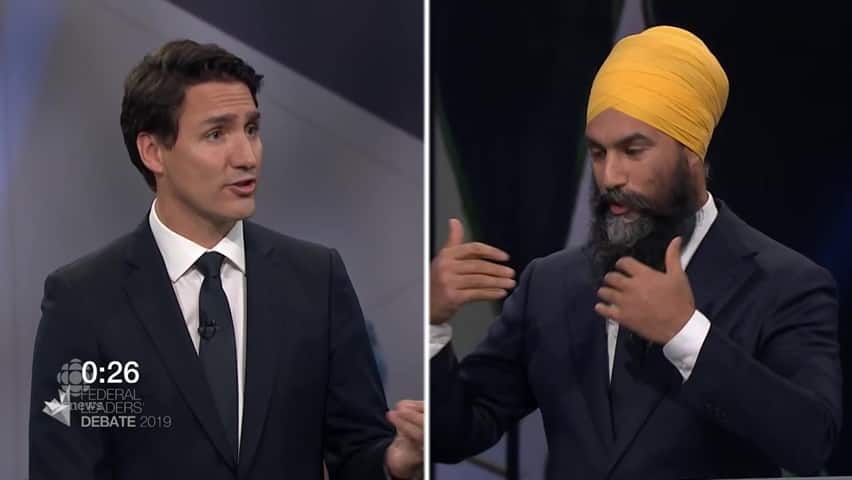
NDP Leader Jagmeet Singh speaks about his battle against discrimination after Liberal Leader Justin Trudeau challenges him to say he’ll intervene on Quebec’s secularism law. 1:15
When asked directly about Bill 21, Trudeau has maintained that he does not believe any government has the right to tell people what to wear. But he has refrained from getting the federal government directly involved — even while not ruling out the possibility of intervening at some point.
There is a case to be made for Ottawa staying out and letting Quebeckers themselves lead the challenges to the law. Federal involvement could further inflame public opinion in a province that prizes its autonomy. But the court challenges program offers an option for indirect support — something that should be harder for Quebec nationalists to demonize because politicians aren’t involved in deciding who gets the funding.
Majority will, minority rights
The Liberal Party’s interest in reviving the program predated the discussion in Quebec that led to Bill 21, but Liberals also might think that Bill 21 is exactly the sort of thing that the court challenges program exists to deal with.
In an interview with CBC’s Power & Politics this week, Blanchet presented two arguments against providing the funding to Montreal’s English school boards.
First, he argued that the school boards already have ample resources and shouldn’t need federal funding to mount a legal challenge. That could be an argument for changing the funding criteria.
But his second argument was much broader.
“What I say is that a citizen, a group, an institution has the right to disagree with the law. It has a right to challenge the law in court,” he said. “What we cannot accept, and we’ve been saying that for a whole year now, is when the government is taking Quebec taxpayers’ money to challenge a law which is largely approved by Quebec citizens and people. This is what we do not agree with.”
In a similar statement released by the Bloc on Wednesday, Blanchet is quoted as saying that the will of Quebec’s National Assembly, which passed Bill 21, must be respected.
That amounts to a suggestion that the court challenges program should be severely curtailed — that it should not be used to support challenges against any rightfully adopted provincial or federal law, particularly if the law is popular with the general public.
Constitutional and human rights exist, in part, to protect individuals and groups against abuse by the majority. But Blanchet now suggests that the court challenges program — a program designed to help protect those rights — should defer to that majority.
Is a society to be judged by how it treats all of its minorities — or just by how it treats those minorities who are easier to support politically?
Source: The Bloc changes its tune on Canada’s court challenges program
François Legault accuse son homologue à Ottawa d’insulter les Québécois, alors qu’une enveloppe de 125 000 $ d’un programme fédéral de contestation judiciaire (PCJ) finance le recours de la commission scolaire English-Montreal contre la loi 21 sur la laïcité.
« Ce n’est quand même pas anodin. On poursuit un gouvernement national qui a adopté une loi avec l’appui de la nation québécoise ! » s’est insurgé jeudi le premier ministre du Québec.
Même si le PCJ est un organisme indépendant du gouvernement fédéral, administré par l’Université d’Ottawa, M. Legault estime que Justin Trudeau aurait pu l’« encadrer » pour qu’il ne finance pas un recours contre la loi 21.
« Je pense que Justin Trudeau insulte les Québécois. […] Je [lui] demande de s’assurer que ce financement ne soit pas donné pour contester la loi 21 », a-t-il martelé jeudi.
« Je comprends que certains disent que c’est un programme indépendant, [mais] un gouvernement peut encadrer une institution » comme le PCJ, a-t-il insisté.
La ministre de la Justice, Sonia LeBel, tout comme M. Legault ont ajouté qu’ils regarderaient les recours dont ils disposent face à la CSME.
« On va regarder tous les recours, parce que c’est une commission scolaire qui est sous tutelle », a dit le premier ministre du Québec.
La loi sur la laïcité a été adoptée sous bâillon en juin 2019.
Le Parti québécois déposera jeudi une motion au Salon bleu pour que « l’Assemblée nationale dénonce le financement fédéral, octroyé via le Programme de contestation judiciaire, du recours devant les tribunaux pour invalider » la loi 21.
« On demande un vote unanime pour envoyer un message fort que le gouvernement fédéral ne peut pas faire indirectement, ce qu’il souhaiterait peut-être faire directement », a lancé le chef intérimaire, Pascal Bérubé en mêlée de presse.
Pour sa part, le chef intérimaire du Parti libéral, Pierre Arcand, dont la formation s’est opposée à l’adoption de la loi sur la laïcité de l’État, la contestation judiciaire vient démontrer que « visiblement, le débat » sur la loi 21 « n’est pas clos » au Québec.
« On pensait, nous, que c’était quelque chose dont on entendrait plus parler. C’est ce que le gouvernement Legault nous avait promis et visiblement, ça repart », a-t-il lancé avec une pointe d’ironie. « Ça va être aux tribunaux de décider », a ajouté M. Arcand.
Source: Loi 21: «Justin Trudeau insulte les Québécois», accuse Legault


 Multicultural Meanderings