A Bittersweet Homecoming for Egypt’s Jews

Interesting both with respect to the personal histories and connections, as well as the politics:

Clutching a decades-old black-and-white photo, Doris Wolanski directed a vehicle through Cairo’s chaotic traffic, her gaze trained on the street corners, in search of rue du Metro.

The photo showed an 8-year-old girl and her mother on a balcony overlooking a wide, deserted boulevard. The girl was Mrs. Wolanski, now 71; the apartment was her Jewish family’s home until they were expelled from Egypt in 1956, during the Suez crisis. Now she was trying to find it again.

The address wasn’t much help — rue du Metro had been renamed — but she hoped that details on the photo might lead her home. Spotting a familiar landmark, she filled with anxious anticipation.

“My stomach is churning, it really is,” she said. “I’m back to that little girl of 8 with my uniform, two pom-poms and a hat. It’s a very strange feeling.”

Mrs. Wolanski’s mission was part of a much larger homecoming for Egypt’s Jewish community, which at its peak numbered 80,000 and is now racing toward extinction.

Last weekend, 180 Jews from Europe, Israel and the United States traveled to the city of Alexandria on Egypt’s Mediterranean coast to attend religious ceremonies at a historic synagogue that was rescued from ruin. It was the largest such gathering of Jews in Egypt since they were pressured to leave during the Arab-Israeli wars of the 1950s and 1960s.

Egypt’s government paid for the $4 million synagogue renovation — part of a longstanding drive to rescue the country’s crumbling Jewish heritage which President Abdel Fattah el-Sisi has stepped up.

Last year, Mr. el-Sisi ordered the renovation of a badly dilapidated Jewish cemetery which is one of the oldest in the world.

And he supported a scholarship project, run with the help of an Israeli scholar, that uncovered a rare, 1,000-year-old Hebrew Bible.

But Mr. el-Sisi’s embrace of Egyptian Jews is also awkward and laced with contradictions. The visit of 180 Jews took place under a news media blackout, with no coverage in Egyptian outlets, and amid iron-tight security by Egyptian officials who at times outnumbered their visitors.

Although Mr. el-Sisi paints himself as a moderate, he has done little to counteract anti-Semitism in Egyptian society, where Jews are often conflated with Israel, and where many young Egyptians know little of their country’s Jewish past — and how it ended.

“I’m full of questions,” said Philippe Ismalun, who fled Egypt after his father was arrested during the 1967 Middle East war. “After so many years of Jews being told that Egypt is not their country, not their home, it was puzzling to see the government spend so much money and effort on renovating the synagogue.”

In part, the answer is politics.

Perhaps 16 Egyptian Jews remain in Egypt — six in Cairo and another 10 in Alexandria, mostly in their 70s and 80s, according to community leaders in both cities. The government says it is rescuing their synagogues and cemeteries so Jewish heritage can take its rightful place alongside Egypt’s Pharaonic, Coptic and Islamic civilizations.

“It’s a message for Egyptians that we lived in a unique diversity — Jews, Christians, everyone — for millenniums,” Khaled El-Anany, Egypt’s minister for antiquities and tourism, said in an interview.

For Mr. el-Sisi, though, the good works also cement his foreign alliances. In recent years, Egypt has quietly allied with Israel to carry out secret airstrikes against the Islamic State in Sinai. Mr. el-Sisi’s officials were muted in their criticism of President Trump’s contentious plan to resolve the Israeli- Palestinian conflict.

Since Mr. Trump came to power in 2016, Mr. el-Sisi has hosted at least 10 delegations of American Jewish leaders at his presidential palace, apparently viewing them as a vehicle to leverage influence in Washington.

Last February, one of those delegations appealed for his help in saving Cairo’s Jewish cemetery, which had fallen into a woeful state.

Squatters had encroached on the ninth-century cemetery, building houses and stealing its marble tombstones. Sewage pooled in corners, goats roamed between graves and garbage was piled high in places.

Local criminals used the cemetery as a place to deal drugs or burn the rubber coating from stolen electrical cables, said Magda Haroun, the head of Cairo’s half-dozen strong Jewish community.

“It was in a terrible shape,” said Ms. Haroun, 67, whose sister’s grave lies beneath a squatter’s house.

A cleanup started within hours of Mr. el-Sisi’s meeting with the American group, she said. It has been continued by A Drop of Milk — an old Jewish welfare organization now dedicated to rescuing Jewish heritage, and composed mostly of Christian and Muslim volunteers.

“We’ve removed tons and tons of rubbish,” she said. “But there’s much more to be done.”

For many of the Jews who returned to Alexandria last weekend, the Shabbat service at the renovated Eliyahu Hanavi synagogue, an imposing neo-Classical structure that officially reopened in January, was an emotional moment.

A cavernous ark holds dozens of Torah scrolls collected from Alexandria’s other synagogues that have been sold to developers. Heavy wooden pews gleam with brass plaques bearing the names of Jewish families since scattered across the world.

Mr. Ismalun, who lives in Switzerland, brought along the kipa he wore as a child for his bar mitzvah in the same synagogue.

“It was very moving,” he said.

Yet many could not fail to notice that the news media had been barred from the event, and that not a single Egyptian government official had come along. Many said they felt isolated, and it raised a broader question about whether Mr. el-Sisi will allow ordinary Egyptians access to the synagogue that his government has so lavishly restored.

“The Egyptian attitude is between ambivalent and schizophrenic,” said Rabbi Andrew Baker of the American Jewish Committee, who noted that he also attended the reopening of a Cairo synagogue 10 years ago, under President Hosni Mubarak, which took place in similarly veiled conditions.

“The Egyptians appreciate that people have a positive view of this from abroad,” Rabbi Baker added. “But now that you have this beautiful synagogue, it’s fair to ask what purpose it will serve in the future.”

Egypt’s unresolved relationship with Israel is undoubtedly a factor. Despite a 1979 peace treaty, the two countries have not normalized relations, and public debate about the subject remains taboo in Cairo. In 2016, an Egyptian lawmaker was expelled from Parliament for inviting the Israeli ambassador to his home for dinner.

Copies of “The Protocols of the Elders of Zion,” an anti-Semitic tract, are sold openly by street vendors in Cairo. After a spate of anti-Sisi protests in September, documents circulated on social media that purported to prove an old conspiracy theory that Mr. el-Sisi’s mother is secretly Jewish.

At the same time, there are signs of changing attitudes.

Documentaries about the last Egyptian Jews have received a warm reception from young Egyptians eager to know more. And the government authorized an Israeli scholar, Prof. Yoram Meital of Ben Gurion University, to help A Drop of Milk catalog thousands of Jewish scrolls and other relics in Cairo’s shuttered synagogues.

Two years ago, that led them to a goatskin parchment in the back of a closet — a handwritten document, dating from 1028, that covers the third part of the Hebrew Bible and is among the oldest copies of the Bible ever found.

“Many people think the final chapter on the Jewish community of Egypt has been written,” Mr. Meital said in an interview. “I believe the opposite is true — that its heritage has a future that is beginning now.”

Mr. el-Sisi’s outreach has its limits. Jewish leaders want access to a vast register of community records, dating back to 1830 and counting tens of thousands of pages, that catalog births, marriages, deaths and bar mitzvahs.

But Egyptian officials have sequestered the register inside the national archives and, despite a promise from Mr. el-Sisi, refused to provide any access, ostensibly for national security reasons.

“Those records are our heritage. They’re everything about us,” said Reginette Schafer, who left Egypt in 1954 and lives in Washington. “And we can’t get them out.”

For many, the test of Egypt’s commitment to celebrating its Jewish heritage may lie in how the renovated synagogues are used: whether they remain huddled behind armed policemen, as is currently the case, or can be opened to ordinary Egyptians as a monument to a part of their culture that is as old as the pyramids.

“That’s the real challenge,” said Rabbi Baker. “It’s the story you’re telling about this community, and whether you have faith that Egyptians will see it as something positive. That’s my hope.”

Mrs. Wolanski, driving around the Cairo district of Heliopolis with her husband and two sons, beamed with delight when she found her old school, St. Clare’s, where she had once been taught by Catholic nuns.

Later she posed for a photo outside a nearby synagogue where her father prayed, as armed policemen looked on.

But she couldn’t find rue du Metro, or her old apartment. She would save it for next time, she said, “when I come back with my grandchildren.”
Source: A Bittersweet Homecoming for Egypt’s JewsA rare ceremony at an ancient synagogue brought 180 Jews back to Egypt, decades after they were pressured to leave.

Why Did the Coronavirus Outbreak Start in China? Let’s talk about the cultural causes of this epidemic.

Culture, whether food or political, matters:

The new coronavirus disease has a name now: COVID-19. That took a while. The virus’s genome was sequenced within two weeks or so of its appearance, but for many weeks more, we didn’t know what to call it or the disease it causes.

For a time, in some quarters, the disease went by “Wuhan pneumonia,” after the city in central China where the first human infections were detected. But guidelines from the World Health Organization, which christened COVID-19 recently, discourage naming diseases after locations or people, among other things, to avoid “unintended negative impacts by stigmatizing certain communities.”

Indeed. On Jan. 29, an Australian tabloid owned by Rupert Murdoch featured on its front page a red face mask stamped with “Chinese Virus Pandamonium”: The emphasis on “panda” was the paper’s doing, so the misspelling it highlighted presumably was deliberate, too. A Chinese student in Melbourne protested in an op-ed in another paper, “This virus is not ‘Chinese.’

Of course, the virus isn’t Chinese, even if its origin eventually is traced back to a cave in China; nor is the disease that it causes.

Epidemics, on the other hand, are often societal or political — much like famines are usually man-made, even though droughts occur naturally.

As far as the current outbreak goes, two cultural factors help explain how the natural occurrence of a single virus infecting a single mammal could have cascaded into a global health crisis. And now for the controversial aspect of this argument: Both of those factors are quintessentially, though not uniquely, Chinese.

The first is China’s long, long history of punishing the messenger.

A doctor who had flagged on social media the risk of a possible viral outbreak was among several people summoned by the police in Wuhan in early January and warned not to spread rumors. He died recently after being infected with COVID-19.

Similarly, the epidemic of SARS — which is caused by another coronavirus — that broke out in southern China in late 2002 was covered up by local authorities for more than a month, and the surgeon who first sounded the alarm was held in military detention for 45 days.

In 2008, a scandal erupted over tainted baby formula, after major Chinese producers were found to have added melamine to milk powder. (Six infants died; 54,000 had to be hospitalized). Four years later the whistle-blower credited with first exposing the problem was stabbed to death under mysterious circumstances.

These are recent examples, but that doesn’t mean they should be pinned solely on the Chinese Communist Party: The practice of punishing whoever brings embarrassing truths has been the order of the day since at least the time of Confucius, in the sixth century B.C.

The sage took a page from an even more ancient tract, “The Classic of Poetry” (also known as “The Book of Songs”), a collection of songs and poems dating to the 10th century B.C. or before, and adopted a rule from it: “To Manifest the Way, First Keep Your Body Safe.” (明哲保身) That may sound innocuous enough, until you consider the fate of one of Confucius’s beloved students, Zi Lu (子路), also known as Zhong You (仲由), after he ran afoul of the precept: For trying to rebuke a usurper in a power struggle between feudal lords, he was killed and his body was minced. (It is said that Confucius never ate ground meat again.)

In the third century, the maxim took on some literary flair and a cynical didactic twist in an essay on fate by the philosopher Li Kang (李康): “The tree that grows taller than the forest will be truncated by gales” (木秀于林,風必催之). This, in turn, eventually gave rise to the more familiar modern adage, “The shot hits the bird that pokes its head out” (槍打出頭鳥).

Admittedly, China’s rulers occasionally solicit honest views from their subjects — but only of a certain kind or usually for a limited time. Mao Zedong, in his “Hundred Flowers” or “Big Voices, Big Gripes” (大鳴大放) campaign of late 1956 and early 1957, called for the facts and critical opinions to be freely proffered. A few months later came the Anti-Rightist Movement (反右運動) — during which hundreds of thousands of educated people who had spoken out were sent to jail, forced into exile or subjected to years of mistreatment, their careers and families destroyed.

Punishing people who speak the truth has been a standard practice of China’s ruling elite for more than two millenniums and is an established means of coercing stability. It is not an invention of modern China under the Communists — although the party, true to form, has perfected the practice. And now, muzzling the messenger has helped spread the deadly COVID-19, which has infected some 75,000 people.

A second cultural factor behind the epidemic are traditional Chinese beliefs about the powers of certain foods, which have encouraged some hazardous habits. There is, in particular, the aspect of Chinese eating culture known as “jinbu,” (進補) meaning, roughly, to fill the void. Some of its practices are folklorish or esoteric, but even among Chinese people who don’t follow them, the concept is pervasive.

It is better to cure a disease with food than medicine, so starts the holistic theory. Illnesses result when the body is depleted of blood and energy — though not the kind of blood and energy studied in biology and physics, but a mystic version.

For men, it is most important to fill the energy void, which is related to virility and sexual prowess; for women, the stress is on replacing blood, which improves beauty and fertility. Rare plants and animals from the wild are thought to bring the best replenishment, especially when eaten fresh or raw. Winter is said to be the season when the body needs more jinbu” foods. (Could that help explain why both SARS and the current epidemic broke out during that time of year?)

Hard-core believers in “jinbu” seem to buy into this notion, too: “Like-shapes eaten strengthen like-shapes” (以形補形), with the word “shapes” sometimes referring to human organs and their functions. Adherents count as favorites a long list of exotic foods — whose methods of procurement or preparation can be outright cruel, with some simply too revolting to describe here.

I’ve seen snakes and the penises of bulls or horses — great for men, the theory goes — on offer at restaurants in many cities in southern China. Bats, which are thought to be the original source of both the current coronavirus and the SARS virus, are said to be good for restoring eyesight — especially the animals’ granular feces, called “sands of nocturnal shine” (夜明砂). Gallbladders and bile harvested from live bears are good for treating jaundice; tiger bone is for erections.

More mundane yet no less popular is the palm civet (果子狸), a small, wild quadruped suspected of having passed on the SARS virus to humans. When stewed with snake meat, it is said to cure insomnia.

Less wealthy people might turn to dog meat — preferably a dog that has been chased around before being slaughtered, because some people believe that more “jinbu” benefits are reaped from eating an animal whose blood and energy ran high. Similarly, it is thought that animals killed just before serving are more “jinbu” potent, which is one reason the more exotic offerings in wet markets tend to be sold alive — also making them more potent vectors for any virus they might carry.

Eating exotic wildlife has long been endorsed by scholars and elevated to mystical heights, including in the medical treatise “The Inner Bible of the Yellow Emperor” (黃帝内經), written some 2,000 years ago and still revered by many health-conscious Chinese today. Beliefs surrounding the health benefits of certain wildlife foods — which are discussed in newspaper columns and on numerous dedicated internet sites, as well as taught in China’s medical schools — permeate the culture.

True, these practices are not legion across China. Nor are they uniquely Chinese: Many peoples in many other countries eat exotic foods, too. But what is notable about China is that these beliefs about the special powers of some foods have been accepted, are now a given, even among people who do not put them into practice. They have become firmly embedded in the Chinese collective consciousness.

And so there are strong reasons to say that the current outbreak of COVID-19 has been aided by two fundamentally Chinese cultural practices. This may be discomfiting to hear; the notion might even strike some people as offensive. But it is necessary to investigate all the causes behind this deadly epidemic, whatever their nature — because if we don’t, we will only be inviting the next one.

Yi-Zheng Lian, a commentator on Hong Kong and Asian affairs, is a professor of economics at Yamanashi Gakuin University in Japan and a contributing Opinion writer.

Source: Why Did the Coronavirus Outbreak Start in China?

Black Canadian groups call on feds to address economic inequities facing community

Will be interesting to see what, if any, concrete initiatives emerge from this meeting. The Federation of Black Canadians was successful in securing funding for anti-racism programming:

A collective of Black Canadian groups is appealing to the prime minister to address the barriers that prevent the community from achieving economic parity with the rest of the country.

The Black Political Action Committee’s meeting with Prime Minister Justin Trudeau (Papineau, Que.), Diversity Minister Bardish Chagger (Waterloo, Ont.), Social Development Minister Ahmed Hussen (York South-Weston, Ont.), and Liberal MPs Greg Fergus (Hull-Aylmer, Que.) and Emmanuel Dubourg (Bourassa, Que.), on Feb. 3 is part of a long-running lobbying effort during Black History Month to engage the government and other Parliamentarians in its efforts to tackle anti-Black racism.

With this year’s effort focused on the theme of economic inclusion, the collective brought together several groups and individuals—including Arielle Kayabaga, the first Black city councillor in London, Ont., Dahabo Ahmed Omer of the Federation of Black Canadians, and Michael Forrest of the Canadian Black Chamber of Commerce—engaged in this field.

Economic inclusion is “the basis for all other aspects of what inclusion might mean,” said Tiffany Gooch, a Liberal strategist and principal consultant at Aurora Strategy Group, who spearheaded the effort for Black organizations to meet with Parliamentarians in Ottawa, which is in its fourth year. This year marked the effort’s first sit-down as a group with the prime minister, according to Ms. Gooch.

Among their asks was a call to increase Black representation across government and other arm’s-length institutions and to level the playing field in competing for federal procurement contracts. “We want it to be closer to the representation of Black Canadians in population,” Ms. Gooch said. “There’s often a lot of stages involved and red tape, and not a very large understanding of the processes.”

One proposal floated by the collective was to change the points system for awarding tenders, giving firms with a diverse workforce more points.

Black Canadians account for more than 3.5 per cent of the population and 15.6 per cent of visible minorities, according to Statistics Canada. The agency projects that, by 2036, the community might represent between five and 5.6 per cent of Canada’s population.

Public Services and Procurement Canada does not currently have disaggregated data that breaks down the contracts “awarded to specific groups, outside of Indigenous companies,” according to a departmental spokesperson. But the spokesperson noted its Office of Small and Medium Enterprises “is increasing activities across the country to diversify the Canadian bidders and suppliers represented,” and will be on hand at the National Black Canadians Summit in Halifax in March, organized by the Michäelle Jean Foundation, to offer workshops on the procurement process.

Anecdotally, Ms. Ahmed Omer said her organization has observed that Black businesses tend to employ two to three people. “If we’re able to increase that, from two to three, to four to five, that micro change would allow for a macro impact,” she said.

“We got a lot of time with the prime minister. We asked for a response on some of the metrics we’re looking to track the success in the work they’re doing,” Ms. Kayabaga said. “It was more than a photo-op.”

In 2019, the government committed to spend $25-million over five years “for projects and capital assistance to celebrate, share knowledge, and build capacity” in Canada’s Black Canadian communities. The previous year it also recognized the UN International Decade for People of African Descent, which wraps up in 2024.

Mr. Fergus pointed to the funding, and the creation of an anti-racism secretariat to oversee the culture in the federal public service, as an outgrowth of the Black Canadian community’s efforts to press the government to respond.

In explaining why he helped facilitate the meeting, Mr. Fergus said, he did not set out to become a standard bearer for the Black Canadian community in its push for equity when he was first elected in 2015. “But when you see this lack of representation, and you hear from communities, ‘Thank God you’ve made it,’ you feel a responsibility to try to open doors.”

Ms. Ahmed Omer said the task before the government now is to ensure programs and services established to help Black Canadians’ businesses scale up have adequate resources, noting that the UN decade, which Canada adopted, outlines a commitment to advancing economic equality.

‘Elephant in the room’ 

The meeting took place several months after news broke in the middle of the federal election campaign that Mr. Trudeau had worn blackface on more occasions than he could recall. While some members of the community believe Mr. Trudeau’s actions reflected a lack of education on racial issues, others argue that the prime minister should have resigned.

Though Mr. Trudeau’s history did not affect the tenor of the meeting, Ms. Gooch said, “it’s always going to be the elephant in the room.”

“The work they’re [Liberals] doing is going to need to speak for itself,” Ms. Gooch said. “Education is likely coming from all the conversations he’s going to be having across communities. The measure of him as a leader is how he grows from that.”

Though the committee does not purport to be fully representative of the Black community, the Federation of Black Canadians faced scrutiny a few years ago from other prominent Black activists, including journalist Desmond Cole, for being seen as cozy with the Liberals after news surfaced that the group was founded by a sitting judge, Ontario justice Donald McLeod, and counted the wife of then-immigration minister, Mr. Hussen, as its member. Both eventually left the group amid criticism.

“You can find a few well-connected Black people and get into a private meeting with them, where we don’t see what you talk about, where we don’t understand which Black people even informed the agenda,” said Desmond Cole in an interview with The Hill Times on the release of his book, The Skin We’re In: A Year of Black Resistance and Power, in which he dug into the history of the Federation of Black Canadians. “The Liberal Party is completely capable of finding their handpicked, elite class to meet behind closed doors.”

Asked whether such criticism that their ties posed conflicts of interest, Ms. Ahmed Omer said she wasn’t a member of the federation at the time, but that one’s political connections should not bar him or her from participating in “civic duties.”

“We are Black Canadians; we all have a stake in this,” Ms. Ahmed Omer said, adding that the committee’s engagement extended to opposition parties. “I would not agree with the idea that we were too cozy with the Liberals.”

Mr. Fergus dismissed the notion that an individual’s political affiliation bears weight in deciding who he meets with. “I don’t see the relevance of that,” he said. “I have no idea who has ties to the Liberals. This is ridiculous.”

But Ms. Gooch acknowledged that her connections to the Liberal Party didn’t hurt in helping arrange meetings with Parliamentarians.

“All of our communities, political operatives have some sort of political partisan ties. … I try as much as possible to encourage all of these groups to have partisan ties,” she said. “My longtime volunteer and work with the party’s apparatus definitely means I have few numbers to follow up on the logistical side. But across parties, we’ve had a very wide interest in engaging [with us].”

Source: Black Canadian groups call on feds to address economic inequities facing community

Douglas Todd: SFU prof spotlighted foreign ownership in Vancouver 30 years ago

A reminder of how long the issue has persisted and how the political level missed the impact:

“I’ve always had a problem with the media not following the money.”

That’s from Simon Fraser University professor emeritus Donald Gutstein, who more than 30 years ago shone a spotlight on how foreign capital was flooding into Vancouver’s real estate market.

In the late 1980s, Gutstein began poring through Metro Vancouver’s land title office and discovered a tremendous volume of capital was flowing out of increasingly wealthy Asia into B.C. real estate.

The river of money was partly a consequence of Vancouver’s Expo 86, which featured the pavilions of 54 nations and sparked boasts about the city becoming “world class.” That seemed to inspire a host of politicians to head off on “trade missions” around the world to woo investment, which, alas, mostly went into Canadian real estate.

“The investors were just doing what they were invited to do,” says Gutstein, now 81. He emphasizes that the foreign-trade-mission-crazed politicians of recent decades came from every stripe — federal Conservative and Liberal and provincial Social Credit, NDP and Liberal.

Politicians welcomed foreign capital because it “is an easy way to boost your economic numbers,” Gutstein says. But the trouble is most of the money just pumped up the cost of real estate, especially when much of it at the time was funnelled into existing buildings.

After writing Vancouver Inc. in the 1970s to reveal the power developers have over politicians, Gutstein explained the globalization phenomenon in 1990 in The New Landlords: Asian Investment in Canadian Real Estate. It was preceded by a 1998 feature in Vancouver Magazine headlined ‘Hong Kong Money.’

Both grew out of Gutstein’s exhaustive work revealing how financiers like Stanley Ho, David Lam, Charles Tang, S.H. Sung, Geoffrey Lau and others had been buying up B.C. and Canadian towers and houses.

Gutstein discovered Social Credit cabinet minister Grace McCarthy had sold the former Expo 86 lands, which made up one sixth of downtown Vancouver, to Hong Kong billionaire Li Ka-shing for what was even then an astonishingly cheap sum, $8 per buildable square foot. Gutstein also uncovered 20 major Greater Vancouver hotels had been sold in one year, and 15 involved offshore, mainly Asian money.

A specialist in teaching documentary research methods in SFU’s communications department, Gutstein says he was never accused of being “xenophobic.”

Perhaps it was because “I was just following the money to see what happens.” A few journalists, such as The Vancouver Sun’s Elizabeth Godley and the late CBC Radio talk-show host Peter Gzowski, covered The New Landlords. Godley’s piece explained Gutstein’s conviction it would have been far better if offshore investors had instead supported Canada’s manufacturing industries, which would have provided jobs and social stability.

Even though Gutstein escaped personal attack for his research, he now realizes some journalists in the 1990s who tried to cover how Hong Kong, Singapore, Chinese, Japanese and Malaysian capital was pouring into Canadian real estate were accused of being “racist” by developers and their supporters. It induced reporters and editors to move onto other subjects.

Gutstein himself also shifted onto other social critiques in the mid-1990s, after noticing a lack of mainstream interest in the real-estate fallout from Expo 86. He’s since written books about corporate propaganda, Stephen Harper and how the internet undermines democracy.

He’s never, unlike many “progressive” people today, been particularly focused on identity politics, which can emphasize the interests of ethnic, sexual and gender groups over the common good. “I’ve always been more interested in politics and economics and who benefits from the decisions governments make.”

Gutstein acknowledges some disappointment his findings of three decades ago didn’t resonate more with media outlets and what people today call “influencers,” because he is convinced foreign capital was a key reason Metro Vancouver’s housing prices are now among the most unaffordable in the world.

He credits a former UBC business professor, Michael Goldberg, with explaining how a trans-Pacific family-based culture of wealth turned urban Canada into a global real estate market in the 1980s and beyond. “Whistler was already there, and so were parts of West Vancouver and the west side of Vancouver. Local people were not in that market anymore. It was being dominated by investors from all over the world, who already owned real estate,” he says.

“They would use their holdings to buy more real estate. And that put the price of real estate out of the reach of local people in Vancouver. Nowadays, the price of Vancouver real estate is not determined, by any stretch of the imagination, by people who live and work here. It’s determined by this global market, by people who might have property in France and Hong Kong and London.”

Philosophically, Gutstein worries about how capitalism and democracy can coexist. They won’t, he says, if politicians spend their energy trying to please rich people and big business while overriding the interests of the majority of citizens.

He believes the housing crises in Vancouver, Toronto and Victoria could have been forestalled by politicians if journalists and academics had consistently followed the impact of foreign capital — and not waited until a handful began doing so about six years ago, eventually prompting the B.C. NDP and others to act.

Gutstein has no trouble with B.C.’s speculation and vacancy tax, for instance, since it’s designed in part to restrain so-called “satellite” families who invest in property with wealth earned abroad, where it isn’t subject to Canadian income tax. “The money is not really making a financial contribution to the country, so it makes sense to capture the benefit (the buyers obtain) in a tax,” he says.

Though retired from teaching at SFU, Gutstein is still in the game. His most recent book is titled The Big Stall: How Big Oil and Think Tanks are Blocking Action on Climate Change in Canada.

To Gutstein, the climate-change issue central to The Big Stall may even be bigger than skyrocketing Canadian real-estate prices. But that doesn’t mean taking action on one front cancels out doing so on the other.

Asked three decades later if he might have been a prophet without honour in his own country in regard to The New Landlord’s warnings about the dangers of mass foreign investment in Canadian real estate, Gutstein modestly answers: “Possibly.”

Source: Douglas Todd: SFU prof spotlighted foreign ownership in Vancouver 30 years ago

UK’s expensive visa fees ‘could deter NHS staff and scientists’

Supply and demand theory would suggest the higher costs will have an impact on the numbers and attractiveness of the UK as an immigration destination:

The UK’s “sky-high” visa fees could deter vital NHS staff and the “brightest and best” scientists that Boris Johnson wants to attract with his new immigration policy, experts have warned.

Nurses, lab technicians, engineers and tech experts who currently flock to the UK from the EU may not be able to afford to do so if the prime minister’s proposed immigration overhaul becomes law.

At £1,220 per person, or £900 for those on the shortage occupation list, the fees are among the highest in the world – and this is before charges for using the NHS and costs for sponsoring employers are taken into account.

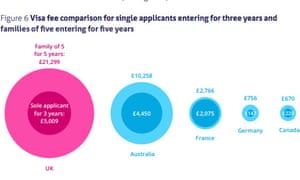
Comparisons with fee structures in other countries, published by the Institute for Government (IfG) thinktank, show that a family of five with a five-year work visa for one individual would have to pay £21,299 before they could enter in the country.

This includes the annual £400 health surcharge that must also be paid upfront per person. This is double the fee charged by Australia and about 30 times the amount charged by Canada, where it costs just over £10,000 for a family for five years. Germany charges £756 for entry for a family of that size.

The fee comparisons are equally stark for individuals. A single person who wants to come to the country will be charged up to £3,220 for five years. If they want to move to the UK with a spouse, the cost would rise to £6,500 for a five-year work stint.

UK visa fees compared with other countries
UK visa fees compared with other countries Photograph: Institute for Government

This compares with Canada, which charges £220 for an individual visa for three years; Germany, which charges £147; and France, which charges £2,075, according to the data supplied to the IfG. Luxembourg charges €50 (£42) for a visa and€80 for a residents permit.

Source: UK’s expensive visa fees ‘could deter NHS staff and scientists’

And on the gender impacts:

The British government’s plan for a post-Brexit immigration overhaul was designed to wean the economy off its reliance on cheap foreign labor. But in the process, women’s groups warned on Thursday, women will suffer disproportionately.

The new points-based system will give precedence to occupations in which women are underrepresented, favor male migrants over female and deepen gender inequality, according to the Women’s Budget Group, an independent network that promotes gender equality.

“The new immigration system roundly fails to understand the lived experience of women, many of whom are prevented from accessing paid work by the weight of unpaid work — caring for children, older people and those with disabilities — that successive governments rely upon them to do,” said Sophie Walker, the chief executive of the Young Women’s Trust, a British feminist organization.

Under the new rules, which will be implemented next January, applicants will be required to receive a job offer with a salary of at least 25,600 pounds, about $33,300. The salary threshold will be lower in special cases where there might be a shortage in skills, such as in nursing.

By and large, however, that requirement will work against women, who are more likely to work in sectors like home and senior care that are relatively poorly compensated, even though the skill levels of such women are relatively high, women’s advocates say.

“Care workers’ average annual salaries stand at just £17,000, not because care work is ‘low-skilled,’ but because the work force is 80 percent female and therefore undervalued and underpaid,” says Mandu Reid, the leader of the Women’s Equality Party.

Imposing the salary requirement would mean “shutting out care workers, piling pressure on women to take on yet more unpaid care, and widening the existing social care gap between need and provision,” she said.

Women are also four times more likely than men to leave paid work to shoulder unpaid caring responsibilities for children and older relatives. This is one cause of the gender pay gap and gender inequality, the Women’s Budget Group found.

As a result of these inequities, major industries like food production, hospitality, health and social care that rely on female migrant workers are likely to see staff shortages after the new measures are put into place.

In the points-based system, the government gives top priority to scientists, engineers, academics and graduates in science, technology, engineering and mathematics, or STEM, once again to the detriment of women because of the gender disparities in those professions.

“There is a great emphasis on wanting to attract scientists to the U.K. under the new system, but it is another well-known fact that women are underrepresented in the sciences,” said Adrienne Yong, a lecturer in law at the City Law School in London.

“That the U.K. will give a Ph.D. in STEM subjects 10 more points than Ph.D.s in other subjects already puts women on a back foot,” she said, “as there is already a problem with female students doing STEM subjects, much less continuing further education to a doctoral level with that specialism.”

On Wednesday, the cabinet minister responsible for migration policy, Priti Patel, suggested that around eight million “economically inactive” people in Britain could be trained to fill such shortages, but experts say that many of those people are women who are already providing full-time care for children and families.

“It feels like they just want us to fill the badly paid jobs while the men and foreigners will get the higher-paying jobs,” said Amy Pears, a mother of three who left her job as a professional caregiver and went on benefits in 2015 because she could not afford child care. “My mother is disabled, so between her and the three children I have my hands full.”

The Women’s Equality Party says that without substantial government investment in child and elder care, women are put into a position where they simply cannot work.

“These shortsighted plans are in fact more likely to exacerbate the shortages in formal care, leaving it to women to pick up unpaid and increase the number of ‘economically inactive’ full-time carers,” Ms. Reid said.

Women’s groups warned that shutting out foreign workers would put more pressure on women who are already in Britain, particularly caregivers.

“Without extra colleagues from abroad, U.K. carers are going to have even less time to do the job they’re employed to do and offer people the dignity they deserve,” Ms. Walker said. “This policy makes it an inevitability that this exhausted system will come under further strain, while female family members will increasingly be expected to pick up the pieces as the system continues to erode.”

Ms. Pears said that many of her European friends and former colleagues, who played important caregiving roles, would be locked out of the new system because they did not qualify for the salary threshold or education qualifications.

“These people are carrying a huge burden for our country, and the truth of the matter is we need them,” she said. “Without them we are putting our services at risk.”

Source: Women Will Be Hit Hard by U.K.’s New Immigration Rules, Experts WarnWith its minimum salary requirements, the new system would particularly affect female migrants, who tend to cluster in lower-paid occupations.By Ceylan Yeginsu

Reducing immigration will not stop America’s rising diversity, Census projections show

Good long analysis:

Immigration has become a dominant issue in America, as the Trump administration continues to curtail the flow of both legal and undocumented immigrants. Now, newly released Census Bureau population projections through the year 2060 provide an assessment of what differing levels of immigration would mean for the nation’s demographic future. These are the first projections in more than a decade that lay out how changing immigration flows would impact the nation’s future population size, its race-ethnic makeup, and its age structure.

The projections show that the current level of immigration is essential for our nation’s future growth, especially in sustaining the younger population. Moreover, despite suggestions to the contrary from the administration, lowering immigration levels further will not keep the nation from becoming more racially and ethnically diverse. Even if the number of migrants was reduced to zero, the percentage of the population that identifies as a nonwhite race or ethnic group would continue to rise.

IMMIGRATION IS ESSENTIAL TO COUNTER SHARP DECLINES IN GROWTH

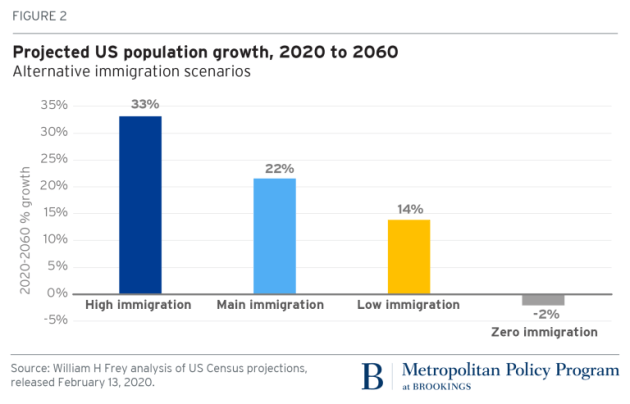
Just how much do different immigration levels affect future U.S. population growth? The new census projections through 2060 provide four scenarios about immigration [1]. The one used in existing census projections is termed the “main” scenario, and assumes that immigration to the U.S. will follow the trends seen from 2011 to 2015. The other three scenarios are: 1) a “high immigration” scenario, which assumes a 50% increase in immigration going forward; 2) a “low immigration” scenario, which assumes a roughly 50% decrease; and 3) a “zero immigration” scenario, which assumes no new immigration to the U.S., but does allow for out-migration from the country.

The projected populations over the 40-year period between 2020 and 2060 indicate a wide range of outcomes. The “main” immigration scenario would lead to population growth of 22%, from 333 million to 404 million. This is less than half of the 46% growth observed over the previous 40-year period, and reflects the fact that—compared to the past—the nation’s aging population will be experiencing higher death rates and more modest fertility rates.

Fig1

Fig2

The results of the three alternative scenarios are varied. The 2060 U.S. population size in the high-, low-, and zero-immigration scenarios is 447 million, 376 million and 320 million, respectively—representing growth rates of 33%, 14%, and -2%. In the zero-immigration scenario, the population begins to decline in 2035 due to a combination of more deaths than births and that emigration from the U.S. would not be countered by immigration into it.

Zero immigration would be demographically unsustainable and unlikely to occur. However, even the low-immigration scenario would lead to tepid population growth rates—in the range of 0.2% to 0.3%—over the final 20 years of the projection period.

DIVERSITY WILL RISE UNDER ALL IMMIGRATION SCENARIOS

Much of the current political discourse equates immigration with a rise in racial and ethnic diversity. While it is true that a large share of immigrants are people of color (especially those arriving from Latin America, Asia, and Africa), the new projections show that the U.S. will continue to become more racially diverse under all migration scenarios, even with zero additional immigration.

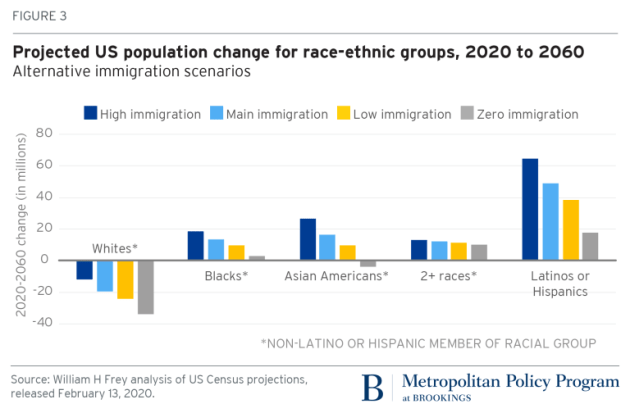
A major reason for this is the aging and projected decline of the population of whites who do not identify with another race or ethnic group. In 2018, the median age of this population was 44, compared to 38 for the nation as a whole, 29.5 for the Latino or Hispanic population, and 21 for those of two or more races. With a rising number of deaths compared to births, the older white population will experience a natural decrease in all projection scenarios, which immigration flows will not counter.

Fig3

The other race-ethnic groups will show mostly positive population contributions over each projection scenario. The largest will occur for the Latino or Hispanic population, which will increase between 18 million and 64 million over the 40-year period, depending on the scenario. Births from existing Latino or Hispanic residents will lead to a natural increase in this population even under low- and zero-migration scenarios.

All other race and ethnic groups contribute to projected population gains with the exception of Asian Americans, whose size is reduced under the zero-immigration scenario. In this case, Asian emigration from the U.S. is not countered by a natural increase. It is noteworthy that in both the low- and zero-immigration scenarios, persons identifying with two or more racial groups contribute more to projected population gains than Black or Asian American residents.

No matter the scenario, the U.S. will experience a rise in the share of the total population that identifies as a nonwhite race or ethnic group.

Fig4

Table 1

Fig5

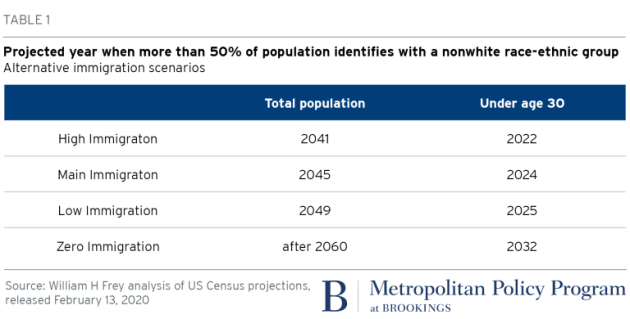
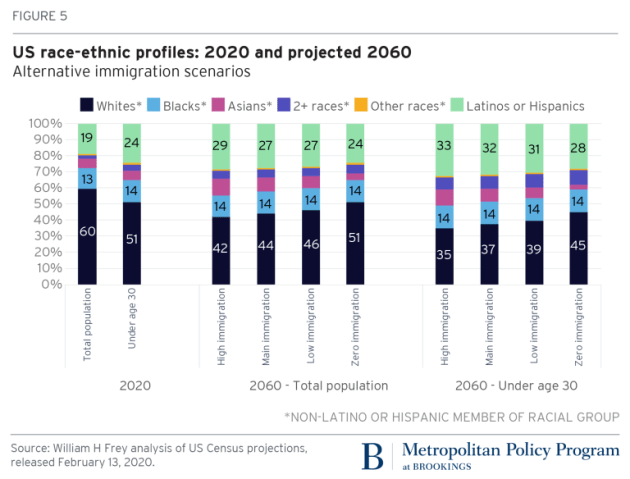
As previously reported, the “main” immigration scenario shows that in 2045, more than 50% of the U.S. population will identify as a nonwhite race or ethnic group, rising to 56% in 2060. In the high-immigration scenario, the 50% tipping point occurs in 2041; in the low-immigration scenario, it is 2049. Even in the zero-immigration scenario, the share of the U.S. population that identifies as a nonwhite race or ethnic group will rise to 49% by 2060.

Because all nonwhite race and ethnic groups are, on average, younger than white residents, their shares of the under-30 population are even larger than for the population as a whole. More than half of the under-30 population is projected to identify with a nonwhite group by the year 2024 in the main immigration scenario; in 2022 for the high-immigration scenario; and in 2025 for the low-immigration scenario. In the zero-immigration scenario, the share of the under-30 population that identifies as a nonwhite race or ethnic group exceeds 50% in 2032 and all years thereafter.

While shrinking in size, the white population is projected to comprise a larger share of the total population than any other single racial or ethnic group in all scenarios. The next largest group in all projections is the Latino or Hispanic population, which is projected to comprise around a quarter of the total population and roughly 30% of the under-30 population by 2060. 

IMMIGRATION IS NEEDED TO BOLSTER YOUNGER POPULATION GROWTH

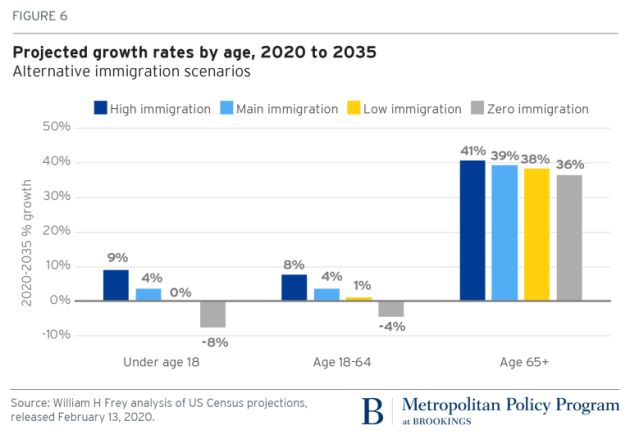
The aging of the U.S. population over the next decade will be propelled by the large baby boomer generation entering its senior years. Meanwhile, the younger population will be growing far more tepidly. This aging will be especially acute over the 2020 to 2035 period—as a result, immigration will make an important difference in how much the nation’s youth (under-18) and primary labor force (ages 18 to 64) populations grow.

Fig5

Under the high-immigration scenario, the youth population would grow by 9% and the labor force population would grow by 8% from 2020 to 2035. Both populations would grow by a modest 4% if current immigration patterns persist. A low- or zero-immigration scenario, however, would lead to stagnating growth or declines for these populations, while the 65-and-older population experiences a projected growth rate exceeding 36%.

The short-term implications of lower immigration levels could lead to noticeable labor force shortages. The longer-term impact is increased age dependency: the extent to which the retirement-age population will be dependent on younger workers for support. In 2020, the old-age dependency ratio (a measure of age dependency found by dividing 65-and-older population by the 18- to 64-year-old population) is 28. But as the population ages over the next 40 years, and age dependency rises, immigration will make a difference. In 2060, the dependency ratio can vary from 39 (under the high-immigration scenario) to a whopping 48 under the zero-immigration scenario. The latter would mean there would be only two working-age persons for every retiree.

THE NECESSITY OF IMMIGRATION TO THE NATION’S FUTURE

The Census Bureau’s alternative population projections make plain that continued immigration at current levels—at a minimum—is necessary to maintain the nation’s growth. With a rapidly aging native-born population, immigration will ensure growth—especially among the youth and labor force populations. Any appreciable lowering of immigration levels will lead to tepid national population growth, potentially negative growth in the youth population, and extreme age dependency.

It is also important to note that the nation will continue to become more racially and ethnically diverse under all immigration scenarios. This is a function of the country’s already large and youthful nonwhite populations, and the projected aging and decreased size of the white population.

Any political rhetoric suggesting that reduced immigration will make the nation “whiter” flies in the face of demographic evidence. In fact, the main reason the United States is growing more rapidly than most other industrialized counties stems from its healthy immigration levels over the past four decades. The Census Bureau’s projections suggest that similar or higher immigration levels will be necessary for the nation to grow and prosper in the decades ahead.

Source: Reducing immigration will not stop America’s rising diversity, Census projections show

Denver’s government doesn’t hold citizenship ceremonies anymore because the federal government won’t share

Petty and counterproductive:

Taking an oath to America is the last step of a complex journey to naturalization — one that Denver has been happy to show off at public libraries and other government buildings in the past during so-called naturalization ceremonies.But several months ago, the federal government blacklisted the city government from holding the feel-good ceremonies that showcase new citizens of the United States in Denver. The U.S. Citizenship and Immigration Services stopped working with the city on the ceremonies after June of 2019, about two years after the city council made it illegal for Denver government employees to share information with federal immigration authorities.

New citizens don’t need a public ceremony to become citizens. They can take oaths at federal offices, which still occurs every day. But naturalization ceremonies are symbolic shows of patriotism as well as bows on a bureaucratic process, and local governments cannot hold the events without citizenship status and other information from federal immigration officials — information that they’ve stopped sharing with the Hancock administration.

“The mission of USCIS is to both celebrate American citizenship through naturalization ceremonies as well as protect the homeland by ensuring the integrity of our immigration system. Unfortunately, the City and County of Denver chooses not to work with USCIS on investigations of potential fraud, which negatively impacts USCIS’ ability to fairly and accurately adjudicate cases involving national security concerns and fraud,” said Jessica Collins, USCIS spokesperson. “Given the situation, USCIS will not be able to collaborate with the City and County of Denver to hold naturalization ceremonies until the City and County of Denver cooperates on the overall USCIS’ mission.”

City Councilwoman Jaime Torres, who formerly headed the Denver Office of Immigrant & Refugee Affairs before taking office, called the decision by USCIS “deeply disappointing.”

“We had been so intentional about celebrating naturalization and citizenship,” she told Denverite.

The blackout has so far gone unannounced.

“If we complain every single time (the Trump) administration did something that is contrary to what this city’s values are, you guys would get sick of us,” said Rowena Alegría, the city’s chief storyteller (that’s her real title).

July 6, 2019 marks the last time USCIS partnered with Denver on a ceremony, a spokeswoman for the federal immigration department said. However at least one ceremony has been held in the city on private property since then. Suburbs around Denver are still hosting the ceremonies.

Denver has partnered with USCIS on these ceremonies for years, developing cross-governmental relationships along the way, Alegría said. And then one day, they had to cut ties. She said the city continues to support and celebrate immigrants in different ways, like My Civic Academy, a leadership program to teach new citizens about Denver.

Source: Denver’s government doesn’t hold citizenship ceremonies anymore because the federal government won’t share

‘What Part of Illegal Don’t You Understand?’

Really good long read by Sonia Nazario, mix of personal account and policy discussion (excerpt):

My family has been running from danger for nearly 100 years. The Nazarios are refugees; their remnants have scattered around the world to survive. My Jewish mother fled Poland in 1933. My Christian father fled Syria two years earlier. They met and married in Argentina, whose right-wing dictatorship imprisoned and almost killed my sister. By giving us a home, the United States saved our lives.

Would it do the same today?

The Trump administration has barred those seeking refuge from our borders and turned our immigration courts into a joke. This is a betrayal of America’s decades-long role as a world leader in refugee protection. It also breaks our own laws and treaty commitments, which say we will take people in, give them a fair court hearing and not return them to harm.

But it is not a total historical anomaly. America has gone through spasms of nativism before. In 1939, Congress tabled a bill to take in 20,000 Jewish children, and the SS St. Louis, which carried 937 Jewish refugees, was turned away from the docks; hundreds aboard were murdered in the Holocaust.

Then, as now, many on both the right and the left have argued that the choice Americans face on immigration and asylum is between zero tolerance and opening the floodgates. But this is a false choice. We can have an immigration policy that is sane and humane.

….

The American government generally does not allow innocent people to be imprisoned, raped and shot in the back. These are the kinds of experiences refugees who come here seeking safety are fleeing.

We can have a pragmatic, compassionate refugee policy. We don’t have to choose between letting everyone in and no one in.

Conservatives may not like this, but we have to let through people who say they are afraid. Allow applicants into the United States and monitor them until their court hearings (which nine in 10 do show up for). Don’t lock them up, as we are doing with some 60,000 immigrants a night, in places where they get inadequate medical care. At least seven migrant children have died in immigration custody since 2018. This simply didn’t happen before. Our government is killing children through neglect.

Make the court process fair; make it fitting of our country. Take our increasingly politicized immigration courts out of the Department of Justice and make them independent. Make sure that immigrant children have a government-funded lawyer, since most cannot afford representation, which basically guarantees they will lose. From October 2017 to June 2018, 70 babies went to court alone.

Liberals might not like this, but we also have to deport migrants who lose their cases. President Trump refers to asylum as a “loophole” in our system. That’s bogus. Yet there is another loophole that must be addressed: A vast majority of those who lose their asylum cases don’t leave the country. They stay and blend into the woodwork. This rightfully riles Americans who believe these unsuccessful asylum-seekers are thumbing their noses at our legal process. Require Immigration and Customs Enforcement to focus on deporting people who have just lost their asylum cases, not the parent who has been here 30 years.

Democrats need to get woke and realize that any immigration reform plan has to show they believe in the rule of law. I’ve lived in a country with no laws. Democrats don’t want that. We cannot take in everyone, so we need to prioritize those fleeing harm. Stop talking about idiotic things like open borders. Or liberals will keep losing on this issue.

There’s something ready-made for Americans who care about this travesty to lobby for: the Refugee Protection Act, introduced in Congress in November. It would require the United States to take in far more refugees, including at least 100,000 a year from El Salvador, Guatemala and Honduras alone. It would prevent the government from forcing people to apply for asylum in other countries they passed through on the way here, and prohibit ports of entry from pleading overcrowding as an excuse to turn people away. It would exempt migrants from criminal prosecution for crossing without documents, and allow asylum-seekers to be released temporarily in the United States if they pose no risk to public safety. It would reverse a Trump administration decision that bars people fleeing domestic or gang violence from obtaining asylum. And it would require our government to appoint lawyers for migrant children.

Americans need to stop whining and to ride Congress to pass this bill. Every one of my fellow Jews in this country should have their hair on fire over this — especially folks like Jared Kushner, whose Polish family, like mine, found safety here.

I often get asked: What part of “illegal” don’t you understand? Well, our laws say we have to help people who are running for their lives. Take it from a Nazario: President Trump is the one who has broken the law.

Immigrants Flock To Canada, While U.S. Declines

From Forbes:

New data show the number of people immigrating to Canada increased by 26% between 2015 and 2019, and is projected to rise higher as the country seeks to overcome the aging of its workforce – a serious problem in all Western nations. In the United States, legal immigration fell by 7% between FY 2016 and FY 2018, and is expected to decline even more sharply due to Trump administration policies.

Canada has announced plans to increase the number of immigrants it accepts each year. “To further ease the challenges of a shrinking labor force and an aging population, our new multi-year immigration levels plan sets out the highest levels of permanent residents that Canada will welcome in recent history,” according to Minister of Immigration, Refugees and Citizenship Ahmed Hussen. By 2021, Canada is expected to increase legal immigration to 350,000 a year, a rise of 78,165, or 29%, from the 2015 level of 271,835.

The big Canadian immigration news in 2019 was the number of Indians who became permanent residents in Canada increased from 39,340 in 2016 to 85,585 in 2019, a rise of more than 117%, according to a National Foundation for American Policy (NFAP) analysis of Immigration, Refugees and Citizenship Canada data. “Canada is benefiting from a diversion of young Indian tech workers from U.S. destinations, largely because of the challenges of obtaining and renewing H-1B visas and finding a reliable route to U.S. permanent residence,” said Peter Rekai, founder of the Toronto-based immigration law firm Rekai LLP, in an interview. (See here.)

In 2019, India was the leading country of citizenship for immigrants to Canada, with more than twice as many immigrants as China, which had 30,260 immigrants in 2019, in second place. Third was the Philippines, with 27,815 immigrants. Nigeria was fourth, with 12,595, and the United States had the fifth most immigrants to Canada, with 10,800.

Even though Trump officials have claimed an affinity for Canada’s immigration system, that is not the case when it comes to immigration levels. As a percentage of each country’s population, Canada admits approximately three times as many immigrants as America. Trump administration-supported bills in Congress would have reduced legal immigration to the U.S. by up to 50%.

A new U.S. Census report highlights the importance of immigration to America’s long-term prospects. “Higher international immigration over the next four decades would produce a faster growing, more diverse, and younger population for the United States,” concluded the Census report.

“We desperately need immigration to keep our country growing and prosperous,” according to William Frey, a Brookings Institution demographer and author of several books examining Census data. “The reason we have a good growth rate in comparison to other developed countries in the world is because we’ve had robust immigration for the last 30 to 40 years.”

The numbers show the United States is headed in the opposite direction from Canada on immigration. Legal immigration to the U.S. fell by 7% between 2016 and 2018, illustrating the impact of Trump administration policies on legal immigration. The administration’s public charge rule, the travel ban and diminished refugee admissions are expected to reduce the annual level of legal immigration by a much greater amount, which will slow labor force growth in the United States and mean lower long-term economic growth for Americans.

It appears the debate about the difference between the U.S. and Canadian immigration systems is not about establishing a points system but whether to offer opportunity to more legal immigrants as in Canada or to face a decline and slower growth as in the United States.

Factbox: Reaction to Britain’s new immigration rules

Good overview of some of the key reactions (largely business-related):

The British government has outlined a new immigration system to manage the flow of workers into the country and replace existing rules from Jan. 1 2021, when Britain will no longer be subject to European Union regulations.

Here is some reaction to it.

Confederation of British Industry

“Several aspects of the new system will be welcomed by business, particularly abolishing the cap on skilled visas, introducing a new post-study work visa for overseas students, and reducing the minimum salary threshold from 30,000 pounds ($38,982),” said director general Carolyn Fairbairn.

“Nonetheless, in some sectors firms will be left wondering how they will recruit the people needed to run their businesses. With already low unemployment, firms in care, construction, hospitality, food and drink could be most affected.”

British Chambers of Commerce

“Companies are already investing heavily in home-grown talent across the UK, but critical labour shortages mean firms will still need access to overseas workers at all skill levels,” said BCC director general Adam Marshall.

“The new points system must be able to respond quickly to changing market needs, and the application process must be radically simplified.”

UKHospitality, which represents Britain’s hospitality sector.

“Ruling out a temporary, low-skilled route for migration in just 10 months’ time will be disastrous for the hospitality sector and the British people. Business must be given time to adapt,” said UKHospitality CEO Kate Nicholls.

“These proposals will cut off future growth and expansion and deter investment in Britain’s high streets. It will lead to reduced levels of service for customers and business closures.”

British Retail Consortium

“Although we welcome the reduction in the salary threshold, it is disappointing that the government has not understood the needs of the economy and the vital contribution of workers supporting the operation of warehouses, food factories and city centre stores,” said Tom Ironside, BRC director of business and regulation.

National Farmers Union

“We have said repeatedly that for farm businesses it is about having the full range of skills needed – from pickers and packers to meat processors and vets – if we are to continue to deliver high quality, affordable food for the public. Failure to provide an entry route for these jobs will severely impact the farming sector,” said NFU President Minette Batters.

Unison, the union which represents care workers.

“These plans spell absolute disaster for the care sector. Care doesn’t even get a mention in the home secretary’s plans,” said Unison assistant general secretary Christina McAnea.

Royal College of Nursing

“We are concerned that these proposals from the government will not meet the health and care needs of the population,” said Donna Kinnair, CEO and general secretary of the RCN.

“They close the door to lower-paid healthcare support workers and care assistants from overseas, who currently fill significant numbers of posts in the health and care workforce.”

Opposition Labour Party

“This isn’t an ‘Australian points-based system’, which is a meaningless government soundbite. It’s a salary threshold system, which will need to have so many exemptions, for the NHS, for social care and many parts of the private sector, that it will be meaningless,” said shadow home secretary Diane Abbott.

Food and Drink Federation

“We have concerns about access to those potential employees who won’t qualify through these ‘skilled’ routes such as bakery assistants, meat processors, and workers essential to the production of huge array of basic foodstuffs such as cheese, pasta, and sausages,” said FDF policy manager Mark Harrison.

Source: Factbox: Reaction to Britain’s new immigration rules