‘We need to be at the table’: nominated Indigenous candidates near 2015’s record high

Of note (have added Indigenous percentage of riding populations):

With at least 43 Indigenous candidates running for federal office in 2019, the number is nearing the record-breaking 54 contenders in 2015, and almost doubling those nominated in 2011.

Most are running under a red banner, with 13 Indigenous people confirmed as Liberal candidates, followed by 11 for the NDP, eight for the Conservatives, seven for the Green Party, and three with the People’s Party, according to party-submitted numbers and a Hill Times analysis of public information. The PPC said it doesn’t have the resources to track demographics for its candidates.

That total is likely to increase, given the NDP and Liberals represented the bulk of nominations in 2015, for a combined 39 of the 54, and both have yet to nominate their full complement of candidates. The Liberals had named 231 out of 338 candidates as of July 29, and the NDP has less than half, with 130 names posted to its website as of Aug. 2.

The 2015 federal election saw a historic 10 Indigenous MPs elected and a historic number of Indigenous voters who cast ballots, with 61.5 per cent turnout on reserves, up from 47.4 per cent in 2011.

Liberal candidate Michelle Corfield, who is running in Nanaimo-Ladysmith, B.C., [8.3 percent Indigenous] said she’s excited by the numbers, thinking about the opportunities that are available now to her 20-year-old daughter and the voice historically marginalized First Nations people can have in government.

First Nations people were denied the right to vote until 1960, and long after that children were taken from their homes and put into residential schools. Up to 2015, there had only been 34 Indigenous MPs elected since Confederation, and 15 Indigenous Senators appointed to the Red Chamber.

“All of these things compounded how people perceived the relationship with the Crown” and affected the perception of participation in politics among Indigenous people, said Ms. Corfield, a former chair of the Nanaimo Port Authority and the Ucluelet First Nation legislative council.

“For decades, people have been making legislation for them but without them, so in order for us to have a voice in significantly designing how legislation informs and impacts Indigenous people, we need to be at the table,” said Ms. Corfield, who’s been a Liberal since she could vote and is one of two Indigenous candidates running in the riding where Green MP Paul Manly won a byelection earlier this year.

‘My whole life is political’

While it’s difficult to pinpoint why record levels of Indigenous people have run for office over the last decade, Liberal candidate Trisha Cowie said she doesn’t have the option not to be political.

“My whole life is political,” she said, pointing to the Indian Act, which determines who has official First Nations status, and historically stripped it from those who fought in wars, pursued post-secondary education, or women who married non-First Nations men.

“It governs my identity to an extent, whether you’re on reserve or off reserve, when there’s a settlement. Everything is political. You could sit back and watch it unfold, but it’s all very personal, so it’s very difficult to do,” said Ms. Cowie who ran in the previous election in Parry Sound-Muskoka, Ont., [5 percent Indigenous] coming less than five points behind Conservative-turned-Indpendent MP Tony Clement, who won’t run again.

“You can actually affect change from the inside instead of always fighting from the outside,” she said.

For the last two years NDP Winnipeg Centre, Man., [18.1 percent Indigenous] candidate Leah Gazan tried to work from outside Parliament, lobbying MPs and Senators to pass Bill C-262, enshrining the United Nations Declaration on the Rights Of Indigenous Peoples into law. Ms. Gazan said it was “horrific” to watch the Senate effectively kill the bill in the waning days of the session, by not moving to put outgoing NDP MP Romeo Saganash’s (Abitibi–Baie-James–Nunavik–Eeyou, Que.) private member’s bill to a vote.

A few hundred kilometres away on the East Coast, Liberal candidate Jaime Battiste [Sydney-Victoria, 10.4 percent Indigenous] was equally frustrated by the outcome, following the weekly developments and delays with his father James Youngblood Henderson, who helped draft the 2006 declaration.

If the Liberals take a second mandate, Mr. Battiste, who is the first Mi’kmaq person to be on a federal ballot and would be Nova Scotia’s first-ever Indigenous member of Parliament, said he’s heartened by the party’s promise to make it a government bill—and therefore more likely to pass —while Ms. Gazan recalled the “years of stalling” by the Liberals before it moved forward.

When looking at the increasing number of Indigenous candidates running, she said it’s important to avoid drawing broad conclusions, because Indigenous people are often “lumped into one group with the same values,” said Ms. Gazan, who’s been fighting for human rights and on the front lines of climate justice for three decades.

The best match for her values, she said, was the NDP, which has several high-profile leaders on its ballot, including former vice-president of the Union of B.C. Indian Chiefs Bob Chamberlin, and Grassy Narrows First Nation chief Rudy Turtle, who has said the Liberals haven’t done enough to help his community with the impacts of mercury poisoning.

Over the last decade, Ms. Gazan said political parties have approached her to run, but this time she said she felt the country is at “a critical juncture” and needed strong voices like hers, willing to speak truth to power.

Voting Liberal this election is “not the strategic vote,” a tactic she said helped take Winnipeg Centre from the NDP in 2015, because of the strong desire to boot former prime minister Stephen Harper. Liberal MP Robert-Falcon Ouellette beat out six-term New Democrat Pat Martin by a margin 26.5 percentage points in the previous election.

“This is one of the few ridings in the country that you can vote your conscience,” she said, and that’s the message her “community-based, community-led campaign” is giving. “I feel like our campaign is starting a movement and we are planning on getting this riding back.”

Lydia Hwitsum, who is running in Cowichan–Malahat–Langford, B.C., [9.4 percent Indigenous] for the Greens, also said without the strategic anti-Harper vote in play, her chances are better. One-term NDP MP Alistair MacGregor is running again after taking it in 2015 with 35.9 per cent of the vote, while the Greens came in fourth, with 16.9 per cent.

Born in 1964, Ms. Hwitsum is acutely aware that the right to vote came shortly before her lifetime. Cultural leaders like her “bright and brilliant” mother would never have had the chance to put their name on the ballot.

“The door’s open now and it wasn’t for them.”

So far, B.C. has the most Indigenous candidates running, with 10, followed by nine in Manitoba, and eight in Ontario. B.C.’s only Indigenous incumbent is Jody Wilson-Raybould, the former Liberal cabinet minister who will run as an Independent this time around in Vancouver Granville.

The Liberal candidates said they were saddened to see a powerful First Nations woman no longer with the party. In the midst of the SNC-Lavalin scandal and allegations the Prime Minister’s Office pressured her as attorney general, Ms. Wilson-Raybould resigned from cabinet and later was booted from caucus.

Ms. Corfield said Ms. Wilson-Raybould made her choice and “knew the consequences of those choices,” while Mr. Battiste said “this election isn’t about Jody and Justin,” but the Conservative policies that had him protesting in the streets four years before.

At the December 2018 Assembly of First Nations national conference, Mr. Battiste said he stood up and asked Conservative Party Leader Andrew Scheer (Regina-Qu’Appelle, Sask.) for one policy that made him different from Mr. Harper.

“And he couldn’t,” said Mr. Battiste, recalling how hundreds of chiefs booed his response that they’d have to wait until the party’s platform was released.

The “big move” by the Liberal party to open membership up made a difference during membership drives signing up supporters who helped him win the Sydney-Victoria, N.S., contested nomination a few weeks ago, said Mr. Battiste, showing the party is “taking strides to make sure Indigenous people are now more involved than ever in the political process.”

Indigenous voters “can be a swing vote in a riding,” said Mr. Battiste, a point the Assembly of First Nations has made to parties and politiciansthrough the 51 ridings it will target this election, 13 of which have Indigenous candidates running.

The Liberals will face their record on reconciliation, which Ms. Gazan said falls far short of Prime Minister Justin Trudeau’s (Papineau, Que.) promise as Canada’s most important relationship.

Four years can’t change 150 years of colonization, said Ms. Corfield.

“Maybe the expectations were set too high,” of the Liberals, but like Mr. Battiste she said this government has done more than any previous. Legislation addressing Indigenous languages and child welfare, and progress on boil water advisories are all signs of progress, they said.

In early March, before Mr. Battiste decided to run for the party, he captured some of that frustration in a Chronicle Herald op-ed, coming to the same conclusion he offers today: more Indigenous candidates must get politically involved.

“The only way to decolonize some of the processes of government is by having more Indigenous voices,” he said.

Source: ‘We need to be at the table’: nominated Indigenous candidates near 2015’s record high
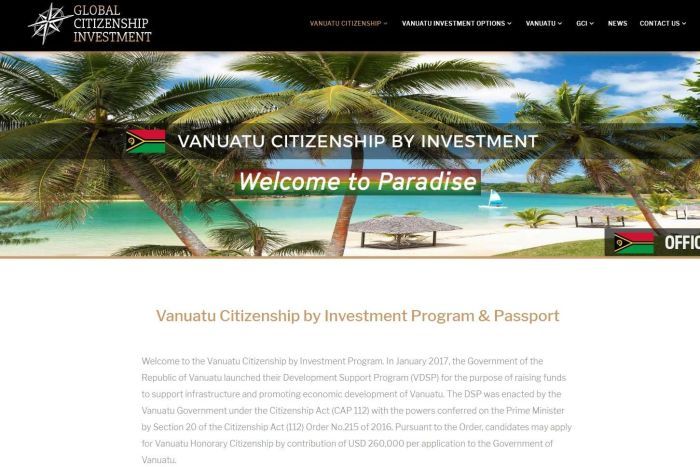
Why Vanuatu’s lucrative ‘passports for sale’ scheme is popular among Chinese nationals

Yet another example of citizenship-by-investment and related abuses:

Are you in the market for a second passport? One that can get you into scores of countries — including Europe, the UK, Hong Kong, Singapore and Russia — without needing a visa?

Key Points:

  • Applicants can become a Vanuatu citizen without needing to set foot in the country
  • It costs about $220,000 for a single application and more for couples and families
  • More than 4,000 passports have been sold under the scheme, with most to Chinese citizens

Or perhaps you’d like to park your money in a tax haven where there are no personal or corporate income taxes.

Maybe you’d just like to get away from the rat race and live on a picturesque tropical island in the South Pacific.

Vanuatu, then, could be the place for you.

These are some of the selling points of Vanuatu’s citizenship by investment scheme, or cash-for-passports as it’s also known locally.

Sales have been booming in recent years, providing the Government with an unexpected but lucrative source of revenue.

But not everyone is happy about the scheme, with several prominent locals — including former presidents and high-ranking chiefs — saying it undermines the value of Vanuatu citizenship and the country’s fight to gain independence from its former colonial masters, the French and British.

The recent deportation of a group of Chinese nationals, some of whom had obtained Vanuatu citizenship, focused even more adverse attention on the scheme.

So how does it work?

Many countries have citizenship by investment schemes but often applicants are required to become permanent residents first and then only after a number of years do they become eligible to become a citizen.

Under Vanuatu’s scheme, successful applicants can become citizens within a matter of months, and there’s no requirement to reside in the country or even set foot on Vanuatu soil at all.

It costs around $US150,000 ($220,900) for a single application and more for couples and families.

Vanuatu citizenship for sale

Interested parties submit their applications through agents who’ve been approved by the Citizenship’s Office and Commission, which oversees the entire process.

The job of screening an applicant’s criminal and financial backgrounds is performed by the Government’s Financial Intelligence Unit.

If their client’s application is successful, the agent pockets around a third of the application fee.

Once approved, freshly minted citizens can then apply for the real prize, a Vanuatu passport.

Why does the Vanuatu Government sell passports?

Pure and simple: to raise revenue. There have been several iterations of Vanuatu’s citizenship by investment scheme since it was first introduced in 2014.

The aim of one of them was to raise money to rebuild the country after Cyclone Pam caused widespread devastation in 2015.

Despite the rising tide of domestic criticism, the Government has largely remained tight-lipped about how many passports have been sold and how much money has been raised.

But in June, a parliamentary committee told local media that more than 4,000 passports had been sold under the scheme.

The Vanuatu Daily Post newspaper examined government financial statements and found that sales sky-rocketed last year, with 1,800 passports sold in 2018 alone.

Most have been sold to people from mainland China even though it’s technically illegal to hold dual citizenship under Chinese law.

What does the deportation of six Chinese nationals have to do with the scheme?

Six Chinese nationals were arrested in the capital Port Vila in late June and later deported back to China at the request of Beijing law enforcement officials.

The group was allegedly running an online financial scam targeting people back in China.

Before their deportation it emerged that four of them had successfully applied for Vanuatu citizenship and obtained passports.

Critics of the citizenship by investment scheme said the incident validated their concerns that undesirable people were buying passports for nefarious purposes.

Vanuatu’s founding president Ati George Sokomanu said the sale of Vanuatu citizenship was demeaning to those who had struggled to achieve the country’s independence.

“The Government needs to state clearly how many passports have been sold, who they’ve been sold to, and how much revenue the sales have generated,” Mr Sokomanu said.

The Financial Intelligence Unit later said none of the deported Chinese nationals had a criminal record and Chinese officials informed local authorities of their investigation after they had been granted citizenship.

Source: Why Vanuatu’s lucrative ‘passports for sale’ scheme is popular among Chinese nationals

Imam banned from preaching at Edmonton community centre

Of note, both the initial offence and the Muslim community response:

A community centre in Edmonton has banned a local imam from holding services there because he allegedly used anti-Semitic tropes in his services and online.

The Killarney Community League Hall banned Sheikh Shaban Sherif Mady from using their space to hold services after B’nai Brith alerted the community centre to Imam Mady’s rhetoric, including claims that international Zionism is behind all global terrorism, including ISIS and the New Zealand shooter, and that the Muslims will kill the Jews on Judgment Day.

Aidan Fishman of B’nai Brith said the police are “dutifully investigating” the matter. He also said B’nai Brith has been in contact with the Alberta Muslim Public Affairs Council (AMPAC).

“They’re aware of this and they, like I’m sure the vast majority of Muslims in Alberta and in Edmonton, have communicated to us that they totally disagree with what this guy said and they condemn it as well,” he said.

Faisal Suri of AMPAC confirmed that AMPAC condemned Shekih Mady’s speeches and online posts. He said AMPAC recognizes both anti-Semitism and Islamaphobia, as they affect two of the biggest communities most harmed by hatred and discrimination.

“We definitely condemn the words of this one individual. One individual’s actions and words do not reflect upon the Muslim community,” Suri said.

He also added that AMPAC is investigating Sheikh Mady, and whether other individuals hold similar views. He said the counci is working to prevent the imam from having any public platforms to advance his views.

Canada’s Safe 3rd Country Agreement With The U.S. Draws Criticism

NPR coverage:

Sitting relaxed at the kitchen table of her new home in a comfortable Toronto suburb, Kinda Bazerbashi recalls how differently she felt when her family lived in Houston.

Originally from Syria, she had lived in the United Arab Emirates, then arrived in the United States with her family on temporary visas and applied for asylum in 2012. Through a series of rejections and appeals, she says, they lived their lives in a legal limbo that made it hard to work, plan or travel to see scattered relatives.

“You are just like in jail, in a nice life,” she says. “There are cars. There is supermarket, but you feel, inside, you are in jail.”

By the time President Trump was elected, only a temporary protected status at the discretion of the White House kept her family from being deported back to Syria. Concerned about the president’s positions on immigration, she and her husband, Anas Almoustafa, looked to an alternative.

“From the TV,” says Almoustafa, “they [were] saying a lot of immigrants, they go to Canada.”

In March 2017, the family did what they had seen on TV and what more than 46,000 people have done since the 2016 election. They walked across the border from the U.S. to Canada, away from official entry points, and applied for asylum.

“People are crossing that way because of the safe third country agreement,” says Maureen Silcoff, president of the Canadian Association of Refugee Lawyers.

Signed in 2002, the agreement operates from the assumption that both the U.S. and Canada offer protections, so people fleeing their homes should apply for asylum in either country they arrive in first.

That kind of deal has gained renewed attention as the Trump administration presses Mexico and Guatemala to take in asylum-seekers traveling through those countries to the U.S. As America’s policies push more migrants to head across its northern border, Canadians and rights groups have challenged the agreement with the U.S.

Under the accord, people leaving the U.S. cannot apply for asylum in Canada at an official crossing point, or vice versa. Except for a few limited cases, such as if they have close family in Canada, they will be turned back to the U.S.

However, what some call a “loophole” in the agreement allows people to apply for asylum in Canada if they can arrive in the country.

“People feel hopeless about their chances of receiving protection in the United States,” Silcoff says. “That essentially drives them to cross between ports of entry.”

Most have traversed one country road on the border of upstate New York and the province of Quebec. Royal Canadian Mounted Police wait on the other side of this unofficial path to apprehend them.

The total number of migrant interceptions since 2016 still pales in comparison to 100,000 on the U.S.-Mexico border this March alone. Numbers have also trended downward this year over last. But Canadian pollster Shachi Kurl of the Angus Reid Institute says the border situation took on an outsize political importance because Canadians were unaccustomed to these types of arrivals.

“Just literally walking across an undefended border was starting to create a deep sense of unease and concern not just in right-wing voters, but it was really an issue that crossed the political spectrum,” she says.

Canada’s opposition Conservative Party has picked up this theme in its campaign to unseat Prime Minister Justin Trudeau’s Liberal government in federal elections this fall. In a speech in May, Conservative leader Andrew Scheer called the numbers of irregular crossings “almost hard to believe,” protesting that some migrants are able to “exploit loopholes and skip the line.”

Trudeau’s government has made a number of changes in the last two years to try to reduce the number of arrivals. The Canadian government sent representatives abroad to discourage people considering traveling to the border and to temper perceptions of the welcome they would receive.

Trudeau also created a new Cabinet-level border security minister, a position filled by former Toronto police chief Bill Blair. Earlier this year, Blair met with then-U.S. Homeland Security Secretary Kirstjen Nielsen about expanding the safe third country agreement so Canada could turn border-crossers back to the U.S. His office declined an interview with NPR but said the two countries have not begun official negotiations.

However, even as the U.S. pushes for similar agreements with Mexico and Guatemala to give migrants heading for the U.S. border asylum in their countries, groups like Amnesty International Canada are urging Canada to withdraw from its asylum deal.

Arguing that the U.S. does not offer equal protections for immigrants, Amnesty Canada director Alex Neve says Canada should allow people to make asylum claims at all official border crossings.

“At a time when refugees and migrants, a very vulnerable group, face this full-out attack on their rights from the U.S. government, Canada shouldn’t be turning its back on them,” Neve tells NPR.

Amnesty has joined with other organizations in a lawsuit to overturn the agreement. Hearings will begin in September.

Silcoff, the attorney, pointed out that U.S. policy changes that have, for example, closed eligibility for asylum to victims of domestic violence, whereas she noted, “They have a good chance because of our laws of receiving protection in Canada.”

Despite their rejection in the U.S., Baserbashi’s family was approved for asylum in Canada last year.

“This is the final step we hope and final move — absolutely it’s [the] final move — because we get approved, thanks God!” she says.

Her family would receive a different reception if they arrived today. The Canadian government passed one more measure this summer, tucked into a large budget bill. The provision bars people from applying for asylum in Canada if they applied previously in the United States or a handful of other countries with which Canada shares biometric data.

Those who have applied elsewhere will now enter an alternative administrative process that Silcoff says offers fewer protections.

A spokesperson for Minister Blair’s office said in an email to NPR that the change was meant to “deter people from making multiple asylum claims in different countries,” but added, “Nobody will be removed without a chance to be heard.”

Source: Canada’s Safe 3rd Country Agreement With The U.S. Draws Criticism

White Terrorism Shows ‘Stunning’ Parallels to Islamic State’s Rise

Of note:

Many scholars of terrorism see worrying similarities between the rise of the Islamic State and that of white nationalist terrorism, seen most recently in the carnage in El Paso, Tex.

“The parallels are stunning,” said Will McCants, a prominent expert in the field.

And they are growing more notable with each new attack.

Experts say that the similarities are far from a coincidence. White nationalist terrorism is following a progression eerily similar to that of jihadism under the leadership of the Islamic State, in ways that do much to explain why the attacks have suddenly grown so frequent and deadly.

In both, there is the apocalyptic ideology that predicts — and promises to hasten — a civilizational conflict that will consume the world. There is theatrical, indiscriminate violence that will supposedly bring about this final battle, but often does little more than grant the killer a brief flash of empowerment and win attention for the cause.

There are self-starter recruits who, gathering in social media’s dark corners, drive their own radicalization. And for these recruits, the official ideology may serve simply as an outlet for existing tendencies toward hatred and violence.

Differences between white nationalists and the Islamic State remain vast. While Islamic State leaders leveraged their followers’ zeal into a short-lived government, the new white nationalism has no formal leadership at all.

“I think a lot of people working on online extremism saw this coming,” said J.M. Berger, author of the book “Extremism,” and a fellow with VOX-Pol, a group that studies online extremism, referring to the similarities between white nationalism and the Islamic State.

In retrospect, it is not hard to see why.

The world-shaking infamy of the Islamic State has made it a natural model even — perhaps especially — for extremists who see Muslims as enemies.

A set of global changes, particularly the rise of social media, has made it easy for any decentralized terrorist cause to drift toward ever-grander, and evermore nonsensical, violence.

“Structurally, it didn’t matter whether those extremists were jihadists or white nationalists,” Mr. Berger said.

White nationalism in all forms has been on the rise for some years. Its violent fringe was all but certain to rise as well.

The feedback loop of radicalization and violence, once triggered, can take on a terrible momentum all its own, with each attack boosting the online radicalization and doomsday ideology that, in turn, drive more attacks.

The lessons are concerning. It is nearly impossible to eradicate a movement animated by ideas and decentralized social networks. Nor is it easy to prevent attacks when the perpetrators’ ideology makes nearly any target as good as the next, and requires little more training or guidance than opening a web forum.

And global changes that played a role in allowing the rise of the Islamic State are only accelerating, Mr. Berger warned — changes like the proliferation of social networks.

“When you open up a vast new arena for communication, it’s a vector for contagion,” he said.

The nihilism that increasingly defines global terrorism first emerged in the sectarian caldron of American-occupied Iraq.

A washed-up criminal from Jordan, Abu Musab Al-Zarqawi, exploited the chaos brought by the American-led invasion to slaughter occupiers and Iraqi Muslims alike, circulating videos of his deeds.

Al Qaeda, for all its religious claims, had, like most terrorist groups, killed civilians in pursuit of worldly goals like an American withdrawal from the Middle East.

But Mr. Zarqawi seemed driven by sadism, a thirst for fame and an apocalyptic ideology that he is thought to have only vaguely grasped.

Al Qaeda objected, fearing he would alienate the Muslim world and distract from jihadism’s more concrete goals.

Mr. Zarqawi instead proved so popular among jihadist recruits that Al Qaeda let him fight under its name. After his death, his group re-emerged as the Islamic State.

His group’s unlikely rise hinted at a new approach to terrorism — and sheds light on why white nationalist terrorism is converging on similar beliefs and practices.

Most terrorists are not born wishing to kill. They have to be groomed. Where past terrorist groups had appealed to the political aspirations and hatreds of its recruits, Mr. Zarqawi’s found ways to activate a desire for bloodshed itself.

The American-led invasion of Iraq had seemed, for many Middle Easterners, to turn the world upside down. Mr. Zarqawi and later the Islamic State, instead of promising to turn it right side up, offered an explanation: The world was rushing toward an end-of-days battle between Muslims and infidels.

In that world, Mr. McCants wrote in 2015, “the apocalyptic recruiting pitch makes more sense.”

This gave the group justification for attacks that otherwise made little strategic sense, like killing dozens of fellow Muslims out shopping, which it said would help usher in the apocalypse foretold in ancient prophecy.

Because the attacks were easier to carry out, almost anyone could execute their own and feel like a true soldier in the glorious cause.

Jihadism retained its core political agenda. But the things that made the Islamic State’s form of terrorism so infectious also made it less strategically rational.

With an ideology that said anyone could kill for the movement and that killing was its own reward, much of the violence took on a momentum of its own.

That, some scholars say, is what appears to be happening now with the extreme wings of the white nationalist movement rising globally.

Seeing a Global Race War

The ideological tracts, recruiting pitches and radicalization tales of the Islamic State during its rise echo, almost word-for-word, those of the white nationalist terrorists of today.

For the latter, the world is said to be careening toward a global race war between whites and nonwhites.

“The Camp of the Saints,” a bizarre 1973 French novel that has since become an unofficial book of prophecy for many white nationalists, describes a concerted effort by nonwhite foreigners to overwhelm and subjugate Europeans, who fight back in a genocidal race war.

So-called manifestoes left by the terrorist attackers at Christchurch, New Zealand, and El Paso, Tex., have warned of this coming war too. They also say their attacks were intended to provoke more racial violence, hastening the fight’s arrival.

Radicalization requires little more than a community with like-minded beliefs, said Maura Conway, a terrorism scholar at Dublin City University. While white backlash to social and demographic change is nothing new, social media has allowed whites receptive to the most extreme version to find one another.

Mr. Berger, in his research, found that these deadly messages, which have had mixed success in traditional propaganda channels in all but the most dire historical moments, can spread like wildfire on social media.

He termed the message one of “temporal acceleration” — the promise that an adherent could speed up time toward some inevitable endpoint by committing violence. And the “apocalyptic narratives,” he found, exploit social media’s tendency to amplify whatever content is most extreme.

As with the Islamic State’s calls for mass murder, this worldview has resonated among young men, mostly loners, who might have previously expressed little ideological fervor or experienced much hardship. It offered them a way to belong and a cause to participate in.

And, much like the Islamic State had found, social media gave white extremists a venue on which to post videos of their exploits, where they would go viral, setting off the cycle again.

In 2015, Mr. Berger wrote that the Islamic State had been “the first group to employ these amplifying tactics on social media.” But, he added, “it will not be the last.”

Maxime Bernier encourage à se battre contre l’imposition des cours d’éducation sexuelle

His party’s strong showing in Burnaby South (close to 11 percent) reflected sex education being an issue among some socially conservative Chinese Canadians:

Maxime Bernier estime que les cours d’éducation sexuelle dans les écoles québécoises briment les droits individuels.

Dans une entrevue accordée à un pasteur baptiste montréalais, le chef du Parti populaire du Canada (PPC) encourage les parents québécois à se battre contre l’imposition de ces cours. Il ne veut cependant pas participer personnellement à cette bataille, question de respecter les champs de compétence ; l’éducation relève de Québec et non pas d’Ottawa.

Le pasteur de l’Église baptiste de l’espoir du Grand Montréal George Antonios a publié l’entrevue avec le chef du PPC samedi sur YouTube.

« Ce genre de programme va à l’encontre d’une manière très profonde des valeurs morales, religieuses, de plusieurs personnes », offre en entrée de matière M. Antonios avant de demander à son invité ce qu’il faut faire « pour au moins donner le choix aux parents de ne pas impliquer leurs enfants dans de tels programmes ».

Aux premières protestations venant, celles-là, de l’église catholique en janvier dernier, le premier ministre François Legault a affirmé qu’aucun enfant ne pourra être exempté de ces cours.

« Je ne veux pas m’ingérer dans les champs de compétence des provinces », a commencé par répondre M. Bernier avant de choisir clairement son camp.

« Il y a une certaine partie de la population qui n’est pas encore au courant que cette législation-là brime les droits individuels des Québécois », a-t-il dit.

« Je vous encourage à faire cette bataille-là pour défendre vos propres droits », a-t-il conseillé aux pasteurs et à ses ouailles.

Dans l’entrevue avec le pasteur Antonios, M. Bernier a abordé une série de sujets chers aux groupes socialement conservateurs.

Il a ainsi réitéré qu’il permettrait à un de ses députés de déposer un projet de loi sur le droit à l’avortement et qu’il y aurait un vote libre sur pareil texte législatif, s’il prenait le pouvoir.

Puis, il a une nouvelle fois dépassé par la droite son rival du Parti conservateur Andrew Scheer dans ce dossier.

« Je trouve ça un peu hypocrite si je regarde M. Scheer qui se dit pro-vie mais qui interdit à ses députés de déposer un projet de loi, qui ne veut pas avoir de débat », a-t-il critiqué.

M. Bernier, lui, a voté, par le passé, pour protéger le droit à l’avortement. Mais il dit maintenant ne pas vouloir se prononcer dans ce dossier tant qu’il n’y a pas un projet de loi à débattre.

Autre sujet cher au courant socialement conservateur, la loi C-16 qui interdit la discrimination en fonction de « l’identité ou l’expression de genre » a également été décriée par les deux hommes.

Cette loi, selon ses détracteurs, pourrait imposer un certain langage pour désigner les personnes transgenres.

« Cette législation-là doit être abolie parce que ça vient donner une direction à l’État en ce qui concerne la liberté d’expression », a tranché M. Bernier, promettant, s’il devenait premier ministre, d’abolir C-16 « le plus rapidement possible ».

Source: Maxime Bernier encourage à se battre contre l’imposition des cours d’éducation sexuelle

York Centre, Eglinton-Lawrence could be most affected by not moving election date

More details and assessments of the election date and its likely impact on orthodox Jewish voters. Based on the 2011 National Household Survey, Canadian Jews form 5 percent or more of the population in 14 ridings (RM Ridings Jewish 5 percent):

Experts say they will be watching a few key ridings in and around Toronto as they try to gauge how Canada’s Chief Electoral Officer Stephane Pérrault’s decision not to recommend moving the Oct. 21 election date to accommodate Orthodox and other observant Jewish voters will affect the election outcome.

“The chief electoral officer is an independent official. None of the parties are accountable for the decisions made by his office, so I don’t imagine that there will be much, if any, political fallout,” said Frank Graves, president of Ekos Research, in an email statement to The Hill Times. “The impact for the Liberals and other parties might be if the Jewish vote turnout is dampened by this decision. I am not certain that will be the case, but I don’t think that would be an important factor in the next election, although it might be a modest factor in a few ridings.”

Mr. Graves said in past elections, Jewish Canadians primarily voted Liberal, but “that has not been the case for some time. The Conservatives did quite well with the Jewish vote under Harper, and I am guessing they will continue to do so.”

Mr. Graves added that the Liberals also do “fairly well” and that he is unclear how “a relatively small vote, which does not lean dramatically one way or the other, which may or may not have reduced turnout, will have much impact in October.”

According to data collected over the past six months by Campaign Research, Jewish Canadians favour Liberals over Conservatives, 42 per cent to 36 per cent. This data is not broken down by riding, or whether those polled strictly observe every holiday. A 2018 study titled “2018 Survey of Jews in Canada by the Environics Institute, the University of Toronto, and York University reported Jewish Canadians preferring the Liberals over the Conservatives by 36 per cent to 32 per cent. This data is also not broken down by riding or religiosity.

Eli Yufest, CEO of Campaign Research, and Quito Maggi, CEO of Mainstreet Research, said that statistically, the more religious an individual is, the more likely they are to vote for a Conservative Party. An article published in the Canadian Political Science Review by Sarah Wilkins-Laflamme, a University of Waterloo sociology professor, found that in 2011 “religious citizens were overall more likely to vote Conservative.”

Finding accurate statistics on the number of Jewish Canadians, and their level of religiosity, in a given riding is difficult because the census only asks about religion every 10 years. The 2011 census asked about religion, and reported 309,650 Jewish Canadians. The 2016 census did not, nor was Jewish included as a checkable box in the ethnic origin section. There was, however, a space where respondents could write in ethnicities that weren’t listed. As a result, the 2016 census reported only 143,665 Jewish Canadians, a 53.6 per cent decline in just five years. Though the percentage of Jewish Canadians has been steadily declining since 1991, the rate of decline is much lower than that, according to Statistics Canada.

On July 26, Statistics Canada released a report that sought remedy the errors of the 2016 census. The report estimated that if past response patterns remained consistent, the number of Jewish Canadians would be between 270,000 and 298,000.

Further complicating the effort to accurately count the number of Jewish-Canadians is the 2018 report by the Environics Institute, the University of Toronto, and York University. It estimated there were 392,000 Jewish-Canadians in 2018.

In the report, the authors said because “Canadian Jews constitute only about one percent of the Canadian population, the use of standard survey research methods was not a feasible option given the high costs of using probability sampling to identify and recruit participants.”

To try and produce as accurate a report as possible within the available budget, they surveyed 2,335 individuals online or over the phone between Feb. 10 and Sept. 30, 2018. It focused on Toronto, Montreal, Vancouver, and Winnipeg, the cities with the largest Jewish populations in Canada. The data were weighted according to population, age, gender, and marital status. The study was not fully based on probability sampling, meaning a margin of error cannot be calculated.

The Environics study breaks down the Jewish population by city, not riding, like the census does. The 2011 census reports the five ridings with the largest percentage of Jewish residents as Thornhill (22.04 per cent), Mont-Royal (22.07 per cent), Eglinton-Lawrence (16.87 per cent), York Centre (14.37 per cent), and Toronto-St Paul’s (12.11 per cent).

The 2016 census has the same ridings in the top five, but with lower numbers in a slightly different order. It reports Thornhill (13.4 per cent), Mont-Royal (8.4 per cent), York Centre (7 per cent), Eglinton-Lawrence (6.6 per cent), and Toronto St. Paul’s (4.5 per cent).

Of those five ridings, four are held by Liberals. Thornhill is the only Conservative riding, held since 2008 by Peter Kent. 338 Canada’s Philippe Fournier categorizes Mont-Royal, held by Liberal MP Anthony Housefather, as the only truly safe seat. In 2015, Mr. Housefather beat Conservative nominee Robert Libman by just under 14 percentage points, or 5,986 votes. Thornhill and Toronto-St. Paul’s, held since 1997 by Minister of Crown-Indigenous Relations Carolyn Bennett, are considered likely to stay in Conservative and Liberal hands, respectively.

Despite 338 Canada’s projection, Mr. Maggi said he is going to be watching Thornhill.

“If the Orthodox community votes in substantially lower numbers, given where we see the overall Liberal numbers in Toronto and the GTA right now, that riding could be competitive,” he said.

The 2011 census reported 34,956 Jewish Canadians in Thornhill, while the 2011 census reported 15,025. Mr. Kent won by just under 15 percentage points in 2015, or 13,516 votes.

Mari Canseco, president of Research Co, and Mr. Maggi both said York Centre will be the riding most affected by the decision given the close 2015 election and the number of voters who could be affected.

Liberal incumbent Michael Levitt, who is Jewish, won by just 1,238 votes in 2015, and 338 Canada has it leaning Conservative heading into October. The 2016 census reported 7,270 Jewish Canadian residents, whereas the 2011 census reported 14,551.

Mr. Canseco said the margin of victory in 2015 already meant York-Centre would be competitive in 2019. He hesitated to say if lower turnout in the observant Jewish community would benefit a single party, though, because “it’s tough to try to look at the decision as something that is going to bring down turnout for a specific party and not others, because we just don’t have the data for it.”

The 2018 Quebec provincial election coincided with the same Jewish holiday, Shemini Atzeret. The election was also not moved, and the heavily-Jewish riding of D’Arcy-McGee saw turnout drop by 26 points, from 72 per cent in the 2015 provincial election to just 46.5 per cent in the 2018 election.

338 Canada lists Eglinton-Lawrence as a toss up. In 2015, Liberal Marco Mendicino won Eglinton-Lawrence by 3,490 votes, or 6.25 percentage points. The 2011 census reported that there were 19,903 Jewish Canadians living in the riding, while the 2016 census reported just 7,490.

Mr. Mendicino is running again, and is being challenged by Conservative candidate Chani Ayreh-Bain. Ms. Aryeh-Bain is Orthodox Jewish herself and was one of the lead plaintiffs in the original case that sought to get Elections Canada to move the election date.

Ms. Aryeh-Bain said she was disappointed by Mr. Perrault’s decision, and that she is dedicating a “fair amount of resources to the Orthodox community.”

She said she will focus on informing voters of the various options available to them. Elections Canada also said in a statement that they would be working with Jewish organizations and members of the Jewish community to inform voters of their options. Ms. Areyh-Bain said that even though there are alternative options, it will still be difficult for members of the observant and Orthodox Jewish community to access them.

“The options aren’t great, because the advanced poll days all fall on either the Sabbath or a holiday, or the eve of Sabbath or the eve of a holiday, so they’re really pressed for time,” she said. “The only other option is to vote at a returning office, or use an absentee ballot. It’s really not ideal.”

Mr. Maggi said he didn’t expect the fact that the government did not move the election date could be used as political ammunition against the Liberals.

“It’s important to remember the Jewish community, just like any other community, has other ballot box questions. I don’t think this issue of the election date is going to be the single ballot question. Those people still care about the same things that most of the general population care about, education, health care, the economy and jobs, the environment. Those are much more likely to be ballot box questions for any group, regardless of their ethnicity.”

Source: York Centre, Eglinton-Lawrence could be most affected by not moving election date

Canada’s Populist Party Introduces Trumpian Immigration Plan

Strong endorsement by the American right. Not sure how this will help the Bernier in Canada:

Donald Trump’s influence has crossed the border into Canada. Last week, the populist People’s Party of Canada unveiled its immigration plan. The plan echoes the America First agenda and would provide a solid immigration model for American patriots to imitate.

The PPC’s plan would reduce immigration, combat multiculturalism, focus on high-skilled immigrants, and emphasize assimilation.

Maxime Bernier, a member of Parliament from Quebec and PPC’s leader, delivered the plan along with “Muslim dissident” and long-time critic of multiculturalism, Salim Mansur. Bernier is a former state minister who nearly became the leader of Canada’s more establishment right-wing party, the Conservative Party of Canada, two years ago. He left the Conservatives last year over their cowardice in addressing vital policies, such as immigration. Word is, he was pushed out by way of a rigged vote. He labelled the Conservatives “intellectually and morally corrupt” before leaving.

“For decades now, there has only been one acceptable position among our political and intellectual elites: more, and more, and more immigration,” Bernier said in a speech last week. “There is a taboo around this topic. As soon as you raise a concern about the level of immigration, someone will accuse you of harboring anti-immigrant views and being racist or xenophobic.”

Bernier singled out Conservatives for their weakness on immigration: “[Conservative Party leader] Andrew Scheer gave a speech on immigration a few weeks ago. He did not say anything relevant or significant. He did not mention any number. Instead, he spent half an hour pleading that he is not racist.”

Bernier said he needed only 30 seconds to dispel media smears his party is racist. He pointed to minority candidates in PPC and the party’s emphasis on “shared values, culture and identity,” not skin color. He told any journalist who may call them racists to “take a hike!”

The PPC’s plan to reduce immigration puts them on the side of most Canadians. Nearly 50 percent of Canadians want immigration reduced, while only 6 percent want it increased. “The Liberals are the extremists! We are the mainstream!” Bernier declared.

At the heart of the PPC’s plan is the extraordinary idea that “Canada’s immigration policy should be to economically benefit Canadians and Canada as a whole.”

Bernier says that “mass immigration, open borders, unvetted immigration, [and] extreme multiculturalism” fails to fulfill this obligation. “On the contrary, it’s a very dangerous type of social engineering. It amounts to large-scale government intervention in society and culture,” he said of Canada’s current policies. “It will bring increasing cultural balkanisation, distrust, social conflict, and potentially violence, as we are seeing in other countries where division has reached a critical level.”

Bernier also noted the economic costs of unrestricted mass immigration. He claims that nearly 74 percent of immigrants are subsidized by the government, which costs Canadian taxpayers between $16 billion and $24 billion every year. He also argues that immigrants, given their congestion in Canada’s major urban areas, cause housing prices and rents to skyrocket; a huge problem, especially in cities such as Vancouver and Toronto.

With these facts in mind, Bernier argues Canada should “stop being politically correct. We must recognize that not all values, not all social customs, not all cultures are equally valuable. Our distinct values are those of contemporary Western civilization.”

He accuses Prime Minister Justin Trudeau of being the “biggest peddler” of the lie “that all cultures are equal.” “[Trudeau] simply doesn’t care about Canada’s culture and identity, heritage and traditions. He sees himself as a citizen of the world.”

Trudeau drew outrage in 2017 when he told one interview he believed Canada had “no core identity” and was, he thought, the first “postnational state.”

Bernier says this “globalist” vision denies Canada’s identity and threatens to destroy it. The PPC plan aims to counter that threat.

The plan would address five key problems. The first is immigration levels: “A People’s Party government will substantially lower the total number of immigrants and refugees we accept every year, from 350,000 to between 100,000 and 150,000, depending on economic and other circumstances.”

The second is multiculturalism: “A People’s Party government will repeal the Multiculturalism Act and eliminate all funding to promote multiculturalism. We will instead emphasize the integration of immigrants into Canadian society.”

The third is economic immigration. The PPC wants to reform the country’s point system to favor skilled immigrants, limit the number of migrants accepted under family reunification, and eliminate birth tourism

The fourth area is assimilation. Bernier’s plan calls for a tougher screening process to ensure migrants “share mainstream Canadian values.” Those who are found to not have Western values will be rejected.

The final area is refugees. The PPC will put more barriers on the border, accept fewer refugees from the United States and abroad, reduce the government subsidization, and end Canada’s reliance on the United Nations for refugee selection.

Bernier promised that his party “will unite Canadians with an immigration policy designed to benefit all of us.”

The plan is similar to immigration proposals President Trump has touted. Both the RAISE Act and the immigration plan Trump announced in May would make America’s immigration system more merit-based and cut down chain migration. Both plans would make it tougher to gain asylum and strengthen border security. Both American plans favor English-speaking immigrants who can easily integrate and contribute.

However, the PPC’s plan goes much further than the two plans Trump proposes. It calls for a reduction in immigration from close to 400,000 under Trudeau to between 100,000 and 150,000, depending on the economy. Trump’s new plan does not reduce immigration in contrast to the RAISE Act.

And neither American plan addresses multiculturalism or the cultural effects of immigration. Then again, America does not have a Multiculturalism Act. Thanks to the efforts of Justin Trudeau’s father, Pierre, Canada made multiculturalism official federal policy, thus supplanting English and French bicultural nationalism.

Most American immigration hawks typically avoid the cultural effects of mass immigration in favor of focusing on its economic effects. There are notable exceptions, such as Tucker Carlson and U.S. Representative Steve King (R-Iowa). Bernier demonstrates a bolder path that attacks mass immigration on both cultural and economic grounds.

The PPC’s immigration plan is a brilliant set of policy proposals and would make Canada great again. Republicans should take notes.

Source: Canada’s Populist Party Introduces Trumpian Immigration Plan

India government revokes disputed Kashmir’s special status

Will be interesting to see how this is interpreted by the different Indo-Canadian communities in both mainstream and ethnic media:

The Indian government has used a presidential order to revoke the special constitutional status of Kashmir, in a bid to fully integrate its only Muslim-majority region with the rest of the country, the most far-reaching political move on the troubled Himalayan territory in nearly seven decades.

Some political leaders in Kashmir warned in recent days that any such move by Prime Minister Narendra Modi’s administration — through the repeal of the constitution’s Article 370 — will trigger major unrest as it would amount to aggression against the region’s people.

Authorities, meanwhile, have launched a new clampdown in the state of Jammu and Kashmir by suspending telephone and internet services, and putting some leaders under house arrest.

The security measures include thousands of newly deployed soldiers, who are camping in police stations and government buildings in the Indian-controlled portion of Kashmir. The deployment in recent days adds at least 10,000 troops in Kashmir, already one of the world’s most militarized regions.

India also has ordered thousands of tourists and Hindu pilgrims to leave.

The decision to repeal Article 370 will mean an end to restrictions on property purchases by people from outside the Indian state of Jammu and Kashmir, and state government jobs and some college places will no longer be reserved for state residents.

The Muslim-majority Himalayan region has been at the heart of more than 70 years of animosity, since the partition of the British colony of India into the separate countries of Muslim Pakistan and majority Hindu India.

Two of the three wars India and Pakistan have fought since their independence from British rule were over Kashmir.

Pakistan’s Foreign Ministry has rejected the revocation of a special status for the portion of disputed Kashmir that it controls. The ministry said in a statement Monday that under UN Security Council resolutions, India cannot change the status of Kashmir, which is claimed by both India and Pakistan.

The ministry said the people of Pakistan and Kashmir will not accept the Indian action, and Pakistan will “exercise all possible options” to block it.

The scenic mountain region is divided between India, which rules the populous Kashmir Valley and the Hindu-dominated region around Jammu city — Pakistan, which controls a wedge of territory in the west — and China, which holds a thinly populated high-altitude area in the north.

Here are some facts about the region and the constitutional change:

Partition

After partition of the subcontinent in 1947, Kashmir was expected to go to Pakistan, as other Muslim majority regions did. Its Hindu ruler wanted to stay independent, but, faced with an invasion by Muslim tribesmen from Pakistan, acceded to India in October 1947 in return for help against the invaders.

Article 370

This provision of the Indian constitution that provided for Jammu and Kashmir’s autonomy — except for matters of defence, finance, communications and foreign affairs — was drafted in 1947 by the then prime minister of the state, Sheikh Abdullah, and accepted by India’s first prime minister Jawaharlal Nehru. It was, though, only classified as a temporary provision, and in October 1949 was included in the Indian constitution by the constituent assembly.

Article 35A

This was added to the constitution in 1954 under Article 370, and empowers the Jammu and Kashmir state parliament to provide special rights and privileges to permanent residents of the state. It will die with the repeal of 370, which means outsiders will likely be allowed to buy property in the region and state residents will likely lose their control of state government jobs and college places.

Wars

The dispute over the former princely state sparked the first two of three wars between India and Pakistan after independence 1947. They fought the second in 1965, and a third, largely over what become Bangladesh, in 1971.

Divisions

A UN-monitored ceasefire line agreed in 1972, called the Line of Control (LOC), splits Kashmir into two areas — one administered by India, the other by Pakistan. Their armies have for decades faced off over the LOC. In 1999, the two were involved in a battle along the LOC that some analysts called an undeclared war. Their forces exchanged regular gunfire over the LOC until a truce in late 2003, which has largely held since.

The insurgency

Many Muslims in Indian Kashmir have long resented what they see as heavy-handed New Delhi rule. In 1989, an insurgency by Muslim separatists began. Some fought to join Pakistan, some called for independence for Kashmir. India responded by pouring troops into the region. India also accused Pakistan of backing the separatists, in particular by arming and training fighters in its part of Kashmir and sending them into Indian Kashmir. Pakistan denies that, saying it only offers political support to the Kashmiri people.

Indian Kashmir

Governed as the northernmost state of Jammu and Kashmir. It has two capitals, Jammu in winter (November-April), Srinagar in summer (May-October).

New Delhi claims the whole of Jammu and Kashmir as an integral part of India.

Pakistani Kashmir

Consists of the smaller Azad Kashmir (“Free Kashmir”) and the Northern Areas, which also formed part of the state before independence. Pakistan says a UN-mandated referendum should take place to settle the dispute over the region, expecting that the majority of Kashmiris would opt to join Pakistan.

Geography

Parts of Kashmir are strikingly beautiful, with forest-clad mountains, rivers running through lush valleys and lakes ringed by willow trees. The western Himalayan region is bounded by Pakistan to the west, Afghanistan to the northwest, China to the northeast, and India to the south.

Population and area

Ten million in Indian Kashmir and more than three million in Pakistani Kashmir. About 70 per cent are Muslims and the rest Hindus, Sikhs and Buddhists. With an area of 222,236 square kilometres, it is slightly bigger than the U.S. state of Utah and almost as big as Britain.

Economy

About 80 per cent agriculture based. Crops include rice, maize, apples and saffron. The area is also known for handicrafts such as carpets, woodcarving, woolens and silk. Tourism, once flourishing, has been badly hit by the conflict.

Source: India government revokes disputed Kashmir’s special status

China and the Difficulties of Dissent (University of Queensland)

Lessons and implications for Canada, particularly universities and academics:

…The University Takes Sides

Following a successful social media campaign, these confrontations caught the attention of local and internationalmedia, and the pro-Hong Kong camp decided to protest again. Amid Facebook and Twitter wars freely available to the reader (particularly UQ Stalkerspace), it became clear that Chinese nationalists were making threats of violence against pro-Hong Kong protestors. Even the Chinese consulate in Brisbane got involved, sending a message of support to “patriotic” Chinese protestors, a clear indication of how Beijing likes to deploy its “soft” power.

Quite rightly, the University of Queensland decided to act. Unfortunately, UQ shares a great deal of commercialised intellectual property with fascist China. It has even promoted a Chinese diplomatic representative to the post of adjunct professor without advertising the fact. It was therefore not entirely surprising that, when the university did finally act, it was against free speech.

First, they attempted to shut down future protests by threatening the enrolment of the protest’s student leaders. The pro-Hong Kong students would be “held responsible” for any violence in a future protest and potentially expelled. In effect, Chinese nationalists were handed a “heckler’s veto”—they were free to cause disruption, secure in the knowledge that the university would silence the speakers, not those disrupting them. The university said it was acting in the interests of safety. Fortunately, the protestors refused to be intimidated, and plans went forward for the protest.

In a final gambit, the University of Queensland decided it would allow the protest but wanted it moved, away from everyone else and away from the plaque commemorating the Tiananmen Square Massacre, which is where it was due to be staged. Again, the protestors refused to back down and the protest went ahead. By now, the issue had become wider than Hong Kong.

The Fragility of Collective Action

The media attention generated by the first two groups of students and their allies caused other dissidents to emerge from the shadows. Free speech advocates, Taiwanese, Uighurs, Falun Dafa practitioners, and Tibetans came out in support of the Hong Kongers and their protest, and soon formed a tiny but determined coalition. Their enemy, however, had changed.

Originally, the enemy had been the Confucius Institute on campus and the extradition bill in Hong Kong; now, it was now the University of Queensland, the Confucius Institute and its propaganda, the lack of transparency regarding Chinese Communist Party (CCP) influence, Vice-Chancellor Peter Høj, and the Chinese nationalists on campus. By the time the protestors gathered a second time, they had various speakers arranged from China’s persecuted minorities, Australia’s own left-wing political parties, and a woman from Hong Kong. As if that wasn’t broad enough, the Taiwanese (ROC) flag was hung above a nearby building, emphasising the common struggle of those threatened by the CCP.

Chants were directed against the oppression of the Uighurs, Tibetans, Hong Kong, and Falun Dafa. Former Greens senator Andrew Bartlett said in his speech that these events should be understood in the broader context of Chinese influence, UQ and freedom of speech, digital surveillance, and colonialism. There were land acknowledgements to the Aboriginal people of Australia, who were neither present nor lending any support to the protest. There were party policies on free speech read aloud to little fanfare or resonance. And there was a speech on the executions and organ harvesting of Falun Dafa practitioners which (if I read the mood correctly) was treated with incredulity and disbelief.

China’s government teaches its people that all dissent against its policies is ultimately directed towards the breakup of the country, and the protest served that narrative perfectly. Protestors really did shift from “close the Confucius Institute” and “withdraw the Hong Kong extradition bill” to “free Hong Kong, free Xinjiang, free Tibet, free Taiwan, free Falun Dafa” in a single move. I agree with all of those aims, but that is exactly why the Chinese nationalists on campus are hypersensitive to any protest movement, to any sense of dissent, to anyone who dares delegitimise the CCP, to anyone who opposes the dictatorship.

In such circumstances, even more moderate Chinese nationalists, who may not be enamoured by many of China’s internal policies, will line up to defend the regime. The status quo seems much more attractive to the average Chinese person than the anarchy they (falsely) think is demanded by liberalisation protest movements. Collective action is fragile and vulnerable to fragmentation, and leftwing protestors who had initially shown solidarity with Hong Kong broke away. UQ’s Socialist Alternative student group refused to back the protest, fearing that somehow it would be hijacked by racists, a fear which proved unfounded.

The Protestors Lose Control of the Narrative

As protestors gathered for the second protest, I saw two curious and unrelated things which I suspected would become related and consequential. First, I watched a man with a deliberately insulting, profane, homophobic sign directed at China’s dictator, Xi Jinping, being led away by police. Second, I watched a Caucasian reporter conduct interviews which appeared to be aimed at creating a pro-China angle.

The interviewer was a left-wing, pro-communist journalist eager to conflate protests against China’s government with racism, and to ignore the depredations of Chinese fascism. The protest, he reported, was “ugly,” and the presence of a former Greens senator was a “cynical effort to put on a more favourable face” on Australian racism. When the protestor with the profane sign was arrested, no one from the protest movement followed him, supported him, or attempted to interfere with his arrest. Indeed, when someone pointed out the arrest taking place, two of the protest organisers urged people to “ignore him” and reiterated “he’s not with us.” However, because the arrest was the only piece of action that day, a media scrum ensued and the headlines followed.

The pro-China Left had a field day, and used that protestor to tarnish everyone else as racists and homophobes, and, naturally, fascists. The Tibetans and Greens in attendance had been duped and used, the argument went. This was all dismayingly predictable. No matter how often the speakers reiterated their commitment to universal human rights and their opposition to the CCP not the Chinese people, their reassurances only succeeded in making them sound defensive. The pro-Hong Kong protestors had been drawn into a bitter squabble with the leftists who ought to have been their allies against Chinese fascism. Their battle has been lost.

A similar argument now prevails in academia, where scholars cannot shake the reputation of being “anti-Chinese” or racist simply for criticising China’s rather open attempts to influence Australian politics. Their battle is probably also lost.

The Danger is Real

Interestingly, and contrary to expectations, the pro-Beijing counter-protestors and most of the Hong Kongers decided to stay away from the second protest. This was not providence—at least, not in every case. Several Hong Kongers were told by family or friends not to attend. Several people reported visitations by the local branch of China’s party representatives. These representatives are either Australian residents or Chinese students who act as informants and messengers for the regime. The message from the Chinese government seemed to be that it was best to stay away entirely, rather than create more publicity in defence of the regime. The absence of the counter-protestors was, in its own way, a fascinating look into Beijing’s ability to discipline its own people in other countries.

Of course, this isn’t new or surprising. Chinese students have been known to report anti-Beijing activists directly to their embassy, and there have been concerns about China’s leverage of its students here for a long time. China’s diplomats in Australia have even been recorded explaining to a Chinese-Australian audience in great detail how “they are at war” and their job as soldiers for China is to influence the Australian political system. The danger is real. Given that China is a country that arrests you if you want to vote, unionise, or criticise the Party, it would be rather surprising if there were no risk involved in allowing China unfettered access to our politicians, academics, infrastructure, and markets.

Source: China and the Difficulties of Dissent