The Australian version of the Conservative Political Action Conference (CPAC) kicks off on Friday, continuing the long tradition here of conservative groups importing ideas, rather than generating them.
This weekend’s event is a branch-office version of the reliably wacky, but troublingly influential annual US conference. Among other things, CPAC is generally credited with launching Donald Trump’s career as a Republican political contender, after he was invited to speak there in 2011.
In the US, the conference offers a forum for hardline rightwing Republicans. Trump headlined again this year, but he was joined by YouTubers Diamond and Silk; former VP candidate Sarah Palin; anti-immigration Fox News host Laura Ingraham; high-profile evangelist Franklin Graham; and Turning Point USA honcho, Charlie Kirk.
But CPAC has sometimes had trouble in deciding which speakers and which ideas cross the line, as conservatives become more open to radical right ideas on race, multiculturalism and immigration. In recent years it has invited, then disinvited, groups like the conspiracist John Birch Society, and individuals like Milo Yiannopoulos.
The Australian version should make us wonder whether conservatives here, too, have trouble drawing a line around mainstream conservatism, and keeping more malevolent political currents at bay.
The problem is not that all of the speakers at CPAC are beyond the pale. Clearly, whatever leftwing people may think of him, former prime minister Tony Abbott could legitimately be expected to be on the platform at a conservative event. Same for former deputy prime minster, and current podcaster, John Anderson. Abbott’s closest adviser, Peta Credlin, now a conservative media star, is someone we would ordinarily expect also.
Rather, the problem is that these ostensibly mainstream figures are legitimising the far more radical figures farther down the bill at the conference.
Raheem Kassam, for example, is a former Breitbart London editor who, according to Labor senator Kristina Keneally, is a “career bigot”. Late last month, she asked that he be denied entry to the country.
Kassam has repeatedly made misogynistic remarks about UK politicians. He has spread false, antisemitic conspiracy theories about billionaire George Soros, who he claimed was “not Jewish and … a Nazi collaborator”.
His favourite target, however, is Islam. He has called the Muslim holy book, the Quran, “fundamentally evil”. He has called for a referendum on the wearing of the Niqab in public. In his time at Breitbart, he obsessively wrote about Islam in terms of terrorism and “jihad”, and alleged “no-go zones” in European cities. He amplified the latter theme into a book.
Any Australian activist or leader who appears on the same stage as Kassam has clearly not reflected on the contribution that Islamophobic political commentary may have made to an Australian allegedly murdering 50 Muslims in Christchurch not five months ago.
Nor have they reflected on the fact that one of Kassam’s most frequent targets, London mayor Sadiq Khan, was also singled out by the Christchurch shooter in his manifesto.
Some of the politicians speaking at the event also represent fairly radical understandings of “conservatism”. US Representative Mark Meadows, of North Carolina, once vowed to send Barack Obama “home to Kenya”, echoing so-called “birther” conspiracy theories about the former president’s origins.
Michigan Representative Rashida Tlaib, a member of the “squad” of leftwing congresswomen of colour, bluntly accused Meadows of racism last February.
Matt Gaetz, who is listed on the website but mysteriously absent from the daily schedule, suggested ahead of last year’s midterm elections that a so-called “caravan” of migrants traveling through Mexico for the US border had been funded by George Soros.
Gaetz’s tweet came just before the Tree of Life synagogue shooting — some commentators suggested that Gaetz and others who spread such theories contributed to the atmosphere in which the murders took place.
The man Raheem Kassam advised, and who he eventually sought to replace as Ukip leader, Nigel Farage, has made a political career of attacking the UK Conservative party from the right on issues such as immigration, multiculturalism and the European Union. He is generally accorded responsibility for Brexit.
And home-grown spectacle Mark Latham sits for the radical rightwing party One Nation in NSW. Apart from his blustering, occasionally defamatory public pronouncements, Latham advocates for a suite of policies which are hostile to sexual and demographic minorities.
Latham’s bad ideas are legion. To pick some at random: he has proposed banning transgender identification, has called patriarchy a “fake theory”, has asserted without evidence an epidemic of “anti-white racism”, and infamously accused a Muslim journalist of “aiding and abetting terrorism”.
One Nation, the party he leads in the NSW parliament, has policies including a Trumpian travel ban, the effective end of refugee settlement for those who arrive in boats, and a whole raft of policies singling out Muslims.
The bigoted ideas expressed by some of those on the program are further legitimated when Australian conservatives effectively embrace them as their own.
Islamophobia, antisemitic conspiracy theories and anti-immigrant xenophobia are not only reprehensible in their own right, but they have factored into recent mass shootings in the United States and New Zealand, and they are tearing apart democracies around the world.
Does this bother the Liberals and media figures who have chosen to participate? It should certainly trouble their colleagues, and the rest of us.
Australian conservatives are having trouble drawing a line between the mainstream and more malevolent politics?
UK Prime Minister Boris Johnson unveiled plans on Thursday for a new fast-track visa to encourage the “best and brightest” of the world’s scientists to emigrate to Britain.
The announcement came as the impending Brexit — a cause championed by Johnson — will see much European Union research funding cut off and place the immigration status of many European researchers at risk.
“To ensure we continue to lead the way in the advancement of knowledge, we have to not only support the talent that we already have here, but also ensure our immigration system attracts the very best minds from around the world,” Johnson said.
The new fast-track immigration route would be targeted towards engineering, technology, and other sciences, the government said.
Research, business sectors support plan
New provisions would remove the requirement of having a job offer before arriving, and would allow an immigrant‘s dependents to access the UK labor market. It would also remove the limit on the number of applicants vying for the Tier 1 Exception Talent visa.
Business and universities hailed the move, as leading institutions such as Oxford and Cambridge have voiced concerns about the impact Brexit could have on their researchers and talent pool.
The 2018-2019 academic year saw a significant drop in applications to British universities from EU students.
Johnson, who has frequently expressed anti-immigrant views, is also seeking to introduce an Australian-style immigration system based on points awarded for higher education qualifications, language competency and other specialized skills.
Would appear so on substantive grounds, by any objective manner:
As Americans grapple with shifts in culture and demographics, majority-minority California is developing a high school curriculum in ethnic studies, one of the first nationally. Not long ago — while managing his extracurriculars and winnowing his college choices — Eli Safaie-Kia, 17, found time to discover a draft of it.
Its contents were, in some ways, standard-issue: readings and projects aimed at fostering tolerance, offering non-traditional perspectives and helping a massive, multicultural populace better understand one another. But in other ways, the draft was confusing even to a Generation Z kid from a blue-state. For one, it presented Israel in a way that went heavy on Palestinian oppression and scarcely mentioned the Holocaust.
So unsettled was the Israeli-American teen by the California Department of Education’s proposed model curriculum, required by a 2016 law, that the Los Angeles high school senior fired off a comment to the department. “I kinda came across the document,” he said, “and once I began reading through it, it was a little bit disturbing to see how one-sided some parts of the ethnic studies proposal was.”
Now, as the comment period for the draft approaches its Aug. 15 deadline, hundreds of complaints, suggestions and op-eds have posted, from conservatives who don’t like its depiction of capitalism as a “form of power and oppression,” to parents stumped by its academic jargon to no small number of Californians who, like Safaie-Kia, wonder why it says so little about anti-Semitism. A bill winding its way toward the governor’s desk (Gov. Jerry Brown vetoed an earlier version) would make ethnic studies a high school graduation requirement.
The model curriculum is intended to serve as a guide for high schools in a state in which non-Hispanic whites represent only 42% of the population, and its proponents say it’s the logical next step for a state that has already adapted, more than most, to an increasingly diverse culture.
But as anti-immigrant rhetoric, violent white nationalism and rising hate crime roil the nation, the furor around it, even here, underscores how far even California has to go.
For example, some commenters have complained that the curriculum’s language, examples and tone are so left-leaning that they won’t work effectively in more conservative parts of California. “After reading this latest school curriculum twist to the left, it makes the decision much easier to go with charter schools and private education,” one critic commented this month.
Supporters of the draft say it’s time for students to learn about the U.S. through a lens often ignored by those in power.
“Sometimes people want to approach ethnic studies as just a superficial diversity class and that’s it,” said R. Tolteka Cuauhtin, a member of the advisory committeethat worked on the draft. “Ethnic studies is an academic field of over 50 years that has its own frameworks, its own academic language, its own understandings of how it approaches subjects and our world.”
“It seems to be fine for other academic disciplines to have their own academic language,” he said. “AP Chemistry for example has some very complex academic terms, difficult to pronounce, but it’s expected because it’s AP Chemistry.”
Colloquial language, Cuauhtin said, doesn’t always sufficiently express the nuances of race, ethnicity and society, and academic terminology can bridge that gap.
Also controversial, including among state lawmakers, is what the draft appears to have left out. The California Legislative Jewish Caucus submitted a letter to the department expressing its concerns:
“While the [model curriculum] specifies the importance of studying hate crimes, white supremacy, bias, prejudice and discrimination, and specifically discusses bias against other communities, it omits any meaningful discussion of antisemitism,” wrote the caucus.
Democratic Assemblyman Jose Medina of Riverside, the author of the bill making ethnic studies a graduation requirement, also signed the letter and is a member of the Jewish caucus. Assemblyman Jesse Gabriel, a Democrat from the San Fernando Valley and vice chair of the caucus, said he supports teaching ethnic studies in schools, but found the draft offensive.
“SOMETIMES PEOPLE WANT TO APPROACH ETHNIC STUDIES AS JUST A SUPERFICIAL DIVERSITY CLASS AND THAT’S IT. ETHNIC STUDIES IS AN ACADEMIC FIELD OF OVER 50 YEARS THAT HAS ITS OWN FRAMEWORKS.”
“Our caucus meetings tend to be relatively low-key but really across the board people were really really upset, really disturbed by the model curriculum and by the way it treats the Jewish community,” he said. “It really reflects an anti-Jewish bias. It’s pretty outrageous that it omits anti-Semitism.”
The draft’s glossary lists other forms of bigotry like islamophobia and xenophobia. “It’s really hard to understand how that could possibly happen given everything that’s going on in the world given the statistics about the dramatic increase in anti-Semitic violence,” Gabriel said.
Earlier this year a report released by the Tel Aviv University’s Kantor Center found that anti-Semitic violence has increased around the world. In April, a gunman opened fire in the Chabad of Poway synagogue near San Diego. One woman was killed and three others were injured.
Critics also say the draft takes a one-sided approach to the Boycott, Divestment and Sanctions movement which calls for countries to sever ties with Israel in solidarity with the Palestinians.
The draft’s glossary defines BDS as a “global social movement that currently aims to establish freedom for Palestinians living under apartheid conditions.” Gabriel, the Democratic assemblyman, called the definition “one-sided propaganda” and said the draft appeared to bend over backwards to include BDS.
“If you’re going to get into issues related to the Israeli-Palestinian conflict — I don’t know why that would be something you’d do in an American Ethnic Studies course — then do it in a way … that’s inclusive and presents perspectives that young people could do critical thinking about these issues,” said Gabriel, adding that he understands the draft will go through multiple revisions. But he said the caucus was also concerned with the draft’s inclusion of a song stating that Israelis “use the press so they can manufacture,” perpetuating an anti-Semitic trope.
The portrayal of Israel was what prompted Safaie-Kia, the Los Angeles teenager, to share a public comment.
“Being a proud Californian and Israeli-American, I would never want to feel hated or discriminated against at my public school, and the inclusion of anti-Israel bias in curriculum would threaten my safety as a minority student,” he wrote.
Stephanie Gregson, the Deputy Superintendent of Public Instruction said the draft currently posted will look very different after review by the Instructional Quality Commission in September. The department is recommending edits and the commission will consider those edits at the meeting.
She said while public comment is posted as open until August 15, people can send comments to ethnicstudies@cde.ca.gov anytime throughout the process, which will continue until January or March of next year. She added that the department is aware of concerns.
Cuauhtin, a committee member who helped create the draft, said the draft is a work in progress, and he agrees that it should say more about anti-Semitism as a form of oppression.
“Given our time constraints, the limited parameters we were given to work with and the public comments we received at the time, I’m proud of our work,” he said in an interview with CalMatters. “If we were still meeting today with the public comments that have been received since, I’m confident there would be some changes made.”
Incoming 12th-grader Safaie-Kia said he has confidence in California to come up with a lesson plan for the diverse demographics that are spreading to the rest of the country. The U.S. Census has determined that, by 2060, America will, like California, be majority-minority.
“As a state I think that we really excel in trying to promote a sense of large community and we are a humongous state and it is difficult,” he said.
“But I think pieces like this curriculum, if done correctly, can really help make such a big state feel like a big community instead of such a place where people aren’t friends with their neighbors or people aren’t connected to someone who may live 300 miles away from them.”
Interesting. Will see if they can pull such individual attention off in a consistent manner:
Québec déploie un autre volet de sa réforme du système d’immigration, en lançant son « parcours d’accompagnement personnalisé », auquel il consacrera 20 millions par année.
Cette annonce, faite jeudi par le ministre de l’Immigration, de la Diversité et de l’Inclusion, Simon Jolin-Barrette, suit ses annonces des derniers mois touchant le système Arrima, qui permet de mieux arrimer l’immigration aux besoins du marché du travail, et la bonification des programmes de francisation.
Le parcours d’accompagnement personnalisé permettra de guider les candidats à l’immigration dès le tout début de la démarche, alors même qu’ils sont encore à l’étranger.
« Dès l’étranger, maintenant, il y a un agent d’aide à l’intégration qui va être attribué à chaque personne immigrante pour la suivre dans son parcours. On va les accompagner au niveau des démarches d’installation. On va faire en sorte qu’ils soient inscrits aux cours de francisation, qu’ils soient orientés, qu’ils soient évalués au niveau de leur français pour qu’ils soient bien classés dans les classes », a expliqué le ministre, en entrevue.
« Par la suite on va les diriger vers les emplois disponibles et on va surtout assurer un suivi en termes de francisation, d’intégration, d’employabilité, durant tout le parcours de la personne », a-t-il résumé. Et le tout sera personnalisé.
Rencontre en 5 jours
Ambitieux, le ministre Jolin-Barrette s’est même donné l’objectif d’accorder un premier rendez-vous en personne avec un agent d’aide à l’intégration « dans les cinq premiers jours ouvrables » suivant l’arrivée au Québec.
À l’heure actuelle, les personnes immigrantes qui arrivent à l’aéroport reçoivent seulement une pochette d’information. Et seulement un immigrant sur deux est rencontré au bureau du ministère de l’Immigration à l’aéroport, rapporte le ministre.
Finalement, les personnes immigrantes seront invitées à suivre la session Objectif intégration. Celle-ci doit permettre de se familiariser avec la réalité socioculturelle du Québec et les caractéristiques du marché du travail. La personne qui complète la session touchera une allocation de 185 $.
« C’est vraiment une approche qui permet de donner les clefs du succès pour l’intégration pour la connaissance de la société québécoise, pour que la personne ait tous les outils en main, qu’elle ne soit pas perdue », a illustré le ministre Jolin-Barrette.
Pour déployer le système, Québec embauchera 78 agents d’aide à l’intégration – un poste nouvellement créé. Ils seront chargés d’évaluer les besoins de la personne immigrante, d’élaborer un plan individualisé, d’orienter la personne vers les ressources appropriées et d’assurer le suivi. À terme, il y aura 84 intervenants.
Employeurs contents
Cette partie de la réforme du système d’immigration a été applaudie par les associations d’employeurs, comme cela avait été le cas pour le système Arrima et pour la bonification des programmes de francisation.
Le groupe Manufacturiers et exportateurs du Québec a salué le Parcours d’accompagnement personnalisé, souhaitant qu’il « favorise l’intégration des travailleurs immigrants et que ces derniers soient bien informés des opportunités qui existent dans le secteur manufacturier, particulièrement en région, et du processus de reconnaissance des acquis. S’ils sont bien préparés pour le marché du travail, ils pourront s’intégrer et progresser plus rapidement. Cette une approche gagnante pour les travailleurs et pour les employeurs », a commenté la présidente-directrice générale, Véronique Proulx.
La Fédération des chambres de commerce du Québec a abondé dans le même sens. « L’accompagnement personnalisé permettra d’assurer un suivi rigoureux de l’évolution de la personne immigrante et ajustera, au besoin, le plan d’action, afin d’offrir un service adapté aux besoins de chaque candidat, ce qui est une mesure bénéfique qui viendra assurer leur entrée rapide sur le marché québécois », s’est réjoui son président, Stéphane Forget.
Depressing but not surprising. Strong beliefs lead to more “automatic thinking,” to use Kahneman’s terminology rather than questioning a belief or being more open to different beliefs:
A new study found Canadians who hold strong partisan beliefs are more likely to be misinformed about key political issues than more politically neutral voters.
Data released Wednesday by the Digital Democracy Project found “strong partisan” Canadians were more often incorrect when answering a set of 10 basic questions about current political issues. Those who had no partisan affiliation, or weaker ties to a political party, were less likely to give an incorrect answer.
The study asked 10 questions that had relatively clear answers — like whether or not Canada is currently on track to meet climate change commitments under the Paris Accord (no), or whether the deficit was greater in 2018 than it was in 2015 (yes).
The results suggest the more partisan a voter is, the more likely they are to give an incorrect answer. But they also suggest — perhaps counterintuitively — that the more traditional news Canadians consume, and the more time they spend on social media, the more likely they were to give an incorrect answer.
“Media consumption is as often equipping partisans with arguments to support their position as it is correcting them on facts, because the facts on these things are actually kind of hard to pin down,” said University of Toronto Professor Peter Loewen, one of the academics behind the study, on Wednesday.
“Over the course of the (federal election) campaign I think you’re going to find that people are going to have different sets of facts depending on what their views are, and they’re going to find those informed by what they read in traditional media outlets.”
The Digital Democracy Project is a partnership between the Public Policy Forum and the Max Bell School of Public Policy at McGill University. In the weeks leading up to the federal election, the project is tracking Canadians’ media consumption, social media usage, and the digital discussion around Canadian politics to put together a picture of how political information flows through the electorate.
The initial report, released publicly Thursday, found most Canadians trust traditional media organizations to accurately report political news. The survey asked respondents to rank their trust on a scale of zero to 10.
“Canadians trust mainstream news organizations (5.8) at similar levels as their friends and family (6.0). Canadians are comparatively much less trusting of the information provided by major political parties (4.8), and in what they read on social media (3.3 for all respondents, 4.2 for respondents who indicated they used social media for political news in the past week),” the report stated.
And unlike American voters, Canadians don’t seem to choose where they get their news from based on their partisan leanings. Liberal, Conservative and NDP voters reported they get their news from roughly the same outlets, with CTV Online and CBC Online leading across partisan lines.
But the report also found a disconnect between what voters are concerned about and what political issues take up the most oxygen in the press.
Respondents to the survey listed the environment, health care and the economy as the three most pressing issues. Looking at the Twitter conversations of a sample of 300 journalists, the report found that while a lot of discussion was devoted to environmental issues, the journalists paid little attention to health care and almost no attention at all to the economy.
On the other hand, the journalists spent a lot of time talking about ethical issues (think: the SNC-Lavalin affair) and foreign affairs, the public listed both categories as much less important.
Malaysia’s move to introduce Arabic script in the Malay language syllabus for primary school has upset non-Malay groups and stirred fears of creeping Islamisation in the racially diverse country.
Tamil and Chinese educationist groups on Monday (Aug 5) said they would meet Deputy Education Minister Teo Nie Ching on the plan to teach Malay-Arabic calligraphy, also known as Jawi or “khat” writing, as part of the Bahasa Melayu subject. The language is currently taught and written using Roman script, but was in the past commonly written in Jawi.
“We are not against the multicultural elements in the country nor are we against Jawi script or the Malay language. We feel with the new syllabus, the teachers and the students will carry a huge burden on their back,” the groups said after meeting at the headquarters of Chinese educationist group Dong Zong.
The Education Ministry’s announcement last week that it would include “khat” in the Year 4 syllabus for 10-year-olds next year has led to a barrage of criticism, with some lamenting that children are being overburdened, and other saying it is a way of Islamising young minds.
A total of 138 officials and assemblymen from the Chinese-dominated Democratic Action Party (DAP), which is part of the ruling Pakatan Harapan coalition, have publicly opposed the plan and urged ministers from the party to do the same.
But DAP stalwart Lim Kit Siang warned Malaysians on Monday that the divisive discourse was a political ploy.
“We must be careful not to fall into the trap of conspirators who want to pit race against race, religion against religion to arouse suspicion, distrust and hatred in our plural society to regain political power,” he said in a statement.
Over the weekend, he defended the proposal, saying that he had taught himself Jawi while detained in prison under the Internal Security Act in 1969.
“It did not make me any less of a Chinese, and may have helped in making me more of a Malaysian,” he said.
Prime Minister Mahathir Mohamad said last Saturday that the plan would go ahead, noting that the government has never objected to other forms of writing including in Chinese.
The move to add six pages on khat and Jawi in textbooks for all students, including in vernacular schools, had been planned since 2014 as part of a revamp of the syllabus and was meant to “inculcate the values of the legacy of the Malay language and national identity”, the Education Ministry said.
Jawi script can be seen across the country on road signs, state emblems and ringgit notes, and was once taught in schools. Malay students currently learn it as part of Islamic studies.
Education Minister Maszlee Malik has denied that the move is aimed at Islamisation of vernacular schools, where the medium of instruction is Mandarin or Tamil. These schools are largely attended by non-Malays, whereas the Malay-Muslim community mainly attend national type schools where the medium of instruction is Malay.
Deputy Minister Teo has received some 36,000 comments to her Facebook post on the issue, many of which expressed unhappiness. One parent, upset that the DAP has not taken a stronger stance against the move, threw eggs at the party’s office in Perak.
The backlash has also caused tensions to rise among the Malays. On Monday, Mr Ismail Sabri Yaakob, vice-president of opposition party Umno said: “Don’t make Malays question the rights given to the Chinese such as Chinese schools… I am warning Dong Zong, Jiao Zong and DAP, enough is enough!” Jiao Zong is another Chinese educationist group.
Professor James Chin, director of the Asia Institute Tasmania, University of Tasmania, said that there is already a section on Jawi, Chinese and Tamil calligraphy in Year 4 Bahasa Melayu textbooks for vernacular schools.
The uproar shows that “there is a lot of suspicion over Maszlee and the Education Ministry trying to Islamise the schoolchildren,” he said, adding that the issue had become “so politicised”.
Kind of ironic when most polls indicate, certainly in Montreal, a decline in the importance of the identity issue.
Along with the typical or deliberate misunderstanding of multiculturalism; which I repeat and continually will do so, is about integration: linguistic, social and economic while recognizing identities, all in the context of Canadian laws and regulations:
Quebec’s Liberal youth wing is proposing the party ditch the concept of multiculturalism in its vision of society as a way of reconnecting with the francophone majority.
Releasing a package of resolutions they say should orient the party in its rebuilding process, youth wing president Stéphane Stril said the Liberal party needs a major political shakeup.
The party needs to draw conclusions from its stinging electoral defeat in 2018 and emerge more progressive, more nationalistic and more active in asserting Quebec’s place in the federation, Stril told reporters at a Quebec City news conference Wednesday.
It should hop on the environmental bandwagon and make fighting climate change priority one should it take power in 2022.
And it should not shy away from the identity issue, which the Coalition Avenir Québec milked with great success in the 2018 election campaign and brought it to power.
“We want the Liberal party to incarnate civic nationalism which would not be based on belonging to an ethnic group but would be a political project, a culture, a language,” Stril said, adding a new Quebec constitution could incarnate the vision.
The Liberals say while the CAQ’s approach to the question amounted to a debate on religious symbols and stirring up fear of others, they believe there are better ways to ensure that Quebec’s identity and culture flourish in the North American context.
If the Liberals form the next Quebec government, they should adopt a law enshrining the concept of interculturalism as its model of choice for integrating new arrivals.
While multiculturalism is often used to refer to a society where people of different cultural backgrounds live side by side without necessarily much real interaction, the youth wing defines interculturalism as recognizing the existence of a francophone majority in Quebec along with the right to individual freedoms.
It would state the best path for immigrants is to learn French and actively interact and exchange with the majority.
“This common culture must serve as a pedestal for the integration of new arrivals,” the youth say in a document released at the news conference.
Although the federal Liberals see the concept of multiculturalism as central to their vision of Canada, Quebec’s Liberals and other provincial political parties have never been hot on the idea.
The Liberal youth wing notes former Liberal leader Robert Bourassa distanced himself from the concept while he was in charge, arguing that such a passive approach was not the best way to protect Quebec’s language and culture in North America.
The youth plan — if adopted at the annual convention this weekend in Quebec City — will become part of a wider debate as the Liberals attempt to reboot after suffering their worst electoral defeat in their 152-year history.
The Liberals want to dip into the identity issue as a way to woo francophone voters living outside the Montreal region. In the last election, nearly all the seats the Liberals won were in Montreal.
But hovering in the background all weekend will be questions about who will actually lead the party. The Liberals currently have no leader since Philippe Couillard resigned after the electoral defeat.
Her potential opponents Marwah Rizqy (St-Laurent), Marie Montpetit (Maurice-Richard) and Gaétan Barrette (La-Pinière) are considering running for the top job but have yet to announce.
In May, the Liberals decided to elect their new leader in the spring of 2020, in time for the next provincial election.
All the potential candidates are expected to turn up for the Liberal youth wing event being held on the campus of Université Laval Saturday and Sunday. The event will wind up with a speech by interim Liberal party leader Pierre Arcand.
On the scale of challenges and problems faced by newcomers, this is pretty low.
In our experience in Ottawa 20 years ago, when ethnic foodstuff selection was much more limited then now, ethnic grocery stores were the place to go to get the foods we liked.
More expensive, yes, but also supporting a local shopkeeper:
It’s been a few months since the international aisle at the Real Canadian Superstore in Thunder Bay, Ont., made some noticeable changes — ones that have had “negative effects” on some newcomers to Canada, according to a teacher at the Thunder Bay Multicultural Association.
The retail giant has stopped carrying a number of international products that were previously available; for example, red pepper paste.
“The students have mentioned that they can no longer find products that they were previously able to find in the Superstore and they do try to go elsewhere to look for the product, but aren’t always successful,” said KaeDee Stein, a teacher in the multicultural association’s Language Instruction for Newcomers to Canada school.
Stein teaches English to newcomers, immigrants and refugees who come to Canada with “no English language knowledge,” and know very little about their new home. She added that it’s “unfortunate” that the Superstore, a division of Loblaw Companies Limited, no longer carries a lot of the products that the newcomers she teaches were previously able to find.
“For the English language learners who don’t know how to speak English, how to communicate what they want and are essentially alien to another country and are already feeling helpless … they don’t feel as independent as they used to,” Stein said.
She said it’s “upsetting and confusing” to them and, with language barriers and the other challenges of living in a foreign country, not being able to cook some of the dishes they are accustomed to has made “life even more difficult.”
“A lot of cultures take so much pride in their food,” she added. “So when they don’t know how to do that anymore, their confidence goes down and their level of independence goes down.”
A ‘bad problem’ for newcomers and refugees
Khalil Ali has called Canada, specifically Thunder Bay, his home for the past three years. Fleeing from Syria in September 2016, Ali said not being able to buy the products previously available at the Superstore has become a “bad problem for newcomers.”
He said the last time he shopped at the Superstore he asked the manager if they could bring back some of the items that had been removed, but he was told that many of the international products that the retailer carried were “[left on the] shelf for a long time,” and “nobody bought them.”
Ali said he used to purchase a specific type of rice and sauce at the Superstore — a product he has trouble describing in English — which makes it harder for him, and others, to search for it at other stores.
He said he’s found some items at Bulk Barn, but at a higher cost.
“Everywhere it’s more expensive than Superstore,” he added, saying that the same product he used to buy at the retail giant for $5 now costs him almost $7 at other retailers.
“It is making problems for me,” he said.
CBC News contacted Thunder Bay Superstore management and subsequently received an emailed response from the Loblaw public relations department, saying that its stores base the items available in their multicultural sections “on the demographics of the community around a particular store,” in order to “reflect the needs of that specific community.”
“As an example, at the Real Canadian Superstore in Thunder Bay, where there is a significant East Asian and South Asian population, we place a greater emphasis on authentic South Asian and East Asian items in the international aisle.”
Company officials added they “value our customers’ feedback and are always looking to improve, to meet our customers’ needs.”
“If there’s something we’re missing, we encourage customers to let us know so that we can look into sourcing the product, to the best of our ability. “
Providing provincial voting rights to expatriates makes little sense. Provincial services are largely residency-based, unlike federal voting rights which are citizenship-based (even there I have serious reservations as noted in earlier posts):
And not convinced in any case that this will make much difference in overall voting trends and turn-out:
What does it mean to be a voter in a Canadian federation increasingly defined by wealth inequality and economic migration?
As public policy scholars, we argue that politicians, policy-makers and citizens alike need to start rethinking how to ensure everyone’s voice is heard in a regionally diverse federation. More specifically, we think that provinces have good grounds for extending voting rights to expatriate citizens. In the case of Newfoundland and Labrador, extending the vote is particularly warranted.
As two expatriate Newfoundland and Labradorians — one of us in Australia — we watched from the sidelines during this spring’s provincial election. It was so defined by negativity and an absence of social vision that it inspired a playful CBC podcast with the question: “Does anyone actually want to win the election?”
That things played out this way came as little surprise. The province is trapped between a need to get its financial affairs in order and politicians who look to spending increases instead of long-term solutions as a means of winning elections. The ruling Liberals, for example, opened their campaign with an extra $152 million for the budget, including a cut to the deficit reduction levy which had only come into effect in 2016.
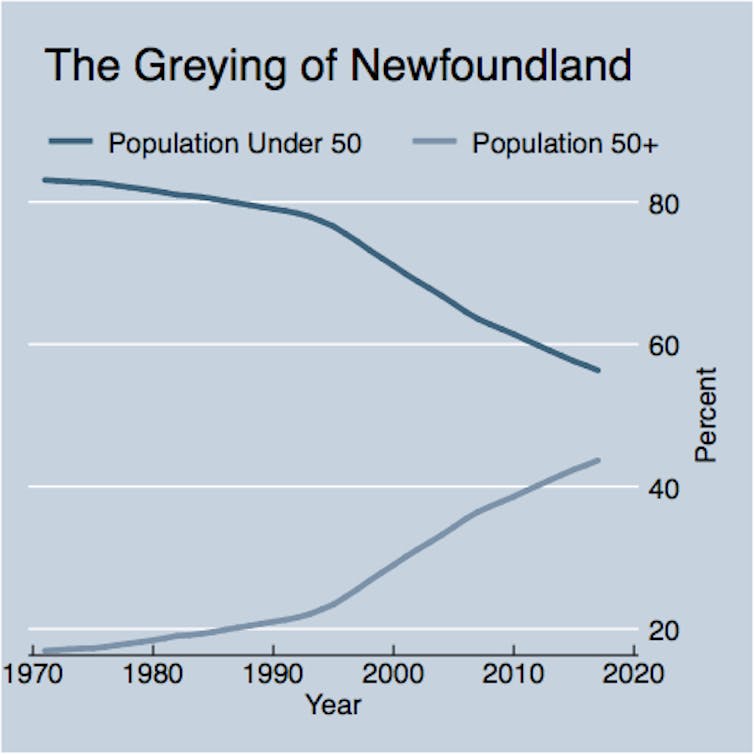
The graph below shows that Newfoundland and Labradorians face a tricky demographic challenge.
The graph vividly portrays how rapidly Newfoundland is growing older.Author provided
The share of the population under 50 years of age has been shrinking for the past 45 years. Since 2000, the population in age quintiles (five-year intervals) has declined in every age group below 50, while increasing in every age quintile above 50. While the population, post-2000, has remained relatively stable, the composition of the province’s population is vastly different.
As the population ages, so too does the median voter.
Citizens who are older are understandably less likely to support long-term reforms that will cut into their more immediate interests. This means that proposing tough solutions to current fiscal problems can make it hard to win elections, especially if there is a rural/urban divide separating younger and older voters.
Unlike Newfoundland’s fiscally tough solutions of the past, we propose a solution that more greatly strengthens attachment to home: Allowing Newfoundlanders and Labradorians living outside the province to vote.
Youth injection
To cast ballots in Newfoundland and Labrador elections, voters must be provincial residents the day before polling day. We propose to extend the vote in a simple, transparent and inclusive manner to anyone 18 or older who has ever attended school in the province.
Why former students? First, many children of Newfoundland and Labrador have been lured or forced abroad to scratch out a living or seek their fortune. All have been victims of the lack of opportunity at home. Many of these people wish to return, and many do return, in their more senior years. Why should their voices not be heard at the provincial ballot box?
A recent study published in the Journal of Labor Economics suggests that the mobility of these workers has boosted pay in their province of origin. Wages rise because employers at home must hike pay to prevent more workers from leaving. This is a real economic gain, on top of any money that workers who leave their home province send back home.
Second, there is precedent — national voter eligibility is not determined by location, but rather by citizenship. The electoral district you vote in federally is determined by your current residential address, but your eligibility to vote is preserved by the government of Canada even when you are living abroad.
Third, consider the civic education that has been instilled in these individuals through the province’s school system. They have a respect for the people and the land, the traditions and the ambitions of their home province.
Generally speaking, we extend the vote to people because they are either directly affected by the collective decisions of government or because they are subject to the laws of that government. Expatriates easily satisfy the first of these two conditions. Provincial policies affect both their ability to return home and their loved ones who remain behind.
To be sure, extending the franchise is not a magic bullet that will immediately solve the province’s problems. And there are no doubt further questions about the voting mechanisms needed to make this proposal a reality.
But we think extending the vote to expatriates strongly aligns with the province’s values. It could also help nudge its politics closer to long-term solutions that respect the roots and rights of all Newfoundland and Labradorians past, present and future.
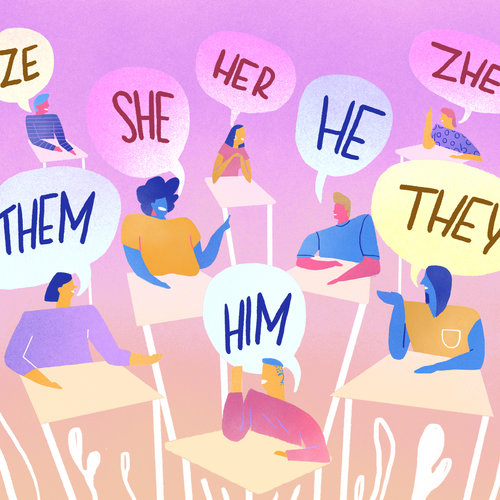
Letter-for-letter, no part of speech gets people more worked up than pronouns do. Linguistic history is dotted with eruptions of pronoun rage. Right now, the provocation is the gender-neutral pronouns that some nonbinary people have asked to be called by, so that they won’t have to be identified as “he” or “she.”
There are several of these in circulation. Some are new words, like “ze” and “co,” but some go back a ways — in fact, people have been proposing new gender-neutral pronouns for 150 years, though none has ever caught on. But the most popular choice, and probably the most controversial one, is the familiar pronoun that people describe as the singular “they.”
You can see why people would pick “they.” In everyday speech we often use that pronoun for a single person, though only when the word or phrase it substitutes for — its antecedent, as it’s called — doesn’t refer to a specific individual. So we say, “Somebody lost their wallet,” or, “If a student fails, they have to retake the course.” Or the person we’re referring to may be simply unknown. Your daughter’s cell phone rings at the dinner table; you say, “Tell them you’ll call them back.” Male or female, one caller or several? The pronoun “they” is like, “whatever.”
That singular “they” goes back hundreds of years. Jane Austen’s novels are bristling with sentences like “No one can ever be in love more than once in their life.” But that use of the pronoun fell into disrepute in the 19th century, when grammarians condemned it as incorrect and proclaimed that the so-called generic “he” should be used instead. The idea is that when you write, “Every singer has his range,” the pronoun “his” refers to both men and women — or as they sometimes put it, “the masculine embraces the feminine.”
When second-wave feminists protested in the 1970s that the generic “he” was sexist, they roused a storm of indignation. They were accused of emasculating and neutering the language. The chairman of the Harvard Linguistics Department charged that they were suffering from “pronoun envy.” William Safire warned that to accept the use of “they” in place of “he” would be to “cave in to the radic-lib forces of usage permissiveness.”
In retrospect, those reactions betrayed the obtuseness that the psychologist Cordelia Fine calls “delusions of gender.” The fact is that the pronoun “he” is never gender-neutral. If Sting had sung, “If you love somebody, set him free,” it would have brought only a male to mind. What the language required was “set them free.”
The gender-neutral singular “they” has history, English grammar and gender equity on its side, and it’s gradually been restored to the written language. Schoolroom crotchets can be hard to let go of. But we’ve largely leveled the linguistic playing field — at least, “he” no longer takes precedence over “she.”
But that didn’t make any provision for the rainbow of nonbinary and nonconforming gender identities that have risen into public awareness in recent years. The language still required us to choose between “he” and “she” to refer to a specific individual. The singular “they” initially sounded awkward here. We can say, “Somebody named Sandy was brushing their hair” where the pronoun replaces the nonspecific “somebody” — that’s been standard colloquial English for centuries. But when someone says just, “Sandy was brushing their hair,” you’re brought up short. Your first thought is that “they” must refer to some group of people whose hair Sandy was brushing.
That new use of “they” has passed muster with the AP’s style guide and the American Heritage Dictionary. In theory, anyone can adopt it, whatever their gender identity. But we’ll still be using “he” and “she” to refer to most individuals who identify as male and female. You can introduce new gender-neutral terms without driving out the gendered ones. “Sibling” has been part of the everyday language for more than 50 years, but we can still talk about brothers and sisters. When someone says, “Taylor has a lot going for them,” it’s a fair bet that that’s the pronoun that Taylor prefers to be called by.
It’s not a lot to ask — just a small courtesy and sign of respect. In fact, the accommodations we’re being asked to make to nonbinary individuals are much less far-reaching than the linguistic changes that feminists called for 50 years ago. Yet the reactions this time have been even more vehement than they were back then.
A fifth-grade teacher in Florida whose preferred pronouns are “they,” “them” and “their” was removed from the classroom when some parents complained about exposing their children to the transgender lifestyle. When the diversity and inclusion office at the University of Tennessee at Knoxville published a guide to alternative pronouns in 2015, the state legislature promptly defunded the center and barred the university from promoting the use of gender-neutral pronouns in the future. Like the classic episodes of pronoun rage in earlier eras, these aren’t about pronouns at all.

 Multicultural Meanderings