Over 80% of Canadians would fail a citizenship test, new poll reveals

No real surprise. More Canada Day clickbait than serious:

To become a Canadian citizen, hopeful permanent residents must achieve a score of 75 per cent or higher on the Canadian Citizenship test.

However, a recent poll by Forum Research found that almost 90 per cent of Canadians would fail this test, and the average score among those polled was just 50 per cent.

According to the results, men, the country’s highest earners, post-graduate degree holders and residents of British Columbia are among the most likely to pass the test.

Survey respondents were asked a series of 10 questions, which included questions about the title of the royal anthem (often confused with the national anthem), who the Métis are, the year the Charter of Rights and Freedoms came to Canada and Canada’s head of state.

Canadians scored most poorly on questions about the title of the Royal Anthem of Canada, civic duties, and Canada’s head of state.

When asked about the title of the royal anthem, only 36 per cent correctly answered, “God Save the Queen,” while 56 per cent responded “O Canada,” and six per cent said it was the Star Spangled Banner.

Respondents were also given a list of official responsibilities Canadian citizens have and were asked to select which item was not an official responsibility. Only 26 per cent correctly responded “driving safely.”

Lastly, over 80 per cent of respondents did not know that the Queen Elizabeth II remains Canada’s head of state to this day

Areas where respondents seemed to know their Canadian trivia included Canadian geography, the English translation of the word “Inuit,” and the significance of the Canada Pacific Railway (CPR).

In the former, 63 per cent of respondents were able to identify that the Midwest is not a Canadian geographical region. In the latter, two thirds of respondents knew that the CPR, which stretches from the Atlantic Ocean to the Pacific Ocean, is representative of unity.

Other questions on which respondents scored fairly well included the year the Charter of Rights and Freedoms was brought to Canada (1982), and identifying the founding peoples of Canada (Indigenous, French and British).

The Forum Poll™ was conducted by Forum Research with the results based on an interactive voice response telephone survey of 1645 randomly selected Canadians. The poll was June 25th -27th, 2019. Results based on the total sample are considered accurate +/- 3%, 19 times out of 20. Subsample results will be less accurate.

Source: Over 80% of Canadians would fail a citizenship test, new poll reveals

International Metropolis 2019 Ottawa and 2020 Beijing

As my last International Metropolis was some 10 years ago, was curious to see how the conference has evolved since then. The overall format remains the same, plenaries in the morning, workshops in the afternoon.

My impression was that of a more interesting and thought provoking conference than those that I remember, a tribute to the IRCC team and advisory committee that developed the program.

The sessions that I found particularly of interest were:

The Indigenous acknowledgement and presence that opened Metropolis was substantive, with a strong statement by Gilbert Whiteduck, with Metropolis also having an Indigenous closing ceremony.

The plenaries that I found most interesting were: Quest for global governance: Compacts and sustainable development goals (Global Compact), Non-state actors and the migration industry, The effects of technology on migration and integration, Cities and migration, and Public confidence in migration.

These daily briefs by Munk school students are good summaries of the presentations and discussions:

June_27_Munk_School_Daily_Brief.original.1561728696 June_26_Munk_School_Daily_Brief.original.1561640630 June_25_Munk_School_Daily_Brief.original.1561555064

For the last half day, not covered by Munk, the more interesting presentations at the Cities and Migration plenary were the effects of South American migrants (e.g., Venezuela) in Ecuador, services for families remaining in the Philippines when breadwinners worked abroad, A puff presentation on the Mayors Migration Council, and to liven things up, OCASI’s Debbie Douglas on some of the uncomfortable truths on racism.

The plenaries ended strongly with the Public Confidence in Immigration session, withPew Research international comparisons, Compas on UK attitudes and that media need to recognize that they are not neutral players but play a role in public and policy debates, Canada’s Environics on Canadian distinctiveness, South African attitudes towards immigrants and the limitations of surveys based on self-reporting with respect to attitudes.

The major tech innovation since my last Metropolis is of course smart phones and apps. While the conference app had login issues for many participants (i.e., for creating individual programs etc), it had a great feature that allowed questions to be submitted, displayed on screens and “voted” upon to allow moderators to choose those questions of greatest interest. An additional advantage was that it virtually eliminated the tendency of some to abuse microphone time and ensure greater focus.

In terms of other conference management notes, some of which may reflect my circumstances, were that some data based presentations (i.e., economic impact) were done without decks making them hard to follow.

2020 International Metropolis in Beijing

The next conference will be held in Beijing under the theme: New Narratives on Global Migration: Open, Fair and Sustainable Development.

Given the ongoing suppression of Uyghur Muslims and other human rights abuses, a curious choice given that the local organizers will certainly make every effort to ensure a controversy-free event.

In terms of historical parallels, and mindful of Godwin’s law, this is comparable to the holding of an international conference on immigration and integration in Germany following the passage of the Nuremberg Race Laws  (the Reich Citizenship Law and the Law for the Protection of German Blood and German Honor).

The dilemma for governments, academics and service provide organizations is whether they wish to participate against this backdrop. Historically, of course, countries and atheletes participated in the Berlin Olympics of 1936 despite the passage of these laws (and only saved by the medals won by Jesse Owens).

For Canadians, an additional issue remains the arbitrary detention of Michael Kovrig and Michael Spavor, who hopefully will be released well before then.I suspect that will be a challenge.

Source: International Metropolis Conference, Presentations

George Will: Last century’s immigration debate makes today’s seem enlightened

Good reminder. But of course, does not excuse the present immigration debate:

If you think we have reached peak stupidity — that America’s per-capita quantity has never been higher — there is solace, of sorts, in Daniel Okrent’s guided tour through the immigration debate that was heading toward a nasty legislative conclusion a century ago. “The Guarded Gate: Bigotry, Eugenics, and the Law That Kept Two Generations of Jews, Italians, and Other European Immigrants Out of America” provides evidence that today’s public arguments are comparatively enlightened.

Late in the 19th century, immigration surged, as did alarm about it, especially in society’s upper crust, particularly its Boston portion, which thought that the wrong sort of people were coming. Darwinian theory and emerging genetic science were bowdlerized by bad scientists, faux scientists and numerous philistine ax-grinders with political agendas bent on arguing for engineering a better stock of American humans through immigration restrictions and eugenics — selective breeding.

Their theory was that nurture (education, socialization, family structure) matters little because nature is determinative. They asserted that even morality and individuals’ characters are biologically determined by race. And they spun an imaginative taxonomy of races, including European “Alpine,” “Teutonic” (aka “Nordic”) and “Mediterranean” races.

Racist thinking about immigration saturated mainstream newspapers (the Boston Herald: “Shall we permit these inferior races to dilute the thrifty, capable Yankee blood … of the earlier immigrants?”) and elite journals (in The Yale Review, recent immigrants were described as “vast masses of filth” from “every foul and stagnant pool of population in Europe”). In The Century monthly, which published Mark Twain, Henry James, Rudyard Kipling, W.E.B. Du Bois and H.G. Wells, an author informed readers that “Mediterranean people are morally below the races of northern Europe,” that immigrants from Southern Italy “lack the conveniences for thinking,” that Neapolitans were a “degenerate” class “infected with spiritual hookworm” and displaying “low foreheads, open mouths, weak chins … and backless heads,” and that few of the garment workers in New York’s Union Square “had the type of face one would find at a county fair in the west or south.” The nation’s most important periodical, The Saturday Evening Post, devoted tens of thousands of words to the braided crusades for eugenics and race-based immigration policies. Popular poet Edgar Lee Masters (“Spoon River Anthology” ) wrote “The Great Race Passes”:

On State Street throngs crowd and push,

Wriggle and writhe like maggots.

Their noses are flat,

Their faces are broad …

Eugenics was taught at Boston University’s School of Theology. Theodore Roosevelt, who popularized the phrase “race suicide,” wrote to a eugenicist that “the inescapable duty of the good citizen of the right type is to leave his or her blood behind him in the world, and that we have no business to permit the perpetuation of citizens of the wrong type.” Woodrow Wilson warned against the “corruption of foreign blood” and “ever-deteriorating” genetic material.

Amateur ethnologists conveniently discovered that exemplary southern Europeans (Dante, Raphael, Titian, Leonardo da Vinci) were actually from the north. One wrote, “Columbus, from his portraits and from his busts, whether authentic or not, was clearly Nordic.” (Emphasis added.) Okrent writes: “In an Alabama case, a black man who married an Italian woman was convicted of violating the state’s anti-miscegenation law, then found surprising absolution when the conviction was vacated by an appellate court’s provocative declaration: ‘The mere fact that the testimony showed this woman came from Sicily can in no sense be taken as conclusive evidence that she was therefore a white woman.’”

The canonical text of the immigration-eugenics complex, Madison Grant’s “The Passing of the Great Race,” is available today in at least eight editions and is frequently cited in the internet’s fetid swamps of white supremacy sites. At the 1946 Nuremberg “Doctors’ Trial,” Nazi defendants invoked that book as well as the U.S. Supreme Court’s Buck v. Bell decision upholding states’ sterilization of “defectives” (Justice Oliver Wendell Holmes, a eugenics enthusiast: “Three generations of imbeciles are enough”) and America’s severely restrictive Immigration Act of 1924. It based national quotas on 1890 immigration data — before the surge of the “motley throng.” Okrent writes, “These men didn’t say they were ‘following orders,’ in the self-exonerating language of the moment; they said they were following Americans.”

Four years before the 1924 act, 76% of immigrants came from Eastern or Southern Europe. After it, 11% did. Some of those excluded went instead to Auschwitz.

Source: Will column: Last century’s immigration debate makes today’s seem enlightened

Eastern Europe’s Emigration Crisis

Not sure how this differs from previous emigration waves from Italy and Spain or indeed Eastern Europe, except that it is facilitated by the EU’s freedom of movement. The same critique has been made with respect to emigration from developing countries to the West and the effective brain drain. Canadians have also worried about those who left Canada for the USA.

While the effect is real on emigration countries, hard to see if there are any effective or acceptable policies to counteract emigration. Does one really want to restrict freedom of movement in the EU and if so, how?

In recent years, most of the debate around the global migration of people has focused on the movement into developed countries and the political battles that ensue. Most famously, Trump has overturned the wisdom of the American political establishment by saying the unsayable on immigration. Politicians from Riga to Rome have won votes (and office) by exploiting similar anxieties. But we seldom talk about the places which, year after year, see more people leave than arrive, and the consequences of countries saying goodbye to some of their best and brightest—often for good.

Nowhere is this concern more pressing than in Eastern Europe. According to the UN, of all the countries that are expected to shrink the most in the coming decades, the top 10 are all in the eastern half of the continent, and seven of those are in the European Union. One cause for concern among many of these countries is the EU’s freedom of movement, one of the four “fundamental freedoms” of goods, capital, services, and people that bind the 28. Although most press coverage of the bloc’s easternmost nations has focused on the rise of anti-immigration populism, there is mounting concern about the brain drain of its most highly qualified citizens to better jobs abroad. In at least six of the EU, the people leaving have become as controversial as those arriving, with some countries now favouring emigration controls.

In essence, the EU’s freedom of movement guarantees an absence of barriers for anyone looking for a job within the 28 countries and makes discrimination based on nationality in work or employment illegal. For many of the EU’s new entrants in the East—including Poland, Hungary and Romania—a future where capital and people could move more freely between themselves and France, the UK, or Germany looked like a fast-track to the top-tier of developed nations. But somewhat ironically, it has only accelerated the departure of those who are crucial to getting there.

In the last century, Eastern Europe has suffered the most dramatic population decline in recent history. According to one study, between 2013 and 2016, approximately 230,000 people left Croatia—a country with a population of only four million—for the 11 “core EU countries” of Western Europe. In the United States, this would be the equivalent of a city the size of Chicago leaving every year. This mass exodus of people is not lost on the country’s politicians; last year the Croatian President called the freedom of movement the “biggest drawback” of the EU. “Mobility is good, as long as people come back. But Croatia is now recording strong negative demographic trends,” she said during a visit to Brussels.

Since Latvia joined the EU, it has lost one-fifth of its population. Romania, a country that according to one organisation is due to see the most drastic population decline, has seen over three million leave the country since it joined the EU in 2007. It lost half of its doctors between 2009 and 2015, the vast majority to better-paid employ in the richer hospitals and surgeries of Western Europe, leaving its health service poorly staffed and on the brink of collapse. High mortality (including infant mortality) and low birthrates are only accelerating the decline.

Large-scale migration of healthcare workers from East to West has been an uncomfortable reality for over a decade, and the young needn’t travel long distances to drastically increase their standard of living. One Estonian doctor who graduated from medical school in 2001 was able to quadruple his salary by moving only 200 kilometres to Finland. In 2018, Denmark enjoyed the EU’s highest average gross annual pay at nine times that of the continent’s lowest in Bulgaria. Who can blame those who head for the greener pastures on the other side?

One solution, that may seem obvious to many, is to increase inward migration from overseas. There is one big problem, however. Eastern European attitudes are  less favourable to immigration than they are in countries in the north and west. Cultural preferences, like sharing a religion, are also more important. According to 2017’s Gallup’s Migration Acceptance Index, all but two of the top 10 countries least accepting of immigration were from Eastern Europe (the others being Israel and the Czech Republic, which is considered Central Europe). Even Japan, a country that has also suffered from population decline—although for different reasons—and is reluctant to accept any large-scale immigration, has now begun to implementmeasures that will open itself up to labour from foreign countries.

The reasons people leave countries in the former Eastern bloc are numerous. Many are concerned about corruption and the limits it places on their country’s future. Others already have family living elsewhere on the continent. Most simply are looking for better prospects for themselves, their children, and their children’s children. Those taking part in the immigration debate in the West should be careful not to forget this fact. The drive to achieve a better life is the most human of instincts and we should not cast blame on those who act on it, lest we throw away our own humanity.

Equally, liberals and progressives in the West should stop viewing the immigration debate solely as an opportunity to flaunt their tolerance and “openness.” A welcoming nature and a desire to help those less fortunate than ourselves are admirable traits, but we mustn’t forget that by welcoming the world’s premier doctors, entrepreneurs, academics, and engineers—with few restrictions—we are depriving the places they come from of their potential; robbing them of the chance to make emigration an option, rather than a necessity—as many feel it is today.

On the liberal Left, acceptance of large-scale immigration is increasingly framed as a moral issue: are you a racist, or a xenophobe? If the answer is “neither,” what’s the problem? This forced dichotomy of good/bad or closed/open is unhelpful and obscures rather than illuminates. Ironically, while liberal immigration policies in general, and freedom of movement in particular, undoubtedly help those who leave, for the vast majority left behind, the result is a country that, in the long term, is measurably worse off. More often than not, those who frame the immigration debate in the starkest terms have little to say about this poaching of skills and talent from elsewhere.

In Europe, a conundrum we will increasingly have to confront is how to embrace openness whilst avoiding the erosion of another country’s social fabric. This may mean fundamentally reevaluating the freedom of movement, or at least restricting it to economies with comparable pay and conditions. Another solution may come in the form of increased cash transfers, and investment in smaller economies by bigger ones to try and level out standards of living. Something must be done soon, or populations in eastern Europe will continue to disappear.

History shows us that mass emigration can change a country forever. In an upstairs window of the Irish president’s official residence, one lamp flickers constantly. Lit by President Mary Johnson in 1990, it is a beacon to light the way home for the millions of descendants of the Irish who left their homeland over the centuries. (Ireland’s population peaked at more than eight million people in around 1840 and hasn’t yet recovered almost two centuries later.) One wonders whether the less prosperous countries of the European Union hit hardest by emigration may light their own lamps soon enough.
Source: Eastern Europe’s Emigration Crisis

There’s a debate over Canada’s new definition of anti-Semitism, and it might sound strangely familiar

Needed raising of some parallels:

You could be forgiven for having missed the fact that Canada has adopted a formal definition of anti-Semitism. It was included as part of the government’s new anti-racism strategy, announced by Heritage Minister Pablo Rodriguez earlier this week, in a list of terminology toward the end.

“Anti-Semitism is a certain perception of Jews, which may be expressed as hatred toward Jews,” it reads. “Rhetorical and physical manifestations of anti-Semitism are directed toward Jewish or non-Jewish individuals and/or their property, toward Jewish community institutions and religious facilities.”

This is a relatively recent definition, adopted in 2016 by the International Holocaust Remembrance Alliance (IHRA), an intergovernmental body with 31 member countries, including Canada. It’s since been adopted by a handful of countries, including the U.K. and Germany.

But controversy has bubbled up around the IHRA definition, fuelled by those who believe it’s over-broad and could chill legitimate criticism of the Israeli state. Though Canada isn’t passing any new laws to curtail debate about Israel, some believe the IHRA definition is a threat to free speech.

If this sounds strangely familiar, that’s because the debate bears a certain resemblance to the controversy that raged for months over M-103, the Liberals’ anti-Islamophobia motion that Conservatives claimed would threaten people’s right to criticize Islam. The arguments in both cases are oddly similar — they’re just coming from very different quarters.

The IHRA definition of anti-Semitism is brief, but includes a list of 11 contemporary examples, such as “the myth about a world Jewish conspiracy,” and the claim that Jews invented or exaggerated the Holocaust. It also lists as anti-Semitic “applying double standards by requiring of (Israel) a behaviour not expected or demanded of any other democratic nation.”

Aidan Fishman, former national director of B’nai Brith Canada’s league for human rights, said his organization pushed for Canada to adopt the IHRA definition because of a “really alarming rise” in anti-Semitic incidents in recent years.

“It’s a very comprehensive definition, which really encapsulates anti-Semitism in its modern form,” he said. Canada’s decision comes in the midst of an international effort by Jewish organizations to urge governments and political parties to formally adopt the IHRA definition.

Anthony Housefather, a Liberal MP from Montreal and chair of the House of Commons justice committee, said defining anti-Semitism is key to fighting it. “Most people just need to be educated and understand where something crosses the line,” he said.

Still, the IHRA definition has not been universally embraced. Last week, just days before the anti-racism strategy was released, the British Columbia Civil Liberties Association (BCCLA) released a statement saying the definition is “extremely vague,” “open to misinterpretation” and could undermine Charter rights to free speech. “We fear that if adopted, the IHRA definition will serve to severely chill political expressions of criticism of Israel as well as support for Palestinian rights,” the association said.

In a statement to the National Post on Thursday, the NDP said the party supports the anti-racism strategy, but likewise raised concerns about the IHRA definition, saying it “could be a threat for people who legitimately denounce grave human rights abuses by the government of Israel against Palestinians.”

Independent Jewish Voices, an organization that supports the call for boycott, divestment and sanctions (BDS) against Israel, is urging Ottawa to reconsider. “The full definition’s examples conflate fundamental criticisms of Israel and/or Zionism with anti-Semitism — a position IJV strongly rejects,” the organization said in a statement, adding its adoption “would pose a serious threat to freedom of expression and academic freedom in Canada.”

Fishman and Housefather both denied this, pointing out that the definition states that “criticism of Israel similar to that levelled against any other country cannot be regarded as anti-Semitic.” But Fishman said support for the BDS movement does constitute anti-Semitism under the IHRA definition to the extent that supporters also, for example, call for the lifting of sanctions against Iran — a double standard, he argued.

“There are many parts of BDS which are indeed a new form of anti-Semitism when you single out Israel,” Housefather said.

Canada’s anti-racism strategy does not propose any new penalties for anti-Semitism, nor does it propose new legislation — it provides only a definition. But Meghan McDermott, staff counsel for the BCCLA, said she worries it could eventually be incorporated into the Criminal Code. “It’s kind of what we would call soft law for now,” she said. “We just worry about that whole floodgates argument.”

That “floodgates argument” is strikingly similar to the concerns raised by Conservatives and other critics of M-103, the 2017 motion that called on the government to condemn Islamophobia and all forms of racism and religious discrimination. Though M-103 was not a government bill and proposed no changes to legislation, critics claimed that because Islamophobia was not precisely defined, the motion could restrict legitimate criticism of Islam.

B’nai Brith was among those critics. At a 2017 meeting of a parliamentary Heritage committee conducting a study of systemic racism as required by M-103, Michael Mostyn, CEO of B’nai Brith, called Islamophobia a “confusing” term with competing definitions. “We must ensure that no one can hide behind the idea that any criticism of Islam represents Islamophobia, or a vague definition to this effect,” he said.

Ultimately, the Heritage committee recommended Canada update its national action plan against racism, a commitment that’s now been fulfilled with the release of the new anti-racism strategy, which defines both anti-Semitism and Islamophobia. Its definition of Islamophobia “includes racism, stereotypes, prejudice, fear or acts of hostility directed towards individual Muslims or followers of Islam in general.”

The Conservatives did not respond to a request for comment about the new strategy and its definitions.

McDermott insisted the two debates — about anti-Semitism and Islamophobia — are not analogous, as the controversy over the IHRA definition centres around criticism of a foreign nation. The debate over M-103, she said, wasn’t “grounded in reality.”

“It seemed to me that it was… people who were Islamophobic who were making those arguments,” she said.

For his part, Fishman said criticism of the IHRA definition is ill-founded. “And I think some of it is actually motivated by a desire on the part of certain groups… to keep pushing anti-Semitism,” he said.

Cara Zwibel, director of the fundamental freedoms program of the Canadian Civil Liberties Association, said she’s concerned about any definition of racism that’s too broad, because of the importance of freedom of expression. Still, she pointed out, nothing in Canadian law has actually changed.

“There’s nothing in that strategy at the moment that seems to restrict rights in any way,” she said. “It’s more about empowering people to respond.”

On Canada Day, let’s reconsider the high cost of citizenship

While I have long advocated for a decrease in citizenship fees, given the mix of personal and public benefits of citizenship, her points on permanent residency fees miss the fact that these only cover processing costs, not the more than $1 billion the government spends on settlement services such as language training.

Both Conservative and Liberal governments in their substantial funding for settlement services demonstrate their recognition of the public, not just personal, benefits of immigration.

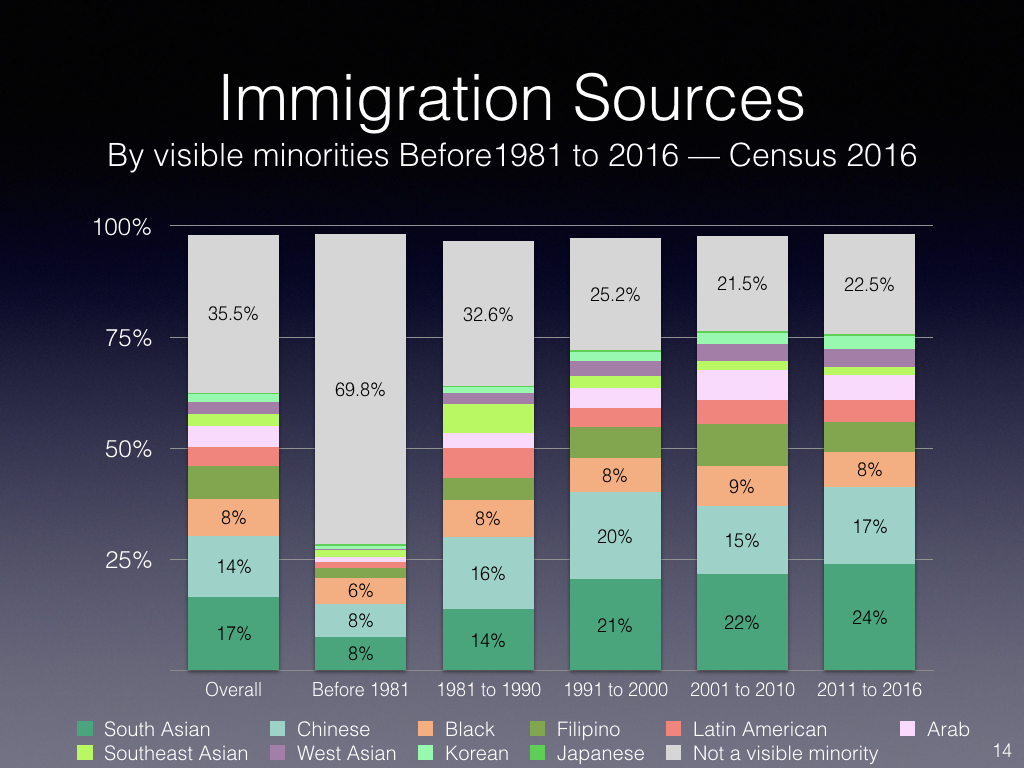
Similarly, while citizenship data (administrative and Census) show some groups adversely affected by the 2014-15 fee increases and other changes, visible minorities form close to 80 percent of all immigrants, so hard to make the case that this is a major barrier:

At any international airport, the passport of those making their way through customs could be a source of envy or a source of pity, quietly communicating the perceived quality of life lived by its holder. Voluminous emigration and immigration have turned citizenship into the “most significant class lottery remaining in the modern world,” in the words of one journalist. Perhaps recognizing this, many countries including Canada have successfully capitalized on immigration.

The path to Canadian citizenship has gone through a series of changes. In the past, in addition to being able to marry into citizenship, one could literally buy citizenship – a program Quebec continues to this day. Currently, the journey to citizenship begins with permanent residency. Apart from transitioning from a student or worker to a permanent resident, other options include using foreign entry programs such as Family Sponsorship, Economic, and Business Immigration.

Regardless of the option, in addition to the application cost comes a payment of $490 for the right of permanent residence fee, without which permanent residence status is not granted. Protected persons are exempt from this expense.

Introduced in 1995 and levied on individuals seeking permanent residency,first at a hefty price of $975, the fee is seen as “a partial compensation for benefits which accrue to the person who acquires permanent resident status and helps to defray various costs incurred in delivering the immigration program.” But this may not have been the only reason for its introduction.

The right of permanent residence fee (then called right of landing fee) came at a time when there was an increase in immigrants from Asia and the Middle East and a plummet in the numbers originating from the U.S. and Europe.

In a world where economic parity is heavily influenced by gender and colour, this fee continues to be a major impediment for many and is especially intensified if one is a woman of colour. Exceptions made for protected persons aside, and though levied regardless of the country of origin, it favours those with economic stature, which in today’s world continues to be withheld from women and people of colour, thereby contributing to inequities in education and employment opportunities.

After proving one’s worth as an upstanding permanent resident, if financial means allow, then the next step toward active civic engagement is in the form of an application for citizenship (bumped to $530 from $100 in 2015) which, once again, could be loaded with added costs.

In total, the price paid to acquire Canadian citizenship quickly escalates, approximately amounting to between $3,000 and $4,000 (or more) and may include translation fees; lawyer’s fees that could be as steep as $400 for a consultation; medical exams and diagnostic testing, which aren’t covered by provincial health care plans; official language testing by a third party; miscellaneous costs such as citizenship certificates; permanent resident card renewal; photographs, conveyance and mailing. And this is without factoring the expenses associated with holding the status as an international student or worker (before applying for permanent residency) within Canada.

In 2017, Canada should have received more than $78-million from 159,262 economic immigrants, solely based on the right of permanent residence fee, many of whom pay this amount even before arriving to Canada. Once here, if these individuals choose to pursue citizenship, then once again it translates into millions of dollars wending their way to government coffers.

There is privilege attached to becoming a Canadian citizen. But it isn’t something that is easily afforded for many. Of the total cost of the arduous, emotional and financially stressful path to citizenship, approximately 15 per cent to 20 per cent is directed toward buying the permanent residence and citizenship rights – to be able to belong, to be able to vote, and most importantly, to be able to call oneself Canadian. The fact remains that, today, the current immigration system, consciously or unconsciously, promotes gender and economic disparity globally. In a world where immigration is more than just a means to move from one country to another, it is time to recognize what this has evolved into – a booming business that only profits certain countries.

Source: On Canada Day, let’s reconsider the high cost of citizenship