Child marriage ‘legal and ongoing’ in Canada, researcher finds

Not clear whether the definition used is the UN one (under 18) or the Canadian federal Civil Marriage Act of 16, although likely the latter. An average of 188 per year:

Ontario, Alberta and Quebec have licensed the most child marriages in the last 18 years, said professor Alissa Koski, who researches the practice in Canada

Since 2017, Canada’s government under Justin Trudeau’s Liberals has conducted foreign policy with an explicitly “feminist” approach, especially as it relates to sexual and reproductive health rights.

Part of that has involved trying to eradicate child marriage overseas. Canada is a leader and key funder of United Nations efforts to end child marriage, which is regarded as a revealing measure of a country’s development.

But there is a curious blind spot.

“There’s been absolutely no reflection on the fact that it remains legal in Canada,” said Alissa Koski, who researches child marriage in Canada as an assistant professor at McGill University’s Department of Epidemiology, Biostatistics and Occupational Health.

The bizarre result is that Canada legally permits the very practices it condemns and combats in the developing world.

Child marriage in Canada “is legal and ongoing,” Koski concludes, and not as a rare legal quirk in niche communities of religious extremists, as media coverage often suggests.

Provinces have, in fact, issued marriage licences for 3,382 children over the last 18 years, according to Koski’s presentation to the Congress of the Humanities and Social Sciences in Vancouver.

In absolute numbers, Ontario sanctioned the most child marriages with 1,353 since 2000, then Alberta with 791, Quebec with 590 and British Columbia with 429. She adds that her results likely “underestimate the true extent of the practice.”

It has happened in every region, Koski said. The vast majority are girls; and compared to boys, girls marry at younger ages and to substantially older spouses.

The rate is highest in Alberta, at five girls per 10,000, and one boy as measured by data from the year 2016, or three children total per 10,000.

Her discovery that Canada has approved at least 3,382 child marriages since 2000 is based on data from vital statistics offices, which indicates the marriage happened in Canada, but otherwise offers limited information. Further work with census data might offer a clearer picture of demographics, although with the added caveat that it will include marriages that happened in other countries before the person came to Canada.

In the United States, the rate of child marriage is about 6.2 children per 1000, higher in girls than boys (6.8 vs 5.7), lower among white people, higher among Indigenous and Chinese, and ranging from less than four children per 1,000 in Maine, Rhode Island and Wyoming, to as much as 10 per 1,000 in West Virginia, Hawaii and North Dakota, according to Koski’s previous studies of child marriage in America.

Her doctoral research was on child marriage in sub-Saharan Africa and India, which fits with the common imagination of the phenomenon as “something that happens elsewhere,” as Koski put it.

For example, her separate research on Canadian media coverage of the issue shows it is almost entirely about Canada’s efforts to eradicate child marriage abroad. The few exceptions are focused on specific religious minorities, primarily the fundamentalist Mormons in Bountiful, B.C., and the fundamentalist Jewish sect Lev Tahor, first in Ste-Agathe-Des-Monts, Que., later in Chatham, Ont.

Canada’s federal Civil Marriage Act sets the minimum age for marriage at 16. Provinces, which administer the licensing, require parental consent for people younger than 18.

But the United Nations, and Canada through its participation in its various programs and documents, regards child marriage as marriage of a child, which is to say someone younger than 18.

The reasons are well known. The proportion of girls who marry before 18 is used as a quantifiable measure of a country’s development progress, Koski said, and it is widely considered a violation of human rights. Research in the US has shown higher mental illness and substance abuse in women who married as girls.

“Child marriage is associated with poor health and economic outcomes, particularly for girls,” she said.

Koski said there seems to be a general political reluctance to raise the age to 18, part of which involves concerns over infringing on religious freedom.

Source: Child marriage ‘legal and ongoing’ in Canada, researcher finds
Québec définit ce qu’est un «signe religieux»

I have pity for the public servants who were tasked with the drafting what appears to be a fairly restrictive definition, given no mention of size (e.g., small pendants of the Cross, Star of David):

Le gouvernement Legault fait volte-face et consent finalement à définir ce que représente à ses yeux un « signe religieux » dans son projet de loi 21 sur la laïcité de l’État.

Depuis le dépôt du projet de loi controversé, le ministre responsable, Simon Jolin-Barrette, avait toujours refusé jusqu’à maintenant, malgré les pressions venant de toutes parts, de définir ce qu’il entendait par l’expression « signe religieux », qui est au coeur du document.

Mardi, en soirée, coup de théâtre à l’Assemblée nationale où son projet de loi est passé au peigne fin : le ministre Jolin-Barrette a déposé un amendement précisant aux nombreux employés de l’État visés par la loi ce qu’ils n’auront plus le droit de porter dans l’exercice de leurs fonctions.

Le libellé de l’amendement à l’article 6 démontre l’intention du gouvernement de ratisser large.

Ainsi, aux yeux du gouvernement, « tout objet, notamment un vêtement, un symbole, un bijou, une parure, un accessoire ou un couvre-chef » sera considéré comme étant un « signe religieux », s’il est porté « en lien avec une conviction ou une croyance religieuse » ou s’il est « raisonnablement considéré comme référant à une appartenance religieuse ».

Il n’y a aucune mention visant la taille de l’objet en question : minuscule ou ostentatoire, le signe religieux sera donc prohibé.

Le gouvernement Legault tient mordicus à faire adopter deux de ses projets de loi avant l’ajournement des travaux, prévu ce vendredi 14 juin : le projet de loi 9 sur l’immigration et le projet de loi 21 sur la laïcité de l’État.

Les deux législations sont pilotées par le ministre Jolin-Barrette.

Le projet de loi 21 en est rendu à l’étape de l’étude détaillée article par article.

Il prévoit interdire à plusieurs catégories d’employés de l’État – policiers, gardiens de prison, procureurs de la Couronne, enseignants et directeurs d’école des niveaux primaire et secondaire du secteur public, notamment – de porter tout signe religieux dans l’exercice de leurs fonctions.

Les employés actuels auraient un droit acquis (« clause grand-père »).

Durant la consultation menée sur le projet de loi, certains des témoins entendus avaient fait valoir que le document était beaucoup trop vague, sans définition précise de ce qui serait interdit ou pas, donc difficile à appliquer.

Source: Québec définit ce qu’est un «signe religieux»

Lessons from the Doug Ford School of Public Administration

I could not resist posting this pointed, and unfortunately all too accurate, rant by Les Whittington. Hopefully, year two will show a more measured and mature governing style (but not hopeful):

School is out at Queen’s Park, but here are the lessons for the next semester based on the first year of Premier Doug Ford’s government in Ontario:

Talk about helping “the people” while you slash programs that many need: Roll back promised funding increases for rape crisis centres, cut legal aid by 30 per cent, cancel a $1 increase in minimum wage, remove rent control for new units, get rid of the basic income pilot program, scrap legislation to help part-time workers, cancel free prescription medication for young Ontarians, kill off free university tuition for low-income students, and slice $84-million in funding for children and at-risk youth.

The public doesn’t pay attention so there’s no problem promising one thing and doing something else: Tell voters “not one single” public service job will be lost under a Ford government, then once elected change that to no “frontline” jobs. Then put thousands of teachers’ jobs at risk by raising school class sizes. Watch other jobs disappear at agencies that are being axed or downsized. Put thousands of beer store employees’ jobs in jeopardy.

Don’t worry about honouring your promise to continue with the planned increase in municipalities’ share of gas tax funding… they can do without that extra $300-million.

Treat the public like a bunch of dazzled rubes: Bread and circuses, supplemented with divisive anger, can be a winner, as U.S. President Trump has shown. Above all, in Ontario this means prioritizing beer and booze. Commenting on the Ford government’s budget, Green Party Leader Mike Schreiner noted the emphasis: “If you look through this budget, it mentions booze and gambling 63 times, it mentions climate change 15 times, and it mentions poverty zero times.”

Avoid annoying demands for consultation and advance information:Better to release details of your unexpected decisions in phone calls to the officials involved rather than publicly, as was done with the planned amalgamation of regional health organizations. Another example: Without warning, the Ford government trashed years of urban planning designed to keep Toronto liveable when it took over the city’s planning in a move to allow developers to build higher buildings—and more of them—in the city’s downtown and midtown. After all, developers need a freer hand.

Personal grudges are as good a basis for public policy as anything else:Given the province’s power over Toronto’s affairs, why not unexpectedly cut the size of Toronto’s city council in half? Didn’t the council give brother Rob Ford a hard time when he was mayor? Rob Ford always favoured a subway line to Scarborough. By taking over subway planning, a Progressive Conservative government can make it happen. As for the provincial Liberals, only old-fashioned notions of fairness could have stopped the PC majority from changing the rules to keep the Ontario Liberals from having a chance to achieve official party status.

Provincial taxpayers are so apathetic they won’t mind if their tax dollars are spent on federal political ads: If your government opposes carbon pricing imposed by the Trudeau government, why not spend millions from the Ontario treasury advertising against it? Also, there’s no need in today’s post-truth environment to mention the fact that Ottawa will be rebating the carbon tax revenues to individual Ontario taxpayers.

Don’t bother the public with difficult issues like climate change or the need to prepare for the green economy: Voters will buy things like park clean-ups as a substitute for action on global warming. So, you can cancel Ontario’s cap and trade program and cut 700 green energy programs, undermine the province’s independent environmental watchdog, and earmark $30-million to challenge the carbon tax in court.

Policies based on illusions of past greatness are always more popular than forward-looking plans designed to try to address the complex issues of modern life: Reduce financial support of post-secondary institutions and kill off new satellite university campuses while cutting funding for innovative research and work on improving Canada’s economic prowess. The future will look after itself.

Don’t bother with nuisances like avoiding favouritism in major government appointments or not interfering in politics outside your sphere: Just because Toronto Police Supt. Ron Taverner was a Ford family friend didn’t mean he wouldn’t have been a good choice for OPP commissioner.

On the federal-provincial scene, a premier should stake out the most provocative position possible, as in this Ford quote from October 2018:“We’ve taken Kathleen Wynne’s hand out of your pocket … and we’re going to take Justin Trudeau’s hand out of your pocket.”

Conservative Leader Andrew Scheer needs all the election help he can get, so pitch in. How could that not work out well for him?

Source: Lessons from the Doug Ford School of Public Administration

Senate survey offers better picture of diversity among Chamber staff

Good to see these data collection efforts and their sharing despite their limitations:

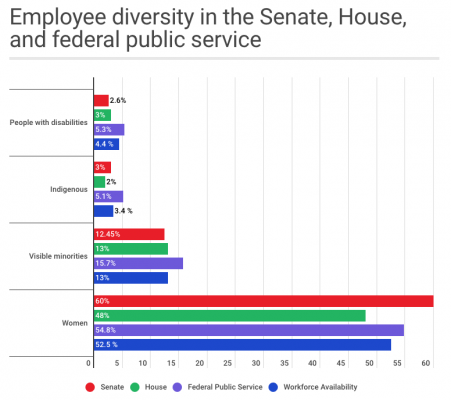
New numbers suggest the Senate’s hiring of women, Indigenous people, and visible minorities is on par with each group’s availability in the workforce, but behind on employing those with disabilities.

An estimated 2.6 per cent of Senate staff are people with disabilities, though they represent 4.4 per cent of the available workforce, according to new data collected from some Senate staff.

At the June 6 Senate Internal Economy, Budgets, and Administration meeting Diane McCullagh, the Senate’s chief human resources officer, reported on her office’s efforts to get better statistics through a voluntary survey of staff in both the administration and Senators’ offices. Because it’s an opt-in survey, the Senate doesn’t have diversity data on all its staff.

The latest push brought in 266 responses, Ms. McCullagh said, and pooled with past efforts, the Senate now has information for 596 people. That represents 81.5 per cent of the 731 employees at the time of the survey, conducted between March 29 and April 26.

Three per cent of Senate staff recorded identify as Indigenous, compared to an estimated 3.4 per cent workforce availability, Ms. McCullagh told Senators. Similarly, among visible minorities, the Senate is a few points off, hiring 12.45 per cent, compared to an estimated workforce availability of 13 per cent. Women represented 60 per cent of those surveyed, well above the 52.5 per cent workforce availability.

Where the Senate is falling behind, it isn’t far, said Ms. McCullagh, but the Senate has “work to do” to hire more people with disabilities.

Breakdown of diversity for staff in the House of Commons, Senate, and public service, according to 2018 data reported by each body. Graph created with Infogram

Ms. McCullagh acknowledged the limitations in the data, noting people are “still fearful” of singling themselves out. But the numbers can still help establish “benchmarks against which we can measure our progress going forward,” she said.

The search for better statistics emerged following a June 2018 report, Diversity in the Senate: From Aspiration to Action, from Internal Economy’s Subcommittee on Diversity.

The new data shows a shift from the 2016 numbers the committee studied, though that report only looked at the Senate’s employees, and didn’t include staff working in Senators’ offices. As of March 2016, among the 354 employees, women represented 59 per cent, visible minorities 15.3 per cent, people with disabilities 5.6 per cent, and Aboriginal people 3.4 per cent.

The new data puts the Senate behind the core public services in all areas, except hiring women, and ahead of the House of Commons only in its hiring of women and Indigenous people.

Of the 192,467 that made up the core public service as of March 31, 2018, women represented 54.8 per cent, according to the most recent report on employment equity. That’s slightly up from the estimated workforce availability of 52.5 per cent for the same year. Indigenous people represented 5.1 per cent of the public service (compared to 3.4 per cent workforce availability), people with disabilities accounted for 5.3 per cent (compared to 4.4 per cent), and visible minorities were 15.7 per cent (compared to 13 per cent workforce availability).

In the House of Commons, as of June 2018, 48 per cent of the House administration’s 2,479 employees were women, two per cent were Aboriginal persons, 13 per cent were visible minorities (up from 10 per cent the previous year), and three per cent were people with disabilities (down from two per cent in 2017).

Senators also asked Ms. McCullagh’s team to start tracking regional representation among staff, and while she didn’t have that data, she said the Senate has a wider reach than it has in the past.

Source: Senate survey offers better picture of diversity among Chamber staff

Hier les italophones, aujourd’hui les musulmans

On the politics of anti-immigration sentiment and a reminder that earlier waves also were affected:

Avec la marginalisation du Parti québécois et le remplacement du Parti libéral par la CAQ, nous assistons à un cycle politique caractérisé par l’alternance sans réelle alternative, en conformité avec l’ordre néolibéral. Ce gouvernement nationaliste de droite élu par 25 % de l’électorat, si l’on tient compte des abstentions, a recours à une recette éprouvée pour, à la fois, consolider et légitimer son pouvoir : détermination d’un problème réel ou imaginaire (la laïcité), élaboration d’une rhétorique alarmiste (retour du religieux) et désignation des responsables du problème (les musulmans). Les stratèges de François Legault n’ont rien inventé. Il y a une cinquantaine d’années, le mouvement nationaliste de l’époque s’est servi de la même recette mais avec d’autres ingrédients : la langue française, l’anglicisation et les italophones.

Il a fallu près d’une décennie pour que le psychodrame linguistique, se déroulant aux dépens des Québécois d’origine italienne, se dénoue enfin par l’adoption de la loi 101. Les relations entre ces derniers et les francophones se détériorèrent à tel point, et pendant si longtemps, que la méfiance et le ressentiment eurent raison de Giuseppe Sciortino, candidat péquiste dans Mercier, lors de l’élection précédant le dernier référendum. Il fut obligé, in extremis, de céder la place à un francophone d’ascendance canadienne-française à la suite de manoeuvres douteuses. Récemment, Michel David, chroniqueur au Devoir, écrivait que la présence de Sciortino, avocat éminemment ministrable au sein du futur gouvernement Parizeau, aurait probablement apporté au camp souverainiste les 45 000 voix qui lui manquaient pour remporter le référendum de 1995. Le nationalisme mesquin et revanchard est parfois suicidaire.

Aujourd’hui, ce sont les musulmans, en particulier les musulmanes, qui ont le mauvais rôle. Pourtant, il y a une vingtaine d’années, près des deux tiers des Québécois étaient contre l’interdiction du voile islamique. Selon un sondage récent, ils sont maintenant au moins autant à vouloir l’interdire. Pourquoi ce revirement ? Nul besoin d’être un exégète de Gramsci pour savoir que l’adhésion à un projet politique ou de société (ou perçu comme tel) est précédée par une longue période de propagation des idées et d’imprégnation des esprits auxquelles contribuent, consciemment ou non, de nombreux acteurs sociaux. En France (source d’inspiration pour certains Québécois) comme ici, politiques, chroniqueurs et essayistes se sont employés avec autant de ferveur que de constance à élaborer une rhétorique hostile à l’immigration et à la diversité culturelle — assimilée au multiculturalisme trudeauiste pour mieux la dénoncer — tout en souscrivant au mythe du choc des civilisations : une idéologie servant, entre autres, à dénigrer l’islam. Partout en Occident, l’islam est devenu l’ennemi à abattre. Le Québec ne fait pas exception. Il faut être d’une grande naïveté pour croire que le projet de loi 21 existerait sans la présence des musulmans.

Nationalistes conservateurs

Ce discours n’aurait pas eu autant de succès sans la contribution, depuis le tournant du millénaire, de nationalistes conservateurs, défenseurs d’une nation ethnoculturelle qui, craignant sans raison valable « la tyrannie des minorités » et « le reniement de soi », poursuivent, tout en le niant, la chimère d’un Québec assimilationniste et homogène. Il y a de cela aussi dans l’interdiction du port du foulard musulman. Ces hérauts d’un temps révolu, aux accents groulciens, doivent nous expliquer pourquoi l’assimilation que les francophones d’Amérique ont combattue avec autant de détermination serait souhaitable pour les immigrants.

Mais pourquoi la laïcité est-elle devenue la priorité de ce gouvernement, auquel on a dû rappeler l’importance de l’environnement, alors que deux millions et demi de Québécois ont un revenu inférieur à 25 000 $, que le système scolaire est le plus inégalitaire au Canada en raison de sa double ségrégation sociale et ethnique, et que les Québécois francophones sont sous-scolarisés par rapport aux immigrants (21 % contre 39 % de diplômés universitaires) et aux anglophones ? L’hégémonie néolibérale est telle, en Occident, que les partis de gouvernement, et non pas les formations politiques marginales, ne se distinguent presque plus sur les questions fondamentales et cherchent à tout prix à se différencier sur des questions secondaires ou fallacieuses, comme la laïcité ici ou l’islamisation et d’autres mythes ailleurs. C’est l’alternance sans véritable alternative. Ceux qui doutent de l’emprise, sur ce gouvernement, de cette rationalité mortifère, fondée principalement sur la concurrence généralisée, n’ont qu’à penser à la mise en concurrence de l’industrie du taxi avec Uber, aux immigrants réguliers avec les travailleurs temporaires et aux maternelles quatre ans avec les CPE.

Mais, au-delà de ce qui précède, il y a une réponse très simple à cette question : la laïcité est devenue une priorité parce que s’en prendre aux immigrants est politiquement rentable, comme partout en Occident. Le psychodrame d’il y a cinquante ans nous a peut-être coûté la souveraineté. Quel prix paierons-nous pour celui qui se déroule maintenant aux dépens des musulmans ?

US envoy decries lack of foreign response to China’s attack on Islam

Valid critique (and understatement of their human rights record):

The US envoy on religious liberty has said he is “disappointed” at the response of governments in the Islamic world to China’s mass incarceration of Uighur Muslims, suggesting they had been threatened by Beijing.

Sam Brownback, ambassador at large for international religious freedom, said some majority-Muslim states did not want to draw attention to their own human rights record. He was hopeful that the more Muslim populations around the world heard about the imprisonment of an estimated more than 1 million Uighurs, the more they will put pressure on their governments to speak out.

The Trump administration has severely criticised Beijing for its campaign against Islam in Xinjiang province, western China, where more than two dozen mosques and Islamic shrines have been razed since 2016. But Washington, in the midst of a tense trade dispute with China, has yet to impose sanctions, and Brownback said he could not say whether any punitive measures were pending.

Meanwhile, Washington’s closest allies in the Islamic world – Saudi Arabia, the United Arab Emirates and Egypt – have been silent in the face of the mass incarceration of Muslims in Xinjiang.

At the beginning of March, the Organisation of Islamic Cooperation passed a resolution which praised China for “providing care to its Muslim citizens”.

The Saudi crown prince, Mohammed bin Salman, has also defended China’s “right to carry out anti-terrorism and counter extremism work for its national security”.

In an interview with the Guardian, Brownback said that the US has been “in discussion” with Riyadh about its response to China, but did not single out the Saudis for criticism, arguing it was an issue for the whole Islamic world.

He applauded Turkey for taking a outspoken approach, and “a number of western countries that have spoken out aggressively on this”.

But Brownback, a former Kansas governor, added: “I have been disappointed that more Islamic countries have not spoken out. I know the Chinese have been threatening them and but you don’t back down to somebody that does that. That just encourages more actions.

“If China is not stopped from doing this they’re going to replicate and push this system out in their own country and to other authoritarian regimes,” he said.

Brownback did not specify what kind of threats China is alleged to have made, but after the Turkish foreign ministry called the incarceration of Uighurs a “great shame for humanity”, China scaled down diplomatic ties and warned of damaged economic relations.

Brownback suggested another reason for reticence of some governments in the Islamic world was they felt vulnerable on their own record on religious rights.

“I think a number of who are concerned about their own human rights record and then they’re saying look: we don’t want people criticizing us [so] we’re not going to criticize somebody else,” he said.

But Brownback said he was hopeful that governments would increasingly come under pressure from their own people to take a stand on the abuses in China.

“I think as more information gets out and particularly as it gets out to the population in some of these places that you’ll see more of their governments act and react,” he said.

Source: US envoy decries lack of foreign response to China’s attack on Islam

Atlantic Immigrant Career Loan Fund aims to help newcomers get Canadian credentials

Worthwhile initiative:

When Dr. Michael Fatokun moved to Atlantic Canada from Nigeria in 2018, he wished to give his family a better life and continue practising medicine. A new program is set to make that process a little easier.

The Atlantic Immigrant Career Loan Fund (AICLF) is supposed to help up to 200 newcomers like Fatokun pay for the credential recognition process.

“Even if you have come with some funds, you still need (a) substantial amount of funds to take exams,” said Fatokun.

Through the fund, newcomers are able to borrow up to $15,000 over four years in professions not eligible for student loan funding. Loans are also available for permanent residents or Canadian citizens to cover the costs of training, testing, licensing and living costs.

AICLF is delivered in partnership with the Multicultural Association of Fredericton, MAGMA in Moncton and the Saint John YMCA. The New Brunswick Multicultural Council will cover all rural areas.

The New Brunswick Multicultural Council is also commencing a provincial survey to determine how many newcomers in the province have training and experience as nurses or personal support workers. This data will be used to improve training and employment programs.

“We recently launched a survey to identify how many immigrants in the province were interested in that field, and over 150 respondents have come forward in the last week,” said Alex LeBlanc, executive director of the New Brunswick Multicultural Council.

The regional approach to providing credential recognition started with medical professionals, engineers and accountants and will now expand to include project management and trades.

Between 2018 and 2027, the Department of Post-Secondary Education, Training and Labour estimates a total of 8,223 openings in nursing- and personal support worker-related positions. At the same time, the province will welcome hundreds of newcomers with training and experience in these exact fields.

Fatokun is awaiting his exam results and hopes to be practising medicine again by early 2020.

Source: Atlantic Immigrant Career Loan Fund aims to help newcomers get Canadian credentials

Farming project helps Yazidi refugees return to roots

Nice:

Adol Ilyas has farmed for as long as she can remember.

It’s how her family earned their living in northern Iraq, before ISIS swept through their village.

Now, the 52-year-old is getting the chance to return to those roots.

She’s part of a farming initiative launched by a Yazidi refugee resettlement group in Winnipeg, Operation Ezra. Dozens of synagogues, churches and schools are part of the group, which has sponsored a dozen Yazidi refugee families so far. It also works with government-assisted refugees.

The aim of the farming project is to unite the Yazidi community and help refugees who are struggling to meet their own food needs.

Michel Aziza, chair of Operation Ezra, says the farming project began about a year ago as a way to provide food assistance for government-assisted Yazidi refugees. (Warren Kay/CBC)

Nearly five years ago, ISIS militants launched attacks on the religious minority in northern Iraq, killing thousands of Yazidis and abducting and abusing many women and girls. The UN called it a genocide.

Ilyas and five of her children escaped, but her other five children, all adults, remain in refugee camps. Speaking through a translator, she said she worries about them constantly.

But getting the chance to farm has brought back good memories. It has helped her cope.

And she’s not alone.

The Yazidi farming project launched last year, yielding about 315 kilograms of potatoes on donated farmland near Portage la Prairie, Man. ( Pierre Verriere/Radio-Canada)

“This is probably one of the most successful projects that we’ve run,” said Michel Aziza, chair of Operation Ezra.

He said the farming initiative began as a pilot project last year after Operation Ezra realized that government-assisted refugees needed extra food support. Government financial assistance typically ends after a year.

Many of the Yazidi newcomers were farmers. So an idea sprouted for refugees and volunteers to farm potatoes on less than an acre of donated farmland near Portage la Prairie, an hour west of Winnipeg.

The project yielded about 315 kilograms of potatoes last fall.

The hope is that members of the Yazidi refugee community will also be able to sell extra produce at local farmers markets. (Angela Johnston/CBC)

This year, the initiative is much larger.

More than 50 families are farming approximately eight acres of land in nearby St. François Xavier. They’re expecting to harvest about 5,400 kilograms of potatoes, plus dozens of other crops — enough to feed about 250 people for months, and to sell what is left over at local farmers markets.

The goal is for the farming project near St. François Xavier to produce enough food to feed at least 250 people for months, including more than 50 Yazidi families. (Angela Johnston/CBC)

Bo Wohlers, president of Shelmerdine Nurseries, donated this year’s land. He’s a congregant of the Charleswood United Church, which is working with Operation Ezra.

“I thought they deserved a good start in Canada, so we offered the land,” he said.

Refugees can ‘come together as a community’

Aziza says in a world where government-assisted refugees face so many challenges, including language, banking and transportation, to name just a few, the farming project is where they can be themselves and work and socialize together as a community.

That sentiment rings true for Majid Haji, one of Operation Ezra’s privately sponsored refugees. He farmed for more than a decade back in Iraq.

He felt nostalgic when he got out in the field here, he said through a translator.

He was reminded of his home as soon as he touched the soil, he said — although the soil in Iraq was a ‘bit tougher.’

Yazidi refugee Majid Haji says he farmed for more than a decade back home in Iraq. (Warren Kay/CBC)

An official with Immigration, Refugees and Citizenship Canada said the government has resettled more than 1,400 ISIS survivors since 2016, with Yazidis making up more than 85 per cent of that group.

Aziza says Operation Ezra plans to sponsor even more families, and to keep growing the farming program as well.

He thinks the refugees and volunteers could work up to 20 acres next year.

Adol Ilyas says she isn’t thinking that far ahead. She’s still focused on this year’s harvest — and looking forward to harvesting the crops and feeding families.

Source: Farming project helps Yazidi refugees return to roots

Ken Cuccinelli Wanted to End Birthright Citizenship and Militarize Border

Revealing background:

Former Virginia attorney general Ken Cuccinelli’s long-rumored role as a top coordinator of the Department of Homeland Security immigration policy finally has an official title. According to an email sent to staff at U.S. Citizenship and Immigration Services on Monday, the longtime border hawk has been named acting director of the agency, whose 19,000 employees orchestrate the country’s immigration and naturalization system.

“We must work hand in hand with our colleagues within DHS, along with our other federal partners, to address challenges to our legal immigration system and enforce existing immigration law,” Cuccinelli wrote in an email to his new colleagues. “Together we will continue to work to stem the crisis at our southwest border.”

The note also previews an escalation of Trump’s crackdown on the asylum system, with Cuccinelli vowing to “work to find long-term solutions to close asylum loopholes that encourage many to make the dangerous journey into the United States so that those who truly need humanitarian protections… receive them.”

As Virginia’s top law enforcement official and in his years serving in the Virginia state senate, Cuccinelli laid a long track of aggressive anti-immigrant policies intended to restrict access to public services, employment, and even citizenship from migrants and their families. That record, combined with his vociferous defense of President Donald Trump on cable news and in conservative media outlets, puts Cuccinelli firmly in line with an administration that has made combating undocumented immigration its top domestic policy goal.

In his new role at Homeland Security, Cuccinelli will be one of the Trump administration’s top bosses on immigration-related matters, a portfolio that has felled other senior administration officials in recent months as the president has grown dissatisfied with stubbornly high rates of illegal entry into the United States.

If his record on immigration issues is any indication, Cuccinelli will embrace that role with relish. While his support for President Donald Trump may be relatively newfound, his championing of hardline Trump-style immigration policies is more than a decade in the making.

Although Cuccinelli first drew national attention during his time as Virginia’s attorney general for his attempts to keep laws against oral sexon the books, he also became a staunch advocate on behalf of aggressive immigration policies in other states. In 2010, Cuccinelli filed an amicus brief in support of S.B. 1070, an Arizona law that allowed police officers to investigate the immigration status of any person arrested or detained by law enforcement based on a “reasonable suspicion” that they were in the country illegally. That same year, he released a legal opinionexpanding a similar policy to include any suspected undocumented immigrant stopped by law enforcement for any reason.

“Virginia law enforcement officers have the authority to make the same inquiries as those contemplated by the new Arizona law,” Cuccinelli wrote in the opinion. “So long as the officers have the requisite level of suspicion to believe that a violation of the law has occurred, the officers may detain and briefly question a person they suspect has committed a federal crime.”

Cuccinelli told reporters at the time that any police officer had the authority to question potential undocumented immigrants “so long as they don’t extend the duration of a stop by any significant degree.”

Those stances on illegal immigration appear tame compared to other proposals that Cuccinelli had backed before becoming attorney general. During his eight years in the Virginia state senate, Cuccinelli was the chief patron—the body’s version of primary sponsor—of a rash of bills targeting undocumented immigrants in the commonwealth.

One proposed law would have allowed employers to fire employees who didn’t speak English in their workplace, and stipulated that any employee so fired would be “disqualified from receiving unemployment compensation benefits.” Another bill would have allowed businesses to sue competitors that they believed to be employing undocumented immigrants for economic damages, plus $500 “for each such illegal alien employed by the defendant.”

In one case, Cuccinelli championed one of Trump’s most aggressive immigration policies before Trump himself did. In a 2008 bill, Cuccinelli urged Congress to call a constitutional convention to amend the 14th Amendment of the U.S. Constitution “to clarify specifically that a person born to a parent who is a U. S. citizen is also a citizen of the United States,” to the exclusion of the children of undocumented immigrants who are born in the United States.

Immigration advocates called Cuccinelli’s appointment as acting head of the nation’s top immigration agency “deeply troubling.”

“Whether Ken Cuccinelli’s appointment is lawful remains to be seen,” said Ali Noorani, executive director of the National Immigration Forum, noting that the appointment appears to sidestep the Federal Vacancies Reform Act. “Cuccinelli’s track record of anti-immigrant stances and statements is deeply troubling. In the end, we need unifying solutions and smart policy on immigration, not further polarization. Cuccinelli’s installation doesn’t bode well.”

Since losing a race for governor in 2013—during which he tried to obscure his record on immigration—Cuccinelli has become a mainstay in conservative media outlets, particularly after Trump’s election. Cuccinelli has called for militarizing the border, blocking all immigrants from Central America to discourage the formation of so-called “caravans,” and once came under scrutiny at CNN after a heated on-air exchange about immigration policy, in which he told contributor Ana Navarro that he was “sick and tired of listening to your shrill voice in my ears.”

Joining the administration in an official capacity is the final step in a long journey from the 2016 Republican primaries. Despite their like-mindedness on immigration, Cuccinelli backed Trump’s staunchest opponent, steering Sen. Ted Cruz’s longshot bid to unseat Trump as the party’s nominee by winning over delegates at the Republican National Convention. Cuccinelli famously threw his credentials to the convention floor in apparent disgust when the convention’s organizers refused to allow a floor vote to challenge Trump’s nomination.

“This is disgusting,” Cuccinelli said at the time.

Douglas Todd: Quebec gets four times as much as B.C. to settle immigrants

A perennial but untouchable issue. Makes it difficult to have sympathy for the costs incurred by the irregular asylum seekers:

It’s one of the most lopsided distributions of federal money in memory.

Quebec gets roughly four times as many taxpayer dollars from Ottawa to settle each of its immigrants as B.C., Ontario and several other provinces get.

What’s worse, the one-sided gap is growing bigger each year.

That’s because of a deal called the Canada-Quebec immigration accord, which prime minister Brian Mulroney signed in 1991 to give unique immigration powers to francophone provinces, mainly to appease a surging sovereigntist movement.

As a result, Quebec this year is receiving more than $11,600 for each immigrant and refugee it takes in, with the money meant to provide settlements services such as language and job training.

B.C. receives only about $2,400 for each new immigrant or refugee. Saskatchewan gets about $2,500, Ontario receives about $2,600 and Alberta gets about $3,300.

The disparity between Quebec and the other provinces is soon going to grow even more egregious.

That’s in part because the new premier of Quebec, Francois Legault, elected last year, is carrying through on his promise to cut immigration levels to his province by 10,000 newcomers annually. That means Quebec’s immigrant intake will drop to roughly the same as that of B.C. — about 40,000 a year.

Despite Quebec chopping its immigration levels by 20 per cent, the province will continue to get more money based on the generous financial mechanisms built into the Canada-Quebec accord.

It includes an escalator clause, which dictates that Canada is obliged in most years to give more money to Quebec to settle its new permanent residents, but never less than in a previous year.

What it adds up to is that Quebec will get $559 million for 2019-20, while B.C. will get a paltry $100 million — while needing to provide services to virtually the same number of new immigrants and refugees as Quebec.

Ontario, which accepts about 130,000 immigrants a year (by far the largest of any province), will get $340 million. Alberta, which usually takes about the same number as B.C., will receive $129 million.

It is an amazing sweetheart deal for Quebec. And few Canadians realize it, since the subject is virtually taboo among politicians.

“If Quebec takes in one immigrant or 50,000 immigrants, it still gets the same amount of money under the Canada-Quebec accord,” says Stephan Reichholt, who heads the umbrella organization that oversees 150 different settlement agencies in Quebec.

As one of Quebec’s foremost specialists on immigrants and refugees, Reichholt says the vast majority of Canadians have no idea the unbalanced funding is occurring — mainly because the federal government doesn’t want a fight with Quebec and its voters, and because it’s too embarrassed to draw attention to the huge gaps.

“It drives the feds crazy. But they can’t do anything about it. Most Canadians don’t understand the mechanism (of the accord). They don’t know what’s going on in Quebec,” said Reichhold, director general of the Table de concertation des organismes au service des personnes réfugiées et immigrantes.

“Meanwhile, the federal government is ashamed. It’s basically a taboo subject.”

To put it mildly, Quebec has little incentive to call attention to its golden financial immigration goose.

“I’m happy Quebec gets all the money. Eighty per cent of it normally goes into general revenue,” said Reichholt, adding an undetermined portion, which may be about to increase, is distributed to settlement agencies.

The imbalanced payments go back more than 25 years, to when Mulroney was trying to get Quebec premier Robert Bourassa to sign the Meech Lake accord, which was intended to persuade Quebec and other provinces to adopt  constitutional changes. Quebec never signed the Meech Lake deal.

Instead, it agreed to the offer made by Mulroney and then-immigration minister Barbara McDougall to give Quebec more control of its own immigration policy, even as Ottawa promised to foot the bill for the costs.

Mulroney’s deal committed Canadian taxpayers to giving Quebec a proportion of all federal spending, which would escalate when spending rises — and would never go down.  That “incredible formula,” as Reichholt called it, continues no matter how many immigrants Quebec chooses to accept.

Vancouver-based Chris Friesen, who is chair of the umbrella body overseeing all settlement services in Canada, said the Canada-Quebec immigration accord is a “lopsided” agreement that basically cannot be renegotiated.

“What we have is the new premier of Quebec being elected by calling for 10,000 fewer immigrants. Meanwhile he gets more money to settle them. Where do you sign me up (for such a deal)?” said Friesen, who chairs the national Canadian Immigrant Sector Alliance and is also settlement director for the Immigrant Services Society of B.C.

The federal government was meant to encourage nation building, Friesen said, by equitably distributing money to the provinces to support their immigrant and refugee settlement programs, which help newcomers learn English or French, obtain jobs and access social services. But that goal has become skewed by the one-sided accord with Quebec.

This is not the only profitable arrangement Quebec has with Ottawa on immigration. There is also the Quebec Immigrant Investor Program, which attracts nine out of 10 of its millionaire applicants from Asia, mostly China. Each must inject a $1.2 million loan into Quebec’s coffers.

But only one in 10 of the well-to-do migrants who take advantage of Quebec’s investor program choose to live there. Instead, most of the roughly 5,000 migrants a year who exploit the buy-a-passport program immediately move to Metro Vancouver and Toronto.

Legault, the new premier of Quebec, was elected in part on his promise to make sure newcomers to the province better integrate. The premier will now have a chance to show that he intends to make that happen, said Reichholt, by funnelling more money from Ottawa into the province’s settlement programs for immigrants and refugees.

Since Reichholt is tasked with overseeing Quebec’s settlement programs, he expects each agency will receive double or triple the funding this year. He also expects the premier to direct some of the settlement money received through the Canada-Quebec immigration accord into public education, health care and to support temporary foreign workers and international students — something the other provinces are not allowed to do.

“Quebec’s immigration program is unique in the world” in the way the province’s politicians can almost entirely call their own shots, while being generously supported by federal tax dollars, said Reichholt.

“But that’s not necessarily fair for you in B.C.”

Source: Douglas Todd: Quebec gets four times as much as B.C. to settle immigrants