Heads up, House staff: It may be time to dust off those ballot boxes.
Another battle over backbench business may be brewing after the Commons procedure committee backed a recommendation to bar Bloc Québécois interim leader Mario Beaulieu’s bid to impose new French-language requirements on Quebec residents applying for Canadian citizenship from going to a full House vote.
Introduced on Nov. 1, Beaulieu’s bill would require permanent residents living in Quebec to have an “adequate knowledge of French” in order to obtain Canadian citizenship.
Under the current laws, they only need an “adequate knowledge” of one of Canada’s two official language, a standard that applies across the country — prompting concerns that Beaulieu’s proposal could violate the Constitution.
Last month, the all-party subcommittee charged with vetting private members’ bills and motions in advance of their addition to the House priority list recommended that the proposal be designated non-votable — while Beaulieu would remain free to bring it to the floor for debate. But when the two hours automatically allocated for second-reading consideration ran out, it would be dropped from the order paper.
During the subcommittee meeting, Library of Parliament analyst David Groves told MPs it raised “complex constitutional issues” — but could nevertheless be permitted to go forward without being designed as non-votable, since Quebec has “a great deal more control over immigration than other provinces,” and, as a result, “has some unique powers in that regard.”
The three subcommittee members weren’t so sure.
“My wife speaks five languages. French is not one of them,” Liberal MP David de Burgh Graham said. “When she got her Canadian citizenship, we had just moved to Quebec” — where, he noted, he already lived. “She would have had to return to Ontario or stay in Ontario to get her citizenship, and I think that’s against the values of our Constitution, our charter.”
New Democrat MP Rachel Blaney agreed.
“As a person who ran an organization that served newcomers to Canada for many years, I remember helping people in our very anglophone part of the world, in B.C., who spoke only French, and they would still be able to get their citizenship by using the French language,” she observed.
“I am not going to vote in support of moving forward with this, because it simply is not … well, I don’t think it’s constitutional, and it totally undermines the fact that Canada is a multilingual country. That’s something we should all be proud of.”
Eventually, the subcommittee voted unanimously to recommend the bill be designated non-votable — a decision that prompted Beaulieu to exercise his right to appeal, which he did during a special appearance before the full committee last week.
But despite garnering support from the opposition side of the table for his pitch to let his bill proceed to a vote, Liberal MPs used their majority to side with the subcommittee and approve the recommended course of action, although Liberal MP Scott Simms noted that his vote was cast “with reservations.”
Beaulieu does have one remaining avenue of appeal: If he can secure the support of at least five fellow MPs representing at least two recognized parties, he can ask the Speaker to convene a secret ballot vote on the committee ruling.
That’s exactly what New Democrat MP Sheila Malcolmson did last year when the same subcommittee concluded that her proposal to establish a federal strategy on cleaning up shipwrecks and abandoned vessels was simply too similar to a government-backed bill introduced after her proposal was tabled.
The House ultimately rejected her call, which she blamed on the Liberal government for telling its MPs to block her attempt to revive the bill.
Even if Beaulieu succeeds in getting his bill back on the main House docket, he’ll still face an uphill battle in convincing his Commons colleagues to actually vote for his proposed new rules for hopeful citizens. That’s because the opposition members who supported his right to bring it forward at committee made it very clear they’d be unlikely to support it in the House.
Quebec plans to slash the number of immigrants it accepts next year, delivering on an election promise by Premier François Legault and setting the province on a collision course with Ottawa.
The Quebec government announced targets on Tuesday to reduce the number of newcomers to 40,000 in 2019, 24 per cent fewer than the 53,300 anticipated this year.
The plan is turning into the first major source of tension between the federal Liberals and the new Coalition Avenir Québec (CAQ) government, just three days before a federal-provincial meeting in Montreal.
While the biggest drop in numbers would occur among qualified workers and other economic immigrants, which are under provincial control, Quebec also wants to cut into two streams of newcomers that fall under federal control: family reunifications involving spouses, children and parents, which would see 2,800 fewer immigrants, and refugees and asylum seekers, which would be cut by 2,450 people.
Groups working with immigrants and refugees called the CAQ plan “cruel” and said it is already stirring panic among families in Quebec who fear they will not be reunited with loved ones abroad.
The CAQ is also facing criticism for the cuts because Quebec is struggling with a chronic manpower shortage.
In Ottawa on Tuesday, Prime Minister Justin Trudeau raised questions about the timing of the plan.
“What I hear from business people across Quebec is that companies are worried about a labour shortage. I’m not sure that this is the best moment to reduce the intake of newcomers,” he told reporters.
Mr. Legault campaigned on a pledge to reduce immigration, arguing that one in five immigrants ends up leaving Quebec. He has framed the cuts not just in terms of better matching newcomers to the needs of the labour market, but as a way of safeguarding Quebec’s identity, values and French language.
The federal government said it will continue to hold discussions with the Quebec government on the issue, including defending the integrity of the family reunification program.
“We are disappointed,” Dominic LeBlanc, the federal Minister of Intergovernmental Affairs, told reporters in Ottawa on Tuesday. “We don’t want a two-tier system in which families in Quebec need more time to bring in their spouses and parents than those in New Brunswick or Ontario. That’s not an ideal situation.”
Mr. LeBlanc added that both the Quebec and Canadian governments should make sure they meet their international obligations in terms of taking in refugees.
Mr. Legault said his government was elected after campaigning on lower immigration levels.
“We have a clear mandate from the population,” he said outside the National Assembly. “The population clearly understood that a CAQ government will reduce the number of immigrants to 40,000. … I trust the good judgment of the federal government.”
Quebec says the reduction will be temporary, with Immigration Minister Simon Jolin-Barrette calling it a “transition.”
“Faced with the difficulties of integration for a large number of immigrants, we had to act and have the courage to take the means to favour their long-term settlement in Quebec,” he said at a news conference.
In the legislature, he said: “What we want to do is deploy the resources to ensure each person who chooses Quebec succeeds.”
The government’s plan was denounced by an umbrella organization for groups working with immigrants and refugees in Quebec. The Table de concertation des organismes au service des personnes réfugiées et immigrantes called the plan “cruel” and unprecedented in Quebec’s history of immigration policy.
“This decision of the government is creating a wind of panic among numerous families that we are meeting in our organization,” said Lida Ahgasi, co-president of the Table, in a statement. “It’s a totally counterproductive decision, since we know that successful integration can only be accomplished within the family. If we want to take care of newcomers, we especially have to respect and protect the integrity of their family unit.”
At their first meeting after the Oct. 1 Quebec election, Mr. Trudeau and Mr. Legault tried to negotiate a deal on immigration. However, Quebec decided on numbers without informing the federal government of its intentions ahead of time. Under the 1991 Canada-Quebec immigration deal, federal funding to facilitate the integration of immigrants in Quebec will still go up next year, even though the intake numbers will go down.
Good study on the differences in economic outcomes by gender, coming out just before my presentation at the ACS organized conference, STATISTICS CANADA: 100 YEARS AND COUNTING, looking at visible minorities and outcomes.
Same gender gaps but when one compares visible minority women, Canadian-born, with not visible minority women, a number of visible minority groups have comparable economic outcomes whereas visible minority men, Canadian-born, do relatively worse compared to not visible minority men.:
Even with the same university degree or college diploma, female graduates earn, on average, less than their male counterparts two years after graduation. Results from a new study, based on administrative data, are focused for the first time on the annual employment income of college and university graduates over time in all provinces and territories.
From 2010 up to 2014, over 900,000 students under 35 years of age graduated from a Canadian public postsecondary institution and entered the labour market. Most of these graduates obtained an undergraduate degree (53%) or a college-level diploma (14%). The median employment income two years after graduation was $43,600 for those with an undergraduate degree and $39,100 for college-level diploma holders.
For all graduating cohorts from 2010 to 2014, men with college-level diplomas or undergraduate degrees had higher median employment income than women with the same credentials. The median employment income was $43,900 for men who graduated with a college-level diploma and $36,200 for women who obtained the same qualification. For those who obtained an undergraduate degree, the median employment income was $47,200 for men and $41,300 for women. Gender differences in employment income are influenced by various factors, such as choice of field of study, occupation, and hours of work. The current study cannot identify whether or not the occupation is related to the field of study of the graduate.
The employment income of graduates varies by educational qualification
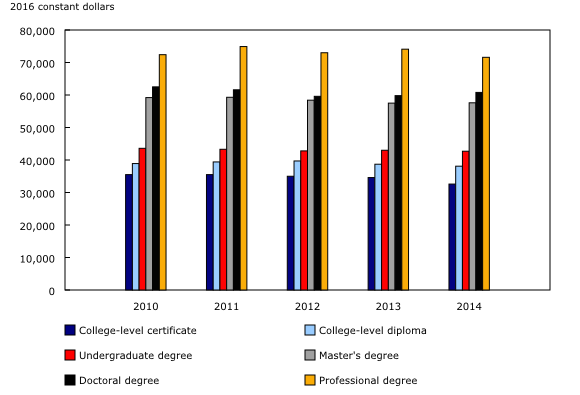
Among graduates who obtained their postsecondary credential from 2010 to 2014, the year of graduation had little impact on their employment income two years after graduation as each cohort of graduates entered a similar labour market environment. However, differences in income were observed by type of qualification for all graduating classes.
Chart 1
Median employment income of postsecondary graduates two years after graduation, by educational qualification, 2010 to 2014 cohorts
For the most recent graduate cohort (students who obtained a credential in 2014), the median employment income two years after graduation ranged from $32,600 for graduates with a college-level certificate to $71,600 for those with a professional degree (which includes graduates from law, medicine, dentistry, veterinary medicine, optometry or pharmacy). The results varied for other qualifications. For example, it was $38,100 for a college-level diploma, $42,700 for those with an undergraduate degree, $57,600 for a master’s degree, and $60,800 for doctoral degree graduates.
Median employment income for men ranged from $35,300 (graduates with a college level-certificate) to $72,800 (graduates with a professional degree). The median employment income for women ranged from $30,400 (college-level certificates) to $70,800 (professional degrees).
Studies in architecture, engineering and related technologies and in health and related fields lead to relatively high median employment income
Graduates from 2014 in architecture, engineering and related technologies, and in health and related fields, had the highest median employment income two years after graduation for college-level diplomas ($47,600 and $44,900, respectively) and undergraduate degrees ($60,000 and $58,200, respectively). Women and men had slightly different results.
For 2014 college-level diploma graduates, the median employment income two years after graduation in health and related fields was $44,000 for women and $50,500 for men. This was followed by architecture, engineering, and related technologies, with women earning $41,100, while men earned $48,900.
Women who obtained an undergraduate degree in health and related fields had the highest median employment income two years after graduation at $60,800, followed by architecture, engineering, and related technologies where the median employment income was $55,900.
Men with an undergraduate degree in architecture, engineering and related technologies had the highest median employment income ($61,000), followed by graduates in mathematics, computer and information sciences ($56,100). Health and related fields programs yielded the seventh highest median employment income for men at $44,100.
Among the 2014 cohort of graduates, women represented 16% of the college-level diplomas and 20% of the undergraduate degrees in the architecture, engineering and related technologies field. In contrast, they accounted for 84% of college-level diplomas and 80% of undergraduate degrees in health and related fields.
For graduates from most provinces, architecture, engineering and related technologies, and health and related fields were also among the top-earning fields of study for both college-level diploma and undergraduate degree graduates.
Employment income increases over time for postsecondary graduates
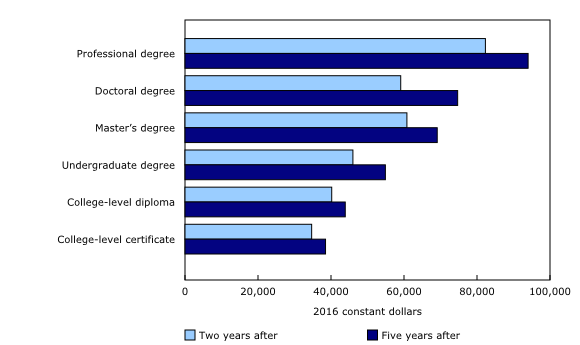
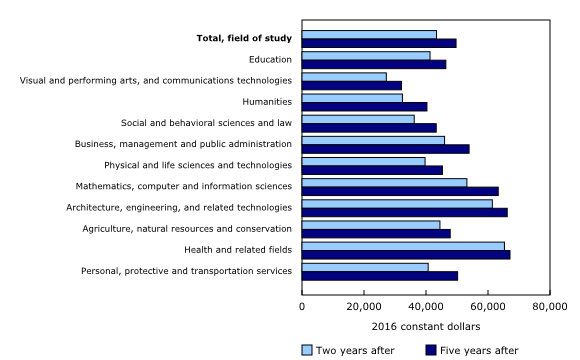
The 2011 graduating class saw their median employment income increase between 9% (for college-level diploma graduates) and 26% (for doctoral degree graduates) when measured first at two years, and then five years after graduation.
Chart 2
Median employment income of postsecondary graduates two and five years after graduation, by educational qualification, both sexes, 2011 longitudinal cohort
Chart 3
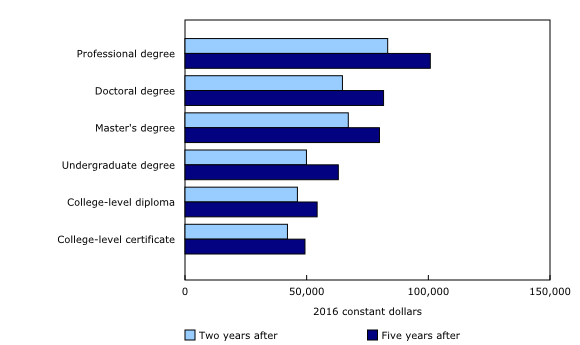
Median employment income of postsecondary graduates two and five years after graduation, by educational qualification, males, 2011 longitudinal cohort
Chart 4
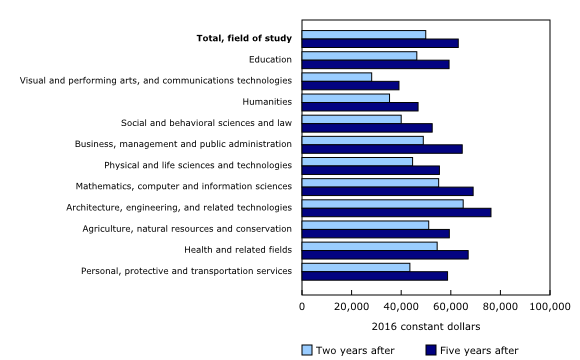
Median employment income of postsecondary graduates two and five years after graduation, by educational qualification, females, 2011 longitudinal cohort
Students who obtained a professional degree in 2011 continued to have the highest median employment income five years after graduation, with an increase of 14% between year two and five. Those with a master’s degree had a slightly higher median employment income two years after graduation than those who earned a doctoral degree, some of whom may have pursued postdoctoral studies. However, five years after graduation, the doctoral degree graduates were earning more.
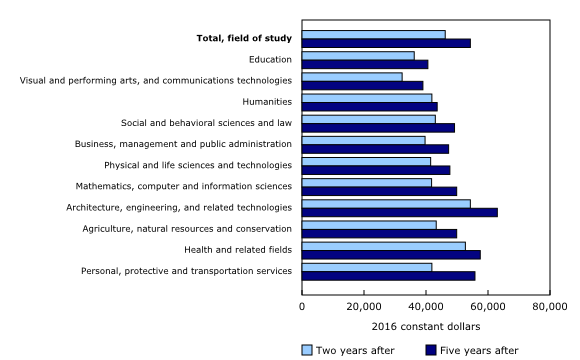
For graduates who earned a college-level diploma in 2011, the median employment income for males increased by almost 18% between two and five years after graduation. Female graduates, in turn, had a more modest rate of growth of 4% over the same period.
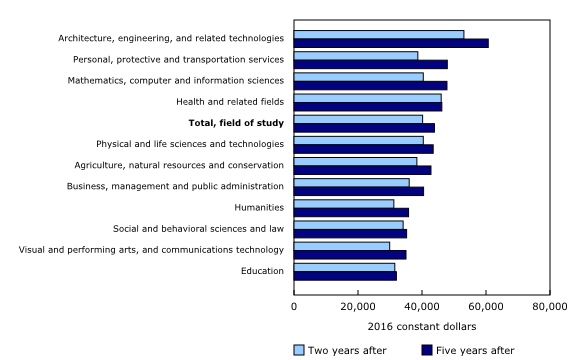
Among male students who earned an undergraduate degree in 2011, overall median employment income increased by almost 26% from years two to five following their graduation. The rate of growth in median employment income for female graduates over the same time period was lower, at 15%.
Median employment income for graduates in health and related fields grows slowly
Although median employment incomes in health and related fields had the lowest growth rate among those with an undergraduate degree from years two to five after graduation (at approximately 4%), it was still among the top fields of study in terms of employment income. Graduates from humanities programs had the second highest growth rate of median employment income (28% between year two and five after graduation), however, their income ranked as one of the lowest among graduates from the major fields of study who obtained an undergraduate degree.
Chart 5
Median employment income of undergraduate degree graduates two and five years after graduation, by field of study, both sexes, 2011 longitudinal cohort
Chart 6
Median employment income of undergraduate degree graduates two and five years after graduation, by field of study, males, 2011 longitudinal cohort
Chart 7
Median employment income of undergraduate degree graduates two and five years after graduation, by field of study, females, 2011 longitudinal cohort
Chart 8
Median employment income of college-level diploma graduates two and five years after graduation, by field of study, both sexes, 2011 longitudinal cohort
Chart 9
Median employment income of college-level diploma graduates two and five years after graduation, by field of study, males, 2011 longitudinal cohort
Chart 10
Median employment income of college-level diploma graduates two and five years after graduation, by field of study, females, 2011 longitudinal cohort
As was the case for students with an undergraduate degree, those with a college-level diploma in health and related fields had the lowest rate of growth (less than 1%) from two to five years after graduation, but started with relatively high median employment income. College-level diploma graduates in visual and performing arts, and communications technologies, had larger income growth between two and five years after graduation at 17%, but started with the lowest median employment income.
Frank Graves and Michael Valpy focus on the shifting views of millennial men, visible minorities as well as not visible minority, towards populism and the right. The 2019 election will provide a test of their thesis but certainly the Conservatives seem to mining this resentment in much of their messaging:
As Canadians, we sit atop the continent, watching as our neighbours slide into cultural civil war. It has become easy to just be appalled as America becomesriven, with social media and antagonistic rhetoric on both sides of the political spectrum erasing themiddle ground. There are two Americas, incommensurably separated on the fundamental issues of the day: climate change, the economy, social issues like health and education, employment, the media, immigration in particular, andglobalization and free trade.
We’ve learned more and more about the populism that has fuelled this complicated moment as the fracture in America races like wildfire throughout Western democracies. It is the biggest force reshaping democracy, our economies and public institutions. It is the product of economic despair, inequality, and yes, racism and xenophobia. It is an institutional blind spot, largely denied or ridiculed by the media, and by the more comfortable and educated portions of society.
It is very much alive in Canada. In fact, our populist explosion has already had its first bangs and is likely to have a major impact on next year’s federal election.
The shifts in the democratic world order over the last decade have increasingly prompted social scientists to discard the left-right political spectrum in favour of an “open-ordered axis,” or what The Economist calls drawbridge-down vs drawbridge-up thinking. The former are cosmopolitan-minded people, in favour of diversity, immigration, trade, and globalization, and who are optimistic about the future; they’re guided by reason and evidence-based policy, and believe that climate change is a dominant priority. Drawbridge-up people, with an “ordered” worldview, are largely parochial, and they have reservations about diversity, are deeply pessimistic about the economic future, believe more in moral certainty than reason and evidence, are disdainful of media, government and of scientific expertise, and are convinced that climate change is trumped by the economy and their own survival. It’s ordered thinking that is metastasizing in Western societies, including Canada’s, especially among the political right. EKOS research from 2017 suggests about 30 to 40 per cent of adult Canadians are drawn to it.
Meanwhile, research over the last 10 years has found that Canada, like the United States, is turning into a society fissured along fault lines of education, class and gender. These are social chasms defined by the concentration of wealth at the top of society and, for everyone else, by economic pessimism and stagnation; by a comfortable feeling on one end of the societal teeter-totter, and a fear on the other end that a subscription to the middle-class dream might no longer be available.
Although there has been a recent uptick for the first time in 15 years, the portion of Canadians who self-identify as middle class since the turn of the century has declined from 70 per cent to 45 per cent, a stark number that mirrors America’s—signalling that Canadians have a deeply pessimistic view of their personal economic outlook.Only one in eight Canadians thinks they’re better off than a year ago. Only one in eight thinks the next generation will enjoy a better life. And EKOS finds that, by a margin of two to one, Canadians believe that if present trends with inequality continue, the country — this country! — will see violent class conflicts.
Ordered populism has already become an illusive, misunderstood theme in provincial elections in Quebec, New Brunswick, and Ontario. Indeed, Doug Ford and his Ontario Progressive Conservatives won thanks to a preponderance of working-class, male electoral support—but a closer examination of the vote shows that male millennials, against expectation, supported Ford in significant numbers and had a high turnout. Millennial women, meanwhile, preferred the New Democratic Party by a margin of 25 points, and the millennial women who didn’t vote NDP largely stayed home. Millennial men split their votes between the NDP and Progressive Conservatives, and they led females millennials by 10 points in turning out to cast ballots.
Survey evidence strongly suggests that these are young men angered by the economic realities they face, and they are hit the hardest by what is happening in Ontario’s economy. A joint study by United Way Toronto and York Region and Hamilton’s McMaster University on poverty and employment precarity in southern Ontario reports that only 44 per cent of millennials in the region — the heartbeat of Canada’s economy — have full-time, permanent jobs, that the majority have not found work that provides extended health benefits, pension plans, or employer-funded training, and that formerly high-paying blue-collar jobs there are rapidly vanishing. The lack of good jobs, coupled with the social catastrophe of affordable housing and the resulting need to delay family formation, is resulting in anxiety and depression that disproportionately affects millennial men—making them ideal targets for the appeals of ordered populism.
What is happening challenges the conventional view that the youngest adults of Canadian society—the millennials, now Canada’s largest electoral demographic—operate with roughly similar, progressive views and values.
Another assumption in need of challenging is the idea that Canada’s ordered populism, like its American counterpart, is a besieged white citadel. In fact, our northern brand is as much the choice of multicultural new Canadians as of white native-born Canada. A significant chunk of new Canadians, many of them non-white, indicate they will vote Conservative in next year’s federal election — even though 65 per cent of Conservative supporters told EKOS this year that Canada admits too many non-white immigrants. And while a majority of Canadians are open to immigration, the intensity of the opposition is red-hot, including in other parties: 20 per cent of New Democratic Party supporters and 13 per cent of Liberal supporters also believe too many non-white immigrants are entering the country..
There are two possible explanations for this: First, new Canadians may bring with them into the country strains of social conservatism that make them hostile to issues like same-sex marriage and what they see as immoral, too-liberal sex education, an inflammatory issue in Ontario over the past couple of years. Thus, what they see as an assault on their values may be more important than a party trying to appeal to voters who want fewer of them in the country.
Second, where neighbourhoods are ethnically homogeneous as many are around the core of Canadian cities—white, brown or otherwise—populism holds appeal. Where there’s more diversity, it doesn’t. As social scientists have discovered, communities which have the least contact with with minority groups are the most hostile to them.
The looming federal election could be a spark for all the populist tinder largely being ignored in Canada. In the 2015 federal election, voting differences by gender for all age groups were flat. Now the federal Conservatives hold a 17-point advantage among men from all age groups other than seniors —a huge change in three years. Federal Conservatives also hold an advantage over Liberals and New Democrats with voters who self-identify as working class, and the party has overwhelming support from non-university-educated Canadians, the group most likely to feel left behind by the disappearance of blue-collar industries.
Former Conservative Prime Minister Stephen Harper led a party supported by the economically comfortable. His successor, Andrew Scheer, leads a party of the economically unhappy, of the new economy’s losers, a base increasingly comfortable with raising the drawbridge even as the Liberal government announces Canada will admit an additional 40,000 immigrants by 2021, bringing the annual number of new, mostly non-white arrivals to 350,000. Any campaign rhetoric that confuses this new support with its old party will only exacerbate the anger—and for the angry to find comfort in populism’s temptations.
What we do know is that Ontario’s Progressive Conservative government, with its populist strains and its vague campaign promises, is what many angry young men voted for. Maybe they didn’t vote for its policies; maybe, in their anger, they just voted to burn the house down, even if the history of populist movements show they’ve rarely worked out.
We can try to understand why it’s happening. We can insist that governments tackle inequality and affordable housing. We can build a future that preserves progress for all of us but addresses the real injuries of those who have embraced populism, while also refusing to bend to their fear, anger and ignorance. But letting populism burn the house down benefits nobody—and we can’t just ignore the smell of gasoline in the air.
Race, as a matter of constitutional principle, cannot factor into the selection of jurors for criminal trials. But in the American justice system, anyone with a bit of common sense and a view from the back of the courtroom knows the colorblind ideal isn’t true in practice.
Racial bias largely seeps in through what’s called “peremptory” challenges: the ability of a prosecutor — and then a defense attorney — to block a certain number of potential jurors without needing to give the court any reason for the exclusion.
The number of challenges allowed varies by state, but commonly 15 or more are permitted. Folk wisdom, among those familiar with the song and dance, is that prosecutors use these challenges to remove nonwhite jurors, who are statistically more likely to acquit, while defense attorneys — who can step in only after the pool has been narrowed by prosecutors — typically counteract by removing more white jurors.
For a long time, the opacity of court records rendered the dynamic as only that — folk wisdom — which has made it difficult to articulate the urgent need to reform this understudied aspect of our system. But now, this informal knowledge has been empirically confirmed, and the case for change couldn’t be more compelling.
My recently published research on juror removal in North Carolina conducted with colleagues at the Wake Forest University School of Law proves — for the first time with statewide evidence — that peremptory challenges are indeed a vehicle for veiled racial bias that results in juries less sympathetic to defendants of color.
Based on statewide jury selection records, our Jury Sunshine Projectdiscovered that prosecutors remove about 20 percent of African-Americans available in the jury pool, compared with about 10 percent of whites. Defense attorneys, seemingly in response, remove more of the white jurors (22 percent) than black jurors (10 percent) left in the post-judge-and-prosecutor pool.
The data also show variety within the state: Prosecutors in urban areas, which tend to have larger minority populations, remove nonwhite jurors at a higher rate than prosecutors do in other parts of the state. Finally, we discovered, to our surprise, that judges also remove black jurors “for cause” about 20 percent more often than they remove available white jurors.
When the dust settles at the close of jury selection, defense attorneys’ actions in the last leg of the process do not cancel out the combined skewed actions from prosecutors and judges. The consistent result is African-Americans occupying a much smaller percentage of seats in the jury box than they did in the original jury pool.
This winnowing of nonwhite jurors is not a quirk of just one state. Earlier this year, investigative journalists in Mississippi and Louisiana collected and published jury data from public records that confirmed similar practices in some areas within those states. And given the parallel results identified in county-level studies and in death penalty cases, the pattern probably holds true for jury selection in most states.
It is not possible, even with this new data, to say exactly why a prosecutor, defense attorney or judge decides to remove any particular juror in a single case. But this racially skewed trend, played out across many cases, is persistent. And it has two especially pernicious effects on the quality of criminal justice.
First, the defendant is not judged by a jury that reflects a cross-section of his or her community — a violation of the courts’ interpretation of the Sixth Amendment. In a system that already disproportionately prosecutes people of color, hedging the constitutional rights of defendants can be particularly harmful.
Second, excluded parts of the community become more cynical about the justice system when they repeatedly see barriers to jury service. If people from certain similar neighborhoods are constantly getting booted from juries, then it’s tempting for residents there to view the police — and prosecutors — as hostile occupiers rather than partners in public safety.
In theory, the Equal Protection Clause of the Constitution, as interpreted in Batson v. Kentucky, prevents attorneys from removing jurors on the basis of race. But “Batson claims” rarely succeed because they require the judge to declare the proposed stated reason for removal was only a pretext hiding discriminatory intent — a notoriously steep standard.
To address the problem, state courts could adopt rules such as the one that the Washington Supreme Court approved last April. The new rule makes it easier to stop juror removals rooted in implicit racial bias by outlawing peremptory challenges defended with explanations highly correlated with race, like “prior contact with law enforcement” or “living in a high-crime neighborhood.”
There are now over half a dozen states completely controlled by Democrats, whose ascendant progressive wing would presumably support such nondiscrimination protections.
Another answer — which could gain support in even the toughest of “tough on crime” red states — is simply to publish more information on jury selection. The details of judge and attorney removals of jurors is already public record, but those details usually remain buried in the hard-copy files of court clerks across the country.
While this year’s successful research shows how journalists and scholars can collect these far-flung records into a useful database, the process can take months or years of driving from courthouse to courthouse, digging out the files of cases that went to trial, recording the clerk’s notations from those files and turning to online resources for background information on judges and lawyers.
States could instead — without much work — just plainly make all jury selection information available online and keyword searchable, easing access for journalists and voters alike.
In most states, voters choose their prosecutors and their judges; and with journalists on hand to swiftly analyze digitized public records of the jury selection habits of prosecutors and judges, citizens could evaluate incumbents’ tendencies as a measure of success or failure.
These two reforms alone would greatly aid efforts to hold prosecutors and judges accountable as well as shore up public trust in the criminal justice system.
The status quo shows that a barely enforceable constitutional doctrine isn’t enough. It’s time to bring this vital process of justice from behind closed doors and into the sunlight. It’s the only way to ensure that defendants are judged by a representative cross section of their community, not the filtered few that litigants want to see in the jury box.
Good summary of the latest Scanlon Foundation report and the point about how important perceptions are regarding how well immigration is managed particularly relevant to Canada:
Australia has not lost faith in immigration. The political narrative has darkened but not the fundamental view of ourselves as an immigrant nation. Most of us remain convinced that we are in so many ways better off for newcomers of all races and creeds who have come in large numbers to our shores.
That is the verdict of the Scanlon Foundation’s 2018 Mapping Social Cohesion Report published on Tuesday. The mission of the foundation is to measure how this migrant nation hangs together. Over the last decade 48,000 of us have been polled to fathom the panics that sweep this country and the steady underlying views Australians have of immigration.
“Immigration is a growing concern,” says the author of the report Professor Andrew Markus of Monash University. “But for media commentators and some politicians it has become an obsession. They are in the business of creating heightened concern, of crisis. But what the survey shows is rather a picture of stability.”
Markus is one of Australia’s leading authorities on the politics of race. This is the 11th report he has written for the Scanlon Foundation. Year in year out his reports show about 80% of us believe immigrants are “generally good” for Australia’s economy and that ours is a better society for the “new ideas and cultures” that immigrants bring to this country. Support for multiculturalism in 2018 stands almost as high as ever at 85%.
“A number of international surveys that look at Australia, America, Canada, a range of European countries from eastern Europe to western Europe, and also countries in other parts of the world, have a consistent finding that on attitudes to immigration and cultural diversity, Australia is within the top 10% of countries which are open to and welcoming of immigration,” says Markus
A glance at the Scanlan report 2018
Putting into perspective the renewed political contest over immigration is the underlying purpose of the latest Scanlon report. This year Fraser Anning called for a return to White Australia; the notion of exiling new migrantsfrom Sydney and Melbourne was seriously debated; and political leaders in all parties called for cuts – sometimes savage – to immigration numbers.
“Politicians present their views on immigration as if they are speaking for the nation,” cautions Markus. “The reality is that their words are directed to that segment of voters in marginal electorates that supports their party, or that may be attracted to their party, or may be lost to their party.”
Rising concern about numbers was a particular focus of this year’s report. This has kicked up significantly in the last few years. In 2016 only a third of Australians believed the migrant intake was too high. Now 43% of us are worried.
In the past, concern about numbers has moved up and down in lockstep with employment figures. Not this time. And the Scanlon pollsters set out to identify what was driving fresh fears in 2018.
“The program itself is something that’s marketable, something that finds a receptive audience,” says Markus. “But there’s a growing concern – still a minority position, but growing concern – that the immigration program is not being well managed.
“This is linked to people’s perceptions of overcrowding, public transport, housing costs, and so on. These issues are much more complex than just immigration intake. That’s what we’re picking up. That’s a risk for Australia going forward.”
Our rising national anxiety about numbers has been measured by a number of pollsters. Lowy, Essential and Newspoll all found a majority wish for the intake to be cut. Ipsos and Scanlon reckon the balance is slightly the other way with 52% of us for keeping – or even increasing – the number of migrants we take.
This picture of a country divided but still open to mass immigration comes with a fundamental caveat: the boats have stopped.
“I think that John Howard was very successful in that mantra of ‘we control who comes into this country’,” says Markus. “That clearly resonates very strongly. Australia maintained its White Australia policy – very strictly controlled – for decades beyond other countries who abandoned theirs quite quickly after the second world war. Australia has stuck to that very religiously.
“I think it’s been established that the policy of stopping the boats, whatever people will understand by that, is a very strong buy-in. People in Australia in large numbers will turn their gaze away from what happens at offshore detention.”
Not published in this year’s Scanlon report but made available to Guardian Australia are figures obtained for the first time showing what the nation thinks of penning refugees on Manus and Nauru. They demolish the idea that Australia has fundamentally changed its mind about the Pacific solution. The best that can be said is that we’re split on the issue.
From the start in 2007, the Scanlon reports have been mapping the dark side of this story. The constituency of those worried about immigration is not small but Markus puts the number of us markedly hostile at only about 10% – though a noisy 10%.
“They paint immigration as somehow transforming Australia, making Australia unrecognisable,” he says. “They see multiculturalism as a threat. Within some of these groups, it gets to the level that they see these activities as treasonous.
“One of the stories that goes around within these circles is that somehow the Australian people were never given a choice. Dangers have been foisted upon the Australian people. Australian people never approved of any of the White Australia policy. You need to have a referendum on that.
“It’s Pauline Hanson’s line, but also far-right groups and it’s been there for decades. What these learned commentators on Australian society seem to miss is that we actually have elections in this country every three years. If people were so upset then they would vote the government out of power and they would vote in One Nation or whoever. We would have Fraser Anning as our minister of immigration if people were so upset.”
Markus found that worries about immigration are uppermost in few of our minds. We are far more worried about the economy, the environment and the poor quality of government. Asked to name the most important problem facing the country today, only 7% of respondents in 2018 picked immigration.
But the figure for One Nation voters was 25%.
Longing for a White Australia has died down over the years but has never died out. Once again the Scanlon report reveals a considerable constituency for keeping new arrivals white and Christian – or at least, not Muslim.
In face-to-face interviews in 2018, 15% of Scanlon respondents agreed it should be possible for immigrants to be rejected simply on the basis of their race or ethnicity. And 18% agreed they could be sorted solely by religion.
As well as conducting 1,500 face-to-face interviews, the teams engaged by the Scanlon Foundation quizzed 2,260 people online, respondents who tend, sitting on their own, to be a little more frank about their negative views.
Online, 22% of us supported sorting immigrants by race and 29% of us for sorting them by religion. These figures mark clear minority positions in modern Australia but they are not insignificant, as the report shows by showing support for the Keep Australia Christian brigade within political parties:
It speaks quite well for religion. But the latest Scanlon Report offers not much evidence that the nation is warming to Islam. The online survey reveals only a tiny fall from 41% of us last year to 39% of us this year who admit to very or somewhat negative attitudes to Muslims.
“It is a notable finding that across the two modes of surveying, and with a different range of questions, discriminatory immigration policy fails to gain support from more than 30% of respondents,” writes Markus. “Nonetheless, the level of negative sentiment towards those of the Muslim faith, and by extension to immigrants from Muslim countries, is a factor of significance in contemporary Australian society.”
Year after year the Scanlon reports have mapped national divisions over race and immigration. The pattern is clear. Whether the issue is the sheer numbers coming to our shores or their colour and creed, much the same rifts appear between young and old, city and country, prosperous and struggling, those with higher education and those who never finished school.
Typical is the breakdown for the Keep Australia White brigade.
“That divide between people who have had the opportunity to go on with their education in a formal way at universities and so on, and those who don’t is a very strong divide,” says Markus. “It’s not something unique to Australia. It would be true certainly of western countries that I’ve looked at.”
Markus admits being stumped by the marked – but still minority – hostility to race and immigration shown by people working in trades. And he is not advancing any easy explanation for the relaxed attitudes of graduates. He believes life on multiracial campuses may have a good deal to do with it. But he places greater weight on study itself.
“Respect for reason is at the heart of a university education,” says Markus. “It’s not what you hear down the pub that goes down. You learn there is a discipline. We arrive at conclusions within a discipline whatever you study. Respect for knowledge and respect for reason is perhaps what drives people away from the camp which embraces delusions and xenophobia.”
Markus is heartened by the victory of Daniel Andrews in Victoria. Commentators and politicians were obsessed throughout the campaign with black crime. The fear is there in the Scanlon figures – a third of Australians generally but 41% of Victorians are afraid of becoming victims of crime – but these fears could not be marshalled to deny Andrews victory.
Though Melbourne is the fastest-growing city in the land with immense pressures on infrastructure, Melburnians aren’t calling for cuts to immigration. “And despite the opposition running hard on black gangs etc, the issue didn’t decide the election,” notes Markus.
More than ever, Melbourne looks like the future of this immigration nation.
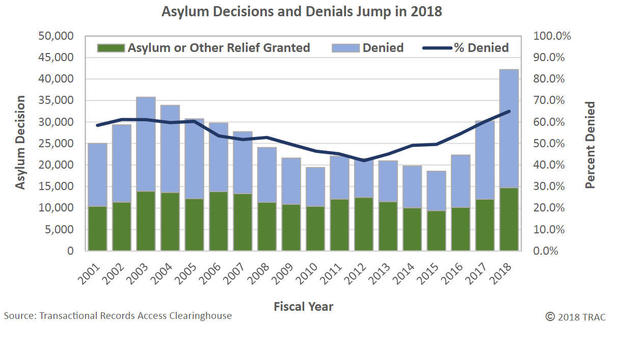
Immigration judges rejected a record-high number of asylum cases this year, refusing 65 percent of immigrants seeking the refugee status, according to a recent report published by Syracuse University’s Transactional Records Access Clearinghouse (TRAC). More than 42,000 asylum cases were decided in the fiscal year ending Sept. 30, 2018, the most since the group began tracking the data in 2001.
The rise marks the sixth consecutive year that the denial rate has increased, according to TRAC’s data. In 2012, the refusal rate was 42 percent; 2018’s rejection rate is nearly 50 percent larger, according to TRAC’s data. The group obtained data from the Department of Homeland Security through Freedom of Information Act requests.
TRAC pointed out the increase “largely reflects asylum applicants who had arrived well before President Trump assumed office.”
Immigration court asylum decisions, between fiscal years 2001 and 2018, shown in a graph provided by Syracuse University.
Immigration judges have been busier than ever before. Courts decided on 42,224 asylum cases this fiscal year, an 89 percent increase from two years ago, according to TRAC’s data. There is little relief in sight: as of Sept. 30, there were more than 1 million backlogged immigration cases, including those seeking asylum.
“I worry that people’s due process is at risk and that’s at play in the rise of denial rates,” said Aaron Reichlin-Melnick, policy analyst at the American Immigration Council, in a telephone interview with CBS News. “People’s claims are getting denied not because it wasn’t valid, but because there just wasn’t enough time to collect evidence and representation in an environment that’s seeking speed.”
Mr. Trump made immigration a key issue of the midterms, often tweeting about a migrant caravan traveling through Central America and Mexico and deploying thousands of troops to the southern border ahead of Election Day on Nov. 6. Days later, Mr. Trump signed an executive order barring asylum from anyone who illegally entered the country, a decree later blocked by a federal judge.
Asylum is a specific immigration process reserved for people of any nation fleeing persecution. Asylum seekers must establish they face “credible fear” in their home country, and – in a majority of cases – are allowed to live on U.S. soil while a judge determines the validity of their claim. Mr. Trump and other proponents of stricter immigration laws say the system has been abused by migrants, calling the practice “catch and release” and have made attempts to limit the system.
A change in immigration language from former Attorney General Jeff Sessionsearlier this year severely limited the ability for asylum seekers to establish persecution based domestic and gang-related violence, two forms of persecution that disproportionately impact migrants from Central America.
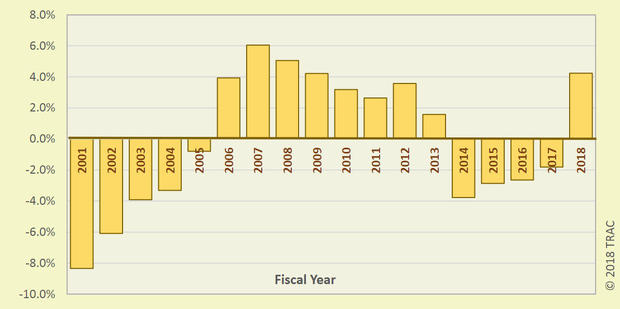
Change in representation rates compared with fiscal year 2001 through fiscal year 2018 (average).
Nearly 80 percent of last year’s asylum decisions were for immigrants from El Salvador, Honduras, Guatemala and Mexico, countries with already historically low asylum grant rates, according to Sarah Pierce, a policy analyst at the Migrant Policy Institute, a Washington, D.C.-based think tank.
“You’re dealing with an administration that’s putting a lot of pressure on immigration judges while looking skeptically at asylum and humanitarianism,” Pierce said in a telephone interview Monday evening with CBS News.
Immigration judge selection continued to play a major role in asylum decisions, according to TRAC. Asylum law can have wide-ranging interpretation, leaving immigration judges with more discretion than some other areas of law, said Reichlin-Melnick. For example in San Francisco’s immigration court, depending on the judge, asylum denial rates ranged from 10 percent to 97 percent.
“It’s refugee roulette,” Reichlin-Melnick said. “The single biggest factor on whether you win your case is just who you end up in front of.”
Does not appear he was entirely comfortable in his testimony, but not to the extent he felt compelled to resign as happens with Statistics Canada when the then Chief Statistician, Munir Sheikh, resigned over his views on the change to the less methodologically sound National Household Survey were misrepresented:
The U.S. Census Bureau’s top scientist on Wednesday insisted the bureau can get a full count of American residents during the 2020 census, despite the Trump administration’s addition of a question on citizenship.
The agency’s chief scientist, John Abowd, made the comments in testimony in federal court in New York, where a group of U.S. states, cities and civil rights groups have sued the administration to remove the question, arguing it could dissuade non-citizens from participating in the decennial census.
Commerce Secretary Wilbur Ross, a Republican, announced the citizenship question in March, saying it was needed to enforce federal laws against voter discrimination.
But plaintiffs say that is a pretext, and they want U.S. District Judge Jesse Furman, who is hearing the case, to strike the question. They say Ross’ real motive is to scare immigrants into abstaining from the census, costing their mostly-Democratic communities political representation and federal aid.
Abowd’s testimony spanned two days and grew tense at times.
Closing arguments were tentatively set for Nov. 27.
On Wednesday, plaintiffs accused government lawyers of “ambushing” them with new evidence.
On Tuesday Abowd appeared to fight back tears when a plantiff lawyer said the Trump administration had decided to add the citizenship question well before asking him to study the matter.
Abowd admitted the question could lower the response rate and quality of data in the 2020 census, but said it will not cause an undercount because the bureau will follow up with non-responders. If that process requires more effort than expected, he said, enumerators can simply work harder.
“There is enough capacity in the current cost model” to “adjust their workloads,” Abowd said, citing a $1.7 billion contingency in the census budget.
He said the bureau will also rely on neighbors and existing government records to augment missing data.
Witnesses for the plaintiffs previously testified that such methods will not produce a full count.
An economist and Cornell University professor, Abowd is among the trial’s most compelling witnesses. Appointed to his Census role during the Obama administration, he advised against including the citizenship question earlier this year. But as a witness, he has had to defend it.
“CARRYING OUT OBLIGATIONS”
On Wednesday, when Abowd testified that the bureau was planning a new study on the impact of the citizenship question on the voluntary response rate of the census, an attorney for the American Civil Liberties Union objected.
“They’re trying to ambush us with new evidence,” attorney Dale Ho said, saying that the information should have been revealed during discovery.
The judge appeared to agree, saying he was “inclined to strike” Abowd’s testimony on the topic.
On Tuesday, Abowd appeared to hold back tears when Ho said Ross had withheld information from Abowd.
Abowd was asked to spend his holidays last December running an analysis on the pros and cons of adding the question. In fact, Ho said, Ross had decided months earlier that he supported its addition.
“From the beginning of the time I started my analysis through today, I’m just carrying out my obligations,” said an emotional Abowd.
In the run-up to the 2018 midterm elections, President Trump doubled down on the restrictive immigration positions that fueled his 2016 presidential campaign. The last few weeks of the campaign, he repeatedly warned Americans about the migrant caravan headed to the United States from Central America, and advocated for the repeal of birthright citizenship. Trump hoped to mobilize Republican voters, thereby helping to elect Republican candidates. Especially in the Senate, this may have helped Republicans gain two seats.
But in the long term, Trump’s anti-immigration approach may alienate millennial voters — and backfire on the Republican Party. The millennial generation, born between 1980 and 1997, is the largest and most diverse adult cohort.
In the midterms, majorities of millennials voted for Democrats. That’s a troubling sign for Republicans
Almost 7 in 10 voters (67 percent) ages 18 to 29, and nearly 6 in 10 (58 percent) of those ages 30 to 44, supported Democratic candidates. That’s mostly the millennial generation. Researchers who study party identification suggest that it’s “sticky” — that the party you vote for in your first few elections tends to harden and become your party for life.
And while a number of issues probably contributed to their votes, their liberal attitudes on immigration may be important.
Demographics are against the long-term success of hard-line immigration policies
The millennial generation is the most diverse adult generation in U.S. history. Hispanics make up 21 percent of all U.S. millennials. My research shows that this diversity contributes to their more progressive and tolerant attitudes toward immigration, compared with older adults.
In my book “The Politics of Millennials,” co-authored with Ashley Ross, we conducted a survey in late 2015 to gauge the generation’s attitudes toward immigrants. The online survey of 1,251 Americans (including an oversample of 621 millennials) was fielded by Qualtrics, with quotas used to make the sample nationally representative. The survey matched U.S. Census figures for gender, race/ethnicity and region, and a weight was employed to calibrate sample so that it equals the general population of age groups.
Across a variety of measures, we found millennials to be significantly more favorable toward immigrants and immigration than older Americans. For instance, one item asked respondents whether they thought immigrants “strengthened the diversity of the country” or “threatened traditional American values.” Among millennials, 52 percent said immigrants strengthened the country’s diversity, while 48 percent said they threatened the country’s values. Among non-millennials, those numbers were 41 and 59 percent, respectively.
We found similar divides when we asked respondents whether immigrants “only take jobs Americans do not want to do” or whether they “take jobs away from Americans.” Fifty-nine percent of millennials gave the pro-immigrant response, while just 49 percent of non-millennials did. Likewise, 45 percent of millennials said illegal immigrants did not threaten the nation’s security, compared with 33 percent of non-millennials.
Millennials, of course, are not monolithic, and differences on immigration attitudes exist across race and ethnic subgroups. To assess these differences, in the same Qualtrics survey, we asked white non-Hispanic, Hispanic and African American millennials to indicate how much they support or are likely to support four immigration policies:
Require that all companies verify the legal status of workers before employing them — a policy known as E-Verify.
Strengthen border security and extend wall or fencing along the U.S.-Mexico border.
Allow undocumented childhood arrivals under age 30 to stay in the United States.
Allow in-state tuition and fees at state universities for undocumented immigrants who arrived in the United States as children.
The figure below displays the mean values of millennial subgroups’ average support for the four immigration policies, from 0 (no support) to 4 (a lot of support).
Number of respondents for each subgroup: White non-Hispanic = 335, African Americans = 106, Hispanics = 158.
As you can see, these three racial/ethnic subgroups hold some different opinions on immigration policies. Hispanics are less likely to support E-Verify and border security measures than are white non-Hispanic and African American millennials.
What’s more, Hispanic millennials are significantly more likely than either white non-Hispanic or African American millennials to support allowing undocumented children to stay in the country. And while African American and Hispanic millennials convey similar levels of average support for in-state tuition for undocumented immigrants, white non-Hispanic millennials aren’t as supportive overall.
On every measure, millennials are more pro-immigrant than non-millennials
Ross and I also show that millennials were quite tolerant toward immigrants even in 2008, at the height of the Great Recession — despite the fact that this group was disproportionately hurt by the economic downturn and might have been expected to resent immigrants for allegedly taking “their’” jobs.
In 2016, Trump rode a hard-line immigration posture all the way to the White House. Since then, many Republican elected officials have embraced this stand as a winning platform.
However, if millennials continue to have more liberal and tolerant attitudes toward immigration, this stance may hurt the Republican Party over the long term.
While accommodation generally should work both ways (i.e., as long as food is labelled and choice of alternatives), it does seem a lack of sensitivity at a national Islam conference. Would the Interior Ministry serve pork at an antisemitism conference?
When Canada organized an international antisemitism conference in 2010, all the food served was kosher:
Germany’s Interior Ministry has come under fire for serving blood sausage at a national Islam conference last week, despite pork being forbidden for practicing Muslims.
The issue has stirred a heated debate — one that touches on the fault line issues of integration and respect for different religions — between critics of the ministry and right-wing groups who justified the decision to serve the dish.
The ministry has defended its decision to serve the sausage consisting of pig’s blood, pork and bacon at the evening buffet on Wednesday. It said the serving reflected the “religious-pluralistic composition” of the event, which brought together Muslim associations and leaders with officials from the federal and local governments.
The ministry added that there was a wide range of food at the “clearly excellent” buffet, with vegetarian, meat, fish and halal dishes available. “If individuals were still offended for religious reasons, we regret this,” it said.
Nonetheless, some have viewed the choice of blood sausage as a deliberate provocation by hardline Interior Minister Horst Seehofer.
Turkish-German journalist Tuncay Ozdamar, who first reported the “#BloodSausageGate” scandal, questioned on Twitter what message Seehofer had intended to send with the culinary decision.
“A little respect for Muslims who do not eat pork would be appropriate,” wrote Ozdamar, who himself claims to eat pork.
In comments published on the website Watson.de, Ozdamar said he had no objection to offering pork in schools with Muslim children because Germany is a multi-cultural country.
“But if I convene an Islam conference and invite Muslims to engage in dialogue, solve the problems of religion that arise in everyday life, then I have to be a bit sensitive, tactful and respectful,” he said.
Green Party politician Volker Beck also slammed the Interior Ministry, writing on Twitter that “appreciating diversity means also considering different habits.”
No clear markings?
Ali Bas, a Green Party spokesman for religious issues, told Watson.de that the blood sausage was not clearly identified at the buffet, but was rather served on appetizer trays. The Interior Ministry had said the food servings were clearly marked.
Many Muslims abstain from eating meat if it is unclear whether it is halal. Blood sausage could potentially be confused with sucuk, a halal sausage widely consumed in Turkey and the Arab world.
The Interior Ministry reportedly served ham in the first year of the annual Islam Conference in 2006.
Far-right AfD sees threat
The far-right Alternative for Germany (AfD) quickly entered the discussion, accusing critics of the Interior Ministry of launching an attack on German culture.
“Tolerance starts at the point where the blood sausage is seen simply for what it is: a German delicacy that no one has to like, but that, just like our way of life, cannot be taken away from us,” AfD lawmaker Alice Weidel wrote on Twitter.
The post was accompanied by a picture of Weidel smiling in front of several blood sausages topped with basil leaves.
Ozcan Mutlu, a Green politician of Turkish descent, responded to the hysteria with a jab at the far-right.
“While the Twitter Nazis are fighting for the survival of the blood sausage and getting riled up over #BloodSausageGate, I’m drinking a beer at a German beer garden in Brooklyn to honor those sensible compatriots back home,” he wrote on Twitter, using the hashtag “#87percent” to refer to the percentage of voters who did not back the AfD in the 2017 general election.






 Multicultural Meanderings