Respect First, Then Gun Control: Brooks – The New York Times

An interesting approach to bringing people together, despite their ideological or other differences:

This has been an emotional week. We greet tragedies like the school shooting in Florida with shock, sadness, mourning and grief that turns into indignation and rage. The anger inevitably gets directed at the N.R.A., those who support gun rights, and the politicians who refuse to do anything while children die.

Many of us walked this emotional path. But we may end up doing more harm than good. If there’s one thing we’ve learned, it is that guns have become a cultural flash point in a nation that is unequal and divided. The people who defend gun rights believe that snobbish elites look down on their morals and want to destroy their culture. If we end up telling such people that they and their guns are despicable, they will just despise us back and dig in their heels.

So if you want to stop school shootings it’s not enough just to vent and march. It’s necessary to let people from Red America lead the way, and to show respect to gun owners at all points. There has to be trust and respect first. Then we can strike a compromise on guns as guns, and not some sacred cross in the culture war.

So I’ve been thinking about a group that’s in the trust and respect business. Better Angels is a nonprofit led by David Lapp, David Blankenhorn and a prominent family therapist, Bill Doherty. The team members travel from town to town finding members of the Red and Blue Tribes and bringing them together for long, humbling conversations.

My Times colleague April Lawson has gotten involved with Better Angels and has been reporting back on its techniques.

One of the most successful parts of the structured conversations is built around stereotypes. Doherty, the head moderator, asks the people at each gathering to name five major stereotypes that the other side throws at them. The Republicans invariably list “racist” first, followed by, say, “uncaring,” “uneducated,” “misogynistic” and “science deniers.”

In a session Lawson attended, a Trump supporter acknowledged that the G.O.P. has had a spotty record on racial matters, but it’s important to him that Blues know that’s not why he holds his opinions.

Doherty says that the Reds feel shamed by the Blues to a much greater degree than the Blues realize. Reds are very reluctant to enter into a conversation with Blues, for fear of further shaming, but they often come to the table when they are told that this will be a chance to “de-monsterize” themselves.

At that session one Blue said she was really grateful to hear a Red acknowledge the Republican history on race. When Blues are asked about the stereotypes thrown at them, they tend to list “against religion and morality,” “unpatriotic” and “against personal responsibility” among their responses. They, too, relish the chance to clear the air.

After the stereotypes are discussed, the room feels different. As one Red in Ohio told Lawson, “I think we are all pretty clear on one thing: Don’t tell us who we are and what we think.” Another Red was moved almost to tears by the damage categories do. “We’re not just cookie-cutter people; we’re individuals. Just because you don’t like something, you don’t have to ridicule it — you probably don’t understand it,” she said. “When someone’s heart is full up with something, and then you demean it without even listening to them — I hate that.”

The discussions reveal other sensitivities. Some Blues didn’t want to enter a venue that had a “Don’t Tread on Me” flag on the wall. To Reds that was a neutral flag from American history, but to Blues it carried all sorts of nasty associations. Reds were offended by the lawn signs that said, “Hate Has No Home Here.” The implication: Hate has no home in my house, but it does in yours.

In another exercise, Reds and Blues ask each other honest, nonleading questions. Blues may ask Reds, “Name a safety-net program you can support.” Reds may ask Blues, “How do you balance having a heart with keeping health care costs under control?”

By the end of the conversations, the atmosphere has changed. Nearly always somebody will say that the discussion was easy because only moderates were in the room, not the people who post crazy stuff on Facebook. The staff tries not to smile, knowing that some of the people were selected precisely because of the intense stuff they posted on Facebook.

“This is not a civility organization,” Blankenhorn told Lawson. Better Angels is aiming to build a group of people whose personal bonds with their fellow citizens redefine how they engage in the political system.

We don’t really have policy debates anymore. We have one big tribal conflict, and policy fights are just proxy battles as each side tries to establish moral superiority. But just as the tribal mentality has been turned on, it can be turned off. Then and only then can we go back to normal politics and take reasonable measures to keep our children safe.

via Respect First, Then Gun Control – The New York Times

Des examens de français mieux adaptés

Appears to have been a comprehensive and thoughtful revision:

Finis les corrections trop sévères et les thèmes trop vagues. Mieux adapté au candidat, l’examen de français obligatoire que les immigrants doivent réussir pour devenir membres d’un ordre professionnel vient d’être entièrement revu pour faciliter la réussite. Et déjouer les tricheurs.

« L’ancien examen n’était pas conçu pour évaluer la compétence langagière liée à la profession », reconnaît Danielle Turcotte, directrice générale des services linguistiques à l’Office québécois de la langue française (OQLF). « Alors que maintenant, tout est conçu pour que les candidats se sentent directement impliqués dans un processus lié à leur profession, à travers une étude de cas. »

Autre changement important : la grille d’évaluation sera plus souple pour la correction de la production écrite, la « bête noire » des candidats, a reconnu Mme Turcotte. Ainsi, on tolérera « de nombreuses erreurs liées à la qualité de la langue », pourvu qu’elles ne nuisent pas à la compréhension. « Les virgules et les accents, ça ne compte pas [comme des fautes] », a-t-elle souligné. Si un candidat écrit « malhreuse » au lieu de « malheureuse », on comprend ce qu’il veut dire, ajoute-t-elle. De la même façon, on ne pénalisera pas un candidat s’il met un article féminin devant un nom masculin. « On n’est plus au mot à mot ou au lettre à lettre. On est dans un contexte de langue seconde. » Cela ne veut pas dire qu’une personne peut se contenter de « baragouiner » le français, avertit-elle. « On vise la compréhension globale, qui assure que la communication se fait de façon à assurer la sécurité du client ou du public. »

Une longue attente

Cela faisait des années que les ordres professionnels réclamaient pour leurs futurs membres un examen qui tienne compte de leur contexte professionnel. En 2012, le comité d’examen de l’OQLF a décidé de répondre à la demande du milieu en créant un nouveau test en collaboration avec chacun des ordres, qui devaient déterminer eux-mêmes les compétences langagières à atteindre. Des experts en évaluation des apprentissages de l’Université de Montréal ont aussi été consultés. D’où le délai de cinq ans avant d’en arriver à cette nouvelle version de l’examen.

« Ça paraît long, mais ne perdez pas de vue la démarche qu’il a fallu faire avec les 46 ordres professionnels », a expliqué Mme Turcotte. Et l’approche par compétence, ici préconisée, demeure assez nouvelle, a-t-elle ajouté.

Ce qui change grosso modo ? Avant, le candidat avait notamment à écrire un texte d’environ 200 mots portant sur une situation en milieu de travail, mais sans nécessairement de lien direct avec le quotidien de sa profession. Par exemple, on pouvait lui demander d’écrire une lettre pour souligner le départ d’un collègue à la retraite ou pour répondre à la plainte d’un client.

Cette fois, l’examen, d’une durée d’au maximum 2 h 30, se fera d’une traite, les quatre étapes — compréhension écrite et orale, expression écrite et orale — étant préalables les unes aux autres et formant un tout. Le candidat reçoit d’abord une fiche avec des consignes qu’il doit comprendre avant de passer à la seconde étape, une discussion avec un maximum de sept autres candidats de sa propre profession. Il devra ensuite écrire un texte d’après ce qu’il aura compris de la discussion de groupe pour finalement terminer son examen par un entretien avec l’évaluateur. Certaines étapes sont filmées et enregistrées.

« Tous les examens ont leur limite, mais […] les scénarios qui mettent l’accent sur la capacité à communiquer dans un contexte de travail, c’est beaucoup plus réaliste », a affirmé Marion Weinspach, cofondatrice de l’entreprise Le français en partage, qui offre des cours de français à cette clientèle d’immigrants voulant intégrer un ordre professionnel.

Si le candidat échoue ne serait-ce qu’à une seule des quatre étapes, il devra recommencer l’examen en entier et être réévalué sur toutes les compétences. Et, comme c’était le cas auparavant, il pourra recommencer l’examen autant de fois qu’il le souhaite (dans les délais prescrits par son ordre professionnel). L’examen est gratuit et il est offert depuis la fin du mois de janvier.

Des inquiétudes

Une enseignante de français se dit très inquiète de la deuxième étape, celle de la discussion de groupe où les candidats devront parler et comprendre les autres qui, comme eux, ne maîtrisent pas le français. « Ils vont entendre parler des gens avec toutes sortes d’accent et ensuite mettre par écrit des informations qui vont avoir été dites de façon imparfaite », s’est inquiétée cette professeure de plus de 20 ans d’expérience qui souhaite garder l’anonymat. L’OQLF rétorque qu’une personne animant la discussion s’assurera du bon déroulement de l’activité.

Et s’il sera plus difficile de préparer les étudiants spécifiquement pour cet examen, au moins la tricherie sera éliminée. « Avant, ils connaissaient les grands thèmes et pouvaient apprendre par coeur des textes qu’ils réécrivaient. »

L’assouplissement des critères d’évaluation pour le français écrit est « un couteau à double tranchant », croit Marion Weinspach. « L’écrit est devenu un petit peu moins exigeant, mais d’un autre côté, c’est au niveau de l’expression orale, où il y a un vocabulaire très spécifique à connaître, que ça devient plus exigeant. Être capable de lire un certificat de localisation pour un courtier ou de verbaliser un bilan pour un comptable, c’est plus difficile mais c’est plus réaliste. Et c’est ce que les ordres avaient demandé. »

La présidente du Conseil interprofessionnel du Québec, Gyslaine Desrosiers, salue la nouvelle version de l’examen, mais rappelle que tout le poids de l’intégration en français des travailleurs immigrants ne doit pas reposer sur l’OQLF. « L’examen, c’est un seul élément de la trajectoire. Il faut qu’il y ait des efforts faits en amont, par l’individu lui-même et son employeur. Le MIDI [ministère de l’Immigration, de la Diversité et de l’Inclusion] doit aider en dégageant des budgets. » Elle met toutefois en garde contre une baisse des exigences. « Dans un contexte de mondialisation, il y a énormément de pression pour ça, […] mais la protection du public exige un minimum de fonctionnement dans la langue. Dans ce sens, l’OQLF a fait son travail et revu son examen. »

via Des examens de français mieux adaptés | Le Devoir

L’Assemblée nationale peut interdire le port du kirpan, confirme la Cour d’appel

That parliamentary privileges permit such a ruling does not the ban appropriate or right:

L’Assemblée nationale du Québec a le droit d’interdire le port du kirpan dans son enceinte en vertu de ses privilèges parlementaires, a tranché lundi le plus haut tribunal de la province. Deux sikhs qui n’avaient  pu entrer dans l’Assemblée nationale en janvier 2011 en raison de leur petit couteau cérémonial tentaient de faire invalider une motion adoptée à l’unanimité par les élus pour exclure les kirpans.

Balpreet Singh et Harminder Kayr, deux membres de l’orgniasme World Sikh Organization of Canada (WSOC) se sont fait interdire l’entrée à l’Assemblée nationale pour des raisons de sécurité, le 18 janvier 2011, en raison de leur kirpan, un couteau porté par de nombreux sikhs pratiquants pour des raisons religieuses. Par conséquent, les deux hommes n’ont pas été en mesure de présenter leur mémoire devant la commission parlementaire qui étudiait un projet de loi visant à interdire le port du voile intégral dans les services publics.

L’affaire a alors rebondi à l’Assemblée nationale, si bien que trois semaines plus tard, tous les députés présents, dont le premier ministre Jean Charest, ont voté en faveur d’une motion appuyant la décision de l’équipe de sécurité « d’interdire le port du kirpan (…) appliquant ainsi le principe de neutralité de l’État ».

C’est cette motion que Balpreet Singh et Harminder Kayr tentaient de faire déclarer «inconstitutionnelle», puisqu’elle aurait brimé leur droit à la liberté de religion, protégée par la Charte canadienne des droits et libertés. Ils demandaient ainsi de permettre à toute personne qui «doit porter un kirpan pour des motifs religieux (de) le porter à l’intérieur de l’Assemblée nationale du Québec qu’il soit député, employé ou visiteur».

La séparation des pouvoirs au coeur du litige

En somme, deux droits fondamentaux s’affrontaient dans ce bras de fer juridique sur la séparation des pouvoirs : le droit à la liberté de religion et le principe du privilège parlementaire. En première instance, le juge Pierre Journet de la Cour supérieure a conclu que les privilèges parlementaires de l’Assemblée nationale permettaient aux élus d’exclure des citoyens de l’enceinte du peuple, même si des droits constitutionnels pouvaient être bafoués.

«Pour garantir la séparation des pouvoirs, la portée des révisions constitutionnelles par les tribunaux sont restreintes par la portée du privilège parlementaire des législatures», écrivent les juges de la Cour d’appel du Québec, dans leur décision majoritaire rendue lundi.

Selon le plus haut tribunal de la province, infirmer la décision du juge Journet signifierait de « faire effondrer la stricte séparation des pouvoirs et de subordonner le privilège parlementaire à l’autorité de la Charte. Ce n’est pas permis par la jurisprudence de la Cour suprême». Ainsi, même si l’exclusion du kirpan pourrait représenter une violation de la Charte, on ne peut mettre de côté la portée du privilège parlementaire, essentiel au «respect de la séparation des pouvoirs (…) dans une société libre et démocratique».

Le privilège parlementaire, qui tire son origine de la Loi constitutionnelle de 1867, octroie notamment aux élus la liberté de parole et l’immunité d’arrestation en matière civile à l’intérieur de l’Assemblée nationale.

via L’Assemblée nationale peut interdire le port du kirpan, confirme la Cour d’appel | Louis-Samuel Perron | Politique québécoise

To vilify Sir John A. Macdonald is to wrongly seek a single scapegoat for Canada’s mistreatment of Indigenous people: Bob Plamondon

A more nuanced understanding of history:

The Elementary Teachers’ Federation of Ontario wants to take his name off their schools. Because of vandalism, his birthday is no longer celebrated in Kingston. Members of the Canadian Historical Association will soon vote on dropping his name from its annual literary prize. Is it only a matter of time before we knock down Sir John A. Macdonald’s statue on Parliament Hill?

How could the man so extensively studied and widely admired for the past century – the man without whom this improbable country may never have come into being – now be so vilified?

It likely began with the 2013 award-winning book by historian James Daschuk, Clearing the Plains. While the book includes only two brief quotes from Macdonald, one strikes at the heart: “We cannot allow them to die for want of food. [We] are doing all we can, by refusing food until the Indians are on the verge of starvation, to reduce the expense.”

Mr. Daschuk’s case against Macdonald’s government is disturbing. But it is also incomplete. When Macdonald made his infamous remark in the House of Commons in 1872, during a debate on government spending, it was in response to a question by Liberal MP David Mills (who later served as Justice minister in the Laurier government and then on the Supreme Court of Canada). While protesting the cost of food rations, Mills warned, “… a barbarous population like the Indians may very easily be made wholly dependent upon the government … to the extent … that it will be very difficult to induce the Indians to devote themselves to industrial pursuits.”

What Mr. Daschuk omitted in his book was Macdonald’s admonition of Mills: “In the case of apprehended famine the matter is to be dealt with on the spot … When the Indians have been starving they have been helped.”

While Macdonald can certainly be criticized, he was nonetheless enlightened by the standards of his time. He was in rare company in expressing sympathy for the Indigenous people: “We must remember that they are the original owners of the soil, of which they have been dispossessed by the covetousness or ambition of our ancestors … the Indians have been the great sufferers by the discovery of America and the transfer to it of a large white population.”

While an overt policy of assimilation is offensive, Macdonald looks saintly compared with U.S. leadership. Indeed, many Indigenous peoples migrated north, referring to the Canada-U.S. border as “The Medicine Line.”

South of the border, the commander of the U.S. army in the West once remarked, “The only good Indian is a dead Indian.” Theodore Roosevelt moderated that statement, but only slightly: “I don’t go so far as to think that the only good Indians are dead Indians, but I believe nine out of every 10 are.” Macdonald wanted to avoid an “Indian war” that had ravaged the United States, arguing it was better to feed them than to fight them.

At a time when Canada was overwhelmingly and overtly racist against Indigenous peoples, Macdonald offered to extend the vote to Indians. One Liberal MP said it would be like bringing a scalping party to the poll; another that it was an insult to place white brethren “on a level with pagan and barbarian Indians.” Liberals also feared that Macdonald would get most of the “Indian vote.” Full voting rights were not given until 1960.

While Macdonald’s government failed to provide adequate food rations as was stipulated in the treaties in the case of famine, Mr. Daschuk points out there was rampant bureaucratic mismanagement, fraud, local prejudice and overt cruelty of the local agents involved. Macdonald, who wanted Indigenous people to replace hunting with farming, was bewildered by news of famine and death and set up a council to study the issue. It was perhaps the first in a long line of futile commissions to study Indigenous issues.

Macdonald’s reputation has also taken a dive after the attention given more recently to the residential-schools catastrophe. While Macdonald was acting on the recommendations of the experts in his day, he was succeeded by 18 prime ministers before the last residential school was closed. As the Truth and Reconciliation Commission records, residential schools were in place before Macdonald became prime minister and did not reach their peak until about 40 years after his death.

Macdonald’s priority was a railway that would enable Canada to achieve sufficient strength to withstand the continental pressures of the United States. This required land and immigration. A tragic consequence of implementing this vision was the eradication of a long-practised Indigenous way of life. Macdonald’s failure is Canada’s failure.

Today, many Indigenous Canadians live in disgraceful conditions without access to clean water and facing epidemic levels of suicide among the youth. How will we be judged by the generations that follow? So, before historians cast their vote on Macdonald, they might want to reflect more broadly than to look for a single scapegoat.

via To vilify Sir John A. Macdonald is to wrongly seek a single scapegoat for Canada’s mistreatment of Indigenous people – The Globe and Mail

Anti-immigration groups at protest demand apology from Trudeau | Ottawa Citizen

It would be interesting to know more about the background of the Asian Canadians at the protest as, at first blush, these appear to be curious bedfellows (the website listed below is largely unpopulated):

Hundreds of Asian-Canadian protesters, supported by several white, far-right, anti-immigrant groups stormed Parliament Hill on Sunday afternoon to demand an apology from the prime minister.

According to plans for the protest on voteforright.com, members of the Asian-Canadian community feel victimized by a Toronto girl’s false claim in January that an Asian man cut off her hijab and Prime Minister Justin Trudeau’s apparent rush to view the fictitious incident as a hate crime.

Anti-Muslim and anti racist protestors voiced their views on Sunday on Parliament Hill. Anti-Muslim protestors joined with a group of Chinese-Canadians who were upset about the controversial hijab news story in Toronto. Ashley Fraser/Postmedia ASHLEY FRASER/ POSTMEDIA

“As the real victim of the hijab hoax, our Asian community was completely ignored by PM Trudeau,” reads a statement on the website.

A man who identified himself as “Yuanyuan” said, “There are some out-of-town conservative Chinese racists and they are collaborating basically with some white nationalist groups here in Canada. As a Chinese Canadian, I’m pretty ashamed about that. That’s why I’m here.”

The large Asian group, with members coming from Toronto and Vancouver to join members of the Ottawa Chinese-Canadian community, chartered buses for the event.

“We want to oppose them,” Yuanyuan said. “We don’t want them on our Hill saying they get to represent Canadian values. We know that their rhetoric is basically trying to normalize violence against minorities and marginalized folk. It’s not really a discussion about whether or not multiculturalism is good or not. We know that they stand for genocide.”

About 100 anti-racist protesters — while denouncing white supremacy and chanting about how welcome Muslims are — also repeatedly screamed “f-ck the police.”

Providing security for the Asian protesters were several anti-immigration, ultranationalist groups such as Quebec’s La Meute — or Wolf Pack — and the Northern Guard. Several Proud Boys — a far-right men’s group — were also in attendance.

La Meute’s Stéphane Roch said his members — of which there are 42,000 in Quebec — were in Ottawa to support the Chinese community.

Roch called them “real Canadians” who have been in the country for hundreds of years. “The Chinese community are a very good community. Trudeau don’t listen to them.”

“The government has to work for the citizens, not for themselves,” Roch said. “The power has to go to the citizens. They have to listen to us.”

An organizer with the Chinese-Canadian community who asked a reporter to “just call me Monica” said the event was behind schedule and chose not to speak to a reporter from this newspaper.

Several Chinese-Canadian protesters were there with their children, who held signs condemning the “hijab hoax” and “fake news.” The signs urged the government not to “stir up ethnic disputes.” Multiple people approached by a reporter indicated they did not speak English.

But speakers urged respect for “human rights” and asked that all Canadians be treated equally.

Among the sea of protesters were several placards taking aim at Trudeau, not Muslims.

Evan Balgord, a journalist and researcher who is following the rise of the new far-right movement in Canada, said that what was branded as anti-Muslim is being re-purposed as anti-Trudeau rhetoric.

“They always were anti-Trudeau, anti-Liberal government, anti-multiculturalism, anti-M-103 (a motion to condemn Islamophobia in the country) but the anti-Trudeau rhetoric is coming more and more to the front.”

Police escorted members of both groups away from the demonstration and some were banned from the Hill.

RCMP officers made a handful of arrests during the demonstration, but several of those people were released. A large group of Ottawa police escorted both groups on and off the Hill.

via Anti-immigration groups at protest demand apology from Trudeau | Ottawa Citizen

Tony Abbott repeats claim immigration cut will improve quality of life | Australia news | The Guardian

One could have a similar debate here without being xenophobic (“stagnant wages, unaffordable housing and clogged infrastructure”):

Tony Abbott has seized on Peter Dutton’s claim that Australia needs to cut its migration intake and signalled he will renew his push to do so by linking migrant numbers to quality of living issues.

On Monday the former prime minister said he would make the case for cutting migration to improve “stagnant wages, unaffordable housing and clogged infrastructure” in a speech in Sydney on Tuesday.

The speech coincides with Malcolm Turnbull’s trip to the US to meet Donald Trump and picks up on themes from Abbott’s “conservative manifesto” launched in 2017, viewed as a critique of Turnbull government policies.

Abbott told 2GB Radio that the “gossip” regarding Barnaby Joyce and politicians’ private lives was a “very serious distraction” to issues including power prices, wages, housing prices and traffic congestion that the government “should be attending to”.

Asked about Jim Molan’s first Senate speech in which the conservative Liberal called for a reassessment of migration levels, Abbott said the program must be run “in Australia’s national interest”.

“Just at the moment we’ve got stagnant wages, unaffordable housing, clogged infrastructure and there is no doubt the rate of immigration impacts on all of these things.”

Abbott said that immigration had averaged 110,000 a year for most of the life of the Howard government and since 2006 “it’s been running at double that rate”.

“That means every five years we are adding – by immigration alone – a city the size of Adelaide to our population.”

Abbott said the level of immigration was “very, very high”, “absolutely unprecedented by historical standards” and “on a per capita basis, vastly higher than any other developed country”.

According to the parliamentary library, an average of 107,000 permanent migrants and people on humanitarian visas entered Australia a year between 1996 and 2006 compared with 190,000 a year from 2006 to 2016.

However, the average in the Howard government was weighed down by low results in the early years. By 2006-07, 161,217 people came to Australia on permanent or humanitarian visas, almost as high as during the Rudd and Gillard Labor governments and Abbott and Turnbull Coalition governments, when it ranged up to 200,000.

The net overseas migration figures were 114,000 a year between 1996 and 2006, and 220,000 a year from 2007 to 2015.

However, from 2006 onwards, estimates for net overseas migration included people who stayed in Australia for 12 months or more, who were added to the population. This means the figures after 2006 are boosted by temporary migrants who later become permanent residents or citizens.

In his book Choosing Openness, Labor’s shadow assistant treasurer Andrew Leigh noted that, according to an OECD survey of academic studies, migrants had minimal impact on housing prices.

Of the OECD’s 28 studies on immigration and wages, 13 reported no effect, seven a small positive effect, and eight a small negative effect, he said.

Abbott qualified his remarks by saying he was “all in favour of immigration but it has to be the right immigration, under the right circumstances, that’s right for our country, including the recent migrants”.

“I think the current rate of immigration does need to be looked at again – that’s what Peter Dutton seemed to be suggesting on Ray’s program last week.”

On Thursday Dutton said Australia must reduce its intake of migrants “where we believe it’s in our national interest”.

Dutton said it was a “perfectly legitimate argument” that Australia’s cities were “overcrowded” including “gridlocked traffic in the mornings”.

“We have to reduce the numbers where we believe it’s in our national interest,” he said. “It’s come back considerably and if we have to bring it back further, if that’s what required and that’s what’s in our country’s best interests … that is what we will do.”

After the Turnbull government recorded its 27th consecutive Newspoll loss on Monday, Abbott said it was “very dangerous and counterproductive” to get rid of a leader “on the basis of a poll, or the basis of 29 polls”.

“It was the prime minister who made the polls this kind of a test, and really it’s the prime minister who has elevated polling into the be-all and end-all,” he said.

via Tony Abbott repeats claim immigration cut will improve quality of life | Australia news | The Guardian

Hungary′s Orban threatens pro-refugee NGOs, slams Muslim immigration | News | DW | 19.02.2018

Keeps getting worse:

Hungarian Prime Minister Viktor Orban amped up his anti-migrant rhetoric on Sunday as he geared up for national elections on April 8. To that end, Orban’s party has proposed new legislation that would penalize NGOs that assist refugees.

“If they do not stop their dangerous activities, we will simply expel them from the land, no matter how powerful or rich they may be,” he said during his annual State of the Nation address.

The new law would levy a 25 percent tax on all foreign funding for asylum seeker aid organizations, and bar their workers from entering settlement camps near the country’s borders.

Although the prime minister’s Fidesz party does not currently have the two-thirds majority in parliament needed to pass the bill, it will likely make significant gains in April’s vote.

Orban also used his yearly address to suggest that the increase of Muslims in Europe is a harbinger of the fall of Western civilization.

“Dark clouds are gathering over Europe because of immigration,” said Orban, who is hoping to be elected to a third term in April.

“Nations will cease to exist, the West will fall, while Europe won’t even realize that it has been invaded,” he ominously declared. “Christianity is Europe’s last hope.”

Since Europe’s refugee crisis began in 2015, Orban has emerged as one of the most high-profile nationalist voices in the European Union. During the height of the crisis, Hungary enacted some of the most draconian responses to the influx of people fleeing war and famine, such as constructing a razor-wire fence along the border with Serbia.

Orban’s time in office has also coincided with a clampdown on foreign influence in the country. Last spring, a bill was introduced to parliament that could potentially shut-down foreign-funded universities such as Budapest’s Central European University (CEU). Written under the auspices of putting Hungarian universities on a level playing field, many see the legislation as unfairly targeting CEU because it is largely financed by Orban critic George Soros.

via Hungary′s Orban threatens pro-refugee NGOs, slams Muslim immigration | News | DW | 19.02.2018

Montreal prelate fears “second class citizenship” for people of faith

Interesting commentary on some cross faith commonalities:

Last fall, the Canadian province of Quebec passed legislation, Bill 62, that would make it illegal for anyone to receive public services if they did not show their face. Dubbed as a “religious neutrality” law, critics claimed the bill discriminated against Muslims who wear headscarves as a part of their religious practice — and should be cause for concern for all people of faith.

In recent months another controversy has brewed over Canada’s summer jobs program — a popular funding initiative for businesses and organizations to hire students during summer break — when the government of Prime Minister Justin Trudeau announced that in order to receive funding, you must attest to supporting abortion rights in Canada. Last month, a group of Jewish, Catholic, and Muslim leaders joined together in protest of the decision and called on the government to reverse its policy.

In an interview with Crux, Archbishop Christian Lépine of Montreal said he feared both the example of Bill 62 and the Canadian Summer Jobs program are moving the country in the direction of relegating people of faith to “second-class citizens.”

CRUX: Bill 62 — which requires that people who receive public services to show their faces — will most concretely affect Muslims who wear the niqab or a burka if religious accommodations aren’t put into place. What principles of religious liberty do you believe to be at stake here?

Archbishop Christian Lépine: – The clear intention of the law is to affirm freedom of religion and conscience in the name of neutrality of the state. But what is neutrality? Neutrality can be understood — and it’s my understanding of it — that everyone is welcome. You don’t have to hold a particular belief and whatever your belief might be, generally, you are welcome — just as you are, as a person. When neutrality becomes “You’re welcome, but signs of your belief cannot be visible,” is this still freedom? Is this still welcoming? You are welcome, but not in every respect.

If you are a government official or civil servant, you might say that we are serving the goal of neutrality by excluding certain signs. But, in my view, I think neutrality would be better served by saying that everyone, along with their particular signs of belief, is welcome. In which case, pluralism becomes visible; one can see that we’re a pluralistic society. However, if you say we’re a pluralistic society but certain visible signs are not allowed, then pluralism becomes invisible. I don’t believe in a neutrality that excludes people.

Why should Catholics care about this case?

Well, first there is the issue of principle. You can say: “It doesn’t involve us, it’s for others.” But one day, it might be for us.

Another concern is the ripple effect. Laws have a socialization effect, sending signals about what society considers important. If we choose to exclude in the name of neutrality, then, perhaps one day, a person will be waiting in a line to be served — maybe at a drug store or some company — and someone will say: “What are you doing here with your burka or niqab? Go back to your country if you don’t like it here. Get out of the line or remove your sign.” The ripple effect of this law can affect people’s mentality and their capacity to welcome others and their beliefs.

Do you see this as a sign of a diminishing of religious tolerance in Canada?

It is a sign of diminishing freedom of religion and conscience. Some might say it’s not very much, but Pope Francis talks about “polite persecution,” and it could possibly lead to that. I don’t think that is the intention of the law, but if neutrality of the state is used to exclude the public manifestation of certain religious beliefs, somehow, you are moving in the direction of creating second-class citizens.

Do you think Pope Francis has helped build a bridge between interfaith communities in Quebec?

Some, in Quebec, were at work building interfaith bridges before the Second Vatican Council. But after the council, religious leaders and civil society made a conscious effort to do so. Pope Francis certainly helps in this regard with his focus on “a civilization of encounter.” Of course, encounter means encountering those within our own belief system, but it’s also about encountering people of other beliefs and other ways of life.

Speaking of interfaith issues, multiple faith-based groups have come together to protest the government’s changes to Canada’s Summer Jobs program guidelines requiring a pledge of support for abortion rights before receiving federal funding. How did this happen and what’s at stake here?

We need to go back to the United Nations Declaration of Human Rights in 1948, which is the model of our Charter of Rights. Not everyone around the table professed the same religious beliefs, philosophy or convictions. There were Christians, but there were also Muslims, atheists, and a Communist regime at the table. After two years of discussion, they had trouble drafting a common declaration regarding the grounds for respecting human rights. So, they made a decision to shift their focus, moving from their own unique starting positions and focusing, instead, on making a solid affirmation of the inherent dignity of every human person. That became the starting point, with each group with their own religions or philosophies justifying it their own way. It wasn’t about using the Declaration to create a belief system to judge other belief systems or to diminish them. It’s about creating a society which includes different belief systems and respects them. It’s not about imposing your belief system on others.

The Charter of Rights is there to protect pluralism and the diversity of religions, beliefs and ways of thinking. It’s not there so I can take my Charter and use it against the beliefs of others. In that sense, I don’t think you can use the Charter of Rights to say “Your beliefs, your ways of thinking are not mine, so you won’t receive any funding from the government.” Abortion is not in the Charter of Rights, so if you want to respect people who hold various beliefs, and if you want to be democratic, you don’t decide who receives funding or not based on matters related to their beliefs.

You mention that Pope Francis has talked about the “polite” persecution of Christians—do you think this is also an example of that?

In the example of the Summer Jobs Program, I would call it a form of exclusion. It says: “You are a part of society, but there are certain aspects of who you are that you should keep private, and we don’t want them to be part of society.” Our Charter of Rights was not made for that; it was made to prevent us from creating second-class citizens.

via Montreal prelate fears “second class citizenship” for people of faith

You’re Wrong! I’m Right! – Kristof, The New York Times

Good piece. We all need to get outside our bubble:

We live in two Americas.

In one America, a mentally unstable president selected partly by Russia lies daily and stirs up bigotry that tears our social fabric.

In another America, a can-do president tries to make America great again as lying journalists stir up hatred that tears our social fabric.

The one thing we all agree on: Our social fabric is torn. In each America, people who inhabit the other are often perceived as not just obtuse but also dangerous. Half of Democrats and Republicans alike say in polls that they are literally afraid of the other political party.

This is not to equate the two worldviews. I largely subscribe to the first, and I’m a villain in the second. But I do believe that all of us, on both sides, frequently spend more time demonizing the other side than trying to understand it, and we all suffer a cognitive bias that makes us inclined to seek out news sources that confirm our worldview.

A classic study offered free research to ordinary Democrats and Republicans. People on both sides were eager to get intelligent arguments reinforcing their views, and somewhat interested in arguments for the other side that were so silly they could be mocked and caricatured (it’s very satisfying to dismiss rivals as libtards or bigots). Neither Democrats nor Republicans were interested in intelligent arguments challenging their own views.

Decades ago, a media expert at M.I.T. named Nicholas Negroponte foresaw the emergence of a news product that he called “The Daily Me,” with information tailored to a user’s needs. Negroponte was thinking of local weather, sports, particular interests and so on, but what actually arrived with the internet was a highly political version of “The Daily Me.”

There’s not an exact parallel in the way the right and the left seek out like-minded news sources. The right has spawned conspiracy nuts like Alex Jones who believe that the Sandy Hook school shooting was faked, and one study found that the more people watched Fox News, the worse they did on a current events test.

So I’m not advocating that you waste time on Breitbart propaganda any more than I’m saying that it was worth listening to leftists in the 1970s who praised Chairman Mao. But wherever we stand on the spectrum, there are sane, intelligent voices who disagree with us — and too often we plug our ears to them.

Moreover, there’s some experimental evidence that our biased approach to getting news actually makes us dumb. For example, one experiment asked 1,000 people to look at a simple data set and draw conclusions about a skin cream’s effectiveness. Not surprisingly, Democrats and Republicans were about equally good at calculating the math and determining how well it worked.

But when the experiment offered the very same data set and said it referred to the effectiveness of a gun control measure, Democrats and Republicans alike went to pieces. In one version, the numbers showed that a gun control measure worked — and Republicans kept flubbing the math. In another version, the gun control measure was ineffective, and this time the Democrats couldn’t manage the calculations.

The evidence on these biases is complex, studies sometimes haven’t replicated well, and I don’t want to exhibit confirmation bias in my warnings of confirmation bias. Researchers also caution that it’s too glib to say we are all locked in our echo chambers, for most Americans still are regularly challenged by dissonant information.

But what does seem clear is that rigid ideological beliefs impair our cognitive functions. For many years, Philip Tetlock of the University of Pennsylvania has been running experiments measuring the ability of thousands of people to make sound predictions.

The best forecasters, Tetlock finds, are not experts or even intelligence officials with classified information, not liberals and not conservatives, but rather those instinctively empirical, nonideological and willing to change their minds quite nimbly. The poorest marks go to those who are strongly loyal to a worldview.

I wondered whether to write this column, for there are so many urgent — and progressive! — causes on the table that I want to thunder about: Dreamers, guns in American life, White House dismissiveness toward domestic violence, and so on. But the “Daily Me” problem also undermines the capacity of liberals to win these arguments. When we stay within our own tribe, talking mostly to each other, it’s difficult to woo other tribes to achieve our aims.

The ideological blinders may worsen because of our tendency to seek out like-minded people. A 2014 Pew survey found that half of consistent conservatives and 35 percent of consistent liberals say “it’s important to me to live in a place where most people share my political views.”

It should be possible both to believe deeply in the rightness of one’s own cause and to hear out the other side. Civility is not a sign of weakness, but of civilization.

via You’re Wrong! I’m Right! – The New York Times

What Can the U.S. Learn From How Other Countries Handle Immigration? – The New York Times

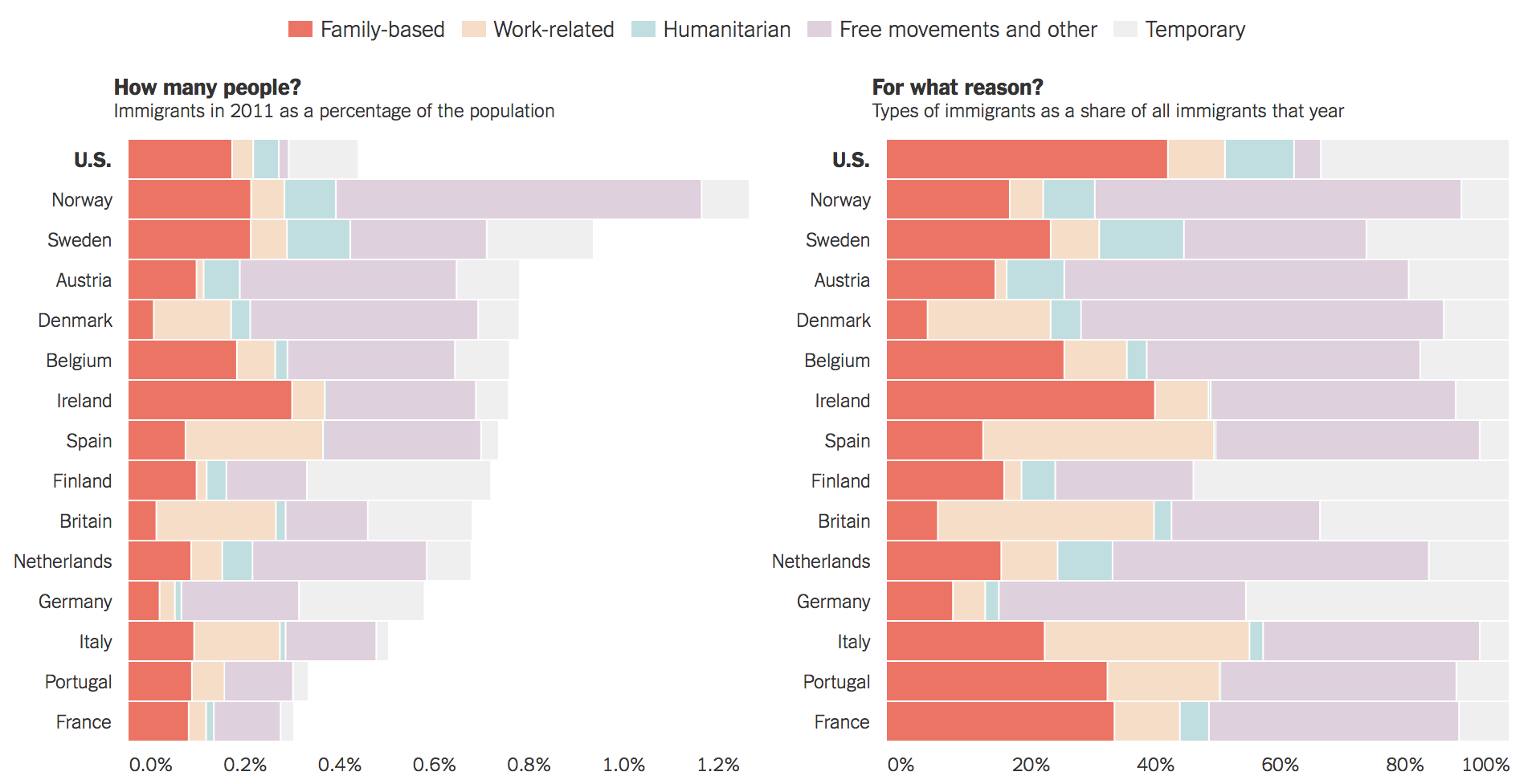
One of the better comparative analyses I have seen, with good charts. If Canada had the same allocation between classes, about 200,000 would be family-class compared to 40,000 economic class  compared to the actual number of 61,000 family and 156,000 economic (2011 data):

Every country regulates immigration in its own imperfect way. Some countries have populations that are 80 percent foreign-born but offer no pathway to permanency. Other countries put up huge barriers to citizenship except for people whose parents were born there.

In the United States, the Senate has struggled, unsuccessfully so far, to pass an immigration reform bill. But the debate has put nearly every category of immigration on the table, from smaller, targeted programs such as Deferred Action for Childhood Arrivals, Temporary Protected Status and the Diversity Immigrant Visa, to big pillars of the immigration system like work-related and family-based migration.

President Trump has called for a shift from what currently makes the American immigration system distinct: its focus on family ties, a framework that accounts for two-thirds of all residency visas, more than any other country. Instead, he and many Republicans would like most visas to be distributed based on employability, with a preference for those who are highly skilled, like doctors, engineers or entrepreneurs.

“In many ways the U.S. immigration system is a relic of the past,” said Justin Gest, a professor at George Mason University who studies comparative immigration policy, referring to how public opinion has changed since 1965, when the family-based system was established. “It is far more generous than I think the spirit of the United States is today.”

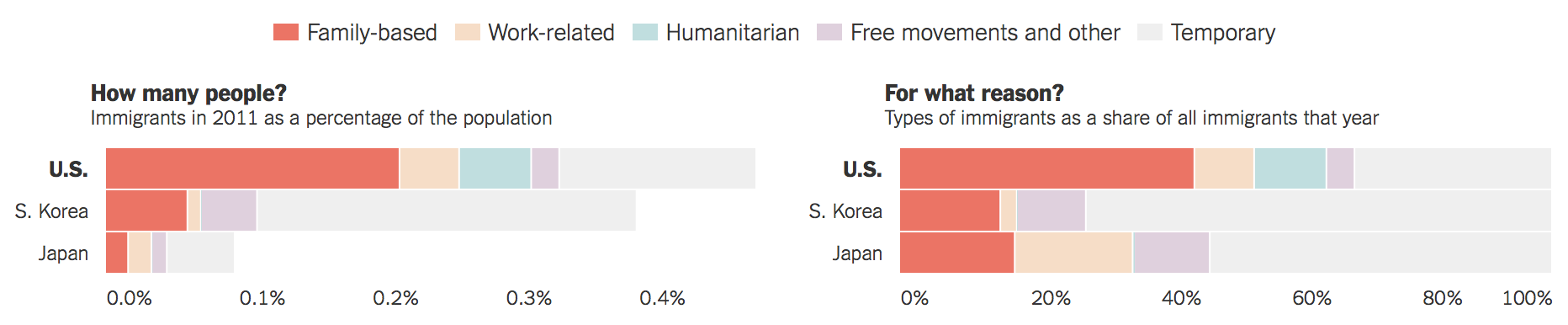
The accompanying chart displays selected countries and the circumstances under which each one welcomes foreigners. It’s based on data from 2011, the latest year available for certain countries like China, and shows temporary migrants (like students and guest workers) and permanent migrants, broken down by the basis for their visa: family ties, employment, humanitarian purposes (as with refugees) or under a free-movement policy (as with the European Union).

Note that the data did not capture undocumented immigrants. Although the United States has good estimates on its undocumented population, data from other countries are spotty and harder to come by.

Simply put, the purpose of an immigration policy is to decide what types of people to allow inside the border. What would it look like if the United States adopted rules more like those of Canada, Japan or Qatar? Compare the policies below.

The Mix if We Looked More Like Canada

In 2011, Canada and Australia relied heavily on immigrants who were admitted based on employability, many of whom were allowed to stay permanently. Both countries used a merit-based point system to determine who qualified, assigning a number of points to criteria such as education, language skills and employment history.

Mr. Trump has said that he would like to emulate the Canadian and Australian systems. But Mr. Gest pointed to a blind spot the size of Ohio — the seventh-most populous state — that could be obscuring how similar the systems already are: undocumented immigrants, who are highly represented in the United States in many low-skill industries like farming and construction.

“If you think of the undocumented as 11 to 12 million temporary low-skilled laborers, then you have a system that looks a little bit more like Canada” in terms of temporary workers, he said. (In fact, Canada and Australia have a much greater proportion of temporary workers than the United States.)

But a merit-based system doesn’t necessarily result in economic payoff, because skills don’t always lead to a job. For example, Canada has struggled to keep its merit-based workers employed since 1967, when the policy was first established.

That’s because some of the very skills and credentials that ushered immigrants into the country were unrecognized once they arrived, so many ended up unemployed or underemployed.

Another reason President Trump might not want to rely too heavily on Canada or Australia as models: Both countries allow in far more immigrants as a percentage of their population. If the United States were to follow their lead, it would involve admitting millions more people.

Or More Like Europe

Historically, most immigrants in Europe have been other Europeans. The European Union allows people to relocate between countries with a level of freedom that is unmatched elsewhere in the world, greatly widening employment pools.

Middle Eastern conflict has created an exception in recent years, spurring a big influx of asylum seekers from war-torn countries. But humanitarian migrants typically make up only a small proportion of Europe’s foreign-born population.

Mercosur, a trade bloc in South America, functions like the E.U., though it allows people to live outside their home countries for only two years at a time, after which they must apply for permission to stay permanently.

It might help to imagine that these partnerships are like Nafta — the policy between the United States, Mexico and Canada that lowers barriers for trade, which President Trump has threatened to eliminate — but instead of goods, the agreements apply to people.

In a system like that, Americans looking for work would be able to expand their searches into Canada and Mexico, but they would also compete against Canadian and Mexican candidates for jobs in the United States.

Or Like Japan and South Korea

South Korea and Japan are so stringent with immigration that they make the United States look lenient. This is partly because of a desire to preserve their cultures, a goal echoed by some conservative groups in the United States.

For example, the Japanese government once offered thousands of dollars to immigrants of Japanese descent to leave the country. And very few people become South Korean citizens without family ties; doing so requires years of residence, an in-person language proficiency test and a written test on customs, history and culture.

On top of stoking racial tensions, these policies have created demographic problems for South Korea and Japan. Both countries’ populations are aging rapidly, social services are underfunded, and many industries face labor shortages.

Some unusual policies, such as Japan’s practice of granting citizenship based on a parent’s Japanese nationality instead of where babies are born, have created situations where three generations of a family may not be Japanese citizens despite having lived in the country all their lives.

Or Like the Gulf States

The Gulf states allow a huge immigrant influx to meet the demand for cheap, low-skilled labor, but almost all of the immigrants are temporary, and they have few rights or protections.

In Qatar, for example, roughly 80 percent of the population is foreign-born. Without them, the skyscrapers of Doha or the 2022 World Cup, for which the government has promised to build more than half a dozen new stadiums, would not be possible. And the Qatari government has been accused of human rights abuses against those workers.

The only way that governments can sustain these heavy immigrant populations is by withholding the generous resources that are granted to ordinary citizens, such as free health care, free college tuition and marriage allowances.

Most Americans would not be comfortable with this approach, said Morris Levy, a political scientist at the University of Southern California who studies public opinion on immigration. “People dislike the idea of a permanent second-class citizen,” he said. “It goes back to a core set of values that people think of as really elemental to being American.”

The Future Is Probably Somewhere in the Middle

Based on the current debate, any solution that Congress agrees on will probably fall somewhere between international models. It could follow some trends that are occurring worldwide.

For example, in many countries, including Canada and Australia, there has been a shift away from exclusively merit-based systems to ones that also consider whether someone has a job offer — something currently done in the United States.

For purposes of immigration, the United States could narrow its definition of family, which is wider than that of any other country, to exclude siblings or adult children who are married.

Although current American policies around family-based migration are the most generous in the world, the results look much different in practice because of limits on the number of visas that can be granted in each category.

“There is a certain mindlessness to family immigration when you take into account eligibility and time,” said Demetrios G. Papademetriou, co-founder of the Migration Policy Institute, a research organization. “Someone qualifies, but it may take 20 years before a visa is open to them.”

“There is a major undisputed advantage to family immigration, chain migration; it’s become apparently a dirty word,” he said. “You have someone here who will show you the ropes, who will take you in that can set up employment for you. When it comes to immigrant integration, family is very important.”

You could envision a merit-based system that incorporates characteristics of our current system. It could grant points to people who have family members in the United States, or who come from countries that are not highly represented in the current population.

In that case, it might be desirable to pay attention to the weight each category is given and to adjust based on economic and social outcomes.

“That is how you keep a point selection system,” Mr. Papademetriou said. “Everything else is just blind faith or politics. Our system that exists today is just politics.”

While the sputtering negotiations are frustrating for many people, especially for those caught up in the system, academics agree that, in general, these decisions should not be rushed.

“Immigration is social engineering,” said Mr. Gest, the George Mason University professor. “You’re building the population of the future.”

via What Can the U.S. Learn From How Other Countries Handle Immigration? – The New York Times