Neo-Nazi Groups Explode Under Trump, Southern Poverty Law Center Finds

Not encouraging:

Neo-Nazi organizations saw the greatest growth among hate groups last year, according to a new report by Southern Poverty Law Center released Wednesday.

There were 954 active hate groups in the United States in 2017, SPLC found, the greatest total since 2011’s record-breaking year. About half of the groups are white supremacist groups, including Neo-Nazis, Neo-Confederates, white nationalists, skinheads, and Christian Identitarians. Almost one-quarter of 900 hate groups are black nationalists, and 114 groups are anti-Muslim. Other groups with specific hatred for the LGBTQ community, the government, and women have risen, albeit in smaller numbers.

“Within the white supremacist movement, Neo-Nazi groups saw the greatest growth—soaring by 22 percent from 99 to 121,” since 2016, according to the SPLC report.

“The overall number of hate groups likely understates the real level of hate in America,” SPLC said, “because a growing number of extremists, particularly those who identify with the alt-right, operate mainly online and may not be formally affiliated with a hate group.”

The report comes after a year of notorious violence by the so-called alt-right. In August 2017, white supremacists gathered for a “Unite the Right” rally in Charlottesville, Virginia that led to the deaths of Heather Heyer and two local law enforcement officials.  In January 2018, a California man who allegedly murdered his gay, Jewish high school classmate trained with Florida-based Neo-Nazi group Attomwaffen, ProPublica reported. In December 2017, a man who frequented alt-right forums and websites like The Daily Stormer killed three people including himself at a New Mexico school, The Daily Beast previously reported.

Since 2014, 43 people have been killed and 67 people have been injured by men associated with the alt-right or white supremacists, SPLC reported earlier this month. Dylann Roof, the man who murdered nine black churchgoers in Charleston nearly three years ago, regularly commented on The Daily Stormer and admitted to planning the race-based attack. “I chose Charleston because it is most historic city in my state, and at one time had the highest ratio of blacks to Whites in the country,” Roof wrote in a note used in his prosecution.

SPLC also counted the murders of Elliot Rodger, the California man who killed seven people, including himself, as one of the first massacres killings carried out by the “alt-right” before the movement went mainstream. Nikolas Cruz, the alleged Florida school shooter who killed 17 people on Valentine’s Day, commented “Elliot rodger will not be forgotten” on a YouTube video last year. Law enforcement said it is investigating whether Cruz was affiliated with a white supremacist group in Florida that initially claimed he was a member.

In a first for the organization, SPLC added two male supremacy groups to its annual report on extremism: Texas-based A Voice for Men and Washington, D.C.-based Return of Kings.  “The vilification of women by these groups makes them no different than other groups that demean entire populations, such as the LGBT community, Muslims or Jews, based on their inherent characteristics,” SPLC said in a statement.

Heidi Beirich, director of SPLC’s Intelligence Project, said that the organization compares male supremacy groups’ methods—using slurs and saying women are “destroying” men—to white supremacist groups like the New Century Foundation, which publishes a magazine that “focuses on the demonization of black people.”

President Donald Trump blamed “many sides” for alt-right violence in Charlottesville, and the SPLC report says Trump’s presidency has emboldened white supremacists. “They believed they finally had a sympathizer in the White House and an administration that would enact policies to match their anti-immigrant, anti-Muslim and racist ideas,” the report stated.

The only hate group that decreased its chapters in 2017 was the Ku Klux Klan, the oldest hate group in the country. “It’s clear that the new generation of white supremacists is rejecting the hooded movement that was founded after the Civil War,” the authors of the SPLC report wrote.

Source: Neo-Nazi Groups Explode Under Trump, Southern Poverty Law Center Finds
Overseas teens left vulnerable by lucrative Canadian student visa program, experts say

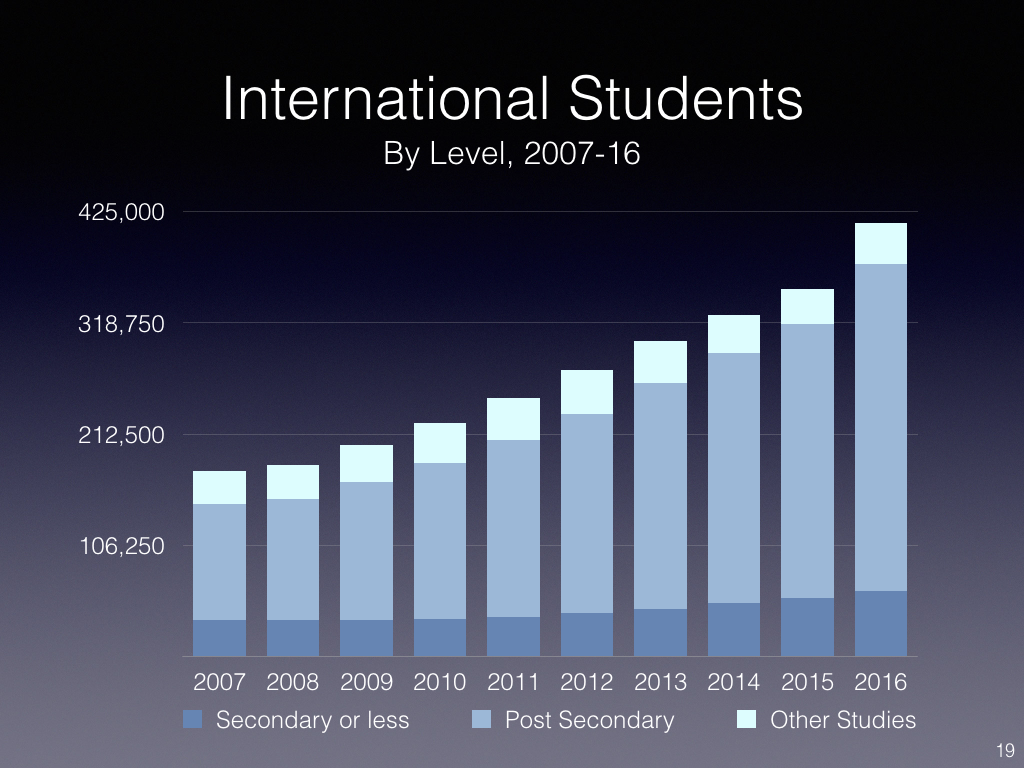
The chart below provides the breakdown by students by education level, showing a significant number of minors where these issues present themselves (about 18 percent in 2016 – haven’t updated with 2017 numbers yet):

…Hundreds of thousands of international students are here from around the world, many even younger than Tina, and largely fending for themselves in a new country without adequate support from school boards, provincial governments and the federal government, industry experts say. And now settlement agencies, student recruiters and host family companies are urging these bodies to regulate the industry.

Moy Wong-Tam, executive director of the Centre for Immigrant and Community Services (CICS) in Toronto said the unregulated industry leaves students vulnerable to scams and poor treatment at the hands of the people responsible for the kids’ well-being, she said.

“It’s concerning because we’re seeing many gaps,” Wong-Tam said. “The system is full of holes right now.”

Custodians and host families

When minors arrive in Canada, they have two main points of contact — a host family or homestay, and a custodian, who is a delegate appointed by the parents to check in on their children and help them in case of any emergencies.

But Wong-Tam, whose settlement agency provided services to 20,000 newcomers in 2016, about 300 of whom were international students, said the industry supporting temporary residents is largely unregulated. Furthermore, she told CBC News it’s unlikely homestay families and custodians can replace a student’s parents, particularly when there’s money to be made from the system.

The students’ families typically pay between $950 and $1,300 a month to the homestay family for meals and a place to live, and between $1,000 and $2,500 a year to the custodian, depending on the range of services he or she offers.

…School boards, firms have their own rules

Currently, Immigration, Refugees and Citizenship Canada (IRCC) requires parents of foreign students under 18 to sign a custodianship declaration form. The federal government’s only stipulation is “a custodian is a responsible adult (Canadian citizen or a permanent resident) who takes care of and supports the child.”

School boards or companies that help families find a custodian have their own rules, including criminal background checks and mandatory insurance. Some, like the York Catholic District School Board, require that the guardian sign an affidavit for his or her role in the student’s welfare and a separate agreement accepting responsibility for any “inappropriate behaviour” from the student.

Alex Mazzucco, program co-ordinator of international education at the Toronto Catholic District School Board, said the students sometimes bring up issues to the board, which can get parents involved, but there’s no way to take a complaint further with the federal government.

“There’s no mechanisms with IRCC where you can file a complaint where they’ll respond,” he said. “We’ve filed complaints but have not received any response.”

Culturally, students often don’t report issues to the school board or even their parents, said Liu.

“Being polite, not speaking up, it’s part of Chinese culture,” he said. “They don’t want to fight with others. When something happens, they first think about themselves. ‘Did I do something wrong?'”

CBC News contacted both the public and Catholic school boards for Toronto, Peel and York Region. The York Region school boards and the Toronto District School Board did not respond to requests for an interview.

Filling the seats

CICS’s Wong-Tam said institutions have a moral obligation to care for the underage students, particularly since “classrooms need international students to fill the seats.”

An international high school student pays an average of $14,000 in tuition a year, according to Greater Toronto Area school boards’ websites. The latest federal government data shows spending associated with international students in 2014, including their visiting families and friends, amounted to $11.4 billion a year, contributed $9.3 billion to Canada’s GDP and helped sustain 123,000 jobs.

A 2015 Ontario report said international students contribute more than $4 billion to the province’s economy annually, generating more than 30,000 jobs.

With this much money coming in, Wong-Tam is calling on the institutions to have a dialogue.

“I know tragedies happen to all Canadians but international students are so much more vulnerable,” she said. “They need a little more help since they’re paying more tuition.”

In an email to CBC News, IRCC said: “Parents or legal guardians are ultimately best placed to select the custodian of their child and to determine whether the custodian is fulfilling the duties entrusted to them.”

Liu said there’s little the parents can do from so far away, so the institutions bringing them in should take more responsibility, including the provincial government, which oversees the school boards.

Ontario’s Ministry of Education told CBC News in a statement: “If a [school] board chooses to have homestay programs, they are responsible for monitoring homestay families’ compliance with applicable requirements (i.e. insurance, safety standards, etc.).”

Wong-Tam, Liu and another homestay company that CBC News interviewed said all the parties need to take responsibility.

Source: Overseas teens left vulnerable by lucrative Canadian student visa program, experts say

UK immigration latest: EU net migration falls over past year as Brexit uncertainty continues | The Independent

Not surprising:

EU net migration is falling as more European citizens leave the UK and fewer arrive in the wake of the vote for Brexit, new statistics show.

The Office for National Statistics (ONS) said overall net migration in the year to September was 244,000 – a similar level to early 2014 and down on record levels in the next two years.

The number of European citizens arriving has plummeted since the EU referendum, while the number of people from outside the bloc has increased.

“EU net migration has fallen as fewer EU citizens are arriving, especially those coming to look for work in the UK, and the number leaving has risen – it has now returned to the level seen in 2012,” said Nicola White, head of international migration statistics at the ONS.

“The figures also show that non-EU net migration is now larger than EU net migration, mainly due to the large decrease in EU net migration over the last year. However, migration of both non-EU and EU citizens are still adding to the UK population.

“Brexit could well be a factor in people’s decision to move to or from the UK, but people’s decision to migrate is complicated and can be influenced by lots of different reasons.”

The number of EU citizens coming to the UK plummeted by 47,000 in the year and the number leaving – 130,000 – is the highest recorded level since the 2008 financial crisis.

Almost a quarter of a million people arrived in the UK to work in the period 2017, with the number of EU citizens falling by 58,000.

Most of the Europeans arriving had a definite job lined up, while a smaller proportion were looking for work.

The biggest nationality starting work in the year to September, according to National Insurance number registration data, was Romanian, followed by Polish, Italian, Bulgarian, Spanish and Indian – who accounted for over half of all skilled work visas granted.

The ONS said that the overall employment rate for EU nationals was 81.2 per cent, followed by Brits at 75.6 per cent and non-EU nationals on 63.2 per cent.

George Koureas, a partner at immigration law firm Fragomen, said: “The UK has become a significantly less attractive place for European citizens to work since Brexit, so it’s no surprise that more EU workers are leaving the country.

“Although the Government may see this as good news, it presents a significant threat to UK businesses, already struggling to hire the skilled workers they need to thrive.”

He said there could be a further impact from the Government’s plan to double the Immigration Health Surcharge, which is paid by migrants to use the NHS, and caps on visas for skilled workers.

via UK immigration latest: EU net migration falls over past year as Brexit uncertainty continues | The Independent

ICYMI: Australia – Dutton pushes on with citizenship changes

More Australia news:

Peter Dutton will try again to pass a controversial suite of citizenship changes shot down in the Senate last year.

The Home Affairs Minister wants to extend the waiting time for permanent residents to apply for citizenship, create tougher English language tests and give himself additional powers.

“I can assure you that the government remains committed to this reform,” Mr Dutton told the National Press Club in Canberra on Wednesday.

“We will work with the crossbench on the basis of a new package of measures flagged at the end of last year.”

Mr Dutton has signalled he is willing to cede some ground in negotiations with the crossbench.

However, he would prefer to secure bipartisan support rather than dealing with an unpredictable assortment of independents, urging the Labor Party to shift its position.

“If they don’t, I’m confident that (Citizenship Minister) Alan Tudge can deal with the independent senators and negotiate an outcome to the package.”

The government initially wanted to lift English requirements from “basic” to “competent”, which would require aspiring citizens to understand fairly complex language and have an effective grasp of English.

It has since agreed to accept a “modest” level, meaning would-be Australians must be able to handle basic communication and have a partial command of the language, while making many mistakes.

The government also wanted to impose its crackdown retrospectively, capturing everyone who applied for citizenship since its policy was announced on April 20, 2016.

It is now willing to hold fire on the changes until July 1 this year.

The Nick Xenophon Team, whose bloc of votes was critical last year, were not immediately won over by the watered-down changes, but their power has since been diminished by the fall-out from the dual citizenship saga.

via Dutton pushes on with citizenship changes

Canadian historian joins uproar in Israel over Polish Holocaust law

There is so often a Canadian connection given the number of immigrant and ethnic communities:

University of Ottawa history professor flew to Israel this week, right into the eye of a brewing diplomatic storm involving the Jewish state and Poland over a controversial bill dealing with remembering the Holocaust.

Jan Grabowski has spent years examining the Holocaust in Poland, where he was born, focusing on Polish-Jewish relations. His research has brought death threats against him and his family and angry letters to his employer demanding he be fired.

But in an interview with CBC News hours after arriving from Canada, Grabowski vowed to press on with his work, outlining the focus of his next book, which will examine the role of the Polish Blue Police during the Second World War.

“It’s about 20,000 people who were armed and who inflicted horrific suffering on the Jews,” he said.

Controversial Polish legislation

Israeli leaders are leading the charge against a piece of legislation passed by the Polish Parliament earlier this month that made it illegal to assert that Poland bore any responsibility for atrocities committed by Nazi Germany.

Six million Jews were killed during the Holocaust, and many of those victims were Polish. Some of the most notorious extermination camps — Auschwitz-Birkenau and Treblinka to name two — were built on Polish soil.

DV1949535

Many Poles have long complained when atrocities committed by Nazi Germany, such as the killings at the Auschwitz death camp, have been linked to the Polish nation. ( Janek Skarzynski/AFP/Getty Images)

But for decades Poles have chafed at references linking their nationals to the crimes of the Holocaust. Former U.S. president Barack Obama issued an apology in 2012 when he used the term “Polish death camp”.

While most scholars, including those at Yad Vashem, the official Israeli memorial to the Holocaust, agree that labelling concentration camps as Polish is misleading, critics say what’s more worrisome is the crux of the new Polish law that imposes fines or prison terms of up to three years for linking “the Polish nation” to crimes committed during the Holocaust.

‘No Polish bystanders’

Grabowski notes that the prison sentence is the same duration Poles could expect to serve behind bars before the Second World War for “insulting the Polish nation.”

At his Tel Aviv press conference. the Polish-Canadian dual citizen discussed a newspaper article from 1936, detailing the case of a Jewish woman who was evicted from a Polish university.

“As she was evicted, she shouted ‘Polish animals.’ They beat her up, but she was the one the police arrested,” Grabowski said. “She was put in prison for two months for insulting the Polish nation.”

Grabowski, who is in Israel for a conference on Holocaust history, has faced much criticism from some Polish historians for his years of research, including his controversial conclusion that 200,000 Polish Jews were killed — directly or indirectly — by Poles during the war.

“There are no Polish bystanders to the Holocaust,” he told reporters.

Poland’s embassy to Canada, in Ottawa, has criticized Grabowki for offering “groundless opinions and accusations.”

“In reality, there was no free Poland during the Second World War, and the Holocaust was the murder by Nazi Germany of six million Jews,” the mission wrote in a statement to Macleans magazine. “Poland, unlike many countries, was never an ally of Nazi Germany and never had a collaborative regime.”

While he questioned the legal effect of the new Polish legislation, calling it “nonsense,” Grabowski does worry about a chilling effect.

“This law was an embodiment of the growing frustration of nationalists in power [in Poland] who simply are trying to find tools with which to freeze the debate, knowing that they cannot refute historical evidence,” he said. “What they can do is they can try to silence people who would like to undertake research in these areas.”

Activists ‘outraged’ at decision to grant citizenship to investors | Jordan Times

Money trumps gender equality:

Activists on Tuesday lashed back at a Cabinet decision a day earlier to grant investors Jordanian citizenship or permanent residency, claiming that the decision was discriminatory and ignored their long-time demands to allow Jordanian women married to non-Jordanians to pass on their citizenship to their spouses and children.

The Cabinet on Monday set several conditions for individuals seeking to obtain Jordanian citizenship, including a zero-interest, five-year $1.5 million deposit at the Central Bank of Jordan (CBJ), or buying treasury bonds valued the same amount at an interest rate to be decided by CBJ and for a period of no less than 10 years.

“This is a provocative decision by the government that allows foreign individuals to obtain Jordanian nationality based on their financial means, while bluntly denying this right to Jordanian women,” said lawyer Noor Imam.

This decision “also comes in favour of rich women, who can now invest and obtain citizenship while the poor do not have this privilege”, Imam told The Jordan Times.

Activists and families of Jordanian women married to non-Jordanians have repeatedly demanded full citizenship rights for their children and spouses.

As it stands now, Jordanian men married to non-Jordanian women can pass on their citizenship to their wives and children, a right that is denied to Jordanian women married to foreigners.

Activist Laila Naffa agreed with Imam, saying that “this step should eliminate all the excuses the government has been giving to the women’s movement to deny the right of citizenship to families of Jordanian women who choose to marry a foreigner”.

Government officials on Tuesday defended the decision as conducive to investment.

Minister of State for Media Affairs and Communications and Government Spokesperson Mohammad Momani said the decision is meant to encourage investment in the Kingdom and boost the national economy.

“Children of Jordanian women married to non-Jordanians have been granted same treatment and privileges to Jordanians to ease up their lives and this decision to encourage investment will be to the interest of their families as part of the Jordanian society,” Momani told The Jordan Times.

The minister stressed that “this decision only aims to support the economy and eventually everyone will benefit from this step, including Jordanian women married to non-Jordanians and their children”.

“The government is always giving excuses in this case, such as wanting to protect the sovereignty of the country, but now they opened the door to anyone who has money to obtain citizenship except the families of Jordanian women who are married to non-Jordanians,” Naffa stated.

She stressed the priority should be given to “these women who are loyal to Jordan and have raised their children to also be loyal to the state”.

Naffa said that Jordan “missed an important opportunity with its decision to give investors citizenship when they could have taken advantage of the decision to announce the same for Jordanian women instead of discriminating against them”.

Tamkeen Fields for Aid’s (TFA) Director Linda Kalash, said: “The decision for investment is good, but the priority should go to the Jordanian women, and citizenship should not be granted based on financial purposes”.

“This is really outrageous and frustrating. Why can’t Jordanian women pass citizenship to their families like the investors?” Kalash told The Jordan Times.

In 2014, the government pledged to ensure the proper application of the “privileges” the government had granted to children of Jordanian women, provided that their mothers had been living in Jordan for a minimum of five years, for at least 180 days per year.

Some of the “privileges” included providing residency permits, the ability to apply for driving licences and real-estate ownership, as well as the availing of benefits in the educational, health, labour and investment sectors.

However, activists and campaign organisers continued to voice concerns that the government did not fully respect its promises, claiming they are still suffering on many fronts from discrimination and complicated governmental procedures when it comes to issuing the documents as promised.

Individuals and entities, who oppose granting citizenship to family members of these women, particularly those with Palestinian husbands, say such a measure will only lead Israel to implement its “ultimate plan of creating a substitute homeland for Palestinians in Jordan”.

Government figures show that there are 88,983 Jordanian women married to non-Jordanians, mostly Gazans, with 355,932 children within these families registered with the Civil Status and Passports Department.

Palestinians, except Gazans, who became refugees after the creation of Israel on Palestinian land, and those who were living in the West Bank when it was occupied by Israel in 1967, have been granted Jordanian citizenship.

via Activists ‘outraged’ at decision to grant citizenship to investors | Jordan Times

OECD warns citizenship by investment programs used to circumvent taxes | Cayman Compass

About time:

The Organization for Economic Cooperation and Development has issued a consultation document (Consultation document – Preventing abuse of residence schemes to circumvent the CRS – OECD.org)that warned of the potential abuse of “residence by investment” or “citizenship by investment” schemes. These schemes allow foreign individuals to obtain citizenship or temporary or permanent residence rights in exchange for local investments or against a flat fee.

While investors may be interested in these for legitimate reasons, including greater mobility because of visa-free travel, better education and job opportunities for children, or the right to live in a country with political stability, there is the potential for misuse, the Paris-based organization said.

An OECD disclosure facility that enables the public to share arrangements designed to avoid tax reporting under the common reporting standards produced information indicating that RBI and CBI schemes are used to circumvent CRS reporting.

The now-issued consultation document assesses how the schemes are used to avoid reporting. It identifies the types of schemes that present a high risk of abuse and it reminds stakeholders of correctly applying CRS due diligence procedures to prevent the abuse.

While the schemes generally do not offer a solution to escape the legal scope of CRS reporting, because they do not provide tax residence or affect tax residence in another country, they can potentially be exploited to undermine the CRS due diligence procedures, the document noted.

This scenario could arise, for example, if an individual does not live in the relevant jurisdictions but claims to be a resident there for tax purposes and supports the claim by providing his financial institution with documents such as a certificate of residence, passport or utility bills.

The schemes that are most susceptible, according to the paper, are those in low or no tax jurisdictions and those that do not impose or only have limited requirements to be physically present in the jurisdiction.

The OECD is seeking public input to obtain further evidence on the misuse of CBI/RBI schemes and on effective ways for preventing such abuse.

The consultation closes on March 19. The responses will be taken into account in determining the next steps that will be taken, the OECD said.

Countries with well-established citizenship-by-investment programs include Antigua and Barbuda, Dominica, St. Kitts and Nevis in the Caribbean, as well as Cyprus, Malta, the U.K., and the U.S. among others.

via OECD warns citizenship by investment programs used to circumvent taxes | Cayman Compass

Quebec: Les femmes en hijab et les hommes en turban pourront être candidats

Encouraging that this was unanimous vote in the Assemblée nationale:

Les parlementaires ont approuvé mardi un changement règlementaire qui permettra à une femme portant un hijab ou à un homme portant un turban de se porter candidats aux élections.

Le Directeur général des élections (DGEQ) a annoncé début février son intention de modifier le Règlement sur la déclaration de candidature. Il propose en outre d’exiger une photo à «visage découvert» dans le bulletin de candidature. Depuis 1989, le règlement exigeait des photos avec la «tête découverte», une disposition qui était jugée discriminatoire.

Le changement règlementaire permettra donc à une femme voilée ou à un homme portant un turban de briguer les suffrages. Il sera toutefois impossible à une femme portant un voile intégral de le faire.

La modification a été avalisée par une commission parlementaire mardi. Elle devrait être en vigueur aux élections d’octobre.

Lors des dernières élections, en 2014, le DGEQ a invoqué ce règlement pour refuser la candidature de Fatimata Sow, qui voulait porter les couleurs du Parti vert dans la circonscription de La Pinière. Mme Sow avait fourni une photo où elle était coiffée d’un hijab.

En vertu de la nouvelle mouture du Règlement, ce bulletin «pourrait» être accepté, a indiqué le DGEQ, Pierre Reid.

En point de presse, il a rappelé que l’objectif du Règlement était de faciliter l’identification des candidats. Selon lui, la disposition qui interdisait toute coiffure n’avait pas sa raison d’être.

«À partir du moment où vous avez un candidat qui s’identifie clairement, à visage découvert, comme c’est prévu pour les électeurs (…), on ne voyait pas d’utilité sans avoir d’autres explications de la présence de cette exigence», a expliqué M. Reid.

Les partis politiques ont exprimé à l’unanimité leur appui au changement règlementaire.

«Nos lois, nos chartes, doivent être respectées», a indiqué le premier ministre, Philippe Couillard.

De toute manière, a-t-il ajouté, peu importe qui se porte candidat, ce sont les électeurs qui décideront s’ils sont élus.

«Nous ne devrions pas être paternalistes vis-à-vis les citoyens et décider à leur place qui devrait être élu ou pas, a-t-il dit. Ils prendront la décision.»

«Le plus important est qu’on puisse voir le visage, a renchéri le chef du Parti québécois, Jean-François Lisée. Alors je n’ai aucun problème (avec cette mesure).»

La Coalition avenir Québec et Québec solidaire ont également approuvé le changement règlementaire.

via Les femmes en hijab et les hommes en turban pourront être candidats | Martin Croteau | Politique québécoise

A Lesson on Immigration From Pablo Neruda – The New York Times

Interesting vignette from history, reflecting ongoing ideological debates:

Chile, like numerous other countries, has been debating whether to welcome migrants — mostly from Haiti, Colombia, Peru and Venezuela — or to keep them out. Although only half a million immigrants live in this nation of 17.7 million, right-wing politicians have stoked anti-immigrant sentiment, opposed the increased rates of immigration in the past decade and directed bile especially against Haitian immigrants.

Immigration was a major issue in elections here in November and December. The winner was Sebastián Piñera, a 68-year-old center-right billionaire who was president from 2010 to 2014 and will take over in March. Mr. Piñera blamed immigrants for delinquency, drug trafficking and organized crime. He benefited from the support of José Antonio Kast, a far-right politician who has been campaigning to build physical barriers along the borders with Peru and Bolivia to stop immigrants.

Chileans aren’t alone in witnessing growing xenophobia and nativism, but we would do well to remember our own history, which offers a model for how to act when we are confronted with strangers seeking sanctuary.

On Aug. 4, 1939, the Winnipeg set sail for Chile from the French port of Pauillac with more than 2,000 refugees who had fled their Spanish homeland.

A few months earlier, Gen. Francisco Franco — aided by Mussolini and Hitler — had defeated the forces of the democratically elected government of Spain. The fascists unleashed a wave of violence and murder.

Among the hundreds of thousands of desperate supporters of the Spanish Republic who had crossed the Pyrenees to escape that onslaught were the men, women and children who would board the Winnipeg and arrive a month later at the Chilean port of Valparaíso.

The person responsible for their miraculous escape was Pablo Neruda, who, at the age of 34, was already considered Chile’s greatest poet. His prestige in 1939 was indeed significant enough for him to be able to persuade Chile’s president, Pedro Aguirre Cerda, that it was imperative for their small country to offer asylum to some of the mistreated Spanish patriots rotting in French internment camps.

Not only would this set a humanitarian example, Neruda said, but it would also provide Chile with much needed foreign expertise and talent for its own development. The president agreed to authorize some visas, but the poet himself would have to find the funds for the costly fares of those émigrés as well as for food and lodging during their first six months in the country. And Neruda, once he was in France coordinating the operation, needed to vet the émigrés to ensure they possessed the best technical skills and unimpeachable moral character.

It took considerable courage for President Aguirre Cerda to welcome the Spanish refugees to Chile. The country was poor, still reeling from the long-term effects of the Depression, with a high rate of unemployment — and had just suffered a devastating earthquake in Chillán that had killed 28,000 people and left many more injured and homeless.

An unrelenting nativist campaign by right-wing parties and their media, sensing a chance to attack the president’s Popular Front government, painted the prospective asylum seekers as “undesirables”: rapists, criminals, anti-Christian agitators whose presence, according to one chauvinistic editorial in Chile’s leading conservative paper, would be “incompatible with social tranquillity and the best manners.”

Neruda realized that it would be cheaper to charter a ship and fill it up with the refugees than to send them, one family at a time, to Chile. The Winnipeg was available but since it was a cargo boat it had to be refurbished to accommodate some 2,000 passengers with berths, canteens for meals, an infirmary, a nursery for the very young and, of course, latrines.

While volunteers from the French Communist Party worked around the clock to ready the vessel, Neruda was gathering donations from all over Latin America — and from friends like Pablo Picasso — to finance the increasingly exorbitant enterprise. Time was short: Europe was bracing for war, and bureaucrats in Santiago and Paris were sabotaging the effort. With only half the cash in hand one month before the ship was set to sail, a group of American Quakers unexpectedly offered to supply the rest of the required funds.

Through it all, Neruda was fueled by his love for Spain and his compassion for the victims of fascism, including one of his best friends, the poet Federico García Lorca, who had been murdered by a fascist death squad in 1936.

As Chile’s consul during the early years of the Spanish Republic, Neruda had witnessed the bombardment of Madrid. The destruction of that city he loved and the assault upon culture and freedom were to mark him for the rest of his life and drastically change his literary priorities.

After the fall of the Republic, he declared, “I swear to defend until my death what has been murdered in Spain: the right to happiness.” No wonder he proclaimed the Winnipeg to have been his “most beautiful poem” as it steamed away — without him or his wife, as they did not want to occupy space that was better occupied by those whose lives were in danger.

And when that magnificent, gigantic, floating “poem” of his, after a hazardous voyage, finally reached Valparaíso, its passengers — despite the protests of right-wing nationalists and Nazi sympathizers — were given a welcome befitting heroes.

Awaiting the penniless survivors of Franco’s legions was President Aguirre Cerda’s personal representative — his health minister, a young doctor named Salvador Allende. Cheering crowds amassed on the dock, singing Spanish songs of resistance, gathered to greet the refugees, some of whom already had jobs lined up.

The refugees who came ashore on the Winnipeg would go on to help fashion a more prosperous, open and inventive Chile. They included the historian Leopoldo Castedo, the book designer Mauricio Amster, the playwright and essayist José Ricardo Morales and the painters Roser Bru and José Balmes.

Almost 80 years later, those undesirables pose disturbing questions for us, both in Chile and elsewhere. Where are the presidents who welcome destitute refugees with open arms despite the most virulent slander against them? Where are the Nerudas of yesteryear, ready to launch ships like poems to defend the right to happiness?

via A Lesson on Immigration From Pablo Neruda – The New York Times

Government of Canada facilitates access to Canadian citizenship for minors – Canada.ca

Good. The Government blinked on this one (see Children applying for Canadian citizenship face hefty fee | Toronto Star from August 2017):

The Government is committed to encouraging all immigrants, including minors under 18 years of age, to acquire citizenship. To help make that easier, the fee for minors applying under subsection 5(1) of the Citizenship Act has been reduced.

On June 19, 2017, the royal assent of Bill C-6 immediately brought into force a legislative amendment that removed the requirement to be 18 years old to apply for a grant of citizenship under subsection 5(1) of the Citizenship Act. This made it easier for minors to apply for citizenship on their own behalf. One of the strongest pillars for successful integration into Canadian life is acquiring Canadian citizenship.

The Honourable Ahmed Hussen, Minister of Immigration, Refugees and Citizenship, announced changes to the fee schedule set out in the Citizenship Regulations to lower the processing fees for minors applying under subsection 5(1) of the Citizenship Act from $530 to $100, bringing them into line with the processing fees for minors applying under subsection 5(2) of the Act.

This ensures that there is no difference in the fee paid by citizenship grant applicants who are minors, regardless of whether they have a Canadian parent, are applying with a permanent resident parent or are applying on their own behalf.

Anyone who already paid the $530 fee for a minor applying under this subsection on or after June 19, 2017, will be reimbursed the difference of $430. Immigration, Refugees and Citizenship Canada will contact these applicants directly to outline the process for receiving a refund.

Minors who do not have a Canadian parent, or a permanent resident parent applying for citizenship at the same time as them, can apply for citizenship under subsection 5(1) of the Citizenship Act. Therefore, the reduction in citizenship fees will help more minors, including immigrant children in the child welfare system or in the care of the state, acquire Canadian citizenship.

The department will be engaging provinces and territories, childcare agencies, immigration service provider organizations and other stakeholders to raise awareness of this change. The department will also provide information on how these institutions can assist minors in their care to acquire citizenship.

via Government of Canada facilitates access to Canadian citizenship for minors – Canada.ca