Neo-Nazis are no joke—they just want you to think they are: Tabatha Southey

Southey on The Daily Stormer style guide – nails it:

“Generally, when using racial slurs, it should come across as half-joking—like a racist joke that everyone laughs at because it’s true,” reads the style guide used by The Daily Stormer, a copy of which the Huffington Post got its hands on this week.

The Daily Stormer is a prominent America-based neo-Nazi and white supremacist website that takes its name and more from Der Stürmer, the tabloid newspaper of the Nazi Party. And what it seems to be saying with that “half-joking” advice and much else in the guide is: “Don the Magic Cloak of Plausible Deniability and come with us!”

This likely won’t come as a surprise to anyone who spends much time online. Many will have observed some of these far, far right fools prancing about under that just-kidding-maybe cover. They do this as if somehow we can’t see exactly what they’re up to, and as if what they’re up to isn’t being Nazis and working to recruit more Nazis.

The style guide instructs prospective contributors on how to use memes, “humour” and “ironic hatred” to “blame the Jews for everything,” that being the site’s “prime directive.” That Jews cause all the bad things “is pretty much objectively true,” says the 17-page primer, apparently penned by site editor Andrew Anglin. “As Hitler says, people will become confused and disheartened if they feel there are multiple enemies. As such, all enemies should be combined into one enemy, which is the Jews.”

The phrase “As Hitler says” is rather the point to that sentence. You use the words “As Hitler says” in that benign, casual, and authoritative way, and it doesn’t much matter what comes after them. You type “As Hitler says, ‘i’ before ‘e’ except after ‘c’,” and you are telling any burgeoning Goebbels looking for a home for their murderous musings that “yes, we’re those Nazis. Goose-step on over and pull up a chair.”

The guide also provides advice on formatting and grammar, site-specific terminology—“Moslem,” not “Muslim,” is the preferred Daily Stormer house style—along with a list of “racial slurs” that are officially “allowed and advisable” that leaves me wondering what exactly crosses a line.

Think of this document as Strunk and White Power.

Keep it simple, keep it anti-Semitic: This is the guide’s message. Not all problems are created by Jews, aspiring Nazi ghostwriters are encouraged to say, but “if we didn’t have the Jews, we could figure out how to deal with non-whites very easily.” Similarly, “Women should be attacked but there should always be a mention that if it weren’t for Jews they would be acting normally.” “Jews are like hormones” seems to be the gist of it, as far I can tell, but until I hear someone say, “Yes, I ate half a cake and cried to an Adele song, it must be my Jews,” I can’t be certain.

The guide’s acceptable terms for women are, by the way, “Slut, whore, bitch, harlot, trollop, slag, skag.” That some of these words are antiquated to the point of near-whimsicality is by design. “The indoctrinated should not be able to tell if we’re joking,” Anglin explains. Put a funny hat on your hatred, play to the crowd.

Effectively utilizing these jokes—the so-called “lulz” in Internet parlance—is vital, the guide cautions, because “most people are not comfortable with material that come across as vitriolic, raging, non-ironic hatred.” Adding the “lulz”—expressing oneself dead seriously but in the cadence of a joke—throws that Cloak of Plausible Deniability over not just to the writer, but the audience as well. “No, I’m not really consuming literal neo-Nazi propaganda,” an as-yet-unconverted reader can tell themselves. “It’s just dead baby humour.”

“The goal is to continually repeat the same points, over and over and over again,” the guide stresses. “The reader is at first drawn in by curiosity or the naughty humour, and is slowly awakened to reality by repeatedly reading the same points.” It bears repeating that, to the writer of this guide, “awaken to reality” means “embrace genocide.”

We’re living in the Irony Age, and we’re forging it into deadly weapons.

What should be completely avoided by anyone who hopes to get their work featured on The Daily Stormer—where the policy is “if we don’t like [the articles] you can put them on your own blog or whatever, if we accept them for publication we will pay you $14.88”—is the “sometimes mentioned idea that ‘even if we got rid of the Jews we would still have problems.’ ”

“The Jews should always be the beginning and end of every problem,” Anglin cautions. Specifics include “poor family dynamics” and the “destruction of the rainforest.”

Regardless of whether you were wondering, the “14 words” represent, for neo-Nazis, the words of David Lane, an American white supremacist leader and convicted felon whose mandate was: “We must secure the existence of our people and a future for white children.” Why 88 cents? Because H is the eighth letter of the alphabet. That “88” is an abbreviation for the “Heil Hitler” salute. Several photographs found on the website registered to white-supremacist mass murderer Dylann Roof featured the number the 88 and 1488 was written in the sand in one picture. (If I have to learn Nazi numerology, you’re gonna join me.)

If you rolled your eyes as you read that, because it’s difficult to take the whole concept of 1488 — it’s like someone telling you their “lucky lottery numbers” of genocide—the reality is that it has  worked. Somewhere between guessing and guffawing is where StormFront wants you to be, but make no mistake—gassing is where they want this to end.

There’s no ambiguity here. “This is obviously a ploy and I actually do want to gas [Jewish people, but that’s not the term he uses]. But that’s neither here nor there,” writes Anglin, and such an extreme position—and once again, this is a feature not a bug—is sometimes discounted as near-self-parody. Stormfront is not a site you have to go digging about on the net to find; it pops up, I have been sent links, and Anglin warns about the kind of posts that can get them booted off Facebook. But it is sometimes dismissed as too fringe to be worth addressing.

This ghastly glibness has, however, seeped deeply into the mainstream—even before it was revealed, theirs was basically a playbook in heavy circulation—and everything Stormfront does serves to make much that would have shocked many of us a few years ago start to look comparatively centrist. They’re the reason people get to the thinking that “those guys in Charlottesville with tiki torches were just blowing off steam.”

The internet is a vast, fresh pitch, but we’re watching an old game. “Never believe that anti-Semites are completely unaware of the absurdity of their replies,” wrote Jean-Paul Sartre in 1946. “They know that their remarks are frivolous, open to challenge. But they are amusing themselves. …They even like to play with discourse for, by giving ridiculous reasons, they discredit the seriousness of their interlocutors. They delight in acting in bad faith, since they seek not to persuade by sound argument but to intimidate and disconcert.”

FBI statistics released in November show that anti-Semitic incidents accounted for 11 per cent of hate crimes of all types in the United States in 2016, and over 50 per cent of religious hate crimes, a slight increase from the year before. African-Americans, like the people Dylann Roof targeted in their church, account for by far the most number of hate crimes, yet again. This “foolishness” is fuel on a very real fire. It’s time we treated them as such.

via Neo-Nazis are no joke—they just want you to think they are – Macleans.ca

A Yazidi Refugee Family In Canada: When Safe Harbour Isn’t Enough

Good long read by Naomi Buck on the needs of Yazidi refugees.

Bringing them to Canada by itself not enough given the ongoing effects of their trauma and consequent need for more supports. German model of particular interest:

….It’s tempting to assume that survivors of war and displaced persons’ camps would be grateful for the relative safety of a hotel room in Canada. But the Dasnis didn’t know they were safe. All they knew was what they didn’t know: where to find food, how to use the television, whether hotel staff could be trusted, who or what would come next.

“We cried for two days,” Adiba recalls. “It was worse than in the camps. Our cellphones didn’t work, we couldn’t communicate with anyone. My nephew stopped eating. I thought he was going to die.”

On the third day, there was a knock on the hotel room door. Adiba’s older sister, Hadiya, answered. The man introduced himself as Hayder Essw. He was the first person in Canada to speak to them in their native Kurdish dialect. Hadiya’s first words to him were: “Please take us back to Iraq.”

Essw was there to help, but he wasn’t a caseworker or government employee. He’s a member of the tight-knit Yazidi community in Toronto, a volunteer who, since the first Yazidi refugees began arriving in early 2017, has spent much of his time tracking newcomer arrivals.

Essw reassured the women that things were going to be all right. Now that they had been “discovered” by the community, help would begin to flow. And it did.

It came from the government, in the form of financial support and health care coverage, as it does for all government-assisted refugees. But the arduous process of the Dasni family’s settlement has fallen largely to volunteers. This kind of civic engagement reflects well on Canada, providing such volunteers exist and, importantly, have the newcomers’ best interests in mind. But it’s leaving a lot to chance. And it raises critical questions about the government’s ability to meet the needs of a brutally traumatized people. As Jan Kizilhan, a German expert on trauma and the Yazidi, puts it, “It’s not enough to just offer them a safe country.”

Yes, the Canadian government provides Yazidi refugees with free health care, but who finds them a doctor and shows them how to get there? Yes, ESL classes are free, but who helps them make sense of Canadian customs and culture? The government prides itself on taking in a “vulnerable population,” but who makes sure they are getting the help they need to come to terms with their past? Without that, they can’t begin to shape a future.

Over the course of several visits spanning four months, Adiba tells me her story. It’s hard, but she’s determined. She wants the Canadian government to do more for her people. She can’t let go of her relatives back in Iraq — in camps, in captivity or whereabouts unknown.

The family now lives in a randomly furnished bungalow — the lamps are still wrapped in cellophane, a Canadian flag hangs on the wall — on a quiet suburban street north of Toronto. Hadiya, the mother of six, runs the household; she is perpetually cleaning or cooking. There are two constants to our visits. One is her offer of sweet black tea or food from her busy kitchen. The other is Majed El Shafie.

El Shafie, a stocky 40-year-old with plump jowls and a quick smile, is the founder and director of the Toronto-based human rights organization One Free World International. With his bespoke suits and buffed leather shoes, he seems out of place in this modest suburban setting, but Adiba insists he be here for our meetings. “Without him, we would go back,” says Adiba, speaking through a translator. “He is the only one who is helping us with everything.”

…El Shafie prefers not to discuss the details of Adiba’s release in her presence, but he put up half of the US$15,000 price tag and has promised to compensate Adiba’s father in full. Sitting in the downtown office of One Free World International, he speaks openly about the bleak — and controversial — business his organization has entered: buying back ISIS slaves. “That was the going price at the time,” El Shafie says, referring to the ransom. “It keeps going up…. But we’re talking human lives here.”

For El Shafie, freedom of religion must be defended at any cost. According to its website, his organization is active in 28 countries around the world and he is drawn to extreme cases, like that of the Yazidi. The mission is personal. Born into a prominent Egyptian family, he was imprisoned and tortured in Hosni Mubarak’s Egypt for publicly converting to Christianity and promoting the faith. After escaping to Israel, he came to Canada as a political refugee in 2002.

Since the 2014 massacre, El Shafie has been working with Kurdish partners on the ground in Iraq to help Yazidi families buy back their daughters, sisters and wives. He estimates that One Free World has helped to pay, in part or in whole, for the release of 600 women. The funds come from donations to his organization, from fees from his speaking engagements and out of his own pocket.

When he is not meeting with officials in Brussels or Washington, or visiting a war zone, El Shafie spends much of his time with the Dasnis and roughly 20 other Yazidi families newly arrived in Toronto. He sees himself as a kind of godfather to the Dasnis. Some of what he has provided might be considered frills: outings to Canada’s Wonderland, Niagara Falls and Toronto’s harbour, which the sisters cite as the highlights of their time in Canada. But he has also played, in practice if not on paper, the roles of settlement worker and social worker: finding the family a house, acting as guarantor on the rental agreement, providing cash infusions for several months until government benefits kicked in, sourcing doctors and specialists, intervening at the local school and attending to personal emergencies.

“Freeing them was one operation,” he says. “But what they face now is tremendously difficult: the stigma, the shame, the memories.” He has lobbied Ottawa forcefully, appearing before and making submissions to the House of Commons immigration committee, asking the government to boost aid to the camps, bring more Yazidi into Canada and provide better mental health support once they’re here.

Germany, home to the largest population of Yazidi outside of Iraq, was the first jurisdiction to focus an aid program on the women and children who had escaped sex slavery. Beginning in early 2015, a small German delegation travelled to camps in the region, screening former ISIS captives for the Special Quota Project, an unprecedented program that brought 1,100 women and children to the southern German state of Baden-Württemberg, where they were given protected housing and intensive medical and psychological treatment. After three years, they can choose to stay in Germany or return to Iraq.

…It’s a question architects of refugee policy grapple with constantly: Who needs it most? And who decides what those people most need?

Jan Kizilhan has spent the last few years finding answers. As the chief psychologist on Germany’s Special Quota Project, the 51-year-old was tasked with selecting which 1,100 Yazidi women would come to Germany for treatment. He interviewed every single one of them and has supervised their therapy in Germany over the last three years.

“The Yazidi suffer intergenerational, secondary and collective traumata,” he says over the phone from his office at the Baden-Württemberg Cooperative State University of Villingen-Schwenningen. “Their treatment requires a high degree of specialization.”

Kizilhan, the grandson of Yazidi killed by Kurdish Muslims in Turkey, emigrated to Germany in the 1970s. His expertise is unique, and Canada’s parliamentary immigration committee consulted with him via video conference in November 2016 while IRCC was formulating its plan for the Yazidi. Having been very clear about the importance of addressing their psychological needs, Kizilhan has been perplexed to hear from colleagues and friends in Canada that therapy is playing a minor role, if any, in their settlement. “If you don’t help these people with their health, they have no hope of integrating,” he says. “Mentally, they are not in Canada, they are still in Kurdistan, in Iraq.”

IRCC turned down a request for an interview for this article, but department spokespeople responded to questions by email. They emphasized that the Yazidi “are a very vulnerable population” and that the government is “conscious of not doing anything that may re-victimize or re-traumatize them.” They also stated that “all resettled refugees are linked to appropriate support services,” and that their health coverage, the Interim Federal Health Program, covers 10 hours of counselling sessions, with the possibility of more, if required. More recently, an IRCC spokesperson added that “the department is following families closely,” and that staff meet weekly to discuss how the families are adapting.

via A Yazidi Refugee Family In Canada: When Safe Harbour Isn’t Enough

‘I have no country’: After more than 60 years in Canada, B.C. woman discovers she doesn’t have citizenship

There are always some people who fall through the cracks and where the issue (and solution) apparently lies with respect to the administrative processes of IRCC rather than the need for a legislative fix (C-37 and C-24 fixed the legislative gaps for “lost Canadians”):

Irene Gyselinck arrived in Canada as a refugee from Germany on Aug. 25, 1951, with her mother and brother. She was just a one-year-old, and has never known any other home since.

But after more than 60 years in Canada, Gyselinck discovered she’s not actually Canadian.

Gyselinck, 67, grew up in Manitoba and now lives in Deep Cove, B.C. Over the course of her life, she has worked as a welder, car detailer, and artist, among other things. She also married, had two children and was widowed.

She always had a social insurance number, health insurance and paid her taxes.

The realization that she’s not a Canadian citizen has sent her life into a tailspin, leaving her unable to acquire valid identification and at risk of losing her health insurance.

“I always felt like I was part of the system,” she said. “Now, I feel I’ve been here for 66 years and I don’t count.”

The discovery

Gyselinck discovered her status when she tried to enter the U.S. in March 2012 without a passport. Prior to 2009, Canadians entering the U.S. by car were not required to have a passport, and Gyselinck travelled there many times, using her driver’s license as ID.

But this time, Homeland officials turned her back, urging her to get proper travel documents. They said she had no proof she had a right to re-enter Canada, and would need to apply for a temporary visa to return home.

After several hours of confusion, she was eventually escorted back into Canada.

“It really, really confused me and scared me,” said Gyselinck, who immediately applied for a record of her citizenship. Since then, she’s been in a back-and-forth battle with Immigration Canada, trying to obtain documents proving her status as a permanent resident.

To her shock, she discovered she never became a citizen.

The only person who might know how that happened is her 95-year-old mother. But she has debilitating dementia and alzheimers, and is unable to explain how or why her daughter, unlike other family members, slipped through the cracks. Gyselinck does not know why her mother did not fill out the paper work for her to become a Canadian citizen.

Immigration Canada would not comment on how many of these cases exist.

Gyselink does not have German citizenship, either, which makes her effectively stateless.

She says her lack of citizenship likely went undetected for so long because she never applied for a passport or voted, as she preferred to remain politically unengaged.

She said her older brother, who was also born in Germany, was issued a passport when he joined the Royal Canadian Navy at 18. Gyselinck said she now realizes that had she applied for citizenship before the age of 21, she might have avoided the situation she now finds herself in.

“I realized I have no country,” she said. “I’m an undocumented immigrant.”

Panic sets in

In March 2013, Gyselinck’s husband suddenly died. Shortly afterwards, she applied for the survivor benefit allowance, but because of her lack of documentation, found that she wasn’t eligible.

“I didn’t even have time to grieve,” she said.

Gyselinck took steps to apply for a permanent residency card, with the goal of eventually becoming a Canadian citizen. But she soon discovered that her situation was so uncommon, she faced roadblocks at nearly every step in the process.

In June 2013, she sent an application to Immigration Canada to receive a replacement copy of her record of landing at Halifax’s Pier 21, but it was returned and marked “incomplete.”

A few months later she re-applied, and this time received no response at all.

After two years of back and forth, she eventually received confirmation from Immigration Canada that she is a permanent resident. However, she still lacked the proper identification that would allow her to apply for citizenship.

In March 2017, Gyselinck received a letter from the Insurance Corporation of British Columbia (ICBC) stating that under a new system, her B.C. health card and driver’s license would be issued together. Because one of her ID cards included her middle initial and the other didn’t, she was asked to come to an ICBC office to update the IDs to avoid problems with her health insurance.​

Gyselinck headed to the office to fix what she thought would be a minor clerical issue. But ICBC told her that without a record of landing, passport or permanent resident card, she couldn’t renew her cards under the new system — or her health insurance.

With a major surgery scheduled in February, panic set in. ​

Gyselinck said the back and forth with Immigration Canada has been emotionally devastating, and that she now suffers severe insomnia.

“It’s totally consumed me, the anxiety and stress has caused me to go onto medication,” she said, adding that she’s retired and cannot afford an immigration lawyer.

“It’s really affected me emotionally, it’s isolated me. I’m always in panic mode, so people just don’t want to talk to me.”

‘Very betrayed’

Immigration Canada confirmed to CBC News that Gyselinck arrived in Canada in 1951 and, according to their records, is not a citizen.

They said children who arrive in Canada at a young age must apply for citizenship along with their parents.

A spokesperson for Immigration Canada initially responded to CBC’s request for information by directing Gyselinck to apply for a permanent residency card.

After CBC asked specific questions about the hurdles Gyselinck faced in trying to apply, Immigration Canada assigned a case worker to the file.

The B.C. health ministry has now told Gyselinck that her health number will remain active until February so she can undergo her surgery.

Immigration lawyer Richard Kurland said cases like Gyselinck’s are not as uncommon as they might seem — especially in cases from decades ago. Immigrant parents might not have applied for citizenship for their children because they didn’t understand the process, or couldn’t afford to.

“The person has worked so hard to get a solution and they’re only at the permanent residence confirmation decision,” he said. He added that Gyselinck “should be allowed to immediately apply for citizenship, because she obviously qualifies.”

Gyselinck said her experience has left her feeling “very betrayed.”

“I’ve always been proud to be Canadian, so to speak, because I thought I was. And I still consider myself a Canadian after all this.”

via ‘I have no country’: After more than 60 years in Canada, B.C. woman discovers she doesn’t have citizenship – British Columbia – CBC News

Holocaust must be bigger part of migrant courses: German minister

Will be interesting to see how the revised Canadian citizenship study guide portrays antisemitism, Islamophobia, and other forms of racism and discrimination:

More emphasis should be placed on the Holocaust in integration courses for migrants, Germany’s justice minister said, reflecting heightened unease among leading politicians about a spate of anti-Semitic acts including Israeli flag burnings.

More than a million migrants have arrived in Germany in the last three years, many of them fleeing conflict in the Middle East, causing concern that anti-Semitism could increase.

German police have reported protesters setting Israeli flags ablaze and using anti-Semitic slogans in Berlin and other cities in demonstrations against US President Donald Trump’s decision to recognise Jerusalem as Israel’s capital.

In a piece for weekly magazine Der Spiegel, Justice Minister Heiko Maas wrote that the Holocaust, in which the Nazis killed six million Jews, and its significance needed to become an even more important part of integration courses and migrants should be tested on it in the examination at the end of their course.

“The lessons from the Holocaust need to be one of the guiding ideas in those lessons and not just some chapter of German history,” he said.

“Racism has no place in Germany, so everyone who wants to stay in Germany for the long term needs to be clear that we fight the Neonazis’ anti-Semitism and we won’t tolerate any imported anti-Semitism from immigrants either,” Maas added.

Jens Spahn, a senior member of Chancellor Angela Merkel’s Christian Democrats (CDU), told Der Spiegel he thought immigration from Muslim countries was one of the causes of recent anti-Semitic demonstrations in Berlin.

via Holocaust must be bigger part of migrant courses: German minister

La haine de Louis-Ferdinand Céline se rappelle au présent

Similar issues as with respect to publishing Mein Kampf. Despite this being prepared as a critical edition, likely some will ignore that aspect and misuse the book:

La réédition des pamphlets antisémites, racistes et pro-hitlériens de Louis-Ferdinand Céline, orchestrée en 2012 par une petite maison d’édition de Québec, fait polémique en France depuis quelques jours alors que Gallimard se prépare à la rendre disponible sous sa marque aux lecteurs français dans le courant de l’année 2018.

La diffusion de ces textes sulfureux était interdite jusqu’à aujourd’hui en Europe, à la demande de la veuve de l’auteur. Elle inquiète toutefois le bureau du premier ministre français, Édouard Philippe, qui, par la voix de son délégué à la lutte contre le racisme, a réclamé cette semaine à Antoine Gallimard des détails sur « les conditions d’élaboration de cette édition critique » afin de s’assurer qu’elle ne devienne pas un outil de propagande haineuse. Des craintes non fondées, a indiqué jeudi au Devoir l’éditeur québécois de cette réédition, puisqu’elle est accompagnée d’un « appareil critique » solide qui permet de « démystifier ces textes », mais également de les circonscrire « dans une période close », les années 1936, 1937, 1938 et 1941, qui les a fait naître.

« Garder ces textes dans l’ombre leur conserve un pouvoir de séduction, celui de l’interdit », a résumé l’éditeur Rémi Ferland, propriétaire des Éditions Huit, qui a porté la réédition des pamphlets de Céline sous le titre Écrits polémiques il y a cinq ans. À l’époque, la rage haineuse et le radicalisme destructeur de l’auteur contenus dans ses Mea Culpa, Bagatelles pour un massacre, L’école des cadavres et Les beaux drapsvenaient de tomber dans le domaine public, au Canada seulement, et ce, 50 ans après la mort de l’auteur. « Toutes proportions gardées, la publication de Sade a été longtemps défendue, poursuit-il. Or, la levée de cet interdit n’a assurément pas fait naître de vocation au sadisme, pas plus, à mon humble avis, qu’une édition de Céline n’entraînerait une recrudescence de l’antisémitisme. »

Avec le style efficace et révolutionnaire qu’on lui connaît, Louis-Ferdinand Céline pourfend sans retenue dans ces textes acides les Juifs et attribue à ce peuple tous les maux du monde en le soupçonnant de tenir les ficelles des mondes politique, économique ou culturel. Les préjugés étaient nourris ouvertement par des politiciens et des intellectuels de son temps. Ils ont préparé la voie à l’horreur du génocide qui a marqué l’histoire du XXe siècle. « Dans un contexte où le fléau de l’antisémitisme doit être plus que jamais combattu avec force, les modalités de mise à la disposition du grand public de ces écrits doivent être réfléchies », estime le délégué du premier ministre, Frédéric Potier, dans une lettre adressée à Gallimard et reproduite cette semaine par le site ActuaLitté. Le représentant du gouvernement français rappelle au passage l’importance d’accompagner ces textes d’un « appareillage critique » capable d’« éclairer le contexte historique et idéologique de leur production » et de décrypter les « biais de l’auteur et des erreurs factuelles contenues » dans ces écrits chargés.

Malgré nos appels, il n’a pas été possible de parler à Antoine Gallimard vendredi. Selon nos informations, l’acquisition en novembre dernier des Écrits polémiques auprès des Éditions Huit, pour le marché français, vise bel et bien à assurer ce bon encadrement critique. Cette édition a été établie, présentée et annotée par le spécialiste de l’oeuvre de Céline, Régis Tettamanzi, professeur à l’Université de Nantes et auteur de Céline à l’épreuve (Édition Honoré Champion), qui a collaboré à l’édition de l’oeuvre de Céline dans la prestigieuse collection La Pléiade. Entre autres.

Dans L’esthétique de l’outrage. Idéologie et stylistique dans les pamphlets de L.-F. Céline (1999), M. Tettamanzi reconnaît qu’il est « évidemment dangereux de voir ces textes circuler sans précaution aucune, comme un produit anodin ». Dans l’introduction des Écrits polémiques, il ajoute que l’Internet en a fait justement ce « produit anodin » qui force désormais, selon lui, la republication de ces propos haineux « munis d’un appareil critique qui les fasse échapper, précisément à une lecture banale » et « banalisée ».

Lucette Destouches, la veuve de Céline, aujourd’hui âgée de 105 ans, s’est toujours opposée à la publication des textes antisémites de son mari, respectant ainsi la volonté de Céline qui craignait de son vivant que la réédition de ses propos racistes ne le fasse condamner à mort dans le contexte d’après-guerre. L’édition orchestrée en 2012 par la maison célinophile de Québec a valu d’ailleurs une mise en demeure à l’éditeur dans laquelle Mme Destouches protestait contre ce projet et réclamait que la commercialisation de cet ouvrage de 1044 pages se fasse à l’extérieur des frontières de la France et de l’Union européenne. Gallimard vient donc de la faire changer d’avis en obtenant l’autorisation de publier ce titre qui, depuis 2012, a été vendu à 2400 exemplaires et a fait l’objet de six tirages, selon les informations obtenues auprès des Éditions Huit. L’oeuvre de Céline va entrer dans le domaine public en 2032 en France.

La publication des écrits antisémites de Louis-Ferdinand Céline n’est pas sans rappeler la réédition en 2016 de l’autobiographie d’Adolf Hitler, Mein Kampf (Mon combat), qui avait fait polémique à l’époque, déchirant les tenants de l’interdiction perpétuelle et ceux préconisant au contraire un regard critique et une lecture accompagnée de ces oeuvres pour en saisir l’esprit dévastateur qui semble parfois vouloir se rappeler dans certains discours au mauvais souvenir du présent.

The growing diversity within federal ridings: Policy Options

My latest:

Increased political representation of visible minorities in Canada makes it virtually impossible for any major political party to take explicit anti-immigration positions.

via The growing diversity within federal ridings

For those interested, the full table of all 338 ridings can be found here: C16 – Visible Minority – Ridings

CSIS settles multimillion-dollar lawsuit with employees who claimed workplace Islamophobia, racism and homophobia

Appears new CSIS director understood the implications and reacted quickly:

Canada’s spy service has settled a multimillion-dollar lawsuit with five intelligence officers and analysts who claimed they faced years of discrimination because they were gay, Muslim or Black.

The Canadian Security Intelligence Service posted a comment from director David Vigneault on the agency’s website Thursday afternoon, stating that the agreement had been reached with the help of a mediator.

“The settlement is in the best interest of all those concerned,” Vigneault wrote. “The complexity of the ever-evolving threat environment requires that all CSIS employees are equipped to give their best. As such, I strongly believe in leading an organization where each employee promotes a workplace which is free from harassment and conducive to the equitable treatment of all individuals.”

CSIS did not release the terms of the settlement, saying they are confidential.

Toronto lawyer John Phillips, who represented the five employees, said he could not comment on the case.

The $35-million lawsuit, launched in July, was a rare public airing of internal complaints at one of Canada’s most secretive organizations and contained detailed allegations about managers who openly espoused Islamophobic, racist and homophobic views.

Some of the most damning claims concerned emails allegedly sent by managers to Toronto intelligence officer “Alex.” (The five employees and managers are identified by pseudonyms as identifying a spy can be considered an offence under Canada’s Security of Information Act.)

“Alex,” is gay and has a Muslim partner. According to the statement of claim, one email allegedly sent in October 2015 stated: “Careful your Muslim in-laws don’t behead you in your sleep for being homo.”

Vigneault, who had only been appointed director a few weeks before the lawsuit was launched, responded quickly to the allegations.

As the Star reported in October, he invited the five employees to a lengthy meeting to hear the allegations first-hand. He also released a statement acknowledging that his agency suffers from a workplace climate of “retribution, favouritism, bullying and other problems,” which he said is “categorically unacceptable in a high-functioning, professional organization.”

via CSIS settles multimillion-dollar lawsuit with employees who claimed workplace Islamophobia, racism and homophobia | Toronto Star

American Bar Association is ‘greatly concerned’ about low percentage of female and minority US attorney candidates

Consistent with the lack of diversity among Cabinet and other appointees:

ABA President Hilarie Bass has sent a letter to Attorney General Jeff Sessions that asks him to urge senators proposing U.S. attorney candidates to take diversity into account.

The letter (PDF) is dated Nov. 30, nearly two weeks after President Donald Trump announced a ninth wave of U.S. attorney nominations. Of the 57 U.S. attorney candidates announced so far by the Trump administration, one was black and three were women, Newsweek reported.

The letter acknowledges that senators representing states in which U.S. attorneys are to serve have long had the prerogative to make recommendations for appointments. But the attorney general who will oversee the U.S. attorneys “also has influence over the process,” the letter says.

“We are greatly concerned that a lower percentage of women and people of color have been appointed to these positions in the past year than in previous administrations—both Democrat and Republican,” the letter says. “That is why I am writing you to ask that you take an active role to help ensure that the cadre of U.S. attorneys appointed in this administration is more reflective of the legal profession and our society.”

The letter says equal numbers of men and women are graduating from law school, but the profession is 65 percent male and 85 percent white. Progress in achieving diversity “has been uneven, slow, and concentrated in low- and mid-level legal jobs,” Bass writes. “Racial and ethnic groups, sexual and gender minorities, and lawyers with disabilities continue to be underrepresented and face hurdles to advancement throughout the profession.”

“Our failure to achieve a diverse justice system despite the ever-increasing multiculturalism of our nation invites a crisis in public confidence,” the letter says. “A justice system that is not representative of the diverse community it serves risks losing its legitimacy in the eyes of those who come before it.”

via ABA is ‘greatly concerned’ about low percentage of female and minority US attorney candidates

Funding religious schools: the majority of Canadians say at least some public dollars should be provided – Angus Reid

Suspect support would vary if questions were posed with respect to different religions as the 2007 Ontario election showed given concern in particular over Muslim schools:

Should religiously affiliated schools receive taxpayer dollars? And if so, what amount, and under what circumstances?

This ongoing debate in Canadian education – one complicated by the historical position of Catholic schools as a key provider of publicly funded education in many provinces – has been revived most recently in Saskatchewan, where legal challenges are underway to a court ruling that the provincial government cannot fund non-Catholic students’ attendance at the province’s Catholic schools.

Recent polling from the Angus Reid Institute – part of a year-long partnership with Faith in Canada 150 – finds Canadians more amenable than not to this particular intersection of church and state.

Asked a broad question about public funding of private, faith-based schools, six-in-ten Canadians (61%) say such institutions should either receive support equal to that enjoyed by public schools (31%), or at least some amount of government funding (30%).

More Key Findings:religious school funding canada

  • Those favouring partial funding were asked a follow-up question about roughly how much money religious schools should receive. More than half (51%) in this group say funds should be less than 50 per cent of what public schools get
  • Younger respondents – those ages 18-34 – are more likely than their elders to say public funds should be appropriated to religious schools (38% favour full funding, and 35% prefer partial)
  • Residents of the three provinces where separate, publicly funded Catholic school boards still operate – Alberta, Saskatchewan, and Ontario – are more likely to support full funding than people in other parts of the country

How much funding should religious and faith-based schools receive?

As mentioned, six-in-ten Canadians (61%) say faith-based education should receive government funding, though they disagree about how much money religious schools should receive in comparison to the public system. Three-in-ten (31%) say faith-based education should receive government funding on par with public schools. Another three-in-ten (30%) say religious schools should get only partial funding, while the plurality (39%) say they should receive no public money at all.

Respondents who said religious schools should receive partial funding were asked how much money they would allocate to such institutions, relative to public school funding. Slightly more than half (51%) said they would provide less than 50 per cent of the amount public schools receive to religious schools, while one-in-five (20%) said they would provide more than 50 per cent of what public schools receive. The rest (29%) were unsure.

Taken together with those who would provide full funding or no funding at all, the group that would provide partial funding can be broken down as seen in the following graph.

religious school funding canada

Notable differences by region, age, and gender

Three provinces – Alberta, Saskatchewan, and Ontario – currently provide separate streams of public funding for Catholic schools. These separate schools have their own publicly funded school boards, and have historically educated Catholics and non-Catholics alike.

Given the prominent ongoing role of publicly funded religious schools in these three provinces, it’s perhaps not surprising that the three are the only regions above the national average in terms of the number of residents supporting full funding for religious education.

It’s worth noting, of course, that in no region of the country does a majority of the population reject all public funding for faith-based schools. Quebec – where the religious neutrality of the state is a recurring and salient political issue – comes closest, as seen in the following table:

Age and gender are also key drivers of opinion on this question, with men more likely to say religious schools should receive “no funding at all” and women more divided, as seen in the graph that follows.

Looking at responses by age, it becomes clear that those closest to their own school days view public spending on religious education most favourably. A plurality (38%) of those ages 18 – 34 say religious schools should receive full funding, while among older age groups “no funding at all” is the plurality choice:

religious school funding canada

One demographic characteristic that – perhaps surprisingly – doesn’t have much impact on responses to this question is whether a person has children living in their household or not.

Parents and guardians are only marginally more likely to favour full funding (33% do, compared to 30% of those without kids in their households – a difference that is not statistically significant). Likewise, people with children are no more or less likely to favour partial funding, nor are they more or less inclined to say this partial funding should be above 50 per cent. See summary tables at the end of this report for greater detail.

Via: http://angusreid.org/funding-religious-schools-majority-canadians-say-least-public-dollars-provided/

Private faith schools are resisting British values, says Ofsted chief | The Guardian

Significant report and issue:

Private faith schools run by religious conservatives are “deliberately resisting” British values and equalities law, according to the chief inspector of schools in England, who appealed for school inspectors to be given new powers to seize evidence during visits.

Source: Ofsted

Amanda Spielman, the head of Ofsted, listed a string of disturbing policies and literature used by private faith schools, detailed in the school inspectorate’s annual report published on Wednesday.

“We have found texts that encourage domestic violence and the subjugation of women. We have found schools in which there is a flat refusal to acknowledge the existence of people who are different, so for example lesbian, gay and bisexual people.

“We also find well-meaning school leaders and governors who naively turn to religious institutions of a particularly conservative bent for advice about religious practice, not realising when this advice does not reflect mainstream thinking,” Spielman said at the report’s launch.

The chief inspector – who took over running the watchdog from Sir Michael Wilshaw at the start of the year – said the discoveries made for uncomfortable reading, denying it amounted to criticism of faith schools in general.

“When I see books in schools entitled Women Who Deserve to Go to Hell; children being educated in dank, squalid, conditions; children being taught solely religious texts at the expense of learning basic English and mathematics, I cannot let it be ignored,” said Spielman, who argued that inspectors should be able to remove such texts from school libraries.

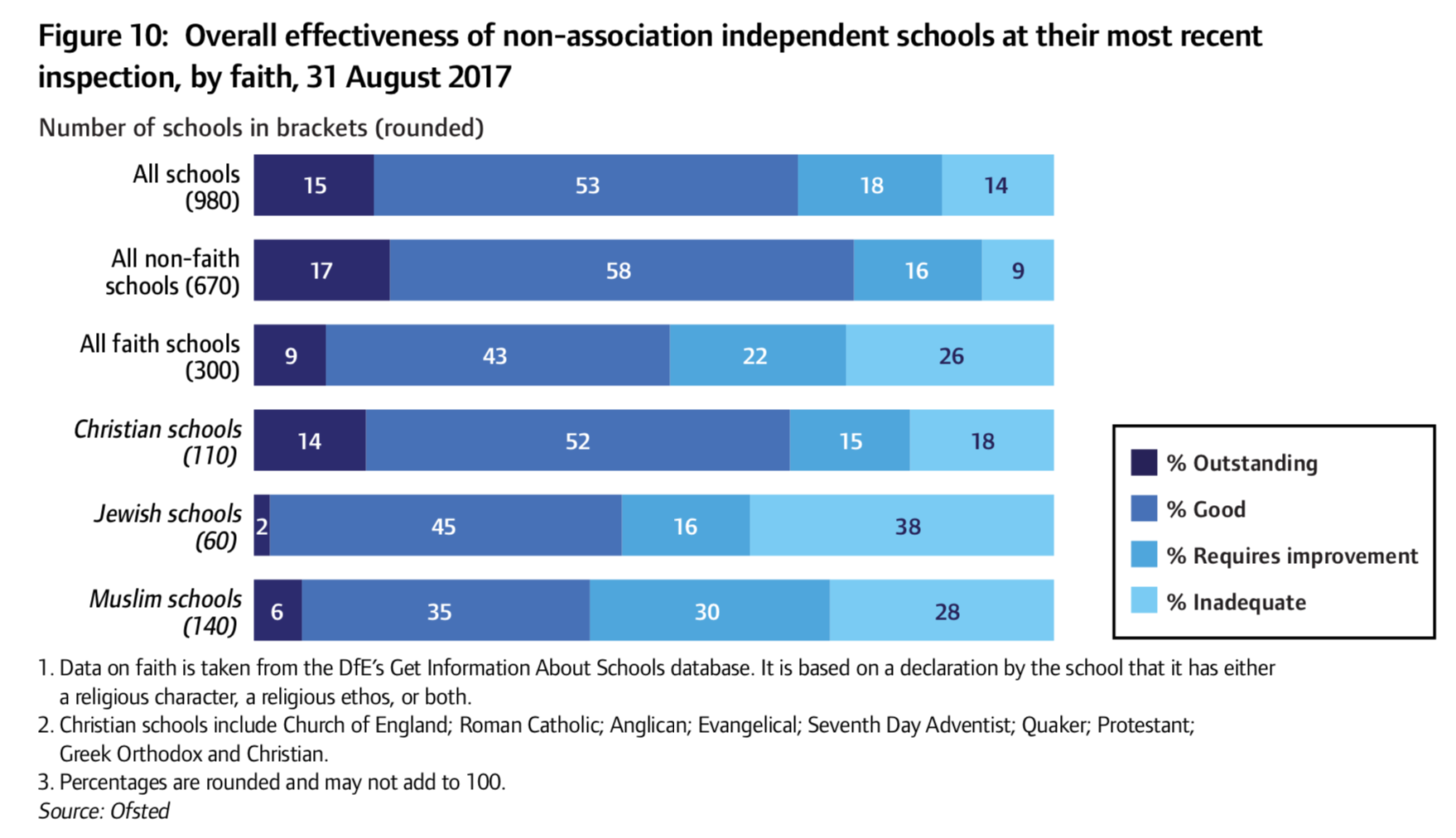
The Ofsted report detailed its recent inspections of private faith schools, with 26% rated inadequate and 22% as requiring improvement – Ofsted’s two lowest categories.

Of the 140 small Muslim private schools inspected by Ofsted in the year, 28% were graded as inadequate, along with 38% of Jewish private schools and 18% of Christian schools.

Spielman had praise for the bulk of state schools, noting that 90% of primaries and nearly 80% of secondaries were rated as good or outstanding.

“If this speech generates any headlines, I doubt they will be ‘English education is good’,” Spielman said.

But the report also focused on a group of schools that Spielman said remained “intractable” to improvement, including a group of nearly 130 that had failed to achieve a good rating in inspections this year or at any time since 2005.

via Private faith schools are resisting British values, says Ofsted chief | Education | The Guardian