It would be interesting to know if second-generation Indo-Canadians continue this practice or not and I understand the researchers are planning to do just that:
Fewer girls than boys are born to Indian women who immigrate to Canada, a skewed pattern driven by families whose mother tongue is Punjabi, according to a new study.
One of the most surprising findings of the study, to be published Monday in the Journal of Obstetrics and Gynecology Canada, is that the preference for boys does not diminish, regardless of how long women from India have lived in Canada.
“It’s counterintuitive,” said Marcelo Urquia, a research scientist at the University of Manitoba’s Centre for Health Policy and lead author of the study. “We know that the longer immigrants are in Canada, the more likely they are to align to the host country.”
But for many Indian immigrants who express a strong desire for sons, the study found, the practice of sex selection remains entrenched. Women who already have two female children are most at risk for abortions in the second trimester, when parents can learn the sex of the fetus. The study builds on previous research led by Dr. Urquia that found a deficit in Canada of more than 4,400 girls over two decades.
The latest study shows that women born in India who already have two daughters gave birth to 192 baby boys in Ontario for every 100 girls. The sex ratios are so distorted, they cannot be explained by natural causes, Dr. Urquia said. Across the globe, by comparison, the odds of having a boy over a girl are slightly higher: 107 boys for every 100 girls.
The preference for boys among many Indian immigrants reveals underlying gender inequities and will not change without intervention, Dr. Urquia said.
Amanpreet Brar, a third-year medical student at the University of Toronto who worked on the study, said gender-selection abortion was talked about openly in India’s Punjab province, where she grew up, but she was surprised to learn that it also happens in Canada.
Ms. Brar, who immigrated to Canada with her family when she was 14, remembers the traditional celebration called a Lohri in India for celebrating the birth of a boy.
“It was rare to hear about a girl’s birth being celebrated,” she said.
But some steps have been taken in Canada to end gender-based customs and celebrate the birth of girls. In Brampton, Ont., where 40 per cent of the population is South Asian, one hospital has started handing out Ladoos, a sugary Indian sweet, when a baby girl is born, Ms. Brar said. Traditionally in India, Ladoos were just for moms who delivered boys.
The study analyzed 46,834 birth records for Indian-born mothers who delivered up to three live births in Ontario hospitals between April, 1993, and March, 2014, and who immigrated to Canada between 1985 and 2012. Mothers who gave birth to twins or triplets were excluded. The study also looked at the mother’s birth place, her mother tongue and how long she had been in Canada.
Among all the mothers having their third child, nearly twice as many males were born compared with females if the previous two children were girls. The ratio was even higher among women whose mother tongue was Punjabi: 240 boys to 100 girls. The ratio of males to females did not differ according to when women arrived in Canada.
Leave it to others to comment, particularly those with experience in dealing with the IRB.
Like all GiC appointments, there is a strong political element (and has always been).
The delay in appointments appears to be characteristic of the government, partially due to its commitment to increased diversity in appointments, but one that affects the timeliness of decision-making.
A slew of seasoned decision-makers tasked with hearing refugee and immigration appeals have either left or will depart from their job in what some call the Liberals’ “housecleaning” of Conservative appointees.
In light of what some critics call inadequate funding and a growing backlog stemming from the recent spike in asylum-seekers crossing into Canada via the United States, the loss of the adjudicators on the immigration and refugee appeals tribunals is expected to toss the system into disarray.
“Our concern is the government is continuing to have a governor-in-council appointment process that is political and discretionary instead of going for a transparent process to appoint the most suitable candidates who are competent, judicious, fair-minded and efficient,” said Raoul Boulakia of the Refugee Lawyers’ Association of Ontario.
“The efficiency and quality of the decisions could be compromised if the people who are brought in do not have the expertise and are not judicious.”
The Immigration and Refugee Board, which oversees both appeals tribunals, said 14 appointees have left their job since last August and another 39 will have their appointments expire by the end of this year. The board confirmed a total of 42 people applied for reappointments to the tribunals, but would not say how many have been successful.
Currently, 23 of the 58 positions at the refugee appeals tribunal are unfilled while the immigration appeals division has six vacancies out of the full complement of 44 appointments.
Like the court system, the refugee and immigration appeals tribunals require adjudicators to have stronger knowledge and experience with the administration of the law in order to review decisions by lower-level refugee judges or immigration officials, who are civil servants.
While failed refugee claimants — and sometimes the immigration minister — can appeal to the refugee tribunal any questionable decisions made by asylum judges, rejected immigration applicants in sponsorships or those facing removal orders can take their cases to the immigration appeals tribunal.
As of the end of December, the immigration appeals tribunal had a backlog of 10,206 cases and a processing time of 20.4 months (compared to 17 months in 2013), while the refugee appeals division had 1,938 cases in the inventory with the average processing time at 124 days (compared to 65 days in 2013), said the refugee board.
Under the old system by the former Conservative government, existing adjudicators seeking reappointment to the tribunals would have all their previous decisions evaluated in terms of quality and quantity before being recommended by the board chair based on their track records.
However, last summer, the Liberal government, which ran an election campaign on transparency and bipartisanship, rolled out a new process for those already sitting on the tribunals by requiring them to reapply for their appointment and pass an online test.
They are then interviewed by a hiring committee made up of the refugee board chair and one representative each from the Prime Minister’s Office, Privy Council Office and the Immigration Department. The composition of the committee opens the door for partisan selection, Boulakia said.
The Privy Council said the government’s new approach to governor-in-council appointments supports “open, transparent and merit-based appointments.”
“All candidates seeking appointment to a GIC position with the Immigration and Refugee Board, be they incumbents or new candidates, are subject to a rigorous selection process developed for the position, which includes inputs and insights from the independent bodies, including the chair of the refugee board,” said Mistu Mukherjee, a spokesperson for the PCO.
“The results of these assessments, made against public and merit-based criteria, are provided to the minister. The minister makes appointment recommendation from this list of highly-qualified candidates.”
Adjudicators who took the test said the questions had nothing to do with immigration and refugee laws and complained they had no way to review the exam or find out why they might have failed.
“The process is partisan and not based on merits. They are cleaning out anyone who was appointed by the previous government, whether they are really affiliated with the Conservatives or not,” complained one adjudicator, who underwent the process and asked not to be identified for fear of repercussion.
“This is complex, technical work. It takes a long time for new members to learn the stuff. This purge means people’s (immigration) status is going to be uncertain for longer. It is going to further affect people’s ability to bring their family members to Canada. This is going to have a huge impact in people’s lives.”
Although it is a common practice for a new government to fill board and tribunal appointments with their party supporters, another affected adjudicator said the test is “flawed” and the process is “rigged.”
“What happens is you feel you are shackled to a political party with your job security resting on the whim of that party. But you are not supposed to get involved in any politics. It is just so wrong when you are not assessed by your performance and good judgment but by who you know,” said the source, whose appointment was not renewed.
“Our political leader has said to refugees, ‘Come to Canada and we will welcome you.’ It’s like an open invitation, but some people who come here are not really who they say they are. With more refugees coming, everybody will be appealing and rushing to the appeals tribunals when they are turned down. This is all about cleaning house.”
Refugee board spokesperson Anna Pape said it is not a requirement for appointees to have experience in refugee and immigration matters and “(complete) training” is provided to all new decision-makers, regardless of their education or experience.
One of the better analysis of the planned changes to Australia’s citizenship regime by Alex Reilly, of Adelaide Law School:
Australia already assesses who to allow in—and to whom to grant residency—before any issue of citizenship arises.
Permanent residents in Australia enjoy almost the full range of civil and political rights as citizens. They have access to the welfare system (after initial waiting periods), Medicare, and education. Citizens alone are able to vote, and they have a greater security of residence.
Citizenship is the last step on the path to full membership. By the time someone is applying for citizenship, they have already been in Australia for a minimum of four years, and have made a life here.
We should be encouraging permanent residents to take up citizenship and to commit fully to Australia. Citizenship, in this sense, is a positive mechanism for inclusion. The government’s focus on citizenship as a mechanism for exclusion in its rhetoric and some of the proposed changes is, therefore, counterproductive.
Prudent. But odd that focus is with respect to the receiving agent function at Service Canada centres, rather than the full service offices of Passport Canada, the responsibility of IRCC (but ATIP documents were from ESDC, not IRCC):
The federal government has been quietly making changes to passport offices in a bid to improve security and address concerns that the facilities could be easy targets for a terrorist attack.
Civil servants in passport and other government offices have for years faced bomb threats, and hostility from individuals who are disgruntled, drunk or suffering mental illnesses.
Internal government documents show that senior officials have more recently worried that someone with extremist views might see a passport office as prime target for an attack, particularly if the federal government revoked their passport privileges because they wanted to go abroad to join a terrorist group.
The briefing note to senior officials at Employment and Social Development Canada says the offices could now more easily become targets, or be collateral damage.
“ESDC Passport offices may be considered targets of symbolic value in future attacks,” reads part of the 2015 briefing note marked, “Canadian Eyes Only.”
The Canadian Press obtained a copy of the documents under the Access to Information Act.
Those concerns were stoked after two separate domestic terrorist attacks in October 2014.
In the first case, Martin Couture-Rouleau hit two soldiers with his car at a strip mall just outside St-Jean-sur-Richelieu, Que., killing Warrant Officer Patrice Vincent, 53. Officials seized his passport that July after police prevented him from flying to Turkey.
Michael Zehaf-Bibeau killed Cpl. Nathan Cirillo at the National War Memorial in Ottawa before storming Parliament Hill. He had come to Ottawa from Vancouver after he ran into problems getting a Canadian passport so he could travel to Libya.
Both attackers were subsequently killed.
The second incident prompted ESDC officials to call in the Mounties to review threats for every passport office in the country. Assessments were also carried out to see what could be done to the physical configuration of spaces, or the layout of services, to better protect the workers inside the office.
The RCMP report from April 2015 concluded that the offices face terrorist and criminal threats, although nothing direct or immediate.
A spokesman for ESDC, which oversees the 151 Service Canada offices that issue passports, said the department has and continues to make changes at existing and soon-to-be-opened facilities in response to the assessments.
Along with physical changes to the offices to increase security there have been operational changes that federal officials hope will lower the risk of an attack. Among the measures was extending the passport renewal period to 10 years from five years and letting Canadians renew their passports online to reduce the number of people who had to go to an office.
Valid commentary and critique by Nicholas Dawson. My sense is that English Canada has better representation of immigrant and visible minority writers:
Pendant le Salon du livre de Québec, la revue Les Libraires a invité dix auteurs à constituer « la bibliothèque idéale », exercice fort amusant dont l’intention était d’encourager des lectures diverses. Toutefois, parmi ces dix « invités de marque », aucun n’était racisé, comme quoi la diversité ethnique demeure un angle mort important dans le milieu littéraire québécois.
Ce type d’omission se reproduit régulièrement. Pour souligner leur dixième anniversaire, les éditions Héliotrope, qui publient des auteurs de grand talent et qui privilégient les voix plurielles (dont celle des femmes et des personnes queer), ont publié sur Facebook une mosaïque de photos présentant les visages tous blancs de ces « voix singulières ». On retrouve la même homogénéité parmi les finalistes des catégories roman, poésie et hors Québec du Prix des libraires, dont le jury n’est également composé que de personnes blanches. L’an dernier, ce même prix n’a été décerné qu’à des femmes, ce dont on doit absolument se réjouir, mais aussi toutes blanches. Il y a quelques visages non blancs parmi les « 100 poètes québécois » recensés par la revue Les Libraires pour la Journée mondiale de la poésie, mais ils se comptent sur les doigts d’une seule main.
Ce ne sont que quelques exemples parmi une pléthore de listes d’auteurs blancs qu’on dresse dans des palmarès, recommandations et recensements, parfois célébrant une « diversité » du paysage littéraire québécois qu’on limite souvent à la parité entre hommes et femmes. Devant ces omissions répétées, j’ai pourtant eu l’instinct de me taire. C’est que je suis un jeune auteur québécois d’origine chilienne, actif dans le milieu mais qui n’a publié qu’un seul livre, avec un deuxième en cours de publication. C’est mon milieu ; on pourrait facilement me reprocher de « prêcher pour ma paroisse », de me faire du « capital symbolique sur le dos des minorités », voire de « jouer la victime ». Ces arguments visent à dépolitiser l’enjeu, l’individualiser, comme si une personne racisée qui crie au racisme ne parlait, au final, que pour son propre intérêt. Pourtant, dans un si petit milieu, certes ouvert d’esprit et sensible, mais où tout le monde se connaît et où les contacts sont légion, de telles démagogies sont efficaces.
Oser prendre la parole
Bref, il y a un problème de représentativité ethnique dans notre milieu littéraire québécois ; les maisons d’édition, les revues, les journaux, les enseignants et les institutions semblent encore relayer la responsabilité aux personnes racisées qui, peu nombreuses et isolées, risquent gros quand elles osent prendre la parole.
[…]. L’enjeu étant très peu soulevé par des gens en position de pouvoir dans ce milieu, les personnes non blanches se retrouvent seules à jouer le rôle de la police ethnique, comme si l’enjeu ne leur appartenait qu’à elles. Pourtant, il s’agit d’un problème qui concerne tout le monde. Célébrer et encourager la diversité ethnique dans la production artistique nationale, c’est non seulement représenter tous les groupes qui constituent notre société, mais surtout contribuer à réduire l’hégémonie des voix majoritaires en permettant aux voix minorisées de les influencer. Pour ce faire, la sous-représentation des personnes non blanches doit être décriée par tous, sans quoi la voix minoritaire, qu’elle soit littéraire ou révoltée, demeure un chuchotement affectant peu les autorités blanches qui ont le beau jeu de garder le silence.
Pour ce faire, il faut d’abord se responsabiliser en reconnaissant ses angles morts, premier pas primordial dont parlent Martine Delvaux et Carole David dans un magnifique article qu’elles ont rédigé pour la revue À bâbord à la suite d’une conférence « autour d’une table ronde sur les femmes et la littérature », événement qui a reçu des critiques parce que les invitées étaient blanches. Une fois cet angle mort reconnu, les personnes en position de pouvoir possèdent les outils pour affronter les questions difficiles : pourquoi les personnes non blanches envoient-elles moins de manuscrits ? Pourquoi sont-elles si peu nombreuses à étudier ou à enseigner la littérature ? Qu’est-ce que les institutions peuvent faire de plus pour, d’une part, attirer les personnes non blanches à prendre part à la production littéraire québécoise et, d’autre part, pour mieux s’adapter aux réalités des minorités dont les langues, les structures et les pratiques ne correspondent pas toujours aux codes dominants ?
Pour répondre à ces questions, je fais donc appel à ces personnes en position d’autorité — éditeurs, journalistes, enseignants — pour qu’elles écoutent d’abord les voix minorisées qui soulignent ce problème blanc auquel plusieurs semblent aveugles. Mais surtout, j’appelle à ce que ces personnes blanches reconnaissent leur hégémonie pour qu’elles cessent de « porter le visage de l’innocence», comme le disent si bien Delvaux et David. Ainsi, en prenant part au débat, elles contribueront à faire de notre milieu littéraire ce qu’il devrait être : un espace de discussion, autoréflexif et politique, qui n’abandonne pas dans des angles morts les personnes minorisées.
Last week’s integration seminars in Copenhagen and Malmö gave me a better appreciation of European debates on integration and multiculturalism (an updated version of my deck with 2016 citizenship numbers is Integration, Diversity and Inclusion – Copenhagen April 2017).
While the two seminars had different participants – Copenhagen included members of the diplomatic corps, officials involved in integration issues and academics from the Centre for Migration Studies, University of Copenhagen, Malmö had only academics, mainly Masters and PhD students – common themes and discussion points emerged. Both events were well attended: between 50-60 in Copenhagen and 25-30 in Malmö.
My pre-reading highlighted just how different Denmark and Sweden’s national policies on integration and multiculturalism are, one reflected in both the Migrant Integration Policy Index (MIPEX) and the Multiculturalism Policy Index (MPI), with the two countries largely at opposite ends of the spectrum. At the municipal level, however, the differences are less clear-cut.
None of the participants in both locations could explain how and why this difference emerged, given that on most other issues both countries have broadly comparable policies and outlooks. Some possible factors mentioned Sweden’s self-perception as a large country compared to Denmark’s being small compared to its earlier history, and thus possible greater societal insecurity. Moreover, Sweden has more urban centres, where diversity is more a fact, whereas Denmark is largely rural save for Copenhagen. But these were cast more in the nature of possible hypotheses, and there appears to be sensitivity, at least among academics, to probe more deeply into the differences.
The Copenhagen event, hosted by the Embassy and the Centre for Migration Studies, was part of the government’s agenda of promoting the Canadian approach to diversity and inclusion (Malmo was in part a follow-on activity to the Governor General’s earlier visit but was self-funded).
As Global Affairs Canada looks at different approaches to meet this commitment, ranging from the symbolic (e.g., this resolution tabled at the UN’s Human Rights Council, The Power of Inclusion and the Benefits of Diversity), high level dialogue (e.g., more senior level engagement like the GG’s messaging in Sweden) or working level (which I would characterize this event as being), I think it is important to emphasize sharing experiences, not promoting models, with some humility in how we approach such discussions.
After all, as I emphasized in both seminars, each country’s geography, history, demographic mix is unique. While we can and should learn from each other, models and approaches cannot be easily transplanted or applied.
Some of the more interesting comments and observations, at least to me, were:
Copenhagen
Immigration and related debates (integration, citizenship and multiculturalism) are largely only viewed through a refugee lens, with little public debate or discussion on what appears a need for skilled immigrants to meet labour shortages. Ironically, there is some recognition in rural areas regarding the contribution immigrants make to the sustainability of rural centres (examples of immigrants from Eastern Europe were cited). This recognition, however, did not translate into any nuance in Danish political debates, where neither rural or business community needs were generally raised, and where all nine political parties hold the same position and focus on refugee issues.
There was considerable discussion of values, which are the important ones and what are the friction points (gender equality being the one most signalled). Some participants were perplexed by Canadian use of the term visible minorities and how it is defined (Denmark does not systematically collect comparable data.)
Malmo
Some of the questions and comments of particular interest included:
How does private sponsorship of refugees work? What is the comparative evidence on how well private vs government sponsored refugees integrate, and over what period of time. Some noted that Sweden’s focus on equality made it difficult to discuss and implement what would be perceived as a “two-tier” system.
Participants noted that like Denmark, immigrants were welcomed in rural areas given their contribution to the local community’s sustainability.
There was an interesting exchange on possible tipping points on reasonable accommodation issues and how these are resolved – or not – through public discussion or, as more likely, through practical accommodations in the various public and private institutions.
An equally interesting question and exchange was with respect to definitions of social cohesion and social inclusion, where I noted that it was largely a question of emphasis: social cohesion stressed expections, social inclusion put more weight on accommodation, but both occurred within the same legal and general framework.
Also raised was the question of “disadvantages” of multiculturalism which led to some discussion about diaspora politics and how foreign policy becomes influenced by homeland concerns.
My observation that in many ways, the citizenship program was “broken” prompted a question (provoked but not planted!) asking for an explanation of how so (i.e., under-resourcing and under-management leading to periodic processing backlogs, recent changes that have resulted in a decline in applications, leading to a decline in the recent naturalization rate).
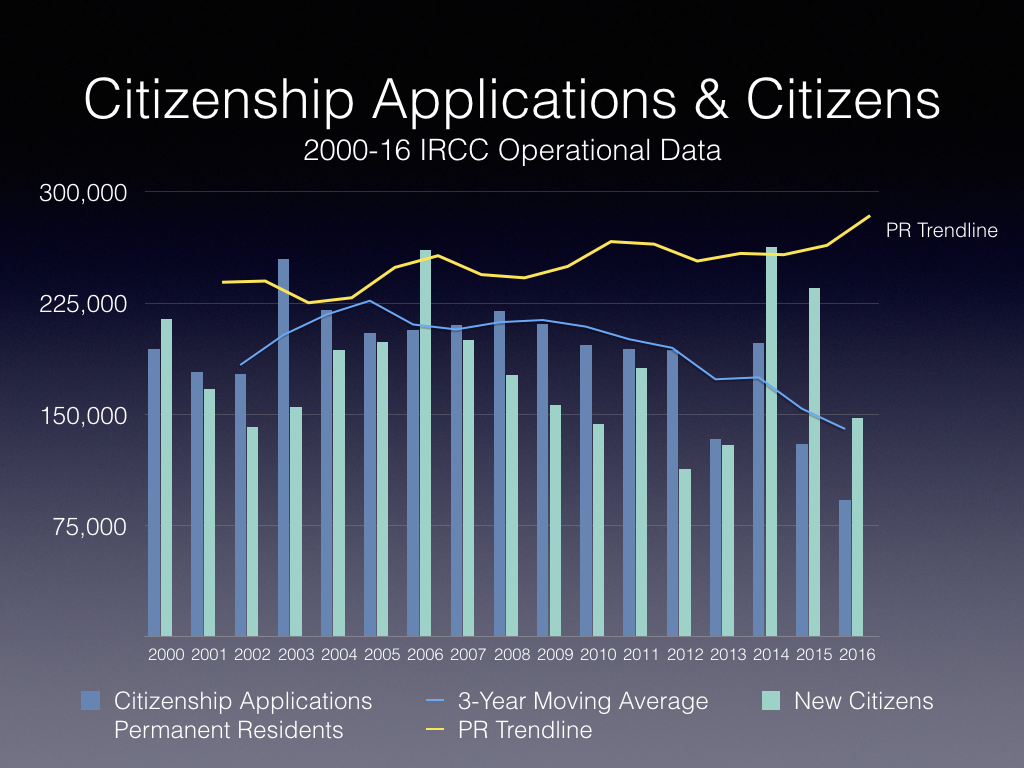
I have been holding off these comments on the IRCC Departmental Plan until the final 2016 citizenship statistics were released. The above chart now includes these showing a steady decline in applications: 198,000 in 2014 (about the historical norm), 130,000 in 2015 and 92,000 in 2016. The number of new citizens, reflecting the additional funding to clear up the backlog of some 300,000 applications, rose to 263,000 in 2014, then dropped somewhat to 235,000 in 2015, with a sharper drop to 148,000 in 2016.
With the number of permanent residents close to 300,000, over time this will mean fewer immigrants taking up citizenship, a major break with the immigrant-to-citizen model.
This “elephant in the room” is mentioned nowhere in the IRCC Departmental Plan (or Performance Report), nor is there any discussion of the societal risks of fewer immigrants taking up Canadian citizenship.
IRCC maintains a meaningless performance management standard: IRCC uses the benchmark of the overall naturalization rate of all immigrants, no matter how long ago they came to Canada, rather than the more relevant number who have become citizens in the last 6 to 8 years.
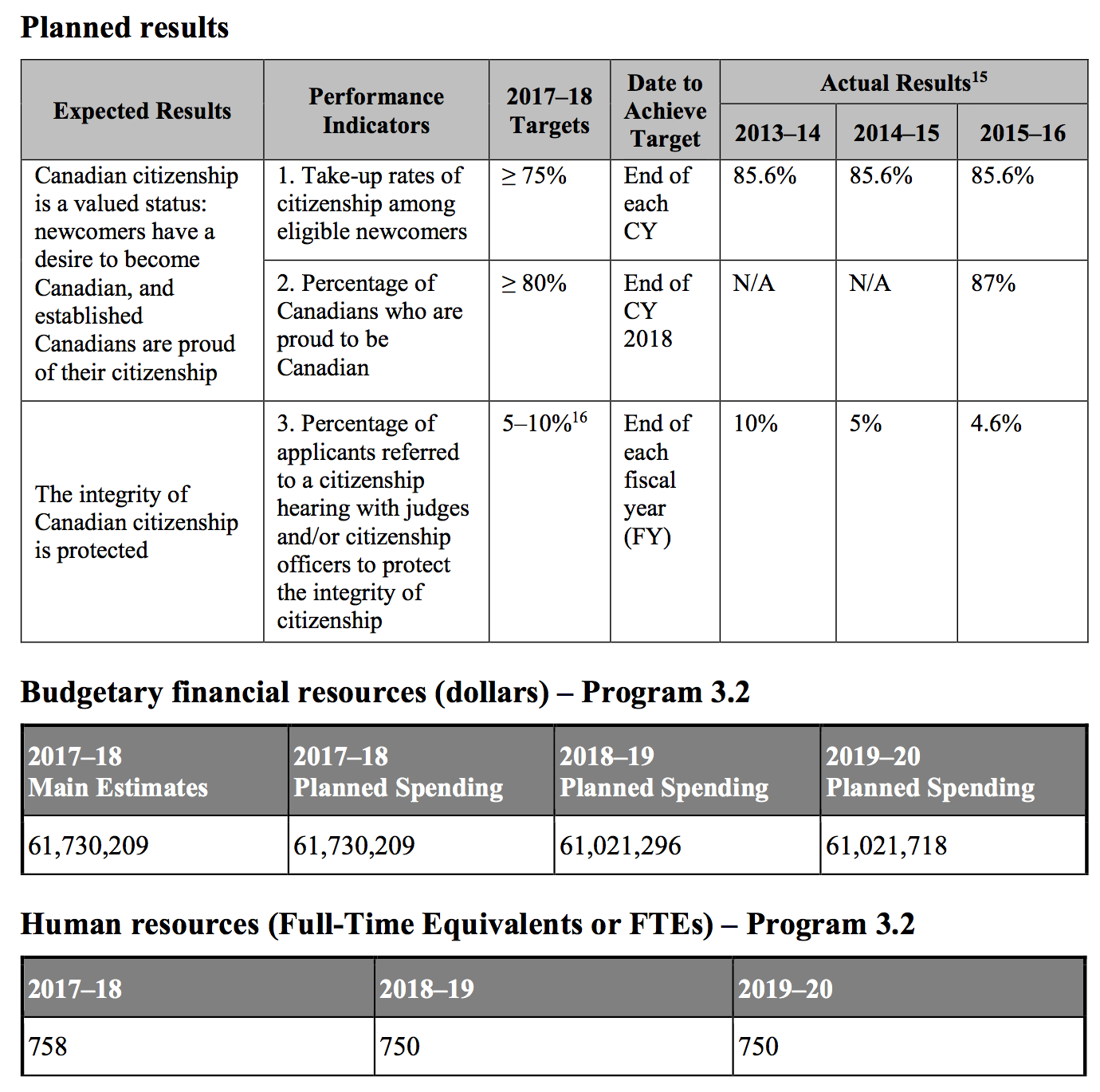
Planned spending is $62 million, projected to remain flat for the next three years (three percent of departmental spending).
Priority: Diversity and attachment
The Department provides newcomers with access to Canadian citizenship and promotes the rights and responsibilities associated with Canadian citizenship, thus fostering a sense of belonging for newcomers and Canadians.
Provide support for proposed legislative changes to the Citizenship Act (Bill C-6) which seek modifications to provisions such as revocation as well as residency and language requirements for citizenship applicants.
Continue to promote citizenship awareness, including through Canada 150 celebrations, and update the citizenship study guide, Discover Canada: The Rights and Responsibilities of Citizenship to be more reflective of Canada’s diversity.
Priority: Efficient processing
The Department aims to ensure that its screening processes are faster for clients and more effective for Canadians.
Expand the eligibility for the new Electronic Travel Authorization (eTA) with proposed expansion for certain travellers from Brazil, Bulgaria and Romania. As well, explore further opportunities to facilitate travel to Canada by lower-risk foreign nationals, such as the increased use of automation to make visitor screening faster, more secure and effective for both travellers and Canadians.
Implement innovative approaches to increase efficiencies and reduce processing times, including reducing the processing time for spousal applications by half, to 12 months. Improve the citizenship application process, enabling qualified permanent residents to obtain citizenship more quickly. The Department will also target citizenship application backlogs and develop tools to improve how work is distributed and handled across its service delivery network.
Program 3.2: Citizenship for Newcomers and All Canadians
The purpose of the Citizenship Program is to administer citizenship legislation and promote the rights and responsibilities of Canadian citizenship. IRCC administers the acquisition of Canadian citizenship by developing, implementing and applying legislation, regulations and policies that protect the integrity of Canadian citizenship and allow eligible applicants to be granted citizenship or be provided with a proof of citizenship. In addition, the program promotes citizenship, to both newcomers and the Canadian-born, through various events, materials and projects. Promotional activities focus on enhancing knowledge of Canada’s history, institutions and values, as well as fostering an understanding of the rights and responsibilities of Canadian citizenship.
Planning highlights
Implement changes to the Citizenship Act following Royal Assent of Bill C-6, including corresponding updates to the Citizenship Regulations.
Update the citizenship study guide, Discover Canada: The Rights and Responsibilities of Citizenship, in support of Canada 150 celebrations.
Continue to collaborate with federal partners and national Indigenous organizations to explore options to respond to the Truth and Reconciliation Commission recommendations.
The Department, through its regular performance reporting processes, has developed specific performance indicators to cover the Citizenship Program’s key outcome areas, including awareness of the responsibilities and privileges associated with Canadian citizenship; desire and successful uptake of Canadian citizenship by newcomers; the integrity of the Citizenship Program; and the value attached to Canadian citizenship. As data are not available at this time, results will be reported in the future.
This pilot will provide some real world data to the existing blind cv studies that have been conducted by Oreopoulos and Reitz.
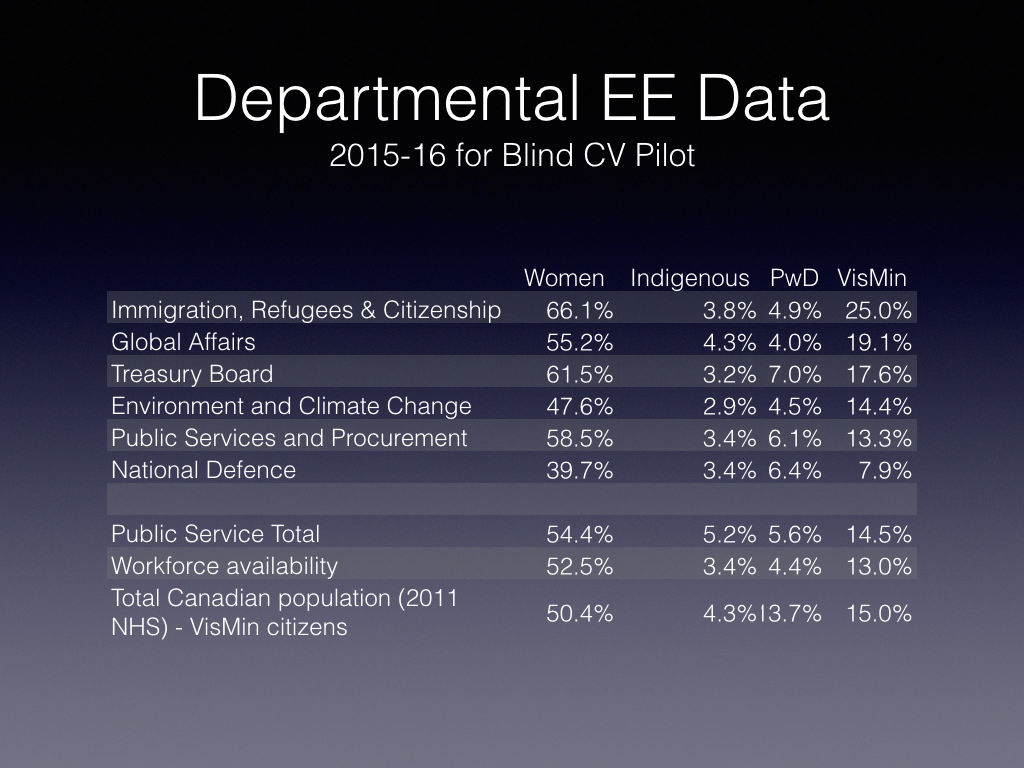
Wisely, the government has chosen to pilot this in a number of departments with different representation challenges, as shown in the table below:
As the government has largely met the goal of being representative of the population it serves, implicit bias may be less of a factor in the government sector. Representation is somewhat less at more senior levels, where implicit bias is likely less of an issue given that candidates are known.
It would be ironic indeed if the pilot, intended to test for bias against visible minorities, would show a bias for visible minorities, given some of the “over-representation” in some departments. In any case, a valuable exercise.
Ottawa has launched a pilot project to reduce biases in the hiring of federal civil services through what is billed “name-blind” recruitment, a practice long urged by employment equity advocates.
The Liberal government’s move came on the heels of a joint study by University of Toronto and Ryerson University earlier this year that found job candidates with Asian names and Canadian qualifications are less likely to be called for interviews than counterparts with Anglo-Canadian names even if they have a better education.
“It’s not just an issue of concern for me but for a lot of people. A number of people have conducted research in Canada, the U.K., Australia and the U.S. that showed there is a subliminal bias in people reading too much into names,” said Immigration Minister Ahmed Hussen, who first delivered the idea to Parliament last year as a rookie MP from Toronto.
“Name-blind recruitment could help ensure the public service reflects the people it serves by helping to reduce unconscious bias in the hiring process.”
Some companies in the private sector, including banks and accounting firms, have already adopted the practice, which removes names from application forms in order to stop “unconscious bias” against potential recruits from minority backgrounds.
In the United Kingdom, the government now requires name-blind applications for university admissions service and other applications for organizations such as the civil service, British Broadcasting Company and local government.
U of T sociology professor Jeffrey Reitz said the initiative is an important step forward but cautioned officials they must consult independent experts in developing the process and reviewing the results to make sure it is done correctly.
To conduct name-blind screening, he said, recruiters must remove any information on a resumé that would reveal the ethnicity of the person, such as name, birth place and membership in an association before coding the candidates in the talent pool.
“If the government is serious about it, they need to make the process transparent and allow researchers to look at the new procedures and the results,” said Reitz, a co-author of the Canadian study on name discrimination against Asians.
Debbie Douglas of the Ontario Council of Agencies Serving Immigrants said she hopes the pilot could benefit other minority groups, given studies have shown that white English- and French-speaking able-bodied women have been the primary beneficiaries of current employment equity programs.
“We hope as the government moves proactively to ensure diversity in hiring it will review the existing program and strengthen it to ensure the intentional inclusion of racialized and indigenous job seekers,” said Douglas.
Treasury Board President Scott Brison, who championed Hussen’s initial idea, said he welcomed the opportunity to explore new ways of recruiting talent for the public service.
“A person’s name should never be a barrier to employment. Diversity and inclusion in the workplace is critical to building an energized, innovative and effective public service that is better able to meet the demands of an ever-changing world,” said Brison at the launch of the pilot at Ryerson Thursday.
The six departments participating in the pilot include Department of National Defence; Global Affairs Canada; Immigration, Refugees and Citizenship Canada; Public Services and Procurement Canada; Environment and Climate Change Canada; and the Treasury Board Secretariat. A report on the pilot is expected in October.
Although a master’s degree can improve Asian candidates’ chances of being called, it does not close the gap and their prospects don’t even measure up to those of Anglo applicants with undergraduate qualifications.
Compared to applicants with Anglos names, Asian-named applicants with all-Canadian qualifications had 20.1 per cent fewer calls from organizations with 500 or more employees, and 39.4 per cent and 37.1 per cent fewer calls, respectively, from medium-sized and small employers.
While as I and Rob Vineberg have argued against indefinite voting rights (Canadian expats shouldn’t have unlimited voting rights), it is nevertheless somewhat amusing that the May government made this commitment, tabled legislation, and then failed to implement, perhaps fearing that most non-resident Britons, particularly those resident in the EU, oppose Brexit and thus likely may be less likely to vote Conservative:
Campaign groups accuse Tories of breaking promise made in October to scrap time limit
Up to 3 million Britons living overseas are to be denied a vote in the general election, the Cabinet Office has confirmed.
In a letter sent to the New Europeans campaign group on Friday, the Cabinet Office said that “unfortunately” British citizens who had lived abroad for longer than 15 years would not be entitled to vote on 8 June.
The letter has prompted a furious reaction from Britons living abroad, and in Europe in particular, with campaign groups accusing the Conservatives of breaking yet another promise.
Nathan Lappin of the constitution group in the Cabinet Office told New Europeans that “there is no sufficient time to change the relevant primary and secondary legislation to enfranchise all British expats, scrapping the 15-year time limit, ahead of the dissolution of parliament before the general election”.
“The people most affected by the referendum were not allowed to vote in it, simply because they exercised their right to live in another country,” said Dave Spokes, one of the founders of the support group Expat Citizen Rights in EU. “Now it seems they will miss out again as their government has repeatedly failed to honour repeated promises to repeal this unjust and unfair rule.
“These people spent their lives working in the UK and many still pay taxes there. It is quite disgraceful that any government can so disregard so many of its citizens.”
Jane Golding, a British lawyer living in Berlin and campaigner for the rights of Britons abroad, said the promise has been broken twice as it was in the Conservative manifesto in the 2015 general election and the Queen’s speech that followed.
“So that is twice we have been denied the right to vote and to participate in the democratic process when this had been promised on an issue, leaving the EU, that directly affects our personal and professional status,” she said.
Last October the government promised to scrap the current 15-year time limit as part of a bid to strengthen ties with emigrants following the decision to leave the EU.
The plans followed a court battle spearheaded by the second world war veteran Harry Shindler, who fought in the Battle of Anzio in Italy in 1944. The 95-year-old, who moved to Italy to be near his grandson in 1982, has been unable to vote in the UK since 1997 but cannot vote in Italy either.
As recently as February, the constitution minister Chris Skidmore assured Shindler and others the government was on track, telling them “their stake in our country must be respected”.
In a written answer on the topic to the New Europeans founder Roger Casale, Skidmore promised “this government will not deny them the opportunity to have their say in how the country is governed”. He also revealed that the government estimated “a further 3 million British citizens resident overseas will be enfranchised”.
Samia Badani, director of New Europeans, said the decision not to expedite legislation was devastating for Britons desperate to have a say on their own futures in Europe but it was not too late to get them on the electoral register. “The time for legislation is now. When there is a will, there is a way,” she said.
Badani said: “We are very disappointed – this is another broken promise. We have been campaigning for the removal of the 15-year rule – which is very arbitrary – for years. We were promised that at the next general election all UK citizens could vote, but it now looks like a double-whammy: they couldn’t vote in the referendum and now can’t vote in the next general election.”
Clearly responding to concerns of the right, and a reflection that immigrant voters play a less important role than in Canadian elections, with the result of fewer immigrant and visible minority MPs:
Australia plans to raise the bar for handing out citizenships by lengthening the waiting period, adding a new “Australian values” test and raising the standard for English language as part of a shake up of its immigration program.
The move comes in a week when Prime Minister Malcolm Turnbull announced axing a temporary work visa popular with foreigners and replacing it with a tougher program in a bid to put “Australia First”.
Australia has seen the rise of nationalist, anti-immigration politics with far-right wing parties such as One Nation garnering strong public support, while the popularity of Turnbull’s ruling center-right government has been languishing.
The new citizenship requirements are expected to be passed by parliament with the backing of right-wing Senators.
On Thursday, Turnbull said basic English would no longer be sufficient to become an Australian citizen under the new test.
Applicants need a minimum level 6.0 equivalent of the International English Language Testing System, and a person will only become eligible for citizenship after four years as a permanent resident, up from one year.
“What we are doing is strengthening our multicultural society and strengthening our values,” Turnbull told reporters in Canberra. “Australian citizenship should be honored, cherished. It’s a privilege.”
“I reckon if we went out today and said to Australians, “Do you think you could become an Australian citizen without being able to speak English?” They’d say, “You’re kidding. Surely you’d have to be able to speak English.”
Turnbull said the current immigration process was mainly “administrative” while the citizenship test largely a “civics test.”
The current citizenship multiple-choice questionnaire tests a person’s knowledge of Australian laws, national symbols and colors of the Aboriginal flag. But Turnbull said it was not adequate to judge whether a person would accept “Australian values.”
“If we believe that respect for women and children and saying no to violence…is an Australian value, and it is, then why should that not be made a key part, a fundamental part, a very prominent part, of our process to be an Australian citizen? Why should the test simply be a checklist of civic questions?”
The new citizenship test will include questions about whether applicants have sent their kids to school, whether they go to work – if they are of working age – and whether becoming part of unruly gangs in cities were Australian values.
“We’re standing up for Australian values and the parliament should do so too,” Turnbull said.
And predictable expressions of concerns (valid) from groups who work with refugees and other vulnerable groups:
Refugees would be hit hardest by changes to Australia’s citizenship test, the refugee council says, with people deterred from applying for citizenship or potentially failing the test under new English language requirements.
The Refugee Council of Australia argues older refugees, and those who’ve arrived from conflict zones with disrupted educations, would find the strengthened English requirement hardest.
“While the overwhelming majority of refugee and humanitarian entrants are children and young people who typically learn English quickly, those brought to Australia as refugees include some older adults, torture survivors and people with disabilities who struggle to master English. These are the people who are most likely to miss out on citizenship under the changes being planned by the government,” the RCOA chief executive, Paul Power, said.
“The sad irony is that people who have come to Australia as refugees value the freedom and security associated with Australian citizenship more highly than any other group in the nation.”
Power said the proposed changes to the citizenship test would not achieve what the government has said it is aiming to do.
“No extremist or terrorist is going to be unearthed by a few questions about values. But the person who will struggle will be the 45-year-old Sudanese mother, who has come to Australia as a refugee, who has had a disrupted, if any, formal education, and is struggling in adulthood to learn a fourth language.”
Department of Immigration and Border Protection statistics reveal refugees apply for citizenship at a higher rate than any other migrant group. But they also fail the test at a far higher rate – refugees have a failure rate of about 8.8% , six times the rate of 1.4% for other categories of migrants. On average, a refugee needs to attempt the citizenship test 2.4 times, double the average for all migrants of 1.2 times.
Henry Sherrell, researcher at the ANU’s Crawford School of Public Policy, said the proposed new English language requirement would be a serious barrier to citizenship, particularly for refugees and people in Australia on family visas or the spouses of skilled migrants.
He said the proposed new English level, the equivalent English proficiency of some university entrance requirements, was too high.
“Migrants want to learn English. They want to work. However, not every single newcomer to Australia is in the position to achieve this level of English. This represents a fundamental change to citizenship in Australia with enormous consequences.”
“Alternative and improved education pathways to acquire citizenship need to be established for different categories of people seeking citizenship.
“The special situations of refugee and humanitarian entrants and other disadvantaged and vulnerable people seeking citizenship must be addressed.”
The test underwent minor changes in 2009. The citizenship test currently has exemptions for people aged over 60 or with significant disabilities. A government discussion paper on the proposed citizenship test changes, released on Thursday, mentions these exemptions and indicates that they will continue.
Refugees already in the country face substantial – in some cases illegal – barriers to becoming citizens.
More than 10,000 potential citizens who have completed all the requirements for citizenship, including passing the test, and are awaiting only a ceremony to confer citizenship.
The government revealed in court there were 10,231 people who had qualified for citizenship who were living in limbo unsure, when, if ever they would be granted citizenship. Some had been invited to ceremonies only to be told by text message the night before that they would not be made citizens.
And from those from English speaking countries (valid, but more than a touch of superiority):
Ian Sinkins, a British electrical engineer in Australia on a temporary skilled class 457 visa, has a serious beef with Australia’s proposed new citizenship requirements.
The changes, announced by the Turnbull government on Thursday, would require aspiring citizens to sit an English-language test, prove a commitment to Australian values and live in the country for four years as a permanent resident, instead of one.
“We’re being tarred with the same brush … [the plan] doesn’t differentiate where people have come from,” Sinkins told Guardian Australia. “We’re from a Christian background, we speak English, and there’s the shared heritage between Australia and England. And yet we have to take an English-language test, to prove certain things that are kind of obvious. It’s unsettling.”
Turnbull said it was “in [migrants’] interests” to learn English, adding “they can maybe take longer before they make their application to be an Australian citizen”.
On Friday the immigration minister, Peter Dutton, said speaking English was desirable “because it makes it easier for people to find work … to speak to their neighbours, to turn up to the local footy club or be involved in their church or mosque or whatever”.
But Sinkins, his wife Lisa and two children, who arrived in Australia two and a half years ago, have experienced no such difficulty. He said they have easily settled into their new life, love Australia’s culture, its work ethic and people.
Lisa Sinkins’ uncle and aunt came to Australia more than 50 years ago as “10 pound Poms” and she has first and second generation Australian cousins. “There is no recognition of such background history in the existing or planned changes to the visa and citizenship regulations,” she said.
Lisa is a head practice nurse in a Melbourne clinic, while Ian works at a German renewable company specialising in energy storage and has set up a local company which is growing to the point it will soon employ local engineers.
But with the planned changes, the family face an uncertain future as it will now take a total of eight years – four on the temporary work visa and a further four as permanent residents – to become citizens.
“We question the wisdom of extending the time on permanent residency from one to four years … for citizens from countries such as the UK that clearly have shared values,” he said.
And Sinkins and his family aren’t alone. Of the 95,758 people in Australia on a 457 visa, 19.5% are from the UK, behind India on 24.6%, to mention just one visa class among many that provide a pathway to citizenship.
Sinkins said Australia could be missing out on skilled and motivated people and families, who may rethink their current aspiration to become Australians and make the nation stronger.
“We are now wondering if we are really welcome in Australia with so many obstacles and changing goalposts … we are even now considering whether we should return to the UK,” he said.

 Multicultural Meanderings