A quarter of Canadians want Trump-style travel ban, poll shows – Politics – CBC News

While I do not find these results all that surprising (but the headline could have been written “75 percent don’t want”) rather than focusing on the negative.

Angus Reid polling tends to be more negative on these issues than Environics and Ekos .

This does however reinforce the need for the government to be attentive to these concerns, even if they are more part of the Conservative than Liberal base (as some of the CPC leadership campaign strategies and opposition to M-103 indicate):

A significant minority of Canadians say Canada’s 2017 refugee target of 40,000 is too high and one in four Canadians wants the Liberal government to impose its own Trump-style travel ban.

Those are just two of the findings in a new Angus Reid poll that looked at Canadian’s attitudes towards the federal government’s handling of refugees.

Overall, 47 per cent of Canadians surveyed said Canada is taking in the right number of refugees. But 11 per cent say 40,000 is too low and Canada should take in more, while 41 per cent say the 2017 target is too high and that we should not be taking in anymore refugees.

Shachi Kurl, executive director of Angus Reid, told CBC News that “41 per cent is not the majority voice but it is a significant segment of the population that is actually saying our targets for 2017 are too high and that, I think, adds to a level of anxiety for those folks.”

“Certainly in terms of that ‘too many, too few’ debate, a lot more people think it’s too many than too few,” she said.

The survey also asked Canadians about the federal government’s decision not to alter its own immigration policy to match that of U.S. President Donald Trump’s after he rolled out his travel ban.

Some 57 per cent of Canadians said the federal government made the right call in not following Trump down the rabbit hole, while 18 per cent said Prime Minister Justin Trudeau’s government should have chose to take in more refugees.

But the number that is perhaps the most interesting is that 25 per cent of Canadians say Canada should have adopted its own temporary travel ban similar to the U.S. policy.

“We tend to, when we are looking a numbers, look at the majority view, but the fact that one in four Canadians are of the mind that we should be looking to our own travel ban is significant and is part of a red flag that is starting to emerge in terms of refugee policy,” said Kurl.

Working hard to fit in

When it comes to whether the government did a good job of resettling refugees, 61 per cent said they either strongly (12 per cent) or moderately (49 per cent) agree that it had. But some 39 per cent of people either moderately (22 per cent) or strongly (17 per cent) disagreed.

Kurl said those surveyed are also split over how well refugees are integrating into Canadian society, and how enthusiastically Canadians are welcoming new arrivals.

A slim majority of (54 per cent) say refugees do not make enough of an effort to fit into mainstream society, while 46 per cent say that they do try hard to fit in.

When the responses are broken down across age groups, it’s revealed that the younger the person, the more likely they are to say that refugees are working hard to fit into Canadian society.

For example, 62 per cent of those in the 18-24 age range say refugees are making enough of an effort to fit in, but in the 25-34 age range that drops to 47 per cent.

There is a slight spike among 35-44 year olds where 54 per cent of those asked said refugees are working hard to fit in, but for those who are 45 and older, only one in four said the same thing.

Source: A quarter of Canadians want Trump-style travel ban, poll shows – Politics – CBC News
M-103: Canadian Muslims need this showing of solidarity: Meighen and Waldman

Good commentary by Warda Shazadi Meighen and Lorne Waldman.

The definition issue is a red herring; should the Canadian Heritage committee study Islamophobia/anti-Muslim hate along with “all forms of systemic racism and religious discrimination,” it will have to, as part of its work, adopt a working definition, where both Minister Joly and MP Khaled have been reasonably clear that its focus is on the practical impacts of discrimination, not free speech.

The critics need to read and understand the text of the motion:

The sentiments of Muslims have become perpetual casualties of wedge politics.

The continual debasing of Muslims, culminating in the recent attack in Quebec City, is precisely why it is important for Muslims to see their leaders express solidarity with them.

M-103 does precisely this in the form of a non-binding motion that condemns Islamophobia. If the motion passes, its symbolism will do much to alleviate the deep suffering of many Muslims. On a practical level, it would result in the House of Commons’s heritage committee taking tangible steps to study the issue, and perhaps make recommendations to address it.

What M-103 will not do is curb freedom of speech. M-103 is not a law. If the concern with M-103 is the limitation of free speech, the non-binding nature of the motion should assuage that anxiety. Only hate laws, which have existed in the Canadian Criminal Code for decades, can actually punish individuals for promulgating certain types of hate. Rest assured that the marketplace of ideas will continue to exist – the threshold under the law for hate speech is quite high and justifiably so. M-103 is no more than a tip of the hat in solidarity.

If the true concern with M-103 is that the term “Islamophobia” lacks clarity, the correct response is to call for a definition of that term. Here is one: the irrational fear of Muslims.

If the opposition to this motion is nothing more than a continuation of wedge politics, we ought to reflect on what type of society we are creating. To alienate Muslims who are eager to contribute to our society is unwise. Camaraderie with any minority group that is being singled out is crucial – it embodies the promise of Canada and what Canada is lauded for globally.

The Conservative Party’s effort to pass a new motion cleansed of the word “Islamophobia” and replaced with condemnation of “all forms of systemic racism, religious intolerance and discrimination of Muslims, Jews, Christians, Sikhs, Hindus and other religious communities” is obstructive and, frankly, misses the mark. It does not help to alleviate the incredibly hurt sentiments of many Muslims. It is also redundant, as the Supreme Court, in the 1990 case of Canada v. Taylor, has already banned any expression that is “intended or likely to circulate extreme feelings of opprobrium and enmity against a racial or religious group.”

Muslims are being targeted now not only in Canada but across Western liberal democracies. To oppose a motion made in solidarity with Muslim Canadians, many of whom have been weighed down by the effects of Islamophobia for too long, is tragic.

Source: M-103: Canadian Muslims need this showing of solidarity – The Globe and Mail

Factors to consider about Sharia law and M103: Kutty 

Faisal Kutty on the M-103 controversy:

For those who fear Sharia creep, it’s too late. It’s already here. For most, rather like “the golden rule,” the Sharia demands that they obey the laws of the land; live peacefully with their neighbours; don’t lie; don’t cheat; pay their taxes; respect each other; care for the underprivileged and the oppressed; and focus on making the world better for all.

In fact, scholars consider the thrust of the Sharia to be advancing human welfare. Muhamad Abdu, a prominent Al-Azhar jurist at the turn of the 19th century, once said: “I went to the West and saw Islam, but no Muslims; I got back to the East and saw Muslims, but not Islam.”

Getting past the Sharia hysteria is not enough, because opponents still have their trump card (pun intended). They don’t have a hate on for Muslims, they only object to the term “Islamophobia.” These newly minted word etymologists argue it is imprecise and precludes legitimate criticism. They counter that it is not a phobia because it is not a mental condition, but a grounded fear of bad ideas.

Au contraire, it is a phobia, because it is prejudice and bigotry towards Muslims and the irrational and exaggerated fear of an assumed, but non-existing monolithic Islam represented by the Sharia bogeyman.

It is exaggerated, because it takes the regressive interpretations of the few who justify terrorism and antimodern ideas and instinctively project it onto all Muslims.

It is irrational because it ignores the peaceful and progressive Sharia interpretations adopted by the clear majority of Muslims while authenticating only the extremist views. All 1.6 billion Muslims (except “moderates”) are painted with the same brush.

Respectful criticism of Islam and even Muslim practices is done daily by many, including Muslims. Yet the Islamophobia label is not used, because it is not done with loathing and contempt. Diversity of opinions are a recognized forte of Islamic jurisprudence.

For the past 26 years, I have critiqued the mainstream Islamic opinions on blasphemy, apostasy, the status of women, etc. I am challenged sometimes, but never have I been labeled an Islamophobe. Many in the Muslim world are persecuted for this, but it’s not for Islamophobia.

Yes, anti-Muslim hate or “Muslimophobia” work, but Islamophobia conveys the deeper, richer and more precise nature of the feelings and beliefs that drive the “othering” of Muslims.Faisal Kutty

Source: Factors to consider about Sharia law and M103 | Toronto Star

Is anti-Semitism truly on the rise in the U.S.? It’s not so clear. – The Washington Post

Marc Oppenheimer on the more important issue than the numbers:

Overall, however, we won’t know for many more months, when the FBI and the Anti-Defamation League have better data to work with, if Nov. 9, 2016, was the start of something new or just a continuation of a regrettable but enduring legacy. My best guess is that we are facing a continued march of the low-level, but ineradicable, Jew hatred that we always live with.

But for now, we Jews should worry less about whether attacks against us are “on the rise,” because it’s not clear whether they are. That’s not the most important question, because to any student of history it’s no comfort if anti-Semitic attacks aren’t on the rise. In many times and places, Jews have been the canary in the coal mine; when racist authoritarianism arrives, we Jews are among the first to sniff it in the air. But that’s not true in this time and place. This isn’t Germany in 1933. In the United States in 2017, the first to be targeted are Muslims or Mexicans — after which they will probably come for Jews, gays, blacks and all the other apparent undesirables who irk Trump’s angriest followers. The real question a reporter who cares about Jewish safety should ask Trump is about the health and safety of other minority groups.

Consider the right-wing parties in Poland, Hungary, Russia, France and elsewhere in Europe: None of them takes anti-Semitism as its central organizing principle. They all have other boogeymen, in many cases Muslims. But Hungary’s Jobbik, the third-largest party in the country, is clearly anti-Semitic, and Poland’s nationalist government, with its revisionist World War II history, is worrisome. All of them attract the support of anti-Semites, and all of them could be expected, like Francisco Franco during World War II, to comfortably make common cause with anti-Semites.

Right-wing and nativist violence does not always begin with Jews. But by fixating on attacks against Jews, we are forgetting the cardinal rule of Jewish self-survival: It may not start with us, but it always ends with us.

Source: Is anti-Semitism truly on the rise in the U.S.? It’s not so clear. – The Washington Post

Les jeunes péquistes refusent de revenir à la charte des valeurs

Encouraging:

Les esprits se sont échauffés au Congrès du comité national des jeunes du Parti québécois (PQ), qui ont rejeté en bloc, dimanche, l’idée d’interdire le port des signes religieux pour tous les employés du secteur public et parapublic pendant leurs heures de travail. Seulement une quinzaine de personnes ont appuyé une mesure qui consistait essentiellement à reprendre les aspects controversés de la charte des valeurs du gouvernement Marois.

« Cette proposition-là, à mon sens, ce n’est pas de la laïcité, c’est, d’une certaine façon, jouer le jeu des racistes. Qui on va attirer au Parti québécois avec cette proposition-là ? » a lancé le délégué Laurent Constantin aux jeunes réunis à Victoriaville. Il a été hué pour avoir utilisé le mot raciste.

« On est Québécois avant tout. C’est de cette façon que nous réussirons à inclure dans la société tous les Québécois de quelque origine qu’ils soient », a exposé Nicolas Turcotte, de l’association des Laurentides, qui avait avancé cette proposition pour le congrès.

Marc-André Bouvette, le nouveau président du Comité national des jeunes du PQ, et Ariane Cayer, la présidente sortante, se sont prononcés contre la proposition. « Les gens sont tannés, les gens ont envie qu’on règle cette question-là une fois pour toutes et là, nous, on a l’odieux d’aller secouer ça encore ? Les gens sont plus capables », a lancé Mme Cayer.

Our Trump moment might not be so white: Saunders

Doug Saunders reminds us of Rob Ford, that his base was largely the non-white suburban poor and the importance of addressing barriers that produce marginalization:

Canada’s most dramatic recent triumph of Trump-style politics occurred in Toronto, where nearly half the city’s voters (and Toronto has more voters than most provinces do) cast a ballot for a wealthy, unpredictable, populist, anti-immigration, anti-elite, racist-mouthed guy named Rob Ford in 2010, and a third voted for his movement in 2014. Many note the similarities between the late mayor and the current President. Others point out the big difference: Ford voters weren’t generally, or even mainly, white.

An analysis by University of Toronto geographer Zach Taylor found that the Torontonians who voted for Mr. Ford overwhelmingly lived in inner-suburban wards whose populations were mainly racial and ethnic minorities, mainly lacking university education and mainly getting by on family incomes of less than $100,000 a year. Those voters are what the journalist Naheed Mustafa, in an analysis of their backgrounds, called “the non-white suburban poor,” whom Mr. Ford pitted against an unseen, well-paid downtown elite (and sometimes against newer immigrants) – “Despite his personal wealth, he gave the impression that he spoke the language of the marginalized.” Sound familiar?

Since the eighties, new Canadians and their families have tended to live in the low-cost, poorly transit-connected high-rise suburbs; they are more likely to be excluded from the housing boom and the secure new-economy jobs that have buoyed Canada; they are generally not white. Mr. Ford spoke their specific language of outsider resentment; he stoked the anger felt by many marginal Caribbean, African, South Asian and East Asian Canadians, and worked their Evangelical and Pentecostal churches. He knew their sense of exclusion could be turned into angry intolerance and he gave his voters a mythic “them” to be angry about. And it worked.

Likewise, the 2011 federal election was the first in which most ethnic and religious minorities voted Conservative. The Harper Tories certainly weren’t a populist far-right party, but they didn’t attract these new voters by moving leftward.

This doesn’t mean minorities in Canada have turned to the far right – they haven’t, any more than anyone else has. It does mean that anger and exclusion and paranoia in Canada, and even racial intolerance and xenophobia in Canada, are just as likely to entrap minority Canadians. The places where I most often hear overtly pro-Trump opinions are on Toronto’s black-music radio station or in the suburban flea markets: His outsider message works there.

Canada has traditionally avoided extremism by offering hope: If you start on the bottom rung, you can make it higher. But the second and third rungs are no longer so secure. If they fail, we could wind up electing the world’s most diverse form of self-destructive intolerance.

Source: Our Trump moment might not be so white – The Globe and Mail

Refugee claims at Canada-U.S. border have doubled over past 2 years

Will likely be an ongoing challenge under the Trump administration:

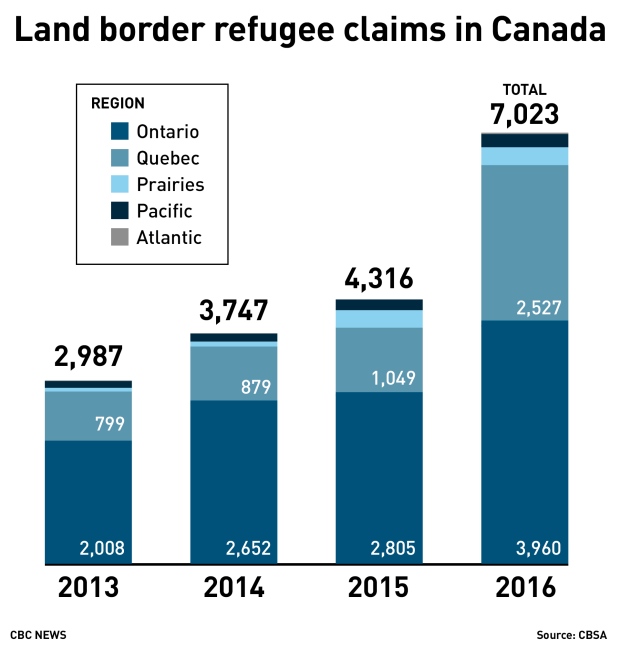
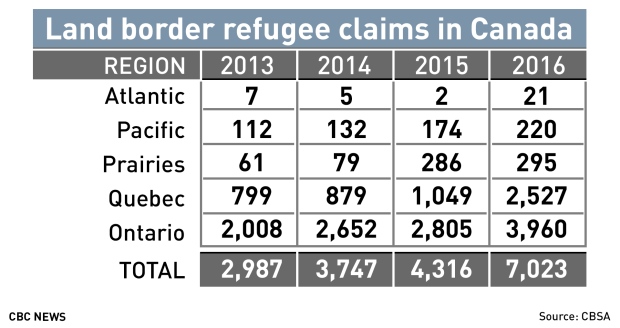
The number of refugee claims made at the border has more than doubled over the past two years, surging to 7,023 in 2016, according to the Canada Border Services Agency.

By comparison, 4,316 people sought refugee status in Canada at land border crossings in 2015 and another 3,747 did in 2014.

But the spike isn’t unusual and represents a return to the volume of refugees Canada has previously received, said Janet Dench, executive director of the Canadian Council of Refugees.

land border refugee claims

“The numbers may look high, but that is because the range you are looking at is one where Canada has been receiving unusually low numbers of claimants,” Dench said in an email interview, noting that there were more than 8,000 land border claims made annually from 1999 to 2004.

“So in the longer perspective, 7,000 is not a very large number,” Dench explained.

Canada changed the way it receives refugees in 2004 with the introduction of the Safe Third Country Agreement with the United States. The agreement says that people seeking protection must make their claim in the first country they arrive in. Canada must accordingly send asylum seekers trying to cross at the border back to the U.S.

21.3 million refugees around the world

In 2016, the largest group of people making refugee claims at border crossings in Canada came from Colombia, followed by Syria, Eritrea, Iraq and Burundi. There were 21.3 million refugees around the globe in 2015, according to the United Nations.

Lorne Waldman, a Toronto-based lawyer who specializes in immigration and refugee law, attributes the recent rise to geopolitical instability. For example, there was a dramatic rise in Turkish refugee claims in Canada following the coup in Turkey.

“The numbers tell stories and the stories are really related to what’s happening politically,” he said, noting that Canada observed a rise in Pakistani refugee seekers that arrived via the U.S. following the Sept. 11 attacks.

land border claims

Waldman said the election of U.S. President Donald Trump, who campaigned on a promise to crack down on immigration and recently tried to enact a controversial travel ban restricting travel from seven Muslim majority countries, likely contributed to the bump.

“As the situation deteriorates in the U.S., the likelihood that we’re going to see more people crossing is very high,” he said.

But, Waldman noted that there has long been a perception among asylum seekers — even before Trump took office — that the U.S. is not sympathetic to refugee claims.

Source: Refugee claims at Canada-U.S. border have doubled over past 2 years – Canada – CBC News

Trump Copies the Worst Mistake of FDR – Scott McGaugh, The Daily Beast

Another example of those who forget history …:

Fear and vengeance have again gripped our nation. It’s not the first time that Americans have acted in a most un-American manner when we have been attacked or feel threatened. Throughout our history, we have branded entire ethnic groups as vague-but-dangerous threats. American communities have been forcibly unrooted without due process. Immigrants from China to the Middle East have been banned from our shore, in a passion first captured by Cicero when he wrote, “In times of war, the laws fall silent.”

February 19 marks the 75th anniversary of President Franklin Roosevelt’s Executive Order 9066 that ordered the removal of more than 100,000 Japanese Americans from the West Coast in 1942, solely because of their ethnicity. There was no due process. No formal charges. Families were given only a few weeks’ notice to sell their businesses, homes, personal belongings, and even family heirlooms. “Japantowns” from San Diego to Seattle were gutted within a few months.

In this century, the 9/11 attack and jihadist-inspired domestic violence have spawned speculative calls for databases of Muslim Americans and mosque closures. Now President Donald Trump has tried to chaotically banish wide swaths of ethnic immigrants, for fear of unknown enemy combatants who may be among them. Out of fear of the invisible few, President Roosevelt authorized the equivalent 75 years ago this month, in what now is considered one of the darkest chapters of American history. President Trump has stopped short of condemning internment camps, despite national apologies by Presidents Reagan and Bush.

Shamefully, Trump is continuing an American tradition of retribution and vengeance against ethnic groups. When Native Americans were viewed as a threat to white settlement and expansion, tens of thousands were forcibly moved onto more than 300 reservations. Indeed, Cicero proved prescient when our Japanese-American neighbors were sent to internment camps about 65 years later in some of the same desolate regions that had been forced upon Native Americans.

It would serve President Trump and his allies well to reflect on Americans’ treatment of their Japanese-American neighbors in World War II. It was euphemistically called “relocation” and “evacuation” at the time. But the reality was far different. It was hysterical payback. Most victims endured nearly two years in a prison-camp environment of barracks where families lived in a single room. They were surrounded by barbed wire and guarded by armed soldiers, weapons turned inward.

Were they truly the American enemies that some feared—just as President Trump views large swaths of Muslims today?

In 1943, President Roosevelt authorized the segregated Japanese-American 442nd Regimental Combat Team. He asked the sons of those incarcerated and others to volunteer for an army commanded by white officers and to possibly die for their country in Europe and the Pacific. Remarkably, 10,000 volunteers from Hawaii stepped forward. Together with about 1,300 volunteers from the internment camps and draftees, army recruiters were overwhelmed by the response.

The 442nd suffered horrendous casualties on near-suicide missions as it compiled a remarkable war record. Ultimately the 442nd became the most-decorated unit of its size in World War II. One of its battalions, the 100th from Hawaii, brutally earned the moniker “Purple Heart Battalion.” The 442nd ultimately earned more than 18,000 awards for valor, more than one for every man. (Yet Japanese-American soldiers were denied Medals of Honor until President Clinton issued 21 in 2000. Only seven were alive to receive them personally.)

They returned home after the war and some suffered continuing hatred from their neighbors. Yet they endured and rebuilt their lives as parents, teachers, merchants, church leaders, and mechanics. Even though their families had been treated as a faceless, homogenous, and undefined internal threat against America, for the most part Japanese Americans suffered silently as they rose above America’s fear and vengeance.

Today their legacy sounds a cautionary note against partisan political talk of Muslim-American databases, muddled policy statements about Muslim Americans abroad, Muslim immigrant banishment, and the dangers of American mosques.

Today’s sweeping characterizations of Muslim Americans and Middle Eastern immigrants are a dangerous echo of America’s World War II treatment of Japanese Americans, as articulated by Oregon Governor Walter Pierce: “Their [Japanese American] ideals, their racial characteristics, social customs, and their way of life are such that they cannot be assimilated into American communities. They will always remain a people apart, a cause of friction and resentment, and a possible peril to our national safety.”

His statement sounds eerily familiar today. It is a sentiment that continues to sully the American spirit. Fear and vengeance must be stifled if thoughtful and constructive decisions are to be made that intelligently protect America’s national security.

Source: Trump Copies the Worst Mistake of FDR – The Daily Beast

John Ivison: Langevin was a man of his time, not a monster, so don’t take his name off an Ottawa building

While I understand the pressures for renaming, I much prefer keeping the original names but with historical plaques that capture both sides of the legacies of historical figures. There are risks in erasing or forgetting history:

To damn Langevin is not only to judge him with the benefit of 135 years of hindsight but also to ignore the political leadership he showed during his nearly 30 years as a cabinet minister. He was not a monster — he was a man of his time.

Brian Lee Crowley, managing director of the Macdonald Laurier Institute think-tank, was not referring to Langevin in his remarks at a “Canada at 150” dinner Thursday, but he may as well have been.

“It is easy to criticize the past and the decisions made there. But it is a conceit of each and every generation that they alone are free from poor judgments and intellectual shortcomings. Looking solely at our past efforts is not the right standards by which to measure Canada and its great achievements,” he said.

Crowley referred to a recent Angus Reid poll that suggested less than half of 18-24 year olds feel a sense of pride and achievement in this country.

Since Canada’s prominent historical figures are increasingly portrayed as a parcel of racists, homophobes and militarists, is it any wonder?

This country is addressing many of the wrongs that have been wrought and has committed not to repeat them. But that does not require we repudiate our past by renaming every bridge, road and building that bears the name of someone whose actions we now deem ill-advised and unacceptable.

As the American poet and civil rights activist Maya Angelou, said: “History, despite its wrenching pain, cannot be unlived. But, if faced with courage, it need not be lived again.”

Source: John Ivison: Langevin was a man of his time, not a monster, so don’t take his name off an Ottawa building | National Post

Ahmed Hussen: The rise and rise of Canada’s immigration minister

Good long profile of IRCC Minister Hussen in Macleans (Hussen is well respected by many Conservatives who while in government engaged with the Canadian Somali Congress – whether this respect will continue as he implements Liberal policies remains to be seen):

Still, Hussen was not exactly a high-profile MP, and when he was tapped to take over the immigration file from veteran John McCallum—who subsequently resigned his seat and was named ambassador to China—the reaction was largely, “Who?” Hussen says he had no sense this was coming, but he was “very, very honoured and really touched” that the Prime Minister handed him this file. “I’ll be frank: it’s a big job, and he didn’t start as a parliamentary secretary, so he didn’t have the opportunity to get seasoned on the brief,” says Chan, who remained friends with Hussen after both left McGuinty’s office. “But I’ve never doubted his intelligence. So for me, his only major challenge is the cut-and-thrust, and the speed with which things will transpire in his life.”

Chan exudes a warm, fatherly sort of pride toward his colleague, despite being only nine years older. Hussen has three sons aged seven, three and five months; Chan’s three sons are just about a decade older, and he’s warned Hussen of how hectic it will be juggling everything now. Chan echoes others who know Hussen, in remarking on how he manages to be quietly commanding. “I think the challenge sometimes is in the heat of the bright lights, some people might take that (soft-spokenness) as a form of weakness. I would never take that as a view, that he won’t see through the issues or that he’s going to act in a capricious way, or that there’s a soft underbelly to him,” Chan says.”There isn’t.”

In fact, the PMO saw Hussen’s “preternatural calm” as a major asset in this portfolio, the senior government official says. The Liberal government—not unlike vast swaths of the U.S. government apparatus, apparently—didn’t know exactly what the Trump administration had planned, but it was clear from the campaign that immigration would be a hot file. Hussen was also seen as an ideal fit because he had, quite literally, been there. “We wanted to make sure there was someone in the control room who really understood what it was like to be on the shop floor,” the official says.

Hussen is almost comically understated about his dramatic public introduction to the job, conceding only that it was a “very interesting” weekend. “I’ve always learned most when I’m placed quickly in a situation where I have to deal with something,” he says. “It was a very steep learning curve to get right into it, but I have a very good staff and supportive department officials.”

When asked about his seeming reluctance to respond to issues like the U.S. travel ban from a personal perspective, Hussen returns to a familiar line in spelling out the various pieces of his identity and history. “I’m very happy and proud of my Somali heritage, but I also make it a point to emphasize that I’m a Canadian citizen, and I’m a Canadian,” he says. “This is where I have spent more of my life, this is home for me and this is the society I have grown to cherish.”

For Hussen, it’s about being proud of his roots, but recognizing that he is a citizen of one country now: Canada.

Source: Ahmed Hussen: The rise and rise of Canada’s immigration minister