New task force aims for diverse public service where everyone feels welcome

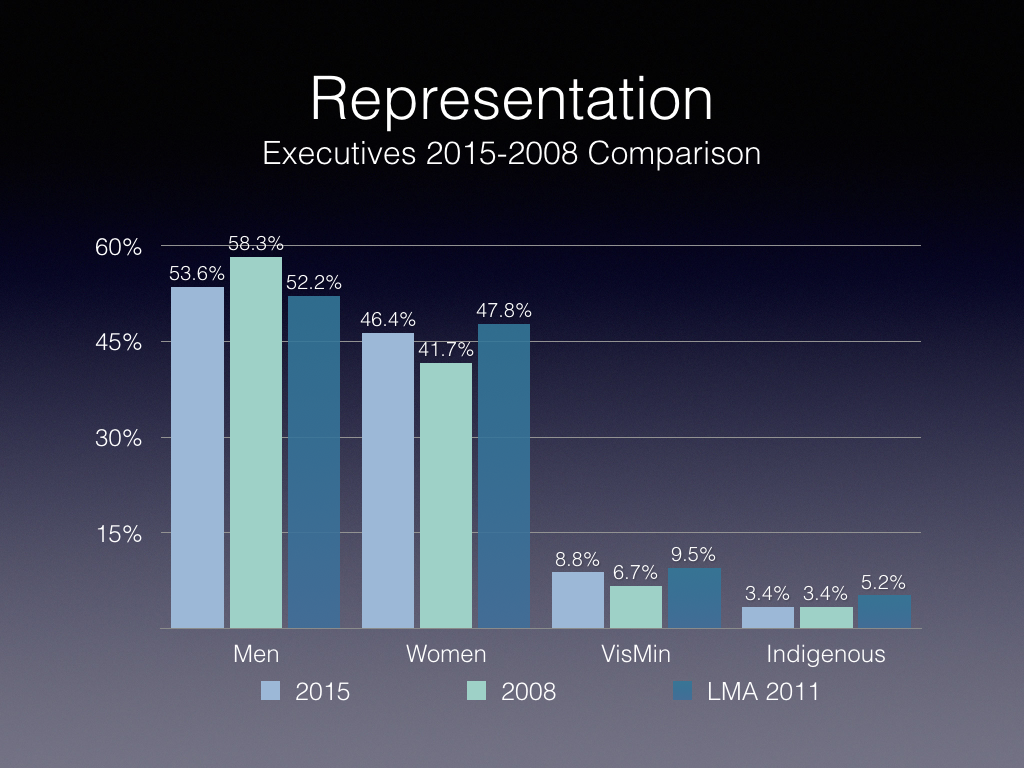
tbs-ee-2015-analysis-007Above slide shows how diversity has changed 2008-15 for executives, slide below for non-executives.

tbs-ee-2015-analysis-006Would be interesting to see the agenda and how it evolves over time, particularly expanding diversity beyond the four employment equity groups:

It’s important not only for the federal public service to be comprised of a fair representation of Canada’s various kinds of people, but also that these employees feel comfortable in their surroundings, says the head of Canada’s largest public service union.

Robyn Benson, president of the Public Service Alliance of Canada (PSAC), said this is among the reasons the Joint Union/Management Task Force on Diversity and Inclusion has been established.

“We, as a union, have great concerns about our workplaces and whether the workplaces are safe for our members, whether or not they are harassment-free, whether or not there is violence in the workplace,” she said. “We wanted to make sure we were part of ensuring that the workplace was safe.”

She added: “While we strive to hire individuals who fall within the equity groups (aboriginals, visible minorities, people with disabilities, and women), you need to not just hire them; you need to provide a workplace where they are safe, where there is no harassment, where there is no violence, where they can be engaged in all levels of the public service, and certainly where there’s accommodation for people with disabilities.”

The new task force includes representation from the following unions: PSAC, the Professional Institute of the Public Service of Canada (PIPSC), the Canadian Association of Professional Employees (CAPE), and the Professional Association of Foreign Service Officers (PAFSO). It also has members from management of the Treasury Board of Canada Secretariat, Correctional Services, Public Safety, Agriculture, and Public Services, as well someone from the Association of Professional Executives of the Public Service of Canada (APEX).

Larry Rousseau, PSAC’s vice-president for the national capital region and co-chair of the task force’s steering committee, echoed the idea that it’s not just about quotas, but making sure those working for the government are comfortable in their surroundings.

“The way to make sure that people feel respected is that they feel included in the processes, in the decision-making, and just the overall work of the public service,” he said. “It’s one thing to have diversity in the workforce. It’s what you do with it that is going to be very, very important.”

Margaret Van Amelsvoort-Thoms, the Treasury Board’s executive director of people management and the other co-chair of the task force’s steering committee, said: “We want every employee to be able to bring their whole self to work, and so [the task force] is the strategy that says, ‘How do we do that and make this an inclusive workplace.’ ”

Mr. Rousseau said one of the task force’s objectives will be defining what diversity is. The federal government already has policies intended to ensure that women, aboriginals, visible minorities, and people with disabilities are adequately represented in the public service. He said preventing discrimination and harassment of people in the LGBTQ community is another issue that has emerged as something all employers should strive for.

Ms. Van Amelsvoort-Thoms added that other demographic factors, such as age, where people are from geographically, and their family structure, can also be part of the conversation about diversity.

The task force was modelled on the Mental Health Joint Task Force that was established in March 2015 under the former Conservative government and continues to function.

Ms. Benson described the roots of this newer Task Force on Diversity: “[Treasury Board President Scott] Brison and I had a discussion several, several months ago about the work around diversity and inclusion. We thought it would be good to construct committees that look like our Mental Health [Task Force],” she said, adding that the Mental Health Task Force “has worked really well.”

While the government didn’t officially announce the Task Force on Diversity until late November, it’s been quietly in operation since September.

Ms. Van Amelsvoort-Thoms said part of the work so far has been doing an “environment scan” of what various employers, in both the private and public sectors, are doing in terms of diversity and inclusiveness. She said the federal government is behind some sectors in its approach to this issue, while it’s ahead of others.

Mr. Rousseau made note of the technology sector, which he said during the 1990s boom years realized the practical benefits of staff diversity and how it brings an array of different perspectives to achieving business goals.

Source: New task force aims for diverse public service where everyone feels welcome – The Hill Times – The Hill Times

What happened to Canada’s support of democratic rights in Hong Kong? [expatriate voting aspect] – David Mulroney

Good column by former colleague and former Ambassador to China David Mulroney on Hong Kong and support for democratic rights.

And appropriate put-down of the Government’s Bill C-33, and its provision to grant indefinite voting rights without any corresponding commitment and responsibility:

Mr. Patten was particularly scathing in his commentary about independence advocates, whose campaign, he said, “dilutes support for democracy.” This was interpreted as criticism of two lawmakers, supporters of independence, who have been forced to vacate their seats. The duo had refused to take the official oath of office, substituting wording that could be considered offensive to China. Their actions sparked legal intervention by China’s government even before Hong Kong’s own courts could consider the issue.

It’s hard to argue with Mr. Patten’s assessment. Pushing for Hong Kong’s independence is wildly unrealistic and, given China’s sensitivity and volatility, irresponsible. But it is also an understandable expression of local frustrations given how little effort has been devoted to exploring more moderate options for democratic governance. If Hong Kong’s leaders, and friends such as Britain and Canada, had remained true to the vision of one country, two systems, the city’s residents would today have at least some say in charting their future. Instead, they are condemned to a form of governance in which they are asked to take up the responsibilities of citizenship without the corresponding rights.

The reverse is true for that fortunate minority among Hong Kong’s seven million residents who also happen to be Canadian citizens. The recently-introduced Bill C-33, which amends the Canada Elections Act, would offer the right to vote to all Canadians residing overseas, as long as they have lived in Canada at some point. It eliminates a previous provision that restricted voting rights to expatriates who had been absent for fewer than five years. The bill is big news in Hong Kong, where a Canadian community of roughly 300,000 includes emigrants to Canada who have since returned, and Canadian-born expats lured by Hong Kong’s low-tax, business-friendly environment.

Passage of the bill will encourage much chest-thumping about Canada’s support for democracy, but it is hard not to see in this something slightly different. Ottawa is offering up one of the most important rights of citizenship, the right to vote in elections back home, without reference to any corresponding responsibilities. This is politically astute, but not particularly courageous. Real support for democracy requires more ambition and more honesty.

Britain, Canada and other democracies have not lived up to their 1997 commitments, failing to follow up with the training programs, institutional exchanges and official encouragement that could have assisted the gradual emergence of healthy democratic institutions in Hong Kong. And they neglected to hold China accountable for its own commitments.

Source: What happened to Canada’s support of democratic rights in Hong Kong? – The Globe and Mail

UK – Anti-Semitism: Official definition ‘will fight hatred’ – BBC News

Sharp contrast to the US Congress’s proposed definition that explicitly included criticism of Israel rather than the more focussed definition of IHRA (their working definition of antisemitism also includes examples where criticism of Israel may cross over to antisemitism):

The government plans to adopt an international definition of anti-Semitism to help tackle hatred towards Jews.

Police, councils, universities and public bodies can adopt the wording, Theresa May will say in a speech later.

The International Holocaust Remembrance Alliance (IHRA), which the UK belongs to, created the definition.

It calls anti-Semitism a “perception of Jews, which may be expressed as hatred toward Jews.”

Prime Minister Theresa May will argue that a clear definition means anyone guilty of anti-Semitism in “essence, language or behaviour” will be “called out on it”.

The International Holocaust Remembrance Alliance hopes its definition, agreed this year, will be adopted globally.

It defines anti-Semitism as “a certain perception of Jews, which may be expressed as hatred toward Jews.”

It adds: “Rhetorical and physical manifestations of anti-Semitism are directed toward Jewish or non-Jewish individuals and/or their property, toward Jewish community institutions and religious facilities.”

Legally binding

Downing Street said anti-Semitic behaviour could be overlooked because the term is ill-defined, with different organisations adopting their own interpretations.

The IHRA – which is backed by 31 countries, including the UK, USA, Israel, France and Germany – set its working definition of what constituted anti-Semitic abuse in May.

The group said having a “legally binding working definition” would give countries the “political tools” to deal with anti-Jewish hate crime.

Conservative MP and special envoy for post-holocaust issues, Sir Eric Pickles, told the BBC that the new definition “catches up with modern anti-Semitism”.

“I think it’s important not to conflate Jewish people with Israel,” he said. “That actually is the point in the definition.”

‘It is unacceptable’

Police in the UK already use a version of the definition. However, it will now also be used by other bodies, including councils.

Mrs May will say: “There will be one definition of anti-Semitism – in essence, language or behaviour that displays hatred towards Jews because they are Jews – and anyone guilty of that will be called out on it.”

She will add: “It is unacceptable that there is anti-Semitism in this country. It is even worse that incidents are reportedly on the rise.”

Source: Anti-Semitism: Official definition ‘will fight hatred’ – BBC News

Black or white? In Brazil, a panel will decide for you

While the policy intent was understandable, implementation is another matter. Having officials develop an assessment table was bound to end up like this (like the history categorizing Blacks by their percentage of Black bloodline):

Public-service jobs in Brazil pay significantly better than private-sector ones and come with a host of generous benefits such as meal and transport allowances; workers are rarely fired and can retire at age 55 with large pensions. Competition, consequently, is fierce. Candidates must pass a gruelling exam that some study for and take repeatedly for five or six years.

Until August of this year, the quota system relied on candidates’ self-identification of their race. That system was being abused, by white people claiming to be mixed-race (although researchers estimate that no more than 5 per cent of applicants were lying).

Under pressure by some advocates from the black community, the government decided the solution was “commissions of verification” – tribunals that would evaluate each candidate. Guidelines from the Ministry of Planning said that panels should consider only physical attributes: “The forms and criteria for verifying the veracity of self-declaration should only consider the phenotypic aspects of the candidate, which will be checked in the presence of the candidate.”

That means that a panel of assessors (three, five or seven people) would look at each candidate and decide if their appearance matched their self-declared race.

Last August, officials in Para, Ms. Chaves’s state, released a chart of criteria for investigators to use, with a point system for physical characteristics such as “lips: thick,” “gums: pink,” “hair: frizzy.” It caused such an uproar that it was hastily withdrawn. But no information has been disclosed about what criteria examiners are using instead. Some tribunals work purely from physical appearance; some panelists apparently see race as more than that and ask candidates about their experience of discrimination, or their families.

The end result, frequently, is confusion. Ms. Chaves has no idea how the three people who made up her tribunal concluded she was white.

Eduardo Sobral, 30, a geologist who says he is mixed-race, was rejected for a reserved position with the Ministry of Planning in Brasilia. He was examined by video-conference, then asked about his “day-to-day life as a brown person.” He replied that it was “normal,” the interview ended and he was rejected. He is suing the ministry.

Rodrigo Campos, an electrician in the central state of Minas Gerais who says he is black, never even got before the assessors: They rejected him based on photos they asked him to submit. Meanwhile Igor Anatoli, a mixed-race police officer from Rio who is trying to join the diplomatic corps, went before a panel of seven in Brasilia in September; they chatted at length about his family and his experience of prejudice and ruled that he is, as he had declared, black.

Source: Black or white? In Brazil, a panel will decide for you – The Globe and Mail

Read Bob Dylan’s Nobel Prize Speech: ‘I Recognize That I Am in Very Rare Company’ | TIME

In his own words:

Well, I’ve been doing what I set out to do for a long time, now. I’ve made dozens of records and played thousands of concerts all around the world. But it’s my songs that are at the vital center of almost everything I do. They seemed to have found a place in the lives of many people throughout many different cultures and I’m grateful for that.

But there’s one thing I must say. As a performer I’ve played for 50,000 people and I’ve played for 50 people and I can tell you that it is harder to play for 50 people. 50,000 people have a singular persona, not so with 50. Each person has an individual, separate identity, a world unto themselves. They can perceive things more clearly. Your honesty and how it relates to the depth of your talent is tried. The fact that the Nobel committee is so small is not lost on me.

But, like Shakespeare, I too am often occupied with the pursuit of my creative endeavors and dealing with all aspects of life’s mundane matters. “Who are the best musicians for these songs?” “Am I recording in the right studio?” “Is this song in the right key?” Some things never change, even in 400 years.

Not once have I ever had the time to ask myself, “Are my songs literature?”

So, I do thank the Swedish Academy, both for taking the time to consider that very question, and, ultimately, for providing such a wonderful answer.

Source: Read Bob Dylan’s Nobel Prize Speech: ‘I Recognize That I Am in Very Rare Company’ | TIME

An Alt-Right Makeover Shrouds the Swastikas – The New York Times

Good long-read on white supremacist groups:

The deceptively benign phrase “alt-right” now peppers the national conversation, often in ways that play down its fundamental beliefs, which have long been considered intolerant and hateful. The term’s recent prevalence corresponds with the rise of President-elect Donald J. Trump; alt-right leaders say his inflammatory statements and Twitter habits in the campaign energized, even validated, their movement.

The movement is also acutely image-conscious, seeing the burning crosses, swastikas and language of yesteryear as impediments to recruitment. Its adherents talk of “getting red-pilled,” a reference to the movie “The Matrix,” in which the protagonist ingests a tablet that melts away artifice to reveal the truth. New, coded slurs have emerged. Fewer pointed hoods, more khaki pants.

But the alt-right movement is hardly monolithic, despite a well-publicized gathering last month in Washington — one that might have been mistaken for just another corporate conference were it not for the white-nationalist sentiments and the Nazi salutes. The factions within its ranks can differ on any number of subjects: white supremacy versus white nationalism, for example, or the vexing “J.Q.” — the “Jewish Question.”

James Edwards, a far-right talk radio host who describes himself as a “European-American advocate” — and who interviewed the president-elect’s son Donald Trump Jr. this year — wrote in an email that the alt-right movement was “a group of marauding conservatives who reject both the failures of establishment conservatism and the false gods of political correctness.”

Race is the uniting factor, Mr. Edwards wrote. “One fundamental element of the Alt-Right that brings the disparate factions together is the awareness of the reality of race and the need for European Americans to have organizations and spokespeople that explicitly advocate for our unique group interests.”

For many years, the mix-and-match gaggle now called the alt-right existed in the shadowed alleys of American culture, sharing views through newsletters, online radio and crude websites. The news media often debated whether to cover their sparsely attended rallies, considering that any attention might grant the groups a veneer of legitimacy.

Andrew Anglin, the founder of the neo-Nazi, alt-right website The Daily Stormer, described the current moment in a recent essay as “a reboot of the White Nationalist movement” — one infused with youthful energy. The foot soldiers of the movement are not old white supremacists marching under a new banner, Mr. Anglin explained, but a mostly younger generation drawn from various online cultures, including conspiracy theorists and that misogynistic stratum of the internet known as the “manosphere.”

Then came Mr. Trump, whose opening gambit as a presidential candidate included his promise to build a wall to keep out Mexican immigrants, whom he called rapists and criminals. The alt-right raised its collective head to listen.

“I’d been waiting to hear those words from a mainstream political candidate all my life,” said Gerald Martin, a retired public-school teacher from Dallas who grew up in a family that opposed desegregation.

He is a veteran of both the Army and a number of white supremacist movements, and name-drops the likes of William Luther Pierce III, a white supremacist who wrote “The Turner Diaries,” a novel about an underground band of white Americans who fight a liberty-crushing government controlled by Jews.

Before the Trump candidacy, Mr. Martin said, few in the alt-right were talking about politics; the movement was more about winning the battle of ideas. But once Mr. Trump began to talk, he said, “suddenly we’re all talking politics and we’re politically energized.”

“We’re almost intoxicated,” Mr. Martin continued. “We don’t have any power — but now we’re close enough to smell it.”

Mr. Trump brushed off his sharing of alt-right messages on social media as inconsequential — the sort of thing that just happens on Twitter. He also denied at one point the existence of any alt-right movement.

“Nobody even knows what it is,” he told CNN in August. “This is a term that was just given that — frankly, there’s no alt-right or alt-left.”

As if to clarify matters, members of the alt-right movement gathered in Washington about two weeks after Mr. Trump’s election for a conference sponsored by the National Policy Institute, an organization that describes itself as being “dedicated to the heritage, identity and future of people of European descent.” Its president, Richard B. Spencer, 38, is a prominent alt-right leader who wears his brown hair in an undercut style once popular among the Hitler Youth. It’s called a “fashy,” as in fascist.

Mr. Spencer said in an interview that as he saw it, the principles of American conservatism throughout most of the 20th century had been wrongly defined within the context of capitalism and its ideological battle with communism. The matter of European identity, he said, was assumed, but never stated outright.

“Race is real,” he said. “Race matters. Race is the foundation of identity.”

Not everyone in the movement appreciated the moment at the end of the conference when some in the audience raised stiffened arms, echoing the Nazi salute. Discussions afterward reflected the divisions in the loosely aligned ranks, as well as an acute awareness of public perception and the need to make their messages somehow more palatable.

…Indeed, the movement has the feel of a dispossessed youth rising up. Hours of interviews with young alt-right leaders suggest a pattern toward their white-nationalist radicalization. Seeing domestic and global strife often rooted in racial and ethnic differences. Finding validation from like-minded people on the internet. Hearing a major presidential candidate echo their grievances.

“The political establishment has made an entire generation of young white men and women into fascists, and that’s a beautiful thing!” said Matthew Heimbach, 25, who runs the Traditionalist Worker Party out of his trailer in Indiana. His group advocates replacing the United States with nation-states based on races, ethnicities and religions.

In Northern California, a university student, felon and Marine veteran, Nathan Damigo, oversees a group called Identity Evropa, which he described as a “fraternity” of mostly young, college-educated men who celebrate European heritage — that is, an embrace of white identity and a rejection of multicultural coexistence.

Ever conscious of the importance of marketing, Mr. Damigo, 30, pointed out that Identity Evropa’s website “looks completely mainstreamed.” And it does, featuring men in business suits who also happen to be sporting the Hitler Youth-style haircut.

But for all the fresh approaches — the slick marketing, the internet savviness — the message remains the same. It is one of separation, of supremacy, of a refusal to recognize the equal worth of others who do not have the same skin tone or share the same religion.

The ascension of the alt-right has lifted some familiar names from the muck of the past, including David Duke, the white nationalist, Holocaust denier and former Louisiana state representative whose national profile has been resurrected.

Pico Iyer on the meaning of home, in a post-Trump world

Interviews with Pico Iyer always are interesting:

Q: Perhaps that’s why you’ve been such an admirer of Canada for so long, since before your paean in The Global Soul?

A: One thing that has long hit me about Canada, ever since I started making annual visits there in 1994, is that people in the cities there are constantly—some would say obsessively—talking and thinking, every day, about diversity and refugees and the future and how to turn a culture made of many disparate parts into something greater than their sum.

The other countries I know—from Britain to the U.S.—have all backed into multiculturalism; it’s taken them by surprise and they’ve tried to adapt or stretch their current society into something that will accommodate new visitors. Only in Canada has there been a strong sense of vision about creating an entirely new kind of society to match the age of movement. And Canada has been addressing that issue for half a century—ever since Pierre Trudeau hung a sign that said “World Citizen” outside his door at Harvard and began travelling the world.

Of course, those who live in Canada are keenly aware of everything that’s going wrong and moments when optimism has been unfounded. But my impression is that the more people travel—whether it’s Salman Rushdie or the spokesperson for the UN High Commission on Refugees—the more they admire Canada, and see something coming to light there that we don’t find so often in Australia or South Africa, in Singapore or Hong Kong.

Whenever my friends there say that their country is no utopia, I agree—but ask them if they really want to move to Dubai or L.A.

Q: You love the inclusive, cosmopolitan vibrancy of Toronto, and you wrote that in Toronto, “the average resident today is what used to be called a foreigner, somebody born in a very different country.” In late 2016, it’s top of mind for many: what does finding home mean in a less immigrant-friendly world?

A: From the beginning, I’ve stressed that home is something internal, invisible, portable, especially for those of us with roots in many physical places; we have to root ourselves in our passions, our values and our deepest friends. My home, I’ve always felt, lies in the songs and novels that I love, in the wife and mother that I’m never far away from, in the monastery to which I’ve been returning for 25 years. Precisely because I don’t belong entirely to Britain or the U.S. or India or Japan, I build my foundations in some way deeper than mere passports, and more in the light of where I’m going than of “where I come from.”

Of course, the Brexit vote, the victory of Mr. Trump, what’s happening around the world represents a backlash against precisely people such as myself, blessed with many homes. But I don’t think that changes the fact—the inarguable reality—that for many in Toronto, say, “home” means a question they’ll always be refining and adding to (and may never answer), while home also means a place like Toronto, where they’re surrounded by people entertaining just the same questions.

We may be joined these days more by the questions we have in common than by the answers we share.

Some people will always ground themselves very strongly in a piece of soil, a grandmother’s property, a tiny plot of land, and that’s great. But in the Age of Movement, there’s no question that the number of people who don’t—or can’t—is growing exponentially.

And on Leonard Cohen:

Q: How did Cohen embody Canada’s best qualities, the homely qualities that make it one of your favourite countries?

A: Somehow Leonard could only have come from Canada, I feel, and it’s no surprise that he held it so firmly in his heart till his dying day.

One of his sovereign graces was always to mix a sense of irony with a sense of passionate quest, to sound as if he never took himself too seriously, yet took many other things (and other people) very seriously indeed. That mix of an Old World sense of drollness and respect for tradition with a New World hunger for something better and fascination with the horizon is, to me, the illuminating beauty of Canada: it never pursues the future as if it can deny every kind of past.

Leonard was really Montreal incarnate, in so many ways, as one who mixed the worldliness and elegance of France with the hopefulness and sincerity of North America.

Source: Pico Iyer on the meaning of home, in a post-Trump world – Macleans.ca

Where immigrants go to school is more important than where they came from | The Economist

More on the OECD PISA results focussing on immigrant children:

IF YOU think starting a new school is scary stuff—try doing it in a new country. Migrants can face a twin disadvantage. They are often concentrated in struggling schools. And, at least at first, they may suffer from having to toggle between languages at home and in class. Two-thirds of pupils born outside their host country use another tongue at home. Nearly one in two second-generation immigrants does so.

It is little wonder that many migrants struggle on the latest Programme for International Student Assessment (PISA) tests. The children of foreign-born parents are on average about a year behind their peers, even after accounting for parental income.

This finding hides a lot of variation (see chart). In Australia and Canada pupils whose parents were born abroad do better on science tests than similar teenagers with native-born parents.

Meanwhile immigrants in European countries are often far behind. In Germany first-generation and second-generation migrants are respectively about 2.5 and 1.5 years behind teenagers with German-born parents, even after accounting for their different economic backgrounds. There are similar results in Finland, a country often lauded for its record of equality in education.

For sure, migrants’ origins matter a lot. Second-generation East Asian pupils in Australia are roughly 2.5 years ahead of those with native-born parents. They do even better than pupils in Singapore, the highest-performing country in PISA, even as results in Australia as a whole have fallen.

Yet the country in which the immigrant attends school is more important than the one he comes from, says the OECD’s Andreas Schleicher. Turkish-born pupils in Germany are nearly two years behind in science tests compared with those in the Netherlands, after adjusting for different economic backgrounds.

Policy makes a difference. Attending nursery or extra language tuition helps migrants catch up. Limiting selection by academic ability gives them more time to make up ground. Not making them repeat a year has the same effect.

Admissions policies matter, too. Avoiding high concentrations of migrants in particular schools would help their academic achievement. It would probably also help poorer native children.

The task of educating migrants better is urgent, especially in Europe. The share of children of foreign-born parents in the OECD that took PISA increased from 9.4% in 2006 to 12.5% in 2015. It could rise further in light of the numbers of migrants settling in Europe in 2015 and 2016.

A survey last year by the OECD found that about 80% of second-generation immigrants feel at home at school. But outliers should cause concern. In France, for example, just 40% of second-generation immigrants say they feel as if they belong in school. That is a figure to make everyone in the country sit up straight.

Source: Where immigrants go to school is more important than where they came from | The Economist

Douglas Todd: The hidden cost of foreign-student policy

Some valid points regarding the rise of international students and their impact although the healthcare costs are likely grossly inflated: using the provincial average is not appropriate for young age cohort that tend to have fewer healthcare needs.

And the concern about slipping standards is more anecdote based without hard data to back this up:

Although unheeded by politicians, Knight and Altbach say Western foreign-student programs have lost their humanitarian ideals, grown into a giant business and now largely draw second-tier students, many of whom struggle with new languages.

Kwantlen Polytechnic University political science professor Shinder Purewal and Patrick Feeney, a B.C.-based education professor now at Chiang Mai University in Thailand, add to such warnings about the hidden costs of Canada’s foreign student policy.

While both scholars support foreign student programs, they fear they’ve mushroomed out of control. Canadians, the scholars say, need to be aware of the disguised burden on taxpayers. Purewal and Feeney also say academic standards are declining in many classrooms.

Working independently, Purewal and Feeney reveal there have been significant repercussions as the ratio of foreign students at B.C.’s two leading universities, UBC and SFU, has grown to one in four, with by far the largest cohort from Mainland China.

Even though the portion of foreign students at suburban Vancouver’s Kwantlen Polytechnic University is one in eight (almost half the foreign students are South Asian), internal documents show that Kwantlen recently paid more than $300,000 to student-recruiting agents in India.

To further illustrate how massive the industry has become, Purewal said Metro Vancouver is home to more than 150 private colleges and universities that cater almost exclusively to foreign students. He calls them “drive-thru institutions, basically two-room colleges.”

What are the hidden financial costs of Canada’s foreign-student policies?

Purewal, who is also a registered immigration consultant, says Canadians are not aware that the more than 300,000 foreign students in the country at any one time receive provincial taxpayer-funded health care.

The foreign students — as well as their spouses and children — have their doctor and hospital visits paid for by Canadian taxpayers, even though they have not contributed to the universal health care program.

With B.C. home to 110,000 foreign students, and the average resident using up almost $6,000 a year in medical expenses, Purewal calculated “the cost could be up $635 million” to the province’s health care system, not including spouses and children (who are also allowed free public-school educations).

“While the post-secondary institutions earn more tuition money, the Canadian taxpayers foot the bill for their health costs,” said Purewal, who has served as a citizenship court judge, where he’s seen how Canadian policy also favours foreign students as future immigrants.

Many foreign students and especially their spouses also seize on the option to work while in Canada, often full-time, says Purewal, echoing a new trend discovered by Vancouver immigration lawyer Richard Kurland.

In many cases, Purewal believes, Canadian bosses prefer to hire foreign students or their spouses. “You can exploit them to bone. They are not going to talk about labour standards. They can’t complain. Employers are happy with this system.”

What’s happening in higher education itself?

Purewal and Feeney are skeptical about the mantra from administrators and politicians that foreign students do not take the seats of domestic students.

The two academics maintain that, since government funding for higher education is declining, the money available to create seats for domestic students is also, in effect, declining. Domestic student enrolment in classrooms is capped.

Former UBC president Stephen Toope is among those who have said B.C. government funding for university students has been cut almost in half from its high in the 1970s, when it covered 70 per cent of per capita costs.

Purewal says the competition between domestic and foreign students becomes particularly keen in winning coveted spots in masters or PhD programs, which are small, with varied selection criteria.

Purewal also maintains universities are not asking most foreign students in Canada, who typically pay anywhere from $12,000 to $18,000 a year in fees, to pay their own way in full.

Their fees do not finance infrastructure, he said. If foreign students had to completely make up for the taxpayer money that has gone into constructing UBC, SFU or Kwantlen, Purewal estimated their fees would have to double or triple.

The quality of education is also declining in many university and college classrooms, says Feeney.

Source: Douglas Todd: The hidden cost of foreign-student policy | Vancouver Sun

Warsaw’s Populist Right Whitewashes Holocaust History – The Daily Beast

More disturbing news about Poland:

Katarzyna Wielga-Skolimowska was given 24 hours to clear out her office, until the end of the month to vacate her flat, and is forbidden to talk to the press about any of it.

The elegant redhead, who is credited for her knowledge of architecture and theater, was abruptly fired from her job as director of the Polish cultural institute in Berlin last week. Did her programs have “too much Jewish content,” as Israel’s Haaretz headlined bluntlyThe Forward in the United States made that a question: “Was Polish Culture Institute Director Fired for Too Much ‘Jewish-Themed Content’?”

As various theories circulate in Berlin about why, one thing is clear—that this is the latest attempt of Poland’s radical nationalist government to revamp its image abroad, not least by playing down any Polish role in the Holocaust. A law proposed last summer, for instance, would make it a crime to use the phrase “Polish death camps” for, say, Auschwitz, which was a Nazi death camp in occupied Poland.

“Everything points to the fact that the dismissal [of the Polish Institute Director] was politically motivated,” Berlinische Galerie director Thomas Köhler tells The Daily Beast. “Her contract would have ended next year. This was clearly intended as a punishment—It’s really bad form.”

Together with other leading culture fanatics in the capital, Köhler signed a protest letter that expressed “dismay“ and “irritation“ at the sudden dismissal. Cilly Kugelmann, who directs the Jewish Museum in Berlin, initiated the letter.

Last year, the Polish Institute screened “Ida,” an Oscar-winning Polish film about a Catholic woman who discovers she is the Jewish child of Holocaust victims. But while showing the film may have gone down well in Berlin, it could have been another strike against Wielga-Skolimowska for Warsaw.

Since Poland’s Law and Justice Party won elections in 2015, the Warsaw government has been going to great pains to “recalibrate many of the ways in which Poles think, talk and learn about their own history.” And to some, it looks like Law and Justice wants to whitewash a lot of the country’s history, even the Shoah, by appealing to nationalist pride.

The way in which “Ida” was broadcast on public television in Poland this year has provided one ground for such suspicion. The film that had won best film prize at the Polish Film Academy in 2013 was this time accompanied by a 12-minute clip in which three critics tore into it, warning about supposed historical inaccuracies.

In October, Wielga-Skolimowska received a damning internal evaluation by the newly appointed Polish ambassador to Berlin, Andrzej Przylebski. Among other things, he warned her, “not to overdo the emphasis—particularly in Germany, which should not receive the role of mediator—on the importance of Polish-Jewish dialogue as the main example of intercultural dialogue which takes place in Poland.“

So this week, the left-leaning Berlin paper TAZ chose the provocative title “Warsaw Purges in Berlin” to report on Wielga-Skolimowska’s dismissal. Two other papers followed suit and claimed that Wielga-Skolimowska was fired for over emphasizing Jewish topics. The theme, as noted, was picked up by the Israeli press. And the Polish embassy was not happy. Both the Berliner Zeitung and the Tageszeitung received a letter demanding a correction.

Law and Justice is not generally considered an anti-Semitic party, not least because it is very pro-Israel. And according to political scientist Janusz Bugajski, despite Poland’s shady new attitude to historical accuracy, there is also “sensitivity that Germany is still evading a full accounting of World War II war crimes and that Poles as a nation are depicted as anti-Semites.”

In his evaluation, Ambassador Przylebski also accused Wielga-Skolimowska of having done a bad job inviting guests and choosing topics. “The blind imitation of nihilistic and hedonistic trends does not lead to anything good in terms of civilization.” he wrote, rather mysteriously and apocalyptically. “Poland must resist this.”

Wielga-Skolimowska is the 14th out of 24 Polish Institute directors around the world to be fired this year, and the reasons vary. Vienna was forced to stop working with an Austrian journalist and writer after he criticised “Law and Justice” in his articles. But the director in Madrid already had to go for not focusing enough on Chopin.

“The Polish government is really celebrating national pride now,” Köhler muses, “and you can understand that: the country has a nasty history. But I expect that now they’ll be doing a very conservative backwards program, with uncritical writers, artists, and Chopin evenings. I don’t know if I’ll still feel like going.”

Bugajski, the political scientist, notes that Ambassador Przylebski, at the very least, seems to be “repeating the kind of language that communists used against ‘decadent Western bourgeois art.’  He adds, “It just shows you that politicians should not try to be culture critics.”