From Hate Speech To Fake News: The Facebook Content Crisis Facing Mark Zuckerberg : NPR

Another good long read on social media, particularly Facebook, and its need to face up to ethical issues:

Some in Silicon Valley dismiss the criticisms against Facebook as schadenfreude: Just like taxi drivers don’t like Uber, legacy media envies the success of the social platform and enjoys seeing its leadership on the hot seat.

A former employee is not so dismissive and says there is a cultural problem, a stubborn blindness at Facebook and other leading Internet companies like Twitter. The source says: “The hardest problems these companies face aren’t technological. They are ethical, and there’s not as much rigor in how it’s done.”

At a values level, some experts point out, Facebook has to decide if its solution is free speech (the more people post, the more the truth rises), or clear restrictions.

And technically, there’s no shortage of ideas about how to fix the process.

A former employee says speech is so complex, you can’t expect Facebook to arrive at the same decision each and every time; but you can expect a company that consistently ranks among the 10 most valuable on earth, by market cap, to put more thought and resources into its censorship machine.

The source argues Facebook could afford to make content management regional — have decisions come from the same country in which a post occurs.

Speech norms are highly regional. When Facebook first opened its offices in Hyderabad, India, a former employee says, the guidance the reviewers got was to remove sexual content. In a test run, they ended up removing French kissing. Senior management was blown away. The Indian reviewers were doing something Facebook did not expect, but which makes perfect sense for local norms.

Harvard business professor Ben Edelman says Facebook could invest engineering resources into categorizing the posts. “It makes no sense at all,” he says, that when a piece of content is flagged, it goes into one long line. The company could have the algorithm track what flagged content is getting the most circulation and move that up in the queue, he suggests.

Zuckerberg finds himself at the helm of a company that started as a tech company — run by algorithms, free of human judgment, the mythology went. And now he’s just so clearly the CEO of a media company — replete with highly complex rules (What is hate speech anyway?); with double standards (If it’s “news” it stays, if it’s a rant it goes); and with an enforcement mechanism that is set up to fail.

Source: From Hate Speech To Fake News: The Facebook Content Crisis Facing Mark Zuckerberg : All Tech Considered : NPR

Groups fighting hate, anti-Semitism see surge of support

Not necessarily surprising but certainly encouraging:

In the wake of the election, the Anti-Defamation League — the national organization devoted to fighting anti-Semitism and bigotry in all forms — is wasting no time in accelerating its efforts against hate in America.

The climate at the organization’s offices post-election is characterized by “exhaustion and energy,” Deborah Lauter, ADL’s senior vice president for policy and programs, told CBS News.

“There’s more of a sense of urgency, more of a sense that we’re more relevant than ever before,” Lauter said. “The day after, when people were shocked by the result personally, they said, ‘Thank God I work here because at least I can get hugs from my colleagues.’”

The organization — which conducts large-scale research on hate groups, including the alt-right; partners with law enforcement to better deal with hate crimes; and cultivates public awareness of hate and bigotry, among other campaigns — has seen an explosion in financial contributions and volunteer interest since Donald Trump’s election. The president-elect won the White House after conducting a campaign critics accused of trafficking in racist and anti-Semitic stereotypes. At various points, Trump called Mexicans “murderers” and “rapists;” suggested an American-born federal judge could not do his job impartially because of his Mexican heritage; advocated “a total and complete shutdown” of Muslims coming to the U.S.; and used imagery lifted from white supremacists and Neo-Nazi online message boards.

It was an election that “saw hate move from the fringes and into the mainstream with unprecedented volume and velocity,” the ADL said in a statement after Donald Trump’s win.

The ADL joins other prominent nonprofit organizations — like the American Civil Liberties Union, the investigative journalism site ProPublica, and Planned Parenthood — who’ve seen dramatic spikes in donations since the election.

Contributions to the ADL jumped 50-fold the day after the election, and that level of giving has persisted throughout last week and this week, the group said. About 70 percent of those donations came from first-time donors. Several major donors are also upping their contributions in light of the election, some to six figures.

In addition, the group’s 27 regional offices have seen significantly higher call volume — 10 to 20 times what they’d normally receive — from people asking how they could support the organization’s work combating bigotry, the ADL said.

“We have seen so many instances where we fear and are concerned about the fact that the extremists’ rhetoric has become mainstream,” Lauter said. “The feeling is one of being disheartened at how easily this can happen. But [we’re] also somewhat energized at how important this work is to rebuild what we thought was the status quo of tolerance in this country.”

Source: Groups fighting hate, anti-Semitism see surge of support – CBS News

Women’s Rights Become A Battleground For Israel’s Ultra-Orthodox Jews : NPR

Continuing religious radicalization in Israel:

Four years ago, a lawsuit was filed by an Orthodox feminist group called Kolech, which means “Your Voice” in the Hebrew feminine. It was one of the biggest class-action lawsuits in Israeli history, and it targeted what was then an all-male, ultra-Orthodox radio station called Kol Barama, founded in 2009.

“There were no women interviewing. You wouldn’t be able to hear a woman on this radio channel,” says Kolech’s executive director, Yael Rockman. “Not only that. This radio channel is not private. They get money from the government. ”

The discrimination lawsuit went all the way to Israel’s highest court, and in late 2014, the women won.

With a birth rate double that of the national average, Israel’s ultra-Orthodox community is growing — and so is its political power. Feminists are girding for more legal battles over women’s rights.

In recent years, Israel’s ultra-Orthodox have lobbied to omit women’s faces from advertisements on the side of Jerusalem buses that circulate in religious areas. During recent Jewish holidays, signs appeared in a religious neighborhood of Jerusalem, Mea Sharim, instructing women to keep off the main road and use side streets for the sake of modesty.

“Radicalization is getting worse, for sure. At the same time, the vision of equal rights, equal participation and women’s power — all of that is getting stronger around the world,” says gender sociologist Elana Sztokman, author of a book called The War on Women in Israel.

Despite the feminists’ legal victory against Kol Barama, Sztokman believes not enough is being done to protect women. She says that because the ultra-Orthodox tend to vote as a homogeneous bloc, they have achieved disproportionate political power and the Israeli government caters to them in an unprecedented way.

Until now, “Jews have never gone to the government authority and said, ‘Let’s make sure that the public spaces fit the needs of our most radical views on women, because it offends our most extreme strict men,'” Sztokman says. “That has never happened until Israel [in the] 21st century.”

Source: Women’s Rights Become A Battleground For Israel’s Ultra-Orthodox Jews : Parallels : NPR

Trudeau government to update federal rules for service in English, French

Will be interesting to see what alternatives, if any, to the Census data traditionally relied upon, and whether the thresholds for providing OL service change:

Prime Minister Justin Trudeau’s government will take the first step Thursday toward modernizing the rules that govern how the government provides services in English and French, CBC News has learned.

Treasury Board President Scott Brison and Canadian Heritage Minister Mélanie Joly will announce the launch of a process to bring the Official Language Regulations, which deal with communicating to the public, up to date.

Under the Official Languages Act, federal government institutions are obliged to provide services to the public in both English and French in the National Capital Region, as well as across the country “where there is significant demand for communications.”

But if an English community in Quebec (or a French-speaking community elsewhere in Canada) is too small to qualify, federal government institutions — from Service Canada to the local post office — aren’t obliged to offer services in the dominant language.

The government uses census results to determine what constitutes significant demand and the regulations spell out how many people have to list a minority language as their mother tongue for an area to qualify for bilingual service.

Minority language groups, however, have at times complained that the regulations are too restrictive and don’t always take into account everyone who would like to be served in a minority language.

The 2011 census found there were an estimated 647,655 Quebecers whose mother tongue was English and a million people living outside Quebec whose mother tongue was French.

In his final report as Official Languages Commissioner last May, Graham Fraser listed providing government services in minority official languages as a priority.

He recommended that the Treasury Board do an evaluation of “the effectiveness and efficiency of its policies and directives” for implementing the rules governing communications and services to the public.

“A minority community can be thriving and growing, but if the majority grows faster, services are lost. This is simply unfair,” Fraser said at the time. “Bill S-209 provides a way of addressing the injustice, as would a revision of the Official Language Regulations.”

Source: Trudeau government to update federal rules for service in English, French – Politics – CBC News

Genetic study reveals surprising ancestry of many Americans | Science | AAAS

Reading this summary article, brings to mind Lawrence Hill’s comment in Blood, “who among us is not mixed up.”

But the patterns and variations in the ‘mixing’ reveal and confirm much of history:

In the United States, almost no one can trace their ancestry back to just one place. And for many, the past may hold some surprises, according to a new study. Researchers have found that a significant percentage of African-Americans, European Americans, and Latinos carry ancestry from outside their self-identified ethnicity. The average African-American genome, for example, is nearly a quarter European, and almost 4% of European Americans carry African ancestry.

Until recently, “human population geneticists have tended to ignore the U.S.,” says Joanna Mountain, a geneticist and senior director of research at 23andMe, a company in Mountain View, California, that offers genetic testing. With its long history of migrations from around the world, she says, the country was “considered to be kind of messy in terms of genetics.” But Mountain and her colleagues thought they might have a fighting chance of deciphering Americans’ complex genetic ancestry. Their secret weapon? 23andMe’s huge database of genetic information.

When a person signs up for a 23andMe genetic analysis, they can choose whether to make their data (with any identifying information removed) available for research. At the time when Mountain’s team compiled the database for their study, 23andMe had 500,000 customers, and about 80% of them had given their permission for their information to be used in that way. (Today, the company has about 800,000 customers.) That makes the data set used for the study “an order of magnitude bigger” than those usually used to examine population mixing, says Katarzyna Bryc, a population geneticist at 23andMe and lead author of the new paper.

The team started by looking at the average genetic ancestry of the three largest groups in the United States: European Americans, African-Americans, and Latinos. Those categories are based on how 23andMe customers defined themselves. But as you might expect in a country where different groups of people have been meeting and mixing for hundreds of years, the genetic lines between the groups are quite blurred.

“You see all of those different ancestries in each of these groups,” Bryc explains. The average African-American genome, for example, is 73.2% African, 24% European, and 0.8% Native American, the team reports online today in TheAmerican Journal of Human Genetics. Latinos, meanwhile, carry an average of 18% Native American ancestry, 65.1% European ancestry (mostly from the Iberian Peninsula), and 6.2% African ancestry.

The new study adds an unprecedented level of detail to patterns that had been noticed in previous, more general studies. For example, the 23andMe data reveals that the proportion of different ancestries, even within one self-identified ethnic group, vary significantly by state. Latinos with the highest proportion of African ancestry (about 20%) are from Louisiana, followed by states such as Georgia, North Carolina, New York, and Pennsylvania. In Tennessee and Kentucky, Latinos tend to have high proportions of European ancestry. And in the Southwest, where states share a border with Mexico, Latinos tend to have higher proportions of Native American ancestry.

At least 3.5% of European Americans carry African ancestry, though the averages vary significantly by state. In South Carolina and Louisiana, about 12% of European Americans have at least 1% African ancestry. In Louisiana, too, about 8% of European Americans carry at least 1% Native American ancestry.

In many states, the history of the region is written in the genomes of its current residents. Louisiana, for example, was a trading hub where different populations met and mingled. But sometimes the stories are even more specific. Oklahoma is the state where the most African-Americans have significant Native American ancestry, Bryc notes. That contact can be traced back to the Trail of Tears, when thousands of Native Americans were forcibly relocated to Oklahoma, which was also home to a significant number of black slaves. “You can really see historical events and historical migrations in the genetics,” Bryc says. “We weren’t actually expecting to be able to see that as clearly as we do.”

Another way that history shows up in contemporary genomes is in what researchers call a sex bias. By looking at the kinds of DNA that are passed down only by mothers, they can calculate how many of a person’s ancestors from each population were male and female. In all three populations, they found the same signal: European ancestors tended to be male, while African and Native American ancestors tended to be female. That imbalance reflects the fact that for much of U.S. history, European men were the most aggressive colonizers, Mountain says. This mixing seems to have started almost immediately after the first European colonizers and African slaves arrived in North America. “It suggests that really early U.S. history may have been a time of a lot of mixture,” Bryc says.

The fact that so many people in the United States carry a mix of different ancestries could have important medical implications. Today, doctors often assume that certain genetic variants are associated only with particular populations—think about sickle cell anemia in African-Americans, for example. But a person’s self-identified ethnicity—or the ethnicity her doctor assumes she is—doesn’t “necessarily correspond to [her] underlying genetics,” Bryc says. In a mixed population like the United States, it’s perfectly possible that a European American could carry the sickle cell variant that’s more common in African-Americans. In order for personalized medicine to live up to its potential, she says, doctors need to “consider the person” and her or his ancestry in all its complexity, rather than just falling back on reductive census categories.

The new study is “a beautiful piece of work,” says Andrés Moreno-Estrada, a population geneticist at Stanford University in Palo Alto, California, who has studied genetic diversity in Mexico and wasn’t involved with the new research. “The U.S. has a very particular genetic imprint compared to the rest of the Americas.” The 23andMe study “is one of steps forward in asserting that it’s possible to disentangle that complex scenario.”

Source: Genetic study reveals surprising ancestry of many Americans | Science | AAAS

Statistics Canada: Patterns and Determinants of Immigrants’ Sense of Belonging to Canada and Their Source Country

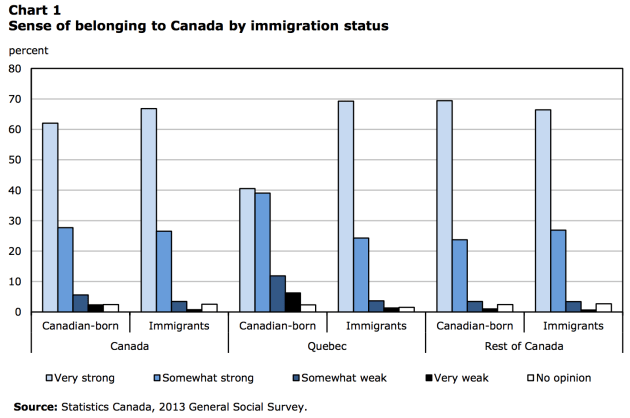
statscan-gss-belongingImportant study by Statistics Canada and John Berry from the General Social Survey confirming high levels of belonging to Canada:

The results show that 93% of immigrants had a very strong or a strong sense of belonging to Canada. Furthermore, a strong sense of belonging to the receiving country is not necessarily incompatible with a sense of belonging to the source country. About 69% of all immigrants had strong sense of belonging to both Canada and their source country (the integrated belonging profile). Another 24% of immigrants had a strong sense of belonging to Canada and a weak sense of belonging to their source country (the national belonging profile). In comparison, very few (3%) had a strong sense of belonging to their source country but a weak sense of belonging to Canada (the source-country belonging profile); and very few (4%) had a weak sense of belonging to both Canada and their source country (the weak belonging profile).

Compared with immigrants in the integrated belonging profile, those in the national belonging profile were characterized by lower levels of civil liberty and life satisfaction in their source countries and by more exposure to Canadian society. Younger age at immigration, more years of residence in Canada, and speaking English or French at home are all significant predictors of the national belonging profile.

The source-country belonging profile was characterized by a high average level of life satisfaction in the source country, older age at immigration, shorter stay in Canada, and perceived discrimination. The weak belonging profile was relatively more prevalent among spouses and dependants of economic principal applicants, or immigrants who came to join their relatives in Canada, and among those who were unemployed, never married, or had very low income.

Overall, this study finds that the overwhelming majority of immigrants had a strong sense of belonging to Canada, with or without a strong sense of belonging to their source country. Source-country attributes were as important as immigration entry status and post-migration experience in affecting immigrants’ sense of belonging to Canada and their source country.

Source: Analytical Studies Branch Research Paper Series: Patterns and Determinants of Immigrants’ Sense of Belonging to Canada and Their Source Country

Social Media’s Globe-Shaking Power – The New York Times

Good long read by Farhad Manjoo on the increasing influence of social media and some of the implications:

As the technology industry came to grips in the last week with the reality of a presidential election that did not go its way, many in Silicon Valley landed on the idea that widespread misinformation spread online was a primary factor in the race’s outcome.

On Monday, both Google and Facebook altered their advertising policies to explicitly prohibit sites that traffic in fake news from making money off lies. That’s very likely a worthwhile fix, even if it comes too late. The internet has loosened our collective grasp on the truth, and efforts to fight that dismaying trend are obviously worth pursuing.

Yet it would be a mistake to end this investigation at fake news. In fact, the dangers posed by fake news are just a symptom of a deeper truth now dawning on the world: With billions of people glued to Facebook, WhatsApp, WeChat, Instagram, Twitter, Weibo and other popular services, social media has become an increasingly powerful cultural and political force, to the point that its effects are now beginning to alter the course of global events.

The election of Donald J. Trump is perhaps the starkest illustration yet that across the planet, social networks are helping to fundamentally rewire human society. They have subsumed and gutted mainstream media. They have undone traditional political advantages like fund-raising and access to advertising. And they are destabilizing and replacing old-line institutions and established ways of doing things, including political parties, transnational organizations and longstanding, unspoken social prohibitions against blatant expressions of racism and xenophobia.

Most important, because these services allow people to communicate with one another more freely, they are helping to create surprisingly influential social organizations among once-marginalized groups. These ad hoc social movements range widely in form, from “alt-right” white supremacists in the United States to Brexiters in Britain to ISIS in the Middle East to the hacker collectives of Eastern Europe and Russia. But each in its own way is now wielding previously unthinkable power, resulting in unpredictable, sometimes destabilizing geopolitical spasms.

“You now have billions of people on the internet, and most of them are not that happy with the status quo,” said Ian Bremmer, the president of the Eurasia Group, a research firm that forecasts global risks. “They think their local government is authoritarian. They think they’re on the wrong side of the establishment. They’re aggrieved by identity politics and a hollowed-out middle class.”

Many factors accounted for Mr. Trump’s win: middle-class economic anxiety in the industrial Midwest; an inchoate desire for some kind of change in the national direction; and some mix of latent racism, xenophobia and sexism across the electorate. But as even Mr. Trump acknowledged in an interview with “60 Minutes” aired Sunday, social media played a determining role in the race.

In the past, Mr. Bremmer said, the concerns of Mr. Trump’s supporters might have been ignored, and his candidacy would almost certainly have foundered. After all, he was universally written off by just about every mainstream pundit, and he faced disadvantages in money, organization and access to traditional political expertise. Yet by putting out a message that resonated with people online, Mr. Trump hacked through every established political order.

“Through this new technology, people are now empowered to express their grievances and to follow people they see as echoing their grievances,” Mr. Bremmer said. “If it wasn’t for social media, I don’t see Trump winning.”

For people who like an orderly, predictable world, this is the scariest thing about Facebook; not that it may be full of lies (a problem that could potentially be fixed), but that its scope gives it real power to change history in bold, unpredictable ways.

But that’s where we are. It’s time to start recognizing that social networks actually are becoming the world-shattering forces that their boosters long promised they would be — and to be unnerved, rather than exhilarated, by the huge social changes they could uncork.

This should come as no surprise. In a way, we are now living through a kind of bizarro version of the utopia that some in tech once envisioned would be unleashed by social media.

Over much of the last decade, we have seen progressive social movements powered by the web spring up across the world. There was the Green Revolution in Iran and the Arab Spring in the Middle East and North Africa. In the United States, we saw the Occupy Wall Street movement and the #BlackLivesMatter protests.

Social networks also played a role in electoral politics — first in the ultimately unsuccessful candidacy of Howard Dean in 2003, and then in the election of the first African-American president in 2008.

Yet now those movements look like the prelude to a wider, tech-powered crackup in the global order. In Britain this year, organizing on Facebook played a major role in the once-unthinkable push to get the country to leave the European Union. In the Philippines, Rodrigo Duterte, a firebrand mayor who was vastly outspent by opponents, managed to marshal a huge army of online supporters to help him win the presidency.

The Islamic State has used social networks to recruit jihadists from around the world to fight in Iraq and Syria, as well as to inspire terrorist attacks overseas.

And in the United States, both Bernie Sanders, a socialist who ran for president as a Democrat, and Mr. Trump, who was once reviled by most members of the party he now leads, relied on online movements to shatter the political status quo.

Why is this all happening now? Clay Shirky, a professor at New York University who has studied the effects of social networks, suggested a few reasons.

One is the ubiquity of Facebook, which has reached a truly epic scale. Last month the company reported that about 1.8 billion people now log on to the service every month. Because social networks feed off the various permutations of interactions among people, they become strikingly more powerful as they grow. With about a quarter of the world’s population now on Facebook, the possibilities are staggering.

“When the technology gets boring, that’s when the crazy social effects get interesting,” Mr. Shirky said.

One of those social effects is what Mr. Shirky calls the “shifting of the Overton Window,” a term coined by the researcher Joseph P. Overton to describe the range of subjects that the mainstream media deems publicly acceptable to discuss.

From about the early 1980s until the very recent past, it was usually considered unwise for politicians to court views deemed by most of society to be out of the mainstream, things like overt calls to racial bias (there were exceptions, of course, like the Willie Horton ad). But the internet shifted that window.

“White ethnonationalism was kept at bay because of pluralistic ignorance,” Mr. Shirky said. “Every person who was sitting in their basement yelling at the TV about immigrants or was willing to say white Christians were more American than other kinds of Americans — they didn’t know how many others shared their views.”

Thanks to the internet, now each person with once-maligned views can see that he’s not alone. And when these people find one another, they can do things — create memes, publications and entire online worlds that bolster their worldview, and then break into the mainstream. The groups also become ready targets for political figures like Mr. Trump, who recognize their energy and enthusiasm and tap into it for real-world victories.

Mr. Shirky notes that the Overton Window isn’t just shifting on the right. We see it happening on the left, too. Mr. Sanders campaigned on an anti-Wall Street platform that would have been unthinkable for a Democrat just a decade ago.

Now, after Hillary Clinton’s loss, the way forward for Democrats will very likely be determined as much by collectives on Facebook as by elites in Washington — and, as a result, we’re likely to see more unlikely candidates and policy positions than we would have in the past.

The upshot is further unforeseen events. “We’re absolutely going to get more of these insurgent candidates, and more crazy social effects,” Mr. Shirky said.

Mr. Trump is just the tip of the iceberg. Prepare for interesting times.
Developer behind ‘Muslim housing project’ in Montreal says anyone with shared values welcome

The latest political debate over integration in Quebec, where PM Couillard has appropriately rejected such separate housing developments:

At a time when restricting religious attire is a recurring theme in Quebec political debate and when some municipalities have blocked proposals for new mosques, the proposed housing project could be seen as a defensive gesture.

But Warda said that is not the case.

“I didn’t hear people say, ‘OK, we have to go and defend ourselves against these nasty Québécois by going and living alone.’ That is not at all my motivation,” he said in an interview.

What he has heard are people who have been renting for 30 years and wish they had something to show for all the money. Although views differ about what Shariah law dictates for Muslims living in a society where mortgages are the norm, many refuse to take out loans that charge interest.

“A lot of Muslims have problems with the idea of interest, which in Arabic is called riba,” Warda said. “That means if you pay more than you were loaned, you are doing something that is very, very, very, very bad from the Muslim point of view.”

He said interest can be circumvented thorough an arrangement in which a house is bought by the bank and then the resident buys it back over time, paying a premium that is considered the bank’s profit, and not interest.

“Let us call it a technicality, for me as an accountant, but for the believers it is not a technicality,” Warda said. Similar arrangements have been used at Muslim housing developments in Ontario and Alberta.

We are here in Canada. We came of our own will. Our intention was not to come to isolate ourselves from society

He said non-Muslims would be welcome to move into his project of prefabricated homes, but they would have to share the values of their Muslim neighbours.

“You don’t drive drunk on the street. If you want to drink alcohol, you drink it in your house,” he said. Women could choose whether to wear the headscarf but they could not walk around in a halter-top and shorts.

“There must be some modesty in the way you dress. We don’t want women living there going half-naked down the streets. We don’t like that,” he said. “If they want to do that, let them go and live in downtown Montreal.”

He has scheduled a meeting Friday evening at the Brossard mosque, the Islamic Community Centre of South Shore, to see if there are enough takers. He said he needs a critical mass of 50 potential buyers before the land can be purchased.

But he has heard opposition closer to home, including from the imam of the Brossard mosque, Foudil Selmoune.

“We are here in Canada. We came of our own will,” Selmoune said in an interview. “Our intention was not to come to isolate ourselves from society or from the community.” He said it would be more constructive for Warda to use his financing proposal to help Muslims buy existing homes rather than creating a Muslim neighbourhood.

The social climate in Quebec can be difficult for Muslims, Selmoune acknowledged.

“It doesn’t mean we have to hide ourselves and get away from the challenges we are going through,” he said. “We have to face them.”

Ottawa to ease path to permanent residency for skilled workers, students

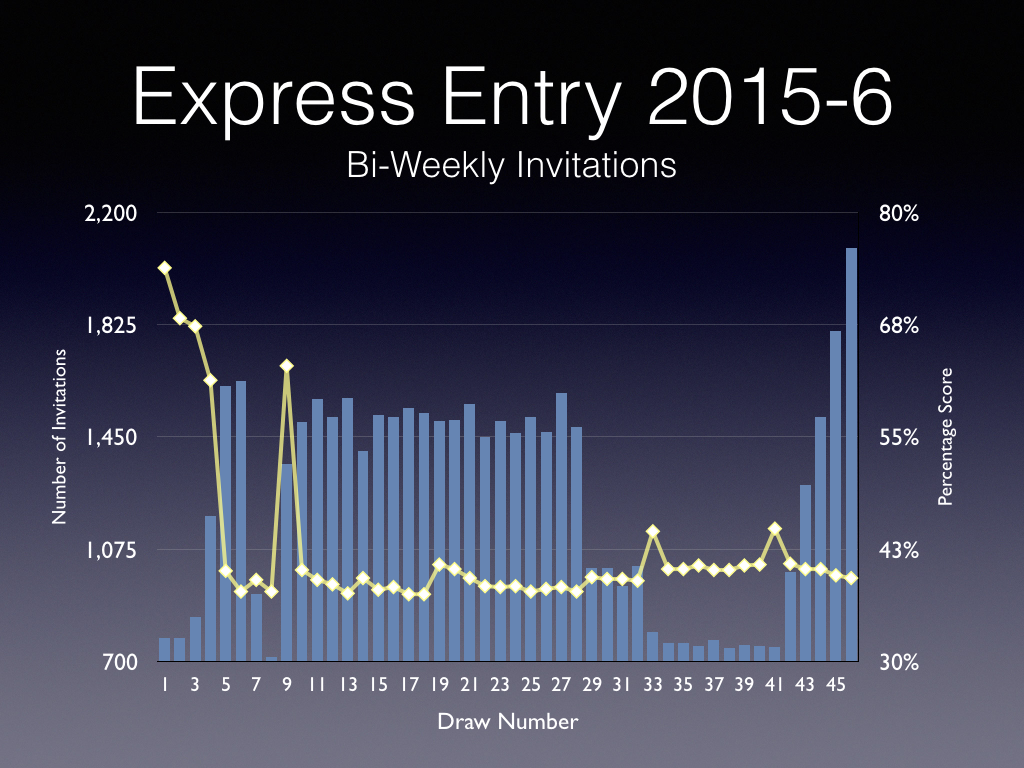
express-entry-draws-2015-001Significant changes (the above chart shows the number of invitations and minimum score for all draws to date before the changes announced this week):

The federal government is changing its electronic immigration-selection system to improve the chances of international students and some high-skilled foreign workers to become permanent residents.

The changes to the Express Entry system, which scores and ranks applicants based on factors such as age, language ability, education and work experience and then matches them with Canadian employers, will take effect on Nov. 19. The changes announced in a news release on Monday will make it easier for some highly skilled workers already in the country and international students who completed their postsecondary education in Canada to get an invitation to apply for permanent residence.

“This is a re-balancing of the points for permanent residency,” said Danielle Lovell, a Vancouver-based immigration consultant. “I think the re-balancing … is an effort to continue to have Express Entry be about high-skilled workers.”

Under the Express Entry system introduced by the previous Conservative government, employers who offer jobs to foreigners must get government approval through a Labour Market Impact Assessment (LMIA), which requires them to prove they could not find a Canadian to do the job. While the LMIA was meant to target abusers of the low-skill temporary foreign worker program, Canadian tech firms had to go through the same time-consuming process even when the only people with the required skills were outside Canada.

The upcoming changes to Express Entry reduce the importance of obtaining an LMIA for high-skilled workers. Some workers already in Canada on a temporary LMIA-exempt work permit and who want to stay permanently will no longer need a LMIA to get job-offer points in the Express Entry system. This includes people working in Canada under the terms of the North American free-trade agreement and workers in Canada temporarily under an intra-company transfer. Applicants must have been working in Canada for at least a year to apply.

These workers will also be in a better position to compete against Express Entry applicants who are still required to obtain an LMIA, as the number of points given for the assessment will be reduced. Previously, job offers supported by an LMIA were worth 600 points; as of Nov. 19, the same offers will be worth either 200 points for senior manager positions or 50 points for all other jobs.

The changes are aimed at making it easier for highly skilled foreign workers to become permanent residents.

…The Canadian tech sector has pressed Mr. McCallum to help it obtain much-needed foreign talent. Allen Lau, CEO and co-founder of the online publishing platform Wattpad, said that while the sector is investing in and training local talent, the demand outpaces the Canadian supply.

“Canada’s innovation economy competes on a global scale for top talent. [The] announcement by Minister McCallum makes it easier for high-growth companies like Wattpad to attract skilled workers and remain competitive,” Mr. Lau said. “Minister McCallum heard our concerns and took action.”

Major changes are also on the way for international students hoping to become permanent residents through the Express Entry system. Applicants who obtained a postsecondary degree, diploma or certificate in Canada will be awarded up to 30 additional points. Under the previous system, no points were awarded for this.

“In a competitive system, 30 points can be the difference between being selected and not,” said Noah Turner, a Montreal-based legal adviser.

Finally, applicants will have 90 days to complete their permanent-residence application if they get an invitation from the government, up from 60 days under the previous requirements.

Source: Ottawa to ease path to permanent residency for skilled workers, students – The Globe and Mail

As demographics change, food banks struggle to meet users’ tastes

Interesting – another aspect of our diverse society:

As food banks across Canada struggle to meet an ever-increasing need – up 28 per cent from eight years ago, according to a new report from Food Banks Canada – they also struggle to meet the demands of a user base that is changing demographically, and requesting different and healthier foods.

According to Food Banks Canada’s HungerCount report, 13 per cent of people who used food banks in the past year were immigrants or refugees. As in the case of the Mississauga Muslim Community Centre, many of them were part of the wave of refugees from Syria who settled in Canada in the past year.

These families do receive government support – about $2,500 each month for a family of four, according to Mr. Syed. But in urban areas where housing costs are especially high, such as Toronto, Vancouver and their respective suburbs, much of that winds up going toward rent. The Surrey Food Bank, about an hour outside of Vancouver, saw a 17-per-cent increase in use last year due in large part to Syrian refugees. And the food bank Mr. Syed runs was created in February specifically to address Syrian refugees, who make up about 95 per cent of the user base.

Still, the food Mr. Syed receives from organizations such as the Mississauga Food Bank, which distributes food through dozens of food banks and meal programs across the city, often does not reflect this changing need.

“People have in their heads what they want to donate,” said Jon Davey, the manager of food programs and distribution for the Mississauga Food Bank. The organization receives food not only from members of the public, but also from corporate donors. For Food Banks Canada, which supports a network of over 500 food banks across the country, its major supporters include companies such as Campbell’s, General Mills, PepsiCo and Mondelez International.

“We can ask for rice and lentils and tuna until we’re blue in the face – it works to a degree,” Mr. Davey said. “But pasta, soup and snacks are three things that are constantly filling up.”

Ethnicity and culture are not the only types of change that food banks face. Increasingly, Mr. Davey said, food banks such as his are dealing with the effects of an aging population, as well as an increase in young people receiving food assistance. More and more universities and colleges have begun offering food-bank services on their campuses.

Another major shift Mr. Davey said he’s seen is an increased demand for healthier, fresher options – mirroring the concerns of the general public about healthier eating.

Over the past year, he said the organization has worked with dietitians to better track its food supply to ensure items cover all four food groups.

He also said that he regularly refuses large quantities of unhealthy donations from both private and corporate donors. Others have done the same. An Ottawa food bank made headlines in 2014 after refusing to accept donations of items such as Kraft Dinner and Dunkaroos. That announcement sparked some criticism, with some questioning whether the Ottawa organization was being overly picky.

Mr. Davey acknowledged these concerns, but emphasized the difficult position his organization and others like it are in. “I’m not trying to disparage the donations we get, because we’re extremely happy people think about us at all,” he said.

Still, he added, “just because people are lower income and need to use the services doesn’t mean they don’t deserve to eat healthy, and doesn’t mean they don’t want to eat healthy.”

Source: As demographics change, food banks struggle to meet users’ tastes – The Globe and Mail