India’s Debate on Citizenship Continues

Of interest:

The Indian Citizenship Act of 1955 outlined the ways in which individuals may acquire citizenship in India and specifically denies it to undocumented migrants. The Citizenship (Amendment) Bill of 2016 attempts to remedy this but does so peculiarly. It looks into granting Hindu, Sikh, Buddhist, Jain, Parsi, and Christian minorities from Afghanistan, Bangladesh and Pakistan citizenship after 6 years of residence in India (as opposed to 11 years, as is the status quo) even without documentation. The Bill draft has been made available online and a Joint Parliamentary Commission with members of both parliamentary houses is examining it — and was open for comments until September 30.

Public discussion about the Citizenship (Amendment) Bill of 2016 follows two lines. First it has been criticized for delineating citizenship on purely religious lines. Although this is not new in a country like India, which was partitioned along religious lines, in this case the bill allows citizenship to undocumented migrants from most major Indian religious groups except for Muslims, at about half the duration currently required. In so many ways, this brings to mind the ruling Bharatiya Janata Party’s (BJP) campaign promise of providing a ‘natural home’ for Hindus in India as this policy is mostly directed towards Hindus from these countries.After facing the kind of opposition that resulted in the deputation of the Joint Parliamentary Committee, government officials attempted to clarify accusations of religious discrimination. They discussed a plan to change the term “religious minorities” in the Bill to “discriminated religious minorities.” However that still does not encompass discriminated Islamic minorities like the Ahmadiyya populations in Pakistan, who will not qualify for Indian citizenship under the relaxed rules should they migrate.

Activists in New Delhi held a protest rally on September 30 to decry this Bill, calling it communally motivated. Activist Kavita Krishnan, for instance, declared that the government needed to remember that India was not, in fact, a Hindu state and could not therefore provide a right of return to populations. They also questioned the need for singling out these specific categories of people, ignoring the persecution of several other groups – like atheists within these nations or potential climate refugees.

Source: http://thediplomat.com/2016/10/indias-debate-on-citizenship-continues/

Tests d’immigration [citizenship] plus chers en français : le commissaire aux langues officielles blâme Ottawa

This should provoke some broader reflection within IRCC about the overall cost of citizenship and the related impact on the naturalization rate. Not just an issue of differential costs for francophones and anglophones:

Le commissaire aux langues officielles est catégorique : le gouvernement fédéral manque à son devoir et nuit peut-être même à l’immigration francophone en acceptant des tests de compétence linguistique en français plus chers et moins accessibles que les tests en anglais.

Après un an d’enquête, Graham Fraser présente un rapport préliminaire qui donne raison aux francophones qui s’étaient plaints de la différence de tarifs entre les tests en français et en anglais. Pour devenir résident permanent, il faut prouver qu’on maîtrise l’une des deux langues officielles, en réussissant, par exemple, un examen reconnu par Immigration, Réfugiés et Citoyenneté Canada (IRCC).
Le problème, c’est que les évaluations en français coûtent souvent des centaines de dollars de plus.
Résultat : pour économiser, des immigrants francophones optent plutôt pour l’examen en anglais. Un choix déchirant pour certains.
Pourquoi cette différence de prix?
Les tests de français offerts au pays sont tous conçus et corrigés en France, soit par la Chambre de commerce et d’industrie de Paris ou par le Centre international d’études pédagogiques. Pour recevoir leur correction finale, les examens doivent être renvoyés outre-mer par la poste.
Autre coût : le salaire des examinateurs. Chaque candidat qui passe le test doit être examiné par deux personnes, ce qui n’est pas le cas pour l’un des tests d’anglais.
Même si les organisations désignées pour administrer les tests sont des tierces parties, insiste Graham Fraser, ces services doivent être « disponibles et de qualité égale » en français comme en anglais, en vertu de l’article 25 de la Loi sur les langues officielles.
IRCC n’a pris aucune mesure pour s’assurer que les candidats aient accès de manière égale aux services d’évaluation linguistique. L’égalité réelle comprend l’égalité d’accès, d’usage, de qualité et de statut.
En plus d’être plus chers, écrit le commissaire, les tests sont aussi plus difficile d’accès pour les francophones. Le Test d’évaluation de français (TEF) n’est d’ailleurs pas du tout offert à l’Île-du-Prince-Édouard, ni à Terre-Neuve-et-Labrador, ni dans les territoires.

Graham Fraser cite en exemple le cas d’un francophone de Whitehorse, au Yukon, qui a dû se rendre à Vancouver, en Colombie-Britannique, pour passer son TEF. Une fois la partie écrite de son test complétée, il a dû attendre quatre jours sur place avant qu’on évalue ses compétences en compréhension orale.
Une fois le test complété, note Fraser, les francophones attendent souvent plus longtemps avant d’obtenir les résultats. Par exemple, en Colombie-Britannique et en Nouvelle-Écosse, « le délai d’attente [pour s’inscrire] pouvait respectivement atteindre trois et cinq mois. »
Le commissaire recommande au gouvernement fédéral « d’entreprendre immédiatement des démarches » pour mettre fin à cette situation qui dure depuis des années, et qui pourrait avoir des conséquences négatives sur l’accueil d’immigrants francophones et, ultimement, sur la vitalité du français au pays.

Source: http://ici.radio-canada.ca/regions/ontario/2016/09/27/001-tests-immigrants-plus-chers-francais-commissaire-fraser.shtml

Facing opponents of an updated sex ed curriculum: Michael Coren

Coren on those opposed to Ontario’s updated sex-ed curriculum:

Recently I covered my second demonstration against Ontario’s new sex education curriculum. Standing outside of Queen’s Park were the usual suspects — fundamentalist Protestants speaking of “sodomites,” ultra-conservative Catholics disgusted at Pope Francis’ ostensible liberalism and various angry people holding clumsy posters. The last time I was here an Elvis Presley impersonator with a dog collar loudly condemned me from the platform. Not this day alas. Elvis had obviously left the building.

As bizarre as it may sound, this is serious stuff and has led to parents removing their children from school and even to the previous provincial government withdrawing this acutely necessary and entirely reasonable curriculum. So who are these perennially outraged men and women who think we’re all doomed and damned?

I know quite a few of them and their leaders; hardly surprising in that it’s always the same people and the same faces. One prominent regular is a leading anti-abortion campaigner who once made up and then spread the rumour that our youngest daughter, who was still at school at the time, was gay. She happens to be straight but her sexuality is irrelevant to us. Thing is, it was done to try to hurt her and by extension hurt me because I had become increasingly vocal in my support for same-sex marriage. The person in question is a devout Catholic.

Others were from a group who had worked successfully to have me fired as a columnist from a Christian newspaper because I had written that a 10-year-old Paraguayan girl raped by her stepfather had the right to an abortion. So, as I say, I know them well and they’re hardly representative of mainstream Canadian society.

Yet in spite of, or perhaps because of, their extremism these zealots do have a following. More than this, they are trying to co-opt minority communities — principally Chinese Christians and South Asian Muslims — into their coalition.

Their anchors are hysteria, paranoia, fear and ignorance. The apocryphal is wrapped up as established fact and what is gossip becomes ironclad information. At their demonstrations and in their literature they quote the curriculum severely out of context and speak of teachers — always unnamed — who are “perverting” children. There are frequent references to pedophilia and the smog of homophobia is seldom far away.

This latter point needs to be understood, because there has been a deliberate effort on the part of the antisex ed leadership to publicly, if not privately, play down or deny the anti-gay prejudice that was so prominent in earlier demonstrations and in their attitudes toward Kathleen Wynne.

While hardline evangelicals are part of the leadership, the central figures are traditionalist Roman Catholics who reject Pope Francis’ moves toward dialogue and have adopted Cardinal Robert Sarah from Guinea as their champion.

This senior cleric’s name is peppered on antisex ed websites and in their conversations. Sarah has denounced what he calls “Western homosexual and abortion ideologies” as being “demonic” and compared them to Nazism. He has described equal marriage as “part of a new ideology of evil” and supports African anti-gay laws, many of which are hideously punitive and lead to the arrest and assault of gay men and women. This is the reality of the antisex ed movement.

What the activists refuse to say is that it is not this particular curriculum they oppose but any attempt by the state to teach children realistically about sex and sexuality, and certainly any approach that embraces the full equality of the LGBTQ community. Many of them oppose birth control and virtually all of them vehemently oppose reproductive choice and premarital sex. This is not, as they claim, “ordinary parents defending their children.”

At the root of much of all this is a denial of sex as a loving, pleasurable, invariably harmless and entirely natural act. They don’t oppose sex in itself but view it primarily, if not exclusively, as a means of procreation rather than as a method of enjoyment. They also refuse to realize that children, even their children, will be and are sexually active. An acidic nostalgia for a time that never was.

Regrettably, the conversation is not over and neither is the opposition. As for the Elvis impersonator, I fear he will be back to sing again.

Source: https://www.thestar.com/opinion/commentary/2016/10/03/facing-opponents-of-an-updated-sex-ed-curriculum.html

Monsef case brings calls to strengthen appeal rights for those facing citizenship revocation

More on citizenship revocation for fraud or misrepreasentation, provoked by Monsef and the upcoming Senate review of C-6:

Not having a connection to Iran is a good thing, according to Sen. Omidvar.

“Once you get Iranian citizenship, it’s with you for the rest of your life whether you want it or not,” said the Indian-born Senator, who is an internationally recognized expert on immigration, diversity and inclusion named to the Senate by Prime Minister Justin Trudeau (Papineau, Que.) earlier this year. “I was an Iranian citizen by marriage, and so when I went to Iran, the only way I could stay there was if I relinquished my passport from India and was issued an Iranian identity.”

Although she left Iran and came to Canada in 1981, and subsequently became a Canadian citizen, she would still be considered an Iranian citizen were she to return to Iran. “That is why I never want to go back,” Sen. Omidvar said in an interview.

Last week, she moved the second reading of C-6 and hopes the Senate will be able to amend the bill to provide “an avenue for an appeal or a hearing” for Canadians whose citizenship is being revoked based on misrepresentation or fraud.

Sen. Omidvar explained that in the case of Ms. Monsef—who at the age of 11 came to Canada with her widowed mother and two younger sisters as refugees—she and her siblings “would be held accountable” if her mother told Canadian immigration officials her children were born in Afghanistan and not Iran.

Under the current system, Ms. Monsef could get a letter from a Citizenship and Immigration Canada official stating that her Canadian citizenship was being revoked based on misrepresentation, and she would have 60 days to respond to the same official who sent the letter. Ms. Monsef could then seek leave to appeal to the Federal Court for a judicial review, but only after she lost her citizenship.

Even then, the court only grants leave on about 15 per cent of citizenship revocation cases, according to Toronto-based immigration and refugee lawyer Lorne Waldman, who is representing the British Columbia Civil Liberties Association and the Canadian Association of Refugee Lawyers in a constitutional challenge to the citizenship revocation regime in C-24 that was filed with the Federal Court last Monday.

He explained that if someone was found to have lied when applying to become a permanent resident and later became a Canadian citizen, that individual could lose both status and face automatic deportation.

What is known about Ms. Monsef’s case “is an example of that scenario,” said Mr. Waldman, who is in court next month on a similar case involving two people who came to Canada as children and whose citizenship is imperilled because of their father’s alleged misrepresentation on his permanent resident application.

Mr. Waldman said he doesn’t believe Ms. Monsef will be stripped of her Canadian citizenship. If the misrepresentation in her case involves where she was born rather than her citizenship at birth “it is not likely that would be relevant” in raising questions about the minister’s status in Canada, said Mr. Waldman.

http://www.hilltimes.com/2016/10/03/monsef-case-brings-calls-strengthen-appeal-rights-facing-citizenship-revokation/82379?ct=t(RSS_EMAIL_CAMPAIGN)&goal=0_8edecd9364-032584e435-90755301&mc_cid=032584e435&mc_eid=685e94e554

CBC-Angus Reid poll: Canadians want minorities to do more to ‘fit in’

The latest survey on attitudes towards integration. Questions not that nuanced, and the usual contradiction between two-thirds being satisfied “with how well immigrants are integrating” and an equal number who believe “minorities should do more to fit in better with mainstream Canadian society.”

The online survey was conducted in early September from a sample of 3,904 Canadians. The results have a 2.5 per cent margin of error 19 times out of 20.

The poll was conducted in the wake of a series of issues that dogged politicians as they contested last year’s federal election: a proposed ban on niqabs in public service; the Syrian refugee crisis; and terrorist attacks both in Europe and on Parliament Hill.

The results also hint at why Conservative leadership candidate Kellie Leitch believes she may be onto a winning issue by asking supporters their thoughts on vetting would-be immigrants and refugees for “anti-Canadian values.”

According to the poll, two-thirds of Canadians say they’re “satisfied” with how well new immigrants are integrating into their communities.

That figure seems to fly in the face of another result, because an equal number said they believe “minorities should do more to fit in better with mainstream Canadian society.”

‘Unthinking or mindless multiculturalism’

Former B.C. premier and Liberal cabinet minister Ujjal Dosanjh has written and spoken extensively about the need to address concerns about equality, race and culture in the face of blind devotion to multiculturalism.He said the poll shows Canada’s political leadership needs to pay attention.

“What you want is creative multiculturalism, generous multiculturalism, but not unthinking or mindless multiculturalism where everything anybody brings to this country is acceptable,” he said.

“Diversity is great if we can begin to live with each other in equality, in understanding … but we also understand our collective obligations to building a better society. If we can’t live together with each other properly and make concessions to each other, then this phrase that politicians use — that diversity is a strength — is nonsensical.”

http://www.cbc.ca/amp/1.3784194 

Douglas Todd: Canadians far from resolving not-so-minor niqab issue

More on the niqab in the aftermath of Douglas Todd’s interview with Zunera Ishaq, highlighting some of her apparent contradictions and inconsistencies.

One aspect missing from these discussions is a comparison with the traditionalists or the fundamentalists within other faiths, and how their values are or are not compatible with what we think are Canadian values:

SFU social policy specialist John Richards points out Ishaq’s hearing never got to the Charter of Rights arguments. It’s another indication the debate is not over.

The niqab raises the question Quebec’s noted Taylor-Bouchard commission attempted to answer on the limits of tolerance, which is: How far should Canadians go to “reasonably accommodate” certain cultural practices?

Appropriately, UBC political scientist emeritus Philip Resnick distinguishes Canada’s niqab debate from the August controversy over some French cities banning the full-body “burkini” from beaches.

“The burkini debate arose because emotions were very raw in the aftermath of the Muslim terrorist attack on Nice on Bastille Day. I think there is no more reason to deny women the right to wear a flowing garment when swimming than to deny them a bikini or string swimming suit.”

But Resnick urges Canadians to “avoid tut-tutting and moralizing” over Europeans’ generally more restrictive response to the niqab. “I wonder how quickly Canadian tolerance would be replaced by fear if we had to deal with an intransigent Islamist contingent in our midst?”

I originally intended to write just one column on the far-reaching niqab debate. But plans changed last week when Ishaq, after many earlier calls to her family’s Mississauga residence, picked up the phone and answered some fresh questions.

In addition to emphasizing her “choice” to cover her face, Ishaq said she believes in strict segregation of the sexes, opposes homosexuality and abortion, believes women are “unclean” during menstruation and is convinced Muslims must obey Islamic commands.

…Questions too ‘gentle’

Richards, who travels frequently to South Asia for research, appreciated my exploration into Ishaq’s paradoxical worldview, but also suggested I’d been “gentle.”

I could have asked Ishaq about “apostasy,” which refers to the rejection of a religion, said Richards.

A Pew Research poll found 75 per cent of Pakistanis believe a person should be executed for apostasy.

Many people in Pakistan, the fifth largest source of immigrants to Canada, also believe women must wear niqabs. And hundreds of Pakistani women are killed each year in “honour killings.”

Given the global geo-political issues, I could also have been more curious when Ishaq (who is now on a family trip in Pakistan) said “no comment” in regards to Saudi Arabia’s pressure on women to wear full-length burkas and niqabs.

Even though Ishaq says she is devoted to the supreme value of “choice,” it was unusual that she passed up the chance to criticize an Islamic government that removes women’s choice and requires them to dress a certain way.

Ishaq is affiliated with several politicized Muslim organizations, including the Hanafi school of thought, which believes apostasy is a sin punishable by death, according to the Federal Court and Richards.

Canadian Muslim writer Tarek Fetah has also shown Ishaq has connections with Jamaat-e-Islami and the Islamic Circle of North America (ICNA), which are part of the ultraconservative Salafist movement.

Given Ishaq’s apparent contradictions, Toronto blogger Eiynah says “framing the niqab as some sort of feminist tool of bodily autonomy is the most ludicrous, topsy-turvy thing I’d ever heard of.”

Similarly, Resnick, who specializes in anglophone and francophone cultures, finds it “extraordinary” that many secular left-wing people defend the niqab.

“Ultimately, the issue goes back to the one the Bouchard-Taylor commission in Quebec sought to tackle — what constitutes reasonable accommodation?” Resnick says.

“The niqab offends Canadian sensibilities in a way that the head scarf does not. It reminds us there are countries where women cannot show their faces in public. It represents the most backward-looking and repressive feature of Salafist ideology.

“At the minimum I would agree with those who would bar the wearing of a niqab at any citizenship ceremony. Nor would I see it as acceptable garb for anyone working in the public sector and therefore having to serve a much more diverse Canadian public.”

Like Swedes, political scientists say, Canadians tend to believe in their exceptionalism.

“Many Canadians, in their refusal to take tougher positions on accommodation and integration of immigrants, like to think of themselves as exceptionally virtuous, unlike the wicked Americans or Europeans. But are we?” asks Resnick.

“Quebecois are franker in this regard than English Canadians, in regards to both language and the niqab, since their sense of cultural identity is more clearly on the line than our own.

“But I wonder how well Canadian smugness would survive a serious challenge to our core values, of the type that radical Islamism represents in Europe.”
Source: Douglas Todd: Canadians far from resolving not-so-minor niqab issue | Vancouver Sun

Canada’s demographic gap can’t be filled with immigrants

Jason Kirby on the limits on immigration to address the aging population and the economic integration challenges immigrants face:

This isn’t to say immigrants can’t mitigate the effects of Canada’s aging population. This country’s ability to absorb people from diverse cultures is an advantage remarkably few other nations enjoy.

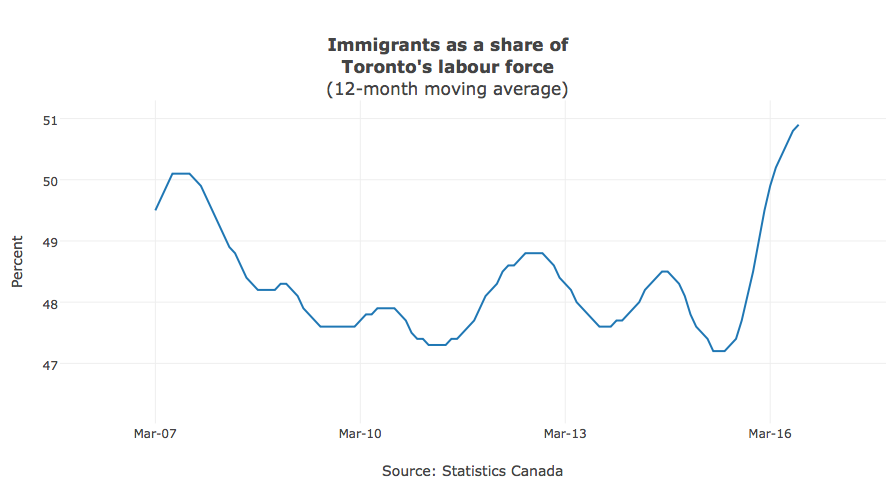
As it is, immigrants are already a major driver of Canada’s labour force. In Toronto, for instance immigrants now account for nearly 51 per cent of the city’s labour force. It’s slightly less in Vancouver (41 per cent) and lower still in Montreal (26 per cent) but all three cities have seen immigrants grow as a share of the labour force over the past few years.

kirby-article

There’s a problem here too, though. New immigrants don’t fare well in Canada’s job market. The unemployment rate among immigrants who landed in Canada within the last five years has, on average, been more than double that of Canadian-born workers over the last decade. Those who came between five and 10 years ago are a bit better off—their unemployment rate is about 1.5 times higher. It’s only among immigrants who’ve been in the country for more than a decade that the gap with Canadian-born workers is erased. It shows that even if Canada ramps up the number of newcomers it accepts, their performance in the labour market will surely lag for years.

The experience over the last year with the influx of more than 30,000 Syrian refugees, who are included in this year’s higher immigration count, has shown how challenging it is to quickly integrate large numbers of people. So too has the backlash in Vancouver against homebuyers from mainland China (and the murky question of who is a foreign buyer and who is a genuine immigrant) even as Canada works to double the number of visa offices in that country. Meanwhile, Canada may pride itself on being more open and tolerant of immigrants, especially in contrast to the ugliness going on in the U.S. and Europe, yet internal polling carried out by Immigration Canada shows one quarter of Canadians feel immigration levels are too high as it is. The news of this year’s immigration boom does not sit well with them.

Which is silly, really, because despite that headline-grabbing number of new immigrants, their number works out to just 0.8 per cent of Canada’s population, or 0.1 percentage points higher than the average of the last 20 years. Some boom.

Source: Canada’s demographic gap can’t be filled with immigrants – Macleans.ca

Canadian Studies profs hold conference on how to stay critical without Harper around

While Twitter commentary has been biting, my take is that it is refreshing to have a group acknowledge its implicit (and sometimes explicit) biases.

A similar reflection others (e.g., public servants, the media) might also be warranted, although my sense is the media is becoming more critical as the government’s time in office becomes longer, with the related decisions (or non-decisions):

Canadian Studies professors slammed Stephen Harper’s Conservative government so much that they’re literally holding a conference in Ottawa to discuss how to keep their critical edge now that he’s gone.

“The loss of the Harper government for Canadian academics is not unlike the loss of George W. Bush for American comedians,” the description of the conference’s theme says.

“The question in this moment of optimism (which may well have passed by the time this conference comes around) is…What do we do now?”

Called “After the Deluge: Reframing/Sustaining Critique in Post-Harper Canada,” the conference will take place at Carleton University on Oct. 28 and 29.

The conference’s theme notes Canadian Studies professors have “long prided themselves on a robust critique of the Canadian State,” and outlines how the Conservative government under Harper antagonized scholars.

 It singles out the elimination of the long form census and budget cuts to Library and Archives Canada as examples of “attacks” on research infrastructure.

“The Harper government also hit the world of Canadian Studies at its doorstep by cancelling the Understanding Canada program in 2012,” it says.

The theme also questions whether Canadian Studies in general has become too “premised on oppositional critique of the state,” and whether that’s really the best approach for their research.

“Are generative, collaborative, appreciative, and assets-based approaches to Canadian Studies a failure of critical vigilance, or a long-overdue paradigm shift?” the conference’s theme ponders.

Peter Thompson, an associate professor at Carleton who’s helping organize the conference, said the event will be less blunt than the theme implies.

“The idea is not just bashing the Harper era,” he said. “It’s about to what extent is there a change, and looking at that with clear eyes. We’re not assuming that there’s a change in government so things are automatically better.”

Thompson — who was very careful to keep the discussion apolitical — did acknowledge that with Prime Minister Justin Trudeau overturning some of the Conservative government’s most controversial policies, there is the potential for contemporary research to become too soft.

“I don’t want to assume what people are going to say at the conference,” he said. “But yeah … it’s about making sure that critique, and that the sharpness of the critique, is still there even though things have changed.”

Papers presented at the conference will touch on areas such as national security, national symbols, and cultural policy, Thompson said.

The conference is organized as part of the Canadian Studies Network, and will also host the network’s annual general meeting.

Source: Canadian Studies profs hold conference on how to stay critical without Harper around | National Post

When The ADL Promotes Anti-Semitism | The Daily Caller

Over reach:

Earlier this week, the Anti-Defamation League (ADL) added the cartoon character and internet meme Pepe the Frog to its “Hate On Display” database, saying it promoted “anti-Jewish, bigoted and offensive ideas.” The announcement gained major media coverage, from The New York Times to The Washington Post to TIME Magazine.

But the symbol was previously unknown to the vast majority of Americans, largely limited to the youthful-skewing hardcore followers of Internet message boards.

Thanks to the ADL, though, all of America’s anti-Semites have a new, cuddly mascot to use in their attacks on Jews.

Last year, the decade-old amphibian was one of the most popular symbols on the social networking site Tumblr. Pepe the Frog has been associated with bigotry for less than a year, as the “alt-right” gained strength during the presidential election. Those who present Pepe as anti-Semitic generally hide behind anonymous names like mashr445, and it can be impossible to tell if they are junior high school girls, an automatic computer program, or even disgruntled Jews. When anti-Semites use their own names, then I get nervous.

 Since historically the character has only rarely represented hateful ideas, the ADL’s categorization is like calling white sheets racist. Yes, the KKK has used white sheets to terrorize blacks and when they do, it’s terrible. But white sheets themselves are hardly a hate symbol. Yet the ADL also lists (I’m not kidding) the numbers 12, 13, 14, 18, 28, 38, 43, 83, and 88 as hate symbols. (Watch out for those bigoted pianos with their 88 keys.)

What’s the upside here for the ADL? What does it think it’s achieving by disseminating information about bigoted use of a cartoon character by a fringe segment of American society? How are their press releases and databases going to save a single Jew from being harassed, fired, or assaulted for his faith?

They won’t. But they will raise money for the ADL.

The organization’s very raison d’être is fighting anti-Semitism, so they can’t continue to replicate themselves without a perception of widespread – and growing – prejudice against Jews. That’s why their 2014 survey of global anti-Semitism was designed to encourage anti-Semitic answers  and even beliefs among respondents. It’s why the organization will try to squelch any dialogue or artistic expression that doesn’t meet its checklist of approved modes of discourse about Jews, Israel, race, sexual orientation, and more.

But this time they’ve gone too far. In order to get its name in the papers, the ADL is aiding and abetting America’s Jew-haters in a concrete way by handing them Joe the Camel of anti-Semitism on a silver platter. The swastika is so darned angular and abstract, whereas Pepe the Frog would make for good temporary tattoos, stuffed animals, or trading cards.

The Pepe episode is a great example of how reckless “educational efforts” by anti-tolerance organizations can be counter-productive. I remember a shocking display at the Museum of Tolerance in Los Angeles that invited participants to match the hate slur to the group being targeted, including some fairly obscure ones. I literally added new spiteful terms for Asians and lesbians to my lexicon. Why is that a good thing?

In an almost certain parody of that exhibit, the 2002 South Park episode “The Death Camp of Tolerance” has the boys visit the Museum of Tolerance and walk through the “Tunnel of Prejudice,” in which voices shout things like “Queer” and “Chink” and “Heeb.”

Most of the fourth-graders are understandably startled by the put-downs – save crudely bigoted Cartman, who calls the exhibit “awesome,” and hops up and down: “I want to ride again! I want to ride again!”

No matter how lucrative, publicizing new ways to persecute Jews is rarely a good idea. The ADL should have plenty to do coping with the anti-Semitism that already exists in the broader society without taking a minor phenomenon and making it mainstream.

Source: When The ADL Promotes Anti-Semitism | The Daily Caller

Denmark’s Right Wing Peddles Anti-Migrant Spray – The Daily Beast

Nasty:

There has never been any question about how some Danes really feel when it comes to refugees and migrants. After all, Denmark is a country where the parliament actually voted to seize certain high-value items from them to help offset the costs of their housing and health care. It is also a country where it is legal to bounce migrants and refugees out of nightclubs just for being migrants and refugees.

Now some Danes have taken things a step further by handing out a special pepper spray that is meant to keep refugees away. The refugee-repellent product, Asyl Spray (presumably playing on the word asylum), was distributed in the southeast port city of Haderslev last weekend by the right-wing Danskernes Parti political group.

The purse-size spray can features the promise to “repel refugees” in a “legal” and “effective” way.

 Party leader Daniel Carlsen, who says he came up with the idea, rebuffed outrage by claiming that most pepper spray is illegal in Denmark, and the anti-refugee spray provided a legal alternative.

“I cannot see how it is racist,” he told CNN. “Pepper spray is illegal here so we wanted to figure out a way for Danish people, in particular women, to protect themselves. It’s obviously not the ideal situation.”

He said he knew that while the spray could not stop migrants and refugees from trying to reach Denmark, it might act as a deterrent for those that have arrived. “In the long run we want to repatriate the migrants, we want to repatriate non-Westerners in general, that is in the long run,” he said. “In the short run we want to provide solutions to make life better and safer for the Danish people.”

Not surprisingly, the Danish approach to migration has raised eyebrows among those concerned about the tens of thousands attempting to reach Europe. The United Nations agency on refugees issued a statement of sheer disgust about the produce, stating that it “strongly regrets that this kind of incident is taking place in Denmark against asylum seekers and refugees, people who have already suffered so much.”

Source: Denmark’s Right Wing Peddles Anti-Migrant Spray – The Daily Beast