Saunders on the similarities between the Black experience in Canada and the USA, and the associated risk of not addressing some of the underlying issues:
So the emergence of the Black Lives Matter campaign against police discrimination in Montreal, Toronto, Calgary and Vancouver is not some copycat echo of a far more violent U.S. crisis; it is a reflection of the lived experiences of many black Canadians, which are measurably different, on average, from those of white and other minority Canadians.
“Although there are certainly some differences in terms of broad historical contours, demographic patterns and patterns of migration, there are some really profound similarities,” between Canada and the U.S., says Barrington Walker, a legal historian at Queen’s University. “I do think that the history of anti-black racism that exists in Canada, that there is a kind of long, institutionalized state memory, the old idea that blacks do not belong as part of the Canadian landscape.”
Dr. Walker’s research has found a consistent pattern in Canadian courts of sharply different treatment of black defendants in trials, judgment and sentencing, and in likelihood of running afoul of the law.
These findings have been confirmed over and over. In 1995, a high-profile Ontario government commission (struck in the wake of the 1992 Yonge Street protests and riots against police discrimination) reported that black and white citizens were treated dramatically differently in policing, charges, court procedures, sentencing and imprisonment. For example, when faced with identical drug-crime charges in similar circumstances, 55 per cent of black defendants but only 36 per cent of white defendants were sentenced to prison – a difference that could not be accounted for fully by non-racial factors. A 2002 Toronto analysis found that black drivers were disproportionately more likely to be pulled over by police without evidence of an offence; they are 24 per cent more likely to be taken to the police station on minor charges and more than twice as likely to be held in jail while awaiting a hearing. (This was strictly a black phenomenon: the data for suspects listed as “brown” was nearly identical to that for whites.) And research in the last two years has shown that random police stops without evidence (“carding”) happens to black Canadians to a hugely disproportionate degree.
What’s the root of this discrimination, which takes place even when officials are racially diverse and liberal-minded? In part, it’s institutional path dependency: Police and judges have always responded to suspects based on traditional patterns (and on patterns learned from the U.S. media and justice system), and it’s hard to break those ugly traditions.
That’s dangerous, because black Canadians are also inordinately excluded from home ownership, neighbourhoods with good public transit and key employment markets. That’s partly due to the timing and economic circumstances of Caribbean immigration, partly due to racism.
Either way, it creates a spiral of discrimination: A group of Canadians who live in fringe rental-only neighbourhoods, with less secure employment and access to resources, who face a more hostile police and justice system, hurting their chances of advancement. It’s not too late to stop this spiral. If we want to be different from our southern neighbours, we need to stop reproducing their most infamous form of inequality.
Hardly surprising, as the intent of the change from the previous system of allowing those born abroad to Canadian parents to retain their citizenship required a formal application and to either reside in Canada for one year prior to their application or have established a “substantial connection” to Canada by age 28, was to limit the transmission of citizenship to those with a more immediate connection to Canada.
Moreover, the previous process was hard to administer and, at least theoretically, allowed for endless transmission of citizenship.
One can debate whether a first or second generation limit is more appropriate and fair (unlike European ‘bloodline’ notions of citizenship, Canada, like most immigration-based countries, has more of civic approach to citizenship).
The same issue of how siblings may be treated differently depending on their birthplace can also arise in second and subsequent generations.
Bill C-6 took a relatively narrow and ‘surgical’ approach to addressing some of the concerns regarding the previous government’s citizenship legislation and related initiatives in line with the platform commitments and maintaining the emphasis on integrity.
This will be discussed during the Senate’s hearings on C-6 given that the family concerned intends to file a brief (it was not discussed at length during the Commons consideration of the Bill):
Like many Canadians, Jennifer and Evan Brown moved to the United States for work. In 2011, they jumped at the chance to live in New York when Evan, a chartered accountant, was offered a job there. After the couple had their first child a year later, they moved back to Canada, where they eventually had a second. But there’s a crucial difference between their children: One has more citizenship-transmission rights than the other.
The Browns, who now live in Victoria, are affected by a law passed by the government of Stephen Harper, whereby the children of Canadian citizens born abroad cannot – with only a few exceptions – pass on their own citizenship if they also have children abroad. The provision was introduced as part of changes the previous, Conservative government made to citizenship laws. While the current Liberal government is undoing much of that legislation, it has so far not addressed the concerns of families like the Browns.
Without citizenship, an individual does not have access to many of the benefits that come with being Canadian, including the ability to travel with a Canadian passport and to vote or run for political office. It can also complicate the individual’s ability to work in Canada and access all social benefits. With that much at stake for their children, Canadians born abroad may feel pressure to restrict their travels and working opportunities.
It took four years for the Browns to figure out that their four-year-old son, Jackson, born in the United States, was affected by the law. Like most children in the same circumstances, their son received a letter from the Canadian government explaining the rule, but the Browns didn’t fully understand it at the time.
Ms. Brown was recently at a local playground when another parent, Roy Brooke, told her how his son, five-year-old Nathan, may not be able to pass citizenship onto his children if they are born abroad as Nathan was. Ms. Brown realized the rule probably applied to her son as well.
“I had the assumption that he’d actually have more doors opened for him having been born in the U.S., and then I felt that possibly we’d actually restricted the most important door for his children,” Ms. Brown said.
The rule stipulates that someone born or adopted outside Canada to a Canadian parent is not a Canadian citizen if the person’s parent was also born abroad after April 17, 2009, when the provision became law. The limit was brought into force in an effort to “achieve greater simplicity and transparency in citizenship laws as well as to preserve the value of citizenship,” according to Immigration, Refugees and Citizenship Canada (IRCC).
The Brown and Brooke families were not working for the Canadian government or Canadian Forces when they had their children abroad – the only exception to the rule – so their children were not exempt from the first-generation citizenship limit.
Mr. Brooke has taken the fight for the citizenship-transmission rights of children like Nathan and Jackson to Ottawa. After two years of unsuccessfully attempting to persuade the Conservatives to change their policy, he is pushing the Liberals to do so. He had his eyes set on the Liberals’ Bill C-6, which aims to reverse some Conservative changes to the Citizenship Act, but was told it was too late to amend the legislation to remove the first-generation citizenship limit. The bill is currently at first reading in the Senate, where Mr. Brooke is now seeking witness status before committee and encouraging others affected to make their concerns known.
Immigration Minister John McCallum said at the end of May that he would look into the matter. His office referred further questions to the Immigration Department, which refused to speculate whether changes may be tabled in the future.
NDP immigration critic Jenny Kwan, who has met with other affected families, called the policy “discriminatory” against Canadians who choose to work abroad, especially in today’s global economy.
“The Prime Minister himself has said on many occasions now, ‘a Canadian is a Canadian is a Canadian.’ This also applies to second-generation Canadians born abroad as well. They shouldn’t be treated as second-class citizens,” Ms. Kwan said.
Mr. Brooke and his wife, Sara Bjorkquist, were working in Geneva, Switzerland, when their son was born in August, 2010. Had they been aware of this law, Mr. Brooke said he and his wife would have thought twice about having children overseas. He’s now concerned that Nathan may not be able to pass on citizenship to his children if he chooses to follow in his parents’ footsteps and work abroad.
“My decision to serve at the UN could penalize me, my son and his offspring,” Mr. Brooke said. “Three generations are hurt because we decided to live overseas for a few years and work for the UN, and that is not right.”
Only a couple of exceptions can apply to the children of Canadians like Nathan: if at the time of the birth abroad, the child’s other parent is a Canadian citizen by birth in Canada or by being granted citizenship through immigration, or if the affected parent is working for the Canadian government or Canadian Forces at the time of the birth.
“If [Nathan] works overseas, his children could be stateless if he works for the Red Cross, the UN or any non-federal government entity, and marries a non-Canadian,” Mr. Brooke said.
Parents of children born abroad who are not eligible for citizenship may sponsor their children to become permanent residents and then apply for citizenship.
In 2009, the Asia Pacific Foundation of Canada estimated that 2.8 million Canadians – or 8 per cent of Canada’s total population – lived abroad. IRCC said it does not know how many Canadians born abroad are affected by the first-generation citizenship limit.
Advocacy groups, including the Canadian Council for Refugees, have called on the government to restore the right to citizenship for the second generation born abroad or at least to provide citizenship to those who would otherwise be stateless under the law.
“By denying citizenship to the second generation born abroad, Canada is creating a new set of ‘lost Canadians’ and making some children born to Canadians stateless,” the CCR said in a report on Bill C-6.
Two Israelis — an Arab and a Jew — posted messages on Facebook saying they were going to kill someone on the other side of the Israeli-Palestinian conflict.
The two posters were real people with active Facebook pages, but the threat was part of an experiment conducted by an Israeli news station last week. The goal was to monitor the reactions of individuals and Israeli authorities who are tasked with keeping tabs on social-media posts that they say might inspire terrorist attacks.
Critics in both communities say social media has served as a conduit for unstoppable deadly violence. While the low-intensity Israeli-Palestinian conflict has been burning for decades, the platforms have given rise to individual extremists and lone-wolf attackers who are much more difficult to stop, officials say.
After posting that he had been inspired to kill Jews, Shadi Khalileh, the Arab citizen, received calls from concerned friends and family. Israeli Arab members of parliament, who heard about his post via word of mouth, even called to ask why he would post such a message, or whether his page had been hacked. Only 12 people “liked” his post.
The Jewish citizen, Daniel Levy, wrote that he had to seek revenge after a Palestinian killed a 13-year-old Jewish girl in her bed. His post drew some 600 “likes,” 25 shares and comments such as “I am proud of you” and “you are a king.” One comment urged him to “please take the post down before you are arrested.”
Israeli police questioned Khalileh about his post — it took some work to convince them that it had all been an experiment. But Levy’s post went undetected by the authorities, the news station said.
In neither case did Facebook flag the posts, which remained online until the station ended the experiment.
The failure of social-media platforms to take action against posts calling for the murder of Israelis or Palestinians, Jews or Arabs, has become a growing issue for those on both sides of this decades-old conflict.
I had coffee this week with three Canadian friends — one of us was born in Egypt, one in Hong Kong, one in Iran and one in Canada (me) — and the subject arose: Is there a relationship between Metro Vancouver’s out-of-control housing prices and racism?
We battered around a few arguments, including that the hundreds of thousands of transnational migrants and investors who have discovered Metro Vancouver in the past decade cannot be morally blamed, individually, for the city’s astronomical housing costs. That is, except for those involved in corruption or tax evasion.
In most cases, transnational migrants, many wealthy and with dual citizenship, are simply doing what anyone in their situation would do if they could afford it: Investing in Canadian real estate to create a safe economic landing for their families outside their often-troubled countries of origin.
While our coffee group recognized some people might scapegoat migrants from certain countries, especially Mainland China, we acknowledged the most crucial thing is to get up to speed on the multiple factors behind runaway housing prices — so we can encourage governments to finally do something to ease them.
Our discussion led me to conclude that the debate over housing affordability does not need to be dominated by race or ethnicity.
It should zero in on public policies that will help Metro Vancouver be a real community — a place not only of ethnic diversity, but of economic diversity, where power is mostly in the hands of the people and the gap between the poor, middle class and rich does not widen more than it has already.
That means discussing policy options, such as whether and how to impose a tax on foreign speculators, tax empty houses, stop international money laundering and tax avoidance, curtail Quebec’s immigrant-investor program, enforce rules in the real-estate industry, add social housing, increase zoning density, adjust immigration levels, shift interest rates and stop foreign donations to B.C. politicians.
But many Canadians don’t seem comfortable with such debates, unlike many in Europe and elsewhere, where it’s generally expected one will be up for a rousing dinner-table discussion about politics, money and power.
Rather than talking about overriding issues such as economic equality and justice, Canadians seem to find it easier, more socially acceptable, to talk about so-called identity politics; which emphasizes ethnicity, gender and individual freedoms.
As a result, in Canada, racial discrimination, or the possibility of it, is often the go-to topic. That’s so even while international agencies continue to rank Canada the most “tolerant” country in the world in regards to immigration. See the recent global surveys by Britain’s respected Legatum Institute and the Social Progress Imperative, a U.S.-based non-profit.
When it comes to housing, why do a relative few British Columbian voices remain fixated on racial issues?
It’s easy to dismiss real estate industry lobbyists who accuse those worried about high housing prices as racist or xenophobic — since their vested interest for the past three decades has been to distract politicians from imposing policies that might cool the flow of foreign money into the market.
Some other Canadians concerned about racism don’t have such dubious motives, but I’m convinced much of their super-vigilance arises out of a misunderstanding of the definition of racism.
The Oxford Dictionary understanding of racism is quite specific. It’s not as sweeping as believed by some people, including the liberal arts academics who build their careers on alleging that “undertones” of racism exist where they may not.
The Oxford Dictionary defines racism as: “Prejudice, discrimination or antagonism directed against someone of a different race based on the belief that one’s own race is superior.”
While the housing crisis may trigger some hard-core racists — people who actually do discriminate based on the belief their ethno-cultural group is superior — there is no evidence such behaviour is widespread in Canada or Metro Vancouver.
Residents of Metro would have a right to be morally concerned no matter where the billions of dollars flooding into the city’s housing market was coming from.
If, theoretically, it were pouring in from tens of thousands of Caucasians based in Kelowna, strong feelings, including resentment, and ethical concerns, including in regards to equality, would be justified.
A number of prominent Canadians who are committed to ethnic diversity and social justice tend to agree.
Vancouver’s housing debate “is not about racism. It’s about a difference in economic power,” said Clarence Cheng, former chief executive officer of B.C.’s SUCCESS Foundation, which supports program for immigrants. “It’s about the rich becoming richer and the poor becoming poorer.”
Albert Lo, head of the Canada Race Relations Foundation, says there’s nothing wrong with collecting information on the national origins of people buying and selling houses in Metro Vancouver, in part because it could combat tax evasion.
“In Canada, we are so used to the idea of tolerance that we sometimes find it odd to look at nationalities. That causes some people to jump up and start using the word ‘racism.’ I don’t think it’s helpful,” says Lo.
Ujjal Dosanjh, a former federal Liberal cabinet minister, lambastes politicians and property developers who misuse the word “racist” to stifle debate over important issues. He says people have to acknowledge the great distance Canadians have come in overcoming bigotry of the early 20thcentury.
UBC planning professor emeritus Setty Pendakur, who has advised the Chinese government, says hyper-vigilant worries about inter-cultural tensions provide a convenient coverup for wealthy investors, whether Canadian-born or from abroad, who “park illegal money here or avoid Canadian taxes.”
Vancouver’s Justin Fung, a member of Housing Action for Local Taxpayers or HALT, says “cries of racism” sidetrack British Columbians from facing the hard policy decisions that will be necessary if we are to ever again link Metro Vancouver wages to housing costs.
So, if as a society we can manage to stay focused on the central issue, how do we institute policies that will help Metro Vancouver become a place where average families can afford to buy or rent decent housing?
Even though it’s ethically fine to collect data on the nationalities of buyers and sellers — and, more importantly, on the country in which they are “residents for tax purposes” — any policies to cool down the housing market must, of course, be universal.
We should expect colour-blindness in all policies designed to counter runaway housing prices — including those that deal with speculation, empty houses, international money laundering, real estate trickery, social housing, political party financing or immigration policy.
The problem is that some hyper-vigilant peoples’ understanding of racism is so sweeping that even after I wrote last week about how B.C. politicians should stop being among the few in the world to accept political donations from foreign companies — someone suggested such a ban may be “xenophobic.”
If that’s the case, virtually the entire world is xenophobic. That includes those who operate The Organization for Economic Cooperation and Development, which covers 35 countries, including Canada.
The OECD, a defender of democracy and sovereignty, recently made it clear that citizens of a nation have a perfect right to protect themselves from transnational powers and money.
As a February OECD report plainly said: “Political parties need to be responsive to their constituents and not influenced by foreign interests.”
Some interesting polling data that sometimes gets lost in the rhetoric:
In the aftermath of a devastating attack in Nice, France, Poland’s interior minister, Mariusz Blaszczak, told reporters that the blame lay with the embrace of multiculturalism. “Have we not learned lessons from previous attacks in Paris and Brussels?” the Financial Times reported Blaszczak as saying. “This is a consequence of the policy of multicultural politics, and political correctness.”
A member of Poland’s controversial right-wing Law and Justice Party, Blaszczak’s point may be in bad taste. However, many around the world probably agree with it.
It’s certainly hard to disagree with the idea that France seems to be more embracing of multiculturalism than Poland. In a recently released study by the Pew Research Centerthat was conducted early this year, just 24 percent of French people were found to believe that diversity made France a worse place to live. A higher proportion, 26 percent, said it made France better, while 48 percent said that it didn’t make much difference.
These results appeared to show that France has one of the most tolerant, though also largely indifferent, attitudes to racial and ethnic diversity in Europe. Only Spain had a higher positive view of diversity. Meanwhile, in Poland, 40 percent of the population said that diversity was a negative, while only 14 percent said it could be a positive and 33 percent said it made no difference. Hungary, Italy and Greece were the only countries with higher negative feelings toward diversity.
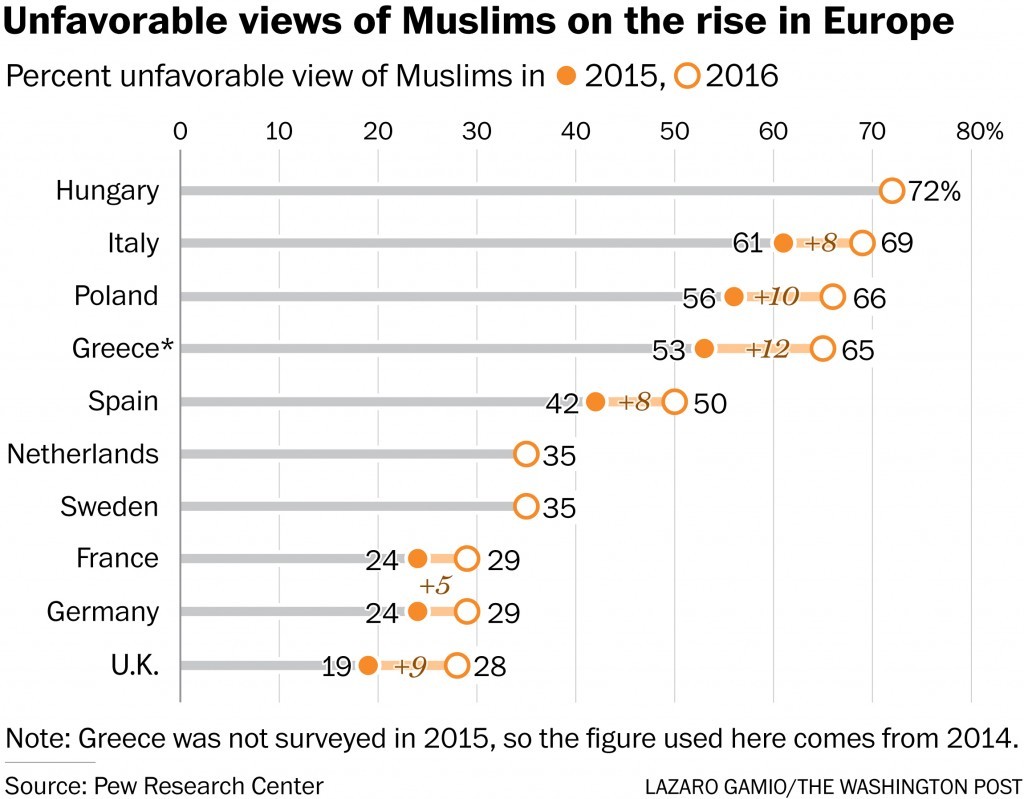
The same poll found that France had a far more positive view of Muslims than much of Europe. Despite a series of terror attacks that were inspired by Islamic extremism, just 29 percent of French citizens were found to have a negative view of Muslims, while 67 percent had a positive view. While this was an increase of 5 percentage points over previous years, only Germany and Britain had more positive views.
Conversely, in Poland, 66 percent had negative views of Muslims, while only 19 percent said they had positive views. Hungary and Italy were the only countries with more negative views — 72 percent and 69 percent, respectively.
People in Poland were also far more likely to believe that Muslims in their country were supporters of groups like the Islamic State, a group whose supporters have cheered the attack on Nice but have not claimed official responsibility. Twelve percent of Poles were said to believe that “most” Muslims in their country supported extremist groups, and a further 23 percent said “many.” Just 12 percent said “very few” supported these groups. In France, 44 percent said “very few” Muslims in their country supported extremism, while just 6 percent said “most” and 13 percent said “many.”
And despite the perceived link between refugees from Muslim majority countries and terrorism that is widespread across Europe, Pew’s data showed that on the whole, French citizens were more concerned about economic factors.
Quebec’s major police forces have among the highest proportions of female officers in the country, a CBC News analysis has found.
Leading the country is the Montreal Police Service, where nearly 32 per cent of its sworn officers are women.
At the tail end for major cities is the Winnipeg Police Service, where the proportion is less than half of Montreal`s at just under 15 per cent.
Of the 332 RCMP officers in Nunavut and the Northwest Territories, less than 11 per cent are women.
For the last three decades, women and girls have formed a slim majorityof Canada’s population, Statistics Canada says.
In May, CBC News surveyed all major municipal, provincial and RCMP divisions in Canada in order to establish a national snapshot of the number of women working in the major law enforcement agencies.
The average proportion of women in these police forces stands at just over 20 per cent.
‘I thought we had done a much better job’
The woman who climbed to the highest rank in the Winnipeg Police Service’s history says she was not expecting these results.
“It was surprising. I thought we had done a much better job at recruiting women,” said former deputy chief Shelley Hart.
“I think there’s so much diversity in our police departments already that compared to what they were 38 years ago when I started, that everybody … sees policing as an option,” she said.
Hart believes that part of the challenge for some forces has been a general drop in applicants.
“Members of the public, young people, they sit back and think, do I want to be in the line of fire and have that kind of scrutiny on the decisions I make and the level of disrespect and violence on the street now and do they look at it now as one of those occupations that is desirable?” she said.
Danny Smyth, Winnipeg’s deputy chief, says he’s unsure how Montreal has managed to close the gender gap to such a degree, but despite the numbers his force has been actively recruiting women for years.
“In the ’90s we made some specific efforts; there was a time when we put in a full class that was exclusively women. I don’t know if other cities have done that and perhaps it’s something we may consider in the future again to bring more parity.”
He says the Winnipeg Police Service does not have set targets for gender recruiting, but it has set objectives for hiring more Indigenous officers.
Women bring ‘different perspectives’
Const. Nancy Roussel, spokesperson for the Quebec City Police Service, says while she knew women were relatively well represented, she was not aware of where they stood compared to their peers.
“If we consider [27.7 per cent] as a good score, then yes we’re happy, however, we haven’t undertaken any specific initiatives to target women. … The process doesn’t give preference to women,” she said.
“Throughout every level of the organization, the presence of more women brings forward different perspectives,” she said.
Not surprising, although it would be interesting to have a breakdown by visible minority group to see if there are significant differences between their confidence in the police (my hypothesis is that Black Canadians, given the prevalence of carding and other practices, would likely have the lowest level of confidence).
The contrast with USA data, however, is striking:
The majority of Canadians view their police forces favourably, but confidence erodes when members of visible minorities are polled, according to a new survey from Angus Reid.
When asked if they have trust in the police and justice system, Canadians said “yes” about most institutions, with only the criminal courts failing to reach a majority of support. Sixty-eight per cent of white people expressed confidence in police while 58 per cent of members of visible minorities did so.
Support for the police and justice system appears to be growing, with a small increase from 2014 and a near-spike from the lows of 2012, when none of the institutions broke 40 per cent support.
Quebec led the way in all categories, with support often more than 10 percentage points higher than in other provinces. Atlantic Canada and British Columbia had the lowest levels of trust.
The survey of 1,505 residents from across the country comes at a time of greater scrutiny of policing. Most recently, Black Lives Matter Toronto staged a sit-in during the Toronto Pride Parade on July 3 to protest against what they argue are discriminatory policing practices targeting black residents in the city.
The results hinted at the frustrations: Of those surveyed, 58 per cent of members of visible minorities trusted the institutions, 10 percentage points lower than white respondents.
While there is a discrepancy between whites and members of visible minorities in Canada, the results are magnified in the United States, where the summer has seen racial tensions simmer in wake of two recent shootings of black men by police. Only 39 per cent of members of visible minorities express confidence in the police, compared with 62 per cent of white residents, a Gallup poll found.
Despite the largely positive Canadian results, the Angus Reid survey also highlighted troubling data about the challenges facing members of visible minorities in the country.
Over a 10-year period, the black inmate population in Canada has surged 60 per cent. In Toronto, where black people make up less than 10 per cent of the population, 41 per cent of youth in child welfare services are black. In Vancouver, close to 60 per cent of people in poverty are members of visible minorities; in Toronto, it’s 62 per cent.
For the first time in nine years, the cap on a prized US visa for the most skilled Chinese and Indian workers is set to be reached.
On July 11, the US State Department announced that it would soon stop accepting applications for the EB-1 visa, from Indian and Chinese nationals. This change could cause some highly-skilled immigrants to lose their current US work authorization.
The EB-1 is for immigrants of extraordinary ability, outstanding professors or researchers, and certain executives at multinational companies. In effect, it’s intended for the world’s “best and brightest” who wish to become permanent US residents, and even eventually citizens. Preliminary figures from the US State Department show that 12,253 Indians and 6,239 Chinese were granted EB-1 visas in 2015. The State Department was not able to provide how many of these visas have been issued so far this year.
As of July, the “priority date” for EB-1 approvals was “current”—meaning that all applications are being considered immediately. However, come August, the priority date will be set to Jan. 1, 2010, for EB-1 applications from Indian and Chinese nationals. That means applicants must have submitted their applications before Jan. 1, 2010, to be considered for the EB-1, this year.
Backdating the deadline, known as “retrogression,” is an administrative maneuver to keep the application queue orderly and manageable when there aren’t enough visas to go around. Since 1991, the priority date for EB-1 has retrogressed from “current” for India three times and for China six times.
Only a limited number of EB-1 visas are available each year, although the exact cap per country is hard to state with certainty because caps depend on a number of shifting factors. A surge in EB-1 applications from one country’s citizens, for example, could cause a decline in the number available to another nation.
For years, it was considered the fastest and most reliable way to gain authorization to permanently stay in the US for work. “The conventional wisdom is try to get into the EB-1 because you don’t have to worry about it,” Susan Cohen told Quartz. “It’s fastest employment-oriented way. Historically it’s always been the fastest.” Cohen is the chair of the immigration practice at Boston-based law firm Mintz Levin.
In the past, Cohen and others in the industry have advised clients to do everything they can to become eligible for an EB-1. A years-long strategy to obtain US citizenship can include getting published in more prestigious publications, working at more highly respected companies, or getting promoted to a managerial position outside the US, before applying. Cohen suspects this last tactic—savvy multinational companies promoting workers they want to transfer to the US—may have caused an increase in demand for the EB-1. [See this article on how Microsoft has adopted this strategy:
The implication for businesses on the whole should be small, since applicants for the EB-1 typically are already in the US, working on another, shorter-term authorization, according to Cohen. There are still risks, however. Employees currently working in the US on a non-extendable, time-limited visa who have been waiting for EB-1 approval could potentially find themselves forced to leave the US when their time runs out. Switching to permanent residency is desirable because it means not needing employer sponsorship of a visa and never having to renew or extend a visa. It also offers the first step toward becoming a US citizen.
Facebook is still a mostly white, mostly male tech company. But it wants you to know that it’s trying to fix that.
Facebook published its employee demographic data on Thursday, revealing data very similar to what the company reported last year around this time. The key metrics:
Facebook’s U.S. employees are 90 percent white or Asian, down from 91 percent in 2015.
Facebook’s senior leadership is 92 percent white or Asian, down from 94 percent last year.
Men account for 83 percent of Facebook’s technical jobs, a slight improvement from last year, when men had 84 percent of these positions.
Women make up 27 percent of Facebook’s senior leadership, up from 23 percent in 2015. This was, on paper, the company’s biggest improvement.
No, these are not significant changes. But they are small improvements.
Maxine Williams, Facebook’s global director of diversity, was keen to point out that while the baseline numbers have not changed much, Facebook is trending in the right direction. Take hiring, for example. Just 3 percent of Facebook’s senior leadership is black, but 9 percent of the senior leadership hires over the past year have been black, Williams said.
How is Facebook going about diversifying its new hires? Well, one move has been to implement a version of the NFL’s Rooney Rule, where at least one minority candidate must be interviewed for each open position. A handful of Facebook teams started using this strategy last summer, but others have since joined in, Williams said.
More PQ debates on multiculturalism/interculturalism, and whether it is appropriate or not for politicians to wish people well during religious holidays:
Le candidat à la direction du Parti québécois Alexandre Cloutier a défendu, jeudi, ses voeux adressés aux musulmans à la fin du ramadan, en se réclamant de Barack Obama et de Bernie Sanders.
L’enjeu de la laïcité continue donc de diviser au Parti québécois, puisque M. Cloutier répond ainsi aux critiques de Jean-François Lisée, un de ses rivaux dans la course actuelle. M. Lisée avait alors fait une charge contre la position multiculturaliste de Justin Trudeau tout en faisant un rapprochement cinglant avec les voeux d’Alexandre Cloutier.
Dans une entrée de blogue publiée par le site Huffington Post jeudi matin, M. Cloutier, qui est député de Lac-Saint-Jean, affirme avoir été «surpris» par les «vives réactions» provoquées par son message émis sur Twitter.
Il dit avoir formulé ces voeux «avec candeur» et par «esprit d’ouverture et de respect» à l’égard des 250 000 Québécois de confession musulmane qui allaient célébrer l’aïd, la fin du ramadan, la semaine dernière.
C’est ainsi, selon lui, que le Parti québécois doit manifester son ouverture et sa capacité à rassembler les électeurs, en faisant appel aux «valeurs d’ouverture» du fondateur de la formation, René Lévesque.
«J’ai la ferme conviction que c’est en commençant par de tels signaux que le Parti québécois ouvre ses horizons et peut aspirer à rassembler davantage», peut-on lire. Ces gestes s’imposent afin de mettre un terme aux «déceptions électorales», poursuit-il.
Et il a laissé savoir qu’il continuera à souligner les fêtes et les moments forts de la vie des communautés culturelles. En cela, il dit s’inspirer d’autres personnalités politiques: Barack Obama, le candidat malheureux à l’investiture démocrate Bernie Sanders et Pauline Marois.
«J’ai exprimé ces voeux comme le président Barack Obama et le candidat Bernie Sanders l’ont fait, aux États-Unis. Comme notre première ministre Pauline Marois l’a fait, elle aussi, en 2013. Je l’ai fait comme tous les députés de l’Assemblée nationale offrent leurs meilleurs voeux de Pâques et de Noël à leurs électeurs, chaque année», écrit-il.
Aux yeux de M. Lisée, ces voeux contrevenaient au principe de neutralité de l’État, mais M. Cloutier soutient qu’il ne «partage pas son avis». Le PQ doit continuer à défendre la laïcité de l’État «en unissant les Québécoises et les Québécois derrière une vision commune du vivre-ensemble», écrit-il.
M. Cloutier soutient que son parti peut s’inspirer des recommandations du rapport Bouchard-Taylor, qui font consensus avec la Coalition avenir Québec et Québec solidaire.
Dans un texte publié sur le site web de sa campagne, M. Lisée, qui est député de Rosemont, s’en est pris à la pratique voulant que les chefs politiques saluent les fêtes religieuses. Il avait pris prétexte des voeux officiels transmis par le premier ministre Justin Trudeau à chacune des fêtes religieuses. Selon lui, la vie des communautés ne se limite pas à leurs pratiques religieuses et on ignore ainsi tous ceux qui sont non pratiquants, agnostiques ou athées.
«Même sans la dérive trudeauiste, la pratique voulant que des chefs politiques saluent les fêtes religieuses mérite réflexion, avait écrit M. Lisée. C’est exactement ce que j’ai indiqué lorsque mon collègue Alexandre Cloutier a souligné la fin du ramadan, un événement effectivement majeur de la vie de nos concitoyens musulmans même si les deux tiers d’entre eux ne sont pas pratiquants.»
Ainsi, un chef de parti et de gouvernement qui se veut un gardien de la laïcité et de la neutralité de l’État devrait s’abstenir de participer à des rituels religieux, a fait valoir le député de Rosemont.


 Multicultural Meanderings