Mixed Remixed Festival Brings Multiracial Stories To Los Angeles : NPR

Given increased intermarriage, not surprising that storytelling becomes part of the experience:

A couple weeks ago, about a thousand people gathered at a museum in Los Angeles for Mixed Remixed, a free two-day festival featuring events like a memoir writing workshop, a Loving Day Wine and Cheese reception, a screening of multiracial short films and a panel on biracial hair (moderated by Code Switch’s own Karen Grigsby Bates!).

In the past, comedians Key and Peele have performed at the festival; this year, Taye DiggsWilly Wilkinson and Natashia Deon took the stage. The performers and panelists, along with regular attendees, come together to celebrate the “mixed experience.”

As a biracial woman, I was intrigued by this description, but curious to know what exactly it meant. After all, the question of what it means to be racially mixed has been a subject of controversy in this country for hundreds of years, and there’s no consensus on what it means to have a mixed experience.

So I called up Heidi Durrow, who founded Mixed Remixed in 2014. We talked about the multiracial “family nod,” hugging our white moms, and something she calls “mulatto fatigue.” She also told me what the festival is about, why it’s important, and who exactly it’s for.

Durrow says she started the festival partly out of selfishness. She’s Danish and African-American, and her 2011 novel, The Girl Who Fell From the Skytells the story of a young Afro-Danish orphan who goes to live with her grandmother in a mostly black neighborhood. While Durrow was shopping the manuscript, a lot of publishers told her there was no demographic for “an Afro-Viking coming-of-age tale.”

Eventually, of course, Durrow did find a publisher, and her book became a New York Times best-seller. But she knew lots of other multiracial folks are still struggling to be heard. So she decided to create a space to connect people who wanted to tell — and hear — these stories. The first festival was in 2014, and it’s always held at the Japanese American National Museum.

It’s important to note that this festival isn’t just for people who consider themselves multiracial. Durrow says it’s not about “mixed pride,” and one of her biggest discouragements is when people ask if they’re allowed at the festival even if they’re not mixed-race.

“Our greatest goal is for people to recognize that the mixed experience is very much the American experience,” says Durrow. “Mixed-race pride, I think, is a difficulty because I don’t want to valorize whatever someone’s idea is about that. We don’t want to buy into ideas of white privilege or light-skinned privilege. What we want to say is, we really are all part of the same story, and we don’t have to be ashamed or invisible or feel lonely in this experience. … The festival is about having a space to say, ‘I’m connected to this person who you don’t even think I’m connected to.’ ”

This year’s attendees included families of transracial adoption, the children of U.S. immigrants, a man who wanted to better understand the experience of his multiracial partner, folks who live in racially diverse neighborhoods, folks who don’t. Durrow says that all of these people are part of the mixed experience.

“I feel like my mom gets to be as mixed as I do,” Durrow says. When, say, visiting a black history museum with her white mother, she worries that some might see her mom as an intruder. In those moments, she says, “I always want to wrap my arms around my mom and make sure people know that she’s not just ‘some white lady.’ She’s connected to me. And that matters.”
Source: Mixed Remixed Festival Brings Multiracial Stories To Los Angeles : Code Switch : NPR
Anti-Islamophobia ad campaign draws heated debate online

Means it’s working:

An ad campaign drawing attention to Islamophobia has Torontonians talking — and that’s just the point, backers of the campaign say.

The poster, recently rolled out at about 150 TTC stations and bus shelters across the GTA, depicts a young white man squaring off against a young woman in a head scarf.

“Go back to where you came from,” he says.

“Where, North York?” she replies.

The ads, launched this week by the City of Toronto and the Ontario Council of Agencies Serving Immigrants (OCASI), have sparked a flurry of comments online and on the street — precisely the point, said Amira Elghawaby: “to have constant dialogue … and force people to rethink their assumptions.”

Elghawaby, spokesperson for the National Council of Canadian Muslims, said recent events have rekindled latent prejudices.

The idea for the campaign was brought forward last fall, to cushion the arrival of Syrian refugees, she said, but has become all the more urgent in the wake of the Conservatives’ proposed partial ban on the niqab in 2015, presumptive Republican presidential candidate Donald Trump’s anti-Muslim rhetoric, the fallout from the Paris attacks and mass shootings in San Bernardino, Calif., and Orlando, Fla..

“Islamophobia has become a serious concern in many communities in Canada,” said Elghawaby, whose organization was consulted on the ad’s creation but isn’t an official part of the campaign.

It’s not uncommon for women wearing a hijab to field unsolicited questions about their origins or criticism of their appearance, Elghawaby said. “That almost goes with the territory of being a visibly Muslim woman in Canada.”

Hijabs and hockey don’t clash; head scarves and beavertails aren’t incompatible, she says: “In other words, I’m as Canadian as the next guy or gal. And newly arrived immigrants and refugees will eventually be as well.”

Some people saw the ad as entrenching stereotypes and inflaming tensions.

“I think it’s in poor taste. I think it feeds into a racial stereotype,” said Toronto resident Bryan Carras, referring to both figures depicted.

“It’s an oppressive form of expression. It makes me sick to think of the countries where there’s human rights problems and where (the hijab) is everywhere,” he said.

Reddit post of the ad sparked more than 200 comments in less than six hours last week.

Some were supportive: “I suppose it’s good for these messages to be out there, as a reminder — to victims as well as perpetrators — that this s**t isn’t acceptable.”

Others less so. “It creates a further divide between people by playing on a stereotypes (sic),” one commenter typed. “You think it’s just white people spewing Islamophobic rhetoric?” wrote another.

A fourth quipped in response: “It’s almost as though, in this instance, white men take things ‘too personal’ and need to stop ‘looking for reasons to be offended…’”

More than 80 per cent of Muslim respondents in an Environics survey last April said they were very proud to be Canadian, 10 per cent more than non-Muslims. Yet an assumption remains “that people who look different are not from here,” says Patricia Wood, a York University geography professor who focuses on diversity and urban citizenship.

Not only can that harm a person’s sense of belonging or safety, it’s simply not accurate, especially in Toronto, Wood says.

Source: Anti-Islamophobia ad campaign draws heated debate online | Toronto Star

Mosque Attacks, Apparent Anti-Islam Spending Up: Report – NBC News

There does appear to be an anti-Islam, anti-Muslim industry:

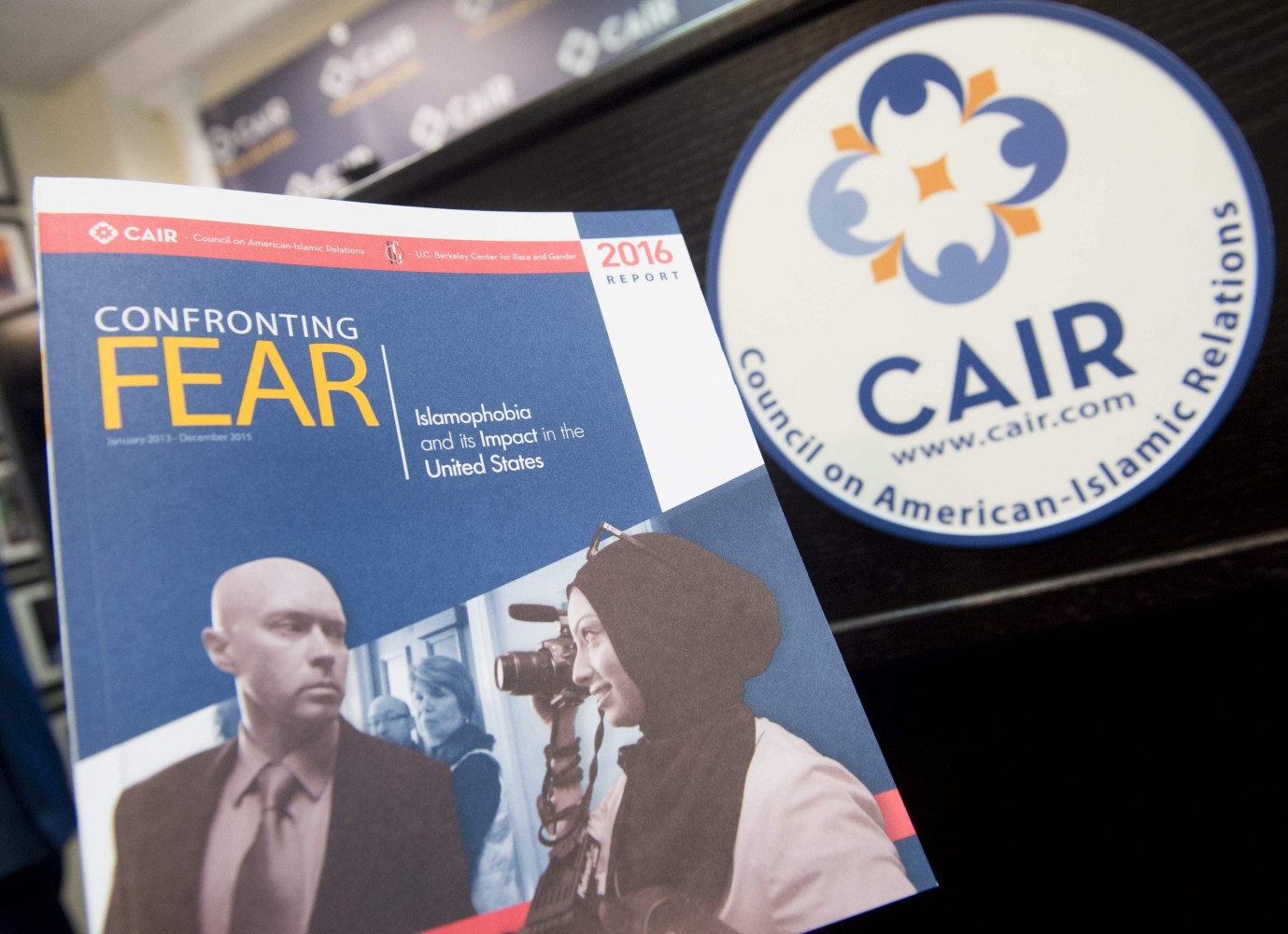
Thirty-three Islamophobic groups had access to $205 million between 2008 and 2013 to spread fear and hatred of Muslims, according to a new report by the Council on American-Islamic Relations (CAIR) and the Center for Race and Gender at the University of California, Berkeley. “Confronting Fear: Islamophobia and its Impact in the U.S. 2013-2015” documents the ways this and other funding has made Islamophobia manifest in America, as well as a new national strategy to improve American understanding and acceptance of Islam. The report also found that mosque attacks had reached an all-time high in 2015.

Image: US-POLITICS-CAIR
A report titled “Confronting Fear,” about Islamophobia in the US released by the Council on American-Islamic Relations (CAIR), is seen at their headquarters in Washington, DC, June 20, 2016. SAUL LOEB / AFP – Getty Images

“The last two months of 2015 saw 34 incidents in which mosques were targeted by vandals or those who want to intimidate worshippers,” Nihad Awad, CAIR executive director, writes in the introduction. “This is more incidents than we usually record in an entire year. This report makes a case that those who value constitutional ideals like equal protection, freedom of worship, or an absence of religious tests for those seeking public office no longer have the luxury of just opposing the U.S. Islamophobia network’s biased messaging.”

The number of Islamophobic groups in America has increased from 69 groups in 2013 to 74 groups in 2015, according to the report. Thirty-three of these groups are considered the inner core of the American Islamophobic network because their primary mission is to promote hate and prejudice against Islam and Muslims. Among the report’s other findings: Attacks on mosques have increased, with 78 recorded incidents in 2015. Ten states have passed anti-Islam laws. Two states have changed the way textbooks are approved in order to change the way Islam is taught in schools, law enforcement trainings on handling anti-Islamic crime has decreased, and a new phenomenon of “Muslim-free” businesses and armed anti-Islam demonstrations has developed.

“The 2016 presidential election has mainstreamed Islamophobia and resulted in a number of un-constitutional proposals targeting Muslims,” Corey Saylor, director of CAIR’s department to monitor and combat Islamophobia, said in a statement. “‘Confronting Fear’ offers a plan for moving anti-Muslim bias back to the fringes of society where it belongs.” 

Source: Mosque Attacks, Apparent Anti-Islam Spending Up: Report – NBC News

Gérard Bouchard désapprouve Lisée à la direction du PQ

Always interesting to follow Bouchard’s commentary and views:

L’auteur et sociologue Gérard Bouchard n’a pas souvent pris position dans l’arène partisane. Mais la candidature d’un fils du Saguenay l’a décidé à sortir de l’ombre. Il avait connu M. Cloutier lors de la course remportée par Pierre Karl Péladeau. Le député péquiste a sollicité l’avis de M. Bouchard sur plusieurs questions – l’immigration, la diversité ethnoculturelle, la laïcité.

En matière de laïcité, M. Cloutier « est assez aligné » sur la proposition du rapport Bouchard-Taylor, qui interdit le port de signes religieux aux seules personnes qui ont un pouvoir de « coercition » sur les citoyens, soit les policiers, les juges, les gardiens de prison. Le président de l’Assemblée nationale ne devrait pas davantage afficher sa foi.

M. Cloutier garde ses cartes sur la question nationale et n’entend dire que six mois avant les prochaines élections s’il y aura un référendum dans un premier mandat péquiste. « C’est l’os qui guette tous les candidats. Le fait qu’il ait décidé d’attendre un peu avant de faire connaître sa position est un signe de prudence, qui ne me gêne pas. La politique change rapidement, les candidats n’ont pas à mettre leurs cartes sur la table tout de suite », estime M. Bouchard.

« Il est temps que le PQ se relève et retrouve la voie qui a toujours été la sienne avec M. Lévesque, M. Parizeau, avec mon frère [Lucien Bouchard] et M. Landry. Le nationalisme du PQ était libéral, progressiste et respectueux des droits. Le PQ était l’exemple en Occident d’un mariage rare entre le nationalisme et le libéralisme. Les Catalans, les Écossais nous disaient que le Québec était un exemple. Ils ne le disent plus depuis deux ans [depuis la charte de Bernard Drainville] », affirme M. Bouchard.

Il est évident « qu’il faut repenser la souveraineté, que ce discours doit être réécrit. Il y a un besoin évident de relève, et je pense qu’Alexandre Cloutier incarne cette relève », souligne aussi M. Bouchard.

LISÉE « INCARNE LA CONTINUITÉ »

Inversement, selon Gérard Bouchard, Jean-François Lisée « incarne plus la continuité que la relève. Il a été au front pendant longtemps ». Le PQ a besoin d’un élan que seul un nouveau visage peut donner, selon lui. Les chefs précédents n’étaient pas des néophytes, mais « la situation du PQ actuellement est complètement différente, son élan est cassé. Pour les jeunes, on ne peut parler de désaffection, mais leur adhésion au PQ n’est plus la même qu’il y a quelques années ».

Pour M. Bouchard, la position de Jean-François Lisée en matière de port de signes religieux ne passerait pas le test des tribunaux. Sa position « ressemble étrangement à la charte des valeurs. Les institutions publiques ou parapubliques auraient à décider de l’utilisation dans leurs lieux de signes religieux ». M. Lisée maintient la clause grand-père, ceux qui sont déjà employés ne seraient pas touchés, mais ceux qui veulent être embauchés seraient écartés.

Source: Gérard Bouchard désapprouve Lisée à la direction du PQ | Denis Lessard | Politique québécoise

Understanding where I’m coming from on Toronto’s race relations: Paradkar

Shree Paradkar on the City of Toronto/OCASI poster (see Toronto campaign against Islamophobia an insult: Fatah). Merit in her idea to have a series of posters that cycle through various groups. One of the more positive legacy of former Minister Jason Kenney was his broadening of integration and multiculturalism discussions to include inter-group relations, not just the white/visible minority dichotomy:

“Where are you from?” is a common enough question in multiracial Toronto.

“Where are you really from?” is the common enough subtext directed at minorities. As a relatively recent immigrant, this doesn’t offend me. I did come from somewhere else. This country is a beloved home as is my country of origin. For second-generation and older minority immigrants, however, I can see why that can be offensive.

“Go back to where you’ve come from” is the other insult directed at minorities that drives home the flawed idea that the default Canadian is Anglo-Saxon. It supposes that everybody else, including our First Nations, is the unwelcome “other” who doesn’t have modern Canada’s best interests at heart.

And so a recent Toronto city-sponsored anti-racism ad takes this statement head on. In a poster a young white man says that to a hijabi, to which she retorts, “Where. To North York?”

It’s an accurate depiction of a frequent occurrence but it doesn’t tell the whole story.

The Toronto ad was made in partnership with OCASI, an agency that helps immigrants. About 150 ads were placed on bus shelters last week and the campaign will run until July 10. Perhaps they will depict more races and more examples. If they don’t, they could simply be polarizing.

Anti-racists erroneously assume everyone understands why — at the moment at least — any talk on racism predominantly challenges the white mindset.

In reality, if you fed that poster to a program that cycled through various racial or ethno-religious backgrounds for both people, and came up with, say, an Asian on the left and a black person, or a Hindu on the left and a Muslim, or an immigrant of 20 years on the left and a new immigrant of the same country, the “Go back to where you’ve come from” sentiment would still be accurate.

 So why focus on whites? While racism, xenophobia, homophobia and sexism exist in all cultures, they are most harmful when they come from a dominant group or a “ruling class,” which in Canada is obviously white and male.

These are the people who construct systems and govern institutions that determine equality and social justice. They create organizational structures and offer jobs. These are the interpreters of the law. If they are themselves afflicted by the “otherness” syndrome, then their views translate into severe injustices in a diverse society.

Eventually, though, if we get the diverse leadership in political and corporate governance we talk so much about, then narrow-minded attitudes in any leader — not just a white male — would be just as harmful.

In the U.S., I see conversations on racism reduced to a binary — white vs. black. That creates divisions; non-black minorities feel marginalized, blacks feel their legitimate historical and contemporary grievances need to be dealt with first, and many whites feel anti-racism is just politically correct hocus-pocus.

Canada has to champion a more nuanced conversation on discrimination.

A poster like this would speak volumes to the people affected by xenophobia. I can’t imagine it would change people who say things such as, “Go back to where you came from.” It could also estrange younger white men who might feel they’re not even given a chance to be fair. These are people in their intellectually formative years who are also exposed to the aggressive rhetoric of the aggrieved far-right. who sees themselves as victimized.

Reservations against this alienation are not about catering to white desire for, and comfort with, the status quo. It’s about reaching out to people who don’t experience racism and therefore don’t think of it as real or harmful.

“The overarching long-term goal is to create a Toronto that says ‘No’ to all forms of discrimination and racism,” the OCASI says in its media release.

Saying no is the easy part.

Bullheaded bigots may be unreachable, but making meaningful strides will mean making the regular white Joe and Jane see from the non-white perspective how their circumstance, whatever it is, still benefited from a privilege not available to others. That won’t happen when divided camps are left talking within themselves.

Source: Understanding where I’m coming from on Toronto’s race relations | Toronto Star

Beware the side-effects of cultural sensitivity, it can provide ammunition for Trump-types

Interesting commentary by former PMO Comms Director and editor of Corriere Canadese, Angelo Persichilli, exploring what cultural sensitivity means: 

Media must report events of particular interest, but we must be careful when we write about Immigration because facts can be interpreted differently.

If we read that a medical doctor has been arrested because he committed fraud, we know that the fraudster is the doctor, not the entire category. However, if there is fraud in Immigration, many easily assume that the entire system is rigged and/or all immigrants are dishonest.

I agreed with Immigration Minister John McCallum when, reacting to the auditor general’s report, he admitted the problem but warned not to interpret it as an indictment against Immigration and immigrants. We must also avoid the subtle criminalization of institutions and people that work hard to do their job interpreting definitions that change from country to country and are redefined daily, according to the new demographic evolution and, at times, conveniently re-arranged according to the needs of all those involved. Furthermore, the volume of the cases to be dealt with is high and increasing, and the people assigned to deal with them are shrinking.

The Immigration department needs new and clear directives but, considering all the changes, it is working better than many government department other countries. As well, the officers involved are doing a good job and potential immigrants to this country are treated with respect and dignity.

There are exceptions and mistakes that must be corrected, but we have neither martyrs nor racists involved. We only have people, from both sides, trying hard to deal with a rapidly changing society, learning daily how to better understand each other. 

Cultural sensitivity is not a well-defined set of rules. It is our willingness to learn from each other and apply the results to our daily lives. If we do a better job explaining this, Donald Trump will soon be back to constructing buildings, not walls.

Source: Beware the side-effects of cultural sensitivity, it can provide ammunition for Trump-types

In Philippines, wartime offspring of Japanese still fighting for citizenship | The Japan Times

The complexities of identities, so many years later:

It estimates there were around 3,000 second-generation Japanese-Filipino descendants, of whom nearly 900 were not registered with the Japanese government due to the wartime turmoil. Most of their fathers arrived in the Philippines before WWII and married local women.

Inomata said the center has filed 235 petitions, of which 172 earned approval and 29 were rejected, including the 10 the center intends to appeal.

Nine other cases are still being heard, while the remaining 25 have been withdrawn, mainly because the petitioners have died.

In an interview, Torres said she will endure the long, hard process of acquiring her father’s nationality just to see her relatives in Japan.

“I have not lost hope. I would be very happy to see my father’s home place and meet our relatives there. My father must have some siblings there,” said Torres, whose petition was formally filed last October but denied in February.

Joining her in the petition are her younger siblings, Roque Go, 80, and Estodi Go, who is 77.

The Maramotos can only rely on their testimonies and a family portrait taken in 1936 to prove their claim of having a Japanese father.

Torres had four siblings, but two are now dead. She said their father arrived in Davao at a time unknown to them, and married their mother, a member of the local B’laan tribe. He worked as a carpenter and had a few Japanese friends in their province.

She has few memories of her father, as she was only 8 years old when he died in an accident in 1940. Torres recalled that her father would speak the B’laan language at home, the Cebuano language when he was with neighbors, and Japanese with his Japanese friends.

In the interview, she said her “Papa” did not teach them the Japanese language, nor did he introduce Japanese customs at home.

The youngest sibling, Estodi, became emotional as he clutched the Maramoto family picture.

“I am appealing for help because I did not see my father myself,” he said.

“I am crying now because I only have this photo of him, and this was the only place where I could see him. So I want to know where my father came from in Japan, and I am also asking for help so I can see our relatives there.

“I want to be recognized as a Japanese citizen because my father was Japanese and his blood flows through me,” he said.

Source: In Philippines, wartime offspring of Japanese still fighting for citizenship | The Japan Times

ICYMI: The Obama Doctrine: What the President Actually Thinks About Radical Islam – The Atlantic

Another good piece by Jeffrey Goldberg:

The fundamental difference between Obama and Trump on issues related to Islamist extremism (apart from the obvious, such as that, unlike Trump, Obama a) has killed Islamist terrorists; b) regularly studies the problem and allows himself to be briefed by serious people about the problem; and c) is not racist or temperamentally unsuitable for national leadership) is that Trump apparently believes that two civilizations are in conflict. Obama believes that the clash is taking place within a single civilization, and that Americans are sometimes collateral damage in this fight between Muslim modernizers and Muslim fundamentalists.

In one conversation, parts of which I’ve previously recounted, Obama talked about the decades-long confrontation between the U.S. and communism, and compared it to the current crisis. “You have some on the Republican side who will insist that what we need is the same moral clarity with respect to radical Islam” that Ronald Reagan had with communism, he said. “Except, of course, communism was not embedded in a whole bunch of cultures, communism wasn’t a millennium-old religion that was embraced by a whole host of good, decent, hard-working people who are our allies. Communism for the most part was a foreign, abstract ideology that had been adopted by some nationalist figures, or those who were concerned about poverty and inequality in their countries but wasn’t organic to these cultures.”

He went on to say, “Establishing some moral clarity about what communism was and wasn’t, and being able to say to the people of Latin America or the people of Eastern Europe, ‘There’s a better way for you to achieve your goals,’ that was something that could be useful to do.” But, he said, “to analogize it to one of the world’s foremost religions that is the center of people’s lives all around the world, and to potentially paint that as a broad brush, isn’t providing moral clarity. What it’s doing is alienating a whole host of people who we need to work with us in order to succeed.”

Does Obama go too far in avoiding the terms “radical Islam” or “violent Islam”? This question represents a not-unreasonable basis for an interesting debate. However, given the realities of the battlefield—that most of the fighting against ISIS is done by Muslim-majority states, and Muslim organizations, and that the leaders of these entities would rather not see the U.S. overgeneralize its description of the fight—then it seems to me, at least, that Obama’s semantic prudence is justifiable.

Donald Trump, I believe, is not capable of making the sort of analysis Obama has made about the splits within Islam. Nor has refuted Obama’s analysis in a cogent fashion. But this is not Trump’s main sin; his main sin is to refuse to listen to experts on counterterrorism, including experts in the U.S. military and intelligence community, who argue that he is helping ISIS by demonizing Muslims. Abu Bakr al-Baghdadi, the so-called caliph of Islamic State, argues that there is no place in the West for a devout Muslim. Donald Trump often gives the impression that he shares this view, and that he is advancing the cause of ISIS, by endorsing its premise that the struggle in which it is engaged is, in fact, civilizational.

None of this is meant to be an argument that Obama does enough, or does enough of the right things, in the struggle against ISIS. I could (and will!) write a critique of the administration’s tactical approach, particularly as it relates to Syria. And Obama could bring more emotional intelligence to bear on this problem: He is eloquent in condemning the fearmongers, but he sometimes fails to acknowledge the legitimate fears of non-racist, non-paranoid Americans who would prefer not to be killed by terrorists acting in the name of Islam. The United States is under intermittent attack from an organization called the Islamic State, which, as Graeme Wood has pointed out in this magazine, represents one, extreme, branch of Islam. There is no point in trying to convince Americans that what is happening is not happening. But neither is there a point in encouraging hysteria and division.

Privately, Obama expresses the deepest loathing for ISIS and other radical Islamist groups. ISIS, he has noted, stands for—quite literally—everything he opposes. Nevertheless, his approach to the challenge of Islamist terrorism is sometimes emotionally unsatisfying; it is sometimes insufficient to the challenge; and he himself is sometimes too fatalistic about the possibility of change in the Middle East.

Donald Trump’s approach, on the other hand, is simply catastrophic.

Source: The Obama Doctrine: What the President Actually Thinks About Radical Islam – The Atlantic

Repeal Islam’s scarlet-letter sex laws – The Washington Post

Asra Q. Nomani on the challenges and need for reform of sex laws and attitudes:

We are never going to see a real cultural shift in the Muslim mind-set about sex and homosexuality until we call out and repeal these scarlet-letter sex laws, and instead choose an interpretation of Islam that values compassion, privacy, acceptance and love over judgment and bigotry.

Just one day after the Orlando massacre, a Dutch woman in Qatar was convicted of the crime of “illicit sex” — for coming forward with the complaint that she had been raped. Several years ago, a Norwegian woman faced similar charges in the United Arab Emirates. Meanwhile, the Islamic State is throwing men accused of homosexuality off rooftops, and the governments of Iran and Saudi Arabiahave executed gay men.

Of the 57 states that belong to the Organization of Islamic Cooperation, a quasi-United Nations for countries with large Muslim populations, at least 23 have zina laws and 38 criminalize consensual adult same-sex, according to data from human rights groups and the International Lesbian, Gay, Bisexual, Trans and Intersex Association. These governments are promoting an interpretation of political Islam, or Islamism, that feeds this culture of punishment for even consensual sex.

The punishments are even worse for gays. Influential Saudi cleric Muhammad Saalih Al-Munajjid, following the rigid interpretation of Islam known as Wahhabism or Salafism, condemns zina as a crime and calls homosexuality “the most abhorrent of deeds,” calling for “execution of homosexuals,” from having them “burned with fire,” “stoned to death” and “thrown down from a high place then have stones thrown at them.”

As in the West, cultural attitudes are closely intertwined with legislation. Babies born out of wedlock, gay sex, transgender relationships and other forms of allegedly illegal sex are shamed, stigmatized or punished — whether by court of law or by vigilante justice, as we saw in Orlando last weekend.

Source: Repeal Islam’s scarlet-letter sex laws – The Washington Post

Canada’s identity is an experiment in the process of being realized: Foran

Interesting reflections by Charlie Foran on Canadian identity and its complexities:

It has certainly been a slow awakening. In 1972, a young Margaret Atwood willed a unity onto the then-nascent notion of a Canadian literature with her influential thematic study, Survival. “When I discovered the shape of the national tradition I was depressed,” she admitted. The immigrant “is confronted only by a nebulosity, a blank: no ready-made ideology is provided for him.”

Ms. Atwood famously declared the act of cultural, political and, yes, meteorological “survival” in such an environment to be our determining narrative. Not long afterward, the journalist June Callwood wondered if the actual daily practice of civility – in part, our overpraised politeness – might be the Canadian unifier. Truth be told, neither concept goes far enough toward the territory of heroic statuary or stirring legend.

Here we are in 2016, when few dispute any longer the unseemly length of English Canada’s colonial hangover. For the first century of nationhood, we didn’t bother moving away from imported and inherited customs and thinking, a stark disavowal of lived history and geography.

Canada in the 21st century is certainly an energized place by comparison. Our cultural industries are big businesses and our artists are reasonably supported. Audiences for most of the arts are on a steady rise.

Even so, we continue to export much of our acting and musical talent, ignore our films, keep Canadian theatre largely in the commercial margins, and at the moment appear destined to outlast the era of brilliant long-form television without making a significant contribution to it – unlike, say, tiny Norway or Denmark.

The senior film producer Robert Lantos fumed in this newspaper at the CRTC’s rejection of an all-Canadian movie channel under the “mandatory carriage” category, calling the chairman “utterly blind to the cultural imperatives of what it takes to be a nation.” That was last weekend. Mr. Lantos also lamented the modest Canadian box office for Remember, the latest film by Atom Egoyan. Add Paul Gross’s impressive Hyena Road to the predictable list of the predictably neglected.

Given these ongoing challenges for Canadian arts and artists, why then would anyone think it lucky for English Canada to be too late to create an old-fashioned cultural nation? Consider the Prime Minister’s comments again, especially his calling us the “first postnational state.”

Like so much of the focus of the new government, the words seem calculated to change the direction of public thought. In the months since the election, the Liberals have proposed lots of new words for fresh thinking: reconciliation, diversity, inclusion, to name a few.

If this was Justin Trudeau’s intent, it is worthy. We do need new language to describe this vast, improbable country called 21st-century Canada. We do need to find a way to inhabit our entire cultural space.

To do so, we must get past one easy misconception – the outdated nation-state model – and one harder reality: the historic comfort level among Canadians with conceiving of themselves as parts of smaller, cozier self-definitions, as well an attendant incuriosity about who else lives reasonably nearby.

The launching point for this project is obvious. Indigenous Canada is where we all live, in terms of geography, spirit, and history. In order for that to be real and meaningful, we must start with the stark: that a cultural genocide occurred, and most of us were unaware or, perhaps, just not concerned enough. Artistic expressions of these truths are necessary, and can only help.

Overall, Canada as an experimental cultural space requires the right spirit in order to take shape. That spirit, simply, is an openness to having your history unsettled and your mind changed. As well, a certain comfort level with complexity and irresolution is probably good. In her forthcoming book, The Promise of Canada, Charlotte Gray calls us an “unfinished and perhaps unfinishable project.” That sounds about right.

At the Vancouver Olympics in 2010, the spoken-word artist Shane Koyczan gained national attention with his poem We Are More. Canadians thrilled to lines such as “We are an idea in the process of being realized” and “We are an experiment going right for a change.”

Source: Canada’s identity is an experiment in the process of being realized – The Globe and Mail