The fight to staunch a street war in Surrey, B.C.

Integration, but into the drug trade and gangs:

[Simon Fraser University criminologist Robert] Gordon, who has been studying the phenomena of drug crime and gang violence in Surrey for 20 years, says the recent trouble is just the extension of shootings that have come and gone dating back two decades. “It all stems from conflicts between groups trying to gain control over the illegal drug trade. It’s all about market share, retaliation-driven, including this latest round.”

It’s a “classic struggle,” says Gordon. In the 1980s a wave of new immigrants arrived from Honduras and El Salvador; they arrived at the same time as a group from Fiji, sparking an early conflict. By the early ’90s, new arrivals from Vietnam were muscling in on the area’s marijuana trade.

Surrey is a very mixed community, he adds. “It has a lot of new Canadians, and it seems as if each successive wave of minority populations runs into this particular problem: Often, they are coming over with poor English skills, low job prospects, they’re coming from places with a lot of violence. For some, the fast money the drug trade provides can be very attractive.”

The latest conflict came “after the arrival of a new group from the Horn of Africa, mostly Somalis,” he says. “They settled in Surrey because it’s less expensive than anywhere else in the Lower Mainland, and some appear to have moved in on existing drug networks run primarily by existing Canadians of South Asian origin. South Asian gangs, not wanting anyone to muscle in, are pushing back. A lot of shooting has involved just that.”

It was only last week that the Surrey RCMP dropped the shocking news that as of April 1, there had been 28 shootings—half of last year’s tally—in just the first three months of 2016. Until then, the public had only been made aware of 16.

Source: The fight to staunch a street war in Surrey, B.C.

US cautions Caribbean countries offering economic citizenship | Caribbean360

Cautious wording but the message is clear:

The United States Government has cautioned Caribbean countries offering a Citizenship by Investment Programme (CIP) to be extra cautious about who they give their passports to, and ensure that recipients have no terrorist or crime links.

It gave the advice, in a statement issued by the US Embassy in Barbados yesterday, even as it made it that it was not advising regional countries on whether or not they should offer economic citizenship.

Under the CIP offered by countries like Antigua and Barbuda, St. Kitts and Nevis and Dominica, foreign nationals are granted citizenship in exchange for a substantial investment in the country.

“The United States does not approve or disapprove individual aspects of citizenship by investment programmes,” the US statement said. “The United States strongly believes that all countries have an inherent responsibility to their citizens and the international community to review fully all applicants who seek a nation’s citizenship.”

“While the United States Government is willing to consult with governments on their citizenship investment programmes, the ultimate decisions to offer and how to operate such a programme, including the issuance of citizenship and related identifying documents, such as passports to applicants, lie with each individual government and not with the United States.”

But, the statement added, the US Government encourages and expects governments to be confident, beyond a reasonable doubt, that applicants are bona fide and their identities have been fully validated, and they have no ties to transnational criminal or terrorist organizations, before handing over citizenship.

The US Embassy did not identify any specific country in its statement.

However, there has been concern in Antigua and Barbuda about the government’s recent decision to remove Iraq from the list of countries whose nationals are barred from obtaining citizenship under the twin-island nation’s CIP.

The main opposition United Progressive Party (UPP) is strongly against it. Political leader Harold Lovell said late last month that given the entrenchment of Islamic State in Iraq and Syria (ISIS) in the Middle Eastern country, that move and the decision by the Gaston Browne administration to establish a presence in Iraq, expose Antigua & Barbuda to danger and compromise the integrity of the country’s passport.

Last November, the St. Kitts and Nevis Government announced an immediate suspension of the processing of new CBI applications from citizens and residents of Syria.

The announcement came less than two weeks after ISIS carried out attacks in Paris, and also followed the arrest of Syrian nationals with fake passports in Honduras and St. Maarten, although the government did not publicly identify those developments as contributing to its decision.

Source: US cautions Caribbean countries offering economic citizenship | Caribbean360

Citizenship Act C-6 Changes: Witnesses 14 April Meeting

At the first set of hearings with witnesses, the majority were supportive of the main changes in C-6 given their concerns regarding Charter rights, due process, and removing barriers for the more vulnerable.

There were a few committee procedural disputes, with the Conservatives challenging the Chair’s discretion in asking questions and asking for use two meetings to discuss issues related to live-in-caregivers, likely both strategies to delay passage of the Bill. The Government side voted down both motions.

The first hour was dedicated to legal and related issues, with Legal Aid Ontario (Andrew Brouwer), Audrey Macklin of UofT Law School, and the Canadian Bar Association Immigration Law Section (Christopher Veeman) testifying. Their presentations and answers to questions reinforced each other. All supported removal of revocation for dual citizens convicted of terror or treason. I will post written briefs as received (they will likely be posted on the CIMM site).

Legal Aid Ontario emphasized their broader mandate to ensure equal access to charter rights, noting the rights of the mentally ill and children in particular. It shares Macklin’s point on the need to ensure that revocation for fraud and misrepresentation has comparable procedural safeguards to other areas, including recourse to the Federal Court. Refugees should get pre-decision time 50 percent credit for permanent residency time to qualify for citizenship. Brouwer made a number of recommendations to improve protections for stateless persons, both those who are legally as well as de facto, and that statelessness should be considered a factor in granting citizenship.

Macklin focused on revocation for fraud and misrepresentation, explaining the protections that existed prior to C-24, with the general principle that the more secure one’s status, and the more important the consequences of losing it, meant the greater the protections needed. The changes made by the previous government meant that those accused of fraud or misrepresentation would have less protection than permanent residents similarly accused, or even those facing a speeding ticket. Procedural protections were needed. First level decision-making should be delegated, with provision for appeal to an independent quasi-judicial body such as the Immigration Appeal Division. There should be various remedial options for the Federal Court to appeal or review.

The CBA noted that it welcomed some of the changes in C-24 that provided greater clarity on residency, streamlined decision-making and the increased resources to address the processing backlog. It agreed with Macklin, calling C-24’s misrepresentation revocation provisions ‘Kafkaesque.’ The CBA also questioned IRCC’s authority to suspend processing of incomplete applications essentially indefinitely. Loss of citizenship should mean reversion to permanent resident status. Some discretion should be provided with respect to physical presence for those whose work takes them overseas but who are based in Canada, citing pilots as an example.

Questions:

Government side:

Q: Would the risk of giving citizenship judges greater flexibility not mean less consistent decisions?

A (CBA): Possible, but that type of discretionary decision-making exists and this provides flexibility to address those with strong cases.

Q: To address statelessness, what provisions would be recommended, and would these be best dealt with in C-6 or separate stand alone legislation?

A: LAO): Within C-6, including a definition would be particularly helpful. Larger issues include ratification of the 1954 statelessness convention, an improved process to determine status similar to other countries like the UK, and amendments to humanitarian and compassionate (H&C) guidelines and the grounds for invoking statelessness.

Q: Why is revocation like banishment and how would the previous revocation provisions of C-24 been incompatible with the Charter?

A (Macklin): Explained mainly with respect to s 7 of the Charter as being cruel and unusual punishment. The normal Ministerial powers do not include punishment, with revocation being a double punishment in addition to jail time. Earlier SCC jurisprudence on the right of prisoners to vote provided a precedent for this reasoning.

Q: For those whose families are in Canada but who work abroad (example from Gulf), physical presence means they may never meet these and not become Canadian.  What suggestions do you have to address these kinds of situations?

A (CBA): During C-24 hearings, our submission recommended IRCC discretion the tests in the previous IRCC policy manual 5, pages 6-7 for a nuanced assessment of connection to Canada. This should be delegated to officials.

Physical presence is black and white, easier to apply, and thus improves processing speed. Trade-off between speed and allowing exceptions. Macklin noted that one can have both clear rules with allowable exceptions.

Q: What is the logic of the CBA in not wanting to require tax returns?

A (CBA): There are already provisions in the Income Tax Act so no need. Risk of misrepresentation revocation in case someone did not file.

Opposition questions:

Q (C): With respect to revocation, people want to feel safe. Three jurisdictions have introduced or passed similar legislation: UK, France (still in Senate) and Australia. Any reaction to the fact that other countries had adopted a similar approach to C-24? Tilson went on at some length to make his points.

A (CBA): From a practical point of view, not sure how revocation makes us safer. Better to keep them in a jail; expelling them means they may come back later. (MP Tilson noted that revocation and expulsion would happen after jail time).

A (Macklin):  France had abandoned its proposed bill. Australia had no entrenched bill of rights. There was ongoing litigation in the UK over revocation practices. More interesting, many countries had not implemented such measures, including the USA. As to question whether revocation made us safer, her understanding was that terrorism was a global problem, one that we should not export elsewhere. She cited the absurd example of a dual Canadian-British citizen, convicted of terrorism, and a ‘race’ to see which country would revoke first.

Q (NDP): What are the implications of the provisions on foreign criminality as a bar to citizenship? On language testing, is not the requirement to do the knowledge test in an official language a form of double testing?

A (LAO): There are justifiable concerns that someone who comes from a repressive regime, that the regime could lay a charge to prevent that person from becoming a Canadian citizen.

A (CBA): CBA advocates a return to the previous system where the knowledge test could take place before a judge with an interpreter.

Q (NDP): Does the steep increase in citizenship fees  result in hardship, and would you recommend the government entertain measure to reduce this hardship.

A (LAO and Macklin): Obvious barriers particularly on refugees. Refugees need citizenship and government should be mindful not to erect barriers.

Q (NDP): What should be the considerations for invoking H&C? At what stages?

A (Macklin): Crucial throughout given no law or regulation can cover all situations. Factors need to be specified.

Q (C) : Under what conditions should citizenship be revoked? Fraud, lying?

A (CBA/Macklin): Yes, for misrepresentation. There could be consideration for long-term residents. Macklin added that the misrepresentation should be material, that citizenship would not have been granted if known. A statute of limitations could be introduced. MP Saroya questioned having a statute of limitations, asking what about war crimes? Macklin noted there was no statute of limitations for war crimes or crimes against humanity. She added, in response to a further question, that citizenship is a limited tool to address safety and security, the criminal justice system and enforcement were more effective.

Second Hour

This was a broader discussion, featuring former Ambassador James Bissett, Debbie Douglas of OCASI, and Ihsaan Gardee of NCCM.

Bissett indicated his opposition to C-6, reiterated his well-known belief that five-year residency was needed. He talked about citizens of convenience, citing the Lebanese evacuation of 2006 and eventual return to Lebanon. His prime argument is that there are two classes of citizenship: natural born (by accident) and choice (naturalization). He then added to that dual citizens (which either can be).  Canada was not the only country to revoke citizenship, citing the UK. He mentioned the CSIS analysis of some 130 radicalized Canadian fighters abroad.

Douglas supported C-6 but argued for greater flexibility in the physical presence requirement with citizenship judge discretion. She noted the difficulty older applicants may have in passing the test; while she believed in its importance, it should not be a condition. Moreover, older applicants should be allowed interpreters in the knowledge test. Up-front language testing was an issue, particularly the cost, and should be eliminated for those who have met all other criteria. There should be greater clarity on the disability exemptions beyond vision and hearing.

Gardee focussed his intervention of the revocation for terror or treason, welcoming the proposed repeal of this provision in C-24. He noted that this had created considerable unease among Canadian Muslims as it created two classes of citizens. Repeal was urgent and he reminded MPs of the Maher Arar case. He mentioned C-51 as another measure that disproportionately singled out Canadian Muslims and should be repealed.

Questions

Government-side:

Q: Asked whether Bissett wanted to comment with the previous witnesses raising the issue of Charter consistency of C-24’s revocation provision.

A (Bissett): While aware of his concerns, as far as he knew it did comply with the Charter as the Dept of Justice would have reviewed the Bill and not let it go forward if not compatible (Note: bit naive given previous government’s record before the courts). C-24 had not been challenged and  there was one case of revocation. The CBA speaks for lawyers but “many other lawyers perhaps disagree or have some doubt.”

Q: Asked about the number of different categories of citizen and whether further categories were not possible, and should the criminal system have different rules for different categories.

A (Bissett): System inherently set up for three classes of citizen: natural-born (accident), naturalized (choice), dual nationals. If one chooses and takes the oath, revocation appropriate for terror or treason. More symbolic than anything else but worthy of penalty.

Q: Cited earlier Bissett article arguing that all Muslim immigrants should be interviewed and that Charter undermines Canadian security.

A (Bissett): Replied that he believes all immigrants should be interviewed and that electronic review of applications not adequate to detect fraud. Went on to say that interviews should apply to countries where terrorists come from, which are mainly Muslim, and that no one hires an employee with an interview. He noted the extent of fraudulent documents in Bangladesh and that the current system of no interviews was both ‘dangerous and silly’.

Opposition:

Q (C) : Importance of language to new Canadians, integration, inclusion, overcome barriers? What about proposed Quebec legislation and emphasis on learning French to overcome inclusion issues? What about their proposed transitory certificate to be evaluated after three years before being fully granted immigration status? What about the requirement to sign a statement of adherence to Quebec values?

A (Douglas): Language is important to function and many can and do. Has not read the Quebec proposals but is doubtful about the idea of a requirement to sign a statement on Quebec values.

Q (C) : There has been no quantitative research by IRCC on the impact of no longer requiring language assessment for 14-17 and 55-64 year olds yet there is large percentage affected. What are the implications and issues around language training”

A (Douglas): We have a robust system but resources are always an issue. The C-24 changes were not evidence-based and were ‘arbitrary.’ (Note: What goes around comes around …) C-6 goes back to a proven system. For refugees and particularly women refugees, it is often hard to pass the knowledge test. For many, coming from situations of violence and war, spending a generation in a refugee camp, some may not be able to pass the language assessment.

Q (NDP): Noted that her mother, who only had a grade 6 education, would have failed language and knowledge requirements. She asked about the barriers posed by these requirements, and the associated costs.

A (Douglas): The 14-17 years olds have spent time in Canadian schools and never understood why language assessment was required. For older women, they ‘pick up what it means to be Canadian’ and an interview with a judge can determine that. Refugee women should have interpretation where required. There are also disability issues like those who are hard of hearing where waivers may be appropriate.

Q (NDP):  Any suggestions to reduce these financial barriers and improve language training?

A (Douglas): Eliminate up-front language fees. Ensure language training available on weekends and evenings. Invest in childcare and transportation to language classes.

Q (C) : Asked about the problems faced by caregivers.

A (Douglas): Settlement agencies deal with many caregivers, with the main issues being long waiting periods for permanent residency status and associated residency issues.

Canadians’ response to refugee crisis, niqab debate showed ‘who we really are,’ GG says

Although the Twitterverse correctly noted that the political aspect of these remarks is inappropriate for a Governor General, nevertheless hard to disagree with the substance:

Gov. Gen. David Johnston says he was initially worried that the niqab debate and the tone of the discussion about the Syrian refugee crisis during the election would hurt Canada’s reputation as a fair and inclusive society.

Johnston made the comments in an exclusive interview with CBC chief correspondent Peter Mansbridge for The National, explaining that ultimately he was reassured by the way Canadians responded.

“Look at the outcome of those two, quote, crises,” Johnston said. “Look at how Canada has managed the Syrian refugee crisis in an exemplary way.

“And look at the debate with respect to the niqab. I think Canada showed its strength, that that should not be, should not sidetrack us from who we really are.”

Johnston added that even though the niqab debate has passed he remains concerned about the possible introduction of ideas that would hurt Canada’s reputation.

“I continue to worry about any initiatives that would cause us to be small-minded, and to lose that sense of A, inclusiveness, B, fairness, C, equality of opportunity,” Johnston said, while warning against any sense of complacency.

“I think we must work constantly to overcome that and to have the larger view, but I’m very optimistic that those voices, those ideas are by no means scarce in Canada. I find them abundant,” he said in the interview airing tonight on The National.

Source: Canadians’ response to refugee crisis, niqab debate showed ‘who we really are,’ GG says – Politics – CBC News

On Saudi arms deal, the new boss in Ottawa is just like the old boss: Neil MacDonald

As someone in the past who has written comparable memos, I can only congratulate the various writers and editors of the memo on the Saudi LAV to FM Dion. Macdonald captures it perfectly:

Well. If further proof was needed that the sunny new regime in Ottawa is perfectly capable of behaving just like the un-sunny previous regime, we now have it, in a memo that was stamped “Secret,” then rather inconveniently laid bare in the Federal Court of Canada.

The document, signed by Foreign Affairs Minister Stéphane Dion, is a gem of hair-splitting, parsing, wilful blindness and justification for selling billions worth of fighting vehicles and weaponry to Saudi Arabia, one of the most oppressive regimes on Earth.

Source: On Saudi arms deal, the new boss in Ottawa is just like the old boss – Politics – CBC News

Quebec: Les cibles (levels) migratoires occultent les vrais enjeux, disent les experts

Quebec academics try to focus the immigration debate (over levels) to the more fundamental issues:

« Cette question de chiffres mise sur la table par le premier ministre, c’est plus pour lancer une polémique, insiste Michèle Vatz-Laaroussi, professeure titulaire à l’École du travail social à l’Université de Sherbrooke sous les murmures approbateurs de l’assistance. Parce que dans la réalité, ce seuil ne sort pas de nulle part, il est le résultat de nombreuses discussions et de rapports d’experts. Ça ne relève pas juste de la ministre. Mais c’est certain que ça fait image. »« C’est un débat vain, renchérit son collègue de l’Université de Sherbrooke, le professeur adjoint à la Faculté de droit Guillaume Rousseau sous les regards entendus de ses collègues. Quand vient le temps de parler d’immigration, le chiffre qui devrait attirer notre attention ne devrait pas être le seuil, mais plutôt le taux d’immigration. » En ce sens, le Québec n’a pas à rougir, soutient celui qui s’est souvent penché sur les questions identitaires. « Je vous assure que nous ne sommes pas fermés, bien au contraire. Même si on décidait de geler ces fameux seuils, le taux d’immigration du Québec demeurerait très élevé par rapport aux autres pays de l’OCDE [Organisation de coopération et de développement économiques]. »

Tout comme Guillaume Marois, M. Rousseau estime d’ailleurs que c’est dans la mise en oeuvre de la politique que le bât blesse. « La question ne devrait pas être : est-ce qu’on augmente le nombre d’immigrants admis ou non ? mais plutôt comment on le fait ? comment on peut bien le faire ? » À son sens, des investissements majeurs devront être faits rapidement pour faciliter l’emploi des nouveaux arrivants, leur francisation et leur régionalisation. « Est-ce qu’on a tendance à limiter le débat de l’immigration à la grande région de Montréal ? Oui, absolument ! Peut-être que la solution serait que le prochain ministre de l’Immigration vienne des régions », lance-t-il en riant, suscitant les applaudissements nourris de la foule.

Source: Les cibles migratoires occultent les vrais enjeux, disent les experts | Le Devoir

Canadian Heritage gives bureaucrats more power over arts funding

This is a significant change with past practice and it will be interesting to see if that applies to all G&C programs at Canadian Heritage, including multiculturalism (readers let me know!).

Ministerial sign-off bedevilled the Multiculturalism Program, as then Minister Kenney and his staff would refuse to sign-off on projects that had been approved by officials. However inconvenient for officials and organizations, it was in retrospect understandable and necessary given the inertia and indeed resistance among officials (see Policy Arrogance or Innocent Bias: Resetting Citizenship and Multiculturalism chapter 2):

Having the final sign-off on all cheques has long been emblematic of the minister’s absolute power over cultural grants and contributions at Canadian Heritage.

But Heritage Minister Mélanie Joly has decided to forfeit that power and allow her bureaucrats to approve 90 per cent of the 8,000 grants and contributions that the department awards each year.

In addition, Ms. Joly has decided to allow cultural groups to sign more multiyear agreements with Canadian Heritage, freeing them up from the obligation to send in an application every year for ministerial approval.

Ms. Joly said the measures will limit political considerations in the awarding of funding, such as favouring areas that voted for the government in power.

“There was often a lot of discretion built into our various programs, and that sometimes allowed for a more partisan approach,” Ms. Joly said at an event with reporters and representatives of cultural groups on Wednesday. “It’s not normal for some ridings not to receive any funding, when groups have a right to that money. It’s normal for us to support arts groups across the country.”

Historically, Ms. Joly said, ministers and their political staff rejected only about 2 per cent of the grants and contributions that had been approved by the bureaucracy. Still, she said partisan officials should not have the right to overturn the decisions of bureaucrats who operate in the same regions as the recipients and have greater knowledge of local needs and priorities.

Under the new system, Ms. Joly will continue to sign off on all funding awarded as part of next year’s celebrations of Canada’s 150th anniversary, and all deals worth more than $75,000, which account for about 10 per cent of the department’s annual output.

Source: Canadian Heritage gives bureaucrats more power over arts funding – The Globe and Mail

Statistics Canada — Police-reported data on hate crime and cybercrime, 2014

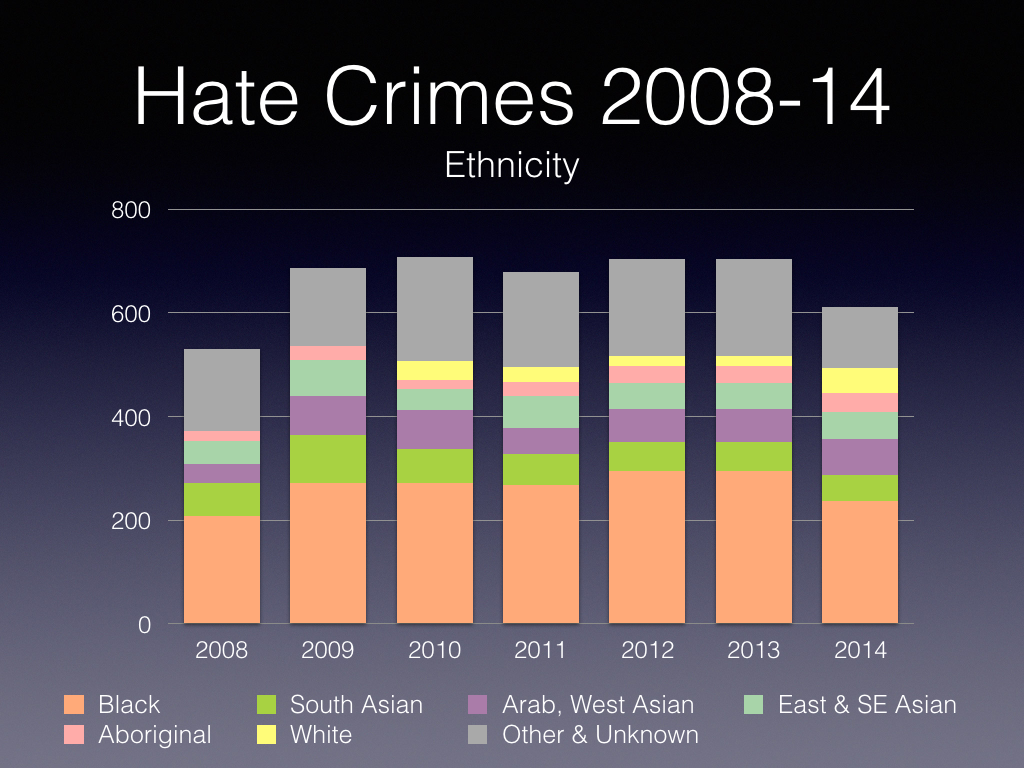
Hate Crimes Comparison.002In contrast to previous years, Statistics Canada does not provide a narrative analysis of what the current year reveals.

The chart above provides the data over the 2008-14 period, showing a slightly decreasing trend with respect to ethnicity related hate crimes and a corresponding slight increase in religion-related hate crimes. Overall numbers continue to remain largely flat at 1,295 (itself surprising given continued population growth).

About half are classified as mischief (612), with the remainder largely involving violence or threats of violence.

While Statistics Canada cautions against comparing year-to-year data, these trends over seven years are more reliable. Police-reported hate crime data tends to be more conservative than that collected by community organizations given the higher reporting burden on victims, so these figures likely under-estimate the number.

As is normal, the larger cities report more hate crimes (e.g., the GTA accounts for 26 percent, greater Montreal 8 percent, greater Vancouver 6 percent and Calgary also about 6 percent). On a per capita basis, larger cities tend to have lower rates than smaller centres. The table below lists communities with more than 10 hate crimes reported along with the per 100,000 rate:

cansim-2520091-eng-8622528054705954879_-_Police_Services_with_more_than_5_incidents

The variation in the per capita rate may reflect a variety of factors ranging from greater willingness to report hate crimes, a more aware police force as well as possible underlying differences.

The following chart confirms again that anti-Black hate is the most common form of ethnicity-related hate crimes: about 50 percent.

Hate Crimes Comparison.003

Religion-based hate crimes are captured in the following chart, showing once again that Canadian Jews are the most targeted. However, in 2014, the relative share for Canadian Jews declined from being in the mid-to-high 50 percent range to just under 50 percent, with hate crimes against Canadian Muslims showing significant increases in the last two years, reaching 23 percent of all religious hate crimes in 2014.

Hate Crimes Comparison.004It remains to be seen how the events of 2015 and some of the language used by the previous government in the lead-up to and during the election campaign affects this trend in next year’s report.

Source: The Daily — Police-reported data on hate crime and cybercrime, 2014

How Germany Has Resisted the Influence of ISIS | TIME

Good article on some of the initiatives Germany is taking to reduce the influence of ISIS (likely other factors also at play):

But Germany also acted early to counteract Islamist propaganda, dating back to before ISIS even emerged as a global terror network. Soon after the deadly shooting at Frankfurt airport in spring 2011, the government instituted a program that may seem counter-intuitive: it began making Islamic studies available to students of all ages, particularly around North-Rhine Westphalia, Germany’s most populous region and home to its largest Muslim communities.

Teachers in this region, whose capital is Düsseldorf, were given a “crash course” in the new Islamic curriculum, which was designed with the help of local imams and religious experts, says Ali Bas, a regional lawmaker who lobbied for this initiative and helps oversee its implementation.

As of this year, 17,000 students in the region were taking courses on Islam, a small fraction of the roughly 300,000 Muslim students in the region but double the number at the start of 2015. By next year, Bas expects the program to grow at an even faster pace, as the first group of teachers are due to complete their degrees in Islamic education and join the faculties of schools across the region.

One of their aims, says Bas, is to make young Muslims feel accepted, “to give them the feeling that they are important in our society.” The broader intention, he says, is to undermine the work of ISIS recruiters, who typically stoke feelings of alienation and social resentment. “Accepting this religion is, for us, a very important aspect of making younger people stronger against extremism,” says Bas, who is an ethnically Turkish Muslim.

The Signpost program, which Sauerborn established in 2014, takes a more targeted approach. With three offices around North-Rhine Westphalia, it offers parents and teachers a place to turn for advice when they see signs of radicalization among young men. In many cases, the program’s counselors go to the schools and hang-outs of devout Muslims in Düsseldorf and other cities to offer guidance, not only on questions of religion but also on social or financial issues, like finding a job or resolving a conflict with a teacher.

German converts to Islam are also invited to seek help from Signpost counselors, who often try to ensure that a convert does not become estranged from his family. “We’d call his mother and say, ‘Look, he’s just a Muslim,’” says Sauerborn. “’That’s not a crime. That’s his choice. That doesn’t mean he’s being radicalized.’”

The hardest part of the program’s mission is winning the trust of the Muslim community, especially among young men who might already feel persecuted or unjustly scrutinized by the authorities. The Federal Office for the Protection of the Constitution, Germany’s domestic intelligence service, pays the salaries of all of the program’s counselors, defines their responsibilities and oversees their work.

But the agency does not use them as informants, says Sauerborn, who sits on the executive board of the Düsseldorf police department. “There is no information exchange, and on that point the Federal Office is very consistent,” he says. “They have never asked for personal information about the people we work with. They just want us to be here to meet their needs.”

One of the program’s counselors agreed to talk to TIME, but only on the condition of anonymity so as not to alert other members of the Muslim community that he works for the German intelligence service. Over the past two years, he says he has worked with about 30 young men in Düsseldorf, some of whom had plans to travel to Syria and join ISIS.

“They think they need to go there and defend Islam, because of these propaganda videos and everything they’ve been told,” he says. In their attempts to dissuade such people, “we don’t say directly that [ISIS] is wrong, that it’s all lies. We have to speak with the people in such a way as to analyze the situation, to see what [Islamist] groups they are attached to, what they want to do in Syria. And then we try to provide concrete help.”

Source: How Germany Has Resisted the Influence of ISIS | TIME

Do ‘British values’ favour colonial comeback over multiculturalism? | Middle East Eye

Myriam Francois’s view on removal of colonial symbols. Some valid points, but there are also risks associated with effacing and forgetting the past (‘those who forget history …’):

And yet, the campaigns have been largely met with consternation. For all the talk of the positive value of diversity within our society, such campaigns remain a struggle on the margins, not entirely dismissed, but requiring quiet co-optation through piecemeal concessions designed to quell the disruptive uprisings of those now too close to power to be metaphorically put down.

Indeed, an admission of racism following a decision to use an image of black hands in chains to advertise a drinks poster is surely a meagre victory for a movement of such ambition. And although a similar campaign at Cambridge succeeded in convincing Jesus College to take down and consider the repatriation of a bronze cockerel looted in the 19th century, such critical demands are yet to become audible to a broader audience.

It is not sufficient to eventually recognise the validity of the cries for freedom among oppressed peoples when the tools which served to uphold that domination continue to permeate popular culture and in many cases, justify new variants on imperial exploitation. In the case of Rhodes, to maintain as a central part of our social vocabulary a man who stands as the cultural equivalent of the “N” word, is to fail to recognise that just as language evolves to reflect changing social norms, so must our concrete edifices.

Critics of the decolonial movement have compared the call for the removal of Rhodes to a form of cultural censorship – where would the movement stop exactly, ask those who, in so doing, unwittingly concede the pervasiveness of imperial ideals within our contemporary culture.

If we might term white supremacy a culture which justifies the encroachment of European powers into other continents and lands under the guise of conferring civility upon peoples assumed to be lagging on the developmental scale, then the edifices of that supremacy must be dismantled.

In their place, society must make way for a consensual cultural construction, in which all voices are not a mere addition to a slightly reformed rotten core – the term “people” expanded to include women and ethnic minorities and quotas to guarantee a token visibility of the “other” – but rather serve to forge a new cultural project away from the racially skewed underpinning of the culture of empire. In this, the decolonial movement is the avant-garde of our generation.

Source: Do ‘British values’ favour colonial comeback over multiculturalism? | Middle East Eye