Why is Ottawa still defending disenfranchisement of expats? – Sevi and Frank
2016/04/23 Leave a comment
The usual weak arguments by Semra Sevi and Gillian Frank.
Starting with the evidence-base on the number of expatriates. The Asia Pacific Foundation number of 2.9 million is composed of 58 percent Canadian-born and 42 percent foreign-born. For the latter (1.2 million), it does not distinguish between those who became Canadian citizens (who can vote) and those who did not, as the purpose of their study was not related to voting rights. Nor does the APF study provide an overall age profile to determine how many are of voting age.
Sevi and Frank admit as much by then later on just referring to ‘over a million’ rather than the higher figure (Canadian-born expats in the US total about 900,000 according to the OECD, total OECD figures are 1.2 million, which exclude major expatriate centres such as China, Hong Kong and the Gulf countries, but these lower figures do not include naturalized Canadians).
Moreover, none of these numbers do not measure the degree of the connection to Canada. Sevi and Frank assert that ‘many’ are connected. How many of the ‘many’ pay Canadian taxes and own property? How many have substantial business ties to Canada? Social ties? I have not seen any such data but readers may correct me.
We do have a sense of how many seek consular services (about 20,000 per year for those who have been abroad for five years or more) and the number of passports issued abroad (about 184,000 in 2015, with about 725,000 passport holders living abroad). These numbers suggest a smaller yet nevertheless significant number of ‘connected’ expatriates.
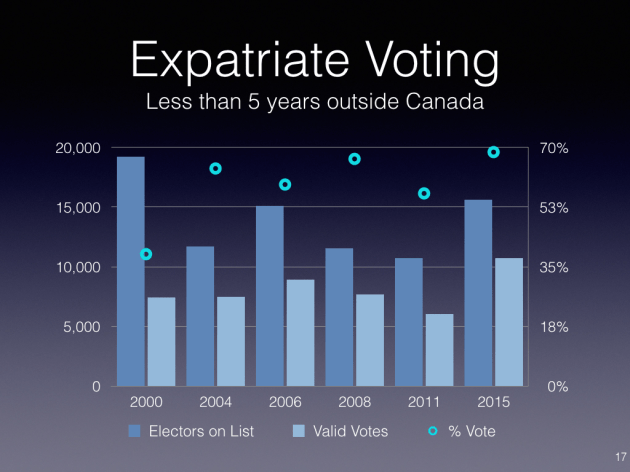
We also have voting data, for those with under 5 years abroad, that show very small numbers, as in the table below, suggesting that relatively few of those who have lived abroad for this period are politically engaged (of course, some may return to Canada to vote, but again, data is lacking).
But beyond the weak evidence base, and the challenges of determining – and implementing – a ‘connection’ test, living outside of Canada for extended periods of time invariably weakens the connection to the day-to-day reality of living in Canada, whether from the perspective of government services such as healthcare, education, transit and the like, or the related political debates and discussions.
Interestingly, neither Sevi nor Frank propose a new number if five is considered too short. 10 years, 15 years, indefinitely? Should those born abroad to Canadian parents be allowed to vote even if they have never lived in Canada?
In the hands of the Supreme Court now, for better or worse.
Despite claims of expat apathy towards Canada, many Canadians living abroad continue to maintain close ties with the country, visit family and friends regularly, pay taxes, own property, follow the news, seek consular services, and desire to continue voting in spite of the bureaucratic hurdles that prevent them from doing so. Many of these Canadians do not hold dual citizenship and cannot vote elsewhere.
The current lawsuit before the Supreme Court reflects the strong ties Canadians abroad maintain with their country, as well as their belief that the democratic process should be modernized to reflect a globalized world with a large Canadian diaspora.
In 2012, Gillian Frank and Jamie Duong, two Canadians living in the United States, filed a lawsuit to restore the right of Canadians abroad to vote. In 2014, Ontario’s Superior Court struck down the law and re-enfranchised expats. The Conservative government responded by appealing this decision and in July 2015, the Ontario Court of Appeal, in a split decision, accepted the attorney-general’s argument.
It’s 2016 and our new Prime Minister recently visited the United States where he rubbed elbows with expat celebrities and met with Canadian business leaders in Washington and New York, lauding their accomplishments while encouraging them to invest in our economy. Prime Minister Trudeau sent a message that he values citizens who reside outside of the country. As much was clear during the 2015 elections when Anna Gainey, the president of the Liberal Party, wrote to the Canadian Expat Association: “We believe that all Canadians should have a right to vote, no matter where they live, and we are committed to ensuring that this is the case.”
In early 2017, the Court will hear arguments about the rights of Canadians abroad to vote. Mr. Trudeau has an unprecedented opportunity to welcome many of these citizens back into our democratic process. One way he could do this is by not defending the litigation before the Supreme Court. Will the Liberals live up to their much-anticipated campaign promise to restore democracy to citizens living abroad? The voting rights of over a million Canadians hang in the balance.
Source: Why is Ottawa still defending disenfranchisement of expats? – The Globe and Mail
 About Andrew
 Multicultural Meanderings