Diversity of Deputy Ministers – Current Baseline

With the announcement that Janice Charente is being replaced by Michael Wernick as Clerk of the Privy Council, I thought it might be interesting to see what the baseline is before further appointments and changes take place this year.

Including the 22 deputies for departments (per GEDS), eight deputies at PCO, and the heads of CBSA, CRS, CSE, CSIS, PSC, RCMP, SSC, StatsCan and TBS (39 deputies or equivalents), generates the following results (14 women, 25 men, 1 visible minority):

Untitled.001

Will update this at the end of the year to see if any significant changes given the government’s focus on diversity and inclusion (and of course if I have missed anyone or mischaracterized anyone, happy to revise).

Kathryn May’s analysis of the appointment worth reading:

The announcement left many public servants scratching their heads as to why Trudeau replaced Charette with Wernick and asked him to help find his replacement.

It’s unclear how long Wernick will be in the job, but one of his key tasks will be studying how to select the next clerk. “The Prime Minister has asked Mr. Wernick for advice on a process to fill the position on a permanent basis,” said the press statement.

Ralph Heintzman, the University of Ottawa research professor who has long argued for an independent appointment process to pick the clerk and all deputy ministers, said the move is in line with the new approach Trudeau is taking to all appointments.

He said finding a new arm’s length process for appointing the clerk is the first step to a “renaissance” of Canada’s non-partisan public service, which many argued had become politicized as more power shifted to the Prime Minister’s Office.
Michael Wernick new Clerk of the Privy Council

The unbending arc: America’s race gap is stuck | Brookings Institution

Richard Reeves on the ongoing economic gap between white and black Americans:

America is in danger of becoming stuck, with insufficient social, geographical, or economic mobility. That’s the claim I made in a recent essay for Esquire magazine, a collaboration between the magazine and Brookings. (You can read the whole package here.)

Poverty persists across generations, too. Half of the black children born on the bottom rung of the income ladder (the bottom quintile) will stay there as adults. A boy who grows up in Baltimore will earn 28 percent less simply because he grew up in Baltimore. Sixty-six percent of black children live in America’s poorest neighborhoods, compared with six percent of white children.

Recent events have shone a light on the black experience in dozens of U.S. cities. Behind the riots and the rage, the statistics tell a simple, damning story. Progress toward equality for black Americans has essentially halted. The average black family has an income that is 59 percent of the average white family, down from 65 percent in 2000. In the job market, race gaps are immobile, too. In the 1950s, black Americans were twice as likely to be unemployed as whites. And today? Still twice as likely.

In part this reflects geographical separation, too. While the degree of segregation by race has reduced slightly in recent years, as shown by my colleague William Frey, black Americans are still likely to live in areas of concentrated income poverty, and to be Stuck in Place, as the title of Patrick Sharkey’s influential book puts it.

Race gaps in wealth are perhaps the most striking. The average white household is now thirteen times wealthier than the average black one. This is the widest gap in a quarter of a century. The recession hit families of all races, but it resulted in a wealth wipeout for black families. In 2007, the average black family had a net worth of $19,200, almost entirely in housing stock, typically at the cheap, fragile end of the market. By 2010, this had fallen to $16,600. By 2013—by which point white wealth levels had started to recover—it was down to $11,000. In national economic terms, black wealth is now essentially nonexistent.

Half a century after the passing of the Civil Rights Act, the arc of history is no longer bending toward justice. A few years ago, it was not unreasonable to hope that changing attitudes, increasing education, and a growing economy would surely, if slowly, bring black and white America closer together. It is now clear that time and economic growth alone will not heal the racial divide.

Source: The unbending arc: America’s race gap is stuck | Brookings Institution

Montréal toujours loin de la parité hommes-femmes

Unfortunately, we do not have consistent cross-municipality data (the NHS/Census allows us to compare gender and median income but the shift to the NHS in 2011 makes comparisons problematic). For all municipal employees across Canada, 59 percent are male:

La proportion de femmes parmi les employés de la Ville de Montréal a diminué depuis huit ans, alors que la métropole s’était pourtant engagée à tendre vers la parité avec les hommes. Le nombre de femmes ayant obtenu un poste de cadre a augmenté, mais celles-ci continuent à gagner moins que leurs collègues masculins. Ce sont là quelques-uns des constats qui se dégagent du plus récent avis du Conseil des Montréalaises, qui sera présenté aux élus de la métropole lors de la prochaine réunion du conseil municipal.

La proportion de femmes parmi les employés de la Ville de Montréal a diminué depuis huit ans, alors que la métropole s’était pourtant engagée à tendre vers la parité avec les hommes. Le nombre de femmes ayant obtenu un poste de cadre a augmenté, mais celles-ci continuent à gagner moins que leurs collègues masculins. Ce sont là quelques-uns des constats qui se dégagent du plus récent avis du Conseil des Montréalaises, qui sera présenté aux élus de la métropole lors de la prochaine réunion du conseil municipal.

Le nombre de femmes cadres progresse

Malgré le recul de la proportion de femmes au sein du personnel de la métropole, le Conseil des Montréalaises se réjouit de constater que leur nombre a tout de même progressé chez les cadres. En 2006, 40 % des cadres étaient des femmes, proportion qui a grimpé à 44 % en 2014 parmi les 1836 cadres de la métropole. Les femmes continuent toutefois à être sous-représentées dans les plus hauts échelons de l’appareil administratif, note le rapport. Celles-ci n’occupaient que 32 % des postes de cadre de direction, soit ceux répondant directement au directeur général. Cette proportion représente tout de même une progression par rapport à 2006, où elles étaient 24 %.

Source: Montréal toujours loin de la parité hommes-femmes | Pierre-André Normandin | Montréal

Where is the PM when Quebec needs him? Lysiane Gagnon

Worth reading, but not as sanguine about her conclusion regarding overall Canadian fears or not regarding Canadian Muslims.

Virtually all polling I have seen, as well as the identity politics practiced by the Conservative government, suggest that a significant number of Canadians do share this fear.

Fine balance between over and under-playing, but overall better to downplay and avoid over-heating fears:

Former prime minister Stephen Harper was too warlike. Now, we have the other extreme: a prime minister who hates conflicts and sees the world through a New Age prism in which everything can be solved with love and understanding. Unfortunately, the country he leads doesn’t live in a dream world.

Maybe Mr. Trudeau’s timidity is also due to the fear of raising anti-Muslim sentiments. But this is a misplaced fear: Canadians are not stupid and they know that the huge majority of Muslims have nothing to do with radical Islam. And Muslims are often the first victims of the murderous groups who reign by terror over large parts of the Middle East and Africa.

Source: Where is the PM when Quebec needs him? – The Globe and Mail

Learn English or leave? Mind your language, Mr. Cameron: Shasta Aziz

Valid points:

If Mr. Cameron’s government is serious about immigrant women learning English, it first needs to reverse the deep funding cuts it has made to organizations providing these services.

Of course, speaking English is going to assist any woman living in the U.K. and will help her to navigate through her daily life with more confidence and ease. But no amount of learning English is going to help integrate a woman if her and her ilk are marked as a problem and a catalyst for fragmenting society.

This is the subtext behind much of the hysterical tabloid media coverage of Muslims in Britain, in the age of the so called war on terror.

Many Muslim women here tell me that they feel increasingly uncomfortable in the country of their birth. They feel exhausted by having to constantly explain who they are and to prove they are loyal to their country every time there is a terrorist atrocity in the world – because the default position is they’re guilty by association.

The politics of identity are becoming more and more loaded in an increasingly polarized world. It is becoming harder especially for young British Muslims to navigate their way through all the noise and increasingly hostile discourse around what it means to be a Muslim in the west.

Monday’s announcement is simply another failed and missed opportunity by the British government to build a meaningful dialogue with a section of the population that it needs to urgently reach out and engage with.

One Muslim woman I interviewed in London after the terrorist attacks in Paris late last year asked me “how am I expected to feel comfortable and at ease in my society if every time I leave my house I’m looking over my shoulder to see who might physically attack me because I’m a visible Muslim woman who wears a hijab? How can anyone expect me to feel like a valued member of my society?”

That is a very good question – and one Mr. Cameron should start thinking about carefully.

Source: Learn English or leave? Mind your language, Mr. Cameron – The Globe and Mail

Global Centre for Pluralism 2016 Corporate Plan

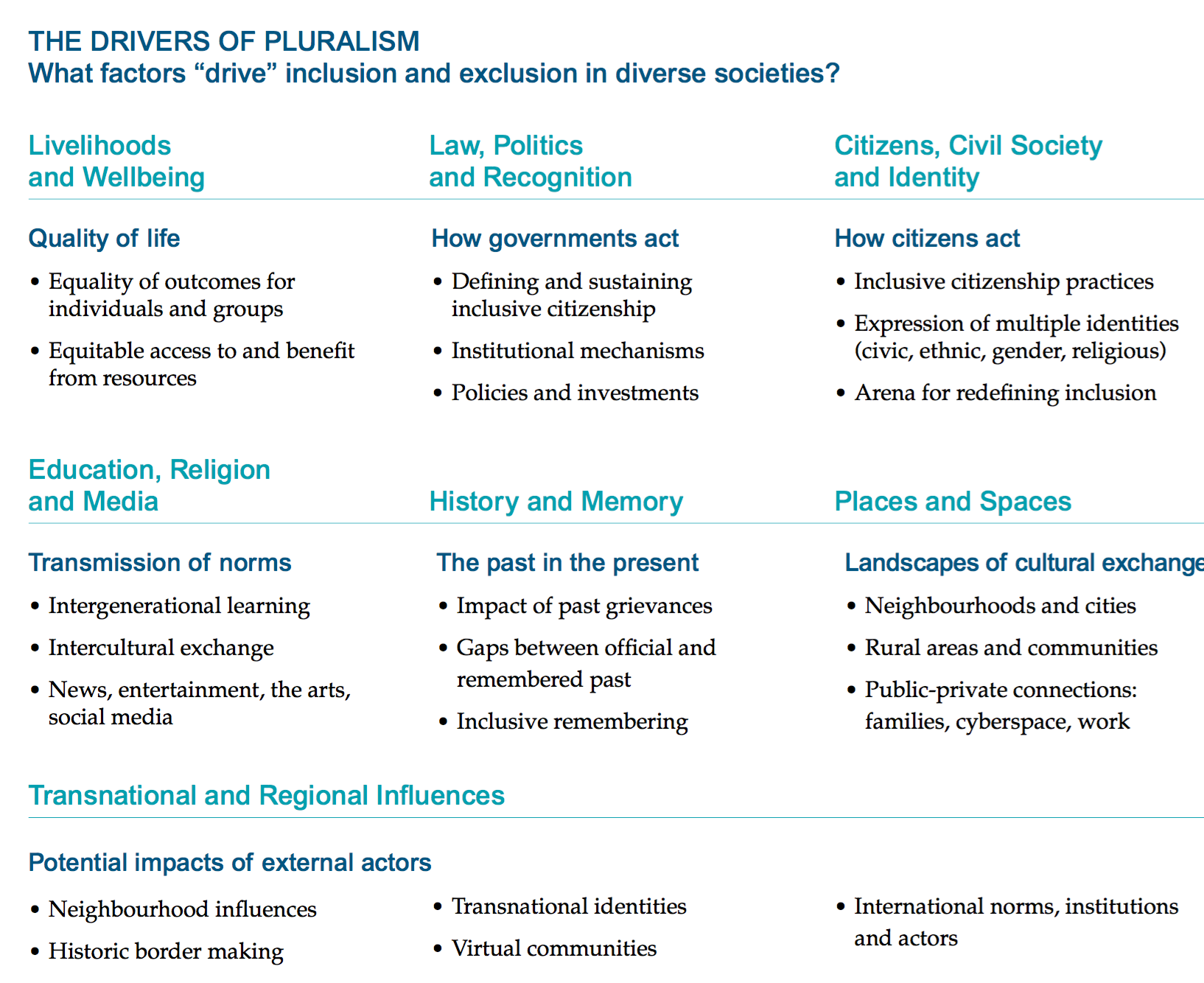
GCP Drivers of PluralismThe 2016 Corporate Plan is out and worth a quick read. The most interesting aspect is their effort to develop pluralism indicators as per the framework above.

Will be interesting to see how this adds to other indicator efforts, more focussed on OECD countries (e.g., MIPEX, OECD), and the ability to obtain good comparative and consistent data.

Some of the elements in the GCP framework will pose particular challenges in this regard (e.g., education, religion and media, history and memory).

Download the 2016 Corporate Plan >

Schools are not powerless to address racial disparities

 Sachin Maharaja, a teacher in the TDSB, on racial disparities.
Data can be helpful in identifying and addressing disparities, both for the school system as well as for the people within the communities themselves, who also have to avoid fatalism:

One thing we do know for sure is that students in our school systems are not all given the same opportunities. Data from the TDSB, one of the only boards to collect detailed demographic information, has shown that students from lower income neighbourhoods are much less likely to be identified as gifted, more likely to be identified as having a learning disability, and more than twice as likely to be placed in applied-level classes. Race also plays a major role in how schools treat children. That is why black students represent 13 per cent of the TDSB population, but only 3 per cent of its students identified as gifted. Meanwhile white students, who make up 32 per cent of the TDSB population, comprise more than half of its students identified as gifted.

While some have disputed the role that racism plays in such inequitable treatment, we have empirical evidence that should put such notions to rest. A 2015 study by researchers at Stanford University gave teachers copies of student records with names that had been changed to be either stereotypically black or white sounding. When teachers saw records with black sounding names, they were much more likely to recommend that those students be suspended from school than when they saw identical records with white sounding names.

Given this reality, having demographic information on our students at least gives us the opportunity to address these glaring inequities. But not everyone thinks this is even a real problem. A Toronto teacher who teaches in a low income neighbourhood once told me that the reason black students and those from low income households are disproportionately placed in lower academic streams is due to “the conditions of their upbringing.” It is this culture of resignation which can be the downside of school systems having an excessive focus on poverty and race.

We see this attitude in some parts of the United States, which has collected detailed race and income statistics for years. Diane Ravitch, an education historian and one of the most prominent voices in American education, demonstrated this when she told a 2011 rally of teachers in Washington, D.C. that “our problem is poverty, not schools.” It was no coincidence then that when Time magazine journalist Amanda Ripley later interviewed D.C. teachers, many stressed all of the disadvantages that their students faced. One teacher relayed the common complaint to Ripley that “parents on this side don’t have the know-how to raise their children.” The result of this type of attitude was that at the end of the school year, students in this teacher’s class fell further behind grade level in reading than when they started, and performed significantly worse than other low-income students in D.C. who had started the year at the exact same reading level.

On balance, it is a good thing to have more detailed information on the students we serve. Burying our heads in the sand and pretending that problems don’t exist is clearly not the solution. But as we better understand the racial backgrounds of our students and the issues of poverty they face, we should be careful to not let that lead to a culture of fatalism and low expectations in our schools.

Lessons from the Japanese Canadian internments: Policies built on fear won’t make us safer

Jordan Stanger-Ross, Eric Adams and Laura Madokoro on some of the lessons from WW II Japanese Canadian interment (for those who have not read it, Joy Kogawa’s novel Obasan captures the reality):

The wartime fates of people of Japanese descent in North America have recently returned to headline news. The National Association of Japanese Canadians, which in the 1980s led the Redress movement, called last year for the repeal of Bill C-51 (the complex omnibus legislation dealing with surveillance, information sharing among government agencies and various new terrorist-related crimes) by reminding the government of what then-prime minister Brian Mulroney called its “solemn commitment” that the mistreatment of Canadians in the name of security would “never again in this country be countenanced or repeated.”

In the fall, NDP Leader Tom Mulcair explicitly compared Bill C-51 to the Orders-in-Council of the 1940s, which curtailed the rights of Japanese Canadians. In the United States, Donald Trump indicated that the mass internment of Japanese Americans during the war may have been the correct policy, shortly before calling for “a total and complete shutdown of Muslims entering the United States.”

Jan. 19, 1943, is therefore a date worth remembering. The forced sale of Japanese-Canadian property marked a moment in Canada’s past when racism, misunderstanding and fear wrapped themselves in misguided notions of security and in the formal language of the law. Other and nefarious agendas could be pursued in a political atmosphere clouded by fear. We live with the legacy of those decisions today – the lost property, livelihoods and connections of a generation of Canadians, the eradication of a downtown neighbourhood in Vancouver, the painful memories of lives dispossessed.

Source: Lessons from the Japanese Canadian internments: Policies built on fear won’t make us safer – The Globe and Mail

Ottawa will seek to settle more Syrians in French communities, says McCallum, Overall settlement challenges

Challenge has shifted to bring refugees here to settling them:

Immigration Minister John McCallum says the federal government is looking to settle newly arrived Syrian refugees in more French-speaking communities across the country.

McCallum says more than 90 per cent of refugees that have arrived in Canada speak neither English or French.

That creates what he calls a blank slate for refugees and provinces to teach newly arrived Syrians either of Canada’s two official languages.

McCallum says where refugees end up living will depend on which communities have the resources to resettle the 10,000 that have arrived since November — and 15,000 more that are scheduled to arrive by the end of February.

The Liberals promised during the election campaign to bring 25,000 Syrian refugees to Canada by the end of 2015.

Once in office, they changed that goal, citing the realities of moving all those people in a short period of time, including inclement weather that didn’t always make flights possible.

The last of the first 10,000 Syrians arrived about a week ago; McCallum says the government will “easily” hit its deadline of bringing a further 15,000 refugees into the country by the end of February.

“We can deliver one, two, three, four, even five flights per day so the challenge is no longer to get the refugees here,” McCallum said.

The new issue facing the government is to resettle those Syrians into Canadian communities, he added.

“The challenge today going forward is to receive them well, to help them find a place to live, a job, language training, all of those things and that involves working with provincial governments and municipalities on the settlement side.”

Further indications of the shifting nature of the challenge:

As Ottawa places thousands of Syrian refugees in hotels and shelters while they hunt for permanent housing, private sponsorship groups are clamouring for families to help.

The disconnect, say critics, is a disservice to the government-assisted families cramped inside the not-so-welcoming temporary accommodation and to the eager community volunteers who have raised the money and have everything ready to receive the newcomers for a new life in Canada.

“The sponsorship group I chair has been ready since mid-December, but there had been no offers. My group is one of 18 affiliated with the Rosedale United Church. No one is getting any referrals,” said former Toronto Mayor John Sewell.

“I suspect there are three or four hundred sponsorship groups in Toronto who are ready to take families, if the government will only refer them to these groups.”

On Tuesday, two cities — Vancouver and Ottawa — said they are halting their reception of government-assisted Syrian refugees as settlement agencies there try to work through housing bottlenecks.

Syrian refugees eligible for resettlement to Canada must first be vetted by the United Nations refugee agency before being referred to Canadian officials abroad and assigned to the three different streams: fully supported by the federal government, private sponsors and the blended class with responsibilities shared between the two.

The government gets the first dip into selecting the eligible refugees recommended by its visa posts and the leftovers are then put into a pool of profiles for the selection of the 100 faith and community groups that hold refugee sponsorship agreements with Ottawa.

Local sponsorship groups that were formed after the Liberal government launched the massive Syrian resettlement plan in November, must partner with the sponsorship agreement holders.

According to Brian Dyck, chair of the Sponsorship Agreement Holders’ Association, some 300 Syrian refugee profiles have been posted since the beginning of January and they were quickly snapped up by his members.

“The matching system was designed for small-scale sponsorship interest. To adapt it to the current public interest is a big challenge,” Dyck explained.

David Cameron to back Muslim veil ban, will announce anti-radicalization measures

Sigh. Pandering to the base (and UKIP) more than improving integration, and by applying it to Muslims only as appears from press accounts (some other religions have separate seating for men and women), further reinforces the Islamist narrative:

Muslim women can be banned from wearing veils in schools, courts and other British institutions, David Cameron has said.

The Prime Minister said he will give his backing to public authorities that put in place “proper and sensible” rules to ban women from wearing face veils.

The Government is also preparing to announce a series of measures designed to stop British Muslims becoming radicalized and travelling to the Middle East to join terrorist groups like Islamic State of Iraq and the Levant.

As part of the plans, ministers will pledge to outlaw gender segregation in public buildings amid concerns that some Muslim organizations are forcing women to sit separately.

Nicky Morgan, the Education Secretary, will also today announce plans to force schools to help stop teenagers travelling abroad to fight alongside jihadist groups such as ISIL.

Schools will be required to inform councils when pupils stop attending without any explanation and Muslim parents will be encouraged to carry out checks to ensure their children are not being radicalized.

Cameron also announced that tens of thousands of Muslim women would face deportation unless they pass a series of English language tests after coming to Britain on spouse visas.

The Prime Minister’s comments about veils will reignite the row over whether British institutions should be able to stop women covering their faces for religious reasons in public places.

The Prime Minister refused to endorse a French-style blanket ban but made clear that individual organizations could choose to stop Muslim women wearing the veil.

Source: David Cameron to back Muslim veil ban, will announce anti-radicalization measures