New citizenship deprivation [revocation] rules in the wake of Paris attacks

Good update of citizenship revocation measures:

The terrorist attacks that happened in Paris on 13 November 2015 have been followed by a toughening of citizenship rules in a number of countries. This is reflected in both a more cautious approach to naturalisation and in proposals to withdraw or deny citizenship to suspects of terrorism (and occasionally to their families).

Increased security concerns adversely affected the Italian attempts to introduce ius soli temperato (moderated ius soli) for second generation migrants. Moderated ius soli would allow children born to foreign nationals in possession of a European Union Long Term Residence Permit to acquire Italian nationality by registration before the eighteenth birthday.

Yet considerably more countries have proposed, and some have already adopted, provisions on grounds of which suspects of terrorism would be deprived of their citizenship.

Three days after the attacks in Paris, speaking at a joint session of both houses of the French parliament, the country’s President François Hollande  proposed citizenship deprivation for dual nationals who are convicted of terrorism.

On 22 November 2015, the Israeli Prime Minister Benjamin Netanyahu put forward a motion to allow the country’s government to withdraw citizenship of those who join the Islamic State.

In early December, the authorities of Dagestan, a Russian federal unit located in the North Caucasus, proposed to the Russian Duma to amend the country’s citizenship law to deprive of citizenship those who ‘left Russia to take part in terrorist activities’.

Similar initiative has also resonated in the Belgian public discourse, where he Flemish nationalist party NVA, argues for amendments to citizenship law to allow the deprivation of nationality to descendants of Belgian citizens (second and third generations) convicted of terrorism. The current citizenship legislation allows withdrawal of citizenship, but only for those who are not born Belgians, or who have acquired citizenship by naturalisation.

Two countries, Australia and Azerbaijan have already amended their legislation in this regard.

Australia has moved to strip dual nationals who ‘have fought in government-designated militant groups or engaged in activities that would support terrorism, such as training, recruitment, or making donations’ already in June 2015 when it adopted the Allegiance to Australia bill. In December 2015, the bill was amended and leads to automatic loss of Australian citizenship for individuals suspected of terrorism who are 14 years or older, even in the absence of conviction. Under the new provisions, citizenship lost on grounds of sections 33AA and 35 cannot be regained. Civil society organisations consider this a controversial and possibly unconstitutional move that creates two classes of citizenship.

The parliament of Azerbaijan amended the country’s s citizenship law on 4 December to withdraw citizenship of those ‘involved in terrorist activity and actions aimed at the violent change of the constitutional system of Azerbaijan’. Under the new rules, such individuals will be automatically deprived of Azerbaijani citizenship.

For more details on the current and past citizenship laws of Italy, France, Belgium and Russia consult our country profile pages.

Source: EUDO CITIZENSHIP
If Donald Trump were campaigning in Canada, could he be charged for hate speech?

Good comparative analysis:

On Monday Donald Trump called for a complete ban on Muslims entering the United States “until our country’s representatives can figure out what’s going on.” Despite universal outrage, the billionaire presidential candidate has only doubled down on his vow, the latest in a string of anti-minority comments ranging from the offensive to the downright absurd. Even respectable commentators have started calling him a fascist.

These comments are in bad taste at best and hateful at worst, why are there no legal repercussions for Trump making them? 

The short answer is because it’s the United States. The U.S. has extremely strong protections for free speech, which is only considered hateful if it will incite direct and immediate violence. Trump pontificating at a podium or in an interview doesn’t qualify. Until he starts an angry mob, he’s free to say whatever he likes.

So for argument’s sake, what if this were happening in Canada? Would anything be different?

Trump’s most recent comments might offend you, but they likely still couldn’t be prosecuted under Canadian law. Though hate speech laws in Canada are broader than they are south of the border, speech needs to meet some very specific requirements to be considered hateful here, too.

Section 319 (1) of the Criminal Code states that hate speech “incites hatred against any identifiable group where such incitement is likely to lead to a breach of the peace” and where the comments are made in a public place.

This would pose two problems for charges under hate speech law.

“[T]he immediacy of the breach of the peace would make it extremely difficult to convict someone for saying what Trump said,” said Faisal Kutty, a Toronto lawyer and human rights activist.

Trump also isn’t making any outright claims despite the subtext of his statements, said Richard Moon, a law professor at the University of Windsor.

“That’s the main problem with trying to fit his current statement under the hate speech law: it doesn’t have any real hateful content in the sense of making a claim about the nature of character of Muslims,” said Moon. “Of course, why should they be excluded other than, presumably, on the belief that they are somehow dangerous? But he leaves that slightly open.”

But I’ve seen and heard people call his comments hate speech. What does that mean?

That’s due to the technicality of law. While his comments might be considered hateful, the burden of proof under the law is higher. The comments must meet specific criteria to be prosecuted, and his comments likely don’t meet these standards.

What about some of his other comments? He’s said a lot more extreme things in the past.

Some of his previous remarks could more easily be prosecuted, like his remarks about Mexican immigrants during his announcement speech on June 16: “They’re bringing drugs. They’re bringing crime. They’re rapists.”

“That is the very stuff of hate speech, and a claim like that made in Canada might well constitute hate speech contrary to the Criminal Code,” Moon said.

So why are Canadian and American hate speech laws so different?

It’s probably due to a lot of factors, but part of it traces back to the founding of the country. America is old, and so are some of the laws, said David Matas, a Winnipeg-based lawyer and author of Bloody Words: Hate and Free Speech.

“In the United States you’ve got a bill of rights which is very old.  It comes from the 18thcentury. Everywhere else, the concept of rights is post-Holocaust, post-Declaration of Human Rights. Being ahead of the gun at the time has left them far behind when it comes to the 21st century.”

Source: If Donald Trump were campaigning in Canada, could he be charged for hate speech?

Diversity Makes You Brighter – The New York Times

Other studies have also shown, I believe, the advantages of diversity in reducing automatic thinking and group think:

Upholding affirmative action in 2003, in Grutter v. Bollinger, Justice Sandra Day O’Connor argued that it served the intellectual purpose of a university. Writing for the majority, she described how the University of Michigan aspired to enhance diversity not only to improve the prospects of certain groups of students, but also to enrich everyone’s education.

Ms. Fisher [the applicant of the case before the US Supreme Court] argues that diversity may be achieved in other ways, without considering race. Before resorting to the use of race or ethnicity in admissions, the University of Texas must offer “actual evidence, rather than over broad generalizations about the value of favored or disfavored groups” to show that “the alleged interest was substantial enough to justify the use of race.”

Our research provides such evidence. Diversity improves the way people think. By disrupting conformity, racial and ethnic diversity prompts people to scrutinize facts, think more deeply and develop their own opinions. Our findings show that such diversity actually benefits everyone, minorities and majority alike.

To study the effects of ethnic and racial diversity, we conducted a series of experiments in which participants competed in groups to find accurate answers to problems. In a situation much like a classroom, we started by presenting each participant individually with information and a task: to calculate accurate prices for simulated stocks. First, we collected individual answers, and then (to see how committed participants were to their answers), we let them buy and sell those stocks to the others, using real money. Participants got to keep any profit they made.

When trading, participants could observe the behavior of their counterparts and decide what to make of it. Think of yourself in similar situations: Interacting with others can bring new ideas into view, but it can also cause you to adopt popular but wrong ones.

It depends how deeply you contemplate what you observe. So if you think that something is worth $100, but others are bidding $120 for it, you may defer to their judgment and up the ante (perhaps contributing to a price bubble) or you might dismiss them and stand your ground.

We assigned each participant to a group that was either homogeneous or diverse (meaning that it included at least one participant of another ethnicity or race). To ascertain that we were measuring the effects of diversity, not culture or history, we examined a variety of ethnic and racial groups. In Texas, we included the expected mix of whites, Latinos and African-Americans. In Singapore, we studied people who were Chinese, Indian and Malay. (The results were published with our co-authors, Evan P. Apfelbaum, Mark Bernard, Valerie L. Bartelt and Edward J. Zajac.)

The findings were striking. When participants were in diverse company, their answers were 58 percent more accurate. The prices they chose were much closer to the true values of the stocks. As they spent time interacting in diverse groups, their performance improved.

In homogeneous groups, whether in the United States or in Asia, the opposite happened. When surrounded by others of the same ethnicity or race, participants were more likely to copy others, in the wrong direction. Mistakes spread as participants seemingly put undue trust in others’ answers, mindlessly imitating them. In the diverse groups, across ethnicities and locales, participants were more likely to distinguish between wrong and accurate answers. Diversity brought cognitive friction that enhanced deliberation.

For our study, we intentionally chose a situation that required analytical thinking, seemingly unaffected by ethnicity or race. We wanted to understand whether the benefits of diversity stem, as the common thinking has it, from some special perspectives or skills of minorities.

What we actually found is that these benefits can arise merely from the very presence of minorities. In the initial responses, which were made before participants interacted, there were no statistically significant differences between participants in the homogeneous or diverse groups. Minority members did not bring some special knowledge.

The differences emerged only when participants began interacting with one another. When surrounded by people “like ourselves,” we are easily influenced, more likely to fall for wrong ideas. Diversity prompts better, critical thinking. It contributes to error detection. It keeps us from drifting toward miscalculation.

Our findings suggest that racial and ethnic diversity matter for learning, the core purpose of a university. Increasing diversity is not only a way to let the historically disadvantaged into college, but also to promote sharper thinking for everyone.

Source: Diversity Makes You Brighter – The New York Times

Distinct societies: Why Canada, U.S., diverge on Syrian refugees: Adams

Michael Adams on the contrast between Canada and the USA:

Americans certainly enjoy unique latitude in the individual pursuit of happiness, but the pursuit of happiness doesn’t always look like much fun. In an environment where there is a lot to fear (financial ruin in an unforgiving system, illness leading to bankruptcy, gun violence inflicted by a stranger, a family member, or an unsupervised toddler), it is perhaps not surprising that some are eager to control the one variable that seems like a no-brainer: don’t give jihadists a green card. But one of the San Bernardino jihadis seems to have been born in Chicago. The “big and beautiful wall” Donald Trump proposed to build to keep dangerous people out of America would require complex architecture indeed. No society is or can be perfectly safe. But societies that have traditionally put a little more stock in collective well-being seem to have better odds. To be fair, those safer, quieter places have also not been the birthplaces of Apple, Google, Tesla, Amazon, Wikipedia and the first man on the moon.

As I have written elsewhere, despite the current apparent spasm of xenophobic sentiment and the din of gun violence, our values research suggests that in fact Americans’ values are tilting in a slightly more Canadian direction – toward greater openness to social difference, a more nuanced sense of personal autonomy, and even a less suspicious attitude toward government. The shift is by no means a sea change, but the election of Mr. Obama (twice) was indeed the product of deep and meaningful changes in the electorate, no matter how lonely he may sometimes appear in White House press briefings these days. As younger voters, women (especially single women), and America’s diverse, city-dwelling voters become more influential politically, America is changing. But those who are on average less keen on this direction of social change (older, more conservative, whiter, more religious and patriarchal voters) have some innings left, as the tremendous polarization of U.S. political discourse attests.

What will become of America in the next election cycle and beyond? And how will the noisy debates and decisions of our neighbour to the south influence our own public conversations and political aspirations? As we wait to welcome 25,000 Syrian refugees, Canada feels like a fairly peaceable corner of a turbulent world. Recent reports suggest, however, that of the more than 25,000 refugees interviewed by the UN, fewer than 2,000 were interested in coming to Canada. Many are likely hoping for reunification with family members in Europe. It would be interesting to know how many are holding out for their shot at the American Dream.

Source: Distinct societies: Why Canada, U.S., diverge on Syrian refugees – The Globe and Mail

Trump’s Anti-Muslim Plan Is Awful. And Constitutional. – Peter Spiro, The New York Times

Good piece by Peter Spiro on the constitutionality of race or religion-based immigration restrictions:

In the ordinary, non-immigration world of constitutional law, the Trump scheme would be blatantly unconstitutional, a clear violation of both equal protection and religious freedom (he had originally called for barring American Muslims living abroad from re-entering the country as well; he has since dropped that clearly unconstitutional notion). But under a line of rulings from the Supreme Court dating back more than a century, that’s irrelevant. As the court observed in its 1977 decision in Fiallo v. Bell, “In the exercise of its broad power over immigration and naturalization, Congress regularly makes rules that would be unacceptable if applied to citizens.”

The court has given the political branches the judicial equivalent of a blank check to regulate immigration as they see fit. This posture of extreme deference is known as the “plenary power” doctrine. It dates back to the 1889 decision in the Chinese Exclusion case, in which the court upheld the exclusion of Chinese laborers based on their nationality.

Unlike other bygone constitutional curiosities that offend our contemporary sensibilities, the Chinese Exclusion case has never been overturned. More recent decisions have upheld discrimination against immigrants based on gender and illegitimacy that would never have survived equal protection scrutiny in the domestic context. Likewise, courts have rejected the assertion of First Amendment free speech protections by noncitizens.

Nor has the Supreme Court ever struck down an immigration classification, even ones based on race. As late as 1965, a federal appeals court upheld a measure that counted a Brazilian citizen of Japanese descent as Asian for the purposes of immigration quotas.

In the context of noncitizens seeking initial entry into the United States, due process protections don’t apply, either. This past June, the court upheld the denial of a visa for the spouse of an American citizen based on the government’s say-so, with no supporting evidence.

The courts have justified this constitutional exceptionalism on the grounds that immigration law implicates foreign relations and national security — even in the absence of a specific, plausible foreign policy rationale. The 1977 Fiallo case, for instance, involved a father seeking the admission of his out-of-wedlock son from the French West Indies — hardly the stuff of national interest.

Indeed, contrary to the conventional understanding, President Trump could implement the scheme on his own, without Congress’s approval. The Immigration and Nationality Act gives the president the authority to suspend the entry of “any class of aliens” on his finding that their entry would be “detrimental to the interests of the United States.” President Obama has used this to the better end of excluding serious human rights violators.

But here’s the interesting thing: Just because Mr. Trump’s proposal has a judicial pedigree, that doesn’t make it “constitutional” in a broader sense. The Constitution and the courts are not synonymous, nor do the courts have a monopoly on constitutional interpretation. Politicians, the legal community, scholars and the public at large are all a part of our continuing constitutional conversation. Clear popular consensus can establish constitutional norms, with or without the courts.

The leading example comes out of the internment of Japanese-Americans during World War II. The Supreme Court upheld the internment in its 1944 Korematsu decision, and that ruling has never been judicially reversed. Technically, it remains good law. But it has been effectively overridden by other actors, and in the court of public opinion. A formal apology and payment of reparations, enacted by Congress and signed into law by Ronald Reagan in 1988, supplies the formal evidence. Korematsu continues to provoke popular shame.

We may be seeing that same shame at work today. Mr. Trump’s plan has triggered an uproar across the partisan divide. Perhaps a religion-based immigration bar may be consistent with court-made doctrine. But it doesn’t reflect our deeper, broadly assimilated understandings of the Constitution.

Source: Trump’s Anti-Muslim Plan Is Awful. And Constitutional. – The New York Times

Donald Trump’s no-Muslims immigration idea right in line with U.S., Canadian history

Canada, of course has its equivalents (Chinese head tax and related restrictions, World War 1 internment, Continuous Journey clause, Japanese World War 2 internment, restrictions on Jewish immigrants etc):

1.Chinese Exclusion Act of 1882

exclusion_act

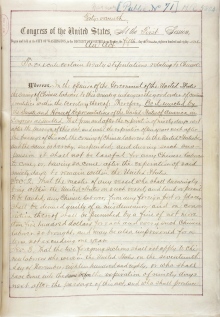
The first page of the Chinese Exclusion Act of 1882. (U.S. National Archives and Records Administration)

The first major law restricting immigration to the U.S. was the Chinese Exclusion Act, which barred all Chinese people from entering the United States.

Signed into law on May 6, 1882, the act came amid outcry from American-born citizens that Chinese workers were to blame for the high unemployment and declining wages plaguing the West Coast.

Not only did the law bar Chinese immigration, but it also prevented Chinese people already living in the country from gaining citizenship.

The law, originally written to last 10 years, was repeatedly amended and extended until its repeal in 1943, when China became an ally against Japan during the Second World War.

2. Immigration Act of 1917

This U.S. federal law was the first to restrict immigration to those who could pass a literacy test.

It also banned all immigration from the so-called “Asiatic Barred Zone,” which encompassed  India, Afghanistan, Persia (now Iran), Arabia, parts of the Ottoman Empire and Russia, Southeast Asia and the Asian-Pacific islands.

Furthermore, it expanded an already-existing category of barred “undesirables” to include sex workers, criminals, alcoholics, political radicals, contract labourers, “idiots, imbeciles, and [the] feeble-minded,” people with epilepsy, tuberculosis or contagious disease, as well as anyone else deemed “mentally or physically defective.”

3. Chinese Immigration Act of 1923

The United States wasn’t alone in discriminating against Chinese immigrants.

In Canada, the federal government imposed a $50 head tax on Chinese immigrants in 1885 after Chinese workers were no longer needed to work on the Canadian Pacific Railway. The amount was raised to $500 in 1903, the equivalent of about two years’ wages at the time.

On July 1, 1923, the head tax was replaced by the Chinese Immigration Act, which barred any Chinese immigrants — or ethnic Chinese people of other nationalities — from entering the country. There were some exceptions for merchants, diplomats and foreign students with proper documentation.

Canada also cast suspicion on those already living here, forcing all people of Chinese origin or descent to register with authorities and to obtain an identity certificate.

The act remained in effect until 1947.

4.Immigration Act of 1924

Travel-NYC-Holocaust Exhibit

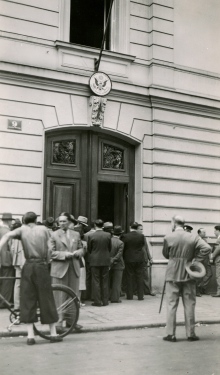
In this 1938 photo, prospective immigrants line up outside the U.S. consulate in Vienna after the German annexation of Austria. American Jews struggled to get refugees out of Nazi-era Europe due to strict immigration quotas in the U.S. (Museum of Jewish Heritage/ Franklin D. Roosevelt Presidential Library/Associated Press)

In an attempt to stem the tide of eastern European immigration to America, the U.S. enacted a quota system, stipulating that visas be provided only to two per cent of the total number of people of each nationality in the United States as of the 1890 national census.

Because so many eastern Europeans moved to the U.S. in the decades leading up to the First World War, lawmakers opted not to use the more recent census of 1910 to calculate the quotas.

The act also barred entry to “any alien who by virtue of race or nationality was ineligible for citizenship” — a provision aimed at the Japanese.

The effects of the quota system were particularly devastating for European Jews, who struggled to obtain visas leading up to the Second World War and the Holocaust.

5. ‘Excessive demand’

The Canadian Immigration and Citizenship Act states “a foreign national is inadmissible on health grounds if their health condition might reasonably be expected to cause excessive demand on health or social services.”

This wording has been used to bar entry of people with illnesses or disabilities.

In 2011, a South Korean family living in New Brunswick faced deportation because their teenage son is autistic. The deportation order was later reversed amid public outcry.

Again in 2012, the National Post reported that a University of Victoria professor from the U.S. and his family were denied permanent residency in Canada because their four-year-old son’s autism.

Source: Donald Trump’s no-Muslims immigration idea right in line with U.S., Canadian history – World – CBC News

Quebec: Difficile régionalisation de l’immigration

The ongoing problem of attracting and retaining immigrants outside of Montreal (Quebec retains relatively fewer immigrants compared to other provinces save Atlantic Canada):

Même si la très grande majorité des réfugiés syriens attendus au Québec en 2015 et 2016 s’établiront dans la grande région de Montréal, plus d’un millier d’entre eux atterriront en région. Y resteront-ils? Rien n’est moins sûr, car la rétention des populations immigrantes hors des grands centres demeure un défi considérable.

C’est une réalité qui n’est que trop familière à Henry Mbatika. Arrivé de la République démocratique du Congo avec sa famille en 2000, ce père de cinq enfants – dont deux sont nés à Sherbrooke – est maintenant seul de son clan au Québec.

Victime d’une fermeture d’entreprise, sa femme n’arrivait plus à trouver du travail et est partie pour l’Alberta en 2012, où elle travaille dans une usine de PepsiCo, à Lethbridge. Les enfants l’ont suivie et le couple est maintenant écartelé entre les deux provinces.

«On est bien à Sherbrooke: il n’y a pas de racisme, les maisons sont plus abordables qu’à Montréal et il y a beaucoup d’espace», dit M. Mbatika, chargé de projet à la Fédération des communautés culturelles de l’Estrie et candidat défait à un poste de conseiller lors des élections municipales de 2013. «Le seul problème, c’est l’insertion socioprofessionnelle. C’est le travail.»

Les efforts de régionalisation de l’immigration ont cours au Québec depuis le début des années 90. Et ils ont eu jusqu’ici des résultats mitigés, dit Michèle Vatz-Laaroussi, professeure au département de travail social de l’Université de Sherbrooke et auteure de plusieurs études sur le sujet.

«L’attraction vers les régions, on l’a pas mal travaillée, et ce n’est pas si mal, dit-elle. Mais la rétention [des immigrants et réfugiés] reste difficile. Les Québécois eux-mêmes quittent les régions, alors pourquoi les immigrants y resteraient-ils?» La régionalisation, dit-elle, a souvent des airs de «banlieuisation», la couronne de Montréal attirant un nombre considérable de migrants.

L’Estrie passe pour une des régions qui réussit le mieux à intégrer les populations venues d’ailleurs. Et pourtant, elle est parvenue à retenir à peine 21% de ses nouveaux arrivants entre 2006 et 2011, selon une étude faite au printemps par l’organisme sherbrookois Actions interculturelles de développement et d’éducation (AIDE).

«C’est tout à fait décevant pour la région, dit le directeur général de l’organisme, Mohamed Soulami. Mais le Québec en entier a de la difficulté avec la rétention des personnes immigrantes. Il y a un manque de soutien aux employeurs pour qu’il y ait une ouverture vers l’engagement d’immigrants.»

Subventions salariales

Et pourtant, comme l’a reconnu hier à Montréal le ministre du Travail, de l’Emploi et de la Solidarité sociale, Sam Hamad, «l’emploi, c’est le meilleur endroit pour s’intégrer».

Le ministre a lancé avec sa collègue titulaire du portefeuille de l’Immigration, Kathleen Weil, un appel aux employeurs pour qu’ils embauchent des réfugiés qui s’établiront au Québec dans les prochains mois.

«Les villes sont bien conscientes du défi de rétention. Il faut avoir des milieux accueillants. Ça commence par des entreprises qui disent: “On a besoin de vous”», a dit la ministre Weil.

Source: Difficile régionalisation de l’immigration | JEAN-FRANÇOIS BÉGIN | Politique québécoise

Pranksters read verses from a Bible disguised as the Qur’an to prove a point

A good experiment, one that reminds us that all religious texts have passages that we find abhorrent:

A YouTube “prank” video is being used once again this week to teach the world an important lesson about never judging a book by its cover.

Quite literally, in fact.

The Holy Quran Experiment was released by Dutch comedians Alexander Spoor and Sacha Harland over the weekend to express the duo’s concerns about reports of Islamophobia motivated by last month’s Paris attacks.

“Since the recent events in Paris, and the association between ISIS and Islam, the Islamic belief has been under constant scrutiny,” reads English subtitles on the Dutch-language video‘s introduction.

“Muslims have been accused of following a religion that has no place in our Western culture,” the piece continues. “This made us wonder: What about Christianity? A religion that has influenced our culture greatly?”

To further explore the question, Spoor and Harland picked up a copy of the Bible and started reading.

Bible Quar'an experiment Dit Is Normaal

Then, after selecting what they called “some of it’s most gruesome verses,” they removed the Bible’s cover, replaced it with the cover of a Qur’an – the central religious text of Islam – and took to the streets.

“Let’s see what happens when we read these passages from the Bible to some people out there, all while leading them to believe these are passages from the Qur’an,” says one member of the team, which goes by Dit Is Normaal on YouTube, before sharing the following quote with several passers-by:

“If you do not obey Me, but act with hostility against Me… you will eat the flesh of your sons and the flesh of your daughters.” (Leviticus)

As it turns out, people in The Netherlands aren’t very keen on the idea of eating their own children. Or putting gay men to death. Or cutting off the hands of women who dare to teach.

“How could anyone believe in this?” one woman says. “That’s unbelievable to me.”

“Cutting off peoples’ hands … I mean, apparently that’s just the way they are,” says another. “If you’ve been raised with this book and these kinds of thoughts it’s going to influence the way you think.”

When asked to compare what they’ve just heard from the (fake) Qur’an to what’s in the Bible, different people the comedians encounter describe the Islamic holy book as “more aggressive” and less “positive” than the Christian holy book.

Then comes the big reveal, which leaves every participant visibly shocked (and most, rather amused).

Bible Quar'an experiment Dit Is Normaal

Harland and Spoor let the faces speak for themselves, choosing to reserve comment and show a reel of the reactions instead.

Source: Pranksters read verses from a Bible disguised as the Qur’an to prove a point – Trending – CBC News

Liberals Urge 33 Of Harper’s Political Appointees To Resign Voluntarily

Interesting that of the 39 letters, 1 is to a citizenship judge (Roy Wong) and four to appointees to the IRB:

Liberal MPs urged dozens of Conservative political appointees Monday to follow the federal government’s request and voluntarily resign from positions to which they were appointed in the dying days of Stephen Harper‘s government.

Last summer, Harper’s cabinet approved the appointment or term extensions for 49 people, whose positions took effect only after the Oct. 19 election.

The Prime Minister’s Office is particularly incensed over the unusual, and extraordinarily high, $1-million-plus severance packages that some appointees negotiated with the Conservative government. In total, taxpayers could be on the hook for $18.5 million to break the contracts.

Thirty-eight people were appointed to terms that took effect between Oct. 20, 2015, and Dec. 30, 2015. Ten people were appointed to terms starting in 2016 and one extreme case was to start in 2019. But John Badowski, the chairperson of the Transportation Appeal Tribunal of Canada, resigned his future appointment last week before being formally asked. 

Given that the Government has expressed its lack of confidence in these appointees, it would be wise for them to voluntarily resign.

Source: Liberals Urge 33 Of Harper’s Political Appointees To Resign Voluntarily

Charts: No, the Y-Axis Doesn’t Always Need to Start at Zero | Re/code

Having spent more than a year on finding the right charts for my book, Multiculturalism in Canada: Evidence and Anecdote, I liked this little video on when to use the 0 and when not (also applies to the x-axis, where for median income data, starting at 0 made no sense):

If you write things on the Internet, angry email is inevitable. If you make charts on the Internet, angry email about those charts is inevitable. Especially if your charts sometimes use a y-axis that starts at a number other than zero. You see, an old book called “How to Lie With Statistics” has convinced people that truncated axes are a devilish tool of deception.

The truth is that you certainly can use truncated axes to deceive. But you can also use them to illuminate. In fact, you often have to mess with the y-axis in order to craft a useful image — especially because data sometimes reaches into negative territory and sometimes goes nowhere near zero. The right principle is that charts ought to show appropriate context. Sometimes that context includes zero, but sometimes it doesn’t. It’s long past time to say no to y-axis fundamentalism.

Source: Charts: No, the Y-Axis Doesn’t Always Need to Start at Zero | Re/code