Multiculturalism in Canada: Evidence and Anecdote Book Launch – Presentation

MiC - Final Cover - Lulu - LargePlease find the link to the deck presentation used at yesterday’s book launch at the Ryerson Centre for Immigration and Settlement (RCIS) and the Global Diversity Exchange. It provides a high level overview of the findings using numerous charts.

Overview Deck

Election 2015: Party Platforms Immigration, Citizenship and Multiculturalism

Now that all the political platforms are out, I prepared this comparative table of the three major parties and their commitments on immigration, citizenship, multiculturalism and related issues.

A number of aspects worthy of note with respect to the Liberals and NDP (Conservatives are largely reinforcing existing policies):

  • Neither party mention repealing C-24 (2014 Citizenship Act) either in whole or in part (e.g., revocation), despite having been clear on the campaign trail and in the debates to do so (save for the Liberals committing to restore pre-Permanent Resident time for international students for residency requirements);
  • The main focus is immigration, with the Liberals emphasizing rolling back some of the changes, the NDP foreign credential recognition;
  • General agreement on refugee policy with some nuances;
  • No real discussion of multiculturalism save for the need for community outreach and engagement as part of a counter extremism strategy, with the NDP also calling for non-discriminatory consular service; and,
  • Both calling for the restoration of the long-form Census.

The link to the pdf version of the table is below (doesn’t translate well into WordPress):

Liberal, NDP and Conservative Platforms

I have tried to summarize accurately the individual commitments. Needless to say, if any readers have any corrections, comments or suggestions, happy to revise this accordingly.

How Tories win immigrant votes using anti-immigrant messages: Doug Saunders

Doug Saunders, always worth reading, flags the longer-term risks of the Conservative approach, drawing on the analysis of Peter Loewen (see earlier post Support for Conservatives’ niqab ban is deep and wide, even among immigrants). We will, of course, see the extent to which the strategy works on election day:

The second is that after accomplishing this, Mr. Harper’s party has run a 2015 campaign built on ethnic and religious distrust, fear and divisiveness. By turning a non-existent issue – involving a miniscule subgroup, women who wear the niqab – into a major campaign issue, and by tying immigration and terrorism policies together rhetorically, the Conservatives have stoked anti-immigrant sentiments and religious intolerance.

That leads to the third surprise: This does not appear to have cost the Conservatives support among immigrants and members of most minorities.

I checked this with Peter Loewen, a specialist in public-opinion analytics at the University of Toronto’s department of political science. He is one of the operators of localparliament.ca, an online portal that tracks the voting intentions of 11,442 eligible and likely voters across Canada. While the survey’s big-picture forecasts are subject to the distortions and biases of online polling (and use algorithms to correct for these), it shines at providing a uniquely large-sample, daily breakdown of intention by immigration status.

It shows that, as of Wednesday, non-immigrant Canadians have a predicted likelihood of voting Conservative of 27 per cent, while foreign-born Canadians have a likelihood of 34 per cent – a statistically significant 7-point difference recorded well after the Tories’ tilt toward ugly ethno-politics.

More significantly, Dr. Loewen told me, “there is no evidence that immigrants are becoming less likely to vote Tory as the campaign goes on. In fact, if anything, the opposite appears true.”

By turning sharply toward anti-immigrant messaging, the Conservatives didn’t lose, and might even have gained, support among immigrants. What gives?

It shows that the politics of intolerance, as well as the more benign social and economic appeals to small-c conservatism, are at least as likely to appeal to minority immigrants as they are to “white” Canadians. On one level, realizing this represents a sort of political maturity – better to have conservative parties fighting for minority votes than the situation in the United States or France, where the right-wing parties still rely on the monolithic intolerance of the white majority.

David Cameron, Britain’s Tory Prime Minister, ran a re-election campaign this year larded with tough messages about detaining and sending back immigrants; he not only won a majority but also doubled his party’s support among ethnic minorities, attracting a million visible-minority Britons.

On a more extreme level, former Toronto mayor Rob Ford’s xenophobic and often outright racist rhetoric made him the preferred candidate for lower-income immigrant voters; his faction still controls the city’s most minority- and immigrant-heavy wards.

Mr. Harper has probably lost the Muslim vote, but that’s only 3 per cent of Canadians. He and his ethnic-outreach agent, Multiculturalism Minister Jason Kenney, are evidently making a calculated bid to make gains among Hindu, Sikh, Buddhist and Christian diasporas by playing on their atavistic fears of their Muslim neighbours.

This is a dangerous game.

Research has shown that Canadians do not bring the ethno-political divisions of their home countries with them: Indo-Canadian Muslims prefer to live among Indo-Canadian Hindus and Sikhs rather than Muslims from other backgrounds, for example. Intermarriage rates are high.

But diversity does not mean that everyone trusts everyone else. My Trinidadian neighbours have sour things to say about Jamaicans, and the Malaysian guy up the street says unprintable things about the local Eritreans. The schisms of the Indian subcontinent – Hindu, Sikh and Muslim; Sinhalese and Tamil; Sunni and Shia; Deobandi and Barelvi – are woven into many family histories. The schisms of the Middle East are woven into others. But in Canada’s system of democratic pluralism, those private divisions are kept in the background, subsumed under a larger values of mutual respect, cooperation and equal treatment. Playing on these histories for electoral gain goes against Canada’s basic values.

Building a diverse and inclusive conservative movement ought to have been a historic accomplishment. But by using intolerance to fuel sectarian mistrust, Mr. Harper is damaging that legacy.

Source: How Tories win immigrant votes using anti-immigrant messages – The Globe and Mail

Loewen: Support for Conservatives’ niqab ban is deep and wide, even among immigrants

Analysis by Peter Loewen

Analysis by Peter Loewen

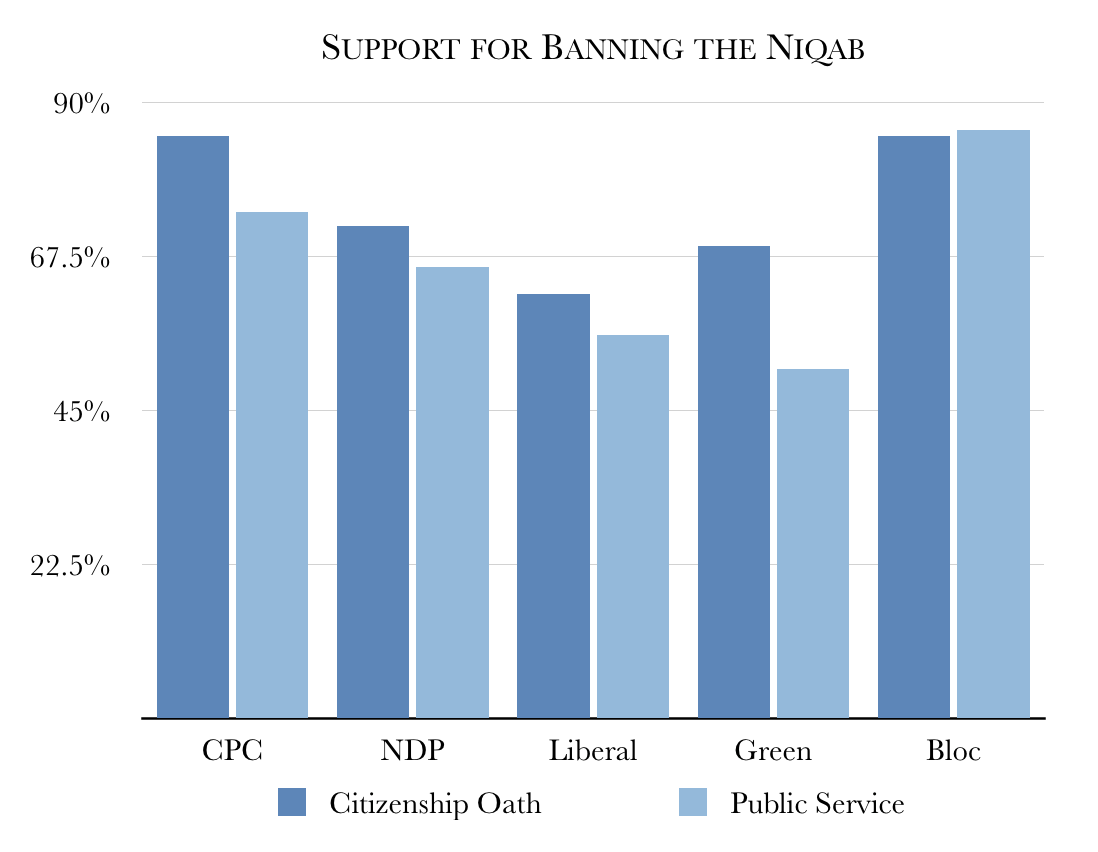
Interesting analysis by Daniel Robinson and Peter Loewen on the changing voting patterns of immigrant voters and the niqab, providing more analysis than in Doug Saunders synopsis (How Tories win immigrant votes using anti-immigrant messages). The chart above compares party supporter views:

On the citizenship oath measure, 72 per cent of Canadians agree. Just 14 per cent disagree. (Another 14 per cent either don’t know or are ambivalent.) This opinion is not isolated to “old stock” Canadians. Among those citizens born outside the country, 70 per cent agree with forcing women to reveal their faces.

… It is a similar story when we ask whether the public service should ban niqabs. Sixty-four per cent of people we surveyed support such a ban. Just 19 per cent oppose it. Support is undiminished among immigrants, where two-thirds (66 per cent) would support a ban and just 16 per cent would not. …

Some have noted that the niqab is an effective issue, not only because it garners wide support but also because it is largely irrelevant to voters. It is, at best, a useful distraction. But this misses something important about voters: they often take their cues from politicians about what is important. By the time we surveyed voters, the niqab had been a point of discussion for more than two weeks. When we asked our respondents how important the issue is to them, 78 per cent indicated that the niqab in citizenship ceremonies is a somewhat or very important issue. We got the same results when we asked about a niqab ban in the public service.

We now have a situation in which opinion-leaders – newspaper columnists, pundits, commentators – almost uniformly insist that a policy is both wrong and unimportant while voters disagree on both accounts.

Our data tell a broader story about multiculturalism and Tory support. Political scientists – especially André Blais and Richard Johnston – have long noted that the 20th century dominance of the Liberal party was attributable to outsized support among Catholics and visible minorities, perhaps especially immigrants (to the extent that those categories overlap). Consequently, the Tories have spent considerable effort courting various groups of immigrants to their party.

Data from both the 2011 Canadian Election Study and Ipsos-Reid’s massive 2011 exit survey suggest that the Tories may have finally closed this “immigrant gap” in the last election. Our data suggest that they have now not only closed the gap, but have created a significant advantage of their own among immigrant Canadians.

To test this, we calculated the odds of Canadians voting Conservative that controls for a respondent’s age, income, education and gender, province of residence and, importantly, religion.

The results, which draw on massive sample sizes, show that a native-born citizen has a 27 per cent likelihood of voting Conservative. The likelihood for an immigrant Canadian voting Conservative is 34 per cent.

Because we controlled for religious affiliation, we can also estimate these effects. Compared to the non-religious, Jews and non-Orthodox Christians have a greater likelihood of voting for the Conservative party. But among Muslim Canadians, there is a clear aversion to the Conservative Party of Canada.

The niqab has become a campaign issue in this election, and perhaps the issue. The are several reasons for this, but public opinion research points to one of the more important ones: given the consistent, widespread support across the political spectrum for the Conservatives’ stated position, the Tories can only stand to gain from the issue playing prominently in the public discourse.

Source: Loewen: Support for Conservatives’ niqab ban is deep and wide, even among immigrants | Ottawa Citizen

The Asian Advantage: Kristof – The New York Times

Looking at the various factors that may play a role:

Does the success of Asian-Americans suggest that the age of discrimination is behind us?

Ministers had no objection to niqabs in public service last March | hilltimes.com

Ongoing interest in my study (Religious Minorities in the Public Service):

But at the time Mr. Clement made his remarks as he and other Cabinet ministers were reacting to the court decision in Ms. Ishaq’s case, several of the ministers said their opposition to the wearing of niqabs only pertained to citizenship ceremonies, not in the public service.

Canadian Press reporter Joan Bryden and other journalists questioned the ministers about Prime Minister Stephen Harper’s comment then that wearing the niqab was contrary to Canadian values and “rooted in a culture that is anti-women.”

“That is what the prime minister said and that is a point of view that one can hold,” Ms. Bryden reported Mr. Clement as saying at the time. “That doesn’t mean that you can impose that view in the workplace or in the private sphere. The one place where I think we have a right and an obligation to stress Canadian values is the act of obtaining one’s citizenship.”

As the election sparks flew again this week over Mr. Harper’s view on the niqab, the department that oversees the public service on his behalf, Treasury Board Secretariat, said in response to questions from The Hill Times it does not have “any data or other information pertaining to niqabs” or any complaints about women wearing them in the public service.

The election campaign research by Mr. Griffith might back up a statement to The Hill Timesfrom the head of the Canadian Council for Muslim women, Alia Hogben, that it is likely no Muslim women in the public service wear niqabs.

…Mr. Griffith prepared a brief paper on the topic based on data he obtained from Statistics Canada from an inquiry last April, when his curiosity was piqued after Mr. Clement’s comments after a change Citizenship Minister Jason Kenney ordered for a legal manual citizenship judges must abide by.

Federal Court Judge Keith Boswell ruled last February the change, which required citizenship judges to reject citizenship applications from female candidates wearing niqabs if they refused to show their faces at two successive ceremonies, was unlawful because it violated an existing regulation that requires citizenship judges to administer the oath of citizenship “with dignity and solemnity,” and “allowing the greatest possible freedom in the religious solemnization or the solemn affirmation thereof.”

The Harper government appealed the ruling, failed in a bid to get the Federal Court of Appeal to overturn Judge Boswell’s ruling and also failed in an attempt to get the Federal Court of Appeal to stay the ruling during an appeal to the Supreme Court of Canada.

Mr. Griffith’s paper  included a wider comparison of religious minorities employed in the federal public services and the public services of British Columbia, Alberta, Ontario and Quebec. Quebec was the lowest at 2.1 per cent, compared to 6.2 per cent in the federal public service, 8.7 per cent in Ontario, 6.8 per cent in B.C. and 6.2 per cent in Alberta.

Source: Ministers had no objection to niqabs in public service last March | hilltimes.com

Indifference Kills: Roger Cohen

Good and strong reminder:

There is no direct analogy between the situation of millions of refugees today and the Jews who were deported from Milan’s Platform 21 (as the memorial is also known). The refugees are fleeing war — not, in general, targeted annihilation. They are victims of weak states, not an all-powerful one. Their plight often reflects the crisis of a religion, Islam — its uneasy adaptation to modernity — not the depredations of a single murderous ideology.

Still, there are echoes, not least in that word, indifference.

The indifference of Hungary, with its self-appointed little exercise in bigotry: the defense of Europe as Christian Club. The indifference of Britain, where the prime minister speaks of “swarms,” the foreign secretary of “desperate migrants marauding,” and the home secretary of threats “to a cohesive society.” The indifference of a Europe that cannot rouse itself to establish adequate legal routes to refugee status that would stem trafficking that has left about 3,000 people dead this year in the Mediterranean.

Then there is the indifference of an America that seems to have forgotten its role as haven for refugees of every stripe. The indifference of a world unready to acknowledge that more than 4 million Syrian refugees absorbed by Turkey, Jordan and Lebanon need a massive program of economic and educational aid over the next decade to confront the crisis. “It’s a trend and not a blip,” David Miliband, the president of the International Rescue Committee, told me.

If the counter-indifference gesture of Milan’s Holocaust memorial were repeated myriad times across a European Union of more than half a billion people, the impact would be dramatic. One quarter of Lebanon’s population is now composed of Syrian refugees; the numbers reaching the E.U. constitute less than 0.5 percent of its population.

Another echo, for Jews, lies in their own situation in Europe a little over a century ago. They were often marginalized. As Rabbi Julia Neuberger pointed out in a recent sermon at the West London Synagogue, around 150,000 Jews, often fleeing pogroms, arrived in Britain between 1881 and 1914. An anti-immigrant group called the British Brothers’ League declared then that Britain could not become “the dumping ground for the scum of Europe.”

Sound familiar?

Yesterday’s “scum” often proves to be the invigorating lifeblood of renewal. Churchill opposed the Aliens’ Act of 1905, designed to control Jewish immigration, on the grounds that “free entry and asylum” were practices from which Britain “has so greatly gained.”

Europe is awash in small-mindedness, prejudice and amnesia. On Syria, the United States is not far behind.

Jarach, whose Jewish family arrived in Milan in the late 19th century, is assisted by Adhil Rabhi, a Moroccan immigrant. They showed me around the memorial, explained how each boxcar was filled with Jews and then shunted to an elevator that took them up to the platform.

Nobody saw the Jews. Nobody wanted to see them. Indifference kills. As Syria demonstrates.

Nicki Minaj Teaches Miley Cyrus a Lesson About White Privilege – The Daily Beast

I don’t follow pop culture but found this piece and the underlying debate of interest:

In the T Magazine piece, Minaj finishes up the vital work of taking Cyrus to task: “The fact that you feel upset about me speaking on something that affects black women makes me feel like you have some big balls. You’re in videos with black men, and you’re bringing out black women on your stages, but you don’t want to know how black women feel about something that’s so important? Come on, you can’t want the good without the bad. If you want to enjoy our culture and our lifestyle, bond with us, dance with us, have fun with us, twerk with us, rap with us, then you should also want to know what affects us, what is bothering us, what we feel is unfair to us. You shouldn’t not want to know that.”

Minaj is picking up where Azealia Banks left off, when Banks tweeted, “Black Culture is cool, but black issues sure aren’t huh?” Banks was subtweeting Iggy Azalea, a white Australian rapper who has come under fire for her distinctly black, Southern sound (she’s also just straight problematic). The faces are different, but the concept is the same: How can we justify a culture where blackness is profitable on the radio, but deadly on the streets? How can we defend white artists who appropriate African-American sounds and styles, in light of all of the black musicians who have been robbed of their own five minutes of fame? If Iggy Azalea and Miley Cyrus want to steal African-American innovations, isn’t a working knowledge of structural racism and a commitment to hearing and amplifying black voices the least that they can do? Why are we cutting Nicki Minaj’s mic anyway—what are we so afraid of?

Tories apply specific criteria for refugees

Unfortunately, given the number of refugees and how many are comparably vulnerable and being persecuted, some additional criteria are needed, and basing this on the likely ease of integration makes sense. And providing greater priority to those religious minority groups at risk also can be justified.

But hard to excuse the poor and lengthy implementation of these criteria and the small numbers actually admitted:

Canada is prioritizing some refugees based on characteristics that include their religion, the age of their children and whether they have a business background, using increasingly specific criteria over the past year.

These criteria are used in a complex triage that attempts to put some groups at the front of the refugee assessment line, The Globe and Mail has learned.

The criteria, known as areas of focus, have favoured specific groups of United Nations-referred refugees including religious minorities and people such as gays and lesbians who face discrimination because of their sexuality.

They also favour categories that include people who have run a business; families whose children are all under 10 years of age; those who speak English or French fluently; those residing outside refugee camps; and women between the ages of 20 and 40 who are victims of violence. Most of these categories also require refugees to have family in Canada, among other criteria.

While the Conservatives have said they are targeting ethnic and religious minorities for resettlement, the details of that policy have been hard to discern. Some areas of focus seem to value qualities considered desirable for economic and cultural integration – language fluency, for example, or a young age at the time of migration. They also raise questions about whether Canada should take on those most in need or those most likely to succeed on arrival – and whether it can do both.

At a time when a growing number of Canadians has been pushing the government to do more on the Syrian refugee file and do it faster, the areas of focus are another layer of administration to be navigated.

Under these criteria a Sunni Muslim single mother with an 11-year-old child who didn’t meet an area of focus could be held back in the pile or bounced through another process, while someone who owned a business and speaks English fluently could be rushed through.

…Speaking on background, a government official said that since not all refugees can be resettled, the government has chosen to focus on ethnic and religious minorities who face serious threats of genocide. He disagreed with the notion the areas of focus are discriminatory, and added that people with official language fluency and children from conflict zones who are younger than 10 are better able to adapt to life in Canada. The areas of focus prioritize the most vulnerable, those threatened by persecution and those best able to successfully settle, the official said.

The new criteria apply to government-assisted refugees who are referred for resettlement to Canada by the UN refugee agency. In the past, Canada has accepted the refugees screened and referred by the agency once they pass Canadian vetting and health and security checks. Now, Canada has hired the Danish Refugee Council, a foreign NGO, to do some additional work on Syrian refugee files, but the nature of that work has not been made clear. The government has declined to answer questions on the subject.

Furio De Angelis, the UN refugee agency’s representative in Ottawa, said the agency refers resettlement cases to Canada solely on the basis of vulnerability. What happens after that is up to the Canadian government. He would not say whether Canada asked the agency to to take into account the areas of focus when making refugee referrals.

“Of course there are discussions between government and UNHCR at all levels … and a lot of things are said in these discussions, but I think we should just stick to what was in the final announcement. The final result of our agreement was that there would be a processing of 10,000 Syrian refugees and UNHCR will submit the cases on the basis of international vulnerability criteria,” Mr. De Angelis said, referring to Canada’s January commitment to take 10,000 Syrian refugees.

Susan Fratzke, a U.S.-based policy analyst at the Migration Policy Institute, said she hasn’t seen the large resettlement countries, such as Canada and the United States, put such emphasis on integration through the development of refugee criteria. It’s something that smaller European countries, such as Denmark, have done more recently, she said.

“Integration is obviously a major concern for all countries in terms of immigration more broadly so it doesn’t surprise me that it is something Canada would want to improve,” Ms. Fratzke said.

Source: Tories apply specific criteria for refugees – The Globe and Mail

Malcolm Turnbull Defends Multicultural Australia As Anti-Islam Protests Gear Up with very inclusive language

Significant change in tone:

It’s not just in NSW where tensions are high. In Bendigo, where a proposed mosque has been the focal point of domestic and international anti-Islam groups for several years now, far-right groups and counter-protesters intent on opposing them are set to rally on the weekend.

Smelling opportunity, perennial fringe candidate Pauline Hanson has resurfaced on morning TV and online, calling for mosques to be shut down and halal food to be outlawed. Last night on Channel Nine’s new talk show The Verdict, former Labor leader Mark Latham claimed western Sydney has “a Muslim problem”.

But there is hope for cautious optimism in a growing boldness on the part of our political leadership to challenge and refute these ways of thinking. In an address this afternoon, Prime Minister Malcolm Turnbull had harsh words for extremists of all kinds, giving a forceful defence of Australian multiculturalism and questioning the kind of narrow-mindedness that blames all Muslims over the actions of a few.

“Australia is the most successful and most harmonious multicultural society in the world. These is no comparable country with its citizens and residents born from outside its shores with such a diverse cultural mix of peoples,” Turnbull said.

“None of us, no one of us, can look in the mirror and say: ‘All Australians look like me’. Australians look like every race, like every culture, like every ethnic group in the world.

“How have we been able to be so successful? It is because of a fundamental Australian value, and that is mutual respect. I want to say to you that mutual respect is the glue that binds this very diverse country together. It is what enables us to be so successful. Mutual respect is fundamental to our harmony as a multicultural society, and it is fundamental to our success. It is fundamental to our future prosperity, it’s fundamental to our national security.

“Now, the key to that mutual respect is that it is a two-way street. Every religion, every faith, every moral doctrine, understands the Golden Rule: Do unto others as you would have them do unto you. So if we want to be respected, if we want our faith, our cultural background to be respected, we have to respect others. That is a fundamental part of the Australian project.

“And it means, therefore, that every single one of us who wants Australia to be successful, who wants our great nation to prosper further in the future — and I have no doubt that almost every single Australian does — than we have to ask ourselves … are we teaching our young people, both by word and by deed, the values of mutual respect? Because if we are not, than we are not doing enough for Australia.”

Turnbull summed up his sentiments in a Facebook post earlier this afternoon, saying: “We have to call out the language, the examples of disrespect, the language of hatred wherever it is practised.”

Turnbull has been unapologetic in his defence of Australian multiculturalism and Islam before. In a Q&A appearance in 2011, Turnbull eloquently outlined the ways Islam has contributed to Western society, as well as the importance of values like tolerance and a willingness to embrace difference over the ostensibly “Australian” values of racial and sectarian division spruiked by anti-Islam groups.

“For heaven’s sake, much of our learning and culture came to us from the Muslims. Our whole system of numbers, and much of the learning of the ancient Greeks only survived because of the Arab and Islamic scholars. The idea that Islam is antithetical to learning or culture is absurd,” Turnbull said at the time.

“It is important for us that we promote and encourage Islamic traditions which are moderate; which support freedom; which support democracy; and support Australian values. Not in the sense of ‘Aussie values’, but in the sense of democracy, the rule of law, tolerance, freedom. They are universal values.”

Most importantly, though, Turnbull’s approach to the situation stands in marked contrast to that of his predecessor, Tony Abbott, who had a history of using divisive, militaristic language when referring to Australia’s Muslim communities. At one of his trademark excessively-flagged national security announcements, Abbott infamously said: “I’ve often heard Western leaders describe Islam as a religion of peace. I wish more Muslim leaders would say that more often, and mean it.”

Source: Malcolm Turnbull Defends Multicultural Australia As Anti-Islam Protests Gear Up | Junkee