Q&A: Mike Molloy, the man who delivered the ‘boat people’

Well worth reading in its underlining the importance of political leadership:

Q: The overwhelming reaction of Canadians—and the Clark government of the day—is now a celebrated part of our country’s history: welcoming 60,000 refugees. How did you pull off such a bold promise?

A: It has everything to do with leadership and direction. There was real leadership at the top and a real recognition that this was a historic challenge and we’d better rise to it. As a mid-level civil servant brought into the middle of it, the thing we never doubted was where the leadership wanted us to go. The clarity of the direction from the top, and the commitment of the people at the top, was amazingly empowering. It allowed us to innovate. It allowed us to figure out new ways of doing things. It allowed us never to break the law, but to stretch it as far as it could be reasonably stretched to deal with what we actually saw as opposed to what the policy-makers might have imagined we’d see.

That is missing here. Over the last four or five days, we have the same profound concern bubbling up from our society—perhaps in an even bigger way than back then—but we’re like a ship without a rudder this time. The engines are ready to go full speed, but in what direction?

Q: It may seem like an obvious question, but what triggered such staunch political will? What was the turning point?

A: The case for intervention was clear. Vietnam was the first real TV war. This was the first real TV refugee crisis. In 1979, we saw so many times a boat absolutely packed with people—with kids—and we would watch it going down before our eyes. We would watch people coming out of the surf, dragging kids behind them, maybe alive, maybe dead. These were immediate images coming into the homes of Canadians that caused this enormous springing up of concern. At that stage, the refugee sponsorship program had never been tried; it had just been invented. And yet Canadians grabbed it and ran with it. We didn’t have to thump the drum at all. We didn’t have to promote it. Canadians just grabbed it and ran, and I think there is a similar spirit today.

Source: Q&A: Mike Molloy, the man who delivered the ‘boat people’ – Macleans.ca

Group calls for streamlined refugee process in Canada

Significant, both substantively and in the wide range of people with different partisan affiliations involved. Will see what the Harper government comes up with to respond to these calls for a more compassionate approach:

A committee of prominent Canadians that includes Louise Arbour and Ed Broadbent is calling for an urgent, de-politicized response to the Syrian refugee crisis that would see Canada push for a ceasefire in Syria, cut its immigration red tape and send visa officers into the field to speed refugee processing.

The group, chaired by former immigration minister Ron Atkey, aims to provide the non-partisan advice that could enable Canada to more quickly welcome large numbers of Syrians displaced by civil war. Its stated aim is to admit “as many Syrians as possible as quickly as possible.” It also calls for Canada to step up its diplomatic efforts to broker a ceasefire by convening an international peace conference that would work toward an enduring solution in the region.

“It’s a cri-de-coeur that’s coming out from many parts of the country,” Ms. Arbour said. The former United Nations human-rights commissioner and chief prosecutor at the international criminal tribunals for Rwanda and the former Yugoslavia, said she’s not rosy-eyed about the prospect of a diplomatic solution to the Syrian civil war, but said Canada should lend its voice to the effort.

Mr. Atkey, who oversaw immigration at the time of the Vietnamese crisis of 1979 when Canada welcomed 60,000 refugees, said Canada should take immediate action to put visa officers into the field to evaluate and process refugee applications. It also needs to streamline its refugee process, he said, to give Syrians access to visas that would allow them to travel more quickly, rather than being stuck in a process that can take years to complete. Canada has responded quickly to previous crises, such as the exodus from Kosovo in 1999, he said.

Source: Group calls for streamlined refugee process in Canada – The Globe and Mail

Reviving the census debate

I would expect any change of government to result in a restoration of the long-form census given the widespread support across different groups.

However, the extent that this change could be made in time for 2016 is unclear (expect that this issue will figure in any transition briefings by Industry Canada/StatsCan).

In Multiculturalism in Canada: Evidence and Anecdote, I was advised by a number of experts not to compare 2011 NHS data with 2006 data given the issues flagged below:

Canadian researchers Daniel Wilson and David Macdonald say they are facing enormous stumbling blocks due to the federal government’s elimination of the mandatory long-form census in 2010.

The pair, doing work for the Canadian Centre for Policy Alternatives (CCPA), a non-partisan research body that focuses on social, economic and environmental issues, is struggling to reconcile trends they’re now seeing in child poverty rates among native children.

The problem: they’re comparing data between the 2006 mandatory long-form census and the new — optional — long-form National Household Survey (NHS) that the federal government introduced in 2011.

Because the data from 2006 and 2011 came from two different processes, the researchers say they can’t tell if the latest trends they’re seeing are real or due to the fact so many fewer people filled in the optional long form in 2011.

“The practical challenge with working with the NHS is doubt — doubt that what you’ve found isn’t what’s actually happening in the world, but rather is a statistical artifact,” says Macdonald, who is also an economist.

Researchers, public policy advocates, statisticians, business groups, economists — and the Liberal and NDP parties — continue to call for the mandatory long-form questionnaire to be brought back, arguing that important statistical data is getting lost.

In a package of recently proposed reforms on transparency, the Liberals are promising to immediately restore the mandatory long form if they form government in the Oct. 19 federal election.

And Jean Ong, a spokesperson for the NDP, said in a statement that the party has long advocated for the restoration of the long-form census and continues to do so.

The lost data has massive implications for public policy decisions, business planning and a host of other areas, proponents of the mandatory long survey say.

Yet so far, the census hasn’t been in the spotlight on the campaign trail. But could it become an election issue?

Paul Jacobson, a Toronto economics consultant who relies heavily on census data for his work, believes it should. He says business planning is being seriously harmed by the new census data collection system.

“All the money in the world given to business surveyors could not replace the (mandatory) long form, period. You need a mandatory survey to get the quality of data you need to make good comparisons in small areas. That’s how you do business planning,” Jacobson says.

Stephen Toope, president of the Federation for the Humanities and Social Sciences, a national public policy advocate for Canada’s scholars, students and practitioners in the humanities and social sciences, says the “essence of the concern” about not having the mandatory long-form census is the impact on public policy.

“Thinking about questions around immigration, social service, children’s health and what kind of investments need to be made and where they need to be made — if we don’t know who is where, it’s very difficult to make informed policy decisions,” Toope says.

Bringing Canada’s access to information back from the brink

More a niche issue rather than one to attract general public attention but important and central to democratic government:

In 2009-10, the federal government logged 35,154 new access requests. That number nearly doubled in five years, to 60,105 requests in 2013-14.

But Michel Drapeau, a lawyer specializing in access law, doesn’t believe the system is suffering due to the increase in volume. Drapeau instead places the blame squarely on the “centre” of the government — the Privy Council Office, the department that supports the prime minister — and department’s willingness to run requests by them.

“To claim a delay becomes now not the exception but the normal course of events,” Drapeau said in an interview last week.

“Access to information is on a slow descent into irrelevance.”

There have been signs that the strain on the system is taking its toll. Summer students and temporary workers are being brought in to deal with “surges” in requests, which typically occur around a big news story. The situation lead one senior access officer to report a “critical shortage” of qualified staff to her superiors.

At the same time, the Conservative government has boasted of a record number of pages released to the public. The government repeatedly pointed to the volume of material released as a sign the system was healthy.

But according to Treasury Board data, only 27 per cent of those requests were “all disclosed” — uncensored — in 2013-14. A further 50 per cent were disclosed “in part,” which includes everything to documents with one line censored and records almost entirely blacked out.

Over their time in power, the Conservatives have made strides towards “open data,” releasing information and datasets collected by federal departments as a matter of course. While most of the files released to date are mapping files from Natural Resources Canada, several departments have released substantial files that can be accessed through the open.gc.ca portal.

But Teresa Scassa, a University of Ottawa professor who served on the federal open government advisory committee, said the government is less likely to voluntarily turn over sensitive or controversial documents — and that’s where access to information comes in.

“These are data sets that are useful to the private sector,” Scassa said of the government’s open data efforts to date.

“And that’s more the orientation of it rather than transparency or accountability, the kinds of things that journalists go after for example when they’re looking to see how governments are dealing with certain kinds of (issues).”

Information Commissioner’s Recommendations

In March, Information Commissioner Suzanne Legault released a comprehensive list of 85 recommendations to overhaul Canada’s access to information system. Broadly speaking, they include:

Maximize Disclosure — Overhaul exemptions that prohibit disclosure, create a public interest override, create a statutory obligation to declassify material.

Reduce delays — Limit extensions by government to a maximum of 60 days, limit internal consultations with other government agencies.

Expand coverage — Expand the institutions covered under access to information to Parliament, ministers’ offices, and the courts.

Toughen penalties — Create new offences for obstructing access, destroying or altering records, and prohibit failing to document decisions or substantial discussions.

Giving the watchdog teeth — Give the commissioner the power to order government documents released.

Escaping the election cocoon

Good piece by Scott Gilmore on the risks of living in a bubble (I try to ensure my newsfeed includes a range of perspectives). As always, it starts from mindfulness of one’s own biases and applies to more than just politics).

Sound advice:

Unfortunately, our habit of tuning out ideas and voices we don’t like is part of our biological programming. “Confirmation bias,” the tendency to search for information that confirms our beliefs and to remember it longer, is a well-documented and inescapable element of our behavior. As a result, we instinctively tailor our universe to limit the emotionally upsetting views that contradict us. Until recently, the shortage of media choices made this hard to do. Left or right, we all watched the same suppertime newscast. Now, it’s finally possible to be bound in a nutshell, and count ourselves kings of infinite space, because we can avoid any bad dreams.

This has been very apparent in the refugee debate. A significant number of Canadians are opposed to allowing in more Syrians, due to the possibility that they would include Islamic State supporters, or that they would spread Islam or because we should be helping our own poor first. If you listen to a specific set of radio stations, read certain blogs and interact with people similar to yourself on Facebook, these ideas aren’t only defensible, they are overwhelmingly obvious.

Likewise, another group of Canadians who subscribe to different newspapers, listen to the CBC and read the Huffington Post are equally convinced of the self evident fact that there is a clear need for Canada to do more, and accepting far more refugees would neither strain our economy nor our social fabric. In reality, both sides are filtering out important pieces of information, making it impossible to see the full picture. Which is why neither group can grasp how anyone could possibly be so asinine as to dispute what is so clearly self-evident.

This is bad, and not just because it prevents us from having civil conversations about Canada’s refugee and immigration policies. It creates a lack of empathy that leads us to denigrate and dismiss the opinions of others. The leaders of all political parties, who are equally unable to acknowledge they do not have a monopoly on the truth, demonstrate this attitude repeatedly.

Our self-made cocoons also impair our ability to make intelligent decisions. In this election, most voters will not watch a single debate, read any of the party platforms or attend any campaign events. They don’t need to. They already know whom they’re going to vote for and, coincidentally, everyone else in his or her cocoon is voting the same way.

And for those we ultimately elect? Their own filters will make their governing decisions less effective. Ruling parties of all stripes tend only to listen to academics who support their agenda, only attend rallies that contain true believers, only read newspapers that  endorse their policies and only engage constituents who already voted for them. If it looks as if the Conservative party has only been thinking about its base for the last nine years, it’s because that’s literally true.

There are ways to cut through these cocoons, however. Just by being aware that you are constantly self-censoring the information that reaches you helps. You can also consciously resist the urge to mute the outspoken critic on Twitter, or unfollow the Facebook friend who shares articles in support of that politician you loathe. One step further would be to actually read some of those articles, or pick up a newspaper you wouldn’t normally read, no matter how much of a rag you think it is.

Source: Escaping the election cocoon

Parties pigeonhole visible minority candidates

Visible_minorities_Candidates_2004-11Good analysis and necessary to complement the under-representation of women (see Debate about the women’s debate missed a bigger point: Antoinia Maioni) by Elizabeth Goodyear-Grant and Erin Tolley:

So far, we have heard quite a bit about the selection of women and Indigenous candidates, but comparatively little about visible minority candidates. This is surprising given parties’ efforts to appeal to visible minority voters and Canada’s increasing racial diversity.

Visible minorities now make up 19 per cent of the Canadian population. The proportion of candidates with visible minority backgrounds is basically unchanged since 2004 — hovering around 9 per cent — even though the proportion of visible minorities in Canada has steadily increased.

In 110 of the country’s 338 ridings, visible minorities make up 20 per cent or more of the population, up from 90 ridings in 2011. The visible minority population is thus significant in both magnitude and scope. Even so, just 13.5 per cent of candidates nominated for the three major parties so far have visible minority backgrounds. That’s 131 out of 964 nominated candidates, with 50 nominations still to come.

It is not just about absolute numbers though. Importantly, in 54 per cent of ridings (183 of 338), there isn’t a single visible minority candidate running for any of the three major parties. In those ridings with incomplete nominations, 11 per cent (36 of 338) so far have only white candidates on the ticket. In other words, it is possible that in nearly two-thirds of the country’s ridings, ballots will not include a competitive visible minority candidate.

Although many of these all-white contests are in rural ridings with small visible minority populations, many are not. In Scarborough-Guildwood, for example, visible minorities make up 68 per cent of the population, but the candidates for the three competitive parties are all white (although, notably, the Conservative candidate is a Dutch immigrant). In Ajax, Chris Alexander, the Minister of Immigration and Citizenship, is running against two other white competitors.

Meanwhile, in eight ridings, three visible minority candidates will square off against one another; in these ridings, the visible minority population averages 74 per cent. This suggests that parties’ wholehearted endorsement of visible minority candidacies only occurs in a handful of ridings where visible minority voters are in the overwhelming majority. At the same time, parties clearly have no problem running an entirely white slate of candidates in ridings with large visible minority populations.

The strategic placement of visible minority candidates in only the most diverse ridings lulls us into thinking that our politics is inclusive, while simultaneously capping the number of seats that visible minority candidates might ever win. Not only is this contrary to Canada’s multicultural ethos, but it is a flawed electoral strategy.

Our own research shows that white voters are about as open to visible minority candidates as they are to white candidates. When visible minority candidates run, they can win, even outside the most racially diverse ridings. But parties tend to limit the electoral prospects of visible minority candidates by pitting them against each other and nominating them primarily in the most racially diverse ridings.

The one qualification to their sound analysis lies in using the number of visible minorities that are also Canadian citizens, making the benchmark 15 rather than 19 percent used.

Source: Parties pigeonhole visible minority candidates | Toronto Star

Terence Corcoran: Open our doors to the world

2G_Non-Univ_Educated_25-34Terrence Corcoran advocates for unlimited immigration:

Canada has never settled on a guiding principle for its immigration policy. It has no moral touchstone to guide policy. If a country the size of Canada — small population, vast land mass, ingrained individual freedom, unbelievable economic potential — were to install a founding principle of immigration,  a starting point for policy, it should be simple, clear and clean. “Canada,” it should say, “is a free country open to all who are willing to abide by its laws, regardless of race, creed, wealth, income, nationality, status or shoe size.” From this principle, it follows that immigration policy should be directed toward as free a border as possible, a border across which the world’s people can immigrate and emigrate at will.

Do not send me your whining and angry letters to the editor and tweets about how such a principle would open Canada’s doors to terrorists, criminals, freeloaders, welfare bums, health-care cheats, anti-Western religious and ethnic groups, low-lifes, genetically inferior races, job-destroyers, communists, fascists and bearers of strange cultural habits and beliefs that will destroy Canada as we know it, bringing more pollution, urban congestion, resource depletion, welfare loads.

Stop. Don’t. It has all been said and alleged before, over and over again, all through Canada’s sometimes impressive but rarely magnificent immigration history.

…So what are we afraid of? More importantly, what are we losing by continuing to freeze the flow of new Canadians at some artificial level that has no rationale beyond the expedience of simultaneously catering to all the various economic, cultural and ideological interests who have a multitude of arguments against increased immigration. Today’s policy clashes over Syrian and other Middle Eastern refugees are a function of a century-old immigration regime that pretends to be objective and is in fact based on prejudice, ignorance and fear.

Instead of fear, we need optimism. Irwin Studin, an assistant professor at the University of Toronto’s School of Public Policy and president of the Institute for 21st Century Questions, proposed five years ago that Canada should aim to raise its population to 100 million by the end of the 21st century. There is only one way to do that. In an interview, Prof. Studin said Canada would need to increase immigration levels by 50 per cent.

We need to install the idea that “Canada is a building proposition” in which, through immigration, there is a constant sense of growing toward a greater future. Studin sees Canada as a greater geo-political power and a much stronger economic performer. “The Canada of 100 million has a far larger national market and the attendant economies of scale and scope — for ideas, for debate, for books, for newspapers, for magazines … for all species of goods and services.”

Above all, Studin is rightly contemptuous of the idea that immigrants take jobs away from Canadians. People are jobs. Without people, capital cannot invest. When regions of Canada complain that there are no jobs for new immigrants, Studin’s response is: “There are no jobs because there are no people.”

Not only are there no jobs without more people, there is less growth and less wealth creation for everyone. Robert Fairholm, now an economist with The Centre for Spatial Economics in Toronto, forecast in 1997 that Canada was heading for a major period of slow and stagnant growth. Due to an aging population, slack immigration rates and declining rates of worker participation in the economy, Fairholm forecast that Canada’s annual growth rate would fall to 2.6 per cent in the first decade of this century, then to 1.6% per cent over the following decade, heading to 1.3 per cent by 2020.

Fairhholm’s 1997 forecast now looks to be dead right. All the investment capital in the world cannot overcome slow population growth and a lack of young working people starting their careers. Canada’s natural trends cannot, and will not, provide the working-age population needed to maintain strong economic growth rates. “That’s why it is useful to bring in people in their 20s and 30s,” Fairholm said in an interview. The existence of a growing working-age population “is a major determinant of how fast an economy will grow.”

To a significant degree, immigration policy — driven by incessant political pandering — is strangling the economy, suppressing growth and condemning Canadians to a slow growth future.

For more growth, in other words, add people, let immigrants land in an open country where all are free and the national aim is 100-million Canadians by 2199.

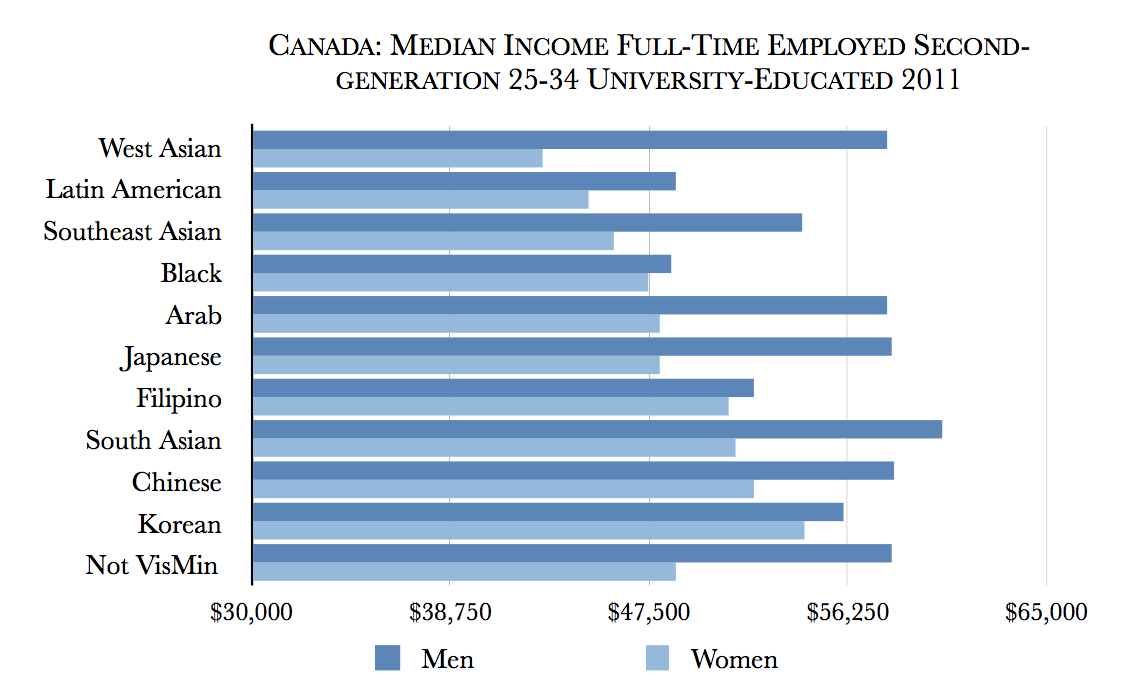
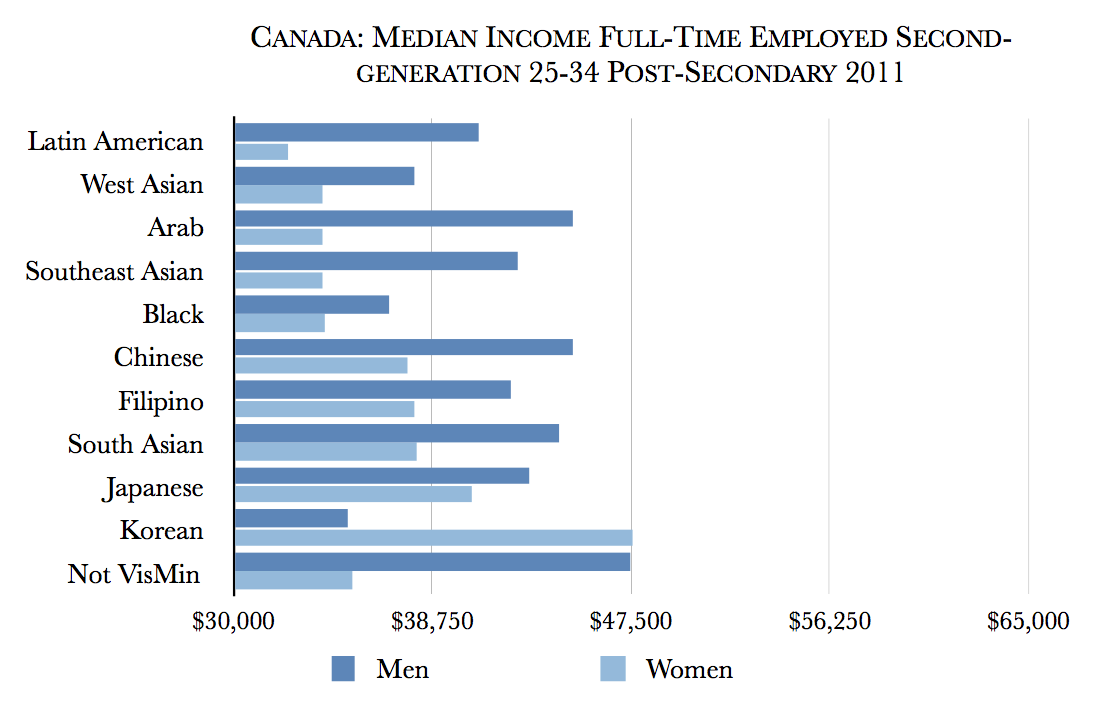
Substantively, silly to argue that Canada is large when the vast majority, despite some dispersion, settle in our major urban centres and that immigrant economic outcomes, including for second-generation, still lag behind non-visible minorities (save for the university-educated 25-34).

2G_University_Educated_25-34

Source: Terence Corcoran: Open our doors to the world

Woman fighting ban on face-covering at citizenship ceremonies gets support from Ontario

Interesting that the Ontario government would take this step (and citizenship is exclusively a federal jurisdiction, unlike immigration which is shared):

The Ontario government is standing alongside a Mississauga, Ont., woman who is challenging the federal government’s ban on face-coverings at citizenship ceremonies.

It has filed its position, called a factum, with the Federal Court of Appeal in advance of a hearing scheduled to begin next week in Ottawa.

The province argues that requiring a Muslim woman to remove her niqab during the public oath-taking ceremony “with the result that if she does not she cannot become a Canadian citizen, fails to respect and accommodate the diversity of religious beliefs and socio-cultural backgrounds of Canadians.”

The factum goes on to say the government’s policy “tells Muslim women that if they wear the niqab, they are not welcome to join the Canadian community.”

The province is also of the view that “visual inspection of a person’s face does not prove that the person has actually spoken the words of the oath or affirmation. The proof is already provided by the existing requirement that citizenship candidates sign a certificate certifying they have taken the oath or affirmation.”

Source: Woman fighting ban on face-covering at citizenship ceremonies gets support from Ontario – Politics – CBC News

ICYMI: French new wave: A cultural shift for Toronto as ‘invisible francophones’ settle in

Less under the radar:

Every year roughly 1,000 French-speaking immigrants settle in Toronto, with the occasional spike – after the 2011 earthquake in Haiti, for example. Many more speak some English and French in addition to their own dialects, such as many newcomers from Congo, said Réjean Sirois, director of the Toronto-area French Catholic board.

It wasn’t clear just how many of these polyglots – using the same logic as scores of Canadian-born parents – would want their children to get an edge through fluent bilingualism, he said.

“They come here and they have to learn both languages, but they recognize that if they go in a French school, they will learn French because outside … everything is in English and they will learn it [anyway],” he said.

Nearly 50,000 Quebec residents (both francophone and anglophone) moved to Ontario between 2006 and 2011, according to census data. On top of that are the native-born Franco-Ontarians, whose numbers are difficult to pinpoint precisely.

After moving to Toronto, francophones often expect to live in English, especially if they marry an English speaker, Mr. Sirois said. They may not realize how much things can change when they ask for education in French. In the town of Collingwood, Ont., northwest of Barrie, a group of parents presented trustees of the regional French Catholic board with lists of local francophone families.

“Parents came to the school board and said, ‘Hey, there’s a lot of francophones there,’” Mr. Sirois said. “When you look at the statistics, at Statscan, you didn’t find that there were a lot of French people there.”

Source: French new wave: A cultural shift for Toronto as ‘invisible francophones’ settle in – The Globe and Mail

Don’t overstate risk of terrorism among refugees, experts say

Good placing in context:

“When we are dealing with people that are from, in many cases, a terrorist war zone, we are going to make sure that we screen people appropriately and the security of this country is fully protected,” Harper said at a campaign stop in Welland, Ont.

“We cannot open the floodgates and airlift tens of thousands of refugees out of a terrorist war zone without proper process. That is too great a risk for Canada,” he added during a question-and-answer session.

Harper’s remarks continue a security narrative the Conservatives launched after the fatal terror attacks by ISIL sympathizers in Ottawa and Saint-Jean-sur-Richelieu almost a year ago. National security is a key plank in the party’s election platform.

But the government should not be presenting refugee resettlement here as an either/or option with anti-terrorism efforts, says Scott Watson, an associate professor of international relations at the University of Victoria.

“I think it’s possible to do a large-scale operation of assisting refugees that (also) has a thorough screening component for security reasons, if there was enough political will to do so. I think both can be done,” he said.

“The vast majority of the people have no interest in contributing to further violence. There could be a couple of people who are sympathetic to ISIL coming in, but if there’s proper security screening and proper integration once refugees are brought into the country, I don’t think it’s something we need to be concerned about.” Besides, “there’s much better ways for them (ISIL) to do what they want to do than to use refugees as the means of doing it,” said Watson.

He and Whitaker have done extensive research on the rise of national security fears that have accompanied concentrated waves of immigration to Canada. Harper’s framing of the Syrian refugee crisis in security terms is similar to concerns, ultimately unfounded, that communist infiltrators would accompany the arrival of Hungarian refugees to Canada in 1956, or with the Cambodian and Vietnamese boat people in the late 1970s.

Whitaker concludes many refugee groups now tend to be seen as importers of external political conflicts to the West.

Canadian Security Intelligence Service (CSIS) officers overseas are responsible for much of the security vetting of refugees and immigrants. Many refugees understandably have no official identity documents. But, “you can’t go back to the Syrians or an area that’s no longer under Iraqi government control and say, ‘by the way, is Mohammed a resident of Erbil?’” said Ray Boisvert, a former CSIS assistant director of intelligence.

“You try to do your best to interview them and get a decent sense of their background and see if you can poke any holes in it.”

Source: Don’t overstate risk of terrorism among refugees, experts say | Ottawa Citizen