European far-Right parties ‘seeking anti-Islam coalition with Jewish groups’

Not surprising but encouraging that most European Jewish groups have rejected the overture:

Right-wing European political parties are seeking to sow religious discord in Europe by approaching Jewish organisations in a bid to form an anti-Islamic alliance.

Speaking to Newsweek on condition of anonymity, a senior figure in one of Europe’s largest Jewish organisations has revealed that their group has been approached in the past year by MEPs, including members of the Austrian Freedom Party, seeking to create a coalition to combat the rise of Islam in Europe. They emphasized that all approaches had been flatly refused.

Last week, Marine Le Pen and other far-Right politicians met with Vadim Rabinovich, the chairman of the European Jewish Parliament (EJP), prompting criticism from European Jewish leaders.

Now the source says that far-Right’s rapprochement with Jewish groups is far from new as politicians from various parties have attempted to court their group, offering to “be friends with Jews” if Jewish groups “help us in our fight against Muslims”.

… The meeting drew criticism from prominent Jewish leaders and led to one member of the EJP, French rabbi Levi Matusof, resigning after the meeting which he called “opportunistic and inappropriate”.

The European Jewish Association, which claims to be the biggest federation of Jewish organisations in Europe, said that the EJP risked “magnifying the problem” of anti-Semitism by “giving a platform to those seeking to spread messages of hate”.

Dr Moshe Kantor, president of the European Jewish Congress, said he was shocked that the EJP met with “fig leaf racists and anti-Semites” and added: “It goes without saying that these people [the EJP] are as unrepresentative of the vast majority of European Jews as this collective of Le Pen’s MEPs is of the vast majority of European citizens.”

In a statement on the EJP’s website, Rabinovich said he was “very surprised” by the negative reaction from other Jewish groups.

“The meeting with the [Europe of Nations and Freedom] opens the new dialogue, which, in our firm conviction is what Europe needs today – a dialogue of everybody with everyone, in order to preserve peace and tolerance and combat anti-Semitism in Europe,” said Rabinovich.

He added that a joint statement with Le Pen had condemned anti-Semitism as “the cancer of Europe”.

European far-Right parties ‘seeking anti-Islam coalition with Jewish groups’.

Matthew Block: It’s a bad time to be religious in Canada

One view regarding the balance between religious and other freedoms but one that in my view, understates the importance of the impact this understanding of religious freedom would have on those who do not share those religious beliefs:

This curtailment of religious freedom has appeared even at the highest levels of government. Consider the leaders of Canada’s three major parties. Over the past few years, one has publicly condemned as “unCanadian” the religious ideals which motivate a Christian organization’s international relief work. Another has banned members of his party from voting according to deeply held moral and religious beliefs on issues regarding life. And another has campaigned to ban women from wearing certain religious garb while taking the oath of citizenship.

Like all Canadians, these leaders are free to dislike the religious choices of others, and to do so vocally. But when government coerces others to act against conscience, or argues that they have no right to express their religious beliefs in the public square, then there is a problem. These are quite literally the first freedoms guaranteed by the Charter of Rights and Freedoms: “freedom of conscience and religion,” and “freedom of thought, belief, opinion and expression.” If religious freedom is to mean anything, it must mean the ability to practice one’s faith both privately and publicly, without interference from the government or the public at large.

We would be closer to the Canadian ideal of a tolerant society if more people believed that.

Matthew Block: It’s a bad time to be religious in Canada

StatsCan takes criticism for cutting funding to LifePaths database

Another example of reduced government emphasis on evidence-based approaches:

Former Statistics Canada official Michael Wolfson is criticizing the agency’s decision to stop funding its LifePaths database, saying the program has been essential for researching the long-term impacts of policy decisions.

Mr. Wolfson, a professor at the University of Ottawa who was previously assistant chief statistician at Statistics Canada, has written a new paper on retirement adequacy, which includes comments about his disappointment over the decision to cut funding to the LifePaths database, which he has used in his own work on retirement income.

“As a result, discussion of multibillion-dollar policies – discussions that could be informed by far smaller investments in statistical infrastructure – can now be pursued in ignorance,” he writes.

Statistics Canada stopped supporting the LifePaths modelling tool at the end of 2014, which means the database is not being updated with new data.

Statistics Canada spokeswoman Nadine Lacroix said the resources required to update and maintain the model were too great, and it “was no longer feasible” to continue the program.

She said the agency is developing a new “dynamic socio-economic” modelling tool that will be structured to ensure “sustainability, efficiency and responsiveness to client needs.” Statistics Canada expects to solicit feedback from stakeholders on the proposal next year.

LifePaths is a complex modelling tool developed in the 1990s that contains data on Canadians starting from 1971. It was started during Mr. Wolfson’s time at Statistics Canada to project demographic trends for Canadians decades into the future. It was intended to help shape public policy in numerous areas – including pensions, education and health care – by modelling the impacts of various policy alternatives.

The decision to stop maintaining the model comes amid broader criticisms over cuts to Statistics Canada research, most notably the 2010 decision to eliminate the mandatory long-form census in Canada and replace it with a voluntary survey.

In an interview, Mr. Wolfson said he has not published comments critical of Statistics Canada in the past, and worries he is being disloyal to his former colleagues by speaking out now.

“But I felt it was sufficiently important that I really felt I had to do it,” he said Monday.

StatsCan takes criticism for cutting funding to LifePaths database – The Globe and Mail.

ADMs have become too insular and inexperienced: study

Interesting and relevant study on ADMs by Jim Lahey (disclosure have spoken to his EX2-3 course on the lessons from Policy Arrogance or Innocent Bias: Resetting Citizenship and Multiculturalism) and Mark Goldenberg, with relevant thoughts on how to improve their expertise and depth of experience:

Once they have become ADMs, they tend to move from job to job and spend less than two years in a position. Most of those moves are within their own departments.

“ADMs move too much and don’t necessarily make the right moves. ADM churn needs slowing down. They are moving too frequently, and not always making the kinds of moves that can broaden and deepen their knowledge, experience and skills,” said Lahey.

“It is absolutely wrong to have ADMs who are generic managers divorced from policy and content. There has been a kind of managerialization of ADM jobs … bringing those jobs down below what they should be.”

The report offers five areas of reform to “raise the bar” for managing and recruiting these senior executives so they have more responsibility, experience, knowledge and leadership skills. It says future ADMs should be a strategic thinkers and visionary; should focus on results, effectiveness and economy; have strong interpersonal skills; and be able to work collaboratively.

Lahey said the overall executive cadre could be significantly cut but this must be managed slowly while targeting the talent in the lower executive levels to develop for the future. Slashing jobs to delayer is too disruptive; instead, the key is to figure out the roles and responsibilities for each level of management. This means adjusting the expectations of ministers and political staff – which could be tough in an era of mistrust between politicians and bureaucrats.

The report also urged bringing in new blood from outside the public service with external recruits accounting for up to 15 per cent of ADM appointees. It also suggests fast-tracking younger executives in their 30s and 40s so they become ADMs – and DMs – at a younger age and having them stay in the jobs longer before retiring.

The study also suggested ADMs stay in a position at least three years before moving to another. In fact, it argued that staying in the job, mastering it and leadership should be tied to performance pay.

ADMs have become too insular and inexperienced: study | Ottawa Citizen.

Daniel Lang: The Senate did not call for imams to be ‘licensed.’ Nor were we fretting about nothing

Senator Lang struggles to justify the Senate report and its messaging on the licensing of Imams:

Contrary to the suggestion made in a recent National Post editorial, the Standing Senate Committee on National Security and Defence did not propose that government intervene to certify or establish a registry of Islamic or other clerics.

The carefully crafted recommendation asks that “the federal government work with the provinces and the Muslim communities to investigate the options that are available for the training and certification of imams in Canada.”

This is a very important distinction because the recommendation is made in response to testimony from members of the Muslim community as well as experts who confirmed that radicalization begins with person-to-person or person to group contact.

The witnesses who appeared before the committee over the past nine months continuously brought up the fact that radicalizing messages mixed with religious ideology was being advocated by some foreign-trained imams in Canada.

Interesting, however, to see that Imam Soharwardy, demonized by Ezra Levant, is now brought forward as a government witness (he has been consistent and reasonably in his messaging).

Daniel Lang: The Senate did not call for imams to be ‘licensed.’ Nor were we fretting about nothing

2013 Hate Crimes Statistics

Hate Crimes Comparison.001

Interesting that in 2013, the number of hate crimes fell by 17 percent, reflecting a 30 percent decline in non-violent hate crimes (mainly mischief-related). For most groups, the per capita rate remained relatively constant, with the most notable decline with respect to Canadian Jews.

B’nai Brith statistics (2014 Audit of Antisemitic Incidents) however show an increase compared to earlier years (their statistics are always higher than police-reported hate crimes).

The National Council of Canadian Muslims recently launched a similar initiative to report on anti-Muslim incidents (NCCM Launches National Hate Crimes Awareness Project) to encourage more reporting (hate crimes against Canadian Muslims increased in this year).

The explanation for the overall decline in reported hate crimes is not clear beyond that it is the minor hate crimes that account for most of the decline.

While self-reporting by different groups is important to raising awareness of, and improving confidence within groups to report hate crimes to the police, there is merit to the consistent reporting  across different groups and categories contained in this report by Statistics Canada.

’14,’ a documentary on citizenship by birth, premieres in Washington – The Washington Post

Interesting documentary and subject:

Who is, or deserves to be, an American citizen is a simple question that gets complicated depending on what else is going on in the culture. Now that immigration is such a preoccupation for some, bills are periodically introduced in Congress to challenge the right of children born in the United States to undocumented immigrant parents to be considered citizens by birth. Check out the Birthright Citizenship Act of 2015 proposed by Rep. Steve King (R-Iowa).

Documentary filmmaker Anne Galisky, who has chronicled the immigrant-rights movement for years, takes on the question in a new work called “14: Dred Scott, Wong Kim Ark & Vanessa Lopez.” The film had its Washington premiere Thursday night at the E Street Cinema. Galisky is lining up more screenings in the area and hopes to pitch it to public television. “Talk to us about bringing it to your school, your nonprofit, your place of worship,” she said to the audience of 75 at the premiere.

… At the time of filming, Vanessa Lopez is the 8-year-old American-born daughter of undocumented immigrant activist Rosario Lopez, now living in Seattle. Vanessa says she wants to be “either an artist, a photographer, a lawyer or a marine biologist.” With her unaccented English and her 8-year-old’s view of the world, she tries to puzzle through the thinking of adults who would deport her mother and grandparents and deny citizenship to children like her.

Vanessa serves as the heart-tugging emotional center of the film, while Galisky draws a direct narrative line from Scott to Ark to the Lopez family. Along the way, she interviews descendants of both Scott and Ark.

Galisky, whose previous film was “Papers: Stories of Undocumented Youth” (2009), said bills to undermine birthright citizenship may seem unlikely to pass, but “I think there’s danger even in calling birthright citizenship into question.”

’14,’ a documentary on citizenship by birth, premieres in Washington – The Washington Post.

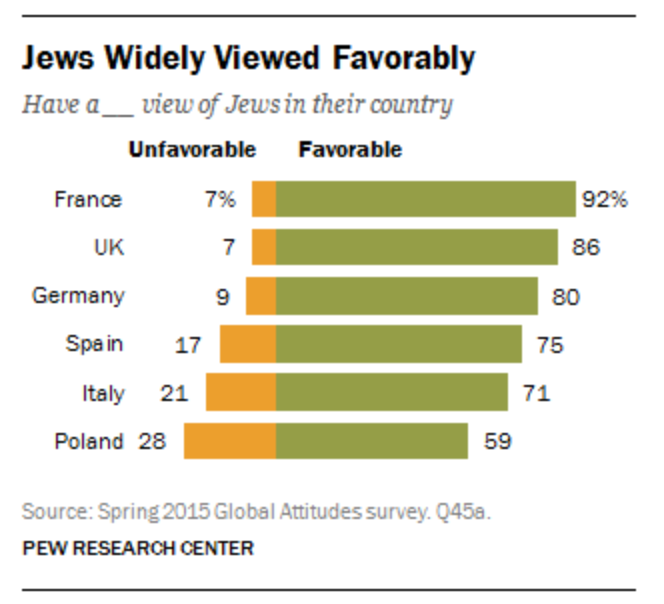
Pew Research: Anti-Minority Sentiment Not Increasing in Europe

European Perceptions of Roma European Perception of Jews European Perceptions of MuslimsInteresting recent public opinion research on attitudes in Europe, with above charts showing highlights. Summary conclusion:

The economic downturn in Europe that followed the euro crisis raised concerns that economic stress would turn Europeans against each other, as many severe economic downturns have done throughout history, sparking xenophobia and anti-Semitism. And Europe has seen a number of hostile actions against Muslims, Jews, Roma and other minorities in recent years. But the activities of a few are not necessarily reflected in the views of the general public.

The 2015 Pew Research Center survey was conducted after the Charlie Hebdo massacre and the simultaneous attack on a Jewish grocery store, perpetrated by radical Islamists in Paris. But, in the wake of these events, there is no evidence that the atrocity sparked new public antipathy toward Muslims in any of the six European Union nations surveyed. In fact, favorability of Muslims actually improved in some nations. At the same time, French sympathy for Jews increased.

http://www.pewglobal.org/2015/06/02/chapter-3-anti-minority-sentiment-not-rising/

CIC Analysis of Citizenship Test Pass Results

While this has been reported before (Immigrants more likely to fail citizenship test the longer they’re here), obtained this and related documents to see what changes may have been made to the citizenship test that could explain the significant increase in the overall pass rate from 82.7 percent 2010-13 to 90.3 percent.

While unfortunately the relevant memos providing options to the Minister have been extensively redacted (here and here), it is clear that considerable effort was made to improve test scores while maintaining the integrity of the test.

This detailed analysis confirms the importance of education:

Main findings: Regression results show that, after controlling for the effect of other individual characteristics in the model, a few individual characteristics are strongly associated with the citizenship test outcome. Among these characteristics, educational attainment stands out as the most important predictor of the test pass rate. The adjusted pass rate for immigrants with a university degree or above at time of landing is considerably higher than those with lower educational attainment.

Differences across immigration categories and countries of birth are also large. While applicants in the economic immigration categories obtain the highest adjusted test pass rates, applicants in the refugee immigration categories obtain the lowest test pass rates.

Applicants born in Afghanistan, Vietnam, Iraq, Algeria, Jamaica, India and Sri Lanka have the lowest adjusted pass rates.

Variables showing modest effect on the pass rate include: age at test, age at landing, official language ability at landing and mother tongue. The differences in test pass rates across categories of all variables are more pronounced for those with lower educational attainment.

Educational attainment at time of landing: • Overall, the test pass rate increases with an applicants’ educational attainment at time of landing. The pass-rate for applicants with Bachelor’s degrees or above is about 20 percentage points higher than those with secondary or less education and 8 percentage points higher than those with trades/diploma/apprenticeship schooling, but 3 percentage points lower than those with Master or Doctorate degrees.

Citizenship Knowledge Test Results – Multivariate Regression Analysis August 2013

Citizenship Knowledge Test Results – Multivariate Regression Analysis Summary Deck 2013