Alberta’s politics have inevitably become more diverse: Hébert
2015/05/04 2 Comments


On the eve of the Alberta election, the national media finally notices that Alberta has changed.
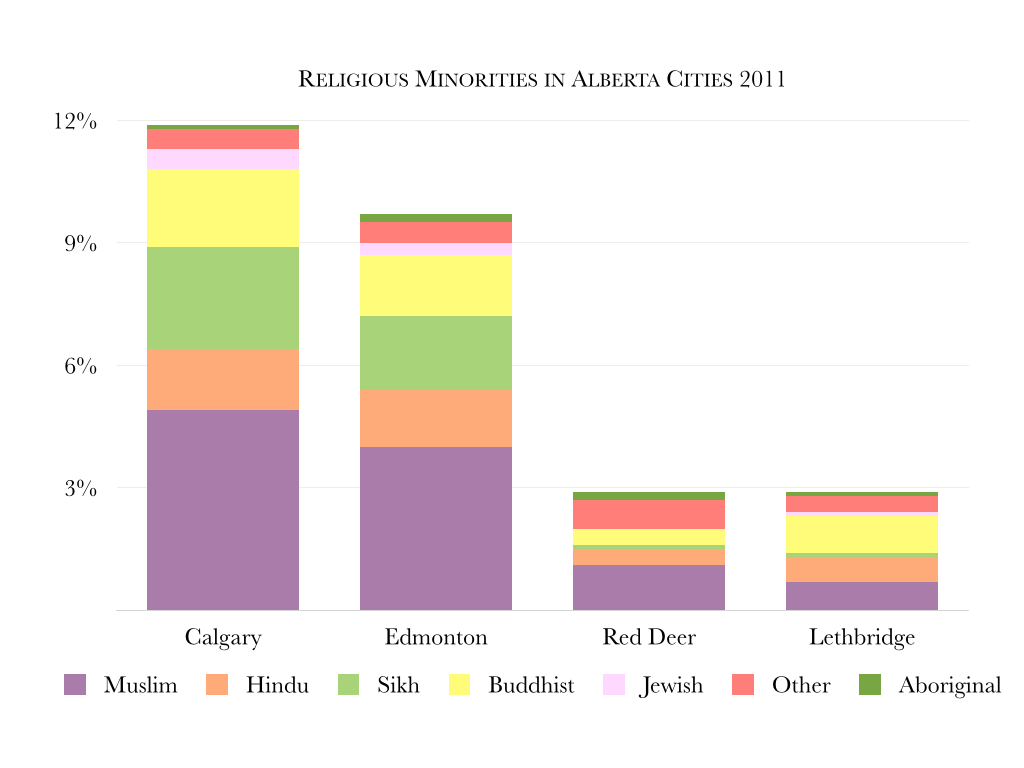
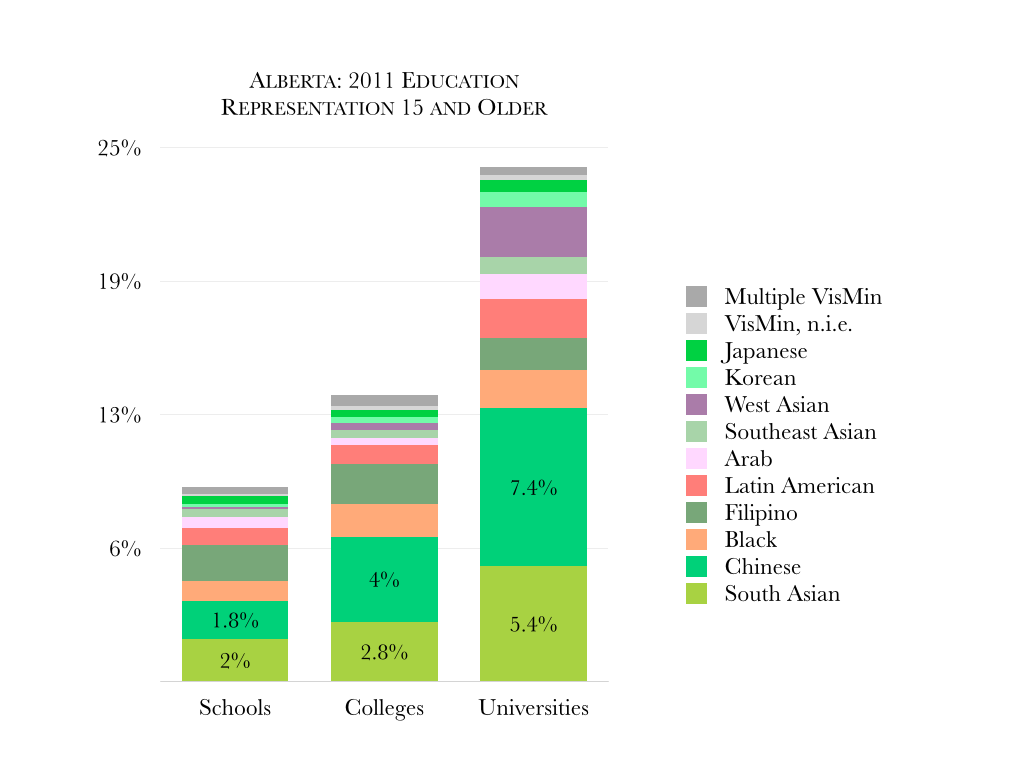
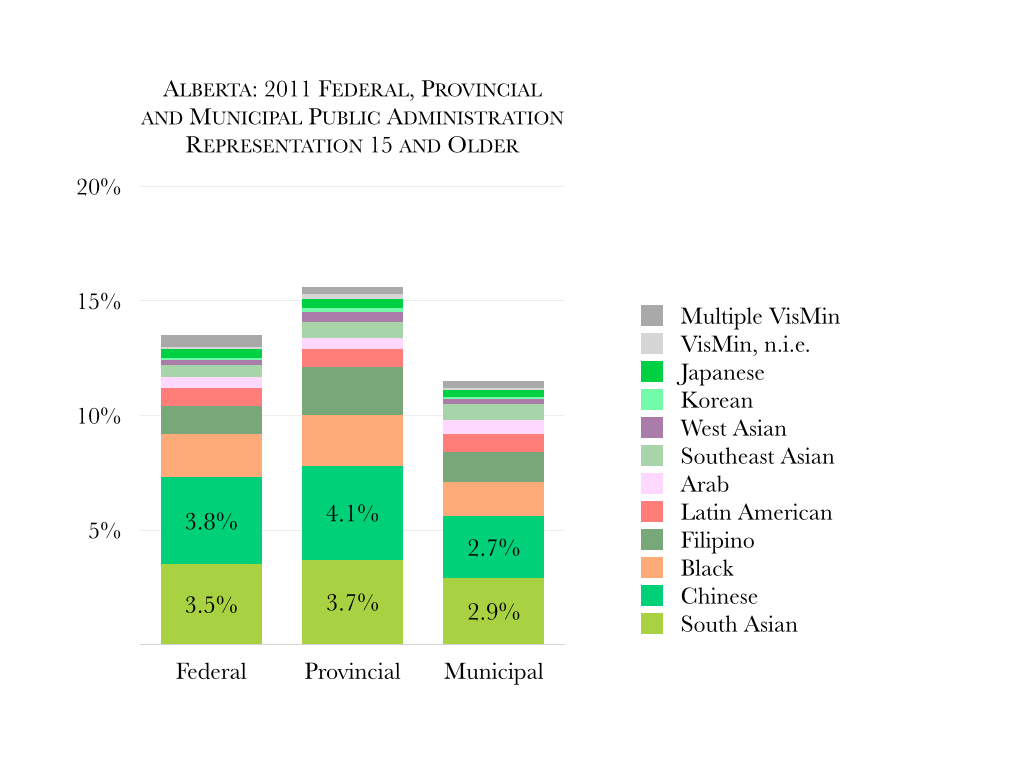
The above charts from my forthcoming book, Multiculturalism in Canada: Evidence and Anecdote, highlight this change from a diversity angle, with Alberta having overtaken Quebec as Canada’s third most diverse province, with strong visible minority representation in healthcare, social services, universities, and provincial government public administration.
Chantal Hébert on the change:
As Alberta goes provincially on Tuesday, it will not automatically go federally. The dynamics of the two back-to-back campaigns are strikingly different.
But over the longer term it would be unwise for the federal Conservatives to bet that their virtual monopoly on Canada’s fourth largest province is immune to the tectonic shift that may see the NDP in power in Edmonton after next week.
In the big picture, it was actually only a matter of time before Alberta’s politics became more diverse.
Sooner or later, the changing demographics of the province were bound to impact on its voting patterns.
Its population has been growing faster than the Canadian average. Its median age (37) is the lowest of the four big provinces.
There is not a poll that does not show that the younger the electorate the better the NDP, the Liberals and the Greens fare versus the Conservatives.
The emergence of the NDP as the leading candidate for provincial government is the biggest crack to date in the monolithic facade of Alberta, but it is not the first one.
That was preceded in 2010 by the election in Calgary in 2010 of Naheed Nenshi, a mayoral candidate who was an outsider to the city’s power circles.
Then there was the taking of an Edmonton riding a year later by NDP MP Linda Duncan with more than 50 per cent of the vote cast and, a year after that, the rise to a close second place of Justin Trudeau’s Liberals in a 2012 Calgary byelection. (In that vote the Green Party came a respectable third with 25 per cent support.)
Even more recently the Trudeau Liberals won 35 per cent of the vote in Fort McMurray — the riding that current Wildrose Leader Brian Jean used to hold during his eight years as a Harper MP.
To predict that Alberta will increasingly take on shades other than blue is not to predict the demise of the federal Conservative party but it is to foresee an ultimately healthier federal political environment.
A more diverse Alberta voice at the national level would be a positive development both for the province and for Canada’s political life.
Alberta’s politics have inevitably become more diverse: Hébert | Toronto Star.
 About Andrew
 Multicultural Meanderings
It has been frustrating when, for most of my life, Albertans (which is how I continue to publicly identify myself despite having lived all over Canada) have occasionally been labelled as religiously extreme “hicks from the sticks” by certain aspects of Canada’s population.
However, in English-speaking Canada, I have noticed a rather significant improvement in these outdated stereotypes over the last couple of decades – and such views are more and more the exception to the rule than the norm. Alberta and the rest of the country have become profoundly interwoven on all levels (deep inter-regional business ties necessitate constant exchanges of capital and people, people move between Alberta and other provinces more so than between any other jurisdiction within Canada, and politically, Alberta is working hand-in-hand with other jurisdictions on national issues of importance more so than at any other time in our history).
But it remains unfortunate that within French-speaking areas of Canada, stereotypes about Alberta and Albertans continue to be as strong as ever. I find that in the unity debate, there are those who consistently (but incorrectly) hold Alberta up as an example of religious extremism, of and anti-French bigotry, and as an example of an anti-progressive, anti-environment, backward anomaly. Incorrect perceptions of what Alberta is, and who Albertans remain deeply ingrained in Québec’s society, and I am not sure how to fix this.
What people are taught in school in Québec is not correct, biased or incomplete. French-language newscasts contain gross omissions. Pro-sovereignty nationalists love to trump up the “Alberta card”, citing it as an example of why Québec is not compatible, nor could ever be compatible with Canada (which is one of the reasons I believe many of Québec’s youth statistically feel no more emotional attachment to Canada than they do with Québec sovereignty — which are both at historic lows).
It is disappointing to hear the above arguments when the language divide and the nature of Québec’s media concentration reinforce such prejudices. It is equally disconcerting when little or no attention is given to the facts on the ground, or to the historical similarities between Québec and Alberta’s major political secularization and massive government infrastructure movements in the 1970s. They are similarities which are perhaps shared more between Québec and Alberta than with any other jurisdiction in Canada. It could even be argued that both provinces went through aspects of their own parallel “Quiet Revolutions”. In the recent historical context of the past 50 years, Alberta and Québec are perhaps the closest cousins they have for one another on a whole host of fronts.
Yet, on the unity front, this lack of knowledge and these incorrect perceptions are a problem. They have the strong potential to continue to pose a problem as Québec’s unity debate continues to unfold.
Perhaps national attention (in both French and English) to the issues in tomorrow’s election will change various perceptions for the first time — especially in Québec.
Thanks for your detailed commentary. Helpful.