IVF babies born in India testing Canada’s citizenship laws – Hindustan Times

One of the latest complexities in citizenship:

At least two cases of children conceived artificially and born overseas are challenging Canada’s hereditary citizenship laws, which stipulate that a child must be genetically related to at least one parent to be considered Canadian. The cases involve children who were conceived via in-vitro fertilization (IVF) using sperm and egg from anonymous donors and are therefore not genetically related to either parent.

In one case involving a British Columbia couple, the embryo was implanted in the woman who hoped to become the mother. In another, the embryo was implanted in a surrogate. Both children were born in India.

The BC case became the subject of repeated court challenges after an immigration officer ruled the child, a girl born in 2009, was not eligible for citizenship through descent because she had no genetic relationship to her Punjabi-origin Canadian father, Malkiat Kandola. He was applying to sponsor his wife as a permanent resident when the child, Nanakmeet, was born.

“For the purposes of determining citizenship by birth outside Canada to a Canadian parent (derivative citizenship), Canadian law relies on evidence of a blood connection (or genetic link) between parent and child which can be proven by DNA testing,” the immigration officer explained in a letter to Kandola.

“This principle … has deep historical roots both in Canada and internationally, and it is evident from the legislative history of the [Act] that Parliament has always intended the term ‘parent’ to refer to genetic parents for derivative citizenship purposes.”

IVF babies born in India testing Canada’s citizenship laws – Hindustan Times.
The Unbearable Whiteness of Congress – The Daily Beast

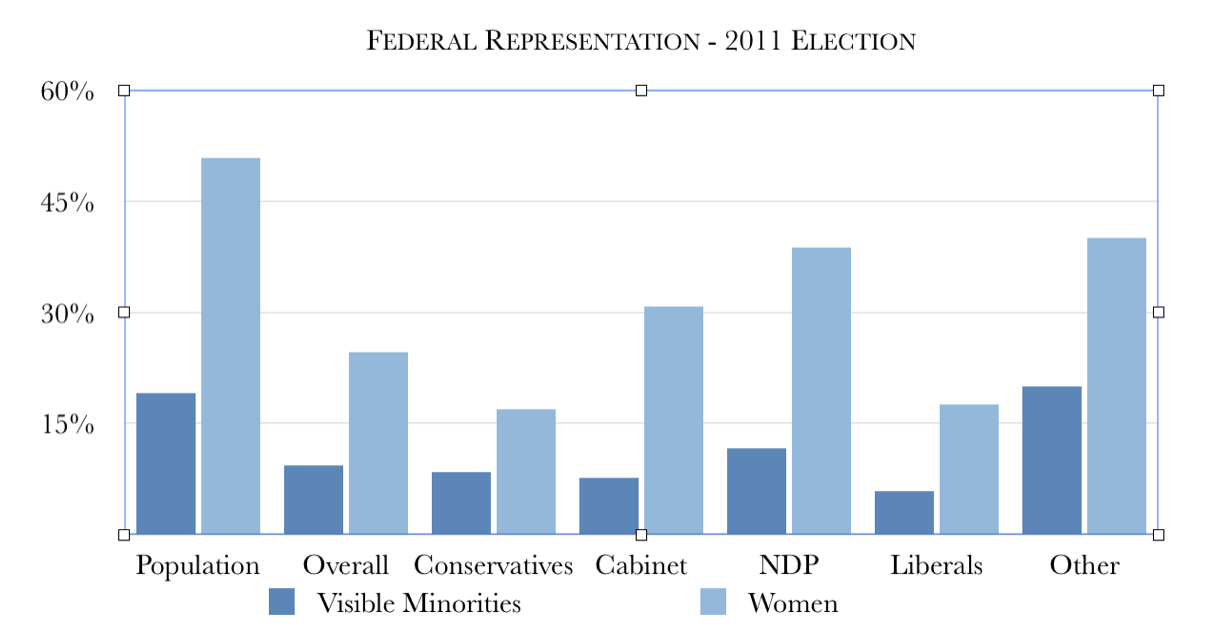
Federal_Representation_-_2011_ElectionA reminder in the US of gaps in political representation for women, blacks and hispanics (chart above shows Canadian representation from the 2011 federal election):

Cue the confetti: The new Congress sworn in on Tuesday is the most diverse in our nation’s history!

That would truly be a milestone to celebrate—until you see what that record “diversity” actually means. Ready? The breakdown of the 114th Congress is 80 percent white, 80 percent male, and 92 percent Christian.

… Look, I don’t care if you are a liberal or a conservative. It’s impossible to make the claim that our Congress accurately reflects the demographics of our nation. And it’s not missing by a little but a lot. If Congress accurately reflected our nation on the basis of race, about 63 percent would be white, not 80 percent. Blacks would hold about 13 percent of the seats and Latinos 17 percent.

But what do we really see? The new Senate has only two black senators. That statistic is even more striking given that earlier this week the first black person ever elected to the Senate, Edward Brooke, was laid to rest. Brooke won his seat in 1966 and served two terms. How far has Congress really evolved on race when in 50 years it has gone from one black senator to two? (Even the arguably more democratic House is only at 10 percent black members.)

Congress moves slowly, and I don’t mean just on passing legislation.

Latinos, the fastest growing minority group in America, are even more underrepresented in Congress. They hold 3 percent of the Senate and a little over 7 percent of the House.

And let’s look at religion. Congress is now 92 percent Christian, resembling more to a papal enclave than our religiously diverse nation. The latest Pew Poll found that nearly 20 percent of Americans identify as atheist, agnostic, or not being affiliated with any religion. Yet there’s only one member of Congress, Rep. Kyrsten Sinema (D-AZ), who openly acknowledges she’s not a member of any religious group.

OK, let’s put race, ethnicity, and religion aside and address the most glaring under representation in Congress of any group: women. This Congress will welcome more women than ever before at 19 percent of the House and 20 percent of the Senate.

The Unbearable Whiteness of Congress – The Daily Beast.

Ottawa to limit number of foreign youth working in Canada

Further to my earlier post (Foreign youth TFW program a risk to youth employment, documents say), appears the Government has decided to cut the program in 2016 both for the valid reason given concern over bilateral irritants and how to manage them, along with further efforts to increase Canadian uptake for foreign opportunities, and likely also to punt and controversies post-2015 election:

Ottawa has reciprocal agreements with 32 countries, but is concerned that Canada accepts far more young workers each year than the number of young Canadians accepted by partner countries.

A Dec. 12 document reveals that Mr. Harper decided partner nations should be warned that quotas will be “reduced significantly” for 2016 unless they take steps to accept more Canadians.

An earlier document dated Oct. 27 shows the government was preparing to manage the fallout from foreign countries that would likely object to quota reductions in the program.

The Oct. 27 document specifically states that any reforms were to be delayed until after Canada and South Korea ratified a long-sought free-trade agreement, a development that occurred in early December.

“Of note is that 24 of the 32 countries’ programs (predominantly in the EU) are slated to be cut between 50 and 99 per cent,” states the Oct. 27 document, which describes a letter from Mr. Alexander to Mr. Harper outlining the minister’s “optimal approach” for reforming the program.

“The letter notes that the cuts will present bilateral irritants in many cases, however consideration has been given to deferring any changes to the quota for South Korea until the [free trade agreement] has been ratified,” it states.

The letter goes on to say that the Prime Minister would respond to the minister in the next few weeks. The Dec. 12 document describes Mr. Harper’s decision.

“The PM indicated that 2015 quotas will be maintained at the 2014 levels but reductions will be implemented in 2016, based on a detailed assessment to be conducted by [Citizenship and Immigration] in consultation with [Foreign Affairs],” the document states.

Ottawa to limit number of foreign youth working in Canada – The Globe and Mail.

University backs professor who says Asian immigration damages Vancouver – The Globe and Mail

More on Professor Duchesne (see his UNB website here) for his overall philosophy on immigration and multiculturalism and the “uniqueness of Western Civilization.”

Not that one cannot have concerns about the pace and nature of change but his phraseology and ideology suggest a less than dispassionate view:

He said Prof. Duchesne is using academic freedom to hide poor scholarship. “He’s only providing one view to students and shaping their minds,” he said. “That whole academic enterprise of why we send our kids to school to become broad thinkers is not being upheld.”

Mr. Jang also said Prof. Duchesne’s views on Asian immigration to B.C. are simply untrue. “It really comes across as very white supremacist. That’s just not Canada. It’s a country of immigrants.”

But Prof. Duchesne, on Wednesday, disputed Mr. Jang’s views, noting that the university’s dean of arts came to see him earlier in the day and upheld his academic-freedom rights.

This week, Prof. Duchesne was quoted by CBC as saying the influx of Asians and Chinese to Vancouver was “too fast, too quick,” leading a “beautiful British city” to take on “a strongly Asian character.”

In an interview from Saint John, he stuck by that view Wednesday, describing Vancouver as a city dramatically altered by Chinese immigrants. “Vancouver can still be seen as a city that still remains British in many areas, but also has this strong, growing Asian side. There is this two-faced character to the city,” he said. “The fast pace of the change is bad.”

University backs professor who says Asian immigration damages Vancouver – The Globe and Mail.

Paris attacks illustrate the power of mockery – Saunders

Nice piece by Doug Saunders on the power of satire:

Mockery travels faster than news or analysis. While Charlie Chaplin’s Interview-style mockery of Adolf Hitler in The Great Dictator was not considered a major part of the arsenal against the Fuhrer in that predigital era (and certainly didn’t provoke violence), the instant spread of disrespectful imagery is capable of threatening entire edifices of authority overnight.

What Charlie Hebdo offended was not any broad community or religion or political tendency, but rather those militant few who are driven to revenge and violence at the prospect of disrespect. Its unsubtle, schoolyard style of humour, much like Mr. Rogen’s, turned off a lot of people and groups, but that’s a fully acceptable response to bad taste and not at all related to vengeful violence.

A century and a half ago, what the police called “respect crimes” were part of the political mainstream in countries such as Canada, where wounded honour was the cause for duels and vengeance. Gauntlet-throwing died out, in most places, for generations. But something has happened in the online age to make mockery, once again, into a potent instrument. The only reasonable response is to deploy it as often, and as mercilessly, as possible.

I remember reading Satanic Verses during the time of the fatwa and some of the passages took my breath away in the sharpness and humour of Rushdie’s use of satire to make his points.

Paris attacks illustrate the power of mockery – The Globe and Mail.

In the Mideast, as in France, satire is a weapon against extremists

Interesting piece by Nahrain Al-Mousawi on satire within the Arab world with some quite amusing examples. Her conclusion regarding the risks of organizing such satire by Western governments is valid.:

While the efforts highlighted above are organic, based on a shared community, other efforts appear to be more technocratically orchestrated. A recent article noted that Mr. Sharro’s satirical chart was widely shared, including by the U.S. State Department’s Center for Strategic Counterterrorism Communications. The CSCC has exhibited its own type of muted mockery in a video countering IS recruitment efforts. The integration of humor in U.S. counter-terrorism strategies has been ramped up since the development of social media and its snarky style of communication. A State Department program calling itself Viral Peace confronts and undermines online currents of extremism with “logic, humor, satire,” in its creator’s words.

But a government-backed effort does not necessarily make for an effective means of striking back (and can often be perceived as intrusive, stilted or awkward). After all, satire’s subversiveness can be an ill-fitting mask worn by government institutions, distinct from more organic efforts, produced in times of crisis by a shared, discursive community – at least, when that community itself is threatened. Still, if laughing in the face of the absurd reveals an ability to “dwell with the incomprehensible without dying from fear or going mad,” then that may be the first step in striking back – by having the last laugh.

In the Mideast, as in France, satire is a weapon against extremists – The Globe and Mail.

Canada vows to accept 13,000 more refugees from Syria and Iraq

Good commitment – finally, now the challenge will be in implementation:

Canada has already accepted 20,000 Iraqis and since mid-2013 has brought 1,060 Syrian refugees to Canada. Total approvals for resettled Syrian refugees now exceed 1,275, with thousands more applications still being processed. This number doesn’t include the many more Syrians who’ve been accepted as refugees after making “inland claims” from within Canada.

The government also announced another $90-million in humanitarian assistance for people affected by the intensifying violence in both Iraq and Syria, home to a long-running civil war as well as battles between Islamic jihadis and government forces. The assistance will be distributed via UN agencies, the Red Cross and aid groups.

Mr. Alexander said the 10,000 new Syrian refugees will be resettled in Canada through both government and private-organization sponsorship. He said he expects roughly 60 per cent will be supported by private sponsors such as church groups and 40 per cent through government arrangements – “roughly the same proportions we’ve always had.”

Refugee sponsor groups said it will be a huge task to help 6,000, or 60 per cent of Syrian refugees, settle in Canada over 36 months. This is on top of the 3,000 additional Iraqi refugees Canada is now accepting.

Some said they hadn’t been officially informed of the proportion that private sponsors are expected to shoulder.

“Over three years, it will be probably on the edge of possible,” Alexandra Kotyk, director of sponsorship at AURA, a charitable organization representing the Anglican Diocese of Toronto and the Toronto Conference of the United Church of Canada.

I have less of an issue than some critics on the issue of need and possible preference given to Christian refugees, as it is hard to argue that Christians, and other minorities, are not likely at more risk than others.

Canada vows to accept 13,000 more refugees from Syria and Iraq – The Globe and Mail.

Immigration feels toddler better off ‘culturally, linguistically’ in India than with parents in Canada | Ottawa Citizen

While always risky to pass judgment based upon media accounts, the immigration officer’s comments, while no doubt well-meaning,  seem particularly obtuse and patronising given the longer-term implications of his continuing to be separated from his parents:

The department’s silence on the case is baffling, especially in light of a report by the Immigration visa officer in Delhi who rejected the parents’ application to be reunited with their son on humanitarian and compassionate grounds.

The visa officer says in the report obtained by the Citizen that Daksh is better off in India, where he lives with his grandparents and is in an environment “culturally and linguistically familiar to him.”

The report also says Daksh has always lived with his grandparents, never with his parents, which they deny.

“Based on information submitted, it would appear that the child has never resided with his father or mother. It seems the child has continuously resided with his grandparents. … It seems to me that (Sood and Bajaj) have already made a determination that the best interest of the child would be for him not to go to Canada.

“To uproot the child at this time and move him to an unfamiliar environment, in a different climate, culture and language would be very upsetting and not in his best interest. In addition, he would be living with unfamiliar people, as his lifelong caregivers would not be with him.”

Immigration feels toddler better off ‘culturally, linguistically’ in India than with parents in Canada | Ottawa Citizen.

National Post Editorial: Good Riddance to Carding

From the National Post Editorial Board:

Police have long defended carding as a vital law enforcement tool, and claim it has led to breakthroughs in major cases. But critics have long claimed  the process was inherently discriminatory, as young, black, male Torontonians were far more likely to be carded than others.

The critics were right. Data compiled by the Toronto Star revealed that young black men were being carded far more often than other citizens. Blacks, who are less than 10% of Toronto’s population, made up roughly a quarter of those being carded.

This is not to suggest that the police were simply bigoted. It is a sad truth that young black men in Toronto kill and are killed at a number that is wildly disproportionate to their share of the population. Young black men are charged with violent crimes more often than their numbers alone would warrant. Carding was the police response to the genuine issue of alarmingly high rates of violent crime among Toronto’s black youth.

But it was still the wrong response. Since 2008, more than a million people have been carded in a city that only sees somewhere in the region of 50 homicides a year. Not only was this an unwarranted police intrusion into the lives of citizens, but it needlessly stigmatized members of a racial minority, casting individuals under suspicion — or certainly making them feel under suspicion — solely on the basis of their race.

My only comment, as earlier posts this week have illustrated (A MacArthur Grant Winner Tries to Unearth Biases to Aid Criminal Justice – NYTimes.comThe Science of Why Cops Shoot Young Black Men), is not that the police are “simply bigoted” but they, like all of us, have subconscious biases and prejudices that play a role here.

National Post editorial board: Good riddance to carding 

Foreign youth TFW program a risk to youth employment, documents say – The Globe and Mail

More on the TFWP and the youth working holiday program:

David Wright, who was senior policy adviser at the department’s headquarters, noted in an e-mail in August, 2013, what he described as “interesting” results from an Australian survey of a similar program.

“It is young local workers who are the main losers in the competition for employment. This is especially the case for those without post-school education, who are seeking less skilled, entry-level jobs,” the e-mail stated, quoting a report from Australia’s Centre for Population and Urban Research.

The government documents were obtained by immigration lawyer Richard Kurland. The Citizenship and Immigration department did not respond to questions about the documents by late Tuesday.

Mr. Kenney has insisted “these nice young people on their working holiday programs” are not a threat to Canada’s labour market.“I think it’s a pretty benign subset of the temporary foreign worker program,” he said during a 2013 debate in the House of Commons.

… International Experience Canada, the much larger category, was left largely untouched. Canadian employers can hire participants without going through a screening process called Labour Market Opinions that is meant to ensure efforts are made to hire Canadians.

The government has noted that working holiday programs are reciprocal deals that allow Canadians to work in 32 other countries, but it has acknowledged few Canadian youth have taken advantage of it, noting at the time of last year’s reforms that the imbalance “is the most serious concern for this initiative.”

The number of people working in Canada as of Dec. 1 of each year under the program has grown from 25,891 in 2006 to a high of 58,933 in 2012. The numbers dropped in 2013 to 56,313. In contrast, only 17,731 Canadians worked abroad under the program in 2012. Most programs have age limits of 30 or 35.

Youth exchange programs have many benefits for participants and surprised that more Canadian youth aren’t taking advantage of the opportunities.

Foreign youth TFW program a risk to youth employment, documents say – The Globe and Mail.