Barbara Kay: ‘Values’ return to Quebec in more sensible Liberal version

Barbara Kay on the more narrow approach to a “values charter.
Apart from her intellectually lazy comment “multiculturalism as it is practised in English Canada,” hard not to oppose the narrow requirement to show one’s face when receiving government services.:
In Quebec, “values” is a loaded term. Last year, the Parti Québécois bought into the assumption that a crackdown on hijabs and yarmulkes and other outward signs of religious belonging would stir up nativist emotions along sovereignty-friendly lines. The gambit failed rather spectacularly, arousing latent racism at the margins, producing across-the-board cultural tensions, and in the end the now-infamous Bill 60, the Charter of Quebec Values, contributed to the PQ’s dramatic tumble from power in last April’s election.

Which does not mean that Quebecers aren’t concerned about cultural self-preservation. Protectionism is not a dirty notion in Quebec, and for good historical reasons. Apart from Montreal, Quebec is the only ethnically homogeneous collective in North America of its size. Disapproval of the PQ version of values protectionism was not an endorsement of multiculturalism as it is practiced in the ROC.

Before there was a PQ Charter of Values, let us remember, there was Bill 94, a Liberal project that had as its centerpiece a prohibition on face cover in the getting and receiving of public services. Polls gave the bill near-unanimous support in Quebec – 95% – and 75% support in the rest of Canada. The lack of equivocation is due not only to Quebecers fears of cultural dilution, but to Quebec’s outsized commitment to feminism (in part a response to the outsized patriarchism of the Catholic Church in Quebec’s history). Female politicians exert a powerful influence over all social and cultural policies and disbursements here. The galling sight of veiled, depersonalized women in this women’s rights stronghold arouses far more animus than any multiculturalist ideal can counter.

And so, now that Quebec has a Liberal majority government once more, it should come as no surprise that Bill 94, which foundered with Liberal party fortunes several years ago, is being revived. On Wednesday Justice Minister Stéphanie Vallée announced that her government will proceed this fall with “inclusive” values legislation. It will be tamer than Bill 60 – I take that to mean no hijabs, crosses or yarmulkes will be challenged – but it would require that public services be dispensed and received with the face uncovered.

Hurrah! One can argue until one turns blue that face cover is of a piece, rights-wise, with head coverings and crosses, but as the Sesame Street Song has it, “One of these things is not like the other.” Three of “these things” are socially harmless. Face cover is anti-social, anti-equality and anti-community in the larger sense of the word. It is associated with oppressive, misogynistic regimes. It is not clothing and is not worn; it is a mask and is, so to speak, “borne.” We do not have the freedom to give or receive pubic services while naked. Too much cover is as indecent as too little when it comes to psychological comfort in our culture.

Barbara Kay: ‘Values’ return to Quebec in more sensible Liberal version
Canadian Museum for Human Rights – More Dissent

More on the CMHR and one of the most vocal critics, Lubomyr Luciuk (see Canadian Museum of Human Rights: Letter Regarding Portrayal of World War 1 Internment):

The editorial Museum opening may silence critics Sept. 17 advises us to wait and see what the Canadian Museum for Human Rights is all about before complaining.

What that counsel ignores is that the CMHRs spokespeople have always admitted that this publicly funded institution will feature a permanent and privileged central gallery space elevating the suffering of one community above all others.

More than four million Ukrainians perished of hunger in six months during the Holodomor, making this arguably the greatest genocide to befoul modern European history. Why wouldnt this Soviet crime against humanity already have a permanent and central place at the CMHR?

The newspaper’s uncritical boosterism in support of the CMHR does not mask the fact that this project will remain controversial and divisive because those responsible for its content never wanted that content to be thematic, comparative, or inclusive. What a shame.

Lubomyr Luciuk

Ukrainian Canadian Civil Liberties Association

Most subsequent letters have taken issue with this view, including the assertion of the Holodomor, not the Holocaust, as the “greatest genocide to befoul modern European history.”

By what measure? What criteria? Starvation worse than gas ovens? Numbers of victims?

Comparing collective and individual suffering under genocides or equivalent atrocities undermines Luciuk’s arguments by diminishing what was, arguably again, unprecedented in terms of its explicit ideology and industrialization.

Just as Luciuk did with the Orwell Animal Farm-inspired postcards saying “some galleries are more equal than others,” and invoking pig imagery (see The war against the Holocaust).

Unfortunate, as he and others in the Ukrainian Canadian community have done much to raise awareness of the Holodomor and World War 1 internment.

Have your say – Winnipeg Free Press.

Venezuela: Move to Revoke Actress’s Citizenship – NYTimes.com

The dark side of revocation against freedom of speech:

The government said Wednesday that it would seek to revoke the citizenship of the actress Maria Conchita Alonso, left, a fervent critic of its socialist-inspired policies. Ms. Alonso was born in Cuba and moved to Venezuela as a child, becoming a naturalized citizen. She has lived for years in the United States. The Interior Ministry will take judicial action to revoke her citizenship, according to the Information Ministry website.

In May, Ms. Alonso said in an interview with the Voice of America, “I wish that the United States would invade with bullets to remove all those wretched communists from Venezuela.” Venezuela is mired in an economic crisis, with inflation of 63 percent a year and shortages of basic goods, problems for which the government frequently blames its opponents. Ms. Alonso competed in the Miss Venezuela pageant in 1975 and has appeared in many films, including “Predator 2.”

Venezuela: Move to Revoke Actress’s Citizenship – NYTimes.com.

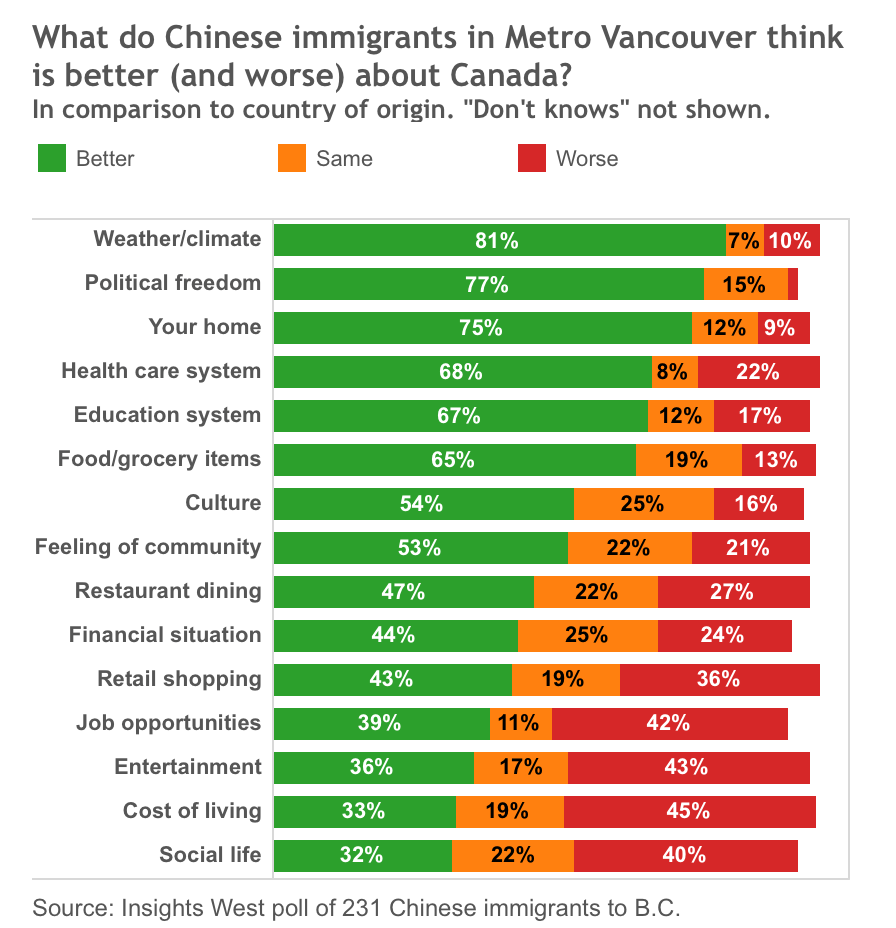
Chinese immigrants happy with life in Metro Vancouver: survey

Chinese_immigrants_happy_with_life_in_Metro_Vancouver__surveyNot necessarily surprising results but interesting nevertheless, as well as the differences between mainland and Hong Kong Chinese:

The survey found Chinese immigrants are very happy with their level of political freedom in Canada, with 77 per cent saying it’s better here and only two per cent saying it’s worse. They also like the weather, with 81 per cent saying the climate here is better than where they came from. And government services get a thumbs up, with 68 per cent saying Canada’s health care system is better and 67 per cent preferring our education system.

Immigrants are less impressed, however, with the job opportunities available to them in this country. Just 39 per cent say their job opportunities in Canada are better than in their country of origin, compared to 42 per cent who say they’re worse.

The cost of living in Metro Vancouver is also a concern, with 45 per cent saying life is more costly here.

Chinese immigrants happy with life in Metro Vancouver: survey.

Hiva Alizadeh — arrested in Project Samosa — pleads guilty to terror plot

Conviction of one of the Ottawa-based cell members, Hiva Alizadeh, demonstrates that the court system can be effective in addressing serious radicalization and terror plots.

Relatively little in mainstream press on his background but it appears to be Iranian Kurdish and he came to Canada as a young adult, not as a child:

And if on Wednesday the slim, bearded man renounced that desire, telling an Ottawa court in a soft voice that “I realize how much mistakes I have done,” his guilty plea and expressed regret did little to ease the court’s abhorrence at his actions.

“You have effectively been convicted of treason,” said Justice Colin McKinnon, telling Alizadeh he had “no hesitation” in sentencing him to the 24-year prison term recommended by Crown and defence lawyers.

With his surprise plea, Alizadeh avoided a trial and possible life sentence under Canada’s toughened terrorism laws. With credit for the time served since his arrest, his term for possessing explosives with an intent to injure works out to a maximum of 18 years. He will not be eligible for parole for nine years.

Public Safety Minister Steven Blaney issued a statement Wednesday, lauding the authorities’ efforts in the case as well as Canada’s counter-terrorism strategy.

“Today’s outcome is a clear sign that the work and the dedication of professionals prevented Canadians from potential harm,” he said.

Will the Government seek to revoke his citizenship? Or will it decide safer to keep him in prison rather than revocation and deportation?

Hiva Alizadeh — arrested in Project Samosa — pleads guilty to terror plot | Ottawa Citizen.

Could Alberta pass Quebec to become the second-largest province? – Macleans.ca

From the latest Statistics Canada population projections for the next 25 years:

The Atlantic provinces aren’t likely to fare well. The population in Newfoundland is likely to drop over the next 25 years. P.E.I. should continue to grow, but most of the growth scenarios StatsCan ran on New Brunswick and Nova Scotia showed the provinces shrinking by 2038.

Under every growth scenario, Ontario will remain the country’s largest province, driven largely by immigration.

Quebec’s population would grow over the next 25 years under all the scenarios, with most of the gains coming from immigration, but because its rate of growth is almost certain to come in lower than the Canadian average, its demographic weight, or share of the total Canadian population, will slide.

Under most scenarios, Alberta’s population will surpass that of British Columbia by 2038. It’ll be the youngest population, too, with the lowest proportion of seniors in the country.

Jason Kirby’s unscientific projections show Alberta’s population possibly becoming larger than Quebec’s some time in the early 2050s.

Economically, this shift will happen sooner:

But population growth is one thing. When people talk about provincial rankings, there’s a good chance they’re referring to the size of their economies, as opposed to how many folks live where. It’s certainly the metric any politician boasts about first, come election time. So, to take our Quebec-Alberta match to the next level, here’s another look into the future, this time using 10-year GDP growth rates. Will Alberta’s economy overtake that of Quebec? Barring some pretty massive changes in provincial fates, that could happen as early as 2016, some three decades before Alberta’s population ever catches up to Quebec’s—which pretty much says everything you need to know about how grim the economy is in la belle province.

Could Alberta pass Quebec to become the second-largest province? – Macleans.ca.

Ignorance is cheap – but parliamentary knowledge costs – Globe Editorial

Globe editorial on ignorance and the Government’s (or at least of some of its MPs) wish to be less open and transparent:

Mr. Wallace posed his own written question asking for the estimated cost to the government of answering Order Paper questions. The answer he got, based on a formula that is dubious at best, was $1.2-million for 253 questions. “Are we sure we’re getting value for the dollar?” Mr. Wallace asked.

Well, let’s think about that. What value do Canadians place on knowing: the percentage of Employment Canada benefits applications that are rejected and how many people have to wait longer than 28 days for a response; which government department is responsible for monitoring the transporation of fissile radioactive material inside our borders; how much money Ottawa has spent developing software since 2011 and what the software actually does; and the amount the government spent on travel expenses while negotiating the Comprehensive Economic and Trade Agreement with the European Union.

These are just some of the opposition questions currently on the Order Paper, and all of them deserve an answer. Mr. Wallace’s suggestion that MPs should ask fewer questions, because ignorance is cheap, is pretty much one of the dumbest things a parliamentarian has come up with in recent memory.

And as most of us know from personal and professional experience, ignorance is expensive given the implications of bad and faulty decisions.

Ignorance is cheap – but parliamentary knowledge costs – The Globe and Mail.

New course in entrepreneurship and multiculturalism at Ryerson 

Interesting program and a practical way to leverage Toronto’s (and Canada’s diversity:

Q:  Is this about marketing to specific ethnic segments?

A:  No, we are talking about educating people to be able to adapt to any of the markets they choose. We are not specifically profiling different demographics. We are giving people the tools to understand to test their ideas with that demographic.

Q:  Any other specifics about the course that you would like to share?

A:  One of the greatest things about it is that it takes the best of Ryerson’s different pieces. You learn about business plans, evaluating opportunities and apply it to a setting that you already want to work in. It’s widely impactful and I look forward to talking to the first group of students to hear if they are getting the impact that we had hoped.

There are six courses– the four required courses build skills in ideation, opportunity evaluation, business intelligence, and venture planning within a multicultural context. Additional electives allow students to enhance their skills in areas that suit their specific needs e.g., accounting or communication.

New course in entrepreneurship and multiculturalism at Ryerson | CanIndia NEWS.

Ismaili Centre: place of prayer, cradle of friendship – Aga Khan

The Aga Khan’s speech at opening of the Ismaili Centre in Toronto:

What we dedicate today is what we identify as an Ismaili Centre – a building that is focused around our jamatkhana, but also includes many secular spaces. These are places where Ismailis and non-Ismailis, Muslims and non-Muslims, will gather for shared activities – seminars and lectures, recitals and receptions, exhibitions and social events. These meeting halls and lounges, work offices and conference rooms will serve the organizational needs of the Ismaili community. But they will also, we trust, be filled with the sounds of enrichment, dialogue and warm human rapport.

Soaring above it all is the great crystalline dome that you have observed, through which light from the prayer hall will provide a glowing beacon, symbolizing the spirit of enlightenment that will always be at the heart of the centre’s life.

In its origins, in its design, and in its programs and activities, the complex we inaugurate today is animated by a truly pluralistic spirit. In this respect too, it reflects the deep-set Ismaili values – pluralistic commitments that are so deeply embedded in Canadian values.

Ismaili Centre: place of prayer, cradle of friendship – The Globe and Mail.

Emergency debate on ISIL draws only handful of MPs | “Root Causes” and Government Stupidity

Interesting to see Conservatives invoking the Liberals R2P (Responsibility to Protect) initiative, which many conservative commentators have panned if memory serves me correctly:

Employment Minister Jason Kenney invoked the “responsibility to protect” doctrine to fight “genocide” against religious minorities in a sparsely attended yet spirited late-night debate Tuesday over Canada’s response to the Islamic State threat.

… In an extensive speech about the violence minorities face, Kenney took aim at “moral relativism” and cynicism, saying that supporting an existing military presence was the only effective response to the urgent situation.

“There are hundreds of thousands of girls who are facing serial gang rape in this circumstance in Iraq. There are children who have been beheaded,” he said, adding that persecuted families “don’t have time for ‘root causes” — a dig at a previous comment by Trudeau.

Kenney added that stopping ISIL from harming more people takes “hard power,” and couldn’t be done “with pleasant speeches, tents or humanitarian supplies.”

While I share his abhorrence of ISIS and similar groups, blindness or ignoring root causes leads to history repeating itself, and not calibrating the degree of intervention appropriately (admittedly hard to do, both substantively and politically).

Emergency debate on ISIL draws only handful of MPs | Ottawa Citizen.

Ottawa Citizen editorial demolishes the PM and Government’s logic in this regard (“We know (terrorists’) ideology is not the result of ‘social exclusion’ or other so-called ‘root causes.’ It is evil, vile and must be unambiguously opposed.”).

Have highlighted the money quote:

Are the Conservatives really arguing that terrorism, as an expression of pure evil, just springs up without explanation, like demonic possession? That any one of us might wake up tomorrow possessed of an urge to become a terrorist for no reason whatsoever? Surely there are reasons why one person takes up arms in an evil cause and another does not. To try to understand those reasons, and reduce their effect, is not to shrug at violence. It is in fact a moral duty.

Setting up these two perspectives in opposition – that terrorism has causes, and that terrorism is evil and must be opposed – might be time-honoured political strategy. But it’s wrong and dangerous rhetoric. One way to oppose terrorism is to understand it. The Conservative talking point implies that anyone who tries to figure out how to stop a kid from suburban Ontario from becoming a jihadi is, somehow, a terrorist sympathizer. It implies that any analyst who tries to understand the ebb and flow of propaganda within a territory is excusing violence. To sneer at any attempt to understand terrorism is a stupid approach to one of the world’s most insidious problems, and the Conservatives ought to know better. They do know better, but they’re trying to score points.

Canada can and must unambiguously oppose terrorism while trying to improve its understanding of how it operates and how its adherents recruit.

Editorial: Yes, terrorism has causes