Canadian International Council – Canadas hub for international affairs » How to Stop Canadians From Becoming Jihadists

Not sure that this article says much that is new. Yes, a variety of approaches, both “soft and hard” should be used, but no matter how good and varied the programs, and no matter how engaged the community and Imams, some will persist and reject the “soft approach” and try to skirt the security approach.

No easy solutions, but this article would benefit from greater acknowledgement of existing soft approaches and Canadian agencies learning from the experience of other governments, a lot has been done here:

While the spirit of these initiatives is welcome, considering the secretive process involved and the RCMP as the lead agency, it seems this counter-radicalization strategy may take a strong, policing, approach to the issue. Also, the government will reportedly make the RCMP the intended first point of contact for concerned community members and parents, meaning community reluctance to involve the police will potentially hamper the ability of the government to address radicalization early and effectively.

Instead, community policing should be coupled with soft approaches to pre-emptively deal with radicalization and should not end when the individual attempts to or successfully travels overseas. This requires a whole-of-government approach, one which includes Public Safety Canada and the RCMP, to create a positive effect on identifying and curbing the growth of extremism and reintegrating those caught in its clutches.

As Mubin Shaikh, former CSIS informant in the Toronto-18 case and currently a PhD student in terrorism studies said in an interview: “A counter-narrative should include Canada’s Muslim community in cooperation with the government, private industry and non-profits. It should include theological appeals and work on the strengths of multiculturalism.” Such a counter-narrative must de-legitimize the extremist narrative by using both the strengths of Canada’s pluralistic society and religious guidance based upon Islamic teachings.

These young men must be made to feel that they are a part of Canadian society, as well as made to understand that their actions are not religiously condoned. This approach must involve community leaders, relatives, colleagues, social workers and organizations with experience in de-radicalization.

Canadian authorities must learn from the counter-radicalization programs of their European peers: which tactics and strategies work; how to partner with impacted communities; how to integrate individuals into Canadian society; and, how best to disrupt the networks that exploit these individuals. Only then will it be possible to fully understand and address the issue of radicalization in Canada, to pre-emptively tackle threats to Canadian security and deal fairly and equitably with radicalized individuals and the communities in which they live.

Canadian International Council – Canadas hub for international affairs » How to Stop Canadians From Becoming Jihadists.

Sheema Khan is more concrete and focused on some of the “soft” initiatives and actions that are needed to reduce radicalization:

Second, rather than pointing fingers at all Muslims and fanning the flames of Islamophobia, there must be meaningful partnerships in which Muslim communities play an important role in rooting out extremism. Muslim communities are the best sensitized to observe changes, which can be subsequently reported to authorities and/or addressed by community programs that focus on religious literacy about jihad, messaging against extremism, support for converts, mentoring, constructive channelling of political grievances and the special role of mothers.

The post-9/11 environment sent a chill about discussions of the “j” word. This naturally led to underground discussions, away from mainstream counternarratives. Today, the topic of jihad must be addressed openly by imams. Religious literacy about its strict conditions and unequivocal prohibition of violence against non-combatants is essential. For example, the British government has appealed to anti-extremist imams to counteract the seeds of radicalization.

Muslims can play an important role by speaking out against atrocities committed in the name of Islam. Muslims throughout the world have spoken and demonstrated forcefully against the Islamic State’s brutality. Strong community abhorrence provides a powerful alternative to the romanticized extremist jihad message.Converts to Islam often lack community support networks and in-depth knowledge of religious sources. Programs need to be developed to provide both elements in order to prevent their exploitation.

Partner with Muslims to root out extremism – The Globe and Mail.
Arab writers mock ISIS terrorists in cartoons and comedy programs aimed at ‘rejecting extremism’

My favourite:

In one skit produced by the Ktir Salbe Show, a taxi driver picks up a jihadi who rejects listening to radio because it didn’t exist in the earliest days of Islam, a knock on ISIS’s literal take on the Quran. The driver offers to turn on the air conditioning, but that too is rejected. The jihadi finally criticizes him for answering a mobile phone.

Fed up, the driver asks: “Were there taxi cabs in the earliest days?”

“No, 1,000 times no!” the passenger answers. The driver responds by kicking out the jihadi and telling him to wait for a camel instead.

Arab writers mock ISIS terrorists in cartoons and comedy programs aimed at ‘rejecting extremism’

Extremism loves company: Sunstein

Cass Sunstein on the psychology of radicalization.

What nudge does he suggest to reduce polarization and extremism?

Why does group polarization occur? The first answer involves information. Suppose that most group members begin by thinking that some religious group, leader or nation is evil. If so, they will hear a lot of arguments to that effect. As they absorb them, they will be inclined to move toward a more extreme version of their initial judgment.

People also care about their reputations, so some group members will adjust their positions in the direction of the dominant view. A disturbing implication is that if group members listen only to one another, and if most of them have extremist tendencies, the whole group might well march toward greater radicalism and even brutality.

Writing in 1998, Russell Hardin, a political scientist at New York University, drew attention to the “crippled epistemology of extremism,” by which he meant to emphasize how little extremists know. Focused on Islamic fundamentalists, Hardin was concerned about what happens “when the fanatic is in a group of like-minded people, and especially when the group isolates itself from others.”

In the years ahead, the international effort to combat violent extremism will sometimes require force, and it will sometimes require economic pressure. But it will succeed only if it disrupts recruitment and radicalization by enclaves of like-minded people.

Bloomberg’s Cass R. Sunstein (pay wall)

Maytree New Ryerson-Maytree initiative set to advance the inclusion of immigrants and visible minorities » Maytree

Should provide further leadership on diversity and inclusion issues:

The initiative will be housed at the Ted Rogers School of Management’s Diversity Institute at Ryerson University and led by Ratna Omidvar as its founding Executive Director who will be relocating to Ryerson. It builds on the long-standing relationship between Maytree and Ryerson, including its research partnerships on the DiverseCity and DiversityLeads projects.

Under Ratna’s leadership, the Ryerson Maytree Global Diversity Exchange will develop a program of academic and applied research, identify evidence-based leading practices and promote policy and solutions that strengthen the case for diversity and inclusion.

In addition, it will become the new home for a suite of successful Maytree programs: Cities of Migration, DiverseCity onBoard, the Flight and Freedom book project and hireimmigrants.

Cities of Migration and DiverseCity onBoard have had impact both in Canada and abroad. Flight and Freedom, due for publication in 2015, will tell the stories of Canadians who have fled their home countries, often under threatening conditions, to find their way to Canada. The book will highlight the contributions they have made to their new country. Hireimmigrants has a solid track record of working with Canadian employers to enhance their skills in attracting, employing and retaining skilled immigrants.

Maytree New Ryerson-Maytree initiative set to advance the inclusion of immigrants and visible minorities » Maytree.

David Cameron seeks to seize passports of Islamist fighters

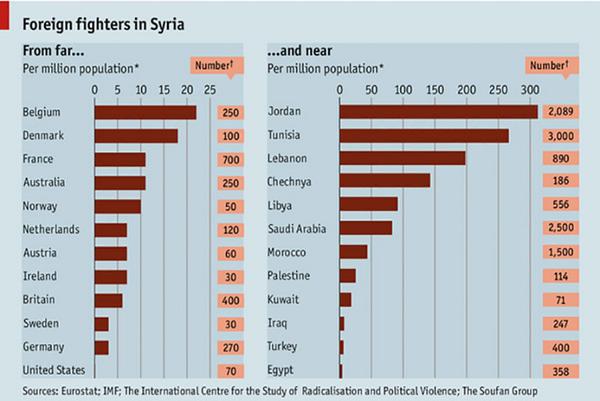
From The Economist

From The Economist

More on efforts to curb home-grown radicalization in the UK. While these are “hard” approaches to prevention, UK has also invested considerably in “soft” approaches as well.

As with all these initiatives, particularly their expanded application of revocation to prevent born-Britons without dual nationality to return home, questions about who decides and whether the person accused can defend himself.

One thing to hold them for investigation (legitimate), another to make a decision without due process.

One could argue that refusing entry, understandable from a security perspective, simply means that any such extremist would return to Syria or Iraq to continue their brutality, rather than being under the watch of the police in the UK:

“There are two key areas where we need to strengthen our powers to fill specific gaps in our armoury. These are around preventing suspects from travelling and dealing decisively with those already here who pose a risk.”

David Cameron’s new anti-terrorism proposals come days after the U.K. raised its terrorism alert to its second-highest level.

Cameron said he would bring in new “specific and targeted legislation” to give the police powers to temporarily seize a suspects passport at the border to give authorities time to investigate them. Currently only Britain’s interior minister has the power to withdraw a passport.

He also said the government would consult on a discretionary power to prevent Britons from returning home if they have pledged allegiance to extremist causes. This would extend existing powers which can only be applied to foreign nationals, naturalized citizens and those with dual nationalities.

David Cameron seeks to seize passports of Islamist fighters – World – CBC News.

Meanwhile, in Canada, more on the RCMP’s High Risk Travel Case Management Group approach to prevention (see also 2014 Public Report on the Terrorist Threat to Canada):

While the report’s emphasis is on prevention and intervention, several recent cases related to the Syrian conflict have raised questions about the effectiveness of efforts to reason with determined youths blinded by zeal.

After serving a prison sentence for his role in the Toronto 18 terrorist group, which plotted bomb and shooting attacks in southern Ontario, Ali Dirie used a fraudulent passport to travel to Syria, where he fought and died last August.

A British Columbia man charged with terrorism in July, Hasibullah Yusufzai, 25, was known to Canadian authorities because of a previous trip he had made to Afghanistan. Although he was on a no-fly list, he still managed to make his way to Syria using a passport that did not belong to him.

When Ahmad Waseem returned to Windsor, Ont. after he was wounded in combat in Syria, his mother hid his passport, his mosque counseled him and police spoke to him. But he returned to Syria last year and now calls the Islamic State of Iraq and Al-Sham his “brothers.” He has been charged with passport fraud.“

Early intervention through a joint community/law enforcement response is no guarantee that a person will not radicalize to violence,” the report says. “However, early intervention is one constructive way to deter potential violent extremists from causing harm.”

Canadian government plans ‘targeted interventions’ to stop citizens from joining armed Islamists in Syria

Sikhs Vow to Litigate Helmets Issue – New Canadian Media – NCM

More on the Sikh motorcycle helmut controversy. A motorcycle as a “standard mode of transportation?” Perhaps, but a higher risk one, hence the need for helmets:

In Ontario, the helmet law as it applies to Sikhs was first challenged in 2008, when the Ontario Human Rights Commission took up the cause of Baljinder Badesha, who was fighting a $110 ticket he received a few years prior for refusing to wear his motorcycle helmet. Scott Hutchison, a constitutional lawyer at Henein Hutchison LLP, represented the OHRC in that case, arguing reasonable accommodation is justified for Sikh motorcyclists, given that observant Sikhs would otherwise be unable to access a standard mode of transportation. Ontario Court Justice James Blacklock, however, ruled against Badesha and the OHRC, issuing a 35-page decision. In it, he writes an exemption would render the helmet law unwieldy, since anyone violating it could simply claim they were devout.

“The officer wouldnt know if he was dealing with a devout Sikh or not, unless he took the word of the accused.”

The original challenge brought by the Ontario Human Rights Commission in 2008 sought an accommodation exemption based on the province’s Human Rights Code. A subsequent appeal of the decision to the Ontario Superior Court in 2011 upped the ante, focusing on Charter rights violations. In the end, Justice John Takach found no error in the lower-court ruling.

Sikhs Vow to Litigate Helmets Issue – New Canadian Media – NCM.

Ontario says No to removing citizenship by birth on soil | Toronto Star

Expect that Ontario, which accounts for 37 percent of all births in Canada, essentially killed federal plans when it formally notified CIC in September 2012 of its opposition:

“In our view, there is not enough evidence to justify the effort and expense required for such a system-wide program change. Citizenship and immigration Canada has not quantified the extent of fraud resulting from ‘birth tourism,’’ said Ontario Deputy Immigration Minister Chisanga Puta-Chekwe.

“At this time, there is insufficient data to demonstrate the demand placed on Ontario’s economy or public services from ‘birth tourists,’” he wrote in a letter to Ottawa, dated September 6, 2012, after a technical briefing on the plan. A copy of the province’s response was obtained by the Star this week.

On Friday, a spokesperson for Ontario Immigration Minister Michael Chan said the province has not changed its position.“While citizenship is the sole responsibility of the federal government under Canada’s constitution, any proposed change to citizenship policy can have profound impact on the provinces and territories,” said the spokesperson.

“Adequate time needs to be taken to understand the full implications of any change in policy. Canada needs to get this right, in partnership with provinces and territories.”

Ontario says No to removing citizenship by birth on soil | Toronto Star.

Direct link to the DM letter here, along with some other related Ontario documents:

ON – Letter from ON DM Citizenship and Immigration to CIC DM 6 Sep 2012

The Franco-American Flophouse: US Citizenship Renunciation Fees to be Raised 422%

Victoria Ferauge on the increase in fees for citizenship renunciation (looks like a tax grab to me):

Well, its a complicated labor-intensive procedure:

“The CoSM demonstrated that documenting a U.S. citizen’s renunciation of citizenship is extremely costly, requiring American consular officers overseas to spend substantial amounts of time to accept, process, and adjudicate cases. For example, consular officers must confirm that the potential renunciant fully understands the consequences of renunciation, including losing the right to reside in the United States without documentation as an alien. Other steps include verifying that the renunciant is a U.S. citizen, conducting a minimum of two intensive interviews with the potential renunciant, and reviewing at least three consular systems before administering the oath of renunciation. The final approval of the loss of nationality must be done by law within the Directorate of Overseas Citizens Services in Washington, D.C., after which the case is returned to the consular officer overseas for final delivery of the Certificate of Loss of Nationality to the renunciant.”

And demand for this service is strong yep, they say that.  450 USD, they say, was already below cost and they are just raising the fee in order to not lose more money on the service.

Now I’m just an old lady and I don’t pretend to be the brightest crayon in the box but if the goal here is to “break even” then they are looking at this all wrong.  Read the outline of the procedure again. Does that sound efficient to you?  Just the assumption that any US citizen showing up to renounce his US citizenship doesn’t really understand what he/she is doing and has to have it explained ad nauseum intensive interviews? and then be sent off to a corner like a little kid to reflect on it before being allowed to come back and do the deed, is just ridiculous.  Right there Id say just treating people like adults and assuming that they do know their own mind would save a lot of time, money and hassle all around.

And the narrative that will come out of this fee raise is not likely to focus on “cost recovery” at US consulates around the world but on what is going to be perceived as a punitive act on the part of the US government.  It looks like they are so embarrassed by the renunciation numbers and the lines to renounce at the US consulates that they are looking for ways to reduce or slow down the demand.  Think about that.  Has the state of US citizenship in the world really come to the point where the US government thinks that Americans have to be actively discouraged from renouncing?

The Franco-American Flophouse: US Citizenship Renunciation Fees to be Raised 422%.

Muslims can live faith more fully within Canadian society, Imam says in book aimed at ‘ostracized’ youth

Imam Delic’s book on the advantages Canadian Muslims have and the need for an intellectual renaissance within Islam:

Anybody who tries to destroy this creativity, who tries to block it, who tries to demean it, definitely does not understand what God Almighty was asking us with the first word that was revealed in the Qu’ran, and that is ‘iqra’ [read]. The first word that was ever revealed to the Prophet, peace be upon him, was not ‘pray,’ or ‘believe.’ It was ‘read.’ And ‘read’ came as a command. Why? Because if we don’t read, we will not learn. And if we do not learn, we will not know. And if we do not know, we will not understand. And if we do not understand, we will not be able to apply. Make sense?” Mr. Delic said. “Knowledge that does not actualize itself in positive action or ethical action is knowledge without base.”

The growth of Islam from the founding in Arabia through expansion as far as Moorish Spain suggests this intellectual command was once well understood, he said.

“At that time, when we stopped being intellectually challenged, or when we didn’t want to challenge ourselves, that creativity died out and that’s the reason why the Muslim community became stagnant, not progressive,” Mr. Delic said. “We need to re-read our historical texts in the context of modern times, modern societies, modern demands. I don’t want to take opinions of scholars from the 14th century that do not talk to my needs, my aspirations, even though I do respect them and their work for the time in which they lived. But their ideas do not apply to my time.”

In 2010, Defence Minister Peter MacKay cancelled a speech by Mr. Delic at an Islamic History Month event because he was then the new executive director of the Canadian Islamic Congress, which frequently indulged extremist views from 9/11 conspiracies to the ethnic cleansing of Palestinians by Israel, and whose founder Mohamed Elmasry once made controversial comments about the Mideast conflict on a talk show that he later apologized for and retracted.

Mr. Delic’s speech was by no means extremist. It was, like his book, a call to active citizenship for Canadian Muslims, and a rejection of Islam’s orthodox, insular traditions.

The Government’s decision to disinvite him Imam Zijad Delic: The cancelled speech | Full Comment | National Post), as well as a narrow focus on relations with minority Muslim communities, created some challenges for the security agencies that recognized the role they could play in reducing risks of radicalization.

Muslims can live faith more fully within Canadian society, Imam says in book aimed at ‘ostracized’ youth

Desperately Seeking Normalcy – Stem Cell Donors – New Canadian Media – NCM

These kinds of campaigns that personalize the issue are likely more effective than impersonal campaigns. And engaging the key communities is key to address the shortage.

As my experience attests, a stem cell transplant is no picnic with considerable risk, but does offer more time to those patients who can benefit from it:

“I think people are just so afraid of the process,” adds Nishaat. “They really feel like you’re taking something from them that cannot be replaced. When you look at minorities, even religiously speaking, the whole notion of organ donation is a major issue. So when it comes to bone marrow or stem cells, I think some of that falls into the same category. In terms of the mentality.”

The cultural stigma is so strong that some discourage their family from accepting donated organs even if a match is found. In one case, a Stanford professor had found a match for a South Asian couple’s 20-something son, but the young man’s parents convinced him at the last minute to refuse the donation.

South Asians 4 Life is one group partnering up with CBS in trying to combat the deep-rooted stigma through awareness campaigns. According to their website, 5,000 South Asians have registered with the OneMatch Stem Cell and Marrow Network. As of 2011, there were nearly 1.6 million South Asians living in Canada, the largest visible minority group in the country StatsCan. At the time of this article, 28 Canadian patients of South Asian descent were also reportedly waiting for a match.

“People actually have the opportunity to change the numbers,” says Munsif. “To make a positive impact. If they knew about it and if they thought or understood it could happen to their loved ones, they would have no hesitation to do it.”

Munsif says various community centres in the GTA have been “very supportive and extremely accommodating,” of their cause, by holding bone marrow donor drives more than two years ago in Nishaat’s name. From there he realized there were many misconceptions about signing up to be a donor.

Desperately Seeking Normalcy – New Canadian Media – NCM.