Cultural communities feel left out of Toronto Pan Am Games

Seems like it may be a repeat of the Vancouver Olympics which were put to shame by London’s relentless upbeat and upfront multiculturalism:

But a marketing consultant involved in the outreach efforts said only a few thousand dollars had been earmarked to buy ad space in dozens of small outlets.

Milind Shirke, director of Ethos Communications, which specializes in marketing to diverse communities, said organizers need to find “respectable amounts” of money to spend on advertising in multicultural newspapers and television, because that’s where many immigrants get their news.

“There’s definitely a strong media consumption of their own media versus the mainstream media,” he said.

In order to attend, those communities “would need to be provided some basic information in terms of pricing, venues, options, discounts, because they’re also value-conscious…. That’s where the media comes in.”

Shirke said it’s also important to include other communities, such as the Toronto region’s large south Asian population, whose home countries are not competing in the Games.

Cultural communities feel left out of Pan Am Games.

How Politics and Lies Triggered an Unintended War in Gaza – Forward.com

I don’t normally post on the Mid-East, but given the current events, a few articles worth reading which may have escaped attention, including the Government’s.

Starting with J.J. Goldberg in the Jewish Daily Forward on how the crisis escalated and Netanyahu’s role:

In the flood of angry words that poured out of Israel and Gaza during a week of spiraling violence, few statements were more blunt, or more telling, than this throwaway line by the chief spokesman of the Israeli military, Brigadier General Moti Almoz, speaking July 8 on Army Radio’s morning show: “We have been instructed by the political echelon to hit Hamas hard.”

That’s unusual language for a military mouthpiece. Typically they spout lines like “We will take all necessary actions” or “The state of Israel will defend its citizens.” You don’t expect to hear: “This is the politicians’ idea. They’re making us do it.”

Admittedly, demurrals on government policy by Israel’s top defense brass, once virtually unthinkable, have become almost routine in the Netanyahu era. Usually, though, there’s some measure of subtlety or discretion. This particular interview was different. Where most disagreements involve policies that might eventually lead to some future unnecessary war, this one was about an unnecessary war they were now stumbling into.

Spokesmen don’t speak for themselves. Almoz was expressing a frustration that was building in the army command for nearly a month, since the June 12 kidnapping of three Israeli yeshiva boys. The crime set off a chain of events in which Israel gradually lost control of the situation, finally ending up on the brink of a war that nobody wanted — not the army, not the government, not even the enemy, Hamas.

The frustration had numerous causes. Once the boys’ disappearance was known, troops began a massive, 18-day search-and-rescue operation, entering thousands of homes, arresting and interrogating hundreds of individuals, racing against the clock. Only on July 1, after the boys’ bodies were found, did the truth come out: The government had known almost from the beginning that the boys were dead. It maintained the fiction that it hoped to find them alive as a pretext to dismantle Hamas’ West Bank operations.

The initial evidence was the recording of victim Gilad Shaer’s desperate cellphone call to Moked 100, Israel’s 911. When the tape reached the security services the next morning — neglected for hours by Moked 100 staff — the teen was heard whispering “They’ve kidnapped me” “hatfu oti” followed by shouts of “Heads down,” then gunfire, two groans, more shots, then singing in Arabic. That evening searchers found the kidnappers’ abandoned, torched Hyundai, with eight bullet holes and the boys’ DNA. There was no doubt.

Prime Minister Benjamin Netanyahu immediately placed a gag order on the deaths. Journalists who heard rumors were told the Shin Bet wanted the gag order to aid the search. For public consumption, the official word was that Israel was “acting on the assumption that they’re alive.” It was, simply put, a lie.

How Politics and Lies Triggered an Unintended War in Gaza – Forward.com.

Secondly, former head of Shin Bet, 2005-11, Yuval Diskin’s A Prayer of a Father in a War of No Choice? (The Gatekeepers captures the hard-headed assessment of six former heads of Shin Bet, including Diskin):

My heart is with my brothers and sisters and the masses of Israeli citizens currently under attack from rockets and missiles. My heart is also with those Palestinians in the Gaza Strip that did not choose this war, have become, against their wills, human shields for the terrorists of Hamas, Islamic Jihad, and the other terror organizations, and have absorbed hundreds of tons of explosives from the air.

My heart is with all the parents whose sons are on the front and who may – in a few more hours or days – enter this miserable place whose name is the Gaza Strip. Everyone who has seen and spent days and nights with sewage flowing in the streets of the miserable refugee camps in Gaza, the West Bank (or for those who want, Judea and Samaria), and Lebanon is able to understand how much we must find a way to resolve this bloody conflict at least partially.

And yes… in the current situation, I think that it is necessary to do everything possible in order to the stop the rockets from the Gaza Strip. And, if there is no other choice, also a ground invasion provided the invasion will have real goals and will not be intended just for the consumption of the incited masses in the hands of the religious fanatics and cynical politicians.

Whoever is familiar with this endless cycle of bloodshed and hatred knows how much the next war is already filled with the blood of the current war. I know and remember this frustrating sense before every operation or war. It is the moment when you realize deep inside yourself the futility and the foolishness of it and, especially, how much in war there are not really any winners…as much as the war escalates and continues, one can see more and more clearly how much it is unnecessary and how much one could have been spared from it if only we had been truly talking out of a desire to solve the conflict, to compromise and build a better future for all of us…

I pray that after everything is finished, we will remember that really at that moment everything starts anew…And when the hourglass is turned over and we begin to count down until the next war, I hope that we will remember that is forbidden for us and for our enemies to pay attention to the same religious fanatics and war-mongering politicians seeking to satisfy the lust of their supporters – on both sides. And how much it is preferable to sit and to resolve what is possible in this bloody conflict.

Until then, I offer a deep prayer that peace and quiet will return quickly to the citizens of Israel in the south, the center, and the north, and that all our regular, reserve, and career soldiers return home in peace, including our four beloved sons. Let it be.

Diskin’s Prayer: On Israel, Gaza, and the next war

And from Gaza, a youth manifesto expressing their frustration:

“Fuck Hamas. Fuck Israel. Fuck Fatah. Fuck UN. Fuck UNWRA. Fuck USA! We, the youth in Gaza, are so fed up with Israel, Hamas, the occupation, the violations of human rights and the indifference of the international community!

“We want to scream and break this wall of silence, injustice and indifference like the Israeli F16s breaking the wall of sound; scream with all the power in our souls in order to release this immense frustration that consumes us because of this fucking situation we live in…

“We are sick of being caught in this political struggle; sick of coal-dark nights with airplanes circling above our homes; sick of innocent farmers getting shot in the buffer zone because they are taking care of their lands; sick of bearded guys walking around with their guns abusing their power, beating up or incarcerating young people demonstrating for what they believe in; sick of the wall of shame that separates us from the rest of our country and keeps us imprisoned in a stamp-sized piece of land; sick of being portrayed as terrorists, home-made fanatics with explosives in our pockets and evil in our eyes; sick of the indifference we meet from the international community, the so-called experts in expressing concerns and drafting resolutions but cowards in enforcing anything they agree on; we are sick and tired of living a shitty life, being kept in jail by Israel, beaten up by Hamas and completely ignored by the rest of the world.

“There is a revolution growing inside of us, an immense dissatisfaction and frustration that will destroy us unless we find a way of canalising this energy into something that can challenge the status quo and give us some kind of hope.

“We barely survived the Operation Cast Lead, where Israel very effectively bombed the shit out of us, destroying thousands of homes and even more lives and dreams. During the war we got the unmistakable feeling that Israel wanted to erase us from the face of the Earth. During the last years, Hamas has been doing all they can to control our thoughts, behaviour and aspirations. Here in Gaza we are scared of being incarcerated, interrogated, hit, tortured, bombed, killed. We cannot move as we want, say what we want, do what we want.

“ENOUGH! Enough pain, enough tears, enough suffering, enough control, limitations, unjust justifications, terror, torture, excuses, bombings, sleepless nights, dead civilians, black memories, bleak future, heart-aching present, disturbed politics, fanatic politicians, religious bullshit, enough incarceration! WE SAY STOP! This is not the future we want! We want to be free. We want to be able to live a normal life. We want peace. Is that too much to ask?”

Gazan youth issue manifesto to vent their anger with all sides in the conflict | World news | The Observer.
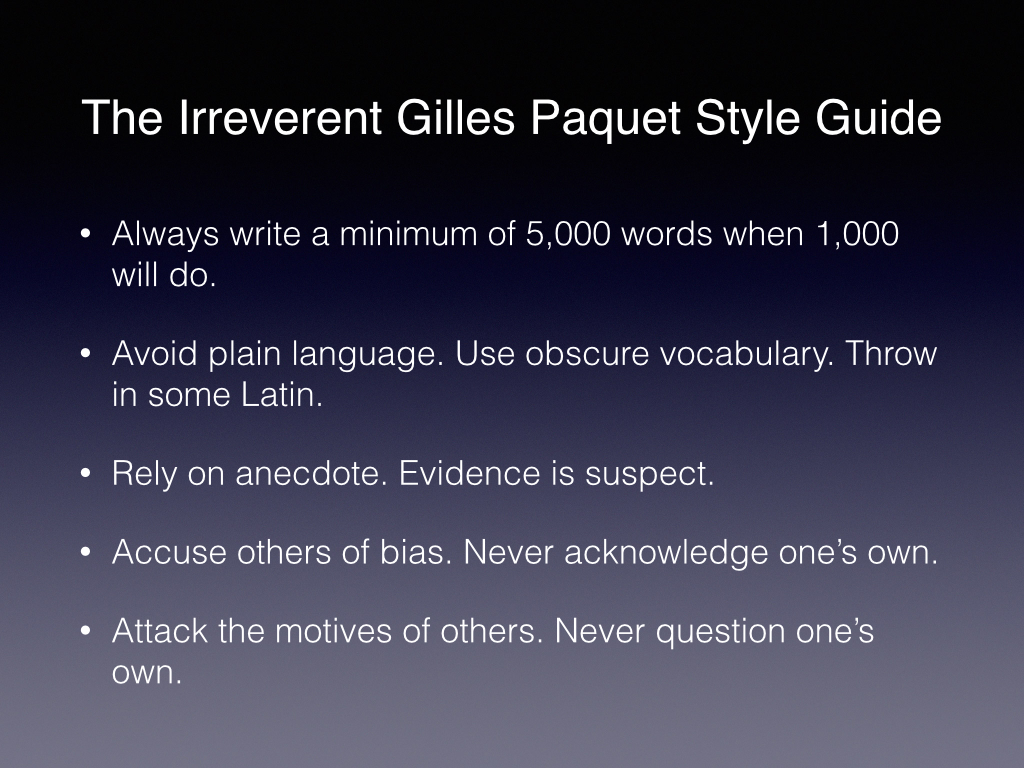
‘Mental Prisons,’ the Public Service and Gilles Paquet

In the spirit of Paquet's call for the "highest and best use of irony and irreverence" and "methodological and intellectual cruelty."

In the spirit of Paquet’s call for the “highest and best use of irony and irreverence” and “methodological and intellectual cruelty.”

My review of Gilles Paquet’s Super-Bureaucrats as Enfants du siècle in the Hill Times:

Ralph Heintzman provoked considerable debate in his Canada 2020: Renewal of the Federal Public Service arguing for an independent, arms-length public service. Ruth Hubbard countered it with The real problem with the public service, arguing that the real problem is competency, not the relationship between the political and bureaucratic levels. Maryantonett Flumian reminds us that politicians are elected, officials are not, and they have to implement government priorities as long as they do not break the law in How public servants support democracy: a response to latest Canada 2020 study.

Gilles Paquet adds his voice in Super-Bureaucrats as Enfants du siècle, which, while focused on officers of Parliament, casts his critique more broadly.

Paquet’s language, as always, pulls no punches. The “tribe” of super-bureaucrats form an “oligarchy.” They have a “sense of superior expertise and total infallibility.” They are agents of “counter-democracy” and impose their “technocratic and ideological views … usurping the role of elected officials.”

Officials practise “active or passive disloyalty” and are guilty of “sabotage.” The “fairy tale” of political reliance on anecdotes versus official reliance on anecdotes led to a “destructive … misuse of power,” which “translated in subterranean efforts to block, derail, or deflect the efforts of fairly able politicians.”

But apart from the tone, what is Paquet’s argument?

That super-bureaucrats, starting with officers of Parliament, but including adjudicatory bodies and the courts, have largely usurped the authority of the government and Parliament through “mandate creep with gusto.”

Their ideology or “diktats of indiscriminate compassion” allow them to portray themselves on the “side of the angels” while pursuing an “unlimited increase of the resources dedicated to the bureaucracy.”

“Super-bureaucrats and higher courts judges have often made unwarranted claims based much more on hubris than on superior competence, and couched in drama-queenesque rhetoric …”

Media and academics have been “defending tooth and nail the sacredness of the super-bureaucrats.”

Other critiques of officers of Parliament have been expressed more in terms of the diminished role of Parliament than of deference to the government (Donald Savoie).

But let’s take Paquet’s argument at face value that the super-bureaucrats and others, including “low-level bureaucrats” like he mentioned, have been actively undermining the government.

I wrote Policy Arrogance or Innocent Bias: Resetting Citizenship and Multiculturalism as more critical of the public service than the government because I felt that we had failed in our role to provide neutral and impartial advice.

We did not acknowledge our ideological and value biases, our evidence base was too slanted towards these biases, and we clung to a narrow interpretation of risk.

But the government also shares some responsibility. It arrived to government with a stronger ideological focus, one that often coloured its perception of evidence and preference for anecdotes (e.g., labour market shortages), and its willingness to discount risk (e.g., recent number of Supreme Court defeats).

But more fundamentally, Paquet is arguing for little or no constraints upon the government of the day.

He devalues the balance that officers of Parliament, adjudicatory bodies, and the courts provide in a context where Parliament no longer plays that role, given increased partisanship, expanded use of time allocation, and omnibus legislation. These trends predate the Conservative government, but have expanded under it.

Moreover, Paquet is also silent on the government’s silencing of those whose statutory role requires them to be a watchdog (e.g., starting with Linda Keen) or kills bodies that provide independent advice (e.g., National Round Table on the Environment on the Economy).

And does he really believe that the original version of Bill C-23, the Fair Elections Act, should not have been challenged?

Reading this paper alongside his companion article, On Critical Thinking, one is struck by just how much Paquet, so critical of others being trapped by their “mental prison,” falls into the same trap.

Is he as mindful of his own biases, ideology, and assumptions as he accuses others of “disingenuity, sophistry, and bullshit?”After all, all three can be found in the left, centre, and right-wing versions of conventional wisdom.

Heintzman’s Canada 2020 report continues to provoke debate (pay wall)


C-24 – Ottawa gives itself new powers to share personal information

Funny, I don’t recall this being mentioned in any of the government communications material:

The powers are included in Bill C-24, an overhaul of citizenship law passed last month, though have drawn little attention. The changes amend the Citizenship Act to allow Stephen Harper’s cabinet to draft regulations “providing for the disclosure of information for the purposes of national security, the defence of Canada or the conduct of international affairs,” including under international deals struck by Citizenship and Immigration Minister Chris Alexander.

Cabinet will also now be permitted to allow the “disclosure of information to verify the citizenship status or identity of any person” to enforce any Canadian law “or law of another country.”

Ottawa contends the final regulations are still being developed and will comply with Canadian law. However, critics warn the changes could lead to Canada sharing citizenship and immigration details with foreign countries, whether verified or not, without oversight.

“This language gives them another legal basis for sharing information,” said immigration lawyer Lorne Waldman, who represented Maher Arar at a federal commission of inquiry a decade ago.

Mr. Waldman said the perils of unfettered information sharing are illustrated by that case. Mr. Arar, a Canadian of Syrian heritage, was jailed and tortured in his homeland, after RCMP wrongly flagged him as a terrorism suspect.

“Go back to Maher Arar,” said Mr. Waldman. “Sharing information is fine, but when you share information, make sure that the information sharing is accurate.”

But consistent with the Government’s approach to C-13 (cyber-bullying and surveillance).

Ottawa gives itself new powers to share personal information – The Globe and Mail.

Federal government turning to Dragons’ Den to shake up policymaking

Interesting. Is this part of transition planning for a future government that may be more willing to loosen the reins?

Or is it more “make work” given that we have a government that, for understandable – if not necessarily justifiable – reasons, prefers to limit discussion and debate, and reduce the independence of watchdogs.

How much latitude does the government want bureaucrats to have, given their perception, not completely unfounded, of our biases?

Will future governments bring us “back to the good old days” (which were not so good anyway) or not?:

According to the briefing documents, some of the innovative policy ideas the government is looking to test as pilot projects could include using social media or other tools to engage or consult the public, end users and others to help inform policy development; or creating a “tiger team” to address specific, time-limited objectives.

Other examples of possible pilot projects include using open data, such as launching a challenge to design apps, or innovative “social finance instruments” to help address social problems.

The deputy ministers’ committee was created in November 2012 and originally called the DMs’ “committee on social media and policy development.” It was initially mandated to consider links between social media and policymaking, including new models for policy development and public engagement.

As of December 2013, the committee was asked to move beyond social media to examine trends and new technologies to help improve and transform policy development.

Yet, the rise of social media and its impact on how government communicates its messages and develops policy remains a concern to the government, according to the documents.

“Many governments around the world are seeing their authority decrease as autonomous networks of citizens and stakeholder groups emerge, decreasing the impact of governments on public policy. Concurrently, the public is becoming less deferential to authority,” the documents note.

The changes in ease of access to information and data are “effectively undoing governments’ monopoly on policy analysis,” says the briefing material.

“Social media is fundamentally changing the nature of citizen-state relations. Citizens increasingly expect democratic governments to be transparent, participative, responsive, and to provide customizable and digital services,” the documents say.

“The speed of social media interactions puts pressure on government to develop quick and coordinated responses, which can conflict with longer-term policy and communications planning and priority setting.”

Federal government turning to Dragons’ Den to shake up policymaking | Ottawa Citizen.

Mothers the latest weapon in U.K.’s fight against terrorism

Another UK initiative to reduce radicalization and extremism:

Now British police are hoping to tap into that mother’s instinct to protect her children. In April, they launched an unprecedented program to encourage Muslim women to contact authorities if they suspect their loved ones are planning to travel to Syria or have already gone.

Women are often best placed to intervene, says deputy assistant commissioner Helen Ball of the Metropolitan Police, one of three senior female police officers running Britain’s counterterrorism operations.

“This is very much about prevention and protection,” says Ball, who devised the program. “It is women who . . . notice a change in behaviour very quickly. We want women to feel confident to come forward, whether it is to police, or a community member they trust or a school teacher.”

Such initiatives — from the benign to the extraordinary — are being taken by governments as they struggle to reduce the number of western Muslims joining the war in Syria for fear they return to cause carnage on the streets of their homelands.

On Tuesday, U.S. Attorney General Eric Holder called the issue a “global crisis in need of a global solution.”

“The Syrian conflict has turned that region into a cradle of violent extremism. But the world cannot simply sit back and let it become a training ground from which our nationals can return and launch attacks,’” Holder said in a speech to Norwegian diplomats and national security officials in Oslo.

… But as Einas Deghayes [mother of an extremist killed in Syria] insists, it is often the mothers who are the last to know what their children are up to.

Mothers the latest weapon in U.K.’s fight against terrorism | Toronto Star.

Robyn Urback: If you want to learn abstinence, go to church. Get Christian sex-ed out of secular public schools

A reminder of other forms of fundamentalism.

It is not just the anecdotes cited by Urback regarding the effectiveness of abstinence approaches; the contrast between California and Texas is striking (Texas Isn’t Keeping Up With National Drop in Teenage Births):

The Pregnancy Care Centre taught courses in about 60 Edmonton-area schools last year, according to executive director Norah Kennedy. She says that their presentations do not explicitly mention Christianity, though the Centre was founded on religious principles. “We are brought in to speak from an abstinence-based perspective; which differs from abstinence-only presentation,” she told the Edmonton Journal. “We present abstinence as the best and safest choice while also giving them a comprehensive overview of all of their options.”

That may be true (though the Dawsons’ complaints, which have yet to be proven, say otherwise). Even still, an abstinence-focused sexual education program will not offer the same wide-ranging, balanced approach to education that a class without an “agenda” can deliver. Indeed, there’s a difference between a lecturer telling students to use a condom if they must, and a lecturer showing students how to properly put on a condom, why they shouldn’t layer condoms (it happens, amazingly enough), why they should use a condom for both vaginal and anal sex (that happens in high school, too) and what to do if the condom breaks.

Students wanting to know about same-sex relationships, the morning after pill and other religious no-nos should also feel free to do so without judgment; that’s hard to do when someone from a faith-based organization is standing at the front of the class. This might be a human rights issue for Emily and her mom, but it’s arguably more an access to education issue for everyone else. Christian sex education should stay out of secular public schools.

The Edmonton School Board dropped the program offered by Pregnancy Care Centre following the complaint and publicity.

Robyn Urback: If you want to learn abstinence, go to church. Get Christian sex-ed out of secular public schools

Chart of the Day: Hate crimes – Five-Year Trends

Source: StatsCan Police-reported hate crimes in Canada (2008-12)

Source: StatsCan Police-reported hate crimes in Canada (2008-12)

Thanks to New Canadian Media, the Statscan 2012 hate crimes report is getting some attention (reporting Share News):

There were 82 more hate crime incidents in Canada in 2012 than in 2011. Some of the increase is partly due to improvements in reporting by some police services.

The study lists Hamilton, Thunder Bay and Peterborough as having the highest incidents of hate crime in Canada.

And the majority, or 82 per cent of hate crimes, occurred in major cities with Toronto, Montreal, and Vancouver leading the way.

Of the hate crimes reported and examined, 75 per cent had been confirmed by police as hate-motivated; and the remaining 25 per cent were recorded as suspected, Statistics Canada said.

Looking at the report, and comparing with the previous four years, some observations:

  • the overall level of hate crimes is remarkably stable (about 1,400 per year);
  • mischief continues to be the most common hate crime;
  • race and ethnicity continue to account for around 50 %;
  • black victims consistently account for about 40 %;
  • Jewish victims range from 53 to 71%, with no trend line ;
  • Muslim victims range between 9 and 15%, similarly with no trend line; and,
  • while victims of hate crimes, save for sexual orientation, are relatively distributed in terms of age, those accused of hate crimes are overwhelmingly young. In both cases, males are predominant.

Some of the disparities in reporting rates (these are police reported hate crimes) reflects the comfort different communities have in reporting to the police.

Muslim hate crimes are likely relatively under-reported given the newness of the community to Canada and likely trust issues with the police.

In contrast,  Canadian Jews are more well established and comfortable reporting to the police, in part given the work of B’nai Brith.

Hate crimes increasing against Blacks and Jews – StatsCan | Share News.

Direct link to the StatsCan report (worth reading):

Police-reported hate crime in Canada, 2012

ICYMI: The Immigrant Advantage – NYTimes.com

The_Immigrant_Advantage_-_NYTimes_comInteresting piece on the relative success of immigrants in the US compared to native-born Americans, particularly in the poorer states with weaker public and other supports:

American scholars have long warned of declining “social capital”: simply put, people lacking the support of others. In Texas, I encountered the wasteland described by writers from Robert D. Putnam on the left to Charles Murray on the right. In mostly white, exurban communities that often see themselves as above the woes of inner cities, I found household after household where country music songs about family and church play but country-music values have fled: places where a rising generation is often being reared by grandparents because parents are addicted, imprisoned, broke or all three.

In places bedeviled by anomie, immigrants from more family-centered and collectivist societies — Mexico, India, Colombia, Vietnam, Haiti, China — often arrive with an advantageous blend of individualist and communitarian traits.

I say a blend, because while they come from communal societies, they were deserters. They may have been raised with family-first values, but often they were the ones to leave aging parents. It can be a powerful cocktail: a self-willed drive for success and, leavening it somewhat, a sacrificial devotion to family and tribe. Many, even as their lives grow more independent, serve their family oceans away by sending remittances.

The Immigrant Advantage – NYTimes.com.

Douglas Todd: We must stand on guard for Canada

Douglas Todd captures the ongoing debate on new Canadians and Canadian values.

I tend to favour Tung Chan’s more pragmatic approach but with a bit more teeth with respect to public and private institutions in terms of setting accommodation limits when they conflict with fundamental equality rights:

Rohani, a businessman who has sat on RCMP diversity committees, and Dosanjh, a lawyer whose biography will be released on Aug. 5, want prospective immigrants to Canada to be taught the essentials of liberal democracy and equality.

“Speaking as an immigrant, if we choose Canada as the best place to come and live, then why aren’t we following its values?” Dosanjh says. “If we want to recreate the society we left behind, why don’t we just stay there? It’s incumbent upon us newcomers to embrace the whole of society, not just its dollars.”

Tung Chan, former head of the government-financed immigrant services society, SUCCESS, is a friend of Rohani’s. But he’s more sanguine about the religion-rooted hazards facing liberal democracy.

Chan would prefer not to highlight the difficulties associated with what he claims in Canada is only the “one per cent who are mal-adapted” and don’t embrace free choice and equality.

Although Chan agrees with Rohani and Dosanjh that new immigrants and all Canadians should be taught about the country’s laws, Constitution, and Charter of Rights and Freedoms, Chan takes a hands-off approach beyond that.

“After the teaching is done,” Chan says, “whether they choose to accept or reject our value system is entirely up to them as long as they do not break the law.”

Dosanjh strongly disagrees, maintaining Canadians shouldn’t be so shy about upholding democratic principles. “Society is not just governed by laws. We have our values, our ethics, our integrity. It’s not a written law, for example, that we should allow people to marry whoever they want to marry.”

Douglas Todd: We must stand on guard for Canada.