Why I am not outraged by the anti-immigration flyer | CanIndia NEWS

A different and provocative take on the Brampton anti-immigration flyer from within the Indo-Canadian community. I think the issue with the flyer was as much over the overall tone and intent of the flyer, as much as the targeting of one specific community:

I spoke with Liberal nominee and Brampton resident Navdeep Bains about the issue and his view was refreshingly balanced, he wasn’t outraged and believed it was important to keep a dialogue going with people with racist views and address their fears rather than shutting them up. When Navdeep was in high school, South Asians were a true minority, his school had a healthy mix of kids representing the Canadian mosaic. One consequence of having neighborhoods with a high density of South Asians means that some of its school have just a handful of Caucasians and a smattering of non-South Asian kids. So while we pay lip service to multiculturalism, our exposure to Caucasians who’ve lived here several generations as well as other Canadians is virtually non-existent.

Perhaps we should introspect and debate the flyer

Rather than expressing outrage and anger against this flyer, there should be reasonable debate about the sensitive issue this flyer has raised. Politicians and community leaders should be out there discussing the fallout of White Flight. Whites fleeing Brampton should be given exit interviews to figure this why they are moving out. Should Brampton have mixed housing, smaller homes for other races who eschew joint families? Do non-South Asians feel unwelcome in Brampton? Are we inconsiderate neighbors? Uncouth even?

Why I am not outraged by the anti-immigration flyer | CanIndia NEWS.
Multiculturalism: Good for the Bottomline and Your Gateway to Global Markets 

Tips on multicultural marketing:

Juliette Mayers the Executive Director for Multicultural Marketing for Blue Cross Blue Shield of Massachusetts shares seven success factors for those desiring to target multicultural consumers:

Do your Homework: Research whether formal or informal is critical to guiding your multicultural marketing program. The research data will inform you on the purchasing habits, lifestyle, and product and service preferences of multicultural consumers. Consult data to help tailor your marketing and advertising campaigns to fit your customers’ needs.

Get Buy-In: Launching a multicultural marketing program must be based on the fact that it makes good, practical business sense. To succeed, it must have the commitment both in human and financial resources and acceptance at all levels of the corporation, beginning at the office of the CEO.

Self Evaluate: It is important to evaluate your services and products to determine if they reflect the cultural sensibilities of consumers you are targeting.

Evaluate Competitors and Industry: Research your competitors and industry’s approach vis-à-vis multicultural consumers and evaluate and review best practices. Ask are there ways we can improve on what’s already being done in the marketplace industry? Then differentiate your brand strategy.

Engage Consumers Through Partnership: Engage in “socially responsible” corporate philanthropy and co-branding marketing programs and sponsorships that are important to multicultural consumers. Positive perception and word-of-mouth advertising are vital to fostering a positive relationship with culturally diverse consumers.

Identify Support Expertise: Outside help can be useful. Find a top quality multicultural/trans-cultural marketing communications firm to assist you. Such expertise can collaborate with your in-house marketing staff and/or advertising agency to ensure your marketing strategies are “on target,”as well as avert any crises that may result from unforeseen issues and perceptions that may arise.

Multiculturalism: Good for the Bottomline and Your Gateway to Global Markets | Colette A.M.Phillips.

Vote à visage couvert: un amendement du Bloc battu

BQ tries to play identity politics on C-23 (Elections Act), perhaps not learning from some of the lessons of the recent QC provincial election. But interesting that this marks the formal acceptance by the Conservative government, after the high-profile berating of Elections Canada for allowing the niqab in 2008 by the Prime Minister:

Ce résultat a « déçu » le député bloquiste, lui qui espérait l’appui des députés conservateurs à sa proposition. Il rappelle que le gouvernement Harper a présenté deux projets de loi pour interdire le vote voilé, deux initiatives qui sont mortes au feuilleton.

« Ils semblent avoir décidé que c’était payant politiquement en 2007 et en 2011, a indiqué M. Bellavance. (…) Ils doivent penser qu’ils n’en ont plus besoin. »

Il reproche au gouvernement conservateur de ne pas tenir compte du fort consensus qui existe au Québec contre le vote voilé.

Vote à visage couvert: un amendement du Bloc battu | Martin Croteau | Politique canadienne.

April Citizenship Processing Statistics – New Tack

Interesting that the Government has shifted its reporting of processing gains from overall national statistics to just highlighting a number of urban centres, comparing April 2014 to April 2013:

Growing number of new citizens in Scarborough (3,200 compared to about half that)

Calgary welcomes more new citizens (1,164 compared to 284)

Montréal welcomes 750 new Canadians (approx. 750, no comparative data for 2013)

Unclear whether change in reporting reflects total national stats not as impressive as previous months, or just a different communications approach. A reminder that consistent performance information aligned to service standards still lacking.

No real increase in Ukraine anti-Semitism, OSCE Rep

Of note:

Rabbi Andrew Baker, who is the Personal Representative of the Chairperson-in-Office on Combating Anti-Semitism at the Organization for Security and Co-operation in Europe, or OSCE, made the statement Tuesday after visiting Ukraine this week.

“There have been several incidents in the last few months including violent attacks which are rare in Ukraine,” Baker told JTA in an email. “By all accounts hate crime incidents in Ukraine are under reported. But apart from these recent events, which many believe were not ‘home grown,’ there does not appear to be any real increase over recent years.”

No real increase in Ukraine anti-Semitism, researcher says | The Times of Israel.

Les fameux avis juridiques sur la Charte restent introuvables

I am not sure what is more objectionable and irresponsible: making apparently false statements about legal opinions or not asking for legal opinions. In either case, another mark against the Marois government:

Dès la première conférence de presse à ce sujet, en septembre 2013, La Presse lui avait demandé si ce projet était soutenu par de tels avis pour expliquer quelles étaient les chances de succès en cour, si la Charte de la laïcité pouvait traverser le test des chartes canadienne et québécoise des droits. M. Drainville avait alors répliqué: «Nous avons la conviction que ce projet-là est constitutionnel. On a des avis qui vont dans ce sens. Mais comme vous le savez, ces avis constitutionnels sont toujours confidentiels, l’ont toujours été et vont le rester.»

L’ex-ministre de la Justice, Bertrand St-Arnaud, avait toujours refusé de confirmer l’existence d’avis juridiques de son ministère sur le projet de loi 60. Mais en campagne électorale, clairement embarrassée, Mme Marois avait laissé entendre qu’elle en avait plusieurs et qu’ils étaient même contradictoires. «Nous avons eu des avis juridiques. Certains nous disent que cette charte pourrait tenir la route. Mais cependant, je tiens à ce point à cette charte que s’il faut aller vers une dérogation, nous le ferons», avait-elle dit, soutenant même que des avis «disent qu’il y a des risques». Peu après, le ministre St-Arnaud avait encore refusé de confirmer que son ministère disposait de tels avis.

Les fameux avis juridiques sur la Charte restent introuvables | DENIS LESSARD | Politique québécoise.

Le PQ n’avait pas d’avis juridique

C-24 Citizenship Act Committee Hearings – 30 April

Good overview by CBC and iPolitics on yesterday’s C-24 hearings. Apart from Martin Collacott of the Centre for Immigration Policy Reform, all other testimony expressed serious concern over the proposed revocation provisions, both on process (how the decision is taken) and substance (should we treat single and dual nationals different, is banishment appropriate?).

Naturally enough, the likelihood or not of the proposed approach being in compliance with the Constitution and Charter was raised again. Minister Alexander on Monday stated that the Bill is in “complete conformity with the requirements of our constitution” (the Government does not release internal legal opinions which are exempt under ATIP). Given the Government’s track record on recent SCC high-profile cases, and any number of other cases, not sure whether Minister Alexander’s certainty is well-placed.

Collacott’s rationale on supporting revocation provisions:

“A survey in 2012 found that eight out of 10 people…agreed that Canadians found guilty of treason or terrorism should lose their citizenship, he said, then mentioned an Ipsos Reid poll from several years earlier that reached a similar conclusion.

“Of course if we started taking away citizenship from every Canadian who was charged with a terrorism act — say, in Russia for activities in Ukraine or a lot of other places — we would have a problem. But I don’t think that’s what the bill’s aimed at. And I don’t think the bill will be misused for that purpose.”

While Collacott is correct on public opinion, having faith in the bill not being misused does not excuse the risks of overly broad drafting, even if one accepts the principle. David Matas of B’nai Brith made the point in noting that “terrorism offence” the term used in the Bill, should be narrowed to “act of terrorism”.

Citizenship has its privileges: committee debates terms of revocation (iPolitics)

Citizenship changes ‘likely unconstitutional,’ lawyers warn (CBC)

David Berger, former Liberal MP and Ambassador to Israel, focuses more on the increased residency and related requirements, arguing:

These measures are counter-productive in the 21st century when people arguably are our most important asset and we should help all of our residents to develop to their fullest potential. Immigrants are particularly critical for Canada, because they account for 67 per cent of our annual population growth.

The removal of flexibility is also out of step with an increasingly globalized economy in which immigrants can contribute to our economy and society through their activities abroad. It also contradicts the goal of the government’s highly touted startup visa which according to Employment Minister Jason Kenney aims to attract the next Steve Jobs or Bill Gates. Immigrants admitted under this program can fully be expected to spend considerable time outside Canada if they are building the next Apple Computer or Microsoft.

Citizen should encourage citizenship

Links to briefs:

Canadian Bar Association

Canadian Association of Refugee Lawyers

B’nai Brith

Centre for Immigration Policy Reform (not yet posted)

Video of 28 April First Session

Ethnic Origin, Age and Religious Views (US)

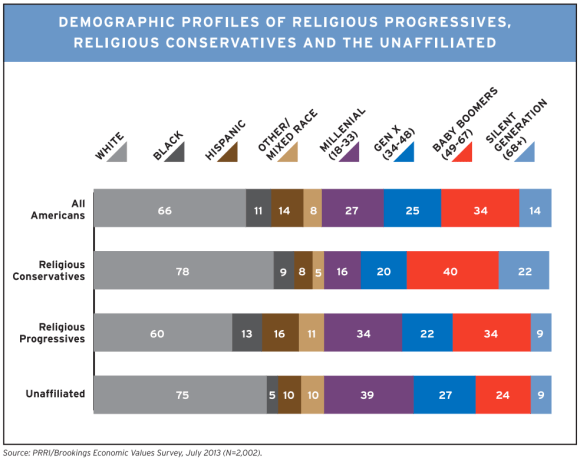
Interesting analysis by Emma Green cross-referencing ethnic origin, age, and religious views in the US:

Blacks, hispanics, and people of mixed race are all more likely to be religious progressives than conservatives; these groups are also among the fastest-growing demographics in the United States. Similarly, Millennials are more than twice as likely to be religious progressives than religious conservatives; in fact, people older than 50 make up more than 60 percent of those who are considered to be religious conservatives. Although it’s impossible to talk to an 18-year-old about her views on culture and predict what she’ll think in two decades, these demographic trends suggest that the religious right is about to start shrinking.

But the question of influence is a little fuzzier. Although more than a third of Millennials are considered religious progressives, roughly 40 percent don’t have any faith at all: A growing number of young people don’t identify with a particular religion. That, along with the fact that an overwhelming majority of religious progressives don’t see religion as “the most important thing in their life,” suggests that faith is losing its overall influence over how people think about social and cultural issues.

Chart Of The Day « The Dish.

Canada hires rookie groups to lead Ukraine election observers

While not clear why the Government chose inexperienced organizations to lead Canada’s team of observers to Ukrainian elections compared to Canadem (public service advice was clear), the size of the delegation reflects diaspora politics. Understandable that governments want more visibility than contributions to international organizations, but still questionable:

Canada’s assignment of such large numbers of bilateral observers — the Liberals did it first in 2004, and the Conservatives have followed suit — has continued despite internal warnings.

One such warning came from Bob Johnston, a regional director general with the former Canadian International Development Agency, in a January 2012 memo.

Johnston recommended Canada channel its election observation efforts through the internationally recognized leader in the field, the Organization for Security and Co-operation in Europe, or OSCE.

However, Johnston noted the government may want to send in short-term bilateral observers “to demonstrate Canada’s commitment to Ukraine’s democratic development” — a message that Prime Minister Stephen Harper and his cabinet have repeatedly emphasized.

“If this option is selected, Canadem would again be the only possible partner,” Johnston wrote.

Johnston’s boss, then CIDA president, Margaret Biggs, agreed.

“Canadem, a Canadian NGO with a long track record of recruiting, training, and deploying election observers, is the proposed implementing organization,” Biggs wrote in a July 2012 memo. CIDA has since been merged into Foreign Affairs….

Veteran Canadian election observers, who have served on numerous international missions, criticized the government for sending such large numbers of bilateral observers when no other country does so. They agreed to speak on the condition they not be identified because all are independent contractors who rely on international work for their livelihoods.

They say the government is sending large numbers of observers to win votes at home because there are an estimated 1.2 million people of Ukrainian descent in Canada.

“You’ve got the gold standard with the OSCE, and we’re sending the maximum contribution we can send anyway. On top of that, for domestic political reasons we’re sending another however-many-Canadians for no reason at all,” said one observer.

Canada hires rookie groups to lead Ukraine election observers.

Middle Easterners Make Up Majority of Second-Citizenship Applicants, Report Says – Middle East Real Time – WSJ

Not surprising:

But statistics in a new report commissioned by Arton Capital, one of those firms, suggest people from the Middle East have come to dominate the citizenship-for-investment landscape.

Just shy of 60% of the world’s super-wealthy who apply for second citizenships come from the region, by the reckoning of Wealth-X, an information company that crunched numbers for the report. Despite containing just 5% of people classified as “ultra high net worth individuals” – multi-millionaires and billionaires – the Middle East now accounts for a majority of the world’s uber-wealthy citizenship-seekers.

Political instability probably has a lot to do with it. Since the Arab Spring erupted in 2011, scores of wealthy people from countries like Lebanon, Egypt and Syria have jumped on the second-citizenship bandwagon as a way to ensure they can still travel, do business and even relocate their families permanently if need be in the fact of instability. People from Lebanon, beset by spillover from Syria’s civil war, made up 15% of second-citizenship applicants, according to the report, while Syrians and Egyptians each made up 7%.

Middle Easterners Make Up Majority of Second-Citizenship Applicants, Report Says – Middle East Real Time – WSJ.