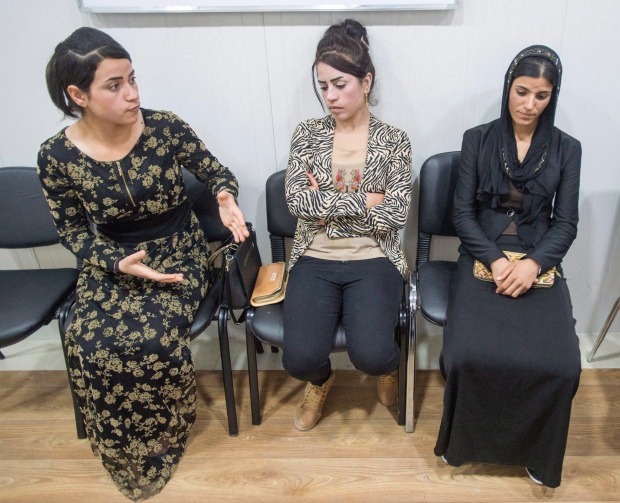
Were the brides of Islamic State cloistered housewives or participants in atrocities?

More background on the women who joined or supported ISIS:

Thousands of foreign-born women left their homes and lives to join Islamic State and marry its fighters. But now that the militant group’s so-called caliphate is reduced to crumbled masonry and scorched rebar, many of them want to return home.

Shamima Begum was a teenage schoolgirl in east London when she left home to join Islamic State; Hoda Muthana, an Alabama-born college student; Kimberly Gwen Polman, a 46-year-old single mom in Canada studying to be a children’s advocate. Now they’re held in a Kurdish-controlled prison in the hinterlands of eastern Syria, asking to be let back into their home countries.

The women branded “ISIS brides,” using initials for the militant group, have become a focal point of fierce debate for governments worldwide: What are states’ responsibilities toward these women?

A central question in that debate is what exactly did the women do in the caliphate? Were they cloistered housewives largely ignorant of the group’s realities, or active participants in its genocidal acts?

Women initially did not join combat

When Islamic State declared the establishment of its caliphate in 2014, it called upon all able-bodied Muslims to emigrate and engage in jihad, or struggle, to further its cause.

Initially, for women, that didn’t include combat, said Charlie Winter, a senior research fellow at the International Center for the Study of Radicalization at King’s College London.

“The role of the Muslim woman ideally was to be a wife and bear children,” he said in a phone interview, “and as a wife and a mother they were participating directly in jihad because they’re creating the next generation of fighters.”

While its militants were waging what Islamic State called “offensive jihad” — blitz campaigns that saw the group put a third of Iraq and Syria each under its dominion — women were to be “bases of support” for husbands, fathers and sons, one wife explained.

Hayat Boumeddiene, the widow of Amedy Coulibaly, the Paris gunman who killed five people in two January 2015 attacks, offered advice for fighters’ wives during a interview in an Islamic State magazine.

“Be advisors to them. They should find comfort and peace with you,” she said in an article in the February 2015 issue of Dabiq. “Do not make things difficult for them. Facilitate all matters for them.”

As a wife and a mother they were participating directly in jihad because they’re creating the next generation of fighters.

Boumeddiene, who like her husband was born in France, is still at large and being sought by French authorities.

Women did claim more operational roles in suicide attacks outside Islamic State territories, said Devorah Margolin, a senior research analyst at the War Studies Department of Kings College London.

But most women who traveled to the caliphate intent on reaching the battlefield were unable to do so.

That changed to a degree as the group began to lose territory and many of its fighters were killed. It began to wage “defensive jihad.”

“By 2017 and 2018 they were proactively calling for women to engage in combat as well,” said Winter.

But there is little evidence women did so in large numbers.

Winter said there had been rumors of women given explosives and weapons training, but Islamic State never confirmed these reports.

There had been predictions women would increasingly take part in suicide bombings, since they generally have an easier time passing through checkpoints and whose faces could remain hidden under their garments.

There was also precedence for their deployment: Abu Musab Zarqawi, the spiritual godfather of Islamic State, dispatched Sajida Rishawi with a suicide vest to the Hotel Radisson in the Jordanian capital of Amman in 2005. She failed to detonate her bomb but was caught by authorities after her husband’s device killed 38 people.

Some carried guns in the religious police force

Islamic State’s religious police, known as the Hisbah, roamed its territory to ensure residents were complying with the caliphate’s harsh edicts. People found in violation faced imprisonment, whipping and amputation. An all-female police force known as the Khansaa Brigade was an integral part of the Hisbah.

“We saw women in the Hisbah. They were all armed,” said Saad Ubaidi, who owns a beauty salon with his wife in Mosul, Iraq.

“Iraqi women had guns, but the foreigners carried ghadaraat,” said Ubaidi, using the slang term for Uzi machine guns.

Women played a vital part in the propaganda war

Women may not have fought on the battlefield, but they helped Islamic State spread its message.

“They were very much part of the propaganda machine of this state-building process,” said Margolin, who is writing a report on women’s role in violent Islamist groups for George Washington University’s Program on Extremism.

Women were some of Islamic State’s most active recruiters online, she said.

Blogs and social media accounts ostensibly held by foreign-born female adherents advertised their lives as if they were in an Islamist utopia. They encouraged others to do hijrah, emigrate to the caliphate.

Some would provide a guide on how to avoid being identified as someone traveling to Syria to join Islamic State. Others would suggest what to pack for life in the caliphate (makeup and Islamic clothing, according to one blogger), or offer quotidian details on how the group assigned housing to fighters and women.

Others would cheer for the group’s barbarism and gruesome tactics.

Muthana, the Alabama-born student and daughter of a Yemeni diplomat who joined Islamic State in 2014, exhorted Americans to follow her lead.

“Soooo many Aussies and Brits here,” she tweeted from her now-suspended account. “But where are the Americans, wake up u cowards.”

She encouraged those who couldn’t travel to Islamic State territory to conduct terrorist attacks in the U.S.

“Veterans, Patriot, Memorial etc Day parades..go on drive by’s + spill all of their blood or rent a big truck n drive all over them. Kill them,” she tweeted.

Women took part in the enslavement of Yazidis

In August 2014, the extremists surrounded Mt. Sinjar in northwestern Iraq. They began to hunt the Yazidis, an ancient religious minority long persecuted for their beliefs, which include elements of Christianity and Judaism. Islamic State viewed them as devil-worshipers.

Thousands of Yazidi men were slaughtered; women and girls were kidnapped and driven away to be sold in markets or given as gifts. In their enslavement, the women and girls would be servants to the household’s wife and raped by the husband.

One wife of an Islamic State member with a Yazidi enslaved in her household defended the practice in an issue of Dabiq. Her article was entitled “Slave-girls or Prostitutes?”

The woman, who called herself Umm Sumayyah al Muhajirah, cited religious texts and the works of scholars to construct an argument for taking Yazidi women as concubines. And she dismissed reports of abuse, attributing them to “devious and wicked slave girls” who “made up lies and wrote false stories.”

And whereas sex with a Yazidi slave is permissible, she adds, prostitutes in the West “openly commit sin.”

“Leave us alone with your burping,” she wrote of people judging the slave practice.

Pinning down what each person did will be difficult

Investigators looking for clues to the individual actions of each woman, away from social media, will have a difficult time gathering evidence admissible in a court of law.

“In the U.S., we’ve had 16 people who returned that we know of, 13 have been prosecuted in federal courts, so there’s a system to do it,” said Seamus Hughes, deputy director of the Program on Extremism at George Washington University.

But most of those were people who admitted their actions, he added. For those who don’t, investigators using Islamic State documents, for example, have to have a rock-solid chain of evidence, which is difficult to establish in the chaotic environment of a war zone.

Witnesses, often intelligence or security personnel, are often reluctant to testify in open court, and identifying women dressed in three-layer niqabs, the de rigueur face covering, will be unreliable.

Even the social media presence these women maintained is being lost. Blogging sites like Tumblr or WordPress, and messaging platforms such as Telegram, have aggressively shut down the accounts of Islamic State-affiliated users.

In any case, said Margolin, the women probably weren’t lying when they said they had been mostly concerned with family matters, but that didn’t absolve them of responsibility.

“Yes, they were wives and mothers, but what that means isn’t like what we mean when we think of a housewife,” said Margolin.

As the bearers of the group’s ideology for the next generation of fighters, she said, they were pursuing a higher objective.

“They represented,” said Margolin, “the future and permanence of Islamic State.”

Source: Were the brides of Islamic State cloistered housewives or participants in atrocities?

For Yazidi survivors of Islamic State killings, the nightmares go on

Ongoing legacy of ISIS atrocities:

Ever since Islamic State visited death and destruction on their villages in northern Iraq nearly five years ago, Yazidis Daoud Ibrahim and Kocher Hassan have had trouble sleeping.

For Hassan, 39, who was captured, it is her three missing children, and three years of imprisonment at the hands of the jihadist group.

For Ibrahim, 42, who escaped, it is the mass grave that he returned to find on his ravaged land.

“They burnt one house down, blew up the other, they torched the olive trees two three times…There is nothing left,” the father of eight told Reuters.

More than 3,000 other members of their minority sect were killed in 2014 in an onslaught that the United Nations described as genocidal.

Ibrahim and Hassan lived to tell of their suffering, but like other survivors, they have not moved on.

She will never set foot in her village of Rambousi again. “My sons built that house. I can’t go back without them…Their school books are still there, their clothes,” she said.

‘THEY WANT TO BE BURIED’

As U.S. President Donald Trump prepares to announce the demise of the Islamist group in Syria and Iraq, U.N. data suggests many of those it displaced in the latter country have, like Hassan, not returned home.

Meanwhile, Ibrahim and his family live in a barn next to the pile of rubble that was once their home. He grows wheat because the olive trees will need years to grow again. No one is helping him rebuild, so he is doing it himself, brick by brick.

“Life is bad. There is no aid,” he said sitting on the edge of the collapsed roof which he frequently rummages under to find lost belongings. On this day, it was scarves, baby clothes and a photo album.

“Every day that I see this mass grave I get ten more gray hairs,” he said.

The grave, discovered in 2015 just outside nearby Sinjar city, contains the remains of more than 70 elderly women from the village of Kocho, residents say.

“I hear the cries of their spirits at the end of the night. They want to be buried, but the government won’t remove their remains.” They and their kin also want justice, Ibrahim adds.

When the militants came, thousands of Yazidis fled on foot towards Sinjar mountain. More than four years later, some 2,500 families – including Hassan and five of her daughters – still live in the tents that are scattered along the hills that weave their way towards the summit.

The grass is green on the meadows where children run after sheep and the women pick wild herbs.

But the peaceful setting masks deep-seated fears about the past and the future.

GRATEFUL FOR THE SUN

Until a year and a half ago, Hassan and five of her children were kept in an underground prison in Raqqa with little food and in constant fear of torture.

She doesn’t know why Islamic State freed her and the girls, then aged one to six, and hasn’t learnt the fate of the three remaining children: two boys Fares and Firas, who would be 23 and 19 now, and Aveen, a girl who would be 13.

There is no electricity or running water in the camp where they live today. She doesn’t remember when her children last ate fruit. “Life here is very difficult but I thank God that we are able to see the sun,” she said.

During the day, her children go to school and are happy, but at night “they are afraid of their own shadow”, and she herself has nightmares.

“Last night, I dreamt they were slaughtering my child,” she said.

Mahmoud Khalaf, her husband, says Islamic State not only destroyed their livelihoods. The group broke the trust between Yazidis and the communities of different faiths and ethnicities they had long lived alongside.

“There is no protection. Those who killed us and held us captive and tormented us have returned to their villages,” Khalaf, 40, said referring to the neighboring Sunni Arab villages who the Yazidis say conspired with the militants.

“We have no choice but to stay here…They are stronger than us.”

Source: For Yazidi survivors of Islamic State killings, the nightmares go on

A Yazidi Refugee Family In Canada: When Safe Harbour Isn’t Enough

Good long read by Naomi Buck on the needs of Yazidi refugees.

Bringing them to Canada by itself not enough given the ongoing effects of their trauma and consequent need for more supports. German model of particular interest:

….It’s tempting to assume that survivors of war and displaced persons’ camps would be grateful for the relative safety of a hotel room in Canada. But the Dasnis didn’t know they were safe. All they knew was what they didn’t know: where to find food, how to use the television, whether hotel staff could be trusted, who or what would come next.

“We cried for two days,” Adiba recalls. “It was worse than in the camps. Our cellphones didn’t work, we couldn’t communicate with anyone. My nephew stopped eating. I thought he was going to die.”

On the third day, there was a knock on the hotel room door. Adiba’s older sister, Hadiya, answered. The man introduced himself as Hayder Essw. He was the first person in Canada to speak to them in their native Kurdish dialect. Hadiya’s first words to him were: “Please take us back to Iraq.”

Essw was there to help, but he wasn’t a caseworker or government employee. He’s a member of the tight-knit Yazidi community in Toronto, a volunteer who, since the first Yazidi refugees began arriving in early 2017, has spent much of his time tracking newcomer arrivals.

Essw reassured the women that things were going to be all right. Now that they had been “discovered” by the community, help would begin to flow. And it did.

It came from the government, in the form of financial support and health care coverage, as it does for all government-assisted refugees. But the arduous process of the Dasni family’s settlement has fallen largely to volunteers. This kind of civic engagement reflects well on Canada, providing such volunteers exist and, importantly, have the newcomers’ best interests in mind. But it’s leaving a lot to chance. And it raises critical questions about the government’s ability to meet the needs of a brutally traumatized people. As Jan Kizilhan, a German expert on trauma and the Yazidi, puts it, “It’s not enough to just offer them a safe country.”

Yes, the Canadian government provides Yazidi refugees with free health care, but who finds them a doctor and shows them how to get there? Yes, ESL classes are free, but who helps them make sense of Canadian customs and culture? The government prides itself on taking in a “vulnerable population,” but who makes sure they are getting the help they need to come to terms with their past? Without that, they can’t begin to shape a future.

Over the course of several visits spanning four months, Adiba tells me her story. It’s hard, but she’s determined. She wants the Canadian government to do more for her people. She can’t let go of her relatives back in Iraq — in camps, in captivity or whereabouts unknown.

The family now lives in a randomly furnished bungalow — the lamps are still wrapped in cellophane, a Canadian flag hangs on the wall — on a quiet suburban street north of Toronto. Hadiya, the mother of six, runs the household; she is perpetually cleaning or cooking. There are two constants to our visits. One is her offer of sweet black tea or food from her busy kitchen. The other is Majed El Shafie.

El Shafie, a stocky 40-year-old with plump jowls and a quick smile, is the founder and director of the Toronto-based human rights organization One Free World International. With his bespoke suits and buffed leather shoes, he seems out of place in this modest suburban setting, but Adiba insists he be here for our meetings. “Without him, we would go back,” says Adiba, speaking through a translator. “He is the only one who is helping us with everything.”

…El Shafie prefers not to discuss the details of Adiba’s release in her presence, but he put up half of the US$15,000 price tag and has promised to compensate Adiba’s father in full. Sitting in the downtown office of One Free World International, he speaks openly about the bleak — and controversial — business his organization has entered: buying back ISIS slaves. “That was the going price at the time,” El Shafie says, referring to the ransom. “It keeps going up…. But we’re talking human lives here.”

For El Shafie, freedom of religion must be defended at any cost. According to its website, his organization is active in 28 countries around the world and he is drawn to extreme cases, like that of the Yazidi. The mission is personal. Born into a prominent Egyptian family, he was imprisoned and tortured in Hosni Mubarak’s Egypt for publicly converting to Christianity and promoting the faith. After escaping to Israel, he came to Canada as a political refugee in 2002.

Since the 2014 massacre, El Shafie has been working with Kurdish partners on the ground in Iraq to help Yazidi families buy back their daughters, sisters and wives. He estimates that One Free World has helped to pay, in part or in whole, for the release of 600 women. The funds come from donations to his organization, from fees from his speaking engagements and out of his own pocket.

When he is not meeting with officials in Brussels or Washington, or visiting a war zone, El Shafie spends much of his time with the Dasnis and roughly 20 other Yazidi families newly arrived in Toronto. He sees himself as a kind of godfather to the Dasnis. Some of what he has provided might be considered frills: outings to Canada’s Wonderland, Niagara Falls and Toronto’s harbour, which the sisters cite as the highlights of their time in Canada. But he has also played, in practice if not on paper, the roles of settlement worker and social worker: finding the family a house, acting as guarantor on the rental agreement, providing cash infusions for several months until government benefits kicked in, sourcing doctors and specialists, intervening at the local school and attending to personal emergencies.

“Freeing them was one operation,” he says. “But what they face now is tremendously difficult: the stigma, the shame, the memories.” He has lobbied Ottawa forcefully, appearing before and making submissions to the House of Commons immigration committee, asking the government to boost aid to the camps, bring more Yazidi into Canada and provide better mental health support once they’re here.

Germany, home to the largest population of Yazidi outside of Iraq, was the first jurisdiction to focus an aid program on the women and children who had escaped sex slavery. Beginning in early 2015, a small German delegation travelled to camps in the region, screening former ISIS captives for the Special Quota Project, an unprecedented program that brought 1,100 women and children to the southern German state of Baden-Württemberg, where they were given protected housing and intensive medical and psychological treatment. After three years, they can choose to stay in Germany or return to Iraq.

…It’s a question architects of refugee policy grapple with constantly: Who needs it most? And who decides what those people most need?

Jan Kizilhan has spent the last few years finding answers. As the chief psychologist on Germany’s Special Quota Project, the 51-year-old was tasked with selecting which 1,100 Yazidi women would come to Germany for treatment. He interviewed every single one of them and has supervised their therapy in Germany over the last three years.

“The Yazidi suffer intergenerational, secondary and collective traumata,” he says over the phone from his office at the Baden-Württemberg Cooperative State University of Villingen-Schwenningen. “Their treatment requires a high degree of specialization.”

Kizilhan, the grandson of Yazidi killed by Kurdish Muslims in Turkey, emigrated to Germany in the 1970s. His expertise is unique, and Canada’s parliamentary immigration committee consulted with him via video conference in November 2016 while IRCC was formulating its plan for the Yazidi. Having been very clear about the importance of addressing their psychological needs, Kizilhan has been perplexed to hear from colleagues and friends in Canada that therapy is playing a minor role, if any, in their settlement. “If you don’t help these people with their health, they have no hope of integrating,” he says. “Mentally, they are not in Canada, they are still in Kurdistan, in Iraq.”

IRCC turned down a request for an interview for this article, but department spokespeople responded to questions by email. They emphasized that the Yazidi “are a very vulnerable population” and that the government is “conscious of not doing anything that may re-victimize or re-traumatize them.” They also stated that “all resettled refugees are linked to appropriate support services,” and that their health coverage, the Interim Federal Health Program, covers 10 hours of counselling sessions, with the possibility of more, if required. More recently, an IRCC spokesperson added that “the department is following families closely,” and that staff meet weekly to discuss how the families are adapting.

via A Yazidi Refugee Family In Canada: When Safe Harbour Isn’t Enough

Canada ‘on track’ to resettle 1,200 victims of ISIS genocide, sexual slavery – Politics – CBC News

Canada is on track to resettle 1,200 survivors of ISIS atrocities by year’s end, and the vast majority of those who have arrived so far are Yazidis:

Critics have accused the Liberal government of hiding details about the special program.

Immigration Minister Ahmed Hussen recently announced that 800 survivors had been brought to Canada but did not specify at the time how many of them were Yazidi.

According to new information provided to CBC News by Immigration, Refugees and Citizenship Canada, 81 per cent are Yazidi. About 38 per cent have come from Iraq, another 36 per cent from Lebanon and 26 per cent from Turkey.

All remaining arrivals are expected to be from Iraq, and the government is “on track” to meet its commitment, said IRCC spokeswoman Nancy Caron.

“We are continuing to conduct interviews, process applications, arrange for approved applicants to travel to Canada and provide settlement supports upon arrival,” she said. “We are continuing to monitor recent political developments in the region and any possible implications this may have on our operation.”

Calls to up intake in 2018

As the special operation continues, there are already calls for the government to boost the number next year.

“I believe that we can do more, to increase the numbers from 1,200, which is such a small little number to the size and the measure of the genocide we saw happening to their community,” said Majed El Shafie, founder of human rights advocacy group One Free World International. “Increasing the number to 3,000 or 4,000 I think is doable; the Canadian government can do that.”

One of the people his organization is helping to resettle is Melkeya, whose last name will not be published to protect Yazidi relatives still in Iraq.

She said she is grateful for the support she has received in Canada but is finding it difficult to live on the monthly allowance of $800.

‘We feel safe here’

“We feel safe here, but we want them to help to bring more Yazidis to the country,” she said in Arabic through a translator. “We are very thankful to the Canadian government, but even the support that we are receiving from them, it’s just enough to pay the rent.”

Melkeya told CBC News reporter Makda Ghebreslassie about the horrific experience of being rounded up, held captive and sold by ISIS militants to a man older than her father who beat and raped her.

She said she would “prefer to die than live this kind of life.” Melkeya managed to escape with the aid of a smuggler her family had paid $12,000 US.

Her sister-in-law, Basema, said she faced a similar fate: sold seven times and raped repeatedly. Her eldest son was captured and held as a child soldier, forced to convert to Islam. And there were other atrocities.

“I witnessed a girl 10 years old, Yazidi girl, who was raped in front of me,” she said, sobbing. “I am 30, I can handle it, but she was 10. She couldn’t even sit down from the pain after they raped her.”

Winnipeg-based Yazidi advocate Hadji Hesso is also urging the government to play a global leadership role by at least doubling this year’s intake to 2,400 next year.

No infrastructure

“To survive in the Middle East is very hard since their entire region has been destroyed,” he said. “There is no infrastructure or foundation, never mind the people who have been raped and killed and enslaved.”

There is no plan to bring in more Yazidis beyond the current federal program.

“At this time, we are focused on fulfilling our commitment to resettle survivors of [ISIS] including Yazidis. We will not speculate on any future commitments at this time,” reads a statement from Hussen’s office.

 ‘It’s a social and cultural shock to be moved away from your own community.’– Jean-Nicolas Beuze, UN refugee agency

On Oct. 25, 2016, MPs unanimously supported an opposition motion sponsored by Conservative MP and immigration critic Michelle Rempel to bring an unspecified number of Yazidi women and girls to Canada within 120 days. In February, Hussen announced that the target would be 1,200 by the end of 2017.

The Yazidis are a religious minority based mainly in northern Iraq, with a culture dating back 6,000 years. ISIS has targeted them in brutal attacks since August 2014.

Massacre, sexual slavery

Last June, a United Nations report declared that the slaughter, sexual slavery, indoctrination and other crimes committed against the 400,000 Yazidi amounted to genocide. Its finding that the militants had been systematically rounding up Yazidis to “erase their identity” meets the definition under the 1948 UN Convention on Genocide.

Jean-Nicolas Beuze, a representative of the UN’s refugee agency in Canada, said every effort should be made to support the Yazidis in Iraq, and only the most vulnerable should be resettled.

“A lot of people choose not to resettle because it’s a social and cultural shock to be moved away from your own community when you have regained a little bit of normalcy, safety and access to services in northern Iraq,” he told CBC News. “We need to keep the resettlement for extremely vulnerable cases, maintain the choice of the person.”

Canada modelled its specialized Yazidi refugee program after the first such project, in the German state of Baden-Wurttemberg. Of the 1,000 survivors in the first phase of that project, an estimated 95 per cent are Yazidis and the other five per cent mostly Christian, spokesperson Christoph Neethen told CBC News.

He said some of the women and children are now living nearly independently and some are working in either paid or volunteer positions. Others rely heavily on supports, including the elderly, who are partially illiterate.

Source: Canada ‘on track’ to resettle 1,200 victims of ISIS genocide, sexual slavery – Politics – CBC News

Newly arrived Yazidis who escaped sex slavery of ISIS eager to build better future in Canada

Another article on Yazidis in Canada, focussed on London:

It’s here in London — where about 300 Yazidis have formed a small but tight-knit community since the early 1980s when they fled the dictatorship of Saddam Hussein — that Bhasa and other recently arrived Yazidis hope to start building a new life for their families and try to move beyond the horrors they suffered in captivity.

Dalal Abdallah, a Yazidi human rights activist who lives in London, says members of her community have been donating clothing, hygiene products and toys for the families who have arrived and look forward to absorbing more into their community.

“For many, many years, we have been struggling [to grow] as a community because no Yazidis were coming through,” she said. “It’s a great opportunity to build our community, and the more people, the merrier.”

She said London has already accepted and integrated Syrian refugees and that there’s enough support for Yazidis, including a program at Victoria Hospital to help refugees deal with trauma.

Other support comes from London’s Cross Cultural Learner Centre, where Yazidis can learn some basic tools for integrating in Canada: how to get housing, set up bank accounts, apply for health cards.

“We are here to support them, welcome them, make them feel comfortable, that they are not alone here,” said Omar Khoudeida, a Yazidi interpreter who works at the centre and who himself came to London nearly 20 years ago as a refugee.

“There’s a community behind them and supporting them.”

But even with that support, Bhasa must still cope with the emotional fallout of a family torn apart by genocide.

She fears being identified. Although she doesn’t know the fate of family members in Iraq, she’s worried that going public could put them in danger. She hasn’t seen her husband and other male relatives since ISIS invaded her home in August 2014.

Daughter still missing

She also fears for her daughter, who was nine years old when she was snatched by the Islamist militant group.

“They took her. She doesn’t know anything about her,”  Khoudeida said.

While ISIS targets all communities, it has particular antipathy for Yazidis, whom it considers to be infidels.

Iraq Cda Yazidis 20170222

ISIS survivors Suham Haji, from left, Samira Hasan and Saud Khalid sit in the Dohuk Girls and Women Treatment and Support Centre in Dohuk, Iraq. The three women are among 900 being treated at the centre after escaping ISIS captivity. (Ryan Remiorz/Canadian Press)

Last June, a UN commission declared in a report that ISIS was committing genocide against the religious group of about 400,000. ISIS, it said, was subjecting “every Yazidi woman, child or man that it has captured to the most horrific of atrocities.”

Source: Newly arrived Yazidis who escaped sex slavery of ISIS eager to build better future in Canada – Canada – CBC News

Liberals unveil resettlement plan for 1,200 Yazidis and other victims of ISIS

One of the few areas that the Conservative opposition has made a positive contribution. Michelle Rempel deserves full credit for pushing the government:

Canada plans to resettle 1,200 Yazidi refugees and other survivors of ISIS by the end of this year.

Immigration Minister Ahmed Hussen announced today that nearly 400 survivors have already arrived in Canada in the last four months since the House of Commons unanimously supported a Conservative motion that called on the government to provide asylum to an unspecified number of Yazidi women and girls.

Of those, about 74 per cent are Yazidi.

Canada has been given consent from the Iraq and Kurdish regional governments, which are supporting and co-operating with the plan, Hussen said.

The motion recognized that ISIS, also called Daesh, is committing genocide against the Yazidi people and holding many of the group’s women and girls as sex slaves.

Hussen said many of the newcomers will have far greater needs than other refugees who have come to Canada.

“Many have experienced unimaginable trauma and vulnerability, both physical and emotional, and many will have unique physical, psychological and social needs, such as trauma counselling,” he told reporters at a news conference in Ottawa Tuesday.

Survivors arriving at ‘controlled pace’

The survivors have been arriving on commercial flights at a “controlled pace” to avoid over-burdening support services. The federal government will also work with provincial, territorial and municipal governments to ensure unique ongoing needs are met.

Although the motion referred only to providing asylum to Yazidi women and girls, the 1,200 refugees will include male family members. Hussen said ISIS also deliberately targets young boys, so the program will help resettle all child survivors of ISIS.

The government will also facilitate private sponsorships of Yazidi refugees, he said.

Source: Liberals unveil resettlement plan for 1,200 Yazidis and other victims of ISIS – Politics – CBC News

‘International leadership:’ MPs chart new course by bringing Yazidi genocide survivors to Canada

Not to be underestimated:

With less than four months to move as many several thousand Yazidis to Canada from conflict zones and refugee camps, MPs will learn from officials this week about the complex security and operational hurdles ahead.

Last month, the House of Commons unanimously adopted a Conservative motion to provide assistance and asylum to survivors of ISIS genocide, mainly from within the Yazidi ethnic minority group. Now, the government must develop a quick action plan that steps outside the traditional United Nations process.

The Yazidi genocide survivors are currently trapped in high-conflict areas in Northern Iraq or waiting in refugee camps in Syria, Greece and Turkey.

On Thursday, MPs on the citizenship and immigration committee will hear about the biggest challenges, first from Canadian officials who were dispatched to northern Iraq on a fact-finding mission, then from German officials about their own experience helping to rescue Yazidi refugees.

Liberal MP and committee chair Borys Wrzesnewskyj said Canada could chart a new process for the world by helping the most vulnerable victims of atrocities outside the UN regime.

Calling this a “new reality,” he said Canada must not wring its hands in the face of horrors, but rather adapt and act with moral authority.

‘International leadership’

“There’s clearly a lack in the established frameworks, and perhaps this is a role Canada can take on internationally and lead in,” Wrzesnewskyj told CBC News. “The fact we’re taking in a number of genocide survivors — women and girls who have gone through unimaginable horrors — we’re taking international leadership by doing this.”

Despite the tremendous challenges, he hopes the committee can provide parliamentary oversight to Canada’s process, and even provide a template for other countries to follow.

“There is almost a personal element to this, and we want to make sure we do this in a way that Canadians can point to with pride and say, ‘We made a difference for these genocide survivors,'” he said.

Yazidis are one of the oldest religious and ethnic minorities in the world with a 6,000-year-old culture, based mainly in northern Iraq.

Source: ‘International leadership:’ MPs chart new course by bringing Yazidi genocide survivors to Canada – Politics – CBC News

Yazidi genocide moves onto McCallum’s plate

To watch:

The whirlwind parliamentary study of the plight of Yazidis and other vulnerable groups has finished, and the witnesses and committee members are looking to Immigration Minister John McCallum to make the next move.

The emotional and often partisan study by the House Immigration Committee included calls from survivors of the Yazidi genocide, community advocates, and opposition MPs for the government to take special action to help persecuted Yazidis—a minority religious group targeted for genocide by ISIL (also known as ISIS, Daesh, and Islamic State)—in Iraq and the surrounding territories.

The Liberal-majority Immigration Committee asked Mr. McCallum (Markham-Thornhill, Ont.) to “accelerate” asylum applications by Yazidis fleeing the violence, and to “create and implement special measures to facilitate Canada’s response” in a letter sent through Liberal MP Borys Wrzesnewskyj (Etobicoke Centre, Ont.), the committee chair.

“We’re asking the government to use existing tools that are available in order to fulfill what the United Nations has called for” for the Yazidi population, said Liberal MP Peter Fragiskatos (London North Centre, Ont.), who temporarily replaced Liberal MP Shaun Chen (Scarborough North, Ont.) on the committee during the study.

Conservative MP Michelle Rempel (Calgary Nose Hill, Alta.), a committee member and her party’s immigration critic, sent her own letter to Mr. McCallum calling for the government to once again exempt Syrian and Iraqi refugees from an annual cap on privately-sponsored refugees coming into Canada, and to examine using a special section of the federal Immigration and Refugee Protection Act to bring asylum-seekers to Canada quicker.

NDP MP Jenny Kwan (Vancouver East, B.C.), a committee member and her party’s immigration critic, sent her own letter to Mr. McCallum. Both Ms. Kwan and Ms. Rempel called on the minister to use that special provision in the Immigration and Refugee Protection Act, section 25, to immediately resettle vulnerable people to Canada, and to begin tracking refugees by ethnicity, religion, and sexual orientation, so as to show how successful the government is at bringing in those under the greatest threat.

Mr. McCallum declined to be interviewed on the subject through spokesperson Félix Corriveau, who wrote in an emailed statement that “the minister’s schedule will not allow him to answer your questions.”

The committee will issue a formal report to the minister once Parliament resumes in the fall.

UN refugee agency, UN convention under fire

The Liberal government faces numerous obstacles to the type of quick, large-scale action urged by the committee members and advocates for persecuted minority groups in the Middle East, South Sudan, Myanmar, and elsewhere.

For one, it has already run up a significant bill during a deficit year for its ongoing admission and resettlement of 25,000 government-assisted Syrian refugees, and has committed nearly $1 billion to support those refugees over six years.

Mr. McCallum told Bloomberg last week that his government was having trouble bringing in refugees fast enough to meet the demand of Canadians who wish to privately sponsor their resettlement. However, there was concern among the leaders of some of Canada’s largest cities that they would not have the resources to deal with the large influx of Syrian refugees as the government hit the stride of its mass resettlement effort earlier this year.

The government faces a more technical barrier to the resettlement of Yazidis and other persecuted groups. Many of those people are living in camps or other places of temporary refuge within the borders of their home country. Under the wording of the 1951 UN Refugee Convention, upon which Canadian law is based, those people are not considered to be refugees as they have not left their country.

Canada currently relies upon the United Nations High Commissioner for Refugees (UNHCR), the UN’s refugee agency, to help it select refugees for resettlement, and that agency does not have the mandate to deal with internally displaced people, David Manicom, the associate assistant deputy minister for Immigration, Refugees, and Citizenship Canada, told the committee.

Canada and the international community should look at reopening the UN Refugee Convention to address that issue, said Mr. Fragiskatos.

However, Mr. Manicom said doing so would be too risky, as some signatories to the convention wish to narrow, not expand, their responsibility to refugees under that convention.

To bring in internally displaced people from hard-to-reach areas, the government may have to follow in the footsteps of Germany, which resettled more than a 1,000 persecuted Yazidis following the ISIL attack in 2014 by working with third-party humanitarian groups instead, Mr. Manicom said.

Government officials are planning a fact-finding mission to Erbil in northern Iraq for the fall, he said.

Source: The Hill Times

Do more to help Yazidis, say Tories as audit of 546 refugees shows they only let in 3

Hard to believe, given all the previous and current rhetoric of the Conservatives. Kind of undermines their case even though I am sympathetic to giving priority to communities at greater risk, including the Yazidis:

As the Conservatives push for more help for Yazidis fleeing persecution at the hands of Islamic militants, new information suggests their efforts to do so while in government were minimal.

Data from a controversial audit of Syrian refugee cases ordered by former prime minister Stephen Harper late last spring reveals of 546 people reviewed, three identified as Yazidi, a Kurdish minority group which practices an ancient faith.

Immigration officials also told a House of Commons committee Monday that Yazidis were never highlighted specifically by the Conservatives as a group that should be prioritized for resettlement, even with their targeted approach to resettlement.

The data and the testimony Monday give both the Liberal and the Conservative arguments over Canada’s refugee policy some new energy after the file was a political flashpoint for most of 2015.

The Conservatives’ areas-of-focus policy drew heavy criticism, with many arguing it flew in the face of international obligations that see the UN choose who is resettled. The Tories argued that they were using the UN criteria, but were drilling down within them to ensure the most vulnerable were helped.

The Tories put religious minorities in that category, but the data obtained by The Canadian Press under access-to-information laws suggest the vast majority of landed Syrians whose files were audited were Sunni Muslim, as is the refugee population at large. About three dozen were Christian.

That few Yazidis arrived under their watch is a fact the Tories haven’t dwelled on as they have been pushing the Liberals for more action.

UN ignores ethnicity when prioritizing refugees

Since 2014, the Yazidis have been subject to forced conversions, murder, rape and enslavement at the hands of Islamic militants — actions recently declared a genocide by the UN.

The Tories now say that declaration should put them at the front of the line for resettlement to Canada.

There are, however, numerous policy roadblocks, especially the fact that most are in their home country of Iraq and as such aren’t eligible for resettlement.

Another challenge is that while a person’s faith or ethnicity might be the reason he or she became a refugee, it’s not something the UN looks at when selecting people for resettlement. In fact, the UN expressly asks states not to prioritize groups that way because the most important criteria must be vulnerability.

The Liberals repeatedly asked Immigration Department officials Monday about the policies of the previous government. While in opposition, they had argued that selecting refugees on the basis of religion — as the Tories were believed to be doing — was wrong. The Liberals have resisted calls to do so with the Yazidis.

But the Tories never gave specific instructions to track Yazidis, the officials said.

What about the Tories’ “areas of focus,” the officials were asked. Were Yazidis placed on that?

“There was no specific group put on the list,” Robert Orr, assistant deputy minister, said.

Source: Do more to help Yazidis, say Tories as audit of 546 refugees shows they only let in 3 – Politics – CBC News

Montreal man under fire from Yazidi activists over rescue efforts

Further to the earlier article (Un Montréalais à la rescousse des esclaves sexuelles de l’EI), appears not quite true:

Montreal businessman Steve Maman has been dubbed the “Jewish Schindler” for his efforts to rescue women and girls from sexual slavery in Iraq.

But now Maman is defending himself against questions about his motives, methods and results being raised by politicians, activists and religious leaders from the very minority group he says he has been pouring his time and energy into saving.

In an open letter last week, the signatories questioned a claim they called “dubious” that Maman’s group, The Liberation of Christian and Yazidi Children of Iraq, had rescued 102 women and girls (a number that has since risen to 128) with just $80,000. They also questioned whether the money paid for the hostage release was going back into Islamic State coffers. They are calling for Maman to offer proof of his tactics and the identities of those who have been saved before they will approve his work.

“We ask the friends of the Yazidi people all over the world who passionately support our vulnerable community to stop donating to Mr. Maman until his work is verified,” reads the letter, dated Aug. 26. “If his project is legitimate, safe, and ethical, we will also support him.”

Maman claims he has the backing of the Iraqi and Kurdish governments and credits his success to powerful and influential contacts in Iraq who have assisted his team of front-line workers.

He refutes critics’ allegations and says he is preparing to publicly defend his claims: “I know what I have in my hands. I can take the hit for another month, two months or three months in the media and let people say I’m a fraud and all that. But three months from now we’re going to go out in public and show everything we’ve done.”

Maman’s defence against the criticisms have become more strident in the last few days. He says he initially chalked it up to a misunderstanding that occurs as information is translated from French to English to Arabic to Kurmanji, a collection of Kurdish dialects.

A few days later, he sent a cease-and-desist letter to one of the signatories, University of Chicago Yazidi specialist Matthew Barber, who is a member of Yazda, a group that raises awareness about the Yazidi plight. The letter warned the signatories to end their criticisms or face a $5-million defamation suit.

Source: Montreal man under fire from Yazidi activists over rescue efforts | Toronto Star