ICYMI: I Asked A Computer To Be My Life Coach – Going Beyond Word Clouds
2016/01/16 Leave a comment
 This is an interesting application of big data.
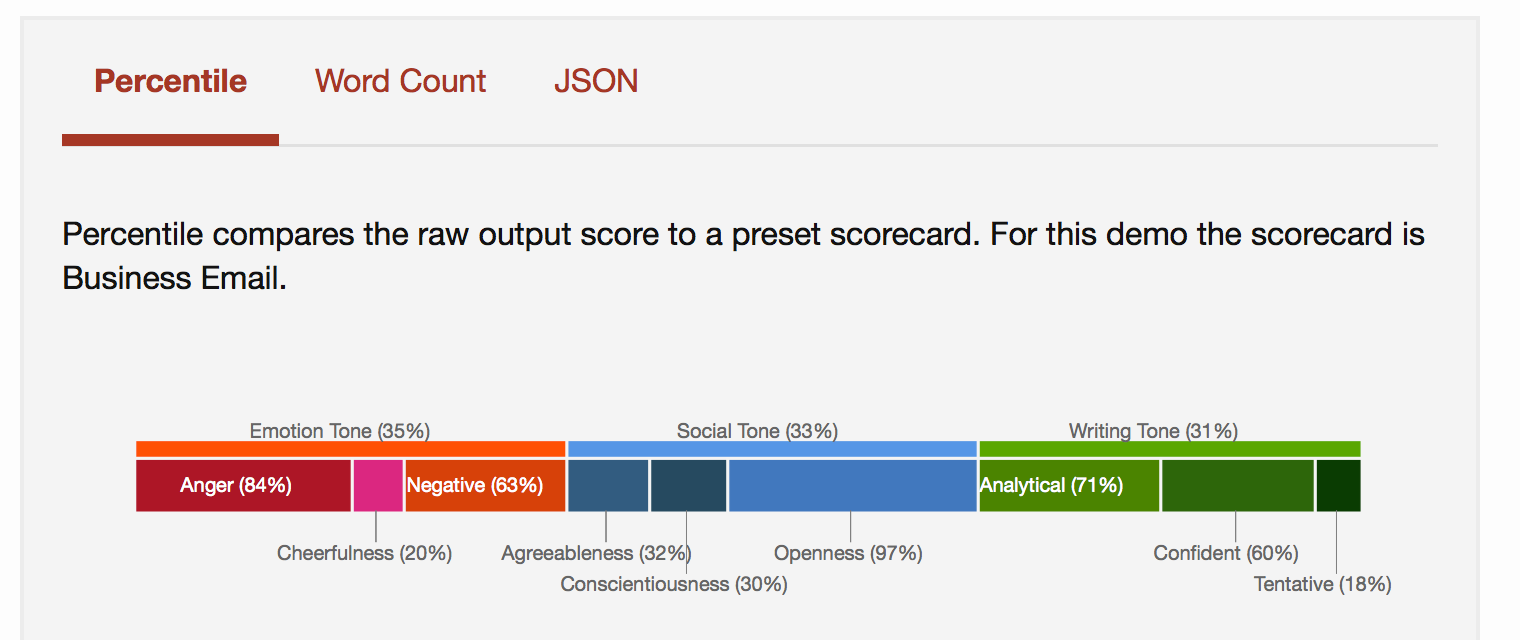
For fun, I tried the demo, which is based upon a business email model, on my post, Implementing diversity and inclusion in Parliament: A more complete picture | My piece in the hilltimes.com.
The above analysis was the result. Readers may wish to experiment with their own texts:
The words you use betray who you are.
Linguists and psychologists have long been studying this phenomenon. A few decades ago they had a hunch that the number of active verbs in your sentences or which adjectives you use (lovely, sweet, angry) reflect personality traits.
They have painstakingly pinpointed various insights. For example, suicidal poets, in their published works, use more first-person singular words (like “me” or “my”) and death-related words than poets who aren’t suicidal. People in positions of power are more likely to make statements that involve others (“we,” “us”), while lower-status people often use language that’s more self-focused and ask more questions. Comparing genders, women tend to use more words related to psychological and social processes, while men referred more to impersonal topics and objects’ properties.
(This 2010 paper in the Journal of Language and Social Psychology goes into great detail about the “psychometrics” of words.)
This research suggests that Internet companies such as Facebook and Google, with their troves of written expressions, are sitting on powerful insights about us as people. But if you ask them, “Hey, can you give me the take on me that you’ve got in-house or that you’ve built for advertisers, with my anonymized data?” — they won’t give it to you. I actually did ask, and they don’t have that kind of offering.
But I’ve found someone who does: IBM’s Watson division. Researchers there have taken the personality dictionaries already created by scientists, dropped them into Watson (the computer that won Jeopardy!), and sent it off to apply it to people on Twitter, Facebook, blogs. That forms a digital population of people and personality types. Over time, more text from more people will help Watson get smarter. (Yes, this is machine learning.)
In its own studies, IBM found that characteristics derived from people’s writings can reliably predict some of their real-world behaviors. For instance, people who are less neurotic and more open to experiences are more likely to click on an ad, while people who score high on self-enhancement (meaning, seek personal success) like to read articles about work.
For IBM, these kinds of interpretations can become a business opportunity.
Understanding people to sell them things is obviously a very big business for marketers. IBM senior researcher Rama Akkiraju suggests other uses: by public relations firms looking for journalists who sound friendly on a specific topic; by editors who want their writers to set a certain tone; by employers looking for a worker who fits their corporate culture.
“We’re moving to make it easier for people to consume insights,” she says.
This use of Big Data, of course, raises serious privacy concerns, which we have examined in many stories. In this exploration, I decided to take a deep dive into Watson’s personal insights — what they can teach me about my career choices and my love life (yep, really went there).
Source: I Asked A Computer To Be My Life Coach : All Tech Considered : NPR
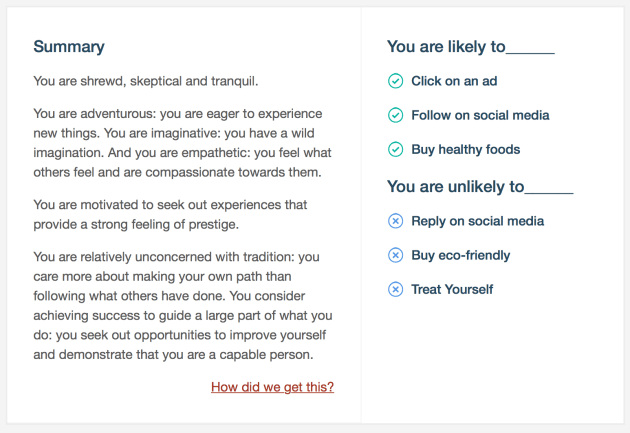
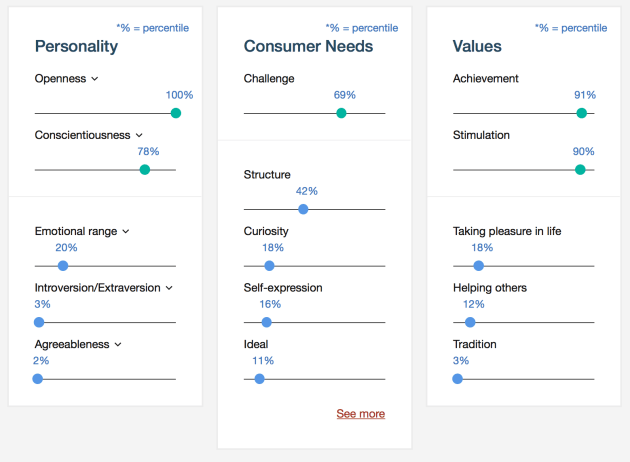
And the Personality Insights tool with respect to the Executive Summary of my book, Multiculturalism in Canada: Evidence and Anecdote:

 Multicultural Meanderings