Wealthy turn anti-immigrant when their riches are threatened

Interesting psychological study, with the fear of loss (absolute or relative) being the motivator (association/correlation, not necessarily causation):

Anti-immigration sentiment rises when affluent people fear losing their wealth, a psychological study has found.

The University of Queensland’s Professor Jolanda Jetten said harsh attitudes towards immigrants were found in times of economic downturn and relative deprivation—and also in prosperous times.

“Affluent people who fear losing in the short or long term experience collective angst about their group’s future vitality and wealth status,” she said.

“Our research found this fuels negative attitudes toward immigrants and minorities. Even though may have a lot, their fear of falling is associated with opposition to immigration.”

Professor Jetten said the research turned accepted wisdom on its head, showing that society’s most economically vulnerable were not always the most supportive of anti-immigration calls.

“In explaining the rise of right-wing populism, many have pointed to the 2008 Global Financial Crisis as the root cause of rising anti-immigrant sentiments,” she said.

“Experts had long believed that economic downturns triggered perceptions of relative deprivation and chances of civil conflict. Moreover, , so the argument typically goes, increase fear and frustration among poor working-class voters. These dynamics are typically referenced when discussing Trump’s victory in the 2016 US presidential elections, and the success of populist parties like One Nation in Australia. The assumption that economic crises combined with individual relative deprivation provide for populism, dominate many of the discussions on the origins of right-wing populism and anti-immigrant sentiments more generally.”

But the new research highlighted wealthier people who might be attracted to such populist parties, said Professor Jetten from the UQ School of Psychology.

“It seems that if you have a lot of money, you feel you have a lot to lose and the fear of falling makes you feel vulnerable and concerned about the future,” she said.

The research team, including Dr. Frank Mols and Dr. Nik Steffens, found an association between opposition to immigration and fear of losing wealth, individually or collectively, across four studies involving a total of more than 1000 people.

“In the laboratory, when we made people feel wealthy they were more opposed to immigration when they were made to feel that they might lose some of their wealth in the future than the group who felt their wealth was secure,” Professor Jetten said.

“In a study among Australian participants we found the their own financial future, or that of Australia’s, will be worse than the present, was associated with more opposition to immigration. The results may help us to explain why support for political parties with anti-immigrant messages sometimes comes from the wealthiest in society. This is important at a time when populist parties and leaders with strong anti-immigrant stances are a force to be reckoned with in many countries.”

Source: Wealthy turn anti-immigrant when their riches are threatened
Immigrant families more likely to own home than add to pension plan, StatsCan says

The impact of rising housing prices and the relative preference and ease for immigrant families to place their wealth in real estate:

Immigrant families who have been in Canada for more than two decades tend to be worth more than families who were born in the country, new data from Statistics Canada released Tuesday shows.

The data agency released an analysis of numbers from 1999 to the 2016 census, comparing immigrant families with those born in Canada and looking at various aspects of their financial lives.

The findings show that both groups have, on the whole, seen a big increase in their wealth over the past two decades.

The average wealth of established immigrant families — those whose major income earner was aged 45 to 64 and landed in Canada at least 20 years earlier — grew from $625,000 in 1999 to $1.06 million in 2016, an increase of $435,000, or more than 69 per cent.

Comparable families where the major income earner was born in Canada are worth less, on average, but saw a bigger gain, from $519,000 to $979,000. That’s an increase of $460,000 or more than 88 per cent.

One reason for the discrepancy may be that immigrant families are much more likely to put their money into real estate. “Compared with Canadian-born families, immigrant families generally hold a greater share of their wealth in housing but a smaller share in [registered pension plan] assets,” the data agency said.

On average, 69 per cent of the wealth increase for immigrant families can be traced to gains in the amount of equity that they have in their homes. That compares to 39 per cent for native-born Canadians.

On the flip side, one third of the wealth gain for Canadian-born families is because of increases in the value of pension plan assets. For immigrant families, that share is just 17 per cent.

Political sociologist Howard Ramos at Dalhousie University in Halifax says it is not surprising to see immigrants being relatively more eager to climb the housing ladder instead of putting their money into other things.

“Many people may not be getting RRSPs or other investments, because they may be self-employed or have had career disruption when they came to Canada,” he said in an interview, “which leads them to the one asset they can control — home ownership.”

“The evidence shows that this as a strategy has paid off in the past and is still paying off for newcomers today,” he said.

Immigrants’ preference for housing as an investment may also be a factor in their willingness to borrow, too. Established immigrant families had a debt to income ratio of 2.17 in 2016, compared with 1.32 for Canadian-born families.

“Most of the difference was due to the larger mortgages carried by immigrant families,” Statistics Canada said.

While their wealth levels may be different, the study shows that there’s little evidence that the two groups manage their finances any differently.

“Specifically, the study finds no evidence that immigrant families use payday loans, withdraw money from registered retirement savings plans or pay off only part of their monthly credit card balances to a greater extent than Canadian-born families of similar age do,” the data agency said.

Ramos says the numbers are some hard data to show that on the whole, immigrants largely become “model economic citizens” who are on the whole doing exactly what was hoped for them.

“It’s interesting to see the evidence of the success of immigrant economics.”

Jelena Zikic, an associate professor at York University’s school of human resource management who studies skilled immigrants, says “they have a mindset of being safe and secure,” so seeking to climb the property ladder makes a certain amount of sense.

“Most of the migrant motivation has to do with ‘I want my kids to be better off’,” she says. “There’s a fear of losing their ground in a new place, so they see [tangible investments] as a way to protect themselves.”

While it may be encouraging to see immigrants becoming wealthier the longer they are in Canada, she says that shouldn’t suggest that they have it easy — quite the opposite, in fact.

She says stories of very qualified skilled immigrants coming to Canada and then having to take low-paying jobs because their credentials aren’t recognized are rampant, something that is bad for them and bad for Canadian society.

“There’s a ceiling effect,” she says. “They enter, but they can’t always progress.”

She adds that those who do succeed often do so because of their own resilience.

“They had very strong motivations to come to Canada, so when they are here they do everything they can [to move up],” she says.

Source: Immigrant families more likely to own home than add to pension plan, StatsCan says

Whites Have Huge Wealth Edge Over Blacks (but Don’t Know It) – The New York Times

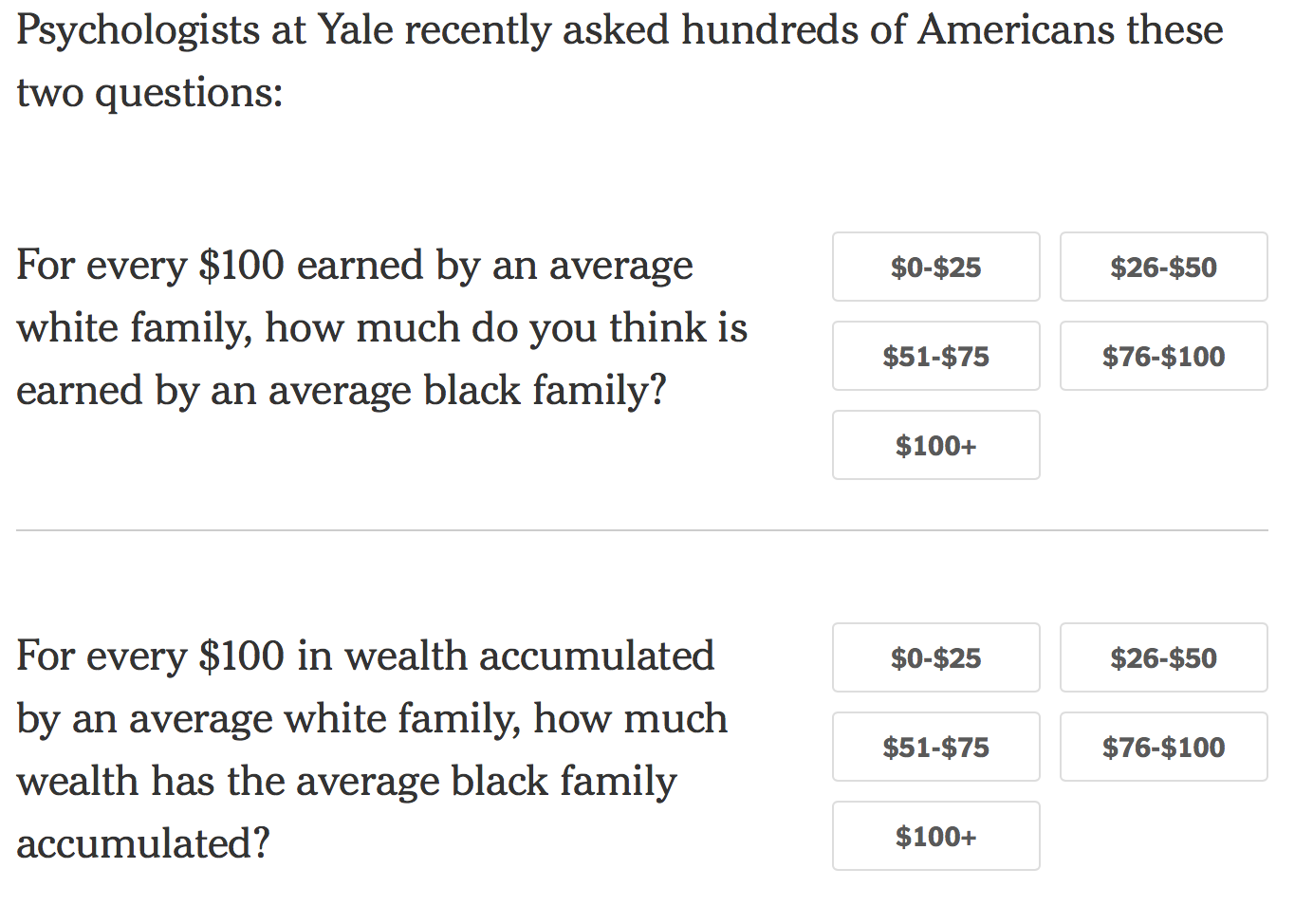
The Yale researchers suspected that many people would not get the answers right.

“I’m a person who studies inequality, who should really know how inequality looks,” said one of the psychologists, Michael Kraus, who researches the behaviors and beliefs that help perpetuate inequality. “And I look at the black-white gap, and I’m shocked at the magnitude.”

Black families in America earn just $57.30 for every $100 in income earned by white families, according to the Census Bureau’s Current Population Survey. For every $100 in white family wealth, black families hold just $5.04.

If Mr. Kraus, of all people, is taken aback by these numbers, what are the odds that most Americans have a good understanding of them? The answer, he and his colleagues fear, has broad implications for how we understand our society and what we’re willing to do to make it fairer.

Americans, and higher-income whites in particular, vastly overestimate progress toward economic equality between blacks and whites, the psychologists reported Monday in the Proceedings of the National Academy of Sciences. Americans believe that blacks and whites are more equal today than they truly are on measures of income, wealth, wages and health benefits. And they believe more historical progress has occurred than is the case, suggesting “a profound misperception of and unfounded optimism” regarding racial equality.

“It seems that we’ve convinced ourselves – and by ‘we’ I mean Americans writ large – that racial discrimination is a thing of the past,” said Jennifer Richeson, who was another of the study’s authors, along with Julian Rucker, a doctoral student. “We’ve literally overcome it, so to speak, despite blatant evidence to the contrary.”

To understand how people have perceived that progress, the researchers asked blacks and whites of varying income levels to estimate answers to the questions above in both recent years and historically. They also asked about how much black workers with a high school diploma but no college degree earn relative to whites of the same education level, and how the earnings of blacks and whites with a four-year college degree compare.

The present-day results, aggregated across several surveys used in the study, are compared here with actual government data:

The researchers suspect that the answer in part has to do with how little exposure Americans have to people who are unlike them. Given how economically and racially segregated the country remains, many Americans, and especially wealthy whites, have little direct knowledge of what life looks like for families in other demographic groups.

But the pattern this study identifies isn’t simply about lack of access to accurate information. As Mr. Kraus points out, popular videos and charts regularly circulate on social media highlighting the startling levels of inequality in America. And yet, many people who click on them forget about the severity of inequality just long enough to be surprised by it again in the future.

“Despite this information being out there, we don’t really take it in,” Mr. Kraus said. This happens “in a way that suggests that maybe we’re motivated to forget it, or motivated to distort it in our own minds.”

He and Ms. Richeson suspect that we also overgeneralize from other markers of racial progress: the election of a black president, the passage of civil rights laws, the sea change in public opinion around issues like segregation. If society has progressed in these ways, we assume there’s been great economic progress, too.

We’re inclined, as well, to believe that society is fairer than it really is. The reality that it’s not — that even college-educated black workers earn about 20 percent less than college-educated white ones, for example — is uncomfortable for both blacks who’ve been harmed by that unfairness and whites who’ve benefited from it.

“It’s very difficult to consider the possibility that some of what we’ve achieved or gained is due to forces that aren’t our own individual hard work,” Ms. Richeson said. “That’s hard to grapple with, especially in American society. We really believe in egalitarianism and meritocracy.”

These findings suggest that the motivation to see the world as fair may be even stronger in this context than stereotypes white Americans hold, for instance, equating blacks with poverty.

The researchers found in some additional surveys that whites answer these questions more accurately when they’re first asked to consider an America where discrimination persists. If we want people to have a better understanding of racial inequality, this implies that the solution isn’t simply to parrot these statistics more widely. It’s to get Americans thinking more about the forces that underlie them, like continued discrimination in hiring, or disparities in mortgage lending.

It’s a myth that racial progress is inevitable, Ms. Richeson said. “But it’s also dangerous insofar as it keeps us blind to considerable inequality in our nation that’s quite foundational,” she said. “Of course we can’t address it if we’re not even willing to acknowledge it.”

And if we’re not willing to acknowledge it, she adds, that has direct consequences for whether Americans are willing to support affirmative action policies, or continued enforcement of the Voting Rights Act, or renewed efforts at school desegregation.