Canada updates list of study programs that qualify international students for work permits

Further tightening:

To better align immigrant selection with Canada’s labour market needs, Ottawa is refining what academic programs are going to qualify international students for the coveted postgraduation work permit.

The Immigration Department has updated its eligibility list, adding 119 new fields of study and removing 178 others based on jobs with long-term shortages. A total of 920 coded programs remain eligible.

The Liberal government has been criticized for the soaring number of international students, who had increasingly used the international education program to come and work in Canada in order to ultimately earn permanent residence in the country.

Many international students enrolled in general programs at institutions that former immigration minister Marc Miller called “diploma mills,” studying in subjects that had no relevance to what’s needed in the labour market.

Last November, the Immigration Department started requiring international students in nondegree programs (programs other than bachelor’s, master’s or doctoral degrees) to complete a program in an eligible field of study to qualify for the postgraduation work permit.

As part of the plan to improve the integrity of the international education system, Miller not only capped the number of study permits issued, but also restricted the access to postgraduation work permits, which could be valid for up to three years and provided the incentive for people to study in Canada.

“It is not the intention of this program to have sham commerce degrees and business degrees that are sitting on top of a massage parlour,” Miller told reporters at a news conference last year. “This is something we need to rein in.” 

According to CIC News, an online media outlet on Canadian immigration, the additional qualifying programs cover health care and social services, education and trades.

However, it said, many of the agricultural and agri-food programs such as farm management and crop production were removed from the list, along with Indigenous education, student counselling and personnel services, environmental studies, building/property maintenance, drywall installation, solar energy technology, airframe mechanics and aircraft maintenance technology, among others.

The Immigration Department says students who applied for a study permit before June 25, 2025, will still be eligible for postgraduation work permits if their field of study was on the list when they applied for their study permit even if it has since been removed.

Source: Canada updates list of study programs that qualify international students for work permits
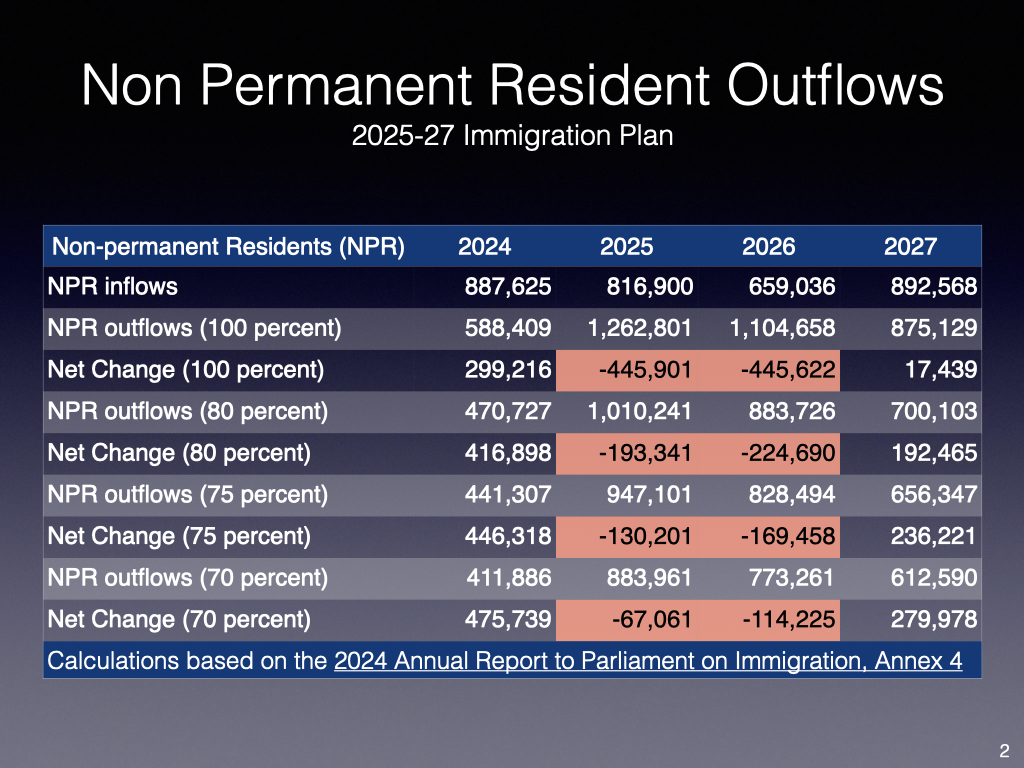

Misleading Canadians: The Flawed Assumption Behind the Government’s Planned Reduction in Temporary Residents

This analysis was prompted by questions regarding the projected numbers of departures with no methodology mentioned, and the suspicion, subsequently confirmed, that it was based on the false assumption that all temporary residents would leave upon expiry of their visa

When IRCC released its annual immigration plan last month, eyebrows were raised over the plan’s prediction of large outflows of temporary residents upon expiry of their visas. The Parliamentary Budget Office noted that “there is significant risk to the demographic projection presented in the Government’s new immigration plan—particularly to the projected outflow of non-permanent residents.” The plan included a table covering projected outflows without indicating the methodology and assumptions behind the table. Subsequently, IRCC has confirmed that the calculations assumed that all temporary residents would leave when their visa expired, save for those who transitioned to permanent residency.

This assumption is just wrong as many temporary residents may well remain in Canada and appears aimed at misleading the public. For illustrative purposes, I revised the plan table to include four assumptions: 100 percent of temporary residents leave (the plan’s assumption), and three alternatives where 80, 75 and 70 percent leave. Should 60 percent or less leave, there would not be any net reduction in the temporary resident population.

The overly precise nature of the numbers—down to individual persons—highlights that the government adapted a purely mathematical approach in its estimates. In the case of permanent resident levels, the government more sensibly uses ranges rather than precise numbers which reflect more accurately operational realities. While politically difficult to admit that some non permanent residents will remain, by not doing so the government attracts more scepticism regarding its plans.

Moreover, as Canada does not track outflows systematically, we will not have accurate data on how many actually leave. The government should explore coordination of flight and CBSA data to obtain better anonymized information on outflows and those who overstay their visa.

The Prime Minister has stated that “Between the amount of people coming and going, we’ll effectively pause population growth for the next two years, then from 2027 onwards, it will balance out and slowly start increasing again at a sustainable pace.” However, this is based on the false assumption that all temporary residents will leave when their visa expires. Unfortunately, as we will not know how many people will stay versus how many people will leave, it will not be possible to verify the extent of errors and estimates.

In short, while inclusion of temporary residents in the annual immigration plan is both overdue and welcome, a more serious approach is needed that better reflects the reality and challenges.

Trudeau says temporary immigration needs to be brought ‘under control’

Better late than never (who let it get out of control?) One of the bigger policy and program fails of this government, one than is damaging the overall consensus in favour of immigration:

Prime Minister Justin Trudeau says the government wants to rein in the number of temporary immigrants coming to the country, saying the situation needs to be brought “under control.”

“Whether it’s temporary foreign workers or whether it’s international students in particular, that have grown at a rate far beyond what Canada has been able to absorb,” Trudeau said at a housing announcement in Dartmouth, N.S.

“To give an example, in 2017, two per cent of Canada’s population was made up of temporary immigrants. Now we’re at 7.5 per cent of our population comprised of temporary immigrants. That’s something we need to get back under control.”

The prime minister then said that this is driving mental health challenges for international students and that more businesses are relying on temporary foreign workers, driving down wages in some sectors.

“We want to get those numbers down. It’s a responsible approach to immigration that continues on our permanent residents, as we have, but also hold the line a little more on the temporary immigration that has caused so much pressure in our communities,” Trudeau concluded.

Immigration Minister Marc Miller said on March 21 Ottawa would set targets for temporary residents allowed into Canada to ensure “sustainable” growth in the number of temporary residents entering the nation. Over the next three years, Miller said the goal is to reduce the amount of temporary residents to five per cent of Canada’s population.

For permanent residents, Canada has a target of 485,000 new immigrants, increasing to 500,000 in both 2025 and 2026.

In their last immigration plan update, the government said there are plans to “recalibrate” the number of temporary admissions to Canada in order to ensure the system is sustainable.

In January, Miller announced a cap on student visa admissions to Canada at 360,000 permits, a 35 per cent decrease from 2023.

Source: Trudeau says temporary immigration needs to be brought ‘under control’

Canada border agent detentions of Mexicans surge to highest levels in a decade

While the removal of the visa requirement for Mexicans is the largest factor, the high number of detentions and asylum determination refusals suggest ongoing enforcement of entry regulations:

Detentions of Mexican nationals by Canadian border agents have surged dramatically this year to levels not seen in a decade, new figures obtained by The Canadian Press show.

According to Canada Border Services Agency, the total number of detentions from Jan. 1 into the first week of September hit 2,391 — roughly six times the 411 in all of last year — and equal to the previous five years combined.

“CBSA cannot speculate why the number has increased,” spokesman Barre Campbell said in an email Thursday. “The agency’s role is to apply Canadian law at the border.”

The sharp increase has contributed to a rise in the rate of detentions of all foreign nationals this year. Figures show agents detained 1,032 people each month this year, compared to 877 a month last year and 993 in 2015.

Experts point to two main factors as the most likely cause of the upswing in Mexicans running afoul of border agents in Canada.

Last December, the Liberal government under Prime Minister Justin Trudeau lifted a visa requirement for Mexicans coming to this country, making it easier to do so. The result was an immediate jump in detentions.

Additionally, the crackdown on undocumented migrants under U.S. President Donald Trump and his threat to remove deportation protections from those foreigners who entered the States illegally as children — the vast majority Mexicans — may also have prompted many of those affected to look north to Canada.

Scott Bardsley, spokesman for Public Safety Minister Ralph Goodale, said on Thursday that Canada was working with Mexican officials to monitor migration trends and address any risks.

“Canadian officials have co-operated closely with Mexican counterparts to lay the ground work for the visa lift and ensure that appropriate safeguards are in place,” Bardsley said in an email. “These efforts include measures to identify and deter irregular migration, including bolstering co-operation on travel-document integrity and traveller screening.”

The last time the Mexican detention numbers were anywhere near current levels was in 2008, at 3,301, border agency numbers show. That year also saw the number of Mexicans seeking refugee status in Canada reach record levels.

In response to what they characterized as phoney refugee claims, the former government under then-Conservative prime minister Stephen Harper imposed an onerous visa requirement in 2009 that meant all would-be Mexican visitors had to provide numerous supporting documents.

“We are spending an enormous amount of money on bogus refugee claims,” Harper said at the time. “This is a problem with Canadian refugee law, which encourages bogus claims.”

Harper’s visa decision resulted in an immediate plunge in detentions and asylum claims that lasted until 2015, with a slight uptick happening last year. However, the requirement angered the Mexican government and civil-rights groups in Canada among others, ultimately leading to Trudeau’s reversal of that decision late last year.

Bardsley defended dropping the visa requirement as a boon to bilateral relations, trade, investment and tourism that he said will result in lasting economic benefits for Canada.

Recent Immigration and Refugee Board statistics also show a dramatic increase in asylum requests from Mexicans this year, although the vast majority of such applications are rejected as unfounded.

In 2016, for example, 242 Mexicans applied for refugee status. Almost three times as many — 660 — were recorded in the first seven months of this year alone. The board does not keep statistics of how many people came via the U.S. rather than from Mexico itself.

The law allows the border agents to detain foreign nationals or permanent residents on reasonable suspicion they pose a danger to the public, may go underground, or where identity is in doubt. The CBSA data relates to detentions not detainees and may include a person detained more than once.

Source: Canada border agent detentions of Mexicans surge to highest levels in a decade | Toronto Star

In Iran, Shock and Bewilderment Over Trump Visa Crackdown – The New York Times

Laying out the impact on people and families (article was written before the weekend chaos):

TEHRAN — Families, businesspeople, athletes and tourists from seven countries in the Middle East and Africa found their travel plans — and even their futures — in a state of suspension on Friday after President Trump signed an executive order temporarily barring thousands from obtaining visas to travel to the United States.

The order is expected to freeze almost all travel to the United States by citizens from the Muslim-majority countries of Iran, Iraq, Libya, Somalia, Sudan, Syria and Yemen for at least 90 days. Three of those countries are considered sponsors of terrorism (Iran, Sudan and Syria), and three are designated countries of concern (Libya, Somalia and Yemen).

Passport-holders from those countries, who have American visas but are outside the United States, will not be permitted to return.

“We only want to admit those who will support our country and love deeply our people,” Mr. Trump said on Friday before signing the order at the Pentagon. “We will never forget the lessons of 9/11, nor the heroes who lost their lives at the Pentagon.”

(The 19 hijackers implicated in the Sept. 11, 2001, terrorist attack came from Egypt, Lebanon, Saudi Arabia and the United Arab Emirates. None of those countries will be subject to what Mr. Trump described as “new vetting measures.”)

During the 90-day period, the Trump administration will assess if the foreign governments on the list are providing enough information about citizens seeking visas to enable the United States to assess whether they pose a terrorism risk. If the governments do not comply, they will be given 60 days to do so; failing that, their citizens will be barred from entering the United States.

Government reaction to the order has been cautious. But there is little doubt that the demand for information will be a challenge for Iran, which sends far more people to the United States each year, around 35,000, than any other country on the list.

While Iran willingly allows its citizens to travel to the United States, it is ideologically opposed to sharing information with Washington. But if it does not, many of its citizens will be cut off from visiting relatives who are among the estimated one million Iranian-Americans living in America.

The visa ban will provide an early indication of where relations between Tehran and the Trump administration are headed, one analyst said.

Photo

The Iranian actress Taraneh Alidoosti in “The Salesman.” She canceled her trip to the Academy Awards on Feb. 26 on news of President Trump’s visa crackdown.CreditHabib Majidi/Cohen Media Group, via Amazon Studios, via Associated Press 

“Trump will regard the Iranian reaction as a test,” said Farshad Ghorbanpour, who is close to the government of President Hassan Rouhani. “If Iran doesn’t comply, they won’t do so either on other issues. We will see in 30 days.”

Another analyst doubted the government would comply with the order.

“We are not obliged to give information about our citizens to the Trump administration,” said Hamidreza Taraghi, considered a hard-liner. “Such a move would be unjustifiable.”

In the United States, Americans of Iranian descent expressed shock and dismay at news of Mr. Trump’s impending policy change, and were particularly concerned about their relatives and friends in Iran.

Trita Parsi, president of the National Iranian American Council, a Washington-based advocacy group, said many Iranian citizens with valid green cards and American visas were distraught. Those outside the United States are fretting they will not be allowed in, and those already in the country fear they will not be able to leave, even temporarily, because they will be barred from returning.

“There is a sense of bewilderment, as well as a sense of injustice,” over why Iran was even included on the list of targeted countries, Mr. Parsi said. No Iranian has been accused of an attack on the American homeland. By contrast, he said, the Sept. 11 attackers included citizens from countries which are not on the list — and “the United States has produced more ISIS fighters than Iran has.”

Iran’s most popular actress, Taraneh Alidoosti, announced on Twitterthat she was canceling her trip to the Academy Awards ceremony in Los Angeles on Feb. 26, after reports that Mr. Trump was about to sign the sweeping executive order.

Ms. Alidoosti plays a leading role in ‘‘The Salesman,’’ directed by the acclaimed Iranian director Asghar Farhadi and nominated for best foreign film. She almost certainly could have obtained a visa as a ‘‘culturally unique artist,’’ but said she no longer felt like making the trip.

“This is not about me or the Academy Awards, it’s about having a discussion about this decision,” Ms. Alidoosti said. “This is such a bizarre ban, it is uprooting people’s lives in ways not imaginable.”

In 2015, according to the Department of Homeland Security, a total of 35,266 nonimmigrant visas were granted to Iranians to enter the United States, compared with 21,381 for Iraq; 16,010 for Syria; 5,549 for Yemen; 4,792 for Sudan; 2,879 for Libya and 359 for Somalia.

GRAPHIC

How Trump’s Executive Order Will Affect the U.S. Refugee Program

The order cuts the number of refugees to the U.S. in half and bars those from Syria.

 OPEN GRAPHIC 

As there is no American embassy or consulate in Iran, Iranians must travel to Ankara, Turkey, Dushanbe in Tajikistan or to Dubai, in the United Arab Emirates, to apply for a visa. The State Department says that more than 40 percent of all applications are rejected. There are numerous agencies in Iran and other countries that mediate and assist Iranians seeking appointments.

Amid Brexit anxieties, Trudeau and Peña Nieto miss the mark [Mexican visa removal commentary]

Good commentary by Steven Murrens on the removal of the Mexican visa requirement:

Secondly, on the travel issue, Canada agreed to lift a visa requirement on Mexican visitors, starting on Dec. 1. It was imposed a few years ago by the previous Conservative government, in response to a spike in Mexicans applying for refugee status in Canada. But the Canadian government made a point of stressing today that, when the visa is dropped, Mexicans would have to apply for a new permit, called an Electronic Travel Authorization (ETA), before coming to Canada.

Steven Murrens, an immigration lawyer with the Vancouver firm Larlee Rosenberg, said the ETA is already proving an effective barrier against the sort of travellers the much-resented visa sought to discourage. The ETA will be required for travellers to Canada from all visa-exempt nations, except the U.S. That means Mexicans will be in the same category as, say, tourists from Europe and Japan, so they can hardly complain.

The online application for an ETA is much less onerous than applying for a visa. Still, Murrens says early experience suggests the ETA will be effective in weeding out problem travellers. “What we’re seeing, from people who are already starting to apply for it even though it’s not mandatory yet, is they do get refused for previous denials of entry to Canada, criminal issues, and…where people may have had previous issues in the United States,” he said.

In other words, on travel, Canada has found a less onerous system that still provides some additional screening. And, on trade, Mexico has finished a gradual process of phasing out trade restrictions. These are not headline-grabbing breakthroughs. They are the incremental signs of a normal international relationship, where friction is inevitable but doesn’t have to be permanently disruptive.

Source: Amid Brexit anxieties, Trudeau and Peña Nieto miss the mark

For the contrary perspective, former Conservative staffer Candice Malcolm, silent on the ETA requirement:

We attracted legions of human smuggling rings and known criminal networks, and spent billions of dollars propping up this charade.

We would get nearly 1,000 refugee claims per month from Mexico alone.

Hence why, in 2009, the Harper government brought in tougher laws and required people from Mexico to get a tourist visa before coming to Canada.

The policy worked. The number of asylum claims from Mexico fell sharply, and the Mexicans who did claim asylum in Canada were much more likely to be bona fide refugees.

But our Mexican counterparts didn’t like the visa. They found it embarrassing and inconvenient. And so, caving to international pressure, Trudeau announced this week he will remove the visa requirement for Mexican visitors.

When asked if the government had conducted a formal review of the Mexican visa policy, Immigration Minister John McCallum admitted it hadn’t.

Typically, Canadian rules only allow the government to lift a visa requirement for countries that make up less than 2% of the total refugee claims.

In 2008, the last year before we required a visa for Mexican travellers, Mexican visitors to Canada made up 26% of total asylum claims.

Scrapping Mexican visa a mistake