Conservatives call for end to ‘one-click citizenship,’ return to in-person ceremonies

The last public data, from the Minister’s transition briefing book, indicated 45 percent of ceremonies were in person. A significant increase from earlier years but agree, as readers will know, the default should be an in-person ceremony, as citizenship ceremonies are not just about convenience but mark and celebrate becoming a citizen with others joining the “Canadian family:”

The Conservatives are asking the Liberal government to end “one-click citizenship” and return all citizenship ceremonies to in-person events. 

“Last year over half of the people who became Canadian citizens did so by clicking a box online. That’s crazy,” Conservative MP Michelle Rempel Garner said Wednesday. 

“There is no way to justify this practice,” she said. “With support for immigration at an all-time low, returning to inclusive, nation-building ceremonies is a no brainer.”

Describing the in-person citizenship ceremony as the “essential unifying bedrock of Canada’s civic life,” Rempel Garner said the move would restore the ceremony’s “community significance.” 

New Canadians began taking their citizenship oaths through virtual ceremonies in April 2020 in order to adhere to social-distancing guidelines. 

In July 2022 the federal government resumed holding in-person ceremonies but kept the virtual option to help get more people through the system.

The federal government said the option took off in popularity; less than 10 per cent of new Canadians availed themselves of in-person ceremonies in the last six months of 2022.

Cutting down wait times

Virtual ceremonies are not exactly “one-click” affairs. According to Immigration, Refugees and Citizenship Canada (IRCC), they require a number of steps

IRCC provides a videoconference link where the person seeking citizenship meets with an official to have their identity verified and watch them cut their permanent resident card up with scissors.

Once that’s done, the person joins a virtual ceremony where they take the oath of citizenship, sign a document affirming they took the oath and send it to IRCC.

In 2023, the federal government floated the idea of having people self-affirm their citizenship oath. But when that idea went out for public consultation, 61 per cent of respondents were against it, and only 36 per cent supportive. 

Conservative MP Tom Kmiec endorsed a petition calling for IRCC to revert to in-person citizenship ceremonies as the default.

The parliamentary secretary to the minister of immigration, refugees and citizenship, Paul Chiang, responded to the petition saying virtual ceremonies have helped IRCC cut down wait times for citizenship ceremonies.  

Source: Conservatives call for end to ‘one-click citizenship,’ return to in-person ceremonies

Hainsworth: My Syrian refugee friend became a citizen. So why was I barred from the ceremony?

Something for IRCC to think about as it maintains the shift to virtual citizenship ceremonies:

I cried tears of joy.

A friend of mine who left the destruction and despair of Aleppo, Syria, became a Canadian citizen on Jan. 24.

And, for me, that is a cause for great joy and celebration.

I too am an immigrant, a naturalized Canadian citizen.

I arrived in Canada Dec. 27, 1971.

My friend left Aleppo in 2016, arriving in Canada in late 2017.

And, I too have been through the ceremony.

Compared to my friend’s journey to citizenship, my family’s immigration to Canada was a cakewalk.

We came from England in late 1971 so my father could take a job in Trail, B.C.

The memory of our departure still causes pain. Indeed, this past October, I stood on a train platform in the city of Leeds, where 50 years ago, my grandparents stood outside the train waving as we pulled away bound for London. And, I cried at the memory. Half a century later, the pain remains. It is not an easy thing to leave one’s homeland and extended family. Even typing this, I get choked up.

Still, I count myself lucky.

I did not have to live through a brutal dictatorship like that of Syrian president Bashar Hafez al-Assad.

I did not have to endure my home being relentlessly bombed.

I did not have to witness the destruction of the city in which I lived.

I did not have to flee to the safety of Beirut, Lebanon, in order to get to Canada.

In all that, I have been blessed beyond measure.

Further, having covered refugee cases, I have been astounded at the thoughtlessness — if not inhumanity — of some Canadians who attempt to deny Canadian citizenship to others fleeing here for their lives.

One former senior journalist was critical of Sri Lankan refugees who spent their life savings to come to B.C. in leaking, rust-bucket boats to escape civil war. He said they should have stood in line at a Canadian consulate in their country to be processed like every other applicant.

I countered that filling out forms and waiting for the mail is hard when people nearby want to slice you apart with machetes. Yes, I listened to the stories of some of those Sri Lankans, some of who arrived one August on the cargo ship MV Sun Sea. I saw their injuries, their missing limbs, as they were led in shackles through a Vancouver office tower for refugee hearings. Some were little old ladies, their heads hung in despair. Yeah, terrorists.

This Canadian says, ‘welcome.’

More than 12 years later, I wanted to be part of my friend’s ceremony, to see them go through that profoundly touching rite. I cry every time I witness it.

Citizenship brings with it great privilege: the right to cast Canadian votes, the right to carry one of the world’s greatest documents – a Canadian passport.

I do not take these things lightly for granted. I am profoundly grateful for them. I did not get them through an accident of birth.

And, as my friend said to me, “The most beautiful thing about being a Canadian is the right of speech.”

That’s free speech, my friends.

However, when I joined the ceremony’s Zoom meeting, I was booted out. People taking the citizenship oath only, I was told.

And, while I accept pandemic restrictions, it is something I must protest.

Now, the citizenship oath includes reference to the monarchy, but it is not an oath to Elizabeth Windsor; it is an oath to the head of state. And, the head of state is an embodiment of the covenant that binds us as a group known as Canadians. This is why the monarch uses the pronoun ‘we.’

And, as part of that ‘we,’ I really, really wanted to be part of my friend becoming a part of this club we call Canadians. I’m somewhat biased but, it’s one of the best clubs in the world.

Further, there is another ‘we’ involved.

It’s a group of people who bonded six years ago to help a then-stranger. Some were friends, others strangers. We (that word again) came together for a common purpose, that most noble of callings, to help another.

To be fair, the oath invitation was really not to be shared. And, I can excuse my friend for sharing it. They were excited.

No Zoom at the inn

To be fair to the organizers, there are restrictions on Zoom, which make it difficult to have multiple people participate in an event with all microphones muted. The citizenship candidates must be allowed to speak and all else remain silent. And, we don’t need people being jerks and interrupting. I respect that.

Could organizers have done it differently?

Well, it is a citizenship court with the oath administered by a judge. I am frequently in the courts and they are not using Zoom. They use Microsoft Teams.

No media, I was told, despite my having explained I am both media and a sponsor group member.

“Due to privacy concerns, media is unable to attend our standard virtual ceremonies,” said a statement from Julie Lafortune, Immigration, Refugees and Citizenship Canada spokeswoman. “The candidates do not sign media consent forms before these events and their names and images appear on screen throughout the event.”

All I could see before being booted off Zoom was faces with numbers.

In all the in-person ceremonies I’ve been to, I’ve never seen a media ban, nor have I seen people signing consent forms at such public events.

Further, Lafortune said, “at this time, only selected ceremonies that are broadcast live are shared with media. We continue to explore alternative videoconferencing platforms that have the functionality required to manage large volumes of participants while ensuring client privacy is maintained during the administrative steps of the ceremony.”

All, that said, my friend’s ceremony is complete.

They are a Canadian.

My heart was with them in spirit and my soul soared for it was a magnificent day in a beautiful person’s life.

I am not naming my friend. There are, sadly, people in this country who will attack refugees and immigrants. Despite the usual bigoted assumptions, my friend has been employed almost since arrival and helps others. Our group raised funds through friends and colleagues and helped them with housing and furniture. Taxpayers didn’t pay for this.

I will not expose my friend to that, and I won’t let such things spoil this magnificent day. Seventy-plus people from around the world became Canadians. And that is a beautiful thing.

I am profoundly grateful to be a Canadian.

What was my friend’s immigration experience like? 

“The journey of belonging was and is not easy. I remember the first day I arrived in Canada. I felt like ‘why am I here? How stupid I was when I left my country and come into the unknown.’

“It seems like I am in the middle of the black and dark ocean, knowing nothing, where to go, how to begin,” they said, tears streaming.

“Challenges are really very important in human being’s life because they make us stronger.

“Despite the days I spent crying or feeling down, this journey of fighting for survival adds more skills, experience and makes me more resilient.”

Welcome, my friend. Welcome.
Source: https://www.coastreporter.net/opinion/my-syrian-refugee-friend-became-a-citizen-so-why-was-i-barred-from-the-ceremony-4992718

‘It feels something was missing’: Pandemic forces new Canadians’ citizenship ceremonies onto Zoom

Hopefully we will be back to more regular in person ceremonies but with social distancing, no handshakes and likely masks, in the next few months:

It’s a moment that Haseena Hotaki and all immigrants long for: taking the oath, shaking hands with the citizenship judge, waving the Canadian flag and cheering with other new citizens.

Instead, on this big day, the 29-year-old Afghani immigrant found herself alone in the living room of her Toronto apartment, in front of her laptop awaiting the appearance of Judge Hardish Dhaliwal on her computer screen so she could be sworn in on Zoom.

“I have heard all these stories from others about what happened at these ceremonies. I pictured what my own ceremony would look like, holding a Canadian flag in a room with other new citizens,” said Hotaki, who came here in 2012 under a government sponsorship.

“Did it really just happen? I just had this over an online meeting through Zoom?” asked the Kandahar native after the 30-minute solo virtual event hosted recently by the judge and four immigration and citizenship officers. “It feels something was missing.”

It wasn’t the dream ceremony Hotaki envisioned when she passed her citizenship exam last September, but it’s still better than a further delay in becoming a full Canadian.

As a result of the coronavirus pandemic, Immigration, Refugees and Citizenship Canada had to cancel all citizenship ceremonies in mid-March because it’s impossible to enforce social-distancing at these functions attended by new citizens and their loved ones.

Immigration department spokesperson Beatrice Fenelon said officials began holding virtual ceremonies on April 1, beginning with individuals and families whose ceremonies had been cancelled and who had contacted IRCC with urgent reasons for needing citizenship, such as employment requirements.

Last year, an average of 20,000 immigrants became new citizens each month. To date since April, 96 ceremonies have been held.

“An important aspect of holding online group ceremonies is the verification of applicants’ identities, which is important to the integrity of the program, especially in an online environment,” said Fenelon.

A virtual ceremony is similar to an in-person one.

In Hotaki’s case, she was asked to show the immigration officers on the screen three pieces of picture ID before she took her oath in English and French with Dhaliwal and signed her citizenship certificate — with an e-signature.

There were no RCMP officers in Red Serge present or singing of the national anthem.

The process wasn’t without its hiccups. Hotaki said her ceremony was twice disrupted due to internet problems that forced her to log onto Zoom again.

“It made me nervous,” said Hotaki, who worked for international aid groups as an English translator in Afghanistan and in the not-for-profit sector after coming to Canada. She started her bachelor program in international development at the University of Toronto last fall.

Hotaki picked a traditional Afghan kochi dress, worn only for celebrations, for her citizenship ceremony to honour this special moment of her life. But she was disappointed there was no one around her to share her joy other than her two young daughters.

The whole experience was surreal, she said, until a citizenship officer asked her to cut and void her permanent residence card.

“The whole ceremony was like a dream. When I looked at my PR card in small pieces, that’s the only thing that seemed real,” said Hotaki, who has founded her own group, Humanity First for Peace, to provide education programs for girls and women in Afghanistan.

“I am grateful for the opportunities Canada has given me and I am extremely proud of who I am today. I have come a long way and feel I finally belong.”

Hotaki kissed and hugged her daughters after the ceremony, then called her parents in Afghanistan to share the news before ordering takeout from her favourite Thai restaurant to celebrate a new leaf of her life in Canada.

Virtual citizenship ceremonies coming for new Canadians whose dreams were crushed by COVID-19

Needed albeit imperfect compared to in-person ceremonies:

Citizenship tests and ceremonies have been cancelled for more than two months because of the global pandemic — but newcomers could soon be taking their oaths online through virtual citizenship events.

On March 14, Immigration, Refugees and Citizenship Canada said it would cancel the ceremonies “until further notice.”

Dhiti Nanavati has been working hard for years to reach her “life goal” of becoming a Canadian citizen. The Toronto-based software company marketing manager said she was deeply disappointed when her scheduled March 27 ceremony was called off.

“I was really looking forward to becoming a Canadian citizen and not knowing when the oath ceremony will take place is naturally very distressing,” she said.”A lot of personal sacrifices have gone into making this a reality and the uncertainty about the ceremony is unsettling. It’s like you’re almost at the finish line of a race, only to be told you have stop because the race is cancelled.”

She said she would welcome an online option. She may soon get one.

In a statement to CBC, the department said the citizenship ceremony represents “the culmination of years of hard work for new Canadians and their families.” It said it will begin scheduling virtual ceremonies, starting with those who already had ceremonies scheduled and have a pressing need for Canadian citizenship.

“IRCC will then work to implement virtual citizenship ceremonies for other cases as quickly as possible,” it said.

Since the pandemic hit, IRCC has considered granting citizenship only in exceptional cases, to people who need it for employment or essential travel.

Last month, University of Manitoba researcher Adolf Ng, who is working on a study related to supply chain management issues during the pandemic, became the first person to be awarded Canadian citizenship through a virtual ceremony.The government says it’s working out a way to administer the ceremonies that protects the integrity of the legal process and also reflects the significance of the occasion. No firm timeframe has been established.

Andrew Griffith — author, fellow of the Canadian Global Affairs Institute and a former senior immigration official — said that in a pandemic climate, virtual ceremonies are probably the most efficient and practical way to avoid a growing backlog of citizenship cases. No one who has paid the fees and passed the tests should be forced to wait, he said.

But Griffith said something will be lost in the translation from an in-person ceremony to an online one.

“I think there’s something particularly special about when the group of 30 or 40, or however many there are, actually sit down together, look around the room and see the diversity of the people who are applying for Canadian citizenship and take the oath as a group,” he said.

Typically, a person takes the solemn oath before a citizenship judge or official, usually in a group setting. Taking the oath of citizenship is the final legal requirement that applicants older than 14 years old must meet to become Canadian citizens.

A sense of security

“It gives you that security,” Griffith said, adding that a sense of security “is pretty valuable, given the state of the world right now.”

Vancouver-based immigration lawyer Zool Suleman said those who have “gone through all the hoops” to become a Canadian should be granted citizenship, even during a pandemic.

Despite global travel restrictions, some people may still need to obtain passports quickly for essential work or other types of travel, he said. Others, he said, might have other reasons for not wanting to wait to obtain their citizenship — tax reasons, for example, or a wish to relinquish citizenship in another country.

“There could be financial reasons, or purely political or social reasons,” he said.

Suleman agrees that the communal experience of becoming a Canadian is precious, but he predicts people will find their own ways to mark the special day.

“Legally, it will all be the same,” he said.

Once people get to the point of taking the oath at a citizenship ceremony, they’ve already checked off a number of other requirements regarding residency and language. They’ve also passed a test on Canadian history and values and paid fees of $630 each.

Stuck in limbo

Citizenship comes with the right to vote and apply for a Canadian passport. Some jobs, including employment with the Canadian Armed Forces, require citizenship.

Last year, nearly 250,000 people became Canadian citizens.

Yasir Naqvi, chief executive officer of the Institute for Canadian Citizenship, said that final step of taking the oath provides a profound sense of belonging. It’s also a way for people to express affection for their adopted home, he said.

“They understand why the process is halted at the moment, but at the moment the delay is a source of anxiety because they want to become Canadian citizens and move on with the next chapter of their life as a Canadian,” Naqvi said.

Soran Kareem of Hamilton, Ont. arrived as a refugee from the Kurdistan region of Iraq five years ago.

He said 2020 was shaping up to be a joyous year: his college studies were wrapping up, his son was learning to walk and he and his wife were on their way to becoming Canadian citizens.They filed their applications in October 2019 but are now in limbo due to delays caused by the pandemic.

“We have been living in stress and uncertainty because we do not know when we can do the test and the ceremony,” he said.

“My wife and I have a lot of stress and worry about this situation because we have many plans (for) when we get the citizenship, especially for studying and moving to another city. We cannot do anything because we do not want to change our address. That could make the citizenship process longer.”

Kareem said allowing people go through the citizenship process online could put to rest many of those concerns.

Parvinder Singh of Toronto took his test on March 10 and hasn’t heard anything since. He said he understands the unprecedented situation officials are dealing with but hopes the government will act fast to help those waiting for citizenship.

“It’s a long process and just coming on to the last point and finding yourself stuck is frustrating,” he said.

Source: Virtual citizenship ceremonies coming for new Canadians whose dreams were crushed by COVID-19

Anger as wait times for Australian #citizenship blow out during coronavirus pandemic

Looks like Australia has been able to ramp up virtual citizenship ceremonies dramatically to about 750 per day, showing it can be done although less meaningful than in person:

More than 16,800 people have received Australian citizenship via virtual ceremonies during the pandemic but many more are still waiting.

The migration sector has voiced concern as the processing times for Australian citizenship applications have blown out amid the COVID-19 pandemic.

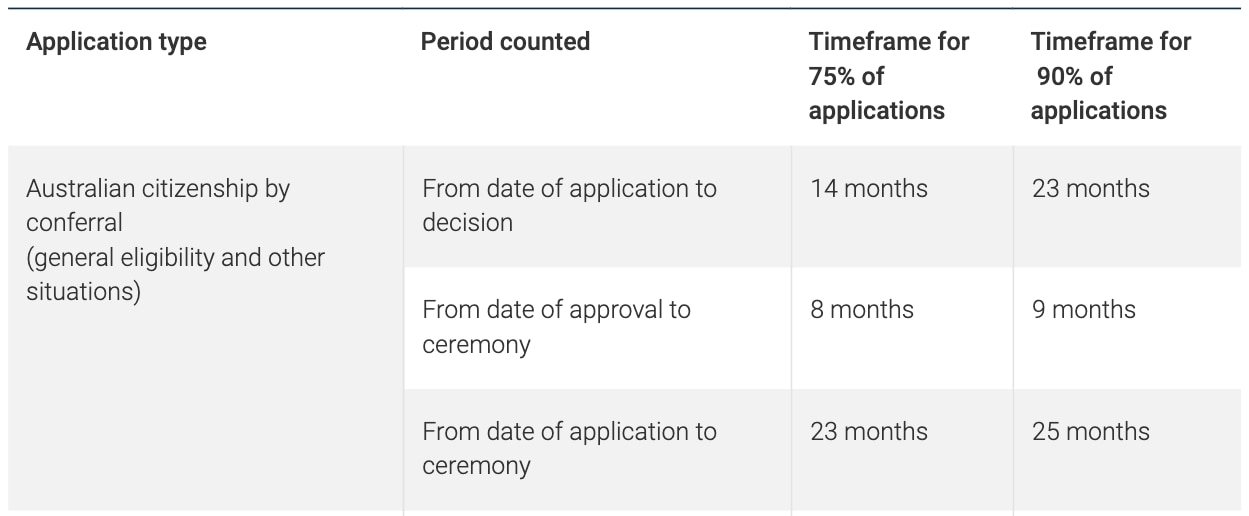
Figures from the Department of Home Affairs show 75 per cent of applications for citizenship by conferral now take 23 months – up from 16 months last June.

Ninety per cent of these applications are completed in 25 months compared to 20 months a year ago.

“Due to the COVID-19 pandemic, all face-to-face citizenship appointments, such as interviews and citizenship tests, have been placed on hold. This has meant an increase in overall processing times,” the spokesperson said.

“The department will recommence in-person interviews and citizenship tests when it is safe to do so,” they said, adding that new applications are still being accepted.

How long it is currently taking to process Australian citizenship by conferral.

How long it is currently taking to process Australian citizenship by conferral.
The Department of Home Affairs

But Carla Wilshire, CEO of the Migration Council Australia, said these numbers needed to be addressed.

“Once people go down the pathway of citizenship, a lot of decisions are put on hold until that citizenship comes through … It’s important we give them certainty as quickly as possible,” she said.

“Getting those waiting times down is critical in terms of really managing people’s sense that their lives are progressing and they are able to make decisions going forward around their commitment towards Australia.”

“Particularly during COVID, where people have a lot of generalised anxiety and feel a sense of insecurity, I think it’s really important that we take measures to … ensure resources are put to use to give citizenship as quickly as possible.”

It is a point echoed by Melbourne-based migration agent Kirk Yan.

“I haven’t seen the government offer a reasonable or acceptable explanation for the long processing times … They can’t explain why it takes two years,” he said.

“For citizenship, as long as you meet the requirements of a permanent resident, you are supposed to get it granted if you pass the citizenship test and the character or identity checks … I don’t know why it takes such a long time for the department.”

He said the latest rise in wait times left many of his clients anxious.

“The current situation has meant lots of people are waiting, just to get information or a response,” he said.

The sector has also pointed to climbing wait times as one reason why the demand for Australian citizenship is dropping.

Clearing the backlog

But even as wait times have gone up, the government has managed to address the backlog of citizenship applications this financial year.

The department spokesperson said during the year 2019-20, up to 22 May this year, 175,304 people were granted Australian citizenship – up 56 per cent on the same period last year.

Over recent months, it has been done via virtual citizenship ceremonies.

More than 750 people have received citizenship through online ceremonies each day since they began, and up to 22 May, more than 16,800 people received citizenship this way.

The latest backlog figure is now 123,727 applications, compared to 221,695 a year ago.

But Migration Council Australia’s Ms Wilshire said this number was “still significant by historical standards”.

“During COVID, there is so much insecurity as people are losing that sense of being able to visit their country of origin and connect with family as global movement is decreasing,” she said.

“I think that affirmation of being part of the Australian community is psychologically quite important for our migrant communities.”

Source: Anger as wait times for Australian citizenship blow out during coronavirus pandemic