ICYMI: How my book on immigration became the voice of Germany at the Venice Biennale
2016/06/14 Leave a comment
Good account by Doug Saunders on how art based upon his book Arrival City helps communicate the issues and challenges:
This put us at the centre of Europe’s most urgent and politically challenging crisis. In an architecture biennale that is often given over to the most abstruse and ephemeral of ideas and visions, we had been asked to create the least abstract pavilion of them all.
After all, the 2016 Biennale’s theme, selected by the acclaimed architect Alejandro Aravena, is “Reporting from the Front”: He wanted exhibitions to focus on the architecture of “the margins,” not the pricey mega-structures that tend to dominate architecture fairs.
The stuff in this pavilion is really happening. And there is real money on the table. Germany is in the midst of an enormously controversial and difficult process of settling around a million refugees who’ve fled the conflicts in Syria, Afghanistan and elsewhere – almost half the refugees arriving in Europe – and housing them in dozens of cities.
For the many thousands of people who have passed through our pavilion during the past two weeks, it has been a break from capital-A architecture and a swift plunge into the most turbulent debate in Europe’s modern history. ( Kirsten Bucher)This has resulted in Berlin’s federal administration spending unprecedented sums on new buildings for this process: Shortly after the committee she sits on chose our “arrival city” exhibition in January, Ms. Hendricks announced that her government will fund the construction of 300,000 to 400,000 new units of social housing each year (for both refugees and established Germans), year after year, for the foreseeable future.
No other government in the Western world is spending this kind of money on housing – and it has been decades since any government has deployed architectural solutions to social problems on this scale. When finished, it will be the equivalent of having created a second Berlin, largely with public funds.
So Europe’s largest demographic and social crisis has suddenly become an architectural and urban-planning crisis: There is an urgent need to learn from the best lessons of the past seven decades of public-housing construction – and, more importantly, to avoid the many design failures of that period, the horrid “projects” and council flats and plattenbau districts, some of which led directly to impoverished and isolated immigrant districts prone to crime and extremism.
A core component of our pavilion is a database, available online, which documents more than 400 refugee-housing projects currently under way in Germany (many are intended to be turned into social or student housing once the refugee emergency abates). Some of them are awful. Some are ingenious. After standing in a room surrounded by these examples, the notion that architectural design has large-scale social consequences becomes far less abstract: These designs, for better or worse, will affect the lives and outcomes of families, communities and cities for generations.
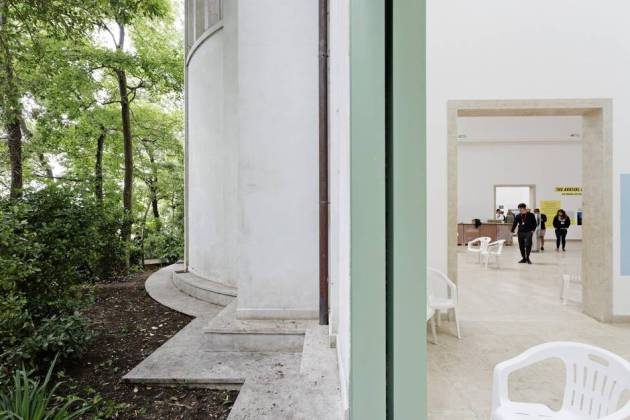
Open to the elements and the passing crowds, the pavilion becomes an informal, improvised place, a teeming marketplace not just of ideas but of real-life things(Kirsten Bucher)Other rooms, and the pavilion’s main chamber, are devoted to the “eight theses of the arrival city” we developed in a series of meetings in Frankfurt. These, distilled from my research conclusions, are emblazoned on the walls and illustrated with case studies of districts and projects in European cities:
The arrival city is a city within a city. The arrival city is a network of immigrants. The arrival city is affordable. The arrival city is close to business. The arrival city is informal. The arrival city is self-built. The arrival city is on the ground floor. The arrival city needs the best schools.
For the many thousands of people who have passed through our pavilion during the past two weeks, it has been a break from capital-A architecture and a swift plunge into the most turbulent debate in Europe’s modern history. Some, like Italian Prime Minister Matteo Renzi, have lingered to take notes. Some have started arguments, sketched designs or told us they suddenly see their city’s kebab-shop district very differently. Others have just hung out, had a bite and soaked up the simultaneous sense of comfort and unfamiliarity – in the process, experiencing a small version of the sort of place we’re chronicling here.

Source: How my book on immigration became the voice of Germany at the Venice Biennale – The Globe and Mail

 Multicultural Meanderings