Immigrant-screening proposal about promoting tolerance, Leith says [with a straight face]

Telling:

But the harshest words for Ms. Leitch have come from Mr. Harper’s former policy director Rachel Curran – now a senior associate at the former prime minister’s new international consulting firm, Harper & Associates.

Ms. Curran called Ms. Leitch’s proposal “really dangerous politics” and accused her of specifically targeting Muslim immigrants.

“We have never had the government actually test people on what their thoughts and beliefs and their values are in Canada, and I don’t think we should go down that path,” Ms. Curran said.

“It’s a pretty dangerous path. It’s actually a pretty Orwellian path.”

Ms. Curran called the barbaric cultural practices tip line an “ill advised policy” that was poorly communicated at the time, but defended it as a last-minute request from a specific ethnic community that she declined to identify. She said she hasn’t spoken about the issue with her former boss, but doesn’t feel he would support Ms. Leitch’s proposal.

“Much of our party’s support came from new immigrants who believed in what the party was doing, and believed in what prime minister Harper was doing. And there is simply no way that he ever would have pursued or proposed a policy that was frankly fundamentally anti-immigrant,” she said.

“I think it does the party a tremendous amount of harm, and if nothing else it divides the party, which is also a bad thing.”

Ms. Leitch denies her proposal targets Muslims in any way.

“I understand the compulsion to paint a discussion about values in this way. But I actually don’t think it’s fair, and I don’t think it’s right,” she said.

Ms. Leitch also brought up two instances where her party sought to block the entry into Canada of those who she said contravene Canadian values of gender equality and women’s rights: so-called “pick-up artist” Julien Blanc in 2014, and in February, Daryush Valizadeh, also known as “Roosh V,” an American blogger who says rape should be legalized on private property.

Source: Immigrant-screening proposal about promoting tolerance, Leitch says – The Globe and Mail

Trudeau’s Liberals more in line with Canadians’ fundamental values: Ekos Poll

Not surprising, as most polling during the election showed Conservative over-reach was off-side general Canadian values:

Graves said his polling found that after 10 years in power, Stephen Harper’s Conservatives were facing “growing tension” between what they stood for and the basic values espoused by Canadians.

“I really believe that the election shifted from being an important election about the economy to a historic election about values.”

His conclusion is supported by another poll EKOS conducted Oct. 8-12. Canadians were asked to identify the “most important factor” that would determine their vote.

Forty-seven per cent said it would be the choice that best reflects their values; 33 per cent said it would be a party platform or ideas; 10 per cent said it would be the party leader; and eight per cent said it would be the local candidate.

Canadians were asked about the “choices” that best describe their “vision” of Canada. Sixty four per cent cited humanitarianism and development versus 23 per cent who opted for defence.

Sixty-three per cent favoured active federal government, while 23 per cent supported “minimal government.”

And 57 per cent favoured “reason and evidence” over the 24 per cent who stood by “moral certainty.”

“I think people got fed up,” Graves said of voters.

“They were really resentful to not only this indifference, but hostility, to science and to reason. It was a very strident anti-intellectualism and it didn’t fit well. It’s not where Canadians were.”

Source: Trudeau’s Liberals more in line with Canadians’ fundamental values: Poll | Ottawa Citizen

The Grits are back in charge, all’s right in Ottawa: Yakabuski

While there are elements of truth in Konrad Yakabuski’s piece (as I covered in Policy Arrogance or Innocent Bias: Resetting Citizenship and Multiculturalism), he over simplifies the reasons for the collective sigh of relief felt by the public service.

It is not driven by an incestuous ‘gene pool’ between Liberal politicians and public servants. It is more driven by education and related experience. We know from polling data that the university-educated are the group that supports the Conservatives the least (government policy analysts are all university-educated). And this support is driven more by small ‘l’ liberal values than big ‘L’ affiliation.

The sharper ideological edge of the Harper government compared to previous Conservative governments, along with a general distrust of evidence in favour of anecdotes and a general less inclusive approach, accentuated the tension between the government and public servants.

Greater alignment between the values of the Liberal government and the public service, along with the latter’s more inclusive approach and support for evidence-based policy, will make for a smoother relationship.

However, the public service needs to be more mindful of its own biases and values in its formulation of policy advice given that it will be less challenged than it was under the Conservatives:

Stephen Harper’s parting thank-you note to the bureaucrats – telling them in a Monday missive that he “will always be grateful for the support of Canada’s world-class public service” – was promptly used by its recipients to line the bird cages of the capital.

The civil servants are already banking on retrieving the sick days the Conservative government had tried to take away from them; the scientists are savouring the prospect of being free to speak out, even if it’s against government policy; the diplomats are yearning to show off a kinder, gentler foreign policy to a world that, Harper critics contend, has been wondering, “What happened to Canada?”

Among public servants, there is a natural preference for Liberal governance. It stems in part from previous long Liberal stints in power during which most of the senior bureaucracy moved up the ranks. In the tiny company town that is Ottawa, decades of intermarriage among bureaucrats, journalists, lobbyists and Parliament Hill staffers have left a gene pool that leans predominantly (L)iberal.

The Ottawa elites share a similar world view, one that squares with Prime Minister Justin Trudeau’s promise of activist government. They also share a bias, acknowledged or not, in favour of a government-driven economy. A bigger state and more regulation enhances the prestige, power and bank accounts of this cozy cohort of Ottawa insiders.

Mr. Harper was not the first outsider to see this. As a candidate for the Progressive Conservative leadership in 1983, Brian Mulroney vowed to hand out “pink slips and running shoes” to a bureaucracy he considered to be infested with Liberal sympathizers. But in Ottawa, he found he needed to get the bureaucracy onside to get anything done.

Though he purged Liberal appointees at government agencies and Crown corporations, Mr. Mulroney trusted, and in turn succeeded in winning the trust of, most of the senior bureaucrats he inherited. His one high-profile ouster of a senior mandarin (Ed Clark, an architect of Pierre Trudeau’s National Energy Program, who went on to become chief executive officer of TD Bank) was an exception to the rule.

Source: The Grits are back in charge, all’s right in Ottawa – The Globe and Mail

Economy? Health care? No, the deciding factor of this election was Canadian values: Adams

Good reflections on the deeper values of Canadians by Michael Adams:

While polls in this election may have indicated that the economy and health care were the campaign’s top issues, Stephen Harper wasn’t defeated last week because he was seen as a poor steward of the economy or an enemy of Canadians’ beloved public health care system. Rather, he offended the values of two-thirds of Canadians. Despite some suggestions to the contrary, these values did not change much during Harper’s time in office. Canada’s political centre of gravity has not shifted.

In addition to a divided centre-left, Stephen Harper’s success could mainly be traced to deft riding-by-riding tactics and to the use of wedge values issues to build out incrementally from his base (not very far, but enough for a majority in 2011). In addition to customized offerings for specific groups of voters (such as targeted foreign policy gestures and boutique tax cuts), our outgoing PM did find a few issues on which he could appeal to large majorities of Canadians.

On crime, Harper took populist positions that were out of step with the evidence about crime reduction and represented sharp departures from both Liberal and Progressive Conservative policies of the past. Public opinion has historically been more punitive than government policy. Mr. Harper saw an opportunity and took it: his government gave the people (especially his base) what they wanted: a tough stance on bad guys.

During this campaign, another values issue came to the fore when a decision by the federal court of appeal enabled Zunera Ishaq to swear her citizenship oath while wearing a niqab. A government-sponsored poll had shown that 82 per cent of Canadians agreed with the Conservative government’s attempt to prevent her from doing so – including 93 per cent in Quebec, where secularism and gender equality have become religion. While Ms. Ishaq exercised her clear Charter right to cover her face, the government put its impotent – but widely shared – objection on prominent display.

Crime and punishment, the niqab, revoking the citizenship of convicted terrorists, establishing a “barbaric cultural practices” hotline, foot-dragging on Syrian refugees (and, earlier, revoking refugees’ health care) – all these symbolic gestures appealed to the Conservative base, but some in fact appealed to large majorities of Canadians.

If some of these moves were so popular, why didn’t they gain Conservatives more traction in the election?

The reason is that other Canadian values run deeper. Research by the Environics Institute tells us that Canadians deeply value their pluralistic society; they believe government has a role to play in building a fair country; they believe in empathy and compromise as social habits.

Many Canadians might be uncomfortable with the niqab, but they take the Charter seriously and in the grand scheme they want a just, inclusive society. Most Canadians’ thinking on sentencing for offenders might be driven more by emotion than by reviews of criminology literature, but traditionally most have not objected when governments have acted on data rather than gut. Over time, a collection of wedge-politics gestures, however cleverly designed, were no longer able to hold back the tide of public sentiment that wanted another kind of big picture.

American poet Walt Whitman wrote: “Do I contradict myself?/Very well then, I contradict myself/(I am large. I contain multitudes.)” Like Whitman, the Canadian public contains multitudes. We have lesser angels and better angels. When we are not fearful we try to be inclusive, fair, and generous. And perhaps even when we are fearful, we try to find our way back to being otherwise.

Source: Economy? Health care? No, the deciding factor of this election was Canadian values – The Globe and Mail

Immigrants more likely to consider Canadian symbols important to national identity

SC - GSS Immigrant Native Comparisons.001

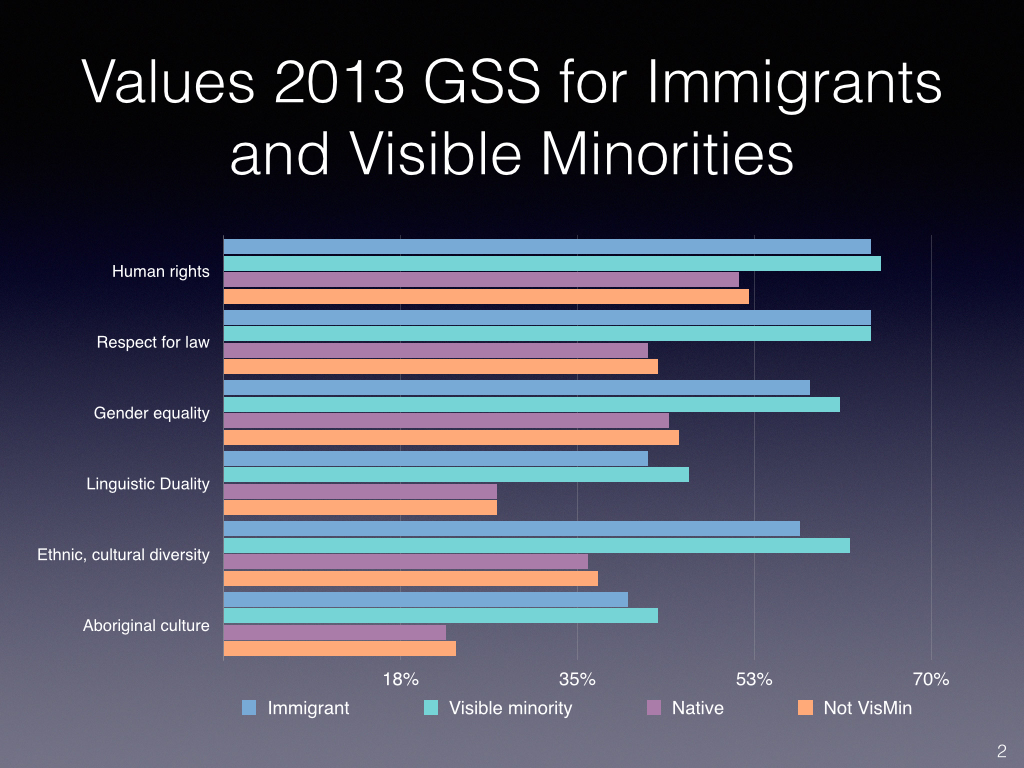
SC - GSS Immigrant Native Comparisons.002Interesting findings from the General Social Survey. For the charts, I have focussed on the contrast between immigrants (first generation) and the native-born and visible minorities (multiple generations but the vast majority first generation) and non-visible minorities.

The key takeaway, and no significant change from earlier surveys, is that for the most part, visible minorities and immigrants have higher level of attachment to Canada than the native-born (in early briefings to Minister Kenney, this type of evidence was cited to indicate that there was no need for major changes to the citizenship program:

The vast majority of Canadians think symbols like the flag and the national anthem are important to Canada’s identity, an expansive survey of opinions by Canada’s national data agency suggests.

More than nine in 10 Canadians surveyed by Statistics Canada said symbols like the Charter of Rights and Freedoms and the flag were important symbols of national identity. Other iconic notions such as the national anthem, the Mounties and hockey were also cited by more than three-quarters of Canadians polled in the agency’s General Social Survey, which asked 27,695 Canadians from all provinces and territories for their views on Canada’s national identity in 2013.

The vast majority of respondents said they believed that Canadians shared specific values. Exactly what those values are, however, is a subject of some debate.

Human rights a major factor

The thing most often cited by those who think Canadians share specific values was the value of human rights, at 92 per cent of respondents. Respect for aboriginal culture (68 per cent) and linguistic duality (73 per cent) also came up a lot.

By and large, immigrants and minority groups were more likely to believe national symbols are very important to Canada’s national identity.

This picture sent out last year by a B.C. RCMP detachment was deemed to be one of the most iconically Canadian images in recent memory. (Royal Canadian Mounted Police)

That gap was especially pronounced when it comes to valuing the importance of the national anthem. When asked about the importance of O Canada, 75 per cent of immigrants viewed it as very important, compared to 61 per cent of non-immigrants.

And all national symbols were viewed as more important by visible minorities than by Canadians at large. The gap was largest in terms of the significance of the charter (82 per cent versus 68 per cent), while the smallest differences were evident for the RCMP (59 per cent versus 54 per cent) and hockey (52 per cent and 45 per cent).

The great frozen game

On the subject of hockey, there’s a gap in how important our national sport is perceived to be between men and women. Half of all men said hockey was important to Canada’s national identity. Only 42 per cent of women said the same.

There was also a gender gap with regards to the belief of whether Canadians even share specific values — never mind what those values may be.

Some 41 per cent of women believed to a great extent that Canadians valued equality between men and women, compared to 53 per cent of men. That gap existed across all age groups, although it was most pronounced among people under 25, where 46 per cent of women said so, but 63 per cent of men did.

Among those over the age of 75, 31 per cent of women said so, compared with 46 per cent of men.

National pride

By and large, Canadians are on the whole proud of Canada’s national identity. That statement is especially true of immigrants, as they “reported a greater feeling of pride in being Canadian and in Canadian achievements,” the data agency said.

There were some geographic differences, however, with people from Quebec feeling generally less proud of Canada’s national identity. Within Quebec, residents of Saguenay had the lowest level of pride in the province, with 52 per cent saying they were either proud or very proud to be Canadian, while residents of Gatineau had the highest levels of pride in Quebec at 76 per cent.

Source: Immigrants more likely to consider Canadian symbols important to national identity – Business – CBC News

What conservatives really care about

Interesting perspective by Sunstein of Jonathan Haidt’s assessment of the similarities and differences between the values of  liberals and conservatives:

In his later work, Haidt has rightly emphasized a sixth moral foundation, one that conservatives and liberals both respect, but that they understand differently: liberty. He finds that conservatives are more likely to emphasize the right to be let alone, while liberals emphasize the rights of vulnerable groups, such as racial minorities, whose freedom requires (in their view) government support. Nonetheless, the biggest and most consistent partisan differences involve loyalty, authority and sanctity.

Haidt’s central claim is that across partisan lines, people often fail to understand one another, because a moral concern that strongly motivates one group may be obscure or unintelligible to another. Democrats are wrong to be puzzled when rural and working-class Americans turn out to favor Republicans. There is no puzzle here, because Republicans are more likely to speak to their deepest moral commitments.

These claims are arresting, but it’s not clear that they are entirely right. Insofar as liberals focus on the environment, they are often motivated by ideas about the sanctity of nature. More than conservatives, liberals appear disgusted by cigarette smoking. Nor are they indifferent to loyalty: If a civil rights leader publicly opposed affirmative action, or if a prominent Democrat broke with the party on health care or climate change, many liberals would feel a sense of betrayal. Conservatives may be more likely to emphasize loyalty in the abstract, but in concrete cases, everyone cares about that virtue.

That said, Haidt’s general conclusions are founded on evidence, not speculation, and he has compiled a mountain of evidence to support his conclusions. There’s a big lesson here for those who aspire to public office, including the White House: If they neglect the values of loyalty, authority and sanctity, they’re not going to speak to the moral commitments of a large segment of the American electorate.

Suspect this also holds true for Canada.

What conservatives really care about

David Cameron: British values arent optional, they’re vital

UK Prime Minister on British values:

The second is social. Our values have a vital role to play in uniting us.

They should help to ensure Britain not only brings together people from different countries, cultures and ethnicities, but also ensures that, together, we build a common home.

In recent years we have been in danger of sending out a worrying message: that if you don’t want to believe in democracy, that’s fine; that if equality isn’t your bag, don’t worry about it; that if you’re completely intolerant of others, we will still tolerate you.

As I’ve said before, this has not just led to division, it has also allowed extremism – of both the violent and non-violent kind – to flourish.

So I believe we need to be far more muscular in promoting British values and the institutions that uphold them.

That’s what a genuinely liberal country does: it believes in certain values and actively promotes them. It says to its citizens: this is what defines us as a society.

What does that mean in practice? We have already taken some big steps.

We are making sure new immigrants can speak English, because it will be more difficult for them to understand these values, and the history of our institutions, if they can’t speak our language.

We are bringing proper narrative history back to the curriculum, so our children really learn our island’s story – and where our freedoms and things like our Parliament and constitutional monarchy came from.

And as we announced this week, we are changing our approach further in schools. We are saying it isn’t enough simply to respect these values in schools – we’re saying that teachers should actively promote them. They’re not optional; they’re the core of what it is to live in Britain.

DAVID CAMERON: British values arent optional, they’re vital | Mail Online.

Ironically, given the UK’s citizenship revocation policy, even for those who would be left stateless, he closes with a reference to the Magna Carta, which abolished banishment as a form of punishment (although not for the convicts who settled Australia):

Next year it will be the 800th anniversary of Magna Carta. Indeed, it was on this very day, 799 years ago, that the Great Charter was sealed at Runnymede in Surrey.

It’s a great document in our history – what my favourite book, Our Island Story, describes as the ‘foundation of all our laws and liberties’.

In sealing it, King John had  to accept that his subjects were citizens – for the first time giving them rights, protections and security.