Experts: Yes, Anti-Refugee Rhetoric Helps ISIS – The Daily Beast

Unfortunately, not understood by so many:

President Obama said Sunday that by rejecting and vilifying Syrian refugees, Republicans (and Democrats who are going along with them) are doing the terrorists’ work for them.

“Prejudice and discrimination helps ISIL and undermines our national security,” Obama said. This sounds like a political talking point, but if you speak with the independent academics who actually study the mentality and motivations behind terrorism, it turns out Obama is correct.  Broad anti-Muslim suspicion and rhetoric is not only anti-American, it helps the terrorists!

I spoke with a number of our nation’s top academics who study the pathology and psychology of terrorism in general and ISIS in particular. Every single one agreed that the anti-Syrian refugee policies and rhetoric help ISIS.

“There is no place for bigotry in effective counterterrorism,” Professor James Forest, the director of the graduate program in security studies and interim director of the Center for Terrorism and Security Studies at UMass Lowell, told me. “Terrorist groups like al Qaeda and Islamic State thrive when they can exploit the vulnerable seams within a society, when they can exacerbate prejudices.”

Arie W. Kruglanski, professor of psychology at the University of Maryland, has written about how ISIS recruitment strategy is based on psychology, not theology.  And within that context, Kruglanski told me: “The refugee debate could fuel the bitterness and sense of grievance of young Muslims anywhere and could be used by ISIS propaganda machine to enhance anti-US sentiment and boost recruitment.”

“Counterterrorism tries to do two things,” explained Professor Max Abrahms, a political scientist at Northeastern University who studies terrorism. “You try to neutralize existing terrorists and you try to not breed new ones. The surest way to breed new ones is if you’re indiscriminate—for instance, punishing non-violent, moderate Muslims.”

In fact, Abrahms noted he thinks an attack like the one in Paris, from so-called homegrown terrorists, is less likely “because the American Muslim population is much happier, better integrated and does better financially.”

A more moderate Muslim population yields a smaller share of extremists and better relations with law enforcement—which explains why Muslims helped law enforcement prevent one out of every two al-Qaeda related plots against the U.S. since 2009.

“We need to cherish the support and moderation of the American Muslim community,” says Abrahms.

Source: Experts: Yes, Anti-Refugee Rhetoric Helps ISIS – The Daily Beast

Half of the attacks since 2001 were committed by men born in the United States.

The paths to violence for the United States-born attackers varied. Some were recent converts to Islam. At least three who were born in the U.S. had previous criminal histories, and onehad a history of mental illness. One seemed to have radicalized after spending time in Yemen. Another became radicalized after being convicted of lying to F.B.I. agents — denying he had made plans to travel to Somalia when in fact he had.

Security experts argue that the risks of routine travel — including the U.S. visa waiver program, which allows citizens of Britain, France, Belgium and 35 other countries to enter the United States without a visa for stays of up to 90 days — are greater than the threat of foreign terrorists coming through the refugee program.

“Further restricting the acceptance of refugees does not address the most likely vulnerability to attacks from abroad, which is the large number of people from visa-waiver countries involved in the conflict in Syria,” said David Sterman, a researcher for the International Security Program at the New America think tank who has been cataloging terrorist attacks carried out since Sept. 11.

Source: The Origins of Jihadist-Inspired Attacks in the U.S. – The New York Times

How America’s Demographic Revolution Reached The Church

Source: How America’s Demographic Revolution Reached The Church

America, the Not So Promised Land – The New York Times

Tara Zahra provides an US historical perspective on return migration (immigrants who return to their country of origin).

In Canada. an estimated one-third of working-age male immigrants leave within 20 years (2006 Statistics Canada study, have not seen anything more recent):

Within Europe, state officials also questioned the myth of the “Golden Country.” This was partly a matter of their perceived self-interest: They were anxious about the number of conscripts and workers lost to “American fever.” But they were also legitimately concerned about the lack of social solidarity in the American “jungle.” The Austrian War Ministry, for example, claimed that “hard labor and an unfamiliar climate, along with the absence of any kind of social protection” resulted in the “complete physical and moral breakdown” of Austrian workers in America.

As European migrants were recruited to replace the plantation labor of freed slaves, some feared that they would be no better treated. Emigration, they insisted, was more likely to deliver migrants to a new form of slavery than greater freedom.

Today’s migrants are not so different from their predecessors. Most make frequent round-trips. They stay in close touch with relatives, aided by low-cost airlines, cellphones and Skype. Many migrants and refugees would like to return home someday, if only they could do so securely. But in a world in which visas are lottery prizes, and refugees die in trucks or find themselves trapped in stateless purgatory, it is not so easy to come and go freely.

In spite of the rhetoric of globalization, we still live with the passports and border controls introduced after the First World War. This system, a response to xenophobic agitation, created the current distinction between legal immigrants and “illegal” aliens. In 1965, the quota system was eliminated, enabling more migrants to come to the United States from Asia, Latin America and Africa. But it remains difficult for migrants to respond nimbly to changing economic or political conditions.

What has not changed is the degree of polarization around migration. Many countries with high levels of migration remain ambivalent about the effects of emigration on their societies. The value of remittances does not clearly outweigh the strain on separated families and the loss of human talent. Migrants continue to have mixed feelings about life in the United States. “We were afraid of poverty,” recalled one family of Bosnian refugees in the 1990s. “We thought we wouldn’t be able to step out on the street because of drugs, murders and similar things. We were afraid that there was no health insurance similar to what we had.”

They came anyway, since “everything looked better than going back to Bosnia with no future at all.”

Americans, meanwhile, are almost perfectly divided about whether immigration makes the United States better or worse, according to the Pew study. Given the overwhelming percentage of Americans descended from immigrants, these attitudes betray deep historical amnesia. We too easily forget the suffering of previous generations of migrants, or imagine that it was redeemed by the relative comfort of their children or grandchildren.

And when these attitudes are combined with xenophobia, punitive migration laws, harsh working conditions and a lack of social support, they raise the same question posed by migrants a century ago. Will my dreams be realized or shattered in America? For most people, the answer will lie somewhere in between.

Source: America, the Not So Promised Land – The New York Times

Wary of Mainstream Medicine, Immigrants Seek Remedies From Home – The New York Times

Likely similar in Canada and some readers may be more familiar with any comparable initiatives here:

With the help of a $130,000 grant from the Cigna Foundation, the Botanical Garden offers training for doctors to help them better understand their patients’ cultural beliefs. So far, 740 medical students and practicing physicians have gone to the garden’s tropical conservatory to learn about medicinal plants and to participate in role-playing exercises. “It is all about promoting increased trust between health care providers and their patients,” Dr. Vandebroek said.

Issues of trust and culture are not the only things that have made some immigrants leery of mainstream medicine. Doctors’ visits are expensive, and herbs, selling for a few dollars a bag, are cheaper than prescription drugs.

According to a study by the Commonwealth Fund, 43 percent of Hispanics in the United States do not have a primary personal care physician or health provider. More than one-third lack health insurance, nearly double the rate for blacks and triple that for white Americans.

High costs and cultural differences have created a troubling disconnect between many Hispanics and the health care system. It is a rift that Dr. Roger Chirurgi, program director for the emergency medicine residency for the New York Medical College at Metropolitan Hospital Center in Manhattan, would like to heal.

“There’s a lot of people who we’ll see at repeat visits, and they’ve never taken their medicine,” Dr. Chirurgi said. “That’s why I’ve been taking my residents to the Botanical Garden for the past three years, to try to become more culturally sensitive and to be able to break through that barrier.”

Dr. Chirurgi now routinely asks patients if they are using herbals when he takes their medical history. He worries about the dangers of unregulated remedies that lack dosage guidelines and scientific evidence of their efficacy. “I want to make sure that they are safe, and don’t interact with the drug that I am prescribing,” he said. Still, he conceded that herbals may be helpful, if only as placebos. “If you believe that something will work,” he said, “it may actually work in some cases.”

Source: Wary of Mainstream Medicine, Immigrants Seek Remedies From Home – The New York Times

Our Favorite Word — ‘Diversity’ — Is Under The Microscope At Mizzou And Yale 

More on some of the US debates on diversity:

The Yale debate plugs directly into the bigger, more meta conversation we’re seeing around “diversity.” One group argues that their right to free speech is infringed upon; another says the school promised them — and they’re paying for — a welcoming, inclusive environment.

As Yale made headlines for these incidents, its officials announced something that received far less attention last week: The school will spend $50 million in the next five years to increase diversity of its faculty. That money will go toward recruitment, implicit bias training for employees involved in faculty searches and tenure decisions, and fellowships for graduate students aimed at expanding the pipeline into academia. It’s a tall order; in the 2014-15 academic year, just 22.5 percent of the university’s 4,410 faculty members were minorities, according to CNN Money, while almost 43 percent of the students enrolled at Yale are minorities.

But the conversation about diversity initiatives in corporate culture and Hollywood — and Holmes’ and Harris’ convincing arguments that existing tactics aren’t working — raises the question: Will a browner, more diverse faculty lead to a better atmosphere for college students hungering for more inclusion?

Part of the problem seems to be that institutions — tech companies, media organizations, TV networks, schools — often frame their pursuit of diversity as an achievement in itself. They unveil breathless new initiatives and pat themselves on the back without investigating how existing internal cultures — and their own attitudes — are getting in the way of authentic inclusion.

As Gene wrote last week, diversity “can’t be productive unless there’s real thought about how to invite and productively metabolize pushback against accepted norms, because that pushback is going to come.”

Yale and Missouri are struggling to find their feet under enormous waves of pushback right now. We’ll have to wait and see whether Yale’s new plan to diversify its staff and the turnover at the top at Mizzou will actually do anything to chip away at the tensions they’re seeing on campus.

Source: Our Favorite Word — ‘Diversity’ — Is Under The Microscope At Mizzou And Yale : Code Switch : NPR

Americans Speak Over 350 Languages At Home, Census Data Shows | TIME

Comparative figures for Canada: Over 200 languages, 73 percent mother tongues other than English or French. Most common other languages: Chinese, Tagalog, Spanish, Punjabi, Arabic, Italian, German, Portuguese, Persian (Farsi) and Polish.

More than 60 million Americans over the age of five speak a language other than English in their home

Americans speak more than 350 languages in their homes according to data released Tuesday by the Census Bureau.

Findings from the 2009-2013 American Community Survey show more than 60 million Americans over the age of five speak a language other than English in their home. Spanish is by far the most common language and is spoken in the home by 37 million people.

Those who speak Spanish at home also tend to learn English, with more than half reporting they had learned the language. Speakers of Asian languages were less proficient in English: only 40 percent of the 1.4 million Vietnamese speakers and 44.7 percent of the 2.9 million Chinese-speakers speaking English “very well.”

The survey’s results show the nation’s largest metropolitan areas are also some of the most linguistically diverse. The Census reports 192 languages are spoken in New York and 54% of Los Angeles residents speak a language other than English at home. The data also shows there are more than 350,000 U.S. speakers of 150 different Native American dialects, such as Navajo, Apache, Dakota, Choctaw and Cherokee.

“While most of the U.S. population speaks only English at home or a handful of other languages like Spanish or Vietnamese, the American Community Survey reveals the wide-ranging language diversity of the United States,” said Erik Vickstrom, a Census Bureau statistician, in a Census press release. “Knowing the number of languages and how many speak these languages in a particular area provides valuable information to policymakers, planners and researchers.”

Source: Americans Speak Over 350 Languages At Home, Census Data Shows | TIME

US Supreme Court Takes On Racial Discrimination In Jury Selection

Interesting, and symptomatic of the situation in so many areas:

The U.S. Supreme Court wrestles Monday with a problem that has long plagued the criminal justice system: race discrimination in the selection of jurors.

“Numerous studies demonstrate that prosecutors use peremptory strikes to remove black jurors at significantly higher rates than white jurors.”

Those are not the words of the defense in the case. They come from a group of highly regarded prosecutors, Republican and Democrat, conservative and liberal, who have filed a friend-of-the-court brief siding with Timothy Foster, who was convicted and sentenced to death in the killing of an elderly white woman in Georgia.

It has been nearly 30 years since the Supreme Court sought to toughen the rules against racial discrimination in jury selection. But Foster’s lawyers argue that black jurors were systematically excluded from the jury at his trial in 1987, while judges at all levels looked the other way for nearly three decades thereafter.

Jury selection is done according to a set of rules. Prospective jurors are usually questioned by both prosecution and defense lawyers and then winnowed down in two different ways. First, the judge removes, “for cause,” those jurors deemed incapable of being impartial. Next, each side, prosecution and defense, has a set number of peremptory strikes, meaning that a certain number of prospective jurors can be eliminated without a stated reason, or for no reason at all.

In 1986, the Supreme Court added a third step in a case called Batson v. Kentucky. Under the Batson rules, if the defense could show a racial pattern in prosecution peremptory strikes, the prosecutor would have to justify each one by demonstrating a non-racial reason for eliminating the juror.

Still, prosecutors found ways to get around this new rule, as demonstrated by an infamous training video made in Philadelphia in the late 1980s after the court’s decision in Batson. The video features then Assistant District Attorney Jack McMahon advising trainees that “young black women are very bad, maybe because they’re downtrodden on two respects … they’re women and they’re blacks.”

He goes on to recommend avoiding older black women too, as well as young black men, and all smart, and well educated prospective jurors.

But, McMahon reminded the trainees that they had to come up with a non-racial reason for their strikes: “When you do have a black juror, you question them at length and on this little sheet that you have, mark something down that you can articulate at a later time if something happens,” he says.

Studies have shown that these proffered reasons are often a mere pretext for racial discrimination. A North Carolina study of jury selection in 173 death penalty cases found that black prospective jurors were more than twice as likely to be struck by the prosecution as similarly situated white jurors. A 2003 study of 390 felony jury trials prosecuted in Jefferson Parish, La. found that black prospective jurors were struck at three times the rate of whites. And in Houston County, Ala., prosecutors between 2005 and 2009 used their peremptory strikes to eliminate 80 percent of the blacks qualified for jury service in death penalty cases. The result was that half of these juries were all white, and the remainder had only a single black member, even though the county is 27 percent black.

Source: Supreme Court Takes On Racial Discrimination In Jury Selection : NPR

The Disproportionate Risks of Driving While Black – The New York Times

Black drivers stopped

Black Drivers ContrabandGood in-depth article and analysis:

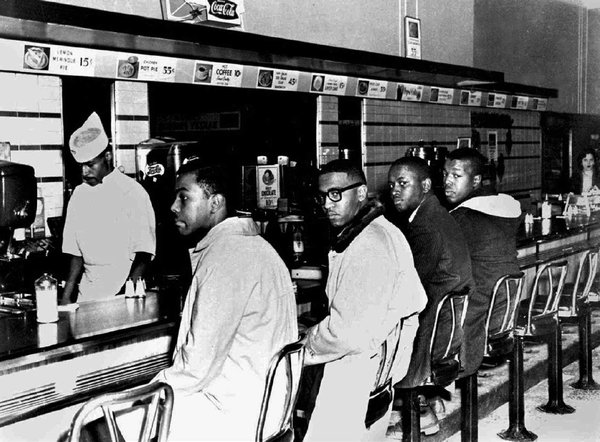
Greensboro has long cherished its reputation as a Southern progressive standout. This was the first Southern city to pledge to integrate its schools after the Supreme Court’s 1954 decision in Brown v. Board of Education, although it was among the last to actually do so. And when four black freshmen from North Carolina A&T State University occupied the orange and green stools at Woolworth’s whites-only lunch counter in 1960, Greensboro midwifed a sit-in movement that spread through the South.

Photo

North Carolina A&T State University students at the whites-only lunch counter at Woolworth’s in Greensboro in 1960. They were, from left, Joseph McNeil, Franklin McCain, Billy Smith and Clarence Henderson.CreditJack Moebes/Greensboro News & Record, via Corbis 

But this is also where hundreds of National Guardsmen suppressed black student protesters in 1969 and where, a decade later, five protesters were murdered at an anti-Ku Klux Klan rally conspicuously devoid of police protection.

And it was here, in 2009, that 39 minority police officers accused their own department of racial bias in a lawsuit that the city spent nearly $1.3 million fighting before agreeing to settle for $500,000. In a city that is 48 percent white, 75 percent of Greensboro’s force of 684 sworn officers remains white.

The Rev. Nelson Johnson, a civil rights leader here since the 1960s, contends that like Greensboro as a whole, the Police Department “has a liberal veneer but a reactionary underbelly.” An activist group he heads recently established a citizens’ board to hear complaints about the police, arguing that official investigations too often are shams.

“This is not about one officer,” Mr. Johnson said at a recent meeting about police behavior at the Beloved Community Center. “This is about a culture, a deeply saturated culture that reflects itself in double standards.”

The Times analyzed tens of thousands of traffic stops made by hundreds of officers since 2010. Although blacks made up 39 percent of Greensboro’s driving-age population, they constituted 54 percent of the drivers pulled over.

While factors like out-of-town drivers can alter the racial composition of a city’s motorists, “if the difference is that big, it does give you pause,” Dr. McDevitt of Northeastern University said.

Most black Greensboro drivers were stopped for regulatory or equipment violations, infractions that officers have the discretion to ignore. And black motorists who were stopped were let go with no police action — not even a warning — more often than were whites. Criminal justice experts say that raises questions about why they were pulled over at all and can indicate racial profiling.

In the past decade, officers reported using force during traffic stops only about once a month. The vast majority of the subjects were black, and most had put up resistance. Still, if a motorist was black, the odds were greater that officers would use force even in cases in which they did not first encounter resistance. Police officials suggested that could be because more black motorists tried to flee.

In an interview, Chief Scott said that overall, the statistics reflected sound crime-fighting strategies, not bias. They have produced record-low burglary rates, and most citizens welcome the effort, he said.

Deborah Lamm Weisel, an assistant professor of criminal justice at North Carolina Central University in Durham, said the best policing practices “involve officers making proactive contacts with citizens, and traffic stops are the main way they do that.”

But many criminal justice experts contend that the racial consequences of that strategy far outweigh its benefits — if, indeed, there are any.

“This is what people have been complaining about across the nation,” said Delores Jones-Brown, a professor at the John Jay College of Criminal Justice in New York. “It means whites are ‘getting away’ with very low-level offenses, while people who are poor or people of color are suffering consequences.”

“It amounts to harassment,” she said. “And police cannot demonstrate that it is creating better public safety.” To the contrary, she added, it makes minority citizens less likely to help the police prevent and solve crimes.

Source: The Disproportionate Risks of Driving While Black – The New York Times

Immigrants in America More Likely Self-Employed, Study Finds | TIME

A marginal difference:

A new Pew Research Center study shows that 10 percent of Americans are self-employed, compared to 11 percent of immigrants.

… self-employed Americans and their employees accounted for 44 million jobs in 2014 or 30 percent of the national workforce.

Canadian data that I have seen shows a larger difference between Canadian-born and immigrants (Immigrants took the brunt of recession-year turn toward self-employment).

Source: Immigrants in America More Likely Self-Employed, Study Finds | TIME