Are noncitizens really voting in US elections?

Spoiler alert. This detailed review indicates they are not:

With illegal immigration one of the top issues on voters’ minds heading into the 2024 election, Republicans are making a nationwide push to require proof of citizenship in order to vote. The GOP-run House of Representatives passed a bill that would do just that, the SAVE Act, in July – with support from five Democrats.

Former President Donald Trump has also repeatedly urged such measures, including in Tuesday night’s debate, alleging that his opponents are irresponsibly encouraging undocumented immigrants to vote. “A lot of these illegal immigrants coming in, they’re trying to get them to vote, they can’t even speak English, they don’t even know what country they’re in practically, and these people are trying to get them to vote,” he said.

Now Speaker Mike Johnson is saying that unless the House and Senate agree to the SAVE Act, he’ll shut down the government when the fiscal year ends Sept. 30 – though it appears he lacks the support within his own party to do so.

But Democrats, citing a lack of documented cases of noncitizen voting, say the law is unnecessary since it’s already illegal for noncitizens to vote. Moreover, they argue, it would result in disqualifying eligible voters. They accuse Republicans, including former President Donald Trump, of pushing this issue to lay the groundwork for claiming the election was stolen if they lose in November.

Is proof of citizenship currently required to vote?

The short answer is, citizenship is required in federal elections, but proof of citizenship generally isn’t, although some voters may provide that while establishing their identity and residency.

Sixteen municipalities allow noncitizens to vote in local elections, according to Ballotpedia. But elsewhere there’s pushback to the idea. Amendments to bar noncitizen voting are on the ballot this fall in eight states: Idaho, Iowa, Kentucky, Missouri, North Carolina, Oklahoma, South Carolina, and Wisconsin.

Source: Are noncitizens really voting in US elections?

The quiet technocrat who steered Biden’s effort to tighten the border

Of interest:

The lead architect of President Joe Biden’s border strategy is not Vice President Kamala Harris, despite persistent Republican claims to the contrary. That role belongs to a bookish, little-known policy adviser named Blas Nuñez-Neto.

A data-driven technocrat, Nuñez-Neto has helped engineer Biden’s pivot toward tougher border enforcement and sweeping restrictions on asylum — moves that contributed to a nearly 80 percent drop in illegal crossings since December.

The transformation is shoring up one of Democrats’ biggest vulnerabilities ahead of the Nov. 5 presidential election and potentially defusing a top-polling issue for Republican nominee Donald Trump. After three years of record crossings, the U.S.-Mexico border is quieter and more controlled today than at any point since late 2020, before Trump left office.

Nuñez-Neto pulled that off by steering the administration back to a border policy framework Democrats used to embrace more easily, according to current and former administration officials. The formula: Be generous and welcoming to immigrants seeking to come lawfully, but stingy and firm with those who don’t.

The White House declined to make Nuñez-Neto available for an interview. Biden officials said the administration’s border policy moves have been shaped by senior White House officials and Homeland Security Secretary Alejandro Mayorkas, whom Nuñez-Neto worked for before being promoted to the White House in June.

In a statement, White House spokesperson Angelo Fernández Hernández said Biden “believes it is a false choice to say we have to walk away from being an America that embraces immigration in order to secure our border.”

“We must enforce our laws at the border and deliver consequences to those who do not have a legal basis to remain in the United States, and we must expand lawful pathways,” Fernández Hernández said.

Southwest border apprehensions by month

Illegal crossings at the U.S.-Mexico border have declined in 2024, according to U.S. Customs and Border Protection data.

Nuñez-Neto’s policy approach embodies the political calculus that while most Americans remain favorably disposed toward immigrants, few things erode the welcoming spirit faster than an out-of-control border. The growing U.S. economy needs workers, too, and immigrants help offset declining U.S. birth rates. But how they arrive matters.

Relying heavily on the president’s executive powers to grant entry using an authority known as parole, the Biden administration has been allowing nearly 75,000 migrants to enter each month through legal channels.

Republican critics denounce those pathways as a “shell game,” arguing the administration is facilitating mass migration through doors that should not be opened in the first place. But the expansion — paired with the most severe restrictions on asylum eligibility at the border from a Democratic administration in decades — has corralled the disorder.

Trump has largely ignored the change, displaying at his rallies a chart that shows record illegal crossings during Biden’s first three years and cuts out data showing the 2024 decline. He continues to label Harris, his Democratic opponent in the upcoming election, as the “border czar,” though she never held such a role. Biden tasked Harris with leading the administration’s plan to reduce Central American emigration by promoting investment and job creation, not to deal with immigration enforcement at the southern border.

That task — arguably one of the least-desirable in a Democratic administration — would become Nuñez-Neto’s.

A change in direction

The Argentine-born Nuñez-Neto was working on border security issues at the Rand Corporation in early 2021 when DHS policy adviser David Shahoulian — one of the few voices in the administration urging tougher measures at the border — recommended him for a job. He became chief operating officer for U.S. Customs and Border Protection.

Trump’s rhetoric and harsh policies in the White House had galvanized immigration advocacy groups and many Democrats against enforcement and the very idea of deterrence as an element of border security. Biden loosened restrictions, fueling a perception that the border was more open even as officials — including Harris — told would-be migrants “do not come.”

Shahoulian soon left the administration in frustration. In late 2021, Nuñez-Neto took over his role shaping border policy at DHS.

More than a year later, as the administration ended the pandemic-era Title 42 border restrictions, Biden officials increasingly sought help from Mexico, Panama and other nations in the region to help contain migration and cooperate with U.S. policies. Nuñez-Neto took on a second role as DHS’s top international envoy. He became a major diplomatic asset: a bilingual U.S. official capable of explaining policy to Spanish-language media and speaking directly to Latin American officials.

Nuñez-Neto developed an especially close partnership with Roberto Velasco, the top official at Mexico’s Foreign Ministry for North American affairs, according to current and former senior officials from both nations. Mexican authorities this year have arrested record numbers of migrants traveling through the country toward the U.S. border, a crackdown that Biden officials credit with sharply curtailing illegal crossings.

Angela Kelley, a senior adviser at DHS until June 2022, said the Biden administration has worked to craft a careful balance of incentives and penalties — carrots and sticks. She had been a longtime advocate for asylum seekers, and worked to resist Trump’s policies. Nuñez-Neto was laser-focused on border crossings, checking enforcement data daily.

“He’s more of a sticks guy, given his background,” said Kelley, now chief policy adviser at the American Immigration Lawyers Association.

Nuñez-Neto was promoted to the White House as the president announced strict new emergency measures that have upended decades of asylum law, closing the border when crossings are high and essentially barring access to U.S. courts for migrants who enter the country illegally.

The restrictions were made possible by a breakthrough agreement Nuñez-Neto helped negotiate with Velasco and other senior Mexican officials. It allows the United States to return large numbers of non-Mexican migrants back across the border — a crucial tool for agencies that have struggled to send deportees to Venezuela and other nations whose relations with Washington are strained.

As the deterrence policies took shape, the number of migrants released into the United States with a pending asylum claim — the procedure decried as “catch and release” — plummeted. It was Nuñez-Neto, not someone from Harris’s team, who fielded questions about the measures from reporters and on Capitol Hill.

“Those of us who follow the inside baseball of immigration know he’s the person that has become the de facto border czar,” said one policy adviser close to the administration who spoke on the condition of anonymity to describe informal conversations with top officials.

Nuñez-Neto has done so with a quiet, disciplined manner that is the stylistic opposite of swaggering Trump-era border officials. Some immigration advocates and activists have come to view him with scorn, as a border-cop-in-sheep’s-clothing who speaks of migrants sympathetically while orchestrating the kind of crackdown immigration hard-liners have only dreamed of.

The sharp drop in illegal crossings has allowed the Harris campaign to go on offense. She blames Trump for sinking a bipartisan Senate bill last winter that would have provided billions in new funding for more border agents, detention capacity, deportation flights and other enforcement tools. She has called for Congress to pass the bill, and says she would sign it into law if she’s elected.

But several of its toughest provisions — in particular the emergency asylum restrictions — are already in place…
Source: The quiet technocrat who steered Biden’s effort to tighten the border

Prejudice against Muslims higher than towards any other group in US, poll finds

Not too surprising given encampments and other Israel-Gaza protests:

Favourable attitudes towards Muslims among Americans have declined and public prejudice against them remains higher than any other religious, ethnic or racial group, a poll published by The Brookings Institution has found.

Released on Tuesday and conducted between 26 July and 1 August, the University of Maryland Critical Issues Poll (UMDCIP) consists of two tracks, one measuring the change in American public attitudes concerning Islam and Muslims and the second which studied prejudice towards racial, religious and ethnic groups – including Jews and Muslims.

Generally, favourable views of Muslims and Islam increased over the last year. The findings show a drop to 64 percent from 78 percent in comparison to 2022 regarding favourable views of Muslims, and a drop to 48 percent in favourable attitudes towards Islam.

Favourable views of Muslims dropped among both Democrats and Republicans, but the drop was starker among Republicans.

In February 2024, 52 percent of Republicans viewed Muslims favourably, but in July 2024, the figure dropped to 46 percent. For Democrats, the drop went from 83 percent in February to 80 percent in July.

The survey sampled 1,510 American adults with oversamples of 202 Blacks and 200 Hispanics.

Anti-Muslim versus anti-Jewish sentiment

Following Israel’s war on Gaza, there has been a dramatic increase in incidents of hate and prejudice against both Jews and Muslims globally.

Prejudice toward Jews and Judaism is included in the poll for the first time.

Among all respondents, favourable views of Muslims were at 64 percent and 48 percent for Islam while it stood at 86 percent for Jews and 77 percent for Judaism.

“The gap between attitudes toward people and religion is not uncommon and has been consistently found in our previous polling, particularly toward Muslims,” the poll says.

Another key factor is race. While only nine percent of white people view Jews as unfavourable, 37 percent of white people view Muslims as unfavourable. Among Black and Hispanic people, the difference is less stark, with 29 percent of Black people viewing Muslims as unfavourable, and 21 percent for Jews. For Hispanics, 33 percent view Muslims unfavourably, with 22 percent for Jews.

College education, familiarity and personal relationships with Jews and Muslims are significant contributing factors that lead to more favourable views towards both Jews and Muslims, according to the poll.

Generational gap

The poll shows that younger Americans have more favourable views towards Jews than Muslims overall, but there is a generational gap. Americans under 30 still have more favourable opinions of Muslims and Islam than Americans aged 30 and over.

While factors explaining this trend still need probing, the reason for the less favourable views of Jews among young people may be the fact that white people tend to have more favourable views of Jews than non-whites, although the share of white people among younger Americans is smaller.

Prejudice toward Muslims is also higher than other groups when it comes to their perceived contributions to American society, the poll says.

Polling shows that only one-third (37 percent) of Americans believe Muslims strengthen American society, while a majority of Americans say the same about every other ethnic, racial and religious group.

Young Americans (under 30) have identical views of the degree to which Muslims and Jews strengthen American society, but older Americans believe Jews (55 percent) contribute far more to American society than Muslims (32 percent).

The lowest figure is found among older Republican Americans, with only 21 percent believing Muslims contribute to American society.

Source: Prejudice against Muslims higher than towards any other group in US, poll finds

USA: Ending Birthright Citizenship Is Harder Than It Sounds

Good analysis:

….All of this could affect birth tourism. In his last administration, Trump issued an executive order outlawing B1/B2 tourist visas for birth tourism, where an alien comes to the U.S. specifically to give birth here and “create” an American citizen, an “anchor baby,” who will file for legal status for his parents at age 21. Prior to Trump’s EO, traveling to the U.S. to give birth was fundamentally legal, although there are scattered cases of domestic authorities arresting operators of birth tourism agencies. Women abroad were often honest about their intentions when applying for visas and even showed contracts with doctors and hospitals to prove they would not become public charges.

As it stands, visitors will be denied temporary visas if it is found the “primary purpose” of their travel is to obtain citizenship for a child by giving birth in the United States. The rule does not apply to the 39 countries in the Visa Waiver Program, and the State Department in implementing the EO forbids its visa officers from even asking in most cases if an applicant is pregnant, making the order hard to enforce.

“This is the first recognition that it’s not OK to use a visitor visa for the purposes of ‘birth tourism,’ so it has a symbolic strength in that respect, at the same time it’s not a very effective way at going after the ‘birth tourism’ industry,” said an analyst at the Migration Policy Institute. While the federal government does not specifically track birth tourism, the Centers for Disease Control and Prevention annually publishes the number of known births in the U.S. to foreign women who reside overseas—around 10,000 such births every year for the past few years.

Source: Ending Birthright Citizenship Is Harder Than It Sounds

Canadian residents face the longest waits in the world for U.S. visas

Of note:

Canadian residents who require a visa to visit the United States face the longest wait times in the world.

A CBC News analysis of wait times for appointments to obtain U.S. tourist visas shows that while wait times in countries like India and Mexico have been improving since November 2022, wait times in Canada have been getting worse.

Six of the 10 longest wait times around the world were recorded at the U.S. embassy and consulate offices in Canada that offer visa appointments.

Currently, those who apply for a B1/B2 visitor visa appointment in Ottawa or Quebec City face the longest wait times in the world — 850 days. Halifax is not far behind at 840 days, followed by Calgary at 839 days. Getting a visa appointment in Toronto takes 753 days, while in Vancouver it’s 731 days.

Wait times can fluctuate from day to day. Earlier this month, Toronto had the longest wait time in the world — 900 days.

The other locations with the longest current wait times are Istanbul, Turkey (774 days), Bogota, Colombia (677 days), Guatemala City, Guatemala (645 days) and Hermosillo, Mexico (576 days).

Source: Canadian residents face the longest waits in the world for U.S. visas

Adams: Why is the Trump campaign getting involved in the gender wars? They’re reading the room

Contrast between Canada and USA with respect to gender always interesting:

…The next few months will reveal whether an openly patriarchal appeal to U.S. voters is a winning move in America in 2024. It’s not a slam dunk: some Americans who believe Dad should be on top may nonetheless be put off by some of the harder edges of the conservative agenda. But while the U.S.’s election result will inevitably influence Canada, Canadian politicians should be careful about borrowing from the gender wars chapter of the U.S. playbook. The underlying values landscape in Canada is marked by more common ground, especially on social issues. Canadian leaders who aspire to be the boss in the House are wise to be circumspect about who’s on top (if anyone) in our households.

Source: Why is the Trump campaign getting involved in the gender wars? They’re reading the room

U.S. speeding up asylum claim processing along the Canadian border

Of note, an area that Canada has to improve upon:

The U.S. government is moving to speed up asylum claim processing at its northern border in an attempt to deter migrants from illegally crossing over from Canada.

Washington is making two changes that fall under the Safe Third Country Agreement (STCA), which calls for asylum seekers to apply for refugee status in the first of two countries they enter.

First, migrants looking to prove that they’re exempt from the STCA will have to provide their documents to U.S. border officials at the time of their screening. Migrants previously were allowed to postpone screenings to gather necessary documentation.

Second, migrants will only have four hours — down from 24 hours — to consult a lawyer prior to their screening.

CBS News first reported on the changes. The U.S. Department of Homeland Security (DHS) confirmed the changes to CBC News.

“DHS carefully reviewed its implementation of the Safe Third Country Agreement with Canada and concluded that it could streamline that process at the border without impacting noncitizens’ ability to have access to a full and fair procedure for determining a claim to asylum or equivalent temporary protection,” the department said in a media statement.

The U.S. has seen a sharp increase in illegal crossings into the country from Canada in the past few years.

Border agents have taken 12,612 migrants who crossed the U.S.-Canada border illegally into custody in the first six months of 2024, according to U.S. Customs and Border Protection. That’s up from 12,218 in all of 2023 and is more than the number that were taken into custody in 2021 and 2022 combined.

Earlier this year, Ottawa reimposed some visa requirements on Mexican nationals visiting Canada, in part to answer a request from Washington to help stem illegal border crossings into the U.S. The number of Mexican migrants attempting to cross into the U.S. from Canada has since dropped.

In 2023, Prime Minister Justin Trudeau and U.S. President Joe Biden announced that they were making changes to the STCA by expanding its application to the entire Canada-United States border, rather than just official points of entry.

Source: U.S. speeding up asylum claim processing along the Canadian border

Immigrants Are Becoming U.S. Citizens at Fastest Clips in Years

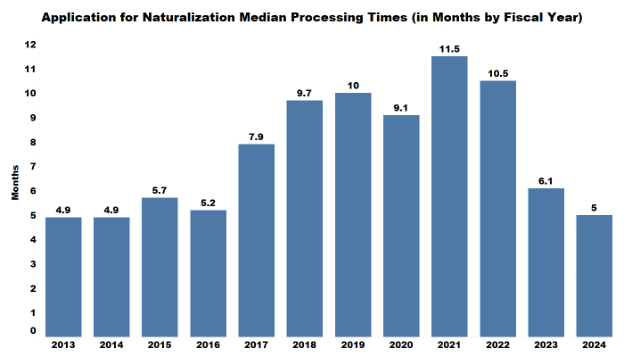
Not surprising, post Trump administration and prior to the 2024 elections. 5 month average processing time is impressive. While I don’t have the average number of months for Canadian citizenship, 71 percent of all applications in 2023 were processed in one year (below the target of 80 percent):

The federal government is processing citizenship requests at the fastest clip in a decade, moving rapidly through a backlog that built up during the Trump administration and the coronavirus pandemic.

At ceremonies in courthouses, convention centers and sports arenas across the country, thousands of immigrants are becoming new Americans every week — and becoming eligible to vote in time for the presidential election this fall.

It’s unclear how many of the new voters live in battleground states, but a number of the states where Kamala Harris or Donald Trump must win have large and growing numbers of voting-age naturalized citizens, including Georgia, Arizona, Nevada and Pennsylvania.

In Savannah, Ga., people from 19 countries streamed into a federal courthouse recently to take the oath of allegiance.

“My case was done in less than six months,” said Gladis Brown, who is married to an American and emigrated from Honduras in 2018.

Generally, lawful permanent residents, known as green-card holders, are eligible to become naturalized citizens if they have had that status for at least five years, or have been married to a U.S. citizen for at least three years.

Green-card holders have many of the same rights as citizens. But voting in federal elections is a right accorded only to citizens. And that can be a powerful motivation to pursue citizenship, especially when big national elections are on the horizon.

“I’m so glad that the process moved quickly,” said Ms. Brown, who was one of the 31 immigrants being sworn in. “People like me want to vote in the election.”

After the ceremony, Ms. Brown celebrated with cake and punch from a local women’s volunteer group — and by completing a voter-registration form provided by a representative of the League of Women Voters.

Naturalization applications typically spike upward in the approach to an election.

“The surge in naturalization efficiency isn’t just about clearing backlogs; it’s potentially reshaping the electorate, merely months before a pivotal election,” said Xiao Wang, chief executive of Boundless, a company that uses government data to analyze immigration trends and that offers services to immigrants who seek professional help in navigating the application process.

“Every citizenship application could be a vote that decides Senate seats or even the presidency,” Mr. Wang said.

At under five months, application processing speed is now on a par with 2013 and 2014. About 3.3 million immigrants have become citizens during President Biden’s time in office, with less than two months to go before the close of the 2024 fiscal year.

The U.S. Citizenship and Immigration Services took 4.9 months, on average, to process naturalization applications in the first nine months of the current fiscal year, compared with 11.5 months in fiscal 2021.

After taking office in 2021, Mr. Biden issued an executive order that sought to dial back his predecessor’s hard-line immigration agenda and “restore faith” in the legal immigration system. Among other steps, the order called for action to “substantially reduce current naturalization processing times” with the goal of strengthening integration of new Americans.

Unlike many federal agencies, the citizenship agency is funded mainly by fees paid by applicants, rather than by congressional appropriations, giving the administration latitude to define its priorities and the allocation of resources.

The Biden administration began deploying new technology and additional staff in 2022 to reduce the pending caseload of citizenship applications, which had ballooned because of heightened scrutiny by the Trump administration and protracted pandemic-related delays in conducting the swearing-in ceremonies.

The Biden administration also shortened the naturalization application to 14 pages from 20. It raised the application fee in April to $710 from $640, but made it easier for low-income people to qualify for a discount.

While there has long been partisan disagreement over how to tackle illegal immigration and overhaul the nation’s immigration laws, naturalizing lawful residents had broad bipartisan support. As president, George W. Bush signed an executive order in 2002 expediting naturalization for noncitizens serving in the military. Since he left office, he has hosted oath ceremonies at his institute in Dallas.

But citizenship has become more politicized in recent years.

Intent on curbing legal immigration, the Trump administration conducted lengthier reviews of naturalization applications. The processing time roughly doubled to about 10 months during Mr. Trump’s tenure.

The bottleneck prevented some 300,000 prospective citizens from naturalizing in time to vote in the 2020 election, according to estimates by Boundless.

It is a crime for noncitizens, including legal permanent residents, to attempt to vote in federal elections. Some Republicans, including former President Trump and Representative Marjorie Taylor Greene of Georgia, have spread unfounded narratives about undocumented immigrants being encouraged to vote by Democrats….

Source: Immigrants Are Becoming U.S. Citizens at Fastest Clips in Years

Todd: Do women, people of colour get fewer votes in Canada? New studies say no

Interesting US study, broadly applicable to Canada:

Given the Olympics are up and running, it’s fitting to reflect on how the image that cartoonists most often use to show that women and ethnic minorities have a disadvantage is one of the hurdles.

The illustrations recur: Of women and people of colour literally having to jump over more and higher hurdles than white people or men to reach victory in their fields, particularly politics.

Now that U.S. Vice-President Kamala Harris, whose mother was born in India and father in Jamaica, is the Democratic Party’s candidate for president, media outlets are especially filled with talk about gender and racial barriers.

But the clichéd metaphor of an unfair hurdles race is in need of an update in light of studies showing that in almost all cases and places women and people of colour compete evenly.

Last month, researchers at the University of Oxford unveiled the findings of the most extensive analysis yet performed on how people vote in view of candidates’ ethnicity and gender.

Lead by Sanne van Oosten, the team looked for the patterns in 43 different sociological experiments in the U.S., Europe and Canada of voter preference over the 10-year period ending in 2022.

The experiments typically involved presenting respondents with profiles of fictional political candidates, while randomly varying the candidates’ race or ethnicity. There were in total more than 310,000 observations of respondents’ preferences.

“Our meta-analysis concludes that, on average, voters do not discriminate against minoritized politicians,” van Oosten said. “In fact, women and Asians have a significant advantage compared to male and white candidates.”

Van Oosten, who had earlier been appalled by gender-based criticism of Hillary Clinton and the race-based undermining of Barack Obama, considers the results good news — for Harris and other candidates who are female and/or of colour.

The researcher has been surprised by the dearth of media interest, however, given that her earlier study of how the public can stereotype Muslim candidates as homophobic received international coverage.

“One journalist at a very highly esteemed newspaper even literally said to me: ‘People aren’t interested in good news’,” van Oosten said on social media.

The study by van Oosten, Liza Mügge and Daphne van der Pas doesn’t deny that there is a small minority of voters who have racist or sexist attitudes. But it does find most voters aren’t negatively impacted by a candidate being female or a person of colour. Indeed, it’s often perceived as a positive.

Here how the authors put it in their meta-analysis:

• “Voters do not assess racial/ethnic minority candidates differently than their majority (white) counterparts.”

• In regard to Asian candidates in the U.S.: “Voters assess them slightly more positively than majority (white) candidates.”

• “A meta-analysis on gender demonstrates that voters assess women candidates more positively than men candidates.”

• When voters from minority ethnic groups share the same ethnicity as the candidate, they positively “assess them 7.9 percentage points higher” than white candidates.

• Even in “patriarchal” societies, such as in Jordan, men will vote for a female candidate over a male if she shares the voter’s ethnicity.

The comprehensive Oxford study also cites the work of Anthony Kevins, of Utrecht University, who found across the U.S., Britain and Canada there is no sign that voters will refrain from marking an X on a ballot for a candidate because of their gender or ethnic background.

In Canada, Kevins found only one distinct bias: That members of the Canadian political left have, all other things being equal, “a higher likelihood of voting for the East Asian candidate.”

The University of Toronto’s Randy Besco, author of Identities And Interests: Race, Ethnicity and Affinity Voting, said in an interview that on average racial minority candidates don’t get fewer votes in Canada.

However, in one specific category, “racial minorities running for the Conservative Party do get less votes.”

The broader finding in the work of Besco and others is about significant so-called “affinity voting,” in which people elect members of their same identity group.

“Chinese and South Asians showed preference for their own ethnic group compared to a white candidate,” Besco said. And they also preferred to vote for members of other minority groups over white candidates. “But this preference was weaker than same-ethnic preference.”

Asked whether Canadians who are white also engage in affinity politics, by tending to mark their ballots for Canadians who are white, van Oosten said in an interview there is no indication white majorities in Britain and Canada make a point of voting for their ethnic in-group. But in the U.S., she said there is an inclination for some white people to do that.

In regard to Canadian voting trends around gender, Besco pointed to the work of his colleague, Semra Sevi of L’Université de Montréal, whose team wrote a paper titled, Do Women Get Less Votes? No.

Sevi et al studied the gender breakdown of over 21,000 candidates in all Canadian federal elections since 1921, when women first ran for seats in Parliament.

The researchers determined, in the 1920s, women were at a 2.5 percentage point disadvantage to men.

But in recent decades, Canadian voters have shown no anti-female bias.

What then explains the disparities on gender and ethnicity among MPs in the House of Commons?

In 2023, about 31 per cent of MPs were female, even though women make up half the Canadian population. Jerome Black and Andrew Griffith also wrote in Public Policy that MPs of colour comprised about 16 per cent of House of Commons members in 2021, while visible minorities made up about 20 per cent of all citizens.

Virtually all the researchers cited in this article maintain that such variance, in Canada and around the world, is not the result of voters being prejudiced against women or members of ethnic minorities.

It’s more about who decides to test the political waters.

The researchers strongly suggest the widespread incorrect belief that voters are prejudiced contributes to fewer minority and female candidates putting their names forward, or being supported, at the nomination stage.

As van Oosten puts it, “the demand” is definitely there for women and people of colour in office. But “the supply” often isn’t, she says, in large part because of misplaced fears about racist and sexist attitudes among the electorate.

In other words, as a society we need to stop discouraging women and people of colour from running for politics — and we can start by throwing away outdated images meant to show they have to jump over extra hurdles.

Source: Do women, people of colour get fewer votes in Canada? New studies say no

US border migrant crossings fall for fifth month in a row

Of note. Unlikely to change much of the political discourse, however:

The number of unlawful crossings by migrants at the US southern border has dropped for the fifth consecutive month, according to official data.

US Border Patrol agents apprehended around 57,000 migrants along the border in July – the lowest recorded since September 2020.

The numbers are down significantly from December, when around 250,000 migrants were caught crossing the border.

President Joe Biden’s administration has credited the decrease to recent actions by him to tackle illegal immigration into the US, an election-year political vulnerability for the Democrats.

“This is the product of a number of actions this administration has taken,” said Homeland Security Secretary Alejandro Mayorkas in an interview with CBS this week.

Mr Mayorkas said those actions include an executive order signed last month by President Joe Biden that allows US immigration officials to deport migrants without processing their asylum claims.

The measure has been called one of the most restrictive border policies by a Democratic president in recent times, and was criticised by left-wing members of the party.

At the time, the president vowed that his executive order would “help us gain control of our border”. He added that “doing nothing is not an option”.

Government data shows that the number of migrants stopped at the US-Mexico border had dropped even before the order.

Border Patrol recorded 141,000 apprehensions in February, 137,000 in March, 129,000 in April, 118,000 in May and 84,000 in June.

The figures do not include official border crossings, where the Biden administration has been processing around 1,500 migrants each day through a smartphone app that schedules appointments between migrants and US border agents.

On the other side of the border, Mexican officials have also been working to curb illegal migration, including stopping people before they attempt to cross on to US soil.

The southern border has been a political headache for the Biden administration heading into November’s election.

Mr Biden has been repeatedly criticised by Republicans and their party’s presidential nominee, Donald Trump, who said last month that the president had “surrendered our southern border.”

The president hit back, accusing the Trump camp of an “extremely cynical political move” by pressing Republican politicians to block a proposed border plan in Congress earlier this year.

Source: US border migrant crossings fall for fifth month in a row